

.jpg)
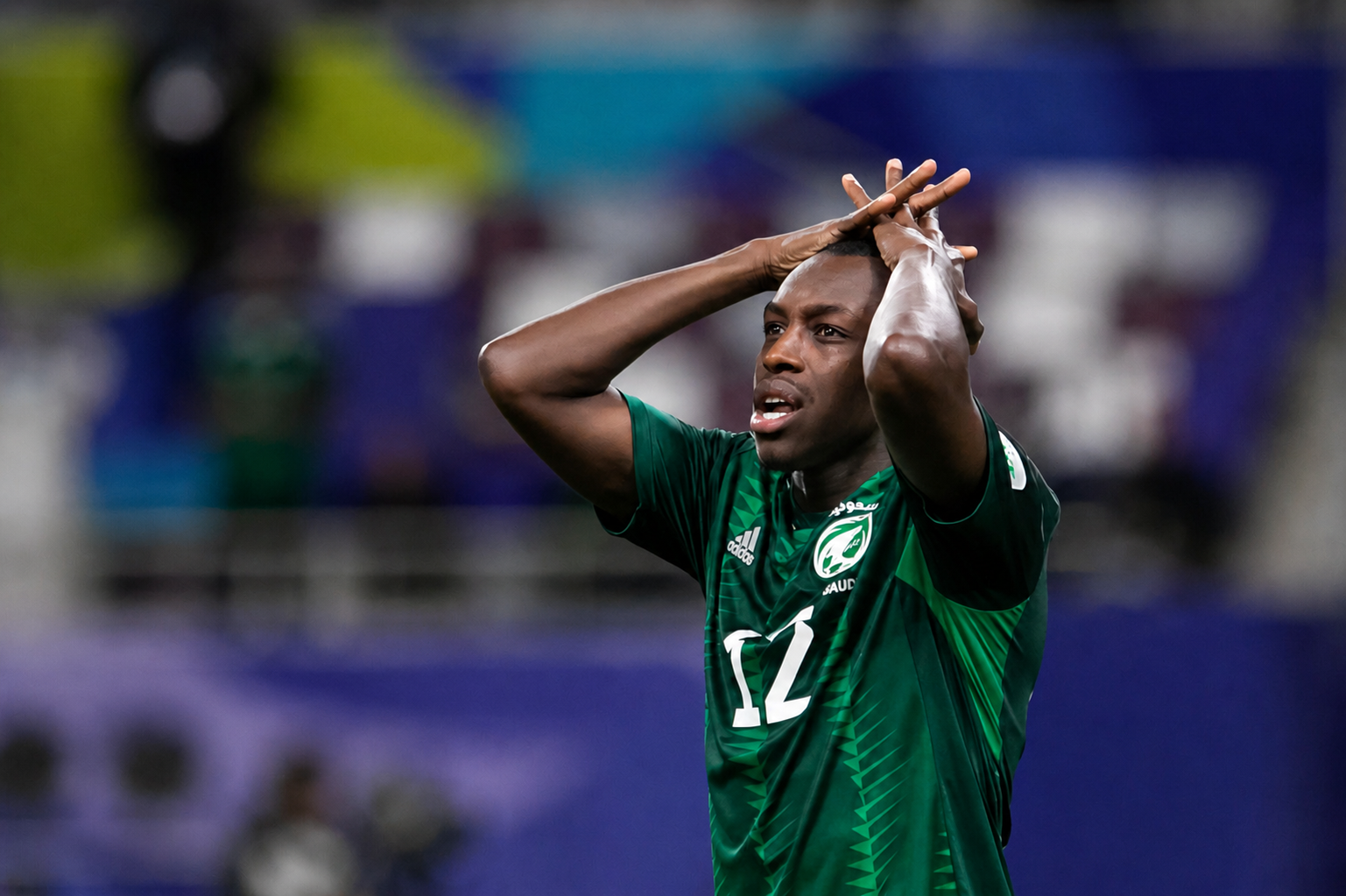
How Saud Abdulhamid’s journey through Rome and into Ligue 1 became more than a career move, and why his patience may be the most significant investment Saudi football has ever made.
There are decisions in football that look irrational on paper. Lower wages, reduced minutes, adaptation costs in a foreign league. A step down from the certainty of home, from the guarantee of a starting role, from a salary that reflects status in a league rapidly ascending on the world stage. By every conventional measure, a Saudi player leaving for Europe is trading something of known value for something profoundly uncertain.
Saud Abdulhamid made that trade anyway. And in doing so, he did not merely make a football decision. He made a capital allocation decision under uncertainty. One that, properly understood, may have consequences far beyond any single career.
Leaving Comfort Is Not a Setback. It Is an Investment
When Abdulhamid departed Saudi Arabia for European football in the summer of 2024, signing for Roma for 2.5 million euros, the economics of that move did not flatter him in the short term. The Saudi Pro League had, in the years prior, become one of the most financially generative environments for professional footballers on earth. At Al Hilal he won six domestic titles across three seasons, accumulated over 70 league appearances, and had built the sort of institutional status that makes leaving feel not just risky but unnecessary.
He left anyway. And the gap between what he forfeited and what he received, in immediate financial terms, is best understood not as a loss but as a premium paid. The premium one pays when investing in something whose returns are deferred, compounding, and fundamentally different in kind from anything a salary slip can capture.
In financial theory, this is called a negative short-term yield with long-term upside optionality. Abdulhamid accepted a diminished immediate return in exchange for something no Saudi league contract could offer: proof that it was possible.
He did not just cross a border. He crossed an information barrier, and that crossing changes the economics of every Saudi player who follows.
Rome Was Not Built in a Day, and Neither Was His Place in It
What followed his arrival at the Stadio Olimpico was not a fairytale. Roma were in turmoil from the first week. Daniele De Rossi, a club icon, had been dismissed just four games into the season, replaced by Ivan Juric, who inherited a dressing room still loyal to his predecessor and a fanbase that had exhausted its patience with the club’s ownership. Into this environment stepped Abdulhamid, a right back from Saudi Arabia that most of Italian football had never seen play.
His debut came on 26 September 2024, coming off the bench in a Europa League draw against Athletic Bilbao. He became the first Saudi player ever to appear in a European continental competition. It was a historic moment, though it was not easy to build on. Juric told the press that Abdulhamid came from a different world and would need time to settle. That assessment set the tone for a period in which Abdulhamid was managed with extreme caution, used sparingly and asked to be patient within a club that was far more interested in its own survival than in integrating a new signing from an unfamiliar market.
Over the entire Serie A season he made just four league appearances, accumulating 205 minutes of top-flight Italian football. He started twice. His one league assist came in a 1-0 win over Empoli in March, which was also the last time he featured in the league. In November, Juric was sacked after only 12 matches in charge, and Roma’s managerial instability continued. Abdulhamid remained peripheral throughout, a player without a manager who believed in him, training daily in a first-class environment but rarely getting to show what that training had produced.
He did score. On 12 December, in a 3-0 Europa League win over Braga, he became the first Saudi player to score in a European competition. The milestone was real and significant. But the minutes remained scarce, and by the end of the season it was clear that something had to change.
The easy narrative would be that Roma was a failure. It was not. It was an education. Abdulhamid trained daily within a Serie A structure, absorbed the tactical and physical demands of European football at close range, and held his position without public complaint through a season defined by institutional chaos that had nothing to do with him. Patience, in circumstances like these, is not passive. It is a form of professionalism that not every player possesses.
By the numbers at Roma: 4 Serie A appearances. 205 minutes of top-flight football. 1 assist. 1 Europa League goal against Braga in December 2024. The first Saudi player to score in European competition.
Lens and the Season That Changed the Conversation
On 3 August 2025, Abdulhamid joined RC Lens on a season-long loan with an option to buy. Lens play with width, intensity and genuine attacking ambition from their defensive positions. Their system demands a right back who can function as a wing back, get forward with purpose, deliver into dangerous areas, and press aggressively when the team is without the ball. It was, in short, exactly the environment that Abdulhamid had spent a year preparing for without getting to show it.
The numbers this season tell a story of consistent, growing contribution. Across 22 matches in Ligue 1 and the Coupe de France, he has accumulated over 1,180 minutes of football, registering 3 goals and 2 assists. His average Sofascore rating of 7.06 places him comfortably within the competitive range for right backs across Europe’s top five leagues. In December, he scored his first Lens goal and provided an assist in a 3-1 Coupe de France win over Feignies. He scored again in Ligue 1 against Metz in March, earning a match rating of 8.1. He completed 90 minutes in back-to-back league games against Lyon and Strasbourg before adding an assist in a 5-1 win over Angers.
These are not the numbers of a player finding his feet. They are the numbers of a player who has found his level and is now producing at it consistently.
These are not the numbers of a player finding his feet. They are the numbers of a player who has found his level and is now producing at it consistently. The contrast with his Roma season is instructive but should not be overstated. Roma gave him the foundation, the tactical education, the acclimatisation to European rhythms and demands. Lens is giving him the expression, the freedom to show what that foundation was built for.
What Lens has also given him is visibility. Ligue 1 is followed closely across Europe, and scouts from clubs in England, Germany and Spain watch the division with genuine attention. Every 90 minutes Abdulhamid completes is, in effect, a live audition. The fact that he is passing it consistently carries consequences not just for his own future but for how the European market evaluates Saudi players more broadly.
By the numbers at Lens: 22 matches across all competitions. Over 1,180 minutes played. 3 goals, 2 assists. Average rating of 7.06. A player in form, in rhythm, and in the conversation.
He Is Not Just a Player Abroad, He Is a Proof of Concept
Every market operates under conditions of information asymmetry, the gap between what sellers know and what buyers do not. Saudi football, until very recently, suffered from a profound version of this problem. Foreign clubs, scouts, and coaches had limited data on what Saudi players could do in high-pressure, tactically sophisticated environments. The perception, unfair but embedded, was that talent developed inside the Saudi system could not travel.
Abdulhamid did not simply play abroad. He reduced that asymmetry. Every match, every clean defensive contribution, every moment of composure under European pressure sent a signal back to the market: the risk premium attached to Saudi exports should be lower than you think.
In signaling theory, the value of a signal comes from its cost. Because the move was genuinely difficult, the message it sends is genuinely credible.
This is signaling theory in its most concrete form. A signal only carries weight if it is costly to fake. His willingness to accept reduced income, a peripheral role at Roma, and the genuine uncertainty of two unfamiliar leagues means the signal he sends carries weight that a comfortable career at home never could.
He has become, in the language of economics, a proof of concept. And proof of concept is extraordinarily valuable at exactly the moment a market is trying to decide whether a new product deserves serious attention.
The Ripple Effects of One Player’s Persistence
The consequences of what Abdulhamid has built extend well beyond his own contract negotiations. Markets are not static. They update based on evidence. When one Saudi player demonstrates European-level competence across two leagues and two seasons, the entire calculus governing the next transfer shifts.
Foreign clubs considering Saudi talent no longer face the same uncertainty they did before. The unknown is smaller. The perceived risk is lower. The valuation, accordingly, can rise. What one player absorbs as personal cost, the next generation of Saudi exports inherits as reduced friction. The pioneer always pays a disproportionate price and makes the path cheaper for everyone who follows.
If one player succeeds, the risk premium attached to the next Saudi export declines. Abdulhamid did not just transfer. He laid infrastructure.
Consider the structural parallel: when the first Saudi companies listed on international exchanges, they absorbed a significant information discount because investors demanded a premium for the uncertainty. As more companies followed, the discount narrowed. The market learned. The asset class became legible. The same logic governs footballers.
The Productive Tension at the Heart of Saudi Football
Saudi football currently contains a tension that should be understood as a strength rather than a contradiction. The Saudi Pro League is investing billions in a strategy of inward accumulation, importing the world’s elite to raise domestic standards, increase global attention, and grow the commercial infrastructure of the game at home. It is a proven model, executed with extraordinary ambition.
Simultaneously, players like Abdulhamid are building something that the league itself cannot build: outward credibility. The credibility that comes only from competing at the source, from being tested in the environments where global football reputation is made and measured.
These two strategies are not in conflict. They are complementary. The league builds the pool. The exports build the brand. The inward investment creates the talent; the outward movement proves its quality. Together, they constitute something approaching a complete vision for the development of a football nation, one with global standing and not merely domestic strength.
Final Thoughts
In an era defined by record contracts and immediate returns, Saud Abdulhamid chose the harder path. Not because it paid more, but because it meant more. And in doing so, he may have increased the value of an entire nation’s footballing future.