

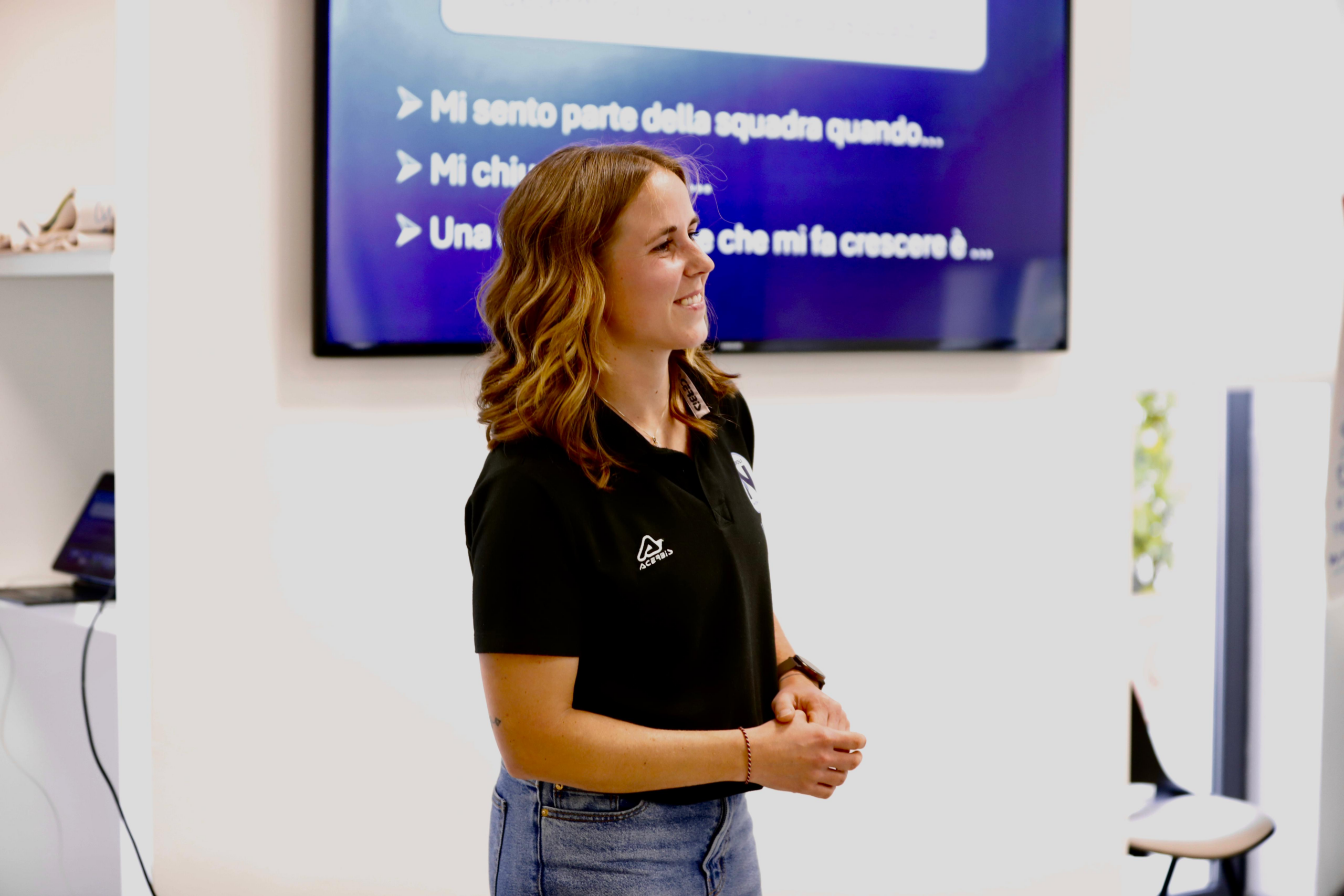
Profile
Role: Footballer, Coach, Psychologist, assistant coach and mental performance specialist at Napoli Women
Specialisation: mental performance, coaching, psychology and player support
Experience: Frauen-Bundesliga, Germany, the United States, Italy and Napoli Women
Focus Areas: mental coaching, player development, dual-career support, injury support and women’s football
Biography
Footballer, Coach, Psychologist. The woman doing it all and changing how the game thinks about its players.
Vivien Beil has lived more of football than most. A Frauen-Bundesliga debutant at 15, a European Championship winner, a professional across three countries and, simultaneously, a psychology graduate who never stopped asking deeper questions about performance, identity and what athletes truly need. Now, having concluded her playing career in 2025, she brings everything that experience built into a dual role as assistant coach and mental performance specialist at Napoli Women. She is not just working in the game. She is working to change it.
She is not just working in the game. She is working to change it.
Key Insights
- Vivien Beil combines elite playing experience, coaching and psychology in her work at Napoli Women.
- Her approach focuses on mental performance, communication, identity and long-term player support.
- She advocates for better structures in women’s football, including dual-career pathways and interdisciplinary support.
Our Exclusive Interview with Vivien Beil
You currently work as both an assistant coach and mental performance specialist at Napoli Women. How do you manage these responsibilities across the course of a typical week, and how do they overlap and influence your work in practice?
A typical week, consist of working on the field with the first team as well as of the field with individual mental coaching sessions that run two to three times a week voluntarily. However, being embedded and working first hand within these environments are of great value and a great experience. Such access has allowed me to connect, observe behaviours, team dynamics and emotional responses in real time allowing me to initiate conversations before problems deepen rather than waiting for players to seek help when things have already become harder to manage. This on field presence is essential for work. It directly ties what is said and talked about in individual sessions and directly unfolds and translates what actually happens in training and match days. On match days, my involvement extends to pre-match routines, as well as on the bench helping with translations and player preparation about to enter the game.
One a week, normally on Tuesdays, I dedicate my entire afternoon, entirely to the youth sector. This is the time, I observe training sessions, have conversations with injured players and exchange feedback with coaches. Players can also book individual mental sessions. Alongside this, I run monthly workshops for all youth teams from U12- U19, covering different mental performance topics. These sessions are interactive by design, built to develop awareness, curiosity and practical tools that players can apply directly in their daily development.
Working with the first team, how do you integrate mental coaching and psychology into training and match preparation alongside tactical and physical work, and what informs your decisions about what players need in key moments?
Communication sits at the centre of my work within first-team training. The way in which a coach communicates carries huge weight and can have a major impact, not just a matter of wright or wrong or correct and incorrect but whether or not it resonates and effective. Communication is always about translating intention into something that is actually received and understood by the player, and this is highly individual. Every player process information differently depending on personality, cultural background and sometimes their own language.
Communication sits at the centre of my work within first-team training.
However, communication is not only external but also internal. The dialogue a player has with herself during performance is equally significant. This inner voice shapes decision making, execution and confidence. A large part of my work is to involves making players aware of that inner voice and guiding them to make it more constructive as well as guiding it from something critical or limiting into something that actively supports performance. On the pitch, I can observe body language and emotional reactions in real time, which allows me to intervene in small but meaningful ways. This might involve reminding players of tools we have worked on or using simple pre-agreed signals to help them reset or refocus.
In key moments, the approach is largely intuitive. Football moves too fast and carries too many variables to rely solely on pre-scripted and structured responses. . I therefore combine what I have in my toolbox with situational awareness, reading the moment and responding in a way that best supports the player or team in that specific context.
You started the “For Your Future” project while still playing. What did you observe within the youth environment that convinced you there was a need for a more structured support system, and how did you translate and structure the programme to support player development?
The believe strong and clear, that players especially young players, need a 360° support system. There was a clear observation that stood out. What youth environments repeatedly showed was early dropout, unrealistic expectations limited understanding of what is it like to be an athlete and its actual demands and difficulties managing thoughts, emotions and behaviours in a pressurised performance environment.
Growing up in Jena gave me strong support and a solid foundation to build from, whereby I was fortunate enough to attend a sports-school that supported both academics and athletics development The US college system reinforced this dual career with specific targeted support across nutrition, psychology, academics and physical development built into the athletes daily environment.
Arriving in southern Italy I quickly realised that this level of structured support was often missing. That gap became the foundation for “ For Your Future” , a programme designed to support athletes beyond performance alone. The programme focuses on mental performance education alongside social media awareness, nutrition and injury support. The aim is not just to equip players for football, but for life, giving them tools they can carry regardless of whether they reach the professional level.
The aim is not just to equip players for football, but for life, giving them tools they can carry regardless of whether they reach the professional level.
Having experienced the student-athlete pathway in the United States alongside your academic background in psychology, how has this dual experience shaped the way in which you support young players balancing sport and education?
Having experienced both structured youth development in Germany and the student-athlete system in the United States was a genuine privilege. Combined with personal discipline and ambition, managing and balancing both sport and education is something that brings real pride and gratitude. The US college system is a unique environment and opportunity and shows that competing at a high-level whist studying and focusing on your education is entirely achievable but demands discipline structure and awareness. But it is also highly rewarding. Personally, I have always valued the balance between physical activation on the pitch and cognitive engagement in the classroom.
Such an experience directly informs the work with players today. I use my experience to support them in managing multiple demands Challenges on the pitch are frequently connected to stress or overload off the pitch. For this reason, I work with players on time management, individual learning strategies, relaxation techniques and overall life balance not just about performance.
The bigger picture matters. An athletic career is not infinite, which makes building a second foundation alongside sport is a necessity. Focusing solely on performance, at the expense of the future of everything else, is a risk no player should take.
You made your debut in the Frauen-Bundesliga at just 15 years old. Looking back, how has that early exposure shaped your understanding of player development, particularly in terms of when players are ready, how to protect them, and how to support their long-term development?
Looking back making my debut at 15 feels so crazy, especially watching 15-year-old players now. The game has evolved significantly, and players typically make their debuts later as a result of greater physical demands and the intensity in which games are played now
What that early experienced has showed me is that talent only gets you so far and alone it’s not enough. What often separates and distinguishes players is the level of maturity both on and off the pitch. How they look after their body, respond to feedback, pursue learning and understand their role within the team environment. The transition from youth football whereby a player is often a star or a standout player, coming up to the first team is quite a significant switch whereby player starts out as a “nobody” with no established status amongst the first team. This significant shift deserves more attention than it usually receives.
Protection matters too. Young players need space to socialise and have a normal life, complete their education and enjoy what these years have to give socially. At the same time, physical load management is crucial, especially when young players are already involved in senior training while still attending school. It’s important to make sure these players are not getting overused between the youth teams, first team trainings and eventually even youth national team call ups. This array of factors should be monitored carefully as overuse at such an age carries real long term consequences.
Long-term development requires consistent communication between the different staff, family and player, realistic expectations from all sides, and an acceptance that progress in football is not linear. It has its own timing and that it must be respected.
Injuries were a recurring part of your career. From your current perspective as both a coach and mental performance specialist, how have those experiences influenced the way you support players through long-term setbacks?
Injuries are part of almost every professional career, and I personally experienced three long-term injuries with surgeries and rehabilitation periods. It was challenging but also deeply instructive. It taught and demanded me to learn a lot about identity, patience and perspective and ultimately about myself and life in general.
One of the most important realisations was simple, that being injured does not mean you stop being an athlete. For players navigating long term injuries, feeling part of the team and being seen
From a mental perspective, injury phases can also become opportunities. Mentally, however, such periods of injuries can be a blessing in disguise and can be a genuine opportunity. Being free from such a pressurised environment can allow players to develop tools such as emotional regulation, breathing techniques, mindfulness, goal setting and gratitude practices without the daily pressure of performance in a way that the demand of a normal season rarely allows
Many athletes define themselves almost entirely through their sport The goal is to broaden identity beyond performance alone and help them recognise that they are far more than just a footballer and injury as difficult as it is can be a moment whereby that realisation can take place.
One of the most important realisations was simple, that being injured does not mean you stop being an athlete.
You have played in Germany, the United States and Italy, three very different football environments. What key differences are there, and how have each environment shaped and influenced the way you work?
Having played in Germany, the United States and Italy have shaped me significantly, as a player, a professional and as a person.
Germany provided structure, discipline and organisation. The emphasis on planning, technical development and consistency created a strong foundation that proved invaluable in which I was very fortunate and lucky to grow up with.
The United States offers a very different environment. Women’s football carries genuine cultural weight there, backed by excellent facilities, high energy and a performance mindset that permeates everything. The game is more physical and fast-paced, and the broader sporting culture is genuinely motivating. I loved what the American experience gave me.
Italy is characterised by passion, creativity and emotional intensity. Especially in Napoli, required adjustment. Coming from Germany and the US, the initial culture shock around the lack of structure, organisation and facilities was real. Napoli offered and had something hard to replicate, extraordinary human warmth, a profound love and passion for football, and sharp tactical insight and with a relationship with the game not just as a sport but as a living art form. It boarders’ art, creative, critical, fluid, always changeable and with fantasy.
Working across these three environments has made me more complete. It also helps me in my daily work with players from different backgrounds, as I can understand their experiences and adapt my communication and support accordingly and makes communication and support more effective. That cross-cultural experience shapes the work every day.
You published The Student-Athlete Journey, drawing from both research and personal experience. What core message did you want young athletes to take from it, and in your view, is the women’s game truly evolving to support dual-career athletes better? If not, what changes are needed?
The central message of the book is that succeeding across sport, education and personal development simultaneously is possible, however, it requires intention, discipline and consistency. The book provides practical tools such as time management, study strategies, recovery habits, nutrition, teamwork and personal development. These may sound simple, what makes the difference is applying them consistently over time.
On dual-career support within women’s football, the picture is uneven. Awareness is growing and intentions are good, but implementation varies significantly and is still inconsistent. In some contexts, professionalisation has even reduced the focus on dual careers, financial stability can create the illusion that long-term planning is less urgent than it actually is.
However, dual career is not only about post-career is not primarily about preparing for life after football, its s about developing the person as a whole. Many athletes struggle deeply following injury or retirement precisely because their identity became too tightly bound to performance alone.
The answer is to look beyond the athlete and support the person in building a balanced, sustainable life. A dual-career pathway is one of the most effective ways to do that.
Through your work at Napoli Women and the Football Lab, spanning first-team coaching, mental performance specialist, and continued development projects within the youth sector, what do you believe should be the key steps in improving the support of players now and in the long term within the women’s game?
The most important step is early education. Players should be introduced to mental awareness from a young age, understanding how thoughts, emotions and behaviours interact, not only in a performance context but in life. The earlier that foundation is built, the greater the long-term benefit, both for the individual and for the women’s game as a whole.
At the same time, Support systems also need to be designed specifically for women’s football, not borrowed from the men’s game. That means accounting for physiological and psychological differences, menstrual cycle awareness, dual-career realities and emotional development pathways that are distinct to this environment.
It is also essential to work in an interdisciplinary way, where staff collaborate rather than operate in isolated roles. Performance and wellbeing are interconnected, and every factor influences a player’s ability to develop and perform sustainably over time. Structures that reflect that reality are not a luxury. They are a requirement.
FAQ
Who is Vivien Beil?
Vivien Beil is a former professional footballer, coach and psychologist who works as assistant coach and mental performance specialist at Napoli Women.
What is Vivien Beil’s role at Napoli Women?
She works with the first team as an assistant coach and mental performance specialist, while also supporting the youth sector through observations, individual sessions and workshops.
What is the focus of Vivien Beil’s work in women’s football?
Her work focuses on mental performance, communication, dual-career support, injury recovery, youth development and building support systems designed specifically for women’s football.