

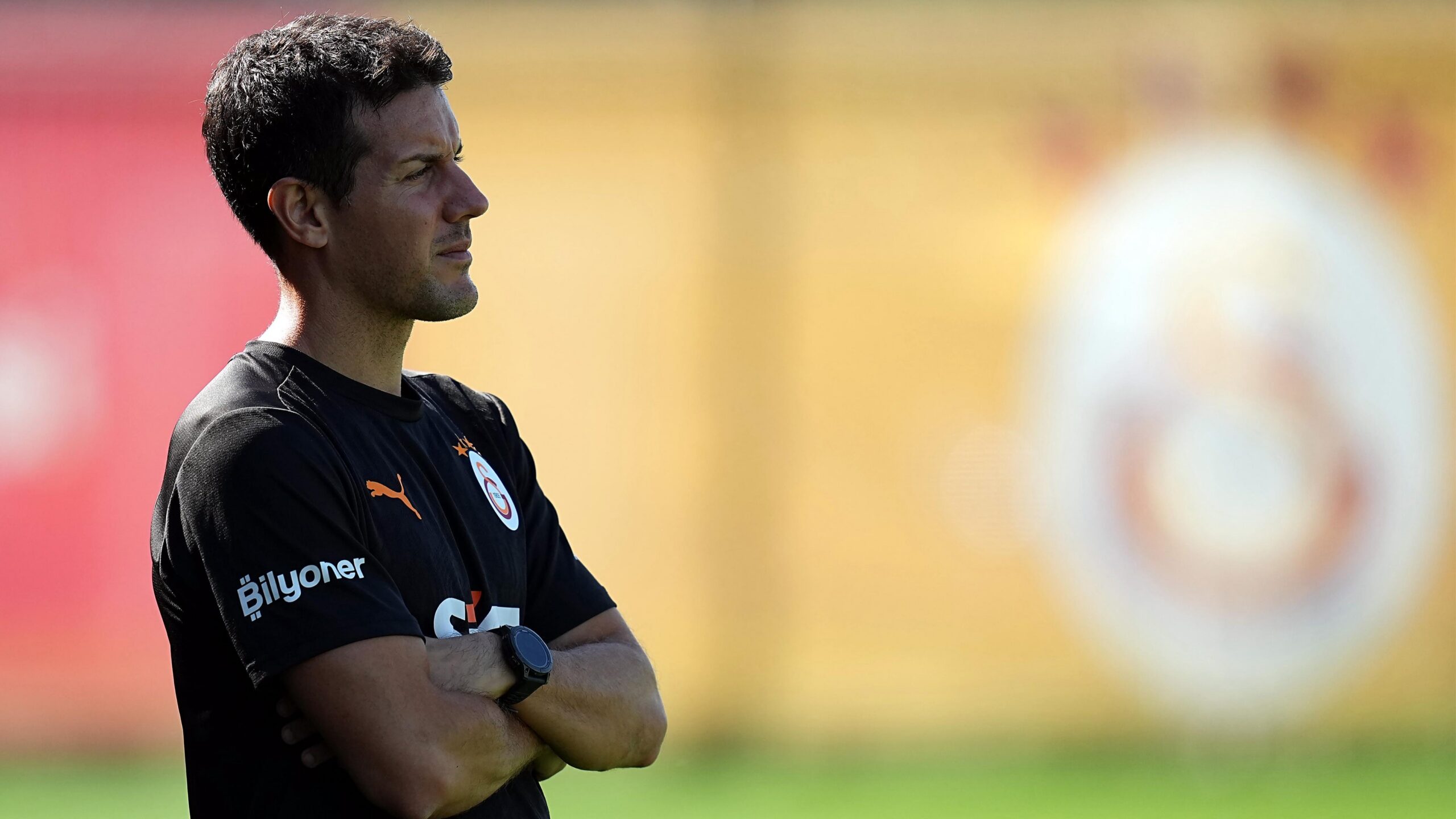
Who is Ismael García Gómez?
Profile
Role: Assistant coach at Galatasaray
Specialisation: tactical intelligence, methodology, analysis, and player development
Experience: Spain, Greece, England, Italy, and Türkiye
Focus Areas: data-driven analysis, tactical clarity, individual development, leadership, and high-performance coaching
Biography
Ismael García Gómez represents a modern football coach whose profile is defined by a rare combination of tactical intelligence, methodological precision, and international experience at the highest levels of the game. As a UEFA Pro Licence holder, notably the youngest in Spain in his graduating year, and with a strong academic background in sports science, he embodies a new generation of coaches who merge data-driven analysis with high-level on-pitch coaching excellence.
Born in Ourense, Spain, García began his journey with a deep passion for understanding the game beyond playing. Early in his career, he developed his expertise within the academy of Deportivo La Coruña, where he worked not only as a coach but also within scouting and methodology structures. This early exposure to talent identification, player development processes, and performance analysis laid the foundation for his holistic understanding of the game.
His career path reflects continuous progression through diverse and demanding football environments. From tactical analyst roles at RCD Mallorca to head coaching experiences in Spanish football, García built a foundation rooted in game understanding, leadership, and adaptability. These early experiences shaped his ability to design game models, implement structured training methodologies, and manage team dynamics under competitive pressure.
A key milestone in his career came with his appointment as head coach of CE L’Hospitalet, competing in the third tier of Spanish football. This role marked his first experience as a head coach at professional level and provided him with a broader understanding of both the game itself and the demands surrounding elite performance. At just 27 years of age, he became the youngest head coach in a professional category in Spain. Beyond the achievement itself, this period proved to be highly formative, strengthening his leadership, decision-making, and squad management skills. It was a defining experience that significantly shaped his coaching identity and prepared him for his future international pathway.
At just 27 years of age, he became the youngest head coach in a professional category in Spain.
His international development accelerated through roles at Asteras Tripolis, Watford, and Udinese Calcio, where he operated within elite professional environments. At Udinese, he worked closely on individual player development at first-team level, contributing to the progression of players such as Rodrigo De Paul, Nahuel Molina, and Destiny Udogie. These players significantly increased their market value during this period, underlining García’s impact on both sporting performance and asset development .
Since 2022, García has been part of the technical staff at Galatasaray, one of Europe’s most demanding and high-pressure clubs. As assistant coach, he has played a key role in one of the most successful periods in the club’s recent history. During his tenure, Galatasaray secured multiple Turkish league titles, domestic trophies, and consistent participation in European competitions, including the UEFA Champions League. The team also set historic performance records, reflecting a highly structured and competitive environment in which García has contributed significantly .
What distinguishes Ismael García is his clear football identity. His methodology is based on structured repetition, tactical clarity, and the creation of competitive habits that transfer directly into match performance. His approach integrates data analysis, video work, and contextual coaching to optimize both individual and collective performance. He is a coach who not only understands the game deeply, but also knows how to translate that understanding into measurable improvement on the pitch.
He is a coach who not only understands the game deeply, but also knows how to translate that understanding into measurable improvement on the pitch.
Beyond tactics, García is recognized for his leadership and communication skills. He combines clarity with emotional intelligence, creating environments where players understand expectations while feeling supported in their development. His ability to connect methodology with human management makes him particularly effective in modern high-performance environments.
With experience across Spain, Greece, England, Italy, and Türkiye, and a proven track record in elite environments, Ismael García Gómez represents a coach who is fully equipped to operate at the highest levels of European football. His profile reflects not only knowledge and experience, but also ambition, adaptability, and a clear vision of how modern football should be played and developed.
Key Insights
- Ismael García Gómez combines tactical intelligence, methodology, analysis, and international coaching experience.
- His career includes roles at Deportivo La Coruña, RCD Mallorca, CE L’Hospitalet, Asteras Tripolis, Watford, Udinese Calcio, and Galatasaray.
- His coaching identity is built around process, tactical clarity, player development, adaptability, and people management.
Our Exclusive Interview with Ismael García Gómez
You have built your career through roles that combine analysis, coaching, and methodology. If you had to define your coaching identity in one core principle, what would it be and how is it visible in your daily work on the pitch?
For me, everything can be simplified into one core idea: enjoying the process. Without genuine engagement in the process, it is very difficult to sustain success over time.
However, I do not refer to comfort. It must be linked to a mindset of constant improvement. There is always something that can be done better and always space to learn.
In my daily work on the pitch, I aim to create that balance. A demanding, detail-oriented environment where players feel engaged, responsible, and motivated to improve continuously.
Ultimately, this combination of enjoyment and constant growth is what drives real and sustainable development.
Ultimately, this combination of enjoyment and constant growth is what drives real and sustainable development.
Many coaches speak about game models, but few manage to truly implement them consistently. What are the non-negotiable elements that must be present for a team to fully live a defined playing identity?
For me, beyond non-negotiables, the key is collective belief. Everyone in the environment must truly believe that what we do serves the team’s success.
This includes the head coach, the staff, and especially the players, who are the central element. Alignment around a shared objective is essential, and that objective is always to win matches.
Within that framework, there is one principle I consider fundamental. Every player must improve. From the moment we start working together, development both as a footballer and as a person is non-negotiable.
Players need to feel that they are progressing and that their individual growth is directly connected to team performance. When this trust exists, the team can fully commit to a defined identity.
Of course, it is not possible to keep every player satisfied at all times. But it is essential that every decision is perceived as honest and always in the best interest of the team.
You have worked in environments where results are immediate and pressure is constant. How do you protect the long-term development of players and ideas in a context that often demands short-term success?
One of the most important lessons I have learned in elite environments is the ability to put results into perspective.
In football, outcomes can often distort performance. Winning does not necessarily mean everything was done correctly, and losing does not always mean the opposite.
For that reason, I aim to remain emotionally balanced when making decisions. From day one, I focus on building a culture where winning is the ultimate objective, but the process is equally valued.
This includes all daily details, training sessions, recovery, individual and collective video work. Every element contributes to long-term success.
When this culture is established, pressure becomes more manageable and, more importantly, the team maintains focus on the process, which I believe is the true driver of consistent performance.
In your experience, what is the biggest misconception clubs still have when it comes to performance analysis and data usage in football today?
Like any major evolution, both in football and in society, new approaches naturally generate different opinions.
In my view, the use of data and information in football is clearly positive, but it must be applied with precision and understanding.
I often remember a phrase Juan Mata used to say: too much water kills the plant. Even something essential can become counterproductive if it is not used correctly.
For me, there are two key principles. The first is context. Data without context can easily lead to misinterpretation.
The second is individualisation. Every player has different characteristics, strengths, and weaknesses, and information must be adapted accordingly.
This is where the human dimension, experience and intuition, continues to make the difference.
I strongly believe that technology, when used with clarity and purpose, enhances processes and ultimately leads to better performance.
I strongly believe that technology, when used with clarity and purpose, enhances processes and ultimately leads to better performance.
You have contributed to the development of players who later reached top international level. When you evaluate a player, what is the one aspect that data cannot show but is decisive for future success?
I often reflect on something Gregg Popovich once said, that there are aspects of a person’s character that cannot be changed. Coming from one of the most influential coaches in sport, that idea carries significant weight.
For me, beyond talent, the decisive factor is mentality. This includes humility, ambition, and the desire to improve on a daily basis.
Today, players receive more feedback than ever before, through coaching, video, and data. At the same time, they are often more sensitive to negative feedback, which makes mental strength even more important.
At elite level, physical and technical qualities are often similar. The real difference is not reaching the top, but staying there.
That is where consistency, discipline, and mindset become critical. I have seen highly talented players fail to sustain their level, while others with less talent succeed because of their mentality.
Another decisive factor is the player’s environment. Modern players operate almost like small organisations, influenced by family, agents, and social surroundings.
A positive environment can accelerate development, while a negative one can limit potential.
For me, mentality and environment are decisive factors that data alone cannot fully capture.
Top teams are often defined by small details. What are the micro-level behaviours or habits within a team that, in your opinion, separate good teams from truly elite ones?
When analysing elite teams that sustain success over time, the key difference lies in how they respond to adversity.
Every team, even those that struggle, can perform well when conditions are favourable. In those moments, everything flows naturally.
The real test comes when difficulties arise. That is when you see whether a team is truly united.
I remember a moment from last season when we lost against Beşiktaş while playing with ten men. After the match, I told Okan Buruk that despite the defeat, we had taken a decisive step towards winning both the league and the cup.
What I saw in terms of collective mentality, effort, and reaction in the following days was decisive.
For me, this defines elite teams. The ability to stay together, respond, and move forward under pressure.
It goes beyond football. It is a characteristic of any strong group. The best teams are built in adversity.
The best teams are built in adversity.
Having worked under different head coaches and football philosophies, how do you filter external influences and build your own clear and authentic coaching voice?
I always say that I am the result of the people I have worked with and learned from.
Throughout my career, I have taken ideas from different coaches and staff members. Some I apply today, while others have been valuable lessons on what to avoid.
The key, in my view, is maintaining a mindset of continuous improvement, constantly striving to develop and evolve.
Over time, these experiences shape your coaching identity, not by copying others, but by filtering and adapting what you learn.
Another essential aspect is adaptability. A coach is always influenced by the environment, not only from a football perspective, but also culturally.
The country, the language, and the way football is understood all play a role.
In modern football, the ability to adapt while maintaining a clear identity is one of the most important qualities a coach can have.
The best coaches are not those with a single fixed idea, but those who can adapt their ideas without losing their core principles.
In modern football, communication within a staff is just as important as communication with players. How do you ensure alignment within a coaching team in high-performance environments?
At the highest level, managing people within the staff is as important as working with players.
Coaching teams are increasingly large and specialised, with different leaders responsible for specific areas, always aligned under the head coach and sporting direction.
In such environments, it is natural that professional and personal aspects may overlap. That is why clarity, honesty, and direct communication are essential.
When issues arise, they must be addressed immediately. This is what builds a culture focused on the collective objective.
In many cases, conflict originates from unclear roles and responsibilities.
For this reason, I believe that leadership roles in modern football have become more complex than ever.
Football knowledge remains important, but the ability to manage people is, without doubt, the most decisive factor.
Looking at the evolution of football over the last decade, what do you believe will define the next generation of elite coaches?
In my opinion, two key aspects will define the next generation of coaches.
The first is the integration of technology and the alignment of all departments within a club, including performance, analysis, and medical.
Coaches must be able to delegate effectively and, more importantly, align these areas towards a shared objective, improving player performance.
Because ultimately, everything revolves around the players, and that will never change.
The second aspect is the ability to adapt to the evolving social context.
Today’s players have a different mindset, with a stronger tendency towards individualism. The challenge is not to resist this, but to understand it and integrate it while reinforcing the importance of the collective.
Emotional management will become increasingly important. The environment is more complex, with more influences and voices involved in decision-making.
For that reason, adaptability, people management, and contextual understanding will define elite coaches in the coming years.
If a club were to bring you in tomorrow, what would be the first visible change they would notice in the team within the first weeks of your work?
I always start from a position of maximum respect for everyone already working within the organisation.
Football is an extremely competitive environment, and reaching the professional level requires passing very demanding filters.
For that reason, I do not believe in immediate or superficial transformation. I believe in processes.
While short-term changes in atmosphere can occur, sustainable improvement comes from building a clear culture.
From the beginning, what I would aim to establish is an environment based on professionalism, consistency, and a strong commitment to daily improvement.
A demanding environment, but one where people also enjoy the work.
In my view, this is the only sustainable path to long-term success.
FAQ
Who is Ismael García Gómez?
Ismael García Gómez is a Spanish football coach with experience across Spain, Greece, England, Italy, and Türkiye, currently part of the technical staff at Galatasaray.
What is Ismael García Gómez known for?
He is known for combining tactical intelligence, methodology, data analysis, player development, and high-performance coaching.
What defines Ismael García Gómez’s coaching identity?
His coaching identity is based on enjoying the process, constant improvement, tactical clarity, adaptability, and creating a demanding environment where people also enjoy the work.