Suriname, 7 June 2024. Second match of the second round to qualify for the final play-offs for the three direct places and two play-offs for United 2026. After the draw on the first day, and with the maths in hand, we have to win to remain in contention for qualification. Today marks exactly two years since the Salvadoran national team’s last victory. If we haven’t won in two years and only a win will do, we can safely say that the situation is extremely complicated. It’s 40 degrees at 4 p.m., with 90% humidity, the pitch is burning hot, and only a rain shower before the warm-up suggests that we won’t be burning up. The players with the most international caps and the captains remain on the bench. It is time for two forwards aged 18 and 20, a recent debutant and a league goalscorer who, for various reasons, has been unable to attend matches since I arrived. The rest of the team consists of players at their peak performance alongside a couple of veterans who give the group confidence. And on the bench, alongside the two captains, a total number of international caps that exceeds those on the pitch. Match strategy.
The match starts with a goal in our favour. We are in complete control and the plan is executed to perfection. But before half-time, they equalise from a corner.
It’s time for calm in the dressing room. There’s no need for shouting and recriminations. In the silence, recovery; and after three minutes, I give my diagnosis. Maintain the same pressure and subdue them even more with the ball, transitioning from long possession to a more aggressive style after breaking through their first line. To do this, our 34-year-old playmaker, who was decided not to start due to the adverse weather conditions (he plays in the Scandinavian league), was going to take control of the game with a more tired opponent and in a more favourable context. A few minutes later, the first goal came. The young players gave way to the captains, who came on to finish the game. A third goal ten minutes from the end gave us a victory that was not enough; we deserved more goals.
Two years later, El Salvador won another game. And qualified for the World Cup.
After two weeks of talking about preparing the team, we can only conclude with the decisive factor: the match. The competition. What you train for. The ultimate goal of preparation. After two, three or six sessions, more than three video sessions, individual talks and sketches of set pieces, it is the player’s moment.
The die is cast… Or is it?
Well, no. The die is not cast. First, because I am not in favour of talking about luck to justify what I do not know. I take full responsibility for what happens to me. And for them, I structure the microcycle as we discussed last week. In the recovery session, we focus on video and on the pitch on what we understand to be trainable in reduced conditions based on what we can improve and repeat; on defence day, we look at the opponent’s attack and our defensive performance; the opposite when we train attack. And set pieces are practised every day in different ways. If we add individual or group talks, templates in the dressing room to see the position in set pieces, plus analysis of our opponents, what else can be added? Many things. And my responsibility is to be at the service of the players before we go out so that everyone is clear about the plan, their starting positions and set pieces, and that my confidence is theirs. Once on the pitch, with the ball rolling on the grass, I have to be focused on seeing what is working in our favour and what is not, and how to give the players ideas so that they continue to insist on what is working and make what is not working work.
The initial ideas
The initial ideas were more about how to surprise the opponent, since my team always played for the same objectives from the same basic positioning at key moments in the game. From there, the game opened up, and our knowledge of the opponent was useful in exploiting their weaknesses through our dynamics. As our idea was not going to change in essence, but was open to specific modifications, the tools at my disposal to help the player focused mainly on two things:
Player modifications: while maintaining the same system, a player with different characteristics could change the course of the game.
Tactical variation: the team started with a 1352 base formation trained from day one, to which a player from the 5 line could be added to the forward line, turning it into a 1343. With that single modification plus the changes in player characteristics, the different combination of variations was enormous, and it did not affect the dynamics of the game patterns or the trained habits in the slightest.
Variations and changes. Anything else?
If the match does not change due to tactical modifications or new players, there are many other complementary factors that the coach can influence to help the team achieve the desired result.
With five substitutions per match under the Qatar World Cup rule, there are many possibilities for giving the team a boost. Five players are half the team. One half could be worn out in the first half and have practically a new team in the second half. Intelligent management of this resource can be crucial to the result.
Hydration breaks allow us to modify aspects of the game that are becoming entrenched. To do this, we must be very clear about the concept we want to convey because there is hardly any time.
Knowing the opponent is crucial so that the changes that can turn the game around are ours. Against poison, an antidote. We must be prepared with all possible options for change, including those of the opponent!
Above all, convey an image of confidence and calm. Confidence, first and foremost, because each player’s self-confidence stems from the confidence of the person who puts them on the field, and if that person conveys that they are confident in them, the focus of attention shifts away from the outside world and, when it shines, it reassures; and calm, because in an environment where the players are at their peak, the coach, from the outside, can only help by making decisions with a cool head, even if his heart is boiling.
Vural Durmuş, a leading athletic performance coach for Galatasaray and the Turkish National Team, has built a career shaping elite players’ fitness and development.
Vural Durmuş is an experienced athletic performance coach and respected figure in Turkish football. With nearly 15 years at the top level, he has consistently worked at the intersection of physical performance, injury prevention, and elite player development. He currently serves full-time with Galatasaray’s first team and supports the Turkish National Team during camps and tournaments.
Durmuş began his professional journey in 2013 at Galatasaray’s academy, before quickly moving up to the first-team staff under Roberto Mancini. Over the following five years, he worked with leading coaches such as Cesare Prandelli, Hamza Hamzaoğlu, Mustafa Denizli, Jan Olde Riekerink, Igor Tudor, and Fatih Terim. During this period, he contributed to winning two Süper Lig titles, two Turkish Super Cups, and four Turkish Cups. After leaving Galatasaray in 2018, he joined Kasımpaşa as performance coach, and later worked privately with professional footballers during the pandemic, focusing on injury recovery and return-to-play programs.
In 2021, he was invited by Hamit Altıntop to join the Turkish National Team staff under Stefan Kuntz, later continuing under Vincenzo Montella. In addition to his work on the pitch, he was entrusted with leading the National Team’s Athletic Performance Department, further establishing his reputation as a key figure in Turkish football’s modern training methods. In 2024, after the European Championship, he rejoined Galatasaray, now working within Okan Buruk’s coaching staff.
Durmuş holds a UEFA A License and the TFF Athletic Performance Coaching diploma, as well as a Master’s degree in Movement and Training Sciences. His career reflects a deep commitment to professionalism, collaboration, and the long-term development of players at the highest level of the sport.
Our Exclusive Interview with Vural Durmuş
Who is Vural Durmuş?
After a background as an amateur footballer, I completed my university studies in Sports Sciences and began my career as an athletic performance coach. For nearly 15 years, I have been working with top-level professional football teams. I currently serve full-time with Galatasaray’s first team and collaborate with the Turkish National Team during international camps.
During my student years, I coached at amateur clubs across all age groups and levels. After graduating, I joined Galatasaray Football Academy in 2013 as an athletic performance coach through a project led by a highly respected professor of mine. About six months later, during Roberto Mancini’s tenure, I was integrated into the first-team staff, marking my first steps into professional football. Over the next five years, I served as an athletic performance coach for Galatasaray’s senior team.
In this period, I worked alongside renowned coaches such as Roberto Mancini, Cesare Prandelli, Hamza Hamzaoğlu, Mustafa Denizli, Jan Olde Riekerink, Igor Tudor, and Fatih Terim. Together, we celebrated two Süper Lig championships, two Turkish Super Cups, and four Turkish Cups.
Following the championship at the end of the 2017–2018 season, I left Galatasaray and continued my career at Kasımpaşa, working within the technical staffs of Mustafa Denizli and Tayfur Havutçu.
At the onset of the pandemic, I focused exclusively for a year and a half on private training sessions with professional players, particularly in injury rehabilitation and return-to-play programs.
Durmuş closely tracks players’ physical performance, combining science and coaching to maximize results.
In October 2021, I was invited by Hamit Altıntop, then Head of National Teams, to join the Turkish National Team staff under head coach Stefan Kuntz. I continued my work with the arrival of Vincenzo Montella and his team, taking on not only the role of Athletic Performance Coach for the National Team but also the responsibility of heading the National Teams’ Athletic Performance Department.
After the 2024 European Championship, I accepted an offer from Galatasaray and rejoined the first-team staff under Okan Buruk, where I continue to serve today.
I hold a UEFA A License and the TFF Athletic Performance Coaching Diploma. In addition, I have completed a Master’s degree in Movement and Training Sciences.
What Does It Feel Like to Work with the National Team?
Serving with the National Team is an experience that words can hardly capture – it carries so many profound emotions and represents one of the greatest honors of my career. From the very beginning of my professional journey, working with the National Team was among my highest aspirations. The moment that dream came true remains one of the most unforgettable memories of my life.
I still remember my first call-up. Upon arrival at the National Teams Training Center in Riva, I was given a private room. Waiting there for my equipment, I felt a wave of anticipation. When I finally put on the training gear and looked at myself in the mirror, the magnitude and meaning of the responsibility ahead struck me deeply. That moment will stay with me forever.
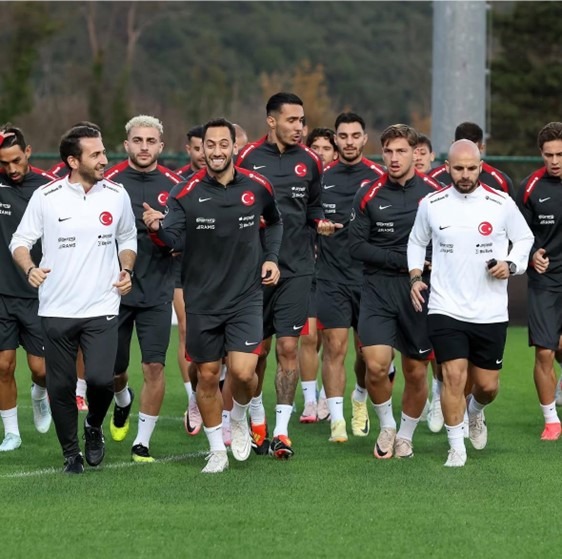
In high-level preparation training with Hakan Çalhanoğlu and the National Team
For me, this role is not merely a professional achievement but also a tremendous honor and responsibility. To share the field with players who wear the crescent-and-star emblem, to breathe that atmosphere, provides an indescribable source of motivation. Each training camp is both physically and emotionally demanding, and being part of a structure that represents the nation gives every single task we perform an added layer of meaning. With this awareness, I strive to give more than what is expected, to fulfill my duty in the best possible way.
The National Team is not only about the players; the technical and support staff are also among the very best in their fields. Working with the top Turkish players – those who carry our passport and compete at the highest level – raises the bar in every respect. This is a unique environment where every player wants to be, and where every moment feels valuable.
And I cannot help but add this: for the first time in our history, we qualified for the European Championship as group leaders. During the 45-day preparation camp, not once did I feel tired. Walking toward a shared goal with a young, highly talented, and deeply connected group of players gives you an extraordinary sense of strength and motivation.
Thank you for sharing this valuable and unifying information. However, from the outside, criticism sometimes arises, particularly the perception that players who have argued with each other during the season cannot be successful with the National Team. What is your opinion on this?
First of all, it must be stated very clearly that the National Team environment is far removed from the competitive rivalries or personal disagreements at club level. It is a very special structure where everyone comes together for the country and all stakeholders serve a common goal. During the club season, competition is natural, and tensions may occasionally occur on the pitch. However, professional-level players have the maturity and awareness to make this distinction and manage these processes in the best possible way.
Taking all this into account, we as the technical staff know and observe our players’ individual characteristics and their behavior both on and off the pitch very closely. Every player who joins the camp arrives not with the mindset of the club jersey they wear, but with the awareness that they are there to fight for the jersey with the crescent and star. In fact, what we call the culture of the National Team is built precisely on this awareness.
Of course, problems can sometimes arise within the team. This is inevitable and applies to every team in the world. In a group of about 60–70 people, including a 35-player squad along with the technical and administrative staff, it is not possible for everyone to like each other, but it is absolutely possible to show respect and move toward the same goal. The important thing is how you manage this group made up of differences.
Good leadership is decisive on the road to success. All of our players are very talented and have the potential to perform at the highest level. But talent alone is not enough; adapting to the dynamics of the team, embracing the environment, and feeling a sense of belonging are just as important as technical ability. Once this sense of unity is created, true cohesion and organization emerge on the pitch, and success follows naturally.
You work simultaneously at Galatasaray and with the National Team. How do you manage these two major responsibilities and ensure coordination between them?
Being active in two major, high-level organizations is both a serious responsibility and a very special experience. The most important elements here are time management, planning, and communication. I work full-time at Galatasaray and take part in the National Team during camp periods.
Both organizations operate with a very high level of professionalism, which makes my work easier. Communication channels are open, needs are clear, and roles are well defined. When I am with the National Team, I remain in constant contact with the club side.
To be honest, working between these two setups can sometimes be tiring, but the professional satisfaction is very high. Being able to work with the country’s top athletes, coaches, and professionals on both sides makes a big difference in many respects. Being in such an environment is very valuable for both my development and my career steps. I try to act with full awareness of the responsibility of being worthy of these roles.
During the intense pace of the season, I always feel the support of my club, which allows me to carry out my duties with the National Team smoothly. The technical staff I work with at the National Team also shows great respect for this matter, and by ensuring mutual coordination, we work without problems. When I received the offer from Galatasaray, I made it clear that I wanted to continue my involvement with the National Team, and Okan Buruk welcomed this, which was one of the decisive factors in my final decision. Vincenzo Montella and his staff also made it clear that, as long as there were no issues on the club side, they wanted to continue with me.
The National Team processes fall at specific times of the season, usually in the form of short camps lasting 8–10 days. Before each camp, the Turkish Football Federation sends an official notice to the clubs. While I continue my duties at the club, my colleagues provide great support in my absence, and when needed, I continue to support the players remotely.
The most critical point is this: both at Galatasaray and with the National Team, there are established systems that function under the leadership of the head coaches. Thanks to this strong coordination, it is possible to work efficiently with both sides.
You not only work with players based in Turkey but also with those playing for some of Europe’s biggest clubs, such as Hakan Çalhanoğlu (Inter), Kenan Yıldız (Juventus), and Arda Güler (Real Madrid). Do you see significant differences between these players and those competing in Turkey?
This is actually one of the questions I am asked most often. I consider working with players from Europe’s elite clubs to be a very valuable and special experience. These players have reached a certain level not only in terms of technical and tactical ability but also in mentality and work ethic. However, this does not mean that one can make a blanket statement such as “those playing in Europe are better.” In Turkey as well, we have players who have reached a very high level both physically and tactically, who take great care of themselves, and who maintain a high degree of professionalism. From a physical perspective, I do not see significant differences between the players you mentioned and those competing in the Turkish league in similar positions. Of course, the systems and game plans in European clubs can raise players to different levels.
In recent years, under the influence of quality foreign coaching staffs and elite-level players coming to our country, both the game quality and the professional approach of players competing in the Turkish league have improved considerably. If we look back about 15 years, there were indeed clear differences between Europe and Turkey. But in recent years, thanks to these high-quality foreign players and coaches, Turkish football has advanced significantly both in terms of play and professional standards.
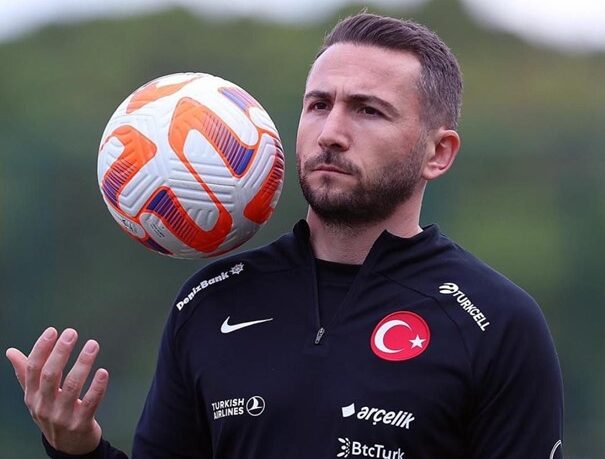
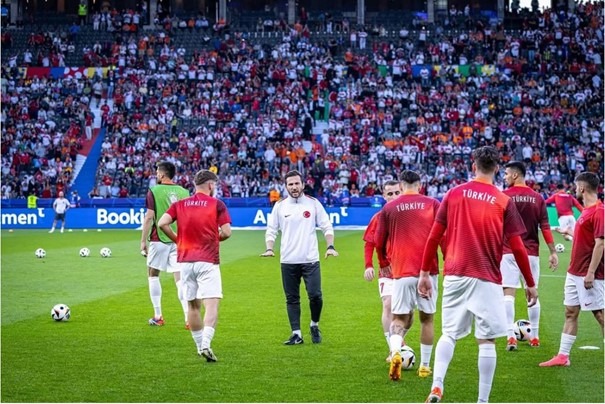
Vural Durmuş guiding the Turkish National Team during pre-match preparations, blending discipline and energy on the international stage.
This development has not been limited to player quality; the level of awareness among Turkish coaches has also risen. Since modern training techniques often require extra work before or after training, our players have now become more conscious and more open in many respects compared to the past.
To give a simple example, when a player competing in Turkey meets another playing in Europe during a National Team camp, they naturally exchange experiences and knowledge. They discuss how their teams work, their travel arrangements, and camp organizations, which raises the overall level of awareness.
Looking back on my time at Galatasaray, I had the opportunity to work with many top-level coaches. The training systems and working methods they implemented introduced structures that were not very common in Turkish football at the time. When we applied these systems and achieved positive results, we began to embrace them ourselves. Similarly, the individual training approaches and habits brought in by some players from Europe also served as examples for us, which naturally improved our own coaching practices.
In recent years, with the updated coaching education programs jointly organized by UEFA and the Turkish Football Federation, the coaching approach in Turkey has also become significantly modernized. Training systems have come very close to European standards. However, it is important not to overlook cultural differences at this point. We have certain habits that are innate or shaped by our environment, and sometimes it is difficult to break these patterns. So while the content and intensity of training may resemble those in Europe, the off-field cultural aspects can make the process a bit more challenging.
The more contact we have with countries that play good football and have strong organizational structures – whether through coaches, player transfers, or data exchange – the more positively it affects the organizational framework of our league. From youth academies up to the Süper Lig, the more correctly this structure is built, the further we can advance as a country. However, it should also be noted that this organizational structure is still in a phase of development. Consequently, while one area improves, it is possible that another may remain lacking.
How do you manage your cooperation with the head coach, assistant coaches, and the medical staff? In your opinion, what is the role of building a common language and trust in a performance-oriented environment? You have also worked with head coaches of very different characters. How did you manage this diversity?
In modern football, success is no longer determined solely by the performance of the eleven players on the pitch, but by the harmony and coordination of all the units working under the umbrella of a club or the national team. In this sense, the communication structure and coordinated work between the head coach, assistant coaches, performance staff, analysts, medical teams, and support staff are absolutely critical and decisive.
In my own field of work, I always prefer to share information objectively, prioritize open communication, and maintain a transparent approach. Topics such as correctly evaluating performance data, planning player workloads, managing injury risk, and overseeing return-to-play processes all require a shared understanding. This is only possible through mutual trust and a common language. Once a trust-based bridge is established between us and the technical staff, decision-making processes become much healthier and sustainable.
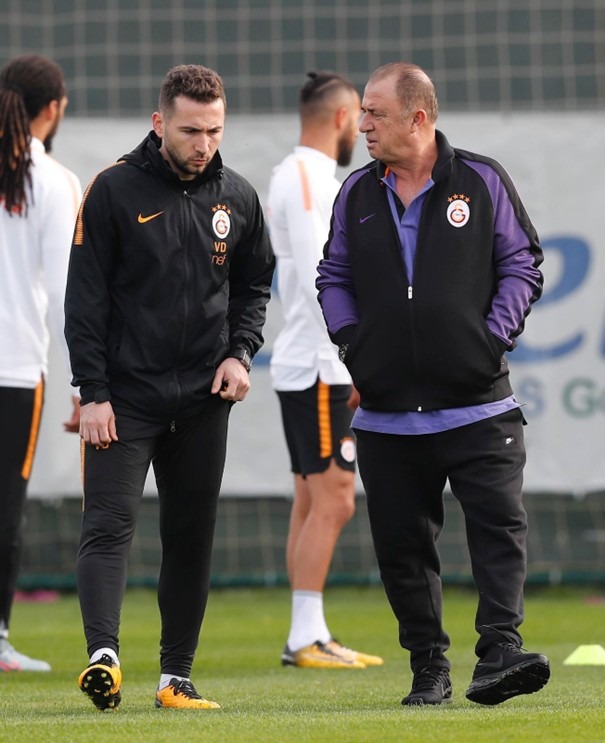
Vural Durmuş working alongside legendary coach Fatih Terim during his early years with Galatasaray.
From Roberto Mancini to Fatih Terim, from Prandelli to Igor Tudor, and currently with Okan Buruk and Vincenzo Montella, I have worked with head coaches of very different characters and philosophies. These experiences gave me the chance to encounter many different approaches. The lessons I took from these processes are extremely valuable to me – almost like a handbook you should always keep by your side. Each coach has a different football philosophy, communication style, and set of expectations. Being able to adapt to these differences and work together opens new perspectives and opportunities for growth in many ways.
The functioning of technical staffs usually follows a defined system. Assistant coaches in particular play a role just as important as the head coach. They are the key figures who reduce the workload of the head coach, ensure organization with other departments, and manage communication both within the staff and with the players.
As for the structure of the medical team, it generally consists of a chief doctor leading physiotherapists and masseurs. As a unit, they play a critical role in ensuring that players are optimally prepared for training and matches. They provide the technical staff with continuous updates on issues such as identifying players at risk of injury, implementing preventative programs, treating injuries, and carrying out regeneration work.
For example, in the return-to-play process after an injury, we plan in advance with the assistant coach which parts of the training a player will participate in and which parts will be done individually. At this point, cooperation with the medical team is also of great importance.
For this process to run smoothly, communication within the staff is vital. Without fast, transparent, and professional collaboration, it is not possible to expect efficient outcomes from these transitions. A similar structure exists within the National Team as well, although camp periods there are shorter, which means that action plans must be implemented more quickly.
I have worked with many different head coaches, each with their own style, and each one has given me different perspectives. Successfully managing these differences is possible by adapting to the team culture and being flexible in your communication style according to the situation. This is a skill that develops over time.
How is the training organization at Galatasaray structured? Can you describe a typical daily training session for us?
The training organization operates according to a specific system and order. The medical and performance teams first evaluate the condition of the players. The technical staff then comes together to analyze the programs prepared for that day. Based on the information provided by the medical team, the training session is designed. While preparing this structure, factors such as the content of that day’s session, the workloads from the previous day, the physical condition of the players, injury risks, and the upcoming match schedule are all taken into account.
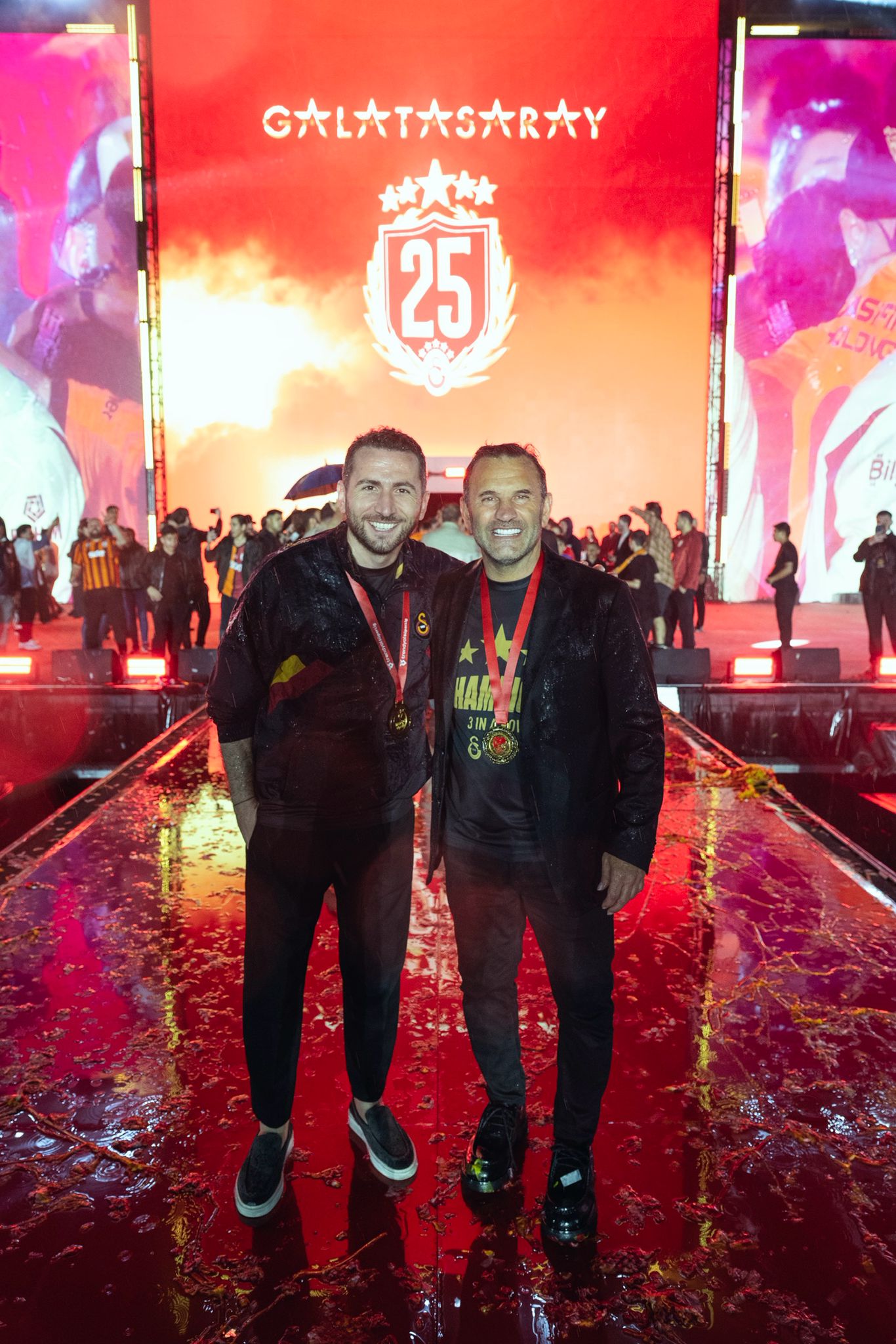
Vural Durmuş shares a proud moment with Okan Buruk as Galatasaray celebrates another Süper Lig title.
Before the official training session begins, players start their preparation processes in the fitness area and treatment room.
Once the on-field program is completed, players with individual programs continue their work either on the pitch or in the gym. Those who finish their training move on to recovery applications.
Throughout this entire process, the performance team, medical staff, and technical staff remain in constant communication. Every workload is planned and monitored in real time, the data from the training sessions is analyzed, and the plans for the following days are shaped accordingly. In other words, every exercise you see on the field is backed by thorough planning and coordinated teamwork.
Do you have a particular message or principle that holds special meaning for you in high-performance sports? How do you convey this perspective to athletes and future coaches?
The world of high performance is unique and intense. You cannot survive here with ordinary effort; it requires serious dedication, consistency, and commitment. If I were to define this field in a single word, it would be “devotion.” Because you are taking on a heavy load, both physically and mentally. While trying to balance your personal life, you must also meet the high demands placed upon you.
I always emphasize to the athletes I work with: in this profession, both good performances and bad performances are part of the journey, and the transition between the two can happen very quickly. We are all human; sometimes we make mistakes, sometimes we perform above expectations, sometimes below. What matters is being able to accept and manage these ups and downs in a healthy way. Staying grounded when you are at the top and being able to rise again after a setback requires real discipline and mental maturity. In both cases, being objective with yourself is of great importance.
For me, the essence of this profession is: “Goal = Work.” Thoughts like “It doesn’t matter if I skip this exercise today” or “It won’t hurt if I eat this dessert” may seem harmless in the short term, but in the long run they take you away from your goals. At the same time, overdoing everything is not sustainable either. The key is adopting a balanced, systematic, and consistent lifestyle. This is particularly evident in individual sports. Take tennis players, for example: sometimes they play matches that last five hours. This cannot be explained by physical endurance alone. Those extraordinary comebacks are the result of mental and emotional resilience combined with strategy.
The clearest message I want to give to future coaches and young athletes is this: if you truly love this profession, you must embrace sacrifice, disciplined living, and consistency as guiding principles. Success is not only about talent; it is about a philosophy of life that makes that talent sustainable.
How important is education, especially for young coaching candidates? Do you still continue to develop yourself?
It is absolutely vital. I still actively pursue education and try to draw from as many different fields as possible. Generations change; people change, the profile of footballers changes, coaches’ expectations and players’ approaches are constantly evolving. Therefore, we also need to keep ourselves continuously updated.
It is impossible to move forward today with the same knowledge we acquired ten years ago. Being open to processes of change and development is always important, but this change should be managed with patience and not with haste. Learning, reading, researching, and investing in yourself is a never-ending journey. Football cannot be limited to “90 minutes, 11 against 11.” Beyond tactics, it also involves managing a group of 30–35 individuals, each with different personalities, perspectives, and experiences. You cannot approach every player in the same way; this is why you must constantly review your perspective and routines.
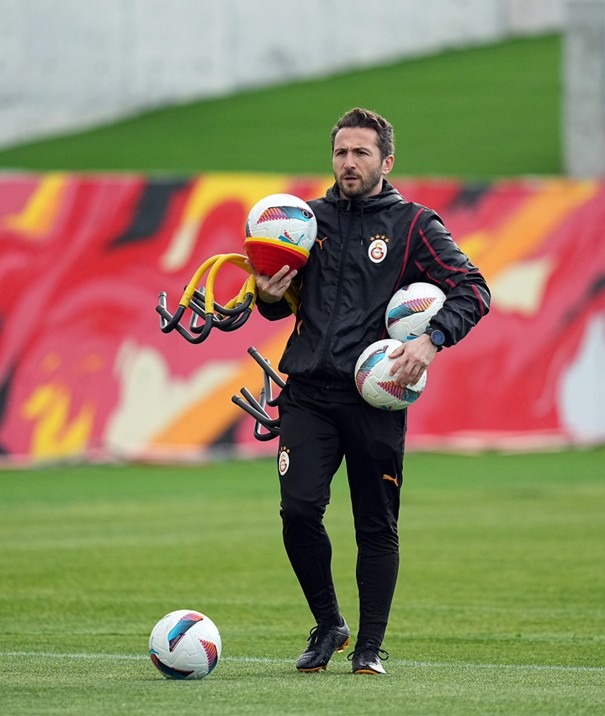
Beyond tactics, Durmuş plays a key role in organizing and preparing high-performance training sessions for Galatasaray.
I do not limit myself to football-related courses or training. I read about art, draw valuable lessons from biographies, and sometimes even get inspired by acting performances in cinema. I try to extract meaning from every detail, often asking myself: “What can this add to me?” Because what I tell players also applies to us: if we are to serve in top-level clubs, we must be ready not only in terms of knowledge but also in vision.
One of the most critical skills in coaching is process management. Every player has a different worldview, dreams, perceptions, experiences, and ways of reacting. Therefore, you cannot approach everyone in the same language. The ability to understand different profiles, analyze them, and respond appropriately at the right time is one of the most important qualities of a good coach.
What role does learning languages play in this process?
For me, language is something I would call an absolute “must.” To be honest, I am very critical of myself in this area. I wish I had invested more time and effort into it earlier. My English is at a certain level now, but because it is not more advanced, I occasionally face difficulties, and that bothers me. That is why I continue to work on it whenever I find the opportunity.
Moreover, I recommend not only learning English but, if possible, also a second language. This is a major advantage when it comes to understanding different cultures, following scientific research and current publications, and integrating more easily into social life. I have a very clear piece of advice for young coaching candidates: in addition to English, make sure you learn another foreign language.
We give the same advice to young players. Almost every player dreams of playing abroad. But without knowing the language, without engaging in social life, and without understanding the culture of the country they live in, achieving success is nearly impossible. And it is not just about failure – this process can also cause serious psychological harm to the player. That is why early language education is a major investment, both for sporting and personal development.
How do you evaluate the development of athletic performance in Turkey? Especially regarding youth academies, what structural changes would you like to see in the coming years?
This question should really be divided into two parts. Starting with the first-team level, I can say that in the past ten years there has been significant progress. In many areas such as equipment, training monitoring, and performance analysis systems, we have come very close to European standards. Especially at the Süper Lig level, clubs now work in a data-driven way, implement individualized training and workload plans, and prefer to use advanced analytical tools.
However, when it comes to youth setups and academies, the picture is unfortunately not as bright. Particularly after the pandemic and the economic downturn that followed, many youth organizations were deeply affected. From training conditions to coaches’ salaries and social security, many fundamental issues face serious challenges. The physical infrastructure is also insufficient; for example, there are clubs where four or five different teams have to use the same pitch simultaneously. In such an environment, it is of course very difficult to talk about the development of quality individuals, athletes, and coaches.
Another important issue is the mismatch between children’s school hours and training schedules. Families are faced with the question: “Should this child go to school or focus on football?” Yet there is no guarantee on either side. As a result, many young talents end up caught in between, unable to fully dedicate themselves to either path, and are ultimately lost.
Especially in big cities, while there are many clubs, the level of facilities and infrastructure is quite inadequate. This means that the trajectory of youth academies needs to be examined in much greater depth and redesigned according to actual needs. From time to time, different clubs have developed model projects, but unfortunately, they have not been sustained in the long term. Looking at the overall picture, it is fair to say – albeit with regret – that we still have a long way to go in this area.
At the level of youth national teams, we participate in many international tournaments, often outperforming strong opponents and achieving victories. However, in the continuation of the process, while players from rival countries go on to play at higher levels, the proportion of our players who reach that stage remains unfortunately very low. I believe we need a sustainable football academy structure that not only produces talent but also supports their development in the long term.
If this system were in your hands, what would you change?
First of all, I would try to solve the issue of “physical space,” which is one of the biggest obstacles to investment and development in youth academies. Today, especially in big cities, even a small piece of land is extremely valuable, so instead of building sports facilities, other types of projects are often preferred. This seriously disrupts the creation and development of the kind of ideal youth football infrastructure that is needed.
Even our country’s biggest clubs, which are supposed to be the cornerstones of Turkish football, unfortunately do not have facilities that meet the ideal standards for their academy teams.
At this point, I believe the state’s sports policies have a decisive role to play. In recent years, many of our clubs have been provided with modern stadiums, which was a very important step. But we also need to implement a similar approach for facilities that can be used by youth academies.
This could be achieved through nationwide initiatives at a mobilization level, with projects that raise awareness and make youth academies a priority in sports facility planning. In this way, the foundation of our football – young players – would be given much healthier environments in which to develop.
If these problems are not resolved, we will continue to struggle with developing our talented players properly. Therefore, change must not only be technical and tactical but also systemic and structural, starting from the grassroots.
Do you think youth academies should be moved outside the big cities because of these challenges?
Yes, it is difficult to say a definite “yes” to this, but I believe there will be a tendency in that direction. The very high land costs in big cities make the sustainability of youth projects extremely difficult. For this reason, it is becoming inevitable for some clubs to move toward more cost-effective areas.
Perhaps new, highly functional training and academy centers could be established in regions close to major cities. Players could develop there up to a certain level and then be integrated into top-tier clubs that meet specific criteria. Such a system would not only support player development but also reduce the density within the cities.
However, for all this to become a truly efficient system, more radical decisions must be made. The establishment of youth development standards within a defined framework, and the strict monitoring and support of these standards, is critically important for the long-term success of our football.
Finally, is there anything you would like to add, or a message you would like to give to young footballers and aspiring coaches?
Whether you are a footballer or a coach, whatever role you take on, attaching yourself passionately to your work, fulfilling its requirements, working extra hours when needed, and making sacrifices are all natural parts of this journey. When you eventually see the results of these efforts, you realize much more deeply how meaningful this profession truly is.
I will never forget the feeling of receiving my first winners’ medal. The effort throughout the season, the challenges faced, the sacrifices made, and then the success at the end… being part of that achievement, being within a story that brings joy to millions of people, is truly invaluable. Or when you see the progress of a player you have worked closely with all season, the breakthrough he makes, his return to the National Team, or his receipt of a good transfer offer… these are just some of the outcomes of the details you have touched and the stories you have contributed to.
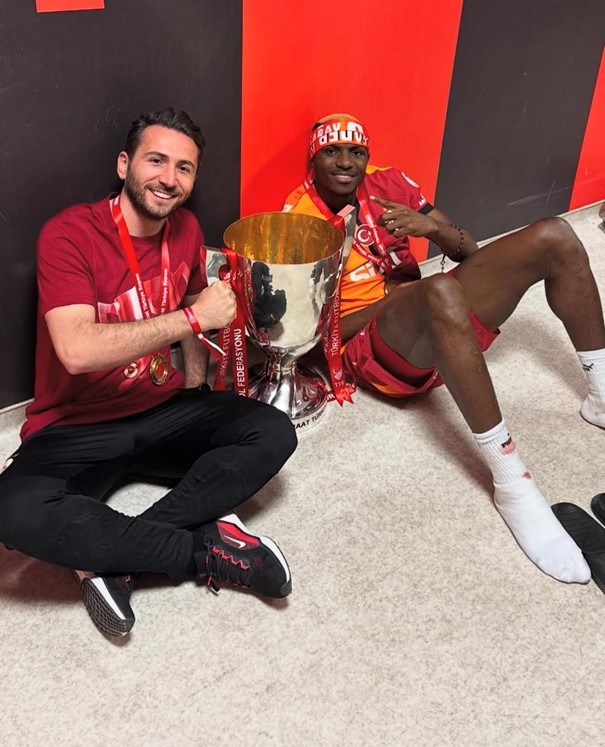
Vural Durmuş celebrates Galatasaray’s title triumph in the dressing room, sharing the moment with players and the coveted trophy.
I am someone who grew up with the dream of becoming a footballer but, for various reasons, had to move away from that dream. Perhaps I was not guided properly at the time, or perhaps I did not act with enough awareness myself. But that process became my greatest source of motivation to begin my path as a coach. Now I ask myself this question: “If I could not become one, if I could not achieve it, how can I support those who can?” That is the mindset I carry with me. Wherever I made mistakes or experienced shortcomings, I try to pass these lessons on to the next generation of coaches or young players so they do not lose valuable time.
Because when we bring together people who do their work correctly, who are ethical, and who are open to growth, we create value not only for individuals but also for our country and even for the world. With this belief, I wish for everyone who puts in the effort to have a clear path ahead of them.
Whether you are a young player or a young coach, make your work meaningful. Because success is not just about financial rewards or lifting trophies – it is about leaving a mark.
So far, I have experienced Turkish League, Super Cup, and Turkish Cup victories. I have served with the National Team and had the chance to represent our country in an international tournament like the European Championship. Looking back, from my student days onward – every sleepless night, every moment of fatigue, every sacrifice, every instance where I never stopped – I feel it was all truly worth it.
My hope is that everyone – whether a footballer or a coach – will one day have the chance to experience these feelings. Because living that feeling becomes one of the most meaningful moments of your life, beyond your profession itself.
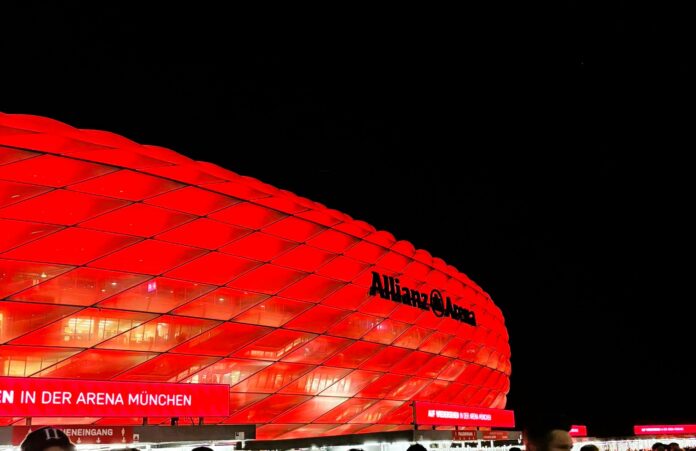
The Allianz Arena lights up Munich’s night sky, a modern icon of world football.
أضحى ”النجاح“ في كرة القدم، في العشرية الأخيرة، مصطلحا يقترن بعوامل عدة، تجاوزت عامل الأداء الرياضي فقط.
حيث أصبحت قدرة الفريق فيتحقيقإيراداتخارجالملعب، خاصة بالنسبة للاندية الأوروبية، تحظى بنفس أهميةالنجاحداخله.
وتعد ”حقوق تسمية الملعب“، إحدى الوسائل التي اطلعت بها الأندية مؤخرا بهدف تحقيق إرادات خارج المداخيل التقليدية (حقوق البث، إعلانات، بطائق الاشتراك، عائدات بيع اللاعبيين…)، وهي بالأساس صفقة تجارية تدفع فيهاالشركاتالعالميةمبالغكبيرةلتكونأسماؤها مرتبطة بملعب نادي معين.
ورغممايمكنأنتضخهذهالاتفاقياتمنملايينالدولارات في خزينة النادي،ممايوفردخلاًإضافيًايكملالمداخيلالتقليديةالسالفةالذكر،تفضلالعديدمنالأنديةعدماتباعالهاجسالمادي،متمسكةبالحمولةوالقيمةالتاريخيةللتسميةالأصليةلملاعبها.
جاذبيةحقوقتسميةالملاعب
يمكن ذكر المكانة، الهيبة، التأثير، التفاعل مع الجمهور، كبعض من المزايا المستهدفة من حقوق تسمية الملاعب، سواء بالنسبة للنادي أو المستشهر.
تشيردراسةإلىأنالأنديةالكبرىفيأوروبايمكنأنتجنيمايصلإلى 303 مليونيوروسنويًامنخلالحقوق التسمية. علىرأسهذهالأندية،تأتياستاداتمثلسانتياجوبرنابيولريالمدريد،الذييُقدّرقيمته ب29.7 مليون يورو، ثم الكامب نو معقل نادي برشلونة ب20 مليون يورو.
تشير المعطيات الحالية إلى إقبال حذر من طرف الأندية،ممايؤشرإلىتوازندقيق حتى في المستقبل القريب..
ستواصلالأنديةفي التطلع إلىحقوقالتسمية وقياس مدى توافق جماهيرها مع خطواتها في هذا المسار.
ومعذلك،قدتقاومالملاعبالتاريخيةالتغييرالكاملفيالتسمية،مفضلة نماذج هجينة، وستستمر المعركة بين الربح التجاريوالتراثالثقافي،رغم وجودملاييناليوروهاتفيالميزان.
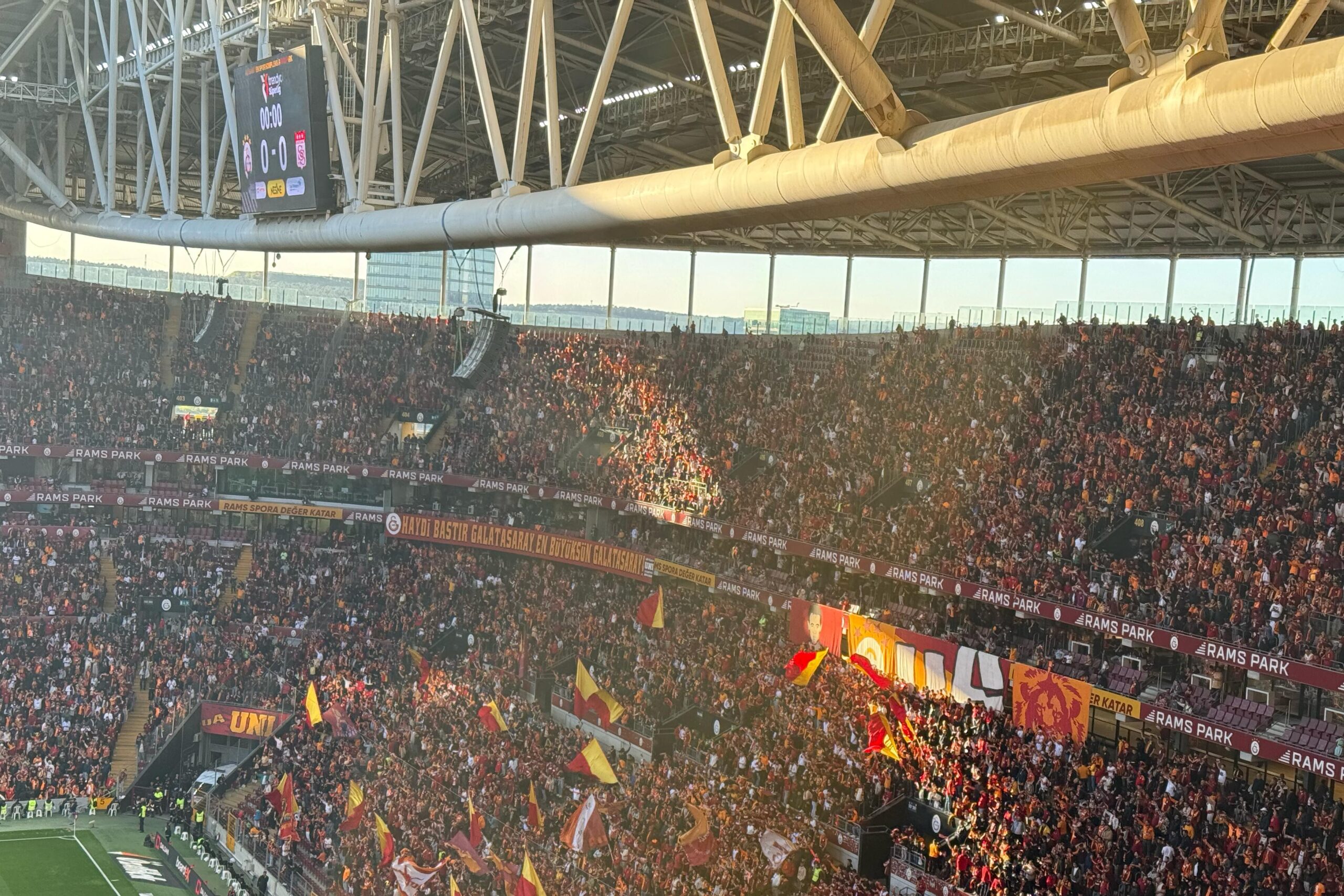
Galatasaray fans fill Rams Park, creating a dramatic backdrop as the club embarks on a new era of record signings.
When Galatasaray announced the signing of Victor Osimhen for €75 million, the deal instantly rewrote the history of Turkish football. The Nigerian striker’s arrival from Napoli, alongside further big money moves for Uğurcan Çakır and Wilfried Singo, has transformed Galatasaray’s squad into one of Europe’s most expensive projects. Just days later, Fenerbahçe countered with a headline signing of their own: Manchester City’s long-serving goalkeeper Ederson, who joined for £12 million after eight years in England.
In the space of one transfer window, the Süper Lig has positioned itself at the center of the European football conversation. The sheer scale of investment is eye-catching, but the bigger story lies in what these moves mean for the future of Turkish football: its competitiveness, sustainability, and global standing.
Galatasaray’s Bold Gamble
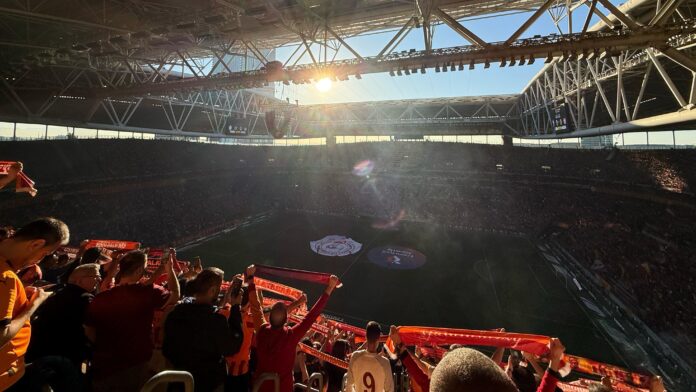
The passion of Galatasaray’s supporters remains a driving force behind the club’s bold ambitions in Turkish football.
For Galatasaray, this window has been defined by ambition on a scale rarely seen outside Europe’s financial superpowers. Osimhen, still in his prime at 26, is not the profile of player usually associated with the Turkish league. The same can be said of Uğurcan Çakır, prised away from rivals Trabzonspor for €33 million, and Monaco’s Wilfried Singo, whose €30.8 million fee further underlines the club’s intent.
This recruitment drive signals more than just a desire to dominate domestically. Galatasaray clearly sees itself as capable of competing again in Europe, where Turkish clubs have struggled to make a consistent impact since the early 2000s. With Osimhen leading the line, the club’s attack carries the kind of global profile that can alter perceptions of the league itself.
Yet ambition has a price. Galatasaray’s spending dwarfs its revenue streams, and while Turkish clubs benefit from passionate fan bases and strong commercial pull, the financial risks are substantial. UEFA’s Financial Fair Play regulations may no longer carry the bite they once did, but the sustainability of such investment will remain under close scrutiny.
Fenerbahçe’s Strategic Response
Fenerbahçe, unwilling to let their rivals dominate the headlines, made their own statement by signing Ederson. The Brazilian goalkeeper arrives with a trophy cabinet that includes six Premier League titles and a Champions League medal, instantly raising the team’s credibility both on and off the pitch.
Unlike Osimhen, Ederson is nearing the later stages of his career. But at 32, he still offers several years at the highest level. His signing is about more than ability; it’s about leadership, mentality, and the kind of international recognition that boosts a club’s brand value. Reports that he will earn €11 million annually highlight the financial weight behind the move, but Fenerbahçe appear to be banking on the commercial and sporting uplift that comes with adding a player of his stature.
The contrast between Galatasaray and Fenerbahçe’s approaches is striking. One has invested heavily in future resale value, the other in proven experience. Both strategies bring risk, but together they set the stage for a Süper Lig season of unprecedented intensity.
A League of Financial Contradictions
To understand the significance of these transfers, they must be placed against the broader financial backdrop of Turkish football. Transfermarkt figures show Süper Lig clubs spent €79.4 million this summer while recouping €34.5 million, a net deficit of roughly €45 million. That is less than the €104 million deficit recorded last season but still points to a league living well beyond its means.
Turkey’s economic climate has not been kind to its football clubs. High inflation and currency instability erode the value of broadcasting and sponsorship deals, making it difficult for clubs to balance books already strained by years of heavy borrowing. Against that reality, splashing tens of millions on new signings may appear reckless.
However, there is another way of looking at it. For clubs like Galatasaray and Fenerbahçe, the only viable path to renewed financial strength might be through sporting success. Stronger squads mean deeper European runs, higher prize money, and greater visibility for sponsors. The risk, then, is calculated: spend now, in the hope of building momentum that generates returns.
Regulation and the Local Talent Question
Overlaying these financial considerations is the Turkish Football Federation’s recent move to restrict the number of foreign players. Since 2024-25, squad limits have been reduced, and clubs are required to field and develop more locally trained talent. This creates a tension between marquee international signings and the long-term health of the national game.
On one hand, bringing players of Osimhen and Ederson’s quality to the Süper Lig raises standards for everyone around them. Young Turkish players training alongside such figures are exposed to higher benchmarks of professionalism and performance. On the other, excessive reliance on foreign stars risks stunting pathways for homegrown talent, especially if short-term pressure to deliver results outweighs development priorities.
How clubs navigate this balance will be central to the league’s future identity. Are these transfers catalysts for growth, or distractions from the structural reforms Turkish football has long needed?
Beyond the Transfers: What’s at Stake
The stories of Osimhen and Ederson are about more than two footballers changing clubs. They reflect a broader attempt to redefine the Süper Lig’s position in the global football hierarchy. For years, Turkey has been viewed as a league of fading stars and passionate crowds rather than a genuine destination for top-tier talent. These transfers challenge that perception, at least symbolically.
If Galatasaray and Fenerbahçe succeed, the ripple effects could be significant. Sponsorship deals may increase in value, broadcasting rights could attract wider audiences, and other clubs may find themselves pressured to follow suit. But if results do not match expectations, or if financial strains overwhelm the rewards, the fallout could deepen existing vulnerabilities.
Conclusion: Record Spending, Record Stakes
The Turkish Süper Lig has always thrived on passion and spectacle. This summer, it has added unprecedented ambition. By signing Osimhen and Ederson, Galatasaray and Fenerbahçe have raised the ceiling of what is possible in Turkish football, but they have also raised the stakes.
The coming season will not just be a test of two clubs’ competitive strength, it will be a test of the league’s financial resilience, regulatory framework, and capacity to sustain momentum in a global football landscape defined by inequality.
In the end, these transfers will be remembered not only for the names involved, but for what they represent: a gamble on the idea that Turkish football can, once again, punch above its weight.
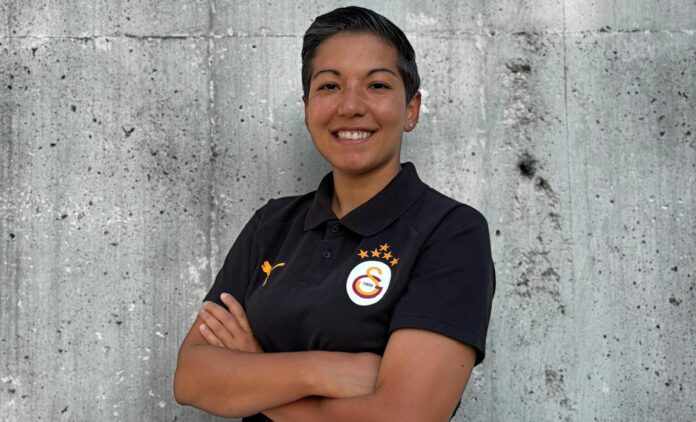
Çağla Korkmaz, Galatasaray’s Assistant Coach and Head of Girls Academy, bringing experience and vision to the future of Turkish women’s football.
Çağla Korkmaz is a former Turkish-German footballer and current coach. Since August 2025 she has been part of Galatasaray, where she works as Assistant Coach of the women’s first team and Head of Girls Academy. A former Turkey international, she brings the experience of playing at the highest level, the structural discipline of German football, and the ability to translate both into her daily coaching work. With a worldwide network in women’s football and a deep commitment to player development, she combines international expertise with a clear vision for building sustainable pathways for girls and women in the game.
Education & Early Career
Born on November 14, 1990, in Munich, Germany, Korkmaz began her football journey in the youth setup of FFC Wacker München. Her early development in Germany’s well-structured football ecosystem gave her a strong foundation in technical and tactical aspects of the game. After progressing through the youth ranks, she played for clubs such as FC Stern München 1919 and FC Ingolstadt 04, eventually establishing herself as a reliable defender.
Professional Playing Career
Her senior career included stints at 1. FC Lübars, VfL Wolfsburg II, TSV Schott Mainz, and SV Meppen. Korkmaz combined defensive stability with leadership on and off the pitch, which earned her a call-up to the Turkey women’s national team, where she represented the country between 2015 and 2018.
Transition to Coaching
After retiring from playing, Korkmaz quickly moved into coaching. In 2018–2019 she served as assistant coach for SV Meppen U17, focusing on youth development and tactical preparation. From 2021 to 2025 she worked as head coach at her former club FFC Wacker München, becoming one of the few female Turkish-German coaches leading a senior team in the German football pyramid. In August 2025 she took the next step by joining Galatasaray as Assistant Coach of the women’s first team and Head of Girls Academy, combining day-to-day elite coaching with long-term academy development.
Leadership & Philosophy
Korkmaz’s coaching philosophy emphasizes discipline, mutual respect, and individual growth within a team-oriented structure. Drawing on her own playing career, she prioritizes player confidence, technical improvement, and emotional intelligence. She advocates for equal opportunities in football and is committed to raising the visibility of women in leadership roles.
Current Role at Galatasaray
At Galatasaray, Korkmaz supports first-team preparation and match analysis while overseeing the Girls Academy. She integrates the discipline and structures of German football into the Turkish environment and uses her international network to create new opportunities for players and staff. Her remit includes methodology design across age groups, coach education, and talent identification. The ambition is to align academy principles with senior-team demands and to establish a transparent pathway from grassroots to the first team.
Vision for Women’s Football
As a bilingual professional navigating both Turkish and German football cultures, Korkmaz serves as a bridge between two systems. She speaks often about the importance of institutional support, quality coaching education, and international exposure for young athletes. Her long-term ambition remains contributing to structured player pathways and inspiring more women to pursue coaching and leadership roles.
Our Exclusive Interview with Çağla Korkmaz
Who is Çağla Korkmaz outside of football?
I’d say I’m the same person on the pitch as I am off it. For me, it’s really important to stay true to who you are in everyday life. If someone were to describe me, I’d say, above all, I’m a mom. I’m deeply family-oriented, I come from a big family, I value harmony, and I love spending time with friends and family doing all sorts of activities.
You recently joined Galatasaray as Assistant Coach of the women’s first team and Head of Girls Academy. What convinced you about this step?
The Galatasaray project offers the chance to combine elite football with long-term development. For me it was important to find a place where I could bring all of my experiences together – my years in German football with its structures and discipline, my international perspective as a Turkish national team player, and my passion for building environments where girls see a clear pathway. Galatasaray is a big club with strong traditions and ambitions, and being able to help shape both the first team and the academy was a unique opportunity.
What excites you most about shaping the Girls Academy at such a big club?
The academy is where the future of women’s football begins. What excites me is creating a structure where young players clearly see their next steps – from grassroots to the first team. At Galatasaray, we have the resources and visibility to make that pathway tangible. For me it’s about more than just training sessions: it’s about preparing girls technically, tactically, and mentally to perform in a professional environment.
Your playing and coaching journey spans both Germany and Türkiye. How do you combine those influences in your daily work?
I was educated as a player in Germany, where discipline, structure, and detailed methodology are central. At the same time, representing Türkiye at international level gave me a deep understanding of different football cultures and the importance of adaptability. In my daily work, I try to combine both: the structural and disciplined approach from Germany with the passion, energy, and resilience that are very present in Turkish football. It’s a mix that I think players respond well to.
You are known for having a strong international network. How does that benefit your work at Galatasaray?
Football is global. Having a wide network means access to knowledge, exchanges with other coaches, opportunities for friendly matches, and also visibility for our players. It allows us to benchmark ourselves against international standards and bring in fresh ideas. For the girls in the academy especially, knowing that they are part of a wider football world can be very motivating.
What philosophies guide your leadership as a coach?
My philosophy is built on discipline, respect, and clarity. Players should always know what is expected of them and why. At the same time, I believe coaching is not only about tactics but also about developing people. My aim is to create an environment where players grow in confidence and character. When you combine a clear game model with open and authentic communication, the results come naturally.
How does your daily routine look inside a top-club environment like Galatasaray?
The rhythm is very intense. Mornings usually start with staff meetings and video analysis of the previous match or the next opponent. Then we move into planning and delivering training sessions. Afternoons are often filled with individual talks with players, academy coordination, and organizational work. The day doesn’t end after training; there are always discussions, feedback, and preparation for the next session. It’s a lot of responsibility, but the professionalism of a club like Galatasaray provides a strong structure that makes the work effective and rewarding.
Who have been the biggest influences on your career?
There are two. First, Salih from my time at Wacker – he played a decisive role in my transition from player to coach, and without him I might not have taken this path so early. Second, my former coach at BSC in the 2nd league, Jürgen Franz. He embodied values that I want to carry forward: integrity, discipline, and humanity. Both shaped me as a coach and as a person.
What are your goals at Galatasaray in the short and medium term?
In the short term, I want to help the first team compete successfully and implement a clear playing identity. At the same time, I am focused on building the foundations of the Girls Academy: methodology, coaching education, and a clear pathway for players. Medium term, the goal is to see academy players regularly making the step into the first team. Personally, I want to continue developing myself, complete further coaching licenses, and contribute to raising the standards of women’s football in Türkiye and beyond.
The new season has begun. For some players, it brings a new club, a new coach, or a reshaped team. Sometimes it’s just one small change: a new signing, a tactical tweak and suddenly you’re no longer in the starting lineup. Instead, you find yourself spending more time on the bench.
It’s a tough reality. Players often feel overlooked, underappreciated, or start to question themselves. These feelings are natural, and they affect not only young talents but also established professionals at the very top of the game. The real question is: how do you respond?
Start with Self-Reflection
Before looking outward, turn the focus inward. Ask yourself honestly: What am I doing well? Where do I need to improve? Writing down strengths and weaknesses provides clarity. With clarity comes direction, and direction keeps you from getting stuck in frustration.
Understand the Reasons, Don’t Search for Excuses
Why am I not playing? The answer is rarely simple. It could be performance, fitness, mentality, or even nutrition. Often, it’s a combination of factors. Everything is connected. Only by understanding the reasons can you address them. Blaming others won’t change anything, taking responsibility will.
Feedback: The Coach Holds the Key
The most direct way forward is through a conversation with your coach. Honest feedback brings clarity: What’s going well? What do I need to improve?
The key is to listen, take notes, and then put in the work. Coaches quickly recognize who accepts feedback and who is willing to grow.
Learn from Others
Your network is a powerful resource. Through your agent or personal contacts, seek out conversations with experienced players who have been through similar phases. Their advice is often the most valuable: practical, grounded, and delivered with the benefit of hindsight.
Mentality: Be Ready When the Chance Comes
Not playing doesn’t mean standing still. On the bench, stay engaged. Follow the game closely, analyze situations, and train as if you’ll play tomorrow. The mindset must be: I’m the next one who will be needed.
And there are countless examples to prove it. Every level, every league, every season produces stories of players who bided their time, stayed mentally strong, and never gave up. The season is long. Opportunities always come. The ones who are prepared, seize them.
Patience, Persistence, and Character
Change doesn’t happen overnight. Expecting everything to be different in a week only leads to disappointment. What’s required is patience and persistence. At the same time, character matters: give maximum effort in training, support your teammates, and set the tone with your attitude. Even without minutes on the pitch, you can earn respect and trust – often the very foundation for your next opportunity.
Parents as Supporters
For parents, this is also a difficult phase. The key is not to add pressure or shift blame onto the coach. Instead, offer patience, encouragement, and steady support. Help your child shift focus away from “not playing” and toward growth.
Take Responsibility and Follow Up
Ultimately, your development is in your own hands. After four to six weeks, go back to your coach for another conversation. Show that you’re committed, proactive, and serious about improvement.
Conclusion
Not playing is a test: emotional, physical, and mental. But it’s also part of the game at every level. These periods shape players, teaching resilience, patience, and the ability to prepare for opportunities before they appear.
In the end, one truth remains: Sitting on the bench is not defeat. It’s a test. Pass that test, and you’ll be ready the moment your chance arrives.
The front of a football shirt is among the most valuable pieces of real estate in global sports marketing. It’s seen by millions each week, on TV, in stadiums, and across social media, turning players into walking billboards for global brands. For clubs, front-of-shirt sponsorships are a critical pillar of commercial revenue, often second only to broadcasting rights. But how these deals are negotiated, structured, and challenged by regulation is an evolving story.
Big Money, Bigger Reach
Over the past two decades, shirt sponsorships have evolved from modest local deals into multimillion-pound global partnerships. For top-tier clubs, a single front-of-shirt deal can now be worth £50 million+ per year. Here are some of the most significant examples:
Manchester United x TeamViewer: In 2021, United signed a five-year deal with German software firm TeamViewer worth £47 million per year. The partnership was one of the largest in football at the time, replacing Chevrolet after a seven-year, £64 million per year deal, still one of the most lucrative ever signed.
Real Madrid x Emirates: Emirates has been on Real Madrid’s shirts since 2013, with the latest extension reported to be worth €70 million per season, including performance bonuses. Emirates also sponsors Arsenal and AC Milan, aligning with its global visibility strategy.
Manchester City x Etihad Airways: The City-Group-wide deal with Etihad, which includes shirt sponsorship and stadium naming rights, is estimated to be worth over £400 million across multiple years. It helped transform City into a commercial powerhouse.
Barcelona x Spotify: In 2022, Barcelona struck a landmark deal with Spotify for both front-of-shirt sponsorship and naming rights to Camp Nou. The total package is estimated at €70 million per season, marking a new era in sports and tech collaborations.
Chelsea x Infinite Athlete: After a chaotic summer of negotiations in 2023, Chelsea signed a one-year deal with data-tech firm Infinite Athlete, reportedly worth £40 million. The deal marked a shift toward emerging sectors like AI and sports data.
Industries Dominating the Front of the Shirt
Different sectors have strategically used football shirt sponsorships to build brand equity, particularly in the following categories:
1. Airlines
Emirates (Real Madrid, Arsenal, AC Milan, formerly PSG)
Etihad Airways (Manchester City)
Qatar Airways (Barcelona, AS Roma, Boca Juniors)
Airlines favour clubs with global audiences to build brand visibility across continents.
2. Financial Services
Standard Chartered (Liverpool – £50m/year deal extended to 2027)
Allianz (Juventus, FC Bayern – kit and stadium naming in some cases)
American Express (Brighton – integrated stadium and shirt deals)
These companies often target football to gain trust, reach high-income viewers, or support regional expansion.
Tech brands use football to boost consumer awareness and credibility, particularly in emerging markets.
4. Betting and Gambling (Controversial)
com (Everton, Watford)
Fun88 (Newcastle United, historically)
Dafabet (Celtic, Fulham)
Betway (West Ham United)
At one point, over half of Premier League clubs had betting sponsors on their shirts. These deals were lucrative, often in the £6-10 million per season range, but also drew public criticism due to gambling addiction concerns and targeting of younger fans.
Gambling Ban: The Shift Away from Betting Sponsors
In 2023, the Premier League announced a voluntary ban on front-of-shirt gambling sponsorships, effective from the start of the 2026/27 season. Clubs will still be able to sign gambling partners for sleeve or training kit placements, but the main shirt front, the most visible spot, will be off-limits.
The move followed increasing pressure from campaign groups, fans, and government. Italy and Spain have already implemented stricter bans on gambling sponsors in football, and similar conversations are ongoing in other countries.
While the financial hit may affect smaller clubs more significantly, the shift is opening up new categories, including crypto (though also volatile), fintech, e-commerce, and sustainability-focused brands, looking to fill the gap.
How These Deals Are Structured
Front-of-shirt sponsorship deals are typically multi-year contracts (3–5 years standard, sometimes longer) negotiated between a club’s commercial team and a brand’s marketing/partnerships department. Agents or specialist agencies often facilitate introductions and negotiations.
Key elements include:
Annual Fee: Fixed payments, often escalating yearly.
Bonuses: Based on performance (Champions League qualification, trophy wins, etc.)
Image Rights: Use of players in advertising, campaigns, or activations.
Global Rights: Many deals include rights to use the club’s branding across international campaigns.
Digital Integration: Increasingly includes social media campaigns, AR/VR activations, and data-sharing agreements.
Kit Inventory: Clubs also offer branding on training kits, warm-up gear, and youth squads as part of bundled packages.
Premium brands (like Emirates or Standard Chartered) often require brand exclusivity clauses and may include values alignment or reputational protection clauses, which allow the sponsor to walk away if the club becomes embroiled in scandal.
The Commercial Value
For elite clubs, shirt sponsorships can account for 10-25% of annual commercial revenue. For clubs with smaller broadcast deals or without European football, that percentage can be even higher.
For example:
Manchester United reportedly earns £200m+ annually from commercial revenue, with shirt sponsorship making up nearly a quarter of that.
Everton’s £10m/year deal with Stake.com represented a significant portion of its commercial income before the Premier League’s gambling clampdown.
Final Thoughts
Front-of-shirt sponsorships are no longer just about slapping a logo on a kit, they are long-term strategic partnerships that link club identity with brand equity. As football’s commercial landscape evolves, clubs must balance financial gain with values, fan sentiment, and growing regulatory scrutiny.
The smartest deals are those that go beyond visibility, offering fans meaningful activations, global engagement, and alignment with the club’s brand. In a world where everything is under the spotlight, especially on the pitch, the logo on the chest is both a statement and a story.
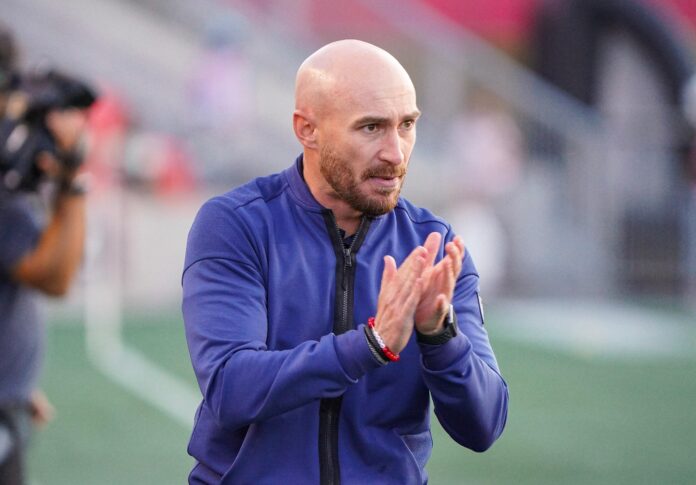
Carlos González, CPL Coach of the Year, leading Atlético Ottawa with passion and tactical clarity on the sidelines.
CPL Coach of the Year. Canadian Premier League regular-season champion. The architect behind Kuwait’s historic AFC U-23 qualification. A developer of future LaLiga stars at Atlético Madrid.
Few coaches in modern football embody adaptability and tactical intelligence like Carlos González. From transforming Atlético Ottawa into title contenders in Canada to guiding Kuwait to a historic milestone in Asia, and shaping elite players in Spain, González has built a global reputation as a coach who delivers both immediate results and long-term development.
Conquering Canada with Atlético Ottawa
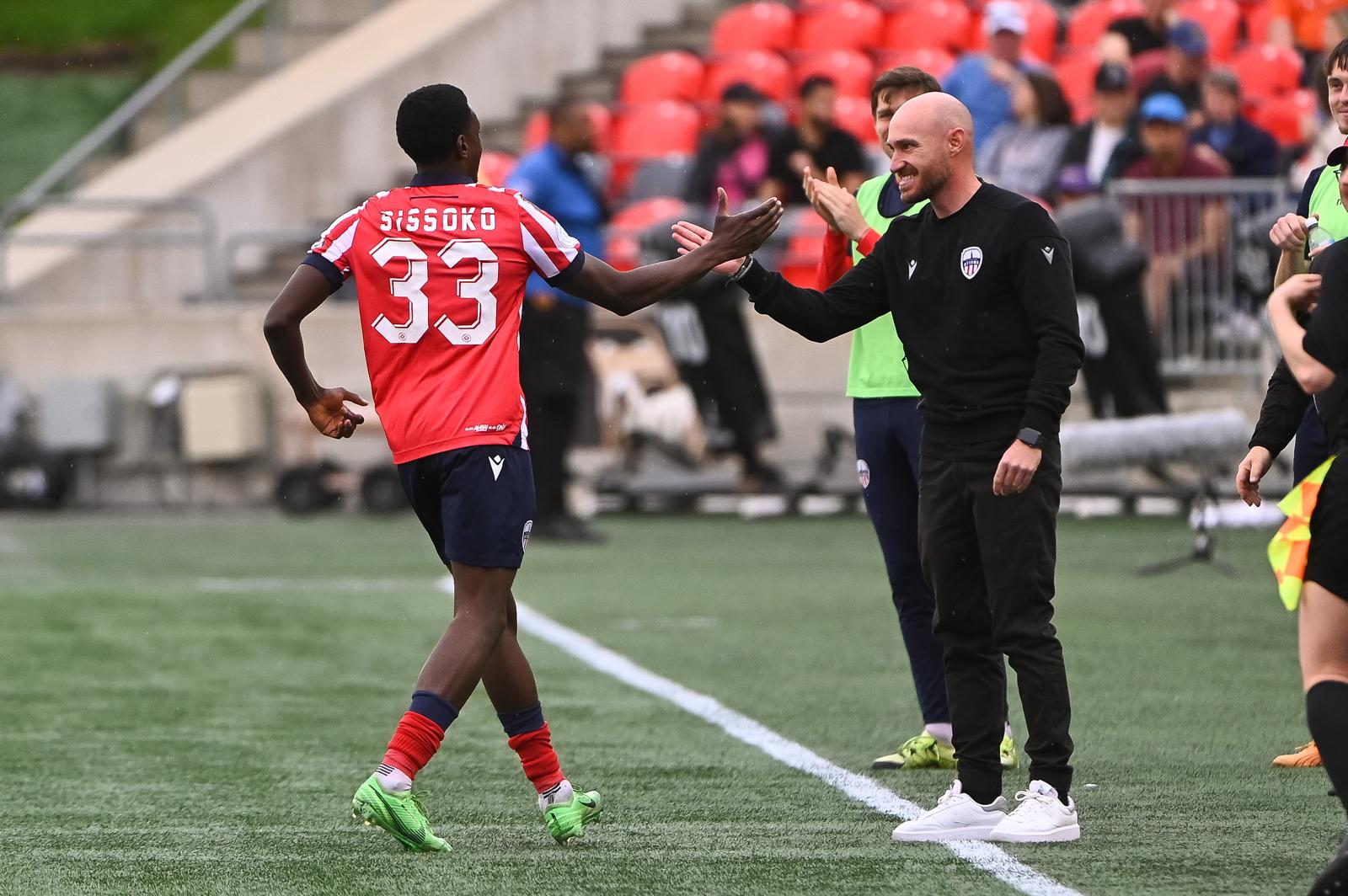
Carlos González shares a celebratory moment with Atlético Ottawa’s Aboubacar Sissoko during a CPL match.
In 2022, González crossed the Atlantic to lead Atlético Ottawa, a struggling team that finished last place the previous season, owned by Atlético Madrid. One season later, they were Canadian Premier League regular-season champions, and he was CPL Coach of the Year.
His success came down to what he calls the formula:
“Success = Talent + Work x Time.”
They built a balanced squad of youth and experience, implemented a flexible tactical identity, and created a culture of ambition and accountability. At home, Ottawa was proactive, dominating possession and controlling tempo. On the road, where travel distances and fatigue were major factors, his side became compact, disciplined, and deadly on the counterattack. This balance between principles and pragmatism defined Ottawa’s rise to the top.
González also emphasized player development within the collective framework. Young Canadian players thrived under his guidance, gaining confidence and technical improvement, while experienced internationals found renewed purpose in his system, resulting in a team that combined youthful energy, tactical structure, and competitive edge.
Kuwait: A Masterclass in Adaptability
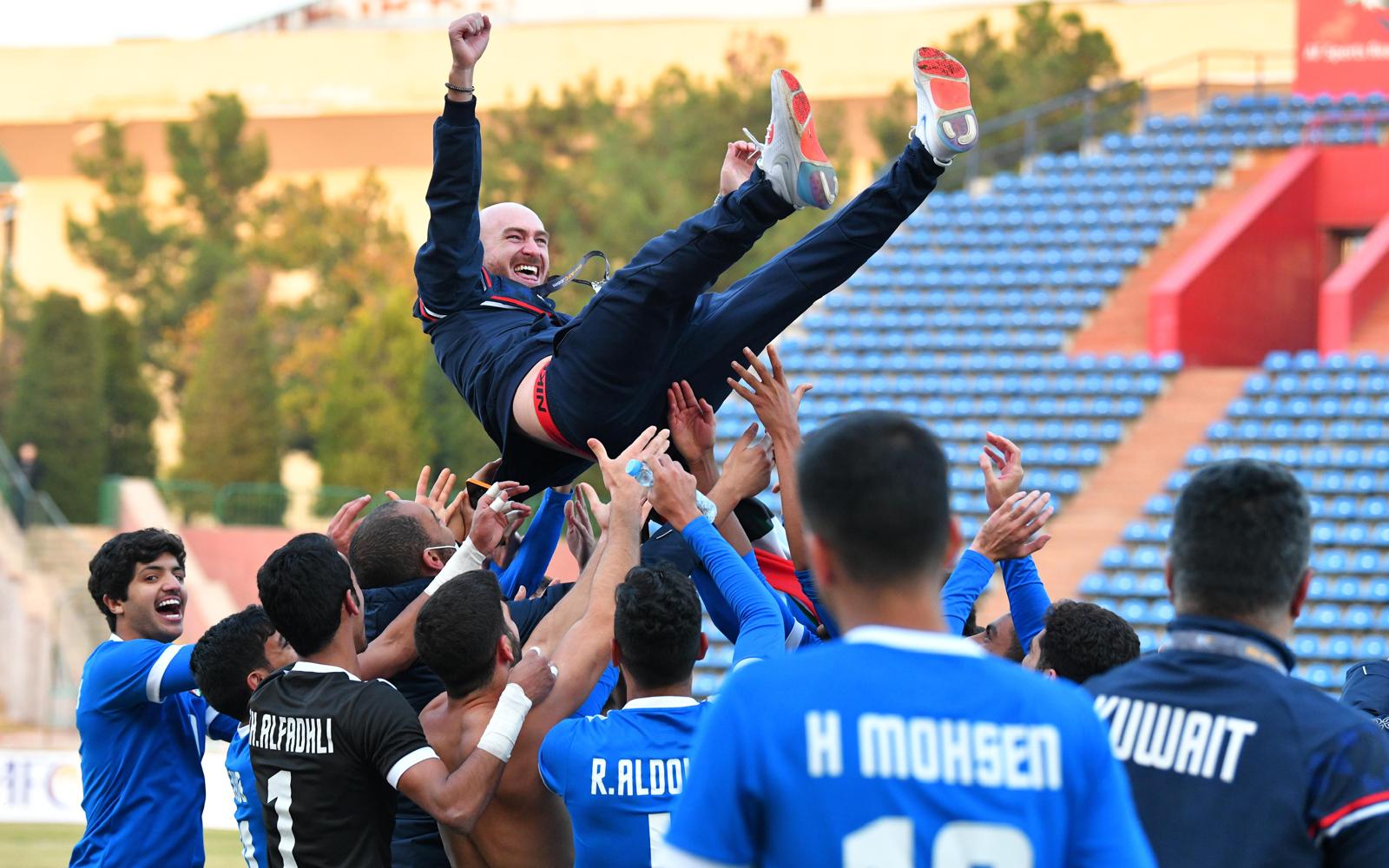
Carlos González is lifted by Kuwait U-23 players after leading the team to historic AFC U-23 Asian Cup qualification.
In 2021, González made a bold move: taking charge of Kuwait SC while simultaneously coaching the U-23 national team. His impact was immediate. Kuwait SC’s results improved dramatically, and the U-23s achieved a historic milestone, qualifying for the AFC U-23 Asian Cup and defeating Saudi Arabia for the first time in history.
Later, as interim senior national team coach, he faced European opposition in friendlies against Bosnia and the Czech Republic, gaining insights into the physical and tactical demands of top-tier international football.
“Adaptability is everything,” he reflects. “A good coach is someone who gets the best out of what they have in any context.”
Academic Foundation: Science Meets Tactics
Before stepping into professional coaching, González pursued Sports Science degrees at Alfonso X El Sabio University and the University of Granada. He also earned an RFEF degree in Fitness Coaching. This academic foundation became his competitive edge.
“Training in any sport involves teaching. Those years gave me the tools to develop a method aimed at improving teams both individually and collectively.”
His first professional role came at Rayo Vallecano, where he started applying those principles. It wasn’t long before his name was associated with some of Spain’s most prestigious youth academies
Developing LaLiga Talent at Málaga & Atlético Madrid
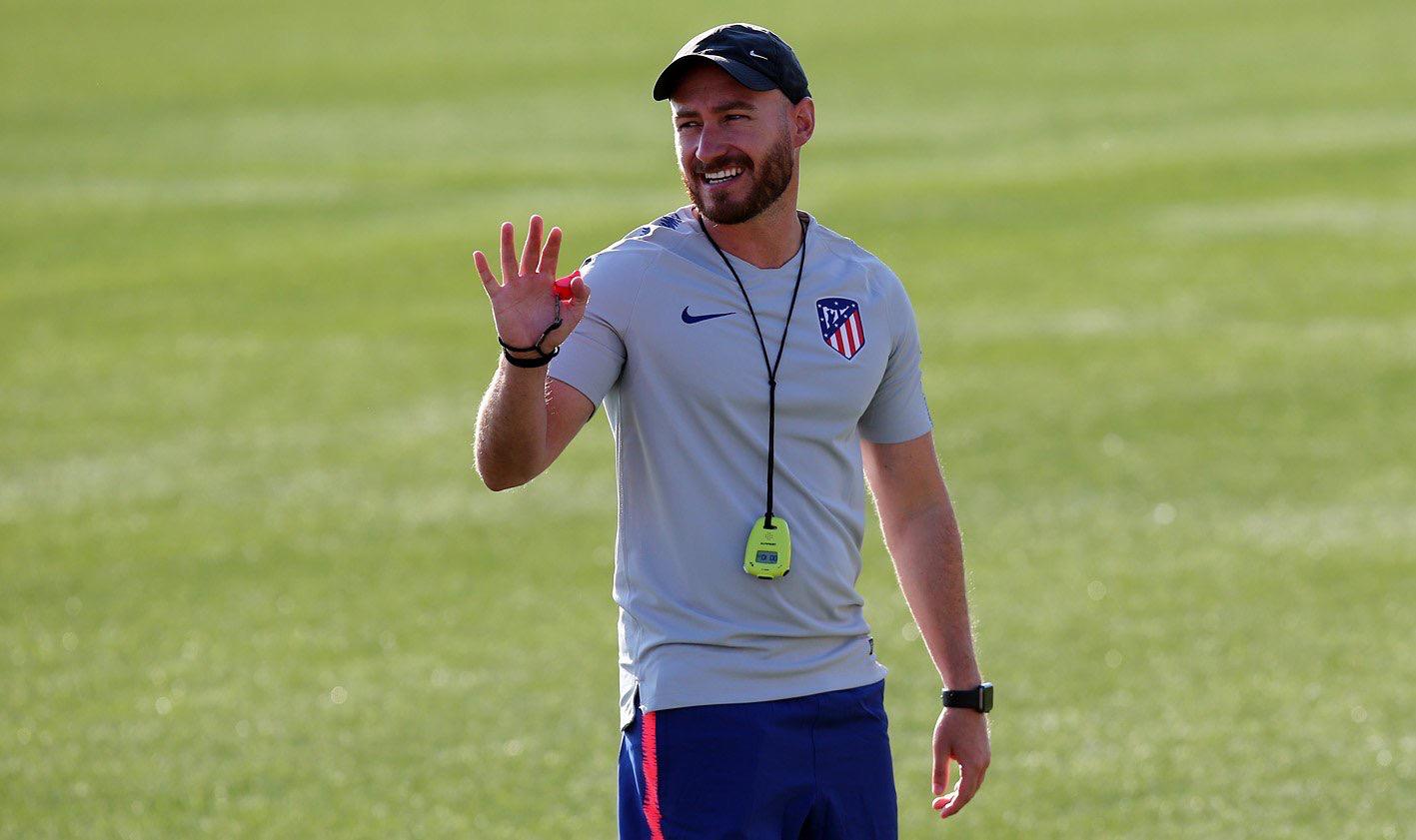
Carlos González on the training ground with Atlético Madrid’s academy, where he developed future LaLiga stars and built his coaching philosophy.
At Málaga CF, González worked under respected academy leaders like Manel Casanova and Francesc Arnau, learning high standards, discipline, and how to shape “street players” into structured, competitive professionals.
Then came Atlético Madrid, where González thrived in an environment that demanded excellence. Rising through the ranks, he adapted his philosophy to Atlético’s DNA: high pressing, intensity, and vertical play. His crowning achievement came with the U-19s, leading them to an undefeated league title and Copa del Rey final, all while promoting players who now feature in LaLiga.
“Bringing together a team with so much individual talent around the same goal was my proudest moment,” he says.
The Philosophy: Combinative, Vertical, and Player-Centric
González’s approach blends modern principles with pragmatism:
In possession: A combinative but vertical style, ensuring fluidity and unpredictability.
Out of possession: Aggressive pressing and compact defensive organization.
Adaptability: Systems tailored to the strengths of his players and the competitive context.
Crucially, González believes individual development drives team performance. “Once the team’s game philosophy is clear, excellence depends on improving players individually,” he says.
Global Perspective, Future Vision
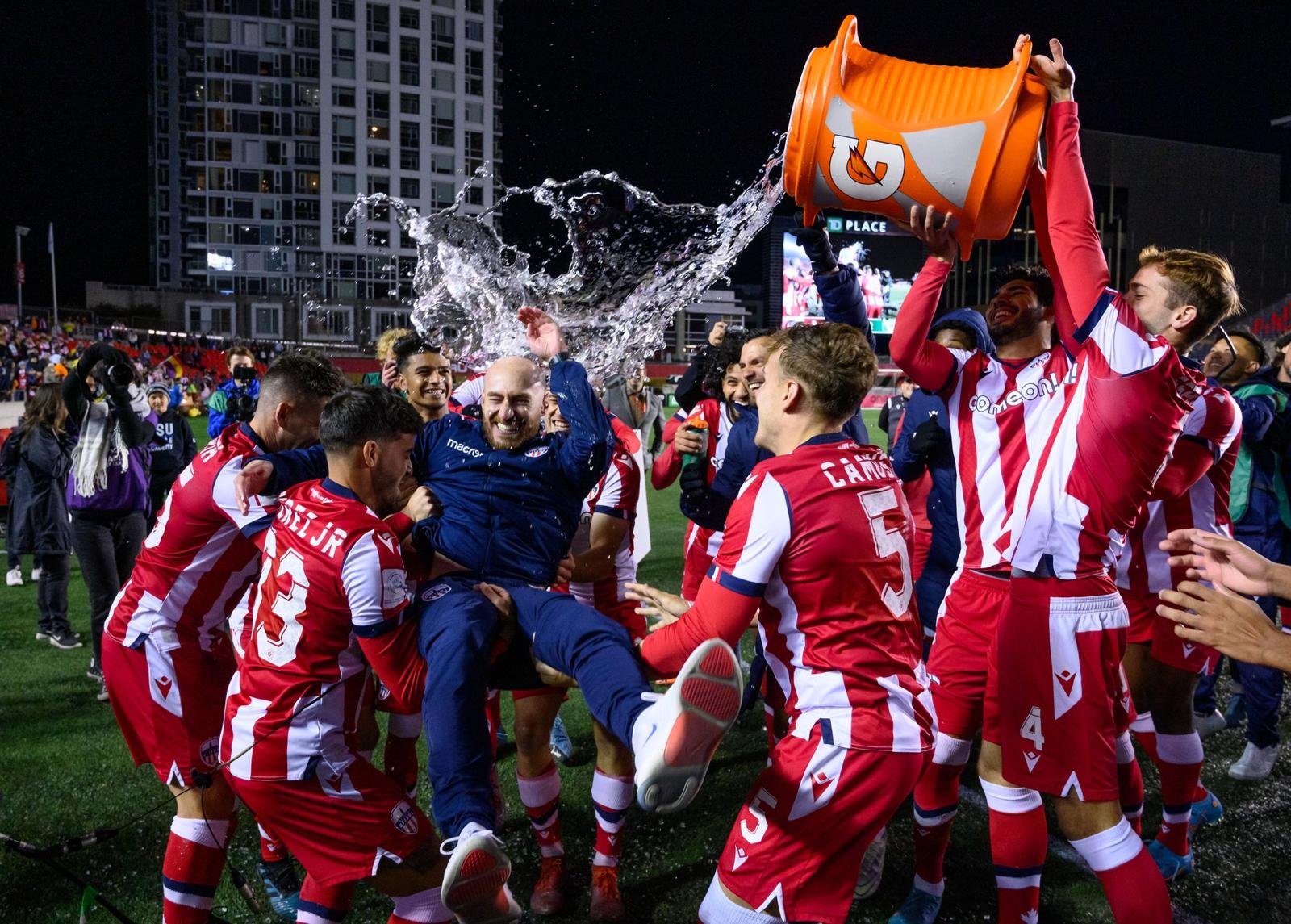
Carlos González celebrates with Atlético Ottawa after a landmark win, a moment that reflects his philosophy of combining ambition, adaptability, and collective spirit.
Having succeeded in Spain, the Middle East, and North America, González has mastered the art of cultural adaptation. “I always analyze what works locally and introduce my ideas without creating resistance,” he explains. Language skills and strong communication have been his key assets in bridging cultures.
Looking ahead, his ambition is clear:
“My goal is to embark on an ambitious project that challenges me and helps a club achieve great things. I’m not limited by geography; my methodology adapts anywhere.”
With a track record of winning titles, developing elite players, and transforming organizations, Carlos González is more than a coach, he’s a strategist, a builder, and a leader for the modern game.
Our Exclusive Interview with Carlos González
How did growing up in Granada influence your early passion for football and your eventual transition into management?
I was born and raised in a town on the coast of Granada (southern Spain) called Almuñécar, where there was a strong football culture. From a very young age, I started playing on the street, on the beach, at school and later in federated clubs, probably influenced by my father, who was passionate about the sport.
You pursued sport science studies at Alfonso X El Sabio University and the University of Granada. How have these academic experiences shaped your approach to coaching?
I believe that training in any sport involves teaching. It was during my time as a student that I began to develop my methodological and teaching skills. I had good teachers who worked with high-level athletes, and I soon began to put these skills into practice at Rayo Vallecano, where I started working. These studies gave me a solid foundation for developing a method aimed at improving my teams both individually and collectively.
What did you learn during your time at Málaga’s academy, and how did that environment prepare you for future roles?
Málaga was a period of great learning, where I took important steps in my formation, as the people who ran the academy were top experienced and proven professionals. Manel Casanova and Francesc Arnau gave me the opportunity to move from assistant to head coach, and Andrés Carrasco was a role model in many ways, especially in terms of discipline and high standards at work. Thanks to them and the working environment they created, I realized how to train players with the determination to win, as competing and the results are very important aspects in elite players formation. I also started to have a deeper understanding of the needs of the “street” player, how to help them better understand the game with the aim of exploiting their natural strengths more often during a match. Andalusia, and Málaga in particular, are still places where children continue to play football in the streets.
Can you walk us through your progression at Atlético Madrid’s academy and how you adapted to greater responsibilities?
At Atlético de Madrid, I felt at home from the start. It was a familiar city and a club with values that were deeply rooted in me, which accelerated all the processes and made me feel very comfortable at work.
The idea of football that I brought with me from Málaga was effectively adapted to the style of play at Atlético de Madrid, creating an intense and pressing style of football without the ball and a combinative but vertical style in attack that was in tune with the academy’s philosophy and the profile of players they wanted to develop for the club’s first team.
Emilio Gutierrez & Miguel Angel Ruiz (Academy Director & Sporting Director) quickly began to trust me to promote within the structure, while I helped, as part of the methodology department where the guidelines and working principles for all the teams were set.
Leading Atlético Madrid’s U-19s to the 2019 final was quite an achievement. What strategies or leadership tactics did you employ throughout that tournament, and how did you reflect on the final outcome?
It was an exceptional season. By creating a very demanding work environment, we managed to win the league (undefeated). This was against great rivals such as a great generation of Real Madrid players. We had a good run in the UEFA Youth League, and as you asked, we also reached the final of the Copa del Rey despite the large number of players who were unable to compete for a very good reason: to rest and prepare for the new pre-season with the first team. Without a doubt, the greatest achievement of that season for me was bringing together a team with so much individual talent around the same goal. We played great football, being brave and showing personality with the ball, but also being very ambitious in pressing and disciplined when we were losing. The vast majority of that generation now play at the highest level, and for me that is a greater source of pride than the trophies we won.
Your first senior role came with Kuwait SC in February 2021. What motivated you to take this bold step, and what were your initial objectives?
That’s right, and I was very clear about it. For me, it was a step with a great area of opportunity. The club requested my loan from the Kuwait FA while I remained in my position as U23 coach. They wanted me and the federation allowed it, so I took that step.
It was undoubtedly a great experience and personal challenge, taking over a team mid-season that was in a negative dynamic in terms of results and expectations, and at the same time testing my level by coaching and convincing experienced players. Those were very demanding months where we combined two FIFA dates with the national team while we were in charge of the club, but with great support from my staff, and good organisation, we were able to move everything forward. The club improved its dynamic significantly, remaining in contention for the title until the last two league games, and we later qualified the team in the group stage of the AFC Cup continental competition played in Jordan.
Simultaneously managing Kuwait SC’s first team and the U-23 national side must have been demanding. How did you manage priorities across both roles?
Absolutely, as I said, we were able to do it successfully thanks to having a high-caliber and relatively large staff, with some staying at the federation and others staying at the club. Only one of my assistants and I would go to the national team’s training camp for 10 days and do both jobs at the same time. My other assistant stayed at the club with the fitness coach and goalkeeping coach. The work carried out at the club during this period was mainly maintenance, as a large number of players from the squad were away with their national teams, which is why we left the work for this period planned prior to the FIFA breaks. At that point, the priority shifted to the national team, although without neglecting the work at the club.
At the end of those dates, we reversed the equation, and the club became the priority. For me, both occupations were very important, but we did pay more attention to the urgent matters, which were what we had at hand at any given moment.
You guided Kuwait’s U-23 squad to qualify for the 2022 Asian Cup final tournament. What were the key challenges and pivotal moments during that qualification campaign?
All houses are built from their foundations, and in this case, as a national team manager, the foundations are choosing the right players for the style of play that you believe will work in the context in which you are competing. There was a good generation of young players, and I believe we made the right choices in the selection process for what we were looking for. Convincing the federation that we had to play with a back three to get the most out of the team was not easy, as these systems were no longer in use in Kuwait.
In this type of group qualifying tournament, for me, you just must think about playing one match, the first one, as that is what will determine your mental state going into the next ones. That’s why we tried to instill in the team from the preparation phase onwards that they should only think about the match in front of them. And it worked. We beat Bangladesh, which gave us a big morale boost going into the match against the favorites, Saudi Arabia. We played a very intelligent second match, taking them where we wanted them to go, controlling the first half and creating a bit more chaos in the second half, where we were able to punish them when they took more risks. It was a historic milestone for the country, as it was only the second time in history that this had been achieved, and the first time we had beaten Saudi Arabia.
Your appointment as Kuwait’s senior national team coach came with a busy friendly schedule. How did those matches against the Czech Republic, Lithuania, and Libya help you assess the team’s development and your own adaptability?
It was certainly unexpected, but at the same time a huge opportunity in a very complex context. I think you touch on the key word in the question, which is “adaptability”. I see a good coach as someone who is able to get the best out of what they have in different working contexts, and for me, that is only possible if you are adaptive.
We took a continuity approach with the senior team, promoting some players from the U23s and backing them up with experienced players who were in great form with their clubs. This proved to be a good combination when it came to competing in the demanding matches we had. The first was against Bosnia and Herzegovina, and we put in an incredible performance, losing 1-0 at the end of the match but having chances to come away with a draw. The match against the Czech Republic was a reality check, highlighting the significant physical difference that still exists between top teams and countries such as Kuwait. We then played against teams of a more similar level, such as Lithuania and Libya, where the team showed periods of dominance, and we were very satisfied with the level of play.
On February 24, 2022, you became head coach of Atlético Ottawa, a team owned by Atlético Madrid. What drew you to this role, and how did the club’s philosophy resonate with your own managerial outlook?
I felt very comfortable in Kuwait, but the truth was that I often missed the day-to-day work with a team, having the ability to improve a player and evolve the team throughout the week, and as a national team coach, I didn’t have that.
Several aspects of this proposal attracted me. First, of course, where I came from (Atlético Madrid). And second, the great challenge it would entail in turning around a project that wasn’t achieving the expected results.
After accepting the proposal and analyzing the problems the team was having, the competitive environment we were in, and, above all, examples of successful teams there, we opted for an idea that would allow us to be competitive in every game and get us closer to winning.
Maintaining the essence of vertical football, given the profile of the athleticism of Canadian players, we wanted to be a team that handled different resources depending on where we played or the moments of the game we were in. At home, we were more proactive with and without the ball, taking risks in many situations. And away from home, mainly due to the handicap of long journeys and the muscle fatigue they caused, we opted to be more reactive, conceding very little and moving forward to counterattack as soon as possible.
Leading the team to first place in the Canadian Premier League’s regular season and earning CPL Coach of the Year honors, what were the reasons behind that stellar campaign?
I think many things were done well that season, of course the design of the squad. It was balanced in terms of youth and experience, not too long (everyone committed and involved), and complete in terms of player profile to meet all the team’s needs and demands throughout the season.
For me, and based on my experience, you’re usually near to win when you follow this formula, “the formula for success”: Success = T+WxT. The first T stands for “Talent”, and in that squad there was definitely; W, for “Work”, the idea, and the ability to convince players with the philosophy of work and football we conveyed on the field; and finally, the T for “Time”… prolonging that idea and work over the months, and that can only be achieved if there’s hunger and ambition in the group. This team had all of that throughout the year, a great talented group of players who bought into the idea and the working method we proposed and who showed great ambition as the weeks went by.
How would you describe your overall chapter in the Canadian Premier League?
I think we can rate this stage as a high or outstanding achievement. We were entrusted with bringing Atlético Ottawa to the level of the best clubs in Canada, and we did so, in both the most visible aspects (results) and the lesser-known aspects (protocols, work processes, professional working context, etc.). I think that, of course, together with Fernando López, the great reference of that project, and Canito from a distance, we were able to help create a very solid foundation for the club to continue competing for great things in the future.
On a personal level, it has been a stage I will always remember with a smile, as I only take away positive things. I believe that working abroad, both in Kuwait and Canada, has made me a much better coach, not only because of the language challenge but also because of my ability to adapt to different cultures and work environments. I see this as a differentiating factor for my professional future.
Across your roles, from youth setups to senior teams, how has your tactical philosophy evolved? Do your methods/ philosophies need to change with different age groups and countries?
Of course, my approach to football has evolved, and I consider myself a much more versatile and adaptable coach than I was during my formative years at Málaga and Atlético Madrid.
Back then, I stuck to classic formations such as 1-4-4-2 or 1-4-3-3, which I used to maintain in both offensive and defensive phases. Throughout my evolution to the present day, I have used a multitude of systems, adapting them to the strengths of the players we had. I believe that in order to perform well, it is essential to position players in a way that facilitates their performance, where they can show their strengths more naturally.
Today, I seek to ensure that, from a starting position, our attack is fluid and dynamic in order to be less predictable and better able to attack our opponents’ weak points. The main premise is to always occupy certain mandatory spaces, so that we can threaten the opponent between the lines (base and pockets) while also threatening in width and, of course, depth.
All this while maintaining a style of play that I identify with most: combinative but vertical play, being a pressing team when we lose the ball and compact once we are overtaken. I believe that the key as a coach is to provide your team with the tools to be highly competitive and able to win games in different ways.
Working with youth players and national squads, how do you prioritise individual development alongside team performance?
I believe that the margin for improvement for a footballer as a national team coach is minimal; a national team coach is a performance maximiser. You have little time, and you are looking for immediate collective results. Of course, you can have a small impact on the player and help them with some details that could potentially improve them, but you lack time and process.
As a club coach, you do have that time, especially in the pre-season, to lay the foundations for the player’s development. We usually create a strategy for their individual improvement, both in terms of understanding the game (based on our model) and understanding and demands of their position, and of course technical and physical improvement.
I firmly believe that much of a team’s improvement comes from individual development. Once the team has an established game plan, executing it correctly or doing so in an excellent manner will come down to the individual development you have achieved in the different players and the internal competition that this generates on a daily basis.
You have coached and developed many great Laliga players. What qualities did you see from the top professional players compared to a regular academy player?
Individual talent, whether offensive or defensive, and the audacity to execute it regardless of who you are facing, therefore mentality. All the players I have coached and seen evolve to the top level have one or more abilities that make them stand out when facing teammates and opponents at their level.
But those who really make it and establish themselves are the ones who break down doors, that is, those who are promoted for their abilities and continue to demonstrate them in much more demanding contexts. Whether it is when they train at higher levels, but especially when they compete in categories above those they are supposed to be in.
That is why I believe in the rapid promotion of players, as this will improve their speed of decision-making and execution when they are involved in the game.
How do you balance the strategic demands of club ownership (e.g., Atlético Madrid in Ottawa) with the on-field realities and player capabilities?
At the end of the day, when you start a new project, you have some goals set from the top down, and other process goals that you set yourself on a day-to-day basis. In my opinion, both should be ambitious but realistic, so that once you’ve completed the cycle, all or most of them have been achieved. I sincerely believe that this is the only way you can leave feeling satisfied with the work done.
For a project to work, I believe in transparency to communicate those goals from the board to the players, and that all the pieces of the machine are aligned from day one so you know where the club wants to go. Fortunately, I’ve achieved success in every project I’ve been involved in, and for that, it’s essential not only to have tools that match the goal but also an ambitious mindset and a focus on the here and now.
You’ve worked in diverse environments such as Spain, Kuwait, Canada. What have been the biggest cultural and professional adjustments, and what skills did they help you cultivate?
The changes or differences I’ve experienced in these three different continents have been substantial, ranging from religion, language, climate, food, or even Football styles.
To do this, the most important thing for me has been to analyse what worked in the place I’ve been, and how to introduce my idea and method without making abrupt changes that would provoke rejection. Knowing what I wanted to do and executing it while adapting to the environment I found myself in.
To do this, the skill that has undoubtedly helped me the most has, of course, been my language skills and the ability to communicate and convey my message.
Looking ahead, are you aiming to return to Europe, continue exploring international roles, or pursue projects in emerging leagues?
My goal is to embark on an ambitious project that will help me continue to advance and grow in my professional career, where I can face new challenges and help the club achieve its objectives.
I am not closed off geographically, as I believe that my personality and methodology can be adapted to different cultures and working contexts.
The number of Japanese players moving to Europe has been growing, and it doesn’t look like it will be slowing down anytime soon. The question I look to answer is one of developmental factors for a player looking to make their move into Europe. What does the journey to the topflight of European football look like for a Japanese player?
The export model/transfer window of Japanese football
When does the Japanese transfer window open and is it different to the rest of the Europe?
Currently the Japanese transfer window (player registration period) opens in two main periods. One in the winter and another in the Summer. The Winter period opened this year from January 20th, 2025, to March 6th ,2025. It opens very close after the end of its previous season and the market is often overloaded with many players looking to find a move to a new club.
The January transfer window is notoriously hard for deals to be struck. Most major European leagues will have clubs looking to strengthen their squad to help with a final push to the end of the season. This makes it hard for transfers to be made between Japan and the major European leagues, as many European clubs may not favor taking major risks on players which they feel are not proven within the level of competition, they are playing in. However, for Japanese clubs it can be the best time to shift their players as it gives them time to organize and prepare their squad as best as possible for the new season.
The summer transfer window (player registration period) opens from July 7th, 2025, to August 20th, 2025. With the Japanese season being in progress during this time.
The J league and JFA both often encourage, and support overseas moves to help with the national team development.
Major changes are now coming to the timings of Japanese football and the transfer market
The J. League is moving the timings of the transfer window to be better in line with the timings of the rest of Europe. This transition will start in the 2026/2027 season where the season will begin approximately in the first week of August 2026, with a winter break from the second week in December to around the third week of February 2027. The season would then end in the final week of May 2027. The decision is of great significance and are a major opportunity for growth.
“We’ve come to a conclusion that it’s necessary to implement the change in order to compete in global markets” said J. League Chairman Yoshikazu Nonomura.
With the Season now expected to be in line with the rest of Europe it shifts the timings of the opening and closing of both the Summer and Winter transfer windows as well. This opens many more doors to Japanese players looking for a club in the rest of Europe as it combats the reason which previously were halting the progress of a transfer for Japanese players to the Major European leagues. It gives players time to settle in with their new club and to follow the same process of preparation for the upcoming season. There will also be less Japanese players scattering to look for a club during the Winter transfer window because of the previous season ending shortly before it and more players will have better opportunities to look for a transfer abroad once their season ends.
Best European Leagues for importing Japanese talent
Belgium – With over 40+ players moving from Japan to Belgium since 2018/2019 it is important to understand the reasons behind a such figure. Belgium is seen as an attractive league within Europe which can help boost the development of a player’s career in Europe with a track record to prove it.
The platform that Belgium provides cannot be understated. Its legal accessibility is a highly influential factor, as well as the impact which Sint-Truidnese has played in providing a platform, through its Japanese ownership.
So, let us break it down, Belgium’s clear legal pathway (Work Permit system)
The minimum age requirement: 18
For a non-EU professional athlete, they will need a single permit. This permit is valid for one year and is specific to the employer.
The single permit combines: Work authorization (Work Permit Type B) + Residence authorization (Long stay visa/residence permit)
In addition to the clear legal pathway Belgium holds a relatively low salary threshold in respect to other European countries. This makes it a viable option for Belgian clubs to be able to afford the recruitment of Japanese players. The salary threshold can be dependent of the region and as of January 1st, 2025, these are the thresholds.
Flemish Region: €101,019 per year
Brussels Region: €88,320 per year
Walloon Region: €51,613 per year
Analyzing success coming out of Belgium
When analysing the success of Belgium as an export country for Japanese players it is clear to see that it is a highly popular location for Japanese talent to make their first step into Europe and break the first deadlock out of the J League (60%). It can help with being development focused and a great opportunity as a stepping stone into European football.
However, from the second Graph it is hard to suggest that the visibility and level of the Belgian Pro League is enough to earn a player a direct move into the highest stage of European football. Therefore, the Belgian Pro League might be better used effectively, as a place to loan out talent.
Successful players who have followed the path from a J League team, directly to Belgium as their first European club can be seen in the likes of players such as Takehiro Tomiyasu and Wataru Endo. Therefore, the opportunity is certainly there for players to make a successful direct move to the top of European football from the Belgian Pro League.
Whilst European clubs who have bought talent from Japan and sent them out on loan to get a taste of European football is evident and have arguably had a higher success rate with the likes of Kaoru Mitoma and Daichi Kamada.
Mitoma was bought by Brighton from Kawaski Frontale and then sent on loan that season to Union SG. He then returned after his loan spell to Brighton where he had a groundbreaking following season.
The presence of Japanese ownership at Sint-Truidense
Sint-Truidense undoubtably plays a significant role in providing a clear pathway for Japanese players into Europe with its Japanese ownership. Sint-Truidense is majority-owned by the Japanese e-commerce company DMM.com. This ownership, led by CEO Takayuki Tateshi, has allowed its management to shift its transfer profile towards developing Japanese players into Europe.
Through the platform Sint-Truidnese has been able to provide it has also helped elevate the perception of Japanese footballers in Europe and especially towards other Belgian clubs to recruit. Growing the popularity of Japanese players into Belgium and contributing to the reason for such high figures as previously seen in the data.
Belgium as a location
On a more human level, Sint-Truiden and many other Belgian cities can be a suitable location for Japanese players to settle down and adapt. It is near Düsseldorf which is seen as a “little Tokyo,” having one of the largest Japanese communities in Europe. With players knowing it can find comfort nearby it makes many Belgian clubs an attractive choice for players and their families.
Germany – Bundesliga
The Bundesliga has always been a consistent location for Japanese talents to make a name for themselves.
Why? – Tactical similarities – The Bundesliga is often seen as a high-pressing, technical league which requires discipline. Traits which are carried and instilled throughout Japanese players from a young age.
Having played in Japan myself, I can say the attention to technical detail cannot be understated. Especially as Japanese are not seen to have an extremely physical template, every technical detail helps with giving themselves an edge over their opponent.
A positive track record – With an abundance of talent having already played in the Bundesliga it only helps to grow trust for clubs. Players such as Yasuhiko Okudera and Shinji Kagawa have proven that Japanese players can thrive in Germany.
Looking past the performances on the pitch
A simple legal framework – Germany possesses a relatively accessible pathway for non-EU players. Professional athletes are often fast tracked for a residency permit as they fall within a special category.
The wage threshold is not publicly fixed for athletes however the wages must reflect a ‘comparable domestic wage’ which tends to be easy to overcome as an average salary in the Bundesliga can range often between Often €500K – €2M+
Why is the Bundesliga not used more?
Compared to the Belgian Pro League, the figures above may seem small. With such a clear legal pathway and substantial amounts of success in the past, why is the Bundesliga not used more commonly compared to Belgian Pro League This can be attributed to a few factors. The Bundesliga is seen as less of a developmental league compared to the Belgian Pro League; therefore, players who do arrive would want to be closer to the ‘finished product’ with a substantial amount of European experience under their belt. Hence, only 23% (3 Players) have made the move directly from the J-League to the Bundesliga since 2018/2019. The Bundesliga can be seen to buy Japanese players who lack European experience and loan them out to Belgium (as seen by Wataru Endo and Daichi Kamada).
Providing a great gateway for Japanese players to get to the top of the European game, such as the Premier League. Acting as the ‘middle ground’ between a lower European league such as the Belgian Pro League and the top of European football.
Some of the most well-known and successful Japanese players have played in the Bundesliga:
Shinji Kagawa – Borrusia Dortmund → Manchester United
The best pathway to the Premier League and the topflight?
The ever-growing numbers of Japanese players in the Championship has put Japan as the 15th largest nationality in the Championship as of the 2024/2025 season. This makes it hard to ignore, raising questions on why such a sudden shift.
Improved access into the UK (Work Permit) ESC+GBE
Are Championship clubs becoming more effective in recruitment through ESC and GBE methods?
Primarily the GBE is a great path when recruiting established Japanese talent especially within the Japan national senior team.
The J League is a Tier 5 League (6 points for regular starting minutes towards GBE)
The Japan national team is well ranked (usually within top 20 – top 30 global therefore usually significant/automatic qualification for a national team player)
Continental competitions (AFC Champions League) add points
Rewards players from clubs who qualify for the AFC Champions League
Through the data seen above, the steep increase in popularity of Japanese players in the championship is evident and I believe the numbers will continue to increase. (As of July 24th, 2025, the number of Japanese players has increased further to 9). However, a young Japanese player without a senior national team appearance may struggle to qualify for a GBE.
Example of a typical j league player
METRIC
GBE POINTS
Regular starter in J1 (Band 5)
4 Pts
AFC Champions League appearances
3 Pts
U23 national team caps
2 Pts
Total
9Pts
The player is just under the 15pts required for a GBE therefore, the ESC route could be taken for approval.
The ESC route:
ESC Criteria
Played in at least one competitive youth or senior international match for a FIFA top 50 ranked nation (Qualififes for Japan NT)
Played in at least one continental youth or senior competition match
Played in at least five domestic youth or senior competition matches
*All of the domestic clauses require the club to be in Band 1-5* (Which the J-League qualifies for)
Although ESC allows a route in, the ESC Conversion still means that for Under 21 and 21 and over ESC players are still required to play 50% of available minutes to makes the ESC conversion in the Championship
This makes the routes for Japanese players entering the UK still accesible compared to the past however, the key still remains to find the balance between recruitment and available minutes + finding ESC strategies such as using the player for on loan.
Player
Club (2024-2025)
Arrival Source
Likely entry route (ESC or GBE?)
Ao Tanaka
Leeds United
Joining from Fortuna Düsseldorf
GBE
International Senior Appearances + Played sufficient minutes in Europe – Bundesliga 2 (Band 4 league)
Yuki Ohashi
Blackburn Rovers
From Sanfrecce Hiroshima
ESC (direct from J1, no senior caps with national team at time of transfer)
Tatsuhiro Sakamoto
Coventry City
From Cerezo Osaka
GBE- Played in Belgium Pro League (Band 2 League) with sufficient minutes
Yu Hirakawa
Bristol City
From Machida Zelvia → Loan → Permenant
ESC – Direct from J1 + no senior international caps at time of transfer
Ryo Hatsuse
Sheffield Wednesday
From Vissel Kobe
ESC – Direct from J1 + Continental Competition experience → still short of 15 points
Tomoki Iwata
Birmingham City
From Celtic
ESC – played for Celtic, with no senior national team experience
Iwata likely still falls short
Tatsuki Seko
Stoke City
From Kawasaki Frontale
ESC – No international caps → J1 + ACL experience not enough for GBE
Results here show how important the ESC has become to provide a route in for young/unproven japanese talents to be given the opportunity to solidify their place as an established Japanese talent in a league like the Championship
Best pathway for players to the top of European football?
The Championship is arguably one of the most competitive second divisions in the world, often considered just below the top European Leagues in intensity and quality.
This means indirect visibility is present from scouts from the Bundesliga and most other top European leagues including the Premier League.
For players joining a Championship club with the goal of promotion it can be a direct way into the Premier League.
Increased Scouting & Agent Networks
With the growing reputation for Japanese players and the demand increasing clubs have made sure to strengthen scouting networks for Japan.
Examples: Manchester City & Yokohama F. Marinos and clubs liked Red Bull are investing in intergrating a club such as Omiya Ardija into their global network.
As the demand continues to grow the desire for agents to obtain clients in Japan would be high. European agents will want to bring the connections between their clients and European clubs. Increasing the visibility of their client and being able to help them push for a move into at times.
The Japanese culture
The values often attributed to Japanese players are those of – humility, hard work and discipline. Often key attributes that clubs look for in a player. They are often seen as value players who don’t rock the boat and can have good acceptance into dressing rooms quickly.
The Japanese culture is something which is a positive for every club looking for a player, as they know they have a player whom they can trust to give their best everyday. With recent track records to prove it the fact is undeniable.
Japanese media & Marketing potential
Japanese players bring media attention and marketing values that English clubs can’t ignore. Even in the Championship, there’s money to be made from Japan’s domestic fan base, especially if the player has connections with the Japan National team. Asian broadcasting rights, merchandise sales, and preseason tours are some large ways in which they bring value.
Pre-season fixtures this summer:
Liverpool FC – (Have Japanese player in Wataru Endo)
Tottenham Hotspur – (Just signed Kota Takai)
Borussia Dortmund – (Strong connections in the past with Japanese players – Shinji Kagawa)
These are just a few of the teams looking to play preseason games in Japan this summer. With links to Japanese players for many clubs it can be a vital selling point in making a successful preseason tour in Japan. This can be a driving point for Championship teams to create a stronger connection with the marketing potential of Japan, especially for the future opportunities which may arise with preseason tours and additional sponsorship deals.
Conclusion
I hope my article has helped you to better understand how the market for Japanese players can best operate for Japanese talents to develop and fulfill their maximum potential. Understanding patterns and structures can be a simple way to do so. However, at the end of the day every career is unique and will be different. There is no set path to success but understanding how it has been achieved in the past is a starting point, to be able to best maximize a player’s career and avoid any obvious developmental mistakes.
The Premier League (PL) has made the US and Canada a top priority as it expands globally. With tens of millions of soccer fans across the region, the league has adopted a multi-pronged approach combining media rights, corporate partnerships, live events, and localized content. This integrated strategy has driven record TV audiences and strong fan engagement. During the 2023–24 season, NBC averaged about 546,000 viewers per broadcast, with a March 2024 match between Manchester United and Liverpool drawing 1.78 million viewers, the largest American audience for any PL game.
Key Initiatives (2021 to 2025):
2021 – NBC Rights Renewal: NBCUniversal secured exclusive English- and Spanish-language TV and streaming rights in the US through the 2027–28 season. In November 2021, it signed a six-year extension worth approximately £2 billion ($2.7 billion), covering all 380 matches per season across NBC, NBC Sports, USA Network, Peacock, and Telemundo.
2022 – Canada Streaming Deal: Premier League rights in Canada moved to Fubo for the 2022–23 season. In April 2025, the agreement was extended through 2028, ensuring that all matches and studio shows remain on the platform.
2023 – US Preseason (Summer Series): The PL launched its first official US preseason tournament in July 2023. Six clubs played eight games across five cities, using major stadiums like MetLife and Lincoln Financial Field. The series was designed to deepen local fan connections.
2023 – Digital and Social Expansion: The league introduced localized content through dedicated accounts like Premier League USA and provided broadcasters with customized highlights and clips for North American audiences. NBC and other partners integrated these assets into studio programming and social campaigns.
2024 – Fan Festivals (Mornings Live): The PL and NBC hosted large-scale match weekend events in major US cities. In April 2024, the Nashville edition of Premier League Mornings Live attracted around 15,500 fans. Over nine events since 2018, nearly 90,000 fans have attended.
2024 – Viewership Records: NBC averaged about 546,000 viewers per match during the 2023–24 season. On May 19, 2024, Championship Sunday averaged 2.9 million viewers. The United vs Liverpool match on April 7, 2024, drew 1.78 million, setting a new US record. Peacock’s exclusive games averaged over 800,000 viewers.
2024 – Club US Tours: Around half of PL clubs toured the US in summer 2024. Liverpool, Arsenal, Manchester United, and others played high-profile friendlies, often against each other or European teams, drawing strong local interest.
2025 – Summer Series (Second Edition): Scheduled from July 26 to August 3, 2025, the second Summer Series will feature Bournemouth, Everton, Manchester United, and West Ham playing six matches in New Jersey, Chicago, and Atlanta. Tickets were sold via Ticketmaster, and NBC Sports will broadcast the games.
2025 – New Sponsorship Deals: The league signed major North American-focused sponsors. Coca-Cola returned as the Official Soft Drink Partner starting in 2025–26, promoting multiple brands like Coke Zero and Powerade. PUMA replaced Nike as the Official Ball Supplier and will support marketing and community programs. Other partners such as EA Sports, Guinness, Microsoft, and Oracle continue to be prominently featured at US events.
2025 – Hispanic Market and Localization: Telemundo retains exclusive Spanish-language rights through 2028. By aligning content with cultural preferences and broadcasting in prime time, the league continues to grow its Hispanic audience. Social content is also tailored for regional languages and tastes.
Media Rights and Broadcasting
At the heart of the North America strategy are broadcast and streaming deals. NBCUniversal has held Premier League rights since 2013 and renewed them in 2021 through 2028. This deal covers all matches, shown across NBC platforms including Peacock. It also includes exclusive Spanish-language rights via Telemundo and Universo. In Canada, Fubo took over from previous carriers in 2022 and extended its deal through 2028.
These arrangements ensure near-total market reach. NBC’s platforms make the league accessible to nearly every American household with cable or broadband. Studio shows like Premier League Mornings and consistent match coverage have helped boost visibility. Average viewership grew 4 percent in 2023–24, and even mid-level matchups on Peacock regularly drew more than 800,000 viewers. Telemundo also reported strong growth, averaging around 244,000 viewers per match. In Canada, Fubo offers both English and French commentary and has become the go-to streaming service for soccer.
Commercial Partnerships and Fan Engagement
The league has activated a robust sponsorship network tailored to the US market. Brands like EA Sports, Coca-Cola, Microsoft Azure, and Guinness leverage the league’s reach across digital, broadcast, and live events. At the Nashville fan fest, sponsor booths provided immersive experiences: Nike hosted an agility challenge, EA Sports presented FC24, and Coca-Cola ran branded fan zones.
The new Coca-Cola agreement emphasizes engagement across multiple product lines, with fan-focused campaigns and giveaways. PUMA’s involvement as a ball supplier includes community programs in US cities. Sponsorship activations often include youth clinics, contests, and charity events. These efforts go beyond traditional branding to deliver hands-on experiences that deepen fan loyalty and enhance sponsor ROI.
Fan Events and Tours
Live experiences are central to the PL’s fan outreach. The Premier League Mornings Live series has brought free matchday events to major cities. These feature big screens, club legends, trophies, sponsor booths, and entertainment, turning match viewing into a full-day festival. By April 2024, nine events had attracted nearly 90,000 attendees.
Preseason tours expand this momentum. The 2023 Summer Series introduced PL teams to new American audiences. In 2024, roughly half of the league’s clubs returned, playing friendlies against one another, MLS sides, and international teams. Fans had rare opportunities to see top players in person. Clubs also organized youth clinics, local promotions, and trophy tours to build year-round engagement.
Localized Content and Digital Reach
The Premier League has tailored its content for the North American market. Broadcasts emphasize US-relevant narratives and offer commentary that guides newer fans through the season. Social media channels like Premier League USA share regionally timed content, memes, and highlights. Features include American players, USMNT references, and cross-league comparisons that appeal to US viewers. Spanish-speaking audiences are reached via Telemundo’s programming and additional NBCUniversal content.
These efforts have helped cement the Premier League as the top European soccer league in North America. By 2025, its mix of media deals, sponsorships, fan events, and localized digital content is delivering record engagement. The expanding US fan base offers a valuable platform for both clubs and commercial partners, making North America one of the Premier League’s most strategically important regions.