

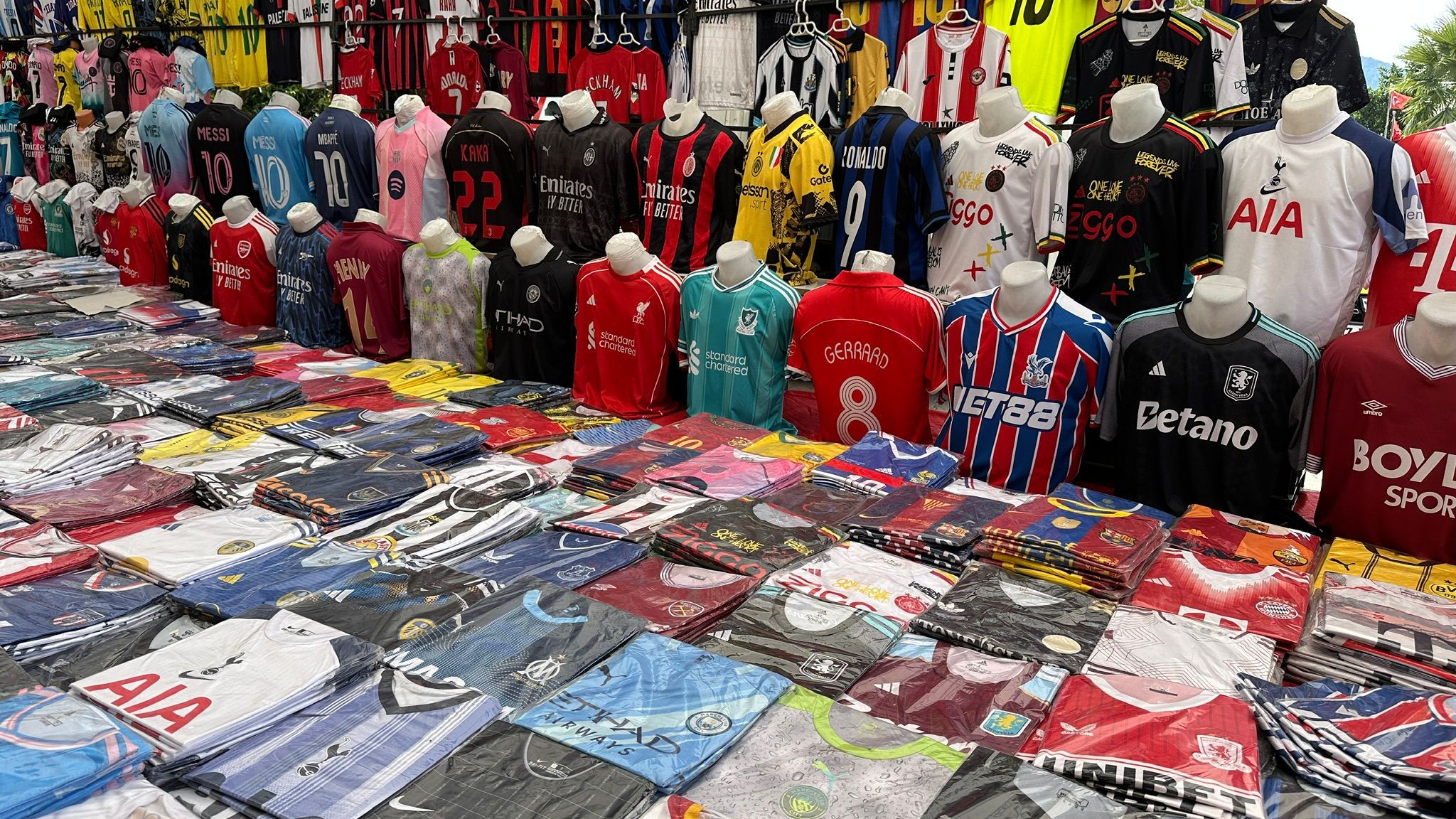
The Secret Power of Jerseys
Sometimes, when you go to a football match, as you walk along that pathway illuminated with stylish lights toward the stands, a cool breeze lifts your shirt. A strange excitement fills you; the moment you feel it, your body has already begun releasing dopamine for the match that will start in just minutes.
As you climb the stands searching for your seat, fragments of predictions about the game from people who don’t know each other reach your ears. You compare their thoughts with your own and take your place with a calm seriousness. As you scan your surroundings, what you feel is generally hopeful and positive: peace, happiness, a measured ambition, and equality…
Yes, in that moment, you feel equal to everyone around you. You can analyze the match with a Harvard-educated physicist sitting next to you, even convince them of your ideas and savor a subtle sense of victory. Now, you are someone who has “defeated” a Harvard physicist (what the topic was doesn’t matter).
That’s football… It equalizes people; it grants them the right to converse, argue, connect, and even exchange insults, though not always approved, regardless of status. With all its positives and negatives, you are equal: with the players on the pitch, the coach, the security staff, the announcers… You are equal.
But of course, there are things where you are not equal; things whose presence you cannot ignore at that moment… Your lives, your talents, the teams you support, and your clothing. Yes, your clothing.
While you sweat your passion in the stands, your cotton t-shirt begins to grow heavy and cling to your skin. Yet for the 22 players on the field, the situation is entirely different. What is a symbol of belonging for you is, for them, an engineering masterpiece developed in laboratory conditions. And right at that point, the sense of equality felt in the stands gives way to technological superiority on the pitch.
So how can a piece of fabric determine a player’s destiny?
So how can a piece of fabric determine a player’s destiny?
The history of football dates back to 300 BC. Since then, it has constantly evolved, eventually taking a form that captivated the masses and secured an almost unshakable throne among sports. Once things reached this level of seriousness, experts began evaluating every possible factor that could enhance a player’s performance.
Research has shown that those stylish jerseys worn in football possess significant potential power within the game, from their color to the very fibers they are made of.
Research has shown that those stylish jerseys worn in football possess significant potential power within the game, from their color to the very fibers they are made of.
At that point, massive investments were made into jerseys, fully leveraging the benefits of advancing technology. Nanotechnological fibers, surfaces that evaporate sweat in less than a second, and textures that reduce friction almost to zero have transformed the jersey from a simple garment into an engineering product that optimizes athletic performance.
How a player benefits from their jersey on the field:
Kinetic Energy and Aerodynamic Drag:
As the player accelerates toward the penalty area, a defender desperately tries to grab their jersey. However, the “slim-fit” design eliminates excess surface area, minimizing friction and leaving nothing to grasp. Proven in wind tunnel tests, this aerodynamic structure reduces air resistance, preserving the mechanical energy expended during sprinting. As the defender’s fingers slip across the fabric, the player continues forward without losing momentum.
Thermoregulation and Evaporative Cooling:
During a sprint, the player’s body temperature rises rapidly. If the fabric were cotton, it would trap sweat, becoming heavy and creating a thermal burden. Instead, the jersey’s 87% polyester and micro-porous structure push moisture to the outer surface rather than trapping it within fibers. Rapid evaporation occurs, keeping skin temperature below critical levels. This “thermophysiological comfort” optimizes temperature signals sent to the brain, reducing the likelihood of mistakes caused by thermal fatigue at decisive moments.
Muscle Oscillation and Neuromuscular Efficiency:
As the player plants their foot to strike the ball, high-frequency vibrations occur in the leg muscles. Compression zones within the jersey mechanically restrict these oscillations. This allows muscular energy to focus solely in the direction of the shot, enhancing mind-body coordination. By preventing unnecessary muscle vibration, both shot precision increases and injury risk at that moment is minimized.
Psychobiological Dominance and Color Signaling:
The moment the player locks eyes with the goalkeeper, the evolutionary impact of the red jersey comes into play. Studies published in Nature indicate that the color red is subconsciously perceived as a signal of dominance and high testosterone. The goalkeeper perceives not just a human opponent but a biologically threatening figure, while the player experiences a subtle confidence boost even before striking the ball. (Red is used as an example; its effects are scientifically supported.)
Football, an ancient sport, demonstrates that jerseys go far beyond visual preference. They are far beyond symbols of belonging; they act as a protective shield of power for the player, influencing the outcome of the game itself.
Football, an ancient sport, demonstrates that jerseys go far beyond visual preference.
Ultimately, that final, decisive shot is not just a movement of the foot; it is the combined victory of the psychological pressure created by the right color, the physical lightness provided by the right fiber, and the clarity of mind enabled by precise engineering…
References:
- Hill, R. A., & Barton, R. A. (2005). Red enhances human performance in contests. Nature, 435(7040), 293–293.
- Attrill, M. J., Gresty, K. A., Hill, R. A., & Barton, R. A. (2008). Red shirt colour is associated with long-term team success in English football. Journal of Sports Sciences, 26(6), 577–582.
- Gavin, T. P. (2003). Clothing and Thermoregulation During Exercise. Sports Medicine, 33(13), 941–947.
- Chowdhury, H., et al. (2014). Aerodynamics of Sports Fabrics. Procedia Engineering, 72, 604–609.
- Beliard, S., et al. (2015). Compression Garments and Exercise: No Influence on Performance. Journal of Sports Sciences.
- MacRae, B. A., Cotter, J. D., & Laing, R. M. (2011). Compression garments and exercise: garment considerations, physiology and performance. Sports Medicine, 41(10), 815–843.
- Nike, Inc. & Adidas AG Technical Reports. Dri-FIT and AEROREADY Technology White Papers.