


The platform that is managing the balance between data, scouting, and human judgment in modern football
Modern football has never been more accessible from behind a screen.
Scouts can watch players across continents without boarding a flight. Analysts can build reports in minutes. Agents can search databases containing thousands of players with a few filters and keywords.
The Problem of Information Overload
But as football has become more digital, another problem has quietly emerged alongside it: information overload. The modern game no longer suffers from a lack of data. Instead, clubs, scouts, and decision-makers are increasingly forced to navigate an overcrowded platform, metrics, and tools all competing to simplify the same process.
In that environment, standing out is difficult.
Some platforms prioritize being able to do it all. Others overwhelm users with numbers that look impressive but offer little practical football value. Very few manage to balance clarity, usability, and genuine football understanding.
That is where Cube is attempting to position itself.
The Origins of Cube
Although Cube officially launched publicly in 2022, the work behind the platform had already been developing quietly within Hungarian football for years. The company partnered with the Hungarian Football Federation in 2019 and previously developed the first expected goals (xG) model applied to Hungarian football.
Cube describes itself as “a football intelligence platform built for the modern game, where every decision, from recruitment to performance analysis, can be strengthened by data.” But beneath the branding lies a broader idea about where football itself is heading.
“Football has never lacked opinions,” Cube explained when discussing the platform’s origins. “What it often lacks is structure.”
“Football has never lacked opinions,” Cube explained when discussing the platform’s origins. “What it often lacks is structure.”
Data as Decision Support
That idea sits at the center of modern recruitment. The challenge is no longer simply identifying players; it is identifying the right players within the right tactical context while filtering through an endless stream of information. Traditional scouting still remains central to football decision-making, and Cube is careful not to position itself as a replacement for live scouting or video-analysis platforms. Instead, the platform functions more as a supplement to the existing scouting process; a tool designed to strengthen, challenge, or contextualize assumptions that may already exist around a player profile.
That distinction feels important in an era where many football technology platforms attempt to present data as a complete solution. Cube’s approach appears more measured. The platform focuses less on replacing the human eye and more on helping users better understand what they are already seeing.
“The ambition is not only to provide a platform, but to become a decision-support partner for clubs, federations, agencies, analysts, and media organizations,” a Cube representative explained during the interview. “Cube helps football organizations build a clearer link between identity, strategy, and daily decisions.”
In many ways, Cube appears less concerned with producing raw numbers and more focused on storytelling through data.
Turning Observations Into Structure
A scout may already believe a midfielder progresses the ball effectively under pressure, or that a winger consistently creates danger in transition moments. Cube attempts to provide structure behind those observations, allowing users to compare performance patterns across leagues, age groups, and tactical environments.
Understanding CubeX
One of the platform’s more interesting features is CubeX, a model that assigns players a performance rating based on a range of statistical indicators. At first glance, the concept resembles a video-game rating system, but the application is considerably more nuanced. CubeX allows users to compare players against others in the same position, both within their domestic league and globally.
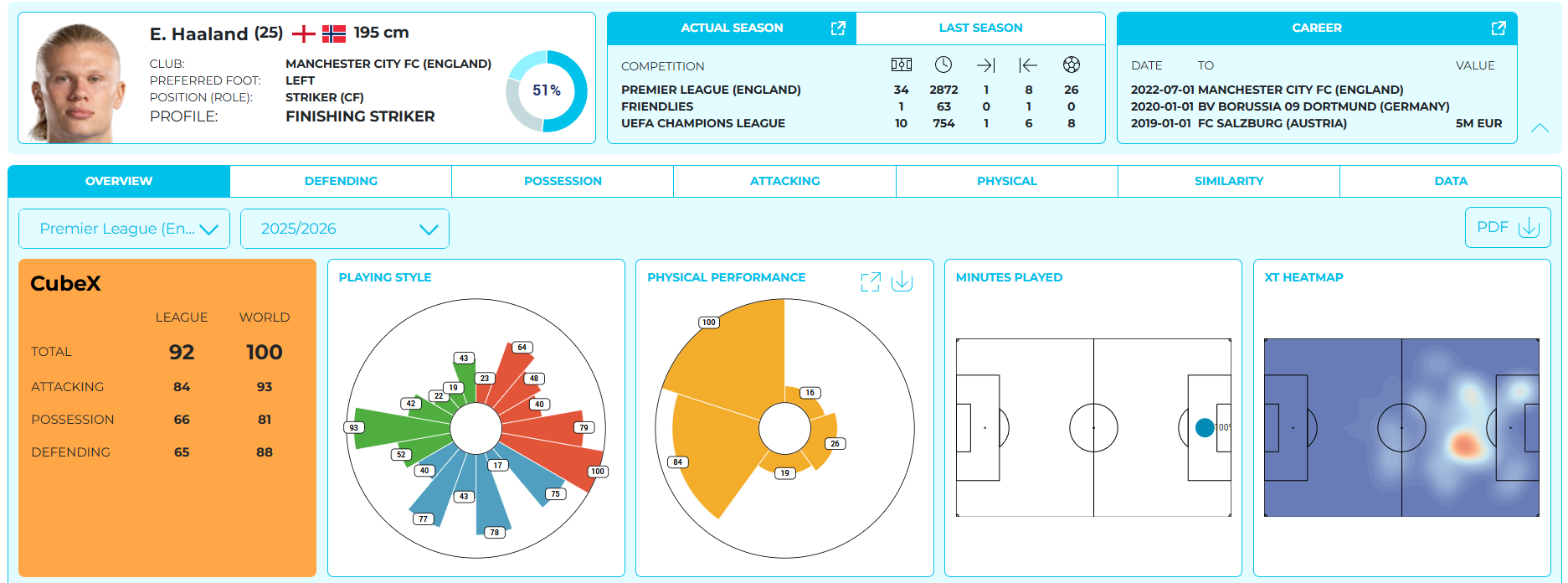
The value in that process is not necessarily in declaring whether a player is “good” or “bad,” but in helping clubs better understand where a player’s profile stands relative to their peers.
For scouts and agents, the platform’s practical value becomes easier to understand through its ability to simplify player comparison across different contexts and competitions. A scout building a shortlist for a possession-heavy side, for example, may already have certain assumptions about a player’s strengths while watching video. Cube allows those observations to be supported or challenged through larger performance samples and positional comparisons.
The process becomes particularly useful when evaluating players outside familiar markets. Rather than relying solely on isolated clips or subjective reports, users can compare players against positional peers both domestically and globally.
That idea becomes more visible through features such as CubeX. The platform assigns players a rating or has ranking-based plots, allowing users to quickly contextualize performance levels within specific roles. For clubs and representatives navigating increasingly global recruitment markets, that kind of contextualization can significantly shorten the early stages of player identification.
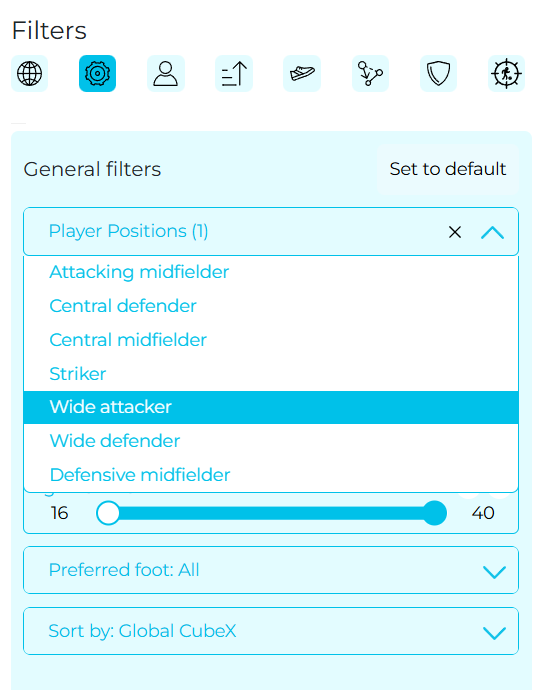
For example, a club searching for a high-intensity winger in Scandinavia may traditionally need weeks of live scouting, video analysis, and reporting before narrowing its options. Platforms like Cube attempt to reduce that process significantly earlier by filtering profiles through tactical and statistical criteria before deeper scouting begins.
The Similarity Tool
One of the platform’s more practically useful features may be its “Similarity” tool, which uses Cube’s algorithm to identify players whose statistical profiles closely resemble that of a selected reference player.
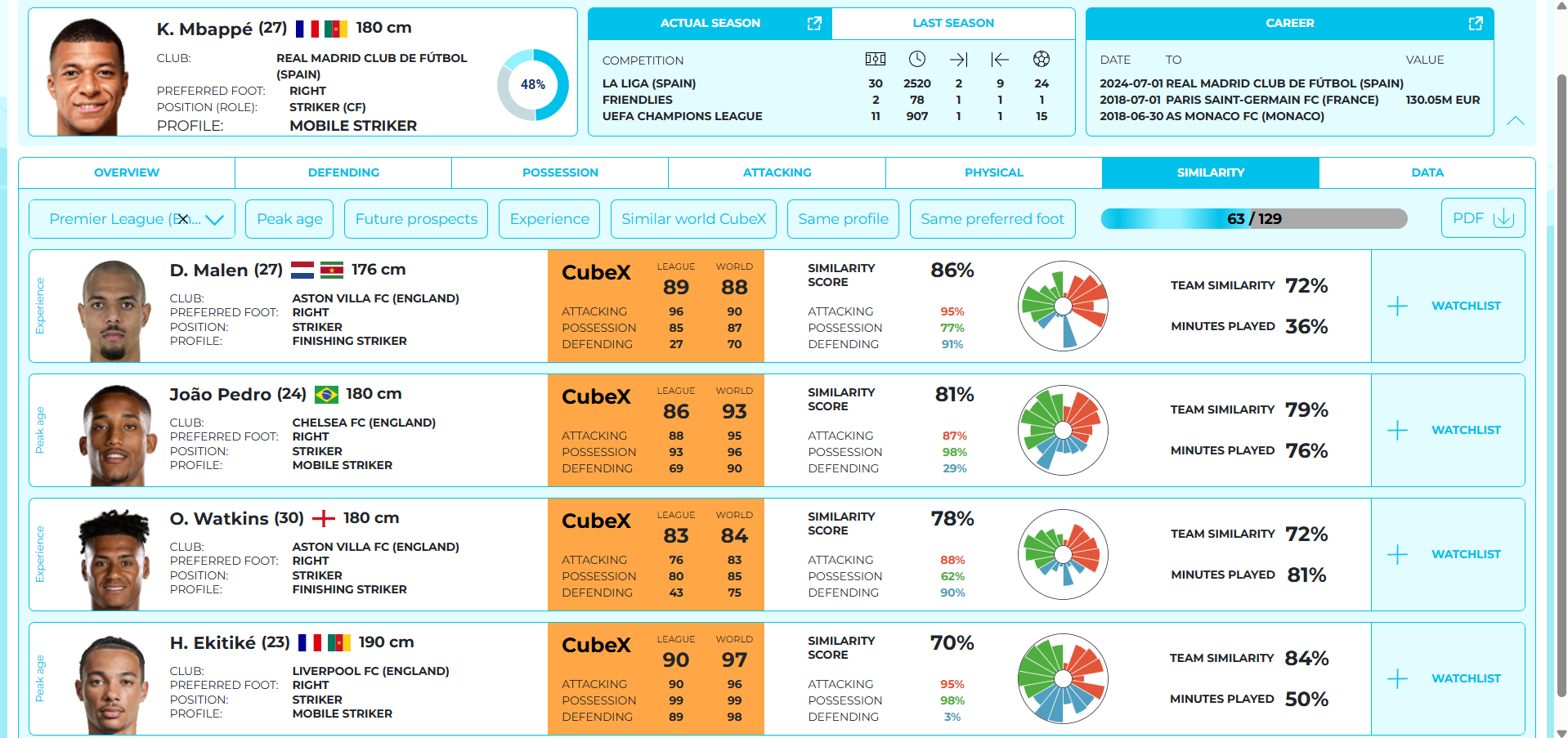
In conversations, a club scout or sporting director often gives loose descriptions or suggests names of players with the desired qualities, such as a winger capable of replicating certain attacking patterns, or a midfielder who mirrors the ball progression and defensive intensity of another player already familiar to the recruitment department. Translating those requests into actual shortlists can often become one of the more time-consuming parts of the scouting process.
Cube attempts to simplify that stage by identifying statistically comparable profiles across different leagues and markets. The tool can help narrow searches significantly earlier in the recruitment cycle, allowing representatives to move from broad assumptions toward more targeted player identification.
Finding Undervalued Player Profiles
One of the platform’s stronger applications lies in identifying undervalued or overlooked player profiles that may not immediately emerge through traditional scouting structures alone. In a world where visibility often shapes perception, some of the most effective profiles can exist outside the leagues and environments that naturally attract attention.
Cube attempts to widen that search process. By applying club-specific criteria across large datasets, the platform allows users to filter for tactical characteristics and performance indicators rather than simply reputation or market visibility. The goal is not necessarily to replace scouting intuition, but to make the scouting process more focused before live evaluation begins.
Rather than asking scouts to search everywhere at once, platforms like Cube attempt to narrow the search earlier by identifying profiles that statistically align with a club’s tactical and positional requirements.
Rather than asking scouts to search everywhere at once, platforms like Cube attempt to narrow the search earlier by identifying profiles that statistically align with a club’s tactical and positional requirements.
Challenging Visibility With Value
In many ways, platforms like Cube are attempting to challenge one of football’s oldest recruitment habits: equating visibility with value.
The modern transfer market naturally gravitates toward familiar leagues, recognizable names, and players already circulating within established scouting networks. But performance itself does not always emerge from the most visible environments. Some profiles develop in smaller leagues, fragmented pathways, or systems that traditional recruitment structures may not consistently monitor.
Data changes that search radius.
A full-back playing in a less prominent league may never generate widespread attention through reputation alone, but certain underlying indicators like progressive carries, defensive recovery actions, and chance creation under pressure can still reveal whether a profile translates tactically beyond its current environment.
That does not guarantee success, nor does it eliminate the need for live scouting and contextual understanding. But it does allow clubs to begin asking more targeted questions earlier in the recruitment process.
The Human Element
That ability to reduce uncertainty earlier in the recruitment process may ultimately explain why platforms like Cube are becoming increasingly relevant across modern football. But even as the game becomes more sophisticated in how it measures performance, there remains a recognition, including from Cube itself, that some aspects of football still resist quantification.
“The final judgment must remain human.”
“The final judgment must remain human.”
It was probably the clearest theme that emerged throughout the conversation.
Data can reduce uncertainty, challenge assumptions, and reveal patterns that the eye may miss. But football is still played by people, coached by people, and shaped by context. Mentality, adaptability, dressing-room fit, emotional resilience, and tactical learning remain areas where human judgment continues to matter deeply.
Cube’s role, as the company emphasized throughout the interview, is not to replace scouts, coaches, or sporting directors. Its purpose is to sharpen their perspective, reduce risk, and provide stronger evidence before decisions are ultimately made.
Final Thoughts
In many ways, the modern game no longer struggles with access to information. The challenge now lies in interpretation. Understanding which profiles truly fit a club’s identity, which performances translate across environments, and which qualities still cannot be fully captured through numbers alone.
Platforms like Cube may continue reshaping how football searches for and evaluates talent. But the game itself remains deeply human.
FAQ
What is Cube?
Cube describes itself as “a football intelligence platform built for the modern game, where every decision, from recruitment to performance analysis, can be strengthened by data.”
What is CubeX?
CubeX is a model that assigns players a performance rating based on a range of statistical indicators, allowing users to compare players against others in the same position, both within their domestic league and globally.
Does Cube replace traditional scouting?
Cube is careful not to position itself as a replacement for live scouting or video-analysis platforms. Instead, the platform functions more as a supplement to the existing scouting process.