

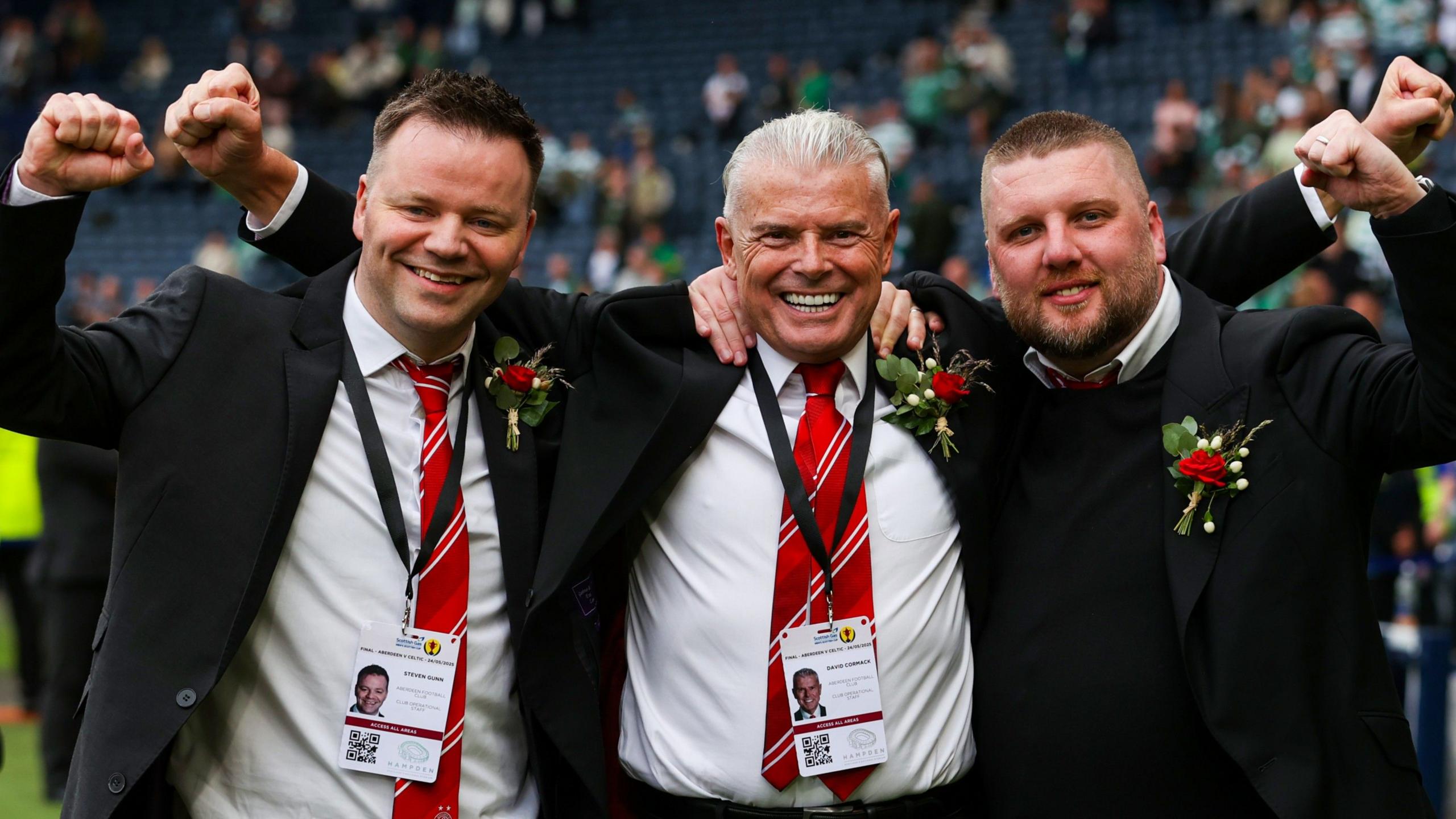
Steven Gunn: The Architect Behind Aberdeen’s Modern Football Strategy
Profile
Role: Director of Football
Specialisation: Football strategy, recruitment, player development, and sustainable growth
Experience: Aberdeen FC, Bayer Leverkusen, Everton, Brentford and Ferencvaros
Focus Areas: European qualification, player development, smart recruitment, player trading, academy development, and football operations
Biography
Steven Gunn’s 25-year journey at Aberdeen FC is a story of persistence, loyalty, and long-term vision. Rising from a university intern to Director of Football, he became a key figure in shaping the club’s modern identity both on and off the pitch.
Originally from the Scottish Highlands, Gunn joined Aberdeen through a university placement and stayed on after graduating in 2002. He progressed through operational roles before being appointed Director of Football in 2021.
In this role, he led a “one-club” approach, aligning football with business operations. His strategy focused on achieving UEFA Top 100 status through European qualification, player development, and sustainable growth via smart recruitment and trading.
In this role, he led a “one-club” approach, aligning football with business operations.
Gunn modernised the football structure: revamping recruitment, integrating data analysis, strengthening the academy, and supporting new facilities. He also helped launch the women’s team and girls’ academy.
His leadership combined data-driven decisions with strong investment in young ambitious people, creating pathways for staff development and long-term stability.
Key achievements included two European group stage qualifications, a Scottish Cup win, and over £21 million generated in player transfers to top European leagues through strategic contract management and strong stakeholder relationships.
Key achievements included two European group stage qualifications, a Scottish Cup win, and over £21 million generated in player transfers to top European leagues through strategic contract management and strong stakeholder relationships.
Since leaving in 2025, Gunn has undertaken club visits and advisory work, with ambitions to return to football in a strategic leadership role. His legacy is defined by the culture, structure, and sustainability he built at Aberdeen.
Key Insights
- Steven Gunn’s 25-year journey at Aberdeen FC took him from university intern to Director of Football.
- His work focused on a “one-club” strategy, European qualification, player development, and sustainable growth.
- His leadership helped modernise Aberdeen’s football structure and generate over £21 million in player trading value.
Our Exclusive Interview with Steven Gunn
How did your football journey begin?
My football journey began as a young boy, playing local and then regional football as part of successful youth and school teams in Invergordon and Ross-shire in the Highlands of Scotland. At 17 I moved to Aberdeen to undertake a Business degree at The Robert Gordon University. For my third year of that course, through persistence, I was fortunate to be selected for an industrial placement at Aberdeen Football Club in the football department under the guidance of then Football General Manager David Johnston. After graduating in 2002, I remained at Aberdeen FC, making several steps over time through Football Co-ordinator, Football Operations Manager, Director of Football Operations roles and ultimately appointed as Director of Football in 2021.
As Director of Football at Aberdeen, what were your core responsibilities in shaping the club’s strategy both on and off the pitch?
I was the primary link between the Football operation and the wider club structure, both at executive level and within the senior management team. This was key in helping my business operations, commercial, and marketing & comms colleagues understand our football priorities and progress, and working to deliver a one-club approach in strategy development and delivery.
The club set a vision to be a UEFA Top 100 club, and this shaped our strategy development and decision making. The club has the most loyal fanbase, but also an expectant fanbase. This desire for success and winning was shared by the Board of Directors, staff and players and the Top 100 benchmark was deemed as a stretch target, but an achievable one. This would rely on on-pitch domestic success – to qualify for European competition through top 4 league finishes, and/or winning the Scottish Cup – but also the ability to increase investment in the squad and performance infrastructure through building, realising and reinvesting value to support the efforts to qualify for European group stage football. Therefore, aside from football performance, the other strategic pillars were opening new trading markets, creating a visible pathway to the team for homegrown prospects, and executing a contract strategy supporting the building of player value over time. It was my responsibility to put the structures, people and processes in place to deliver within these pillars.
When I assumed the Director of Football role, the club was going through a period of change, and on the football side I needed to rebuild the entire player identification and recruitment department, the performance analysis team, develop the Youth Academy structure, contribute to the planning and development at the new training facility, and also building the club’s first Women’s Team and latterly Girls’ Academy. With my team, we were proud of the environment we’d created, while modernising the football operation and incorporating a data-informed approach to player market mapping, player ID, and Head Coach succession planning.
With my team, we were proud of the environment we’d created, while modernising the football operation and incorporating a data-informed approach to player market mapping, player ID, and Head Coach succession planning.
Looking back on your 25-year journey at Aberdeen, which achievements do you consider the defining highlights of your time leading the club’s football strategy as Director of Football?
Up until 2023, we had only managed to achieve European Group stage football on one previous occasion in 2007-08 since the format’s inception. Aside from the opportunity to win a trophy, facing new opponents and travelling to the furthest corners of Europe to support their team are probably the things that the Aberdeen supporters look forward to the most. Therefore, to help deliver two European group stage qualifications within the previous three seasons has been a highlight.
However, the most pleasing achievement on the pitch was winning the Scottish Cup last year for the first time since 1990. To be there to witness the scenes that day with my family who have also sacrificed so much was unforgettable. Those scenes were closely followed by the experience of seeing 100,000 people line the streets of Aberdeen for the victory parade. An incredible two days.
Off the pitch, the club now has a positive reputation as a leading developer of talent having successfully traded players to La Liga, Serie A, the EPL and other top leagues around Europe, which has included Academy-developed talent. The top 6 sale values in the club’s history were all achieved in the last few years where I’d led on end-to-end engagement, contract extensions, and sales strategy. The club should benefit from that reputation, built over time, going forward.
Do you take more pride in the on-pitch successes or the structural changes you implemented behind the scenes?
I enjoyed the on-pitch successes when they came, but you don’t get a lot of time to enjoy them as you are focused on the immediate priorities the very next day. Reflecting now, it was the building of the environment and supporting people in their development in their roles which I take pride in the most. Because of Aberdeen’s geography in the North East of Scotland and the need to be creative and resourceful with the financial resources available, we introduced a lot of people into our performance teams who were in the early parts of their careers. But with bright, ambitious and honest people, we were able to create a visible pathway for their own career progression and many within the coaching, performance and operational infrastructure achieved positive progression in their careers, with some taking another step beyond Aberdeen FC to other rewarding opportunities. I employed a deliberate strategy to invest in people with formal and informal development opportunities, creating this learning environment and it meant in most cases we could rely on ambitious people where they could help the club grow while supporting their own career progression.
Aberdeen achieved over £21m in player trading value under your leadership, can you share a specific transfer or development story that best reflects your recruitment philosophy?
To create opportunities to build trading value, a key ingredient is the approach on contract strategy. The club needs protection on contract length and control on the timing of a player’s potential exit. Key to this is the relationship developed with a player’s agent and a common understanding on the planned trajectory of the player during his time at the club and the window of opportunity to realise the value in the future. If club, player and agent have a common understanding and acceptance of that journey, then all parties can work together to maximise the sale opportunity.
In the examples of McKenna (to Nottingham Forest), Ramsay (to Liverpool), Miovski (to Girona), McCrorie (to Bristol City), and Ferguson (to Bologna), I was able to rely on the relationships built on trust and a common vision for the player to navigate these journeys. Of course, there can be distractions and challenges along the way, particularly when strong interest in a player arrives earlier than originally planned. Again, this is when I relied on relationships built over time with the player and his representatives to absorb the understandable disappointment of potentially not moving earlier. With these players in particular, they were all able to focus on the football, continue with top performances and ultimately all achieved transfers to very good destinations. Aside from Miovski who was on an original 4-year contract, these other players all signed long-term contract extensions prior to their exits on the mutual understanding the club would transfer them at an optimal point in the future. This approach helped us achieve the club record fees.
From first-team success to developing the women’s programme and academy, how did you balance short-term performance with long-term club development?
Sometimes when a club has competing strategic priorities (winning vs style vs pathway development vs player trading) finding that balance can be a challenge. But ultimately, the reason a club seeks to develop a style, introduce emerging talent players to their team, and develop and realise value is to create the conditions to win.
The key for me was ensuring the people, structures and processes were in place to address both. Amongst the instability of First Team Manager and senior coaching changes, with the right supporting people, clear reporting structures and individual and departmental responsibilities, regular forums, open lines of communication and clear processes, we were able to maintain a focus on long-term development.
Key for me was visibility within the training centre and regular connections with both my direct reports and others. Each engagement was an opportunity to reinforce immediate priorities while also supporting structural growth, investment in tools required for success, and people development. I could also rely on very competent function leads who had bought into the overall football and club strategy.
What are your ambitions for the following seasons?
After leaving Aberdeen towards the end of last year after 25+ years at the club, I have had the opportunity to undertake some valuable club learning visits to spend time with colleagues at Bayer Leverkusen, Everton, Brentford and Ferencvaros. I have also been undertaking some advisory work on market mapping, player valuation, training compensation regimes and processes, and the development of AI powered squad planning tools. My intention longer-term is to return to club football for the right opportunity and environment.
FAQ
Who is Steven Gunn?
Steven Gunn is a football executive who spent 25 years at Aberdeen FC and was appointed as Director of Football in 2021.
What was Steven Gunn’s role at Aberdeen?
As Director of Football, he was the primary link between the Football operation and the wider club structure, both at executive level and within the senior management team.
What were Steven Gunn’s key achievements at Aberdeen?
Key achievements included two European group stage qualifications, a Scottish Cup win, and over £21 million generated in player transfers to top European leagues through strategic contract management and strong stakeholder relationships.