Home Blog Page 34

UEFA Women’s EURO 2025: England Retains Title in Record-Breaking Tournament

A person waves a large England flag featuring the red cross of St George, symbolizing national pride and support for England's football team.
Photo by balesstudio on Unsplash

Switzerland | 2–27 July 2025

The Final: England vs Spain

The final took place at St. Jakob-Park in Basel in front of a sold-out crowd of approximately 34,000. Spain opened the scoring in the first half through Mariona Caldentey. England responded in the 57th minute with a goal by Alessia Russo. After a 1–1 draw through 120 minutes, England won the penalty shootout 3–1. Hannah Hampton made two crucial saves, and England converted three penalties to secure their second consecutive UEFA Women’s EURO title.

England’s Historic Triumph

By winning the 2025 final, England became the first team in UEFA Women’s EURO history to retain the title. It was also the first time any English senior national team won a major tournament outside their home country. England’s journey to the trophy included tight knockout matches in which they led for a total of just 4 minutes and 52 seconds – the shortest lead time ever recorded by a champion in the tournament’s history. Coach Sarina Wiegman secured her third UEFA EURO title, remaining undefeated in all EURO finals.

Tournament Summary

Sixteen teams competed in 31 matches across eight cities in Switzerland. The tournament produced 106 goals – the highest total ever recorded at a Women’s EURO. Matches averaged over 3 goals per game. The highest-scoring match of the tournament was Spain’s 6–2 victory over Belgium.

Spectator Milestones

UEFA Women’s EURO 2025 set a new benchmark in audience engagement. 657,291 spectators attended the tournament — the highest attendance ever at a Women’s EURO. 22 of 24 group stage matches were sold out. The quarter-finals attracted over 112,000 fans, including 34,128 for France vs Germany in Bern.

UEFA Player Awards

  • Player of the Tournament: Aitana Bonmatí (Spain)
  • Young Player of the Tournament: Michelle Agyemang (England, 18)
  • Golden Boot (Top Scorer): Esther González (Spain, 4 goals)
  • Oldest Goalscorer: Jess Fishlock (Wales, 38 years, 176 days)
  • Youngest Multi-Goal Scorer: Signe Gaupset (Norway, 20 years, 22 days)
  • Goalkeeper of the Final: Hannah Hampton (England)

Broadcast and Global Reach

The 2025 edition achieved historic media reach. The final was watched by over 45 million viewers worldwide. Total broadcast and digital reach exceeded 500 million. Social media engagement increased by 55% compared to EURO 2022.

Host Cities and Infrastructure

Eight cities across Switzerland hosted matches: Basel, Zurich, Bern, Geneva, Lucerne, Thun, Sion, and St. Gallen. Each city offered fan zones and tournament branding. Public transport and accessibility initiatives supported inclusive attendance.

UEFA Records Set

  • Most goals in a Women’s EURO: 106
  • Most attended Women’s EURO: 657,291 spectators
  • Highest-scoring match: Spain 6–2 Belgium
  • Shortest lead by eventual champions: 4 minutes, 52 seconds (England)
  • First back-to-back champion: England (2022, 2025)
  • Most sold-out matches: 29 of 31

Organisation and Legacy

Over 200 volunteers contributed to successful event operations. UEFA’s “Time for Action” legacy programme supported youth and women’s football. The official mascot “Maddli”, a Saint Bernard puppy, promoted tournament branding and fan outreach. Host cities received long-term investment in grassroots and visibility initiatives for girls’ and women’s sport.

Conclusion

UEFA Women’s EURO 2025 delivered record-breaking results on and off the pitch. From historic attendance to high-level performances, the tournament proved the strength, depth, and momentum of the women’s game in Europe. With England crowned champions once again, the bar has been raised for future editions.

Keeping the Money in the Family: Why Footballers Are Choosing Relatives as Agents

The Growing Popularity of Using Family Members as Agents

Unless you’ve been living under a rock in the last week, you’ll have heard that Lionel Messi is no longer a Barcelona player and has made the move to Paris Saint-Germain after 21 years at the Catalan club. The interesting part of this transfer that I will discuss in this week’s blog is Messi’s agent, Jorge Messi, is his father.

Employing family members as agents was first brought into the public spotlight in 1999 with Nicolas Anelka’s move from Arsenal to Real Madrid which was orchestrated by his brothers. In recent times, it is become increasingly common with players such as the now PSG trio Neymar, Mbappe and Messi all represented by their fathers.

In this blog I will discuss why using family members may be an attractive option for players but also the issues that may arise from doing so. I will then consider how family members should be treated compared to regular agents and how they might be regulated in order to ensure ethical and legal compliance.

Why Would a Player Prefer to Use a Family Member as Their Agent?

Football agents, whether applicable to each individual or not, carry the burden of a bad reputation that is associated with their profession. Players are cautious that the agent may not always act in their best interests but instead will be motivated by filling their own pockets.

The relationship and level of trust that a player places in an agent may never come close to what they have with their family members. A familial connection will mean that a player can be more confident that their agent wants the best for them. Particularly in young players who are wary of agents approaching them, using a family member is a more attractive option as the close, trusting relationship is already there, rather than having to develop a bond with an agent whose intentions may not be known or pure.

The obvious appeal of employing a family member as an agent is that any commission they receive for their services is kept within the family. For example, it is estimated that Neymar Sr has received £100million for Jr’s transfers whilst Jorge Messi has earned approximately £75million in contract commissions for his services. The success of sons and brothers also financially benefitting the rest of the family is a more attractive option than having to remunerate a stranger with a football agent license that may not have the player’s best interests at heart.

In a perfect world, the love and trust between a father and son or brothers would mean that each party is acting in a way that benefits each other as much as possible. Unfortunately, this is not always the case. There is a risk in mixing familial relationships with professional business. The combination may lead to big fall outs. Even family members can develop a hunger for money or power-grabbing from representing their relatives.

Can Family Members be Regulated as Agents

An additional risk that arises from using a family member as an agent is that they may not be qualified enough. Before the removal of an exam in FIFA’s regulations in 2015, family members were exempt from taking it. This made it easier for them to be registered as the representative of their son or brother.

In the case of Juan Mata, his father was a former player and obtained his agent license once he had retired. He now has a client list including players such as his son and Salomon Rondon. There are many other cases in which close relatives of the players are representing them. For example Eden Hazard’s agent is his father, the agent of Sergio Ramos is his brother René Ramos, agent of Mats Hummels is his father Hermann Hummels. We also have Mauro Icardi from PSG who’s agent is his wife Wanda Icardi or Dane Rashford as the brother and agent of Marcus Rashford. So are the brother of Liverpool defender Trent Alexander-Arnold and the father of Chelsea’s Christian Pulisic.

FIFA’s proposed changes to regulations coming into force next year will see family members treated in the same way as all other agents. The regulations contain a clause that prohibits family members from acting as agents unless they are fully licensed. Importantly, this includes the requirement of passing the agency exam. This is a step in the right direction as it will ensure that family members receive a level of education and qualification before they are able to represent their relatives. I expect that FIFA will emphasise that players should only use agents that have a proven level of aptitude in the industry and are qualified enough to serve them well.

Furthermore, a cap on commissions could minimize the ability of relatives to collect disproportionate fees for their services, reducing the risk that they will act on their own greedy interests rather than to seek what is best for the family member they are serving.

Transparency, once again, is vital. If a family member is representing a player, all transactions, commission fees and gifts should be recorded and accessible by FIFA. This will overcome the worry of many that an unnecessary amount of money leaves the game and cannot be accounted for through payments to agents.

Summary

Using family members as agents is becoming increasingly popular and will remain an attractive option for players. They may have a level of trust that can only be had with a family member and not the kind of relationship they could develop with a separate agent.

However, the risk of mixing family and business may not always lead to a beneficial outcome for both parties. Issues arise from greed and power and the lack of qualification that the family member representative may have. It is important that a system is in place that maintains the legal and ethical appropriateness of family members representing players.

FIFA’s proposals for agent regulations are certainly going to improve the dynamic and standard of family members acting as agents. By ensuring that they are sufficiently educated and qualified whilst also preventing them from receiving an unfair and extortionate level of remuneration, the standard of agents will rise and it will go some way in preventing the concerns that prevail from using brothers, fathers or wives as agents.

Football Deal in Bulgaria: Rules, Transfers, and Local Player Requirements

A local football match taking place on a green pitch in Gotse Delchev, Bulgaria, with mountains and residential buildings in the background.
Photo by Branimir Petakov on Unsplash

1. Football Deal in Bulgaria

  • International transfers: Conducted via FIFA TMS; domestic transfers through the BFU platform.
  • Contracts: Professional contracts can be signed from the age of 18 (or 16 with parental consent and BFU approval); duration typically between 1–5 years.
  • Agents: Must be registered and licensed according to FIFA regulations.
  • Transfer windows: Summer (15 June–6 September), Winter (15 January–28 February).
  • Compensation and solidarity payments: According to FIFA regulations.
  • Medical checks: Mandatory before signing.
  • Work permits: Required for non-EU players.

1. Футболна сделка в България

  • Международни трансфери: чрез FIFA TMS; вътрешни – през платформа на БФС.
  • Договори: професионални договори от 18 г. (или 16 с разрешение); продължителност 1–5 години.
  • Агенти: регистрация и лиценз по правилата на FIFA.
  • Трансферни прозорци: летен (15.06–06.09), зимен (15.01–28.02).
  • Компенсации и солидарни плащания – по правилата на FIFA.
  • Медицински прегледи – задължителни.
  • Разрешителни за работа: за чужденци от извън ЕС са задължителни.

2. Rules for Foreign Players (Non-EU)

  • Efbet League: Up to 5 non-EU players can be registered; maximum 3 on the pitch at the same time.
  • Second League: 2 non-EU players allowed.
  • 6th and 7th non-EU players: Clubs must pay a fee of 40,000 BGN per player.
  • Players from countries with bilateral agreements with Bulgaria: Registration process may be simplified.

2. Правила за чужденци (извън ЕС)

  • Efbet Лига: до 5 чужденци регистрирани; до 3 на терена.
  • Във Втора лига – 2 чужденци.
  • За регистриране на 6-ти и 7-ми чужденец – такса 40 000 лв. на човек.
  • Играчите от страни със споразумения с България – по-облекчена регистрация.

3. New BFU Rule for Bulgarian Players

Starting from the 2025/26 season:

  • Each match squad must include at least 5 Bulgarian players, and 4 of them must start, regardless of their age.
  • Clubs can opt out by submitting a declaration and paying a 400,000 BGN fee, which BFU redistributes as bonuses to the other clubs.
  • Non-compliance without declaration → automatic 0:3 loss.
  • BFU does not require a minimum number of minutes played — substitutions before halftime are permitted.

3. Ново правило на БФС за българи

От сезон 2025/26:

  • В групата за мач – поне 5 българи, и 4 задължително титуляри, без възрастово ограничение.
  • Отпадане – чрез декларация и глоба 400 000 лв., разпределяна от БФС като бонус към другите клубове.
  • Нарушения без декларация → служебен резултат 0:3.
  • БФС не изисква минимално време за игра – смяната преди почивката е възможна.

4. Development of Young Players and First Team Integration

  • BFU requires one U21 Bulgarian player to be in the starting lineup.
  • Second League: At least 2 U21 Bulgarian players must play ≥45 minutes each.
  • Amateur leagues: 2 under-23 and 1 under-21 players must play the full 90 minutes.
  • Pathway: Academy → Reserve team → First team or frequent loans to other clubs to gain experience.
  • Contracts for young players can be signed starting from age 16.
  • Financial compensations apply when players are transferred abroad.

4. Развитие на млади играчи и участие в първи отбор

  • БФС изисква по един U21 играч в стартовия състав.
  • Във Втора лига – минимум 2 U21 българи с по ≥45 минути.
  • В аматьорските лиги – 2 <23 и 1 <21 играят пълни 90 минути.
  • Път: академия → втори отбор → първи отбор или чести преотстъпвания с цел трупане на игрови минути и опит.
  • Договори за млади играчи са позволени от 16 г.
  • Финансови компенсации при трансфер в чужбина.

5. Efbet League – Structure

  • 16 clubs for the 2025/26 season; reduced to 14 clubs from the 2026/27 season.
  • Format: Regular season + playoffs (for championship and relegation battles).

5. Efbet Лига – Структура

  • 16 клуба през сезон 2025/26; ще се намалят на 14 от сезон 2026/27.
  • Формат: редовен сезон + плейофи (за първенство и изпадане).

6. Most Successful and Famous Football Clubs in Bulgaria

  1. CSKA Sofia – 31 league titles.
  2. Levski Sofia – 26 league titles.
  3. Ludogorets Razgrad – Dominant force over the last decade, regular participant in European competitions.
  4. Botev Plovdiv – The oldest football club in Bulgaria, founded in 1912.

6. Най-успешни и известни футболни отбори в България

  1. ЦСКА София – 31 титли.
  2. Левски София – 26 титли.
  3. Лудогорец Разград – доминант в последното десетилетие, редовно участие в евротурнири.
  4. Ботев Пловдив – най-старият клуб в страната, основан през 1912г.

Executive Recruitment in Professional Sports: Why Strong Leadership Support Matters

Photo by Mitchell Luo on Unsplash

In professional sports, success is not only determined by talent on the field but also by the right leadership off it. While executive recruitment has been an established practice in American sports-particularly in the NFL and NBA-the concept is still developing in football (soccer). However, this is rapidly changing.

Why Executive Recruitment Is Crucial in Football

The demands on sporting directors, CEOs, and other executives in football have increased significantly. Clubs today operate as global businesses, requiring strong financial management while remaining competitive on the field. Balancing these responsibilities is nearly impossible without professional support.

This is where executive recruitment plays a key role:

  • Strategic Career Planning: Top executives need a clear career strategy-what clubs or organizations align with their strengths and ambitions?
  • Networking & Positioning: Being in the right place at the right time can make or break a career. A professional management team ensures access to the best opportunities.
  • Negotiations & Security: One of the most critical roles of an advisor is to act as an intermediary between the executive and potential employers. Contract negotiations go beyond salary and duration-they involve long-term vision, decision-making authority, and the right working environment. A skilled advisor ensures their client secures the best possible conditions-professionally, discreetly, and the eye level with club decision-makers.
  • Continuous Development & Leadership: Even the most experienced executives need sparring partners to refine their leadership skills and adapt to the ever-evolving demands of the industry.
Lessons from American Sports

In the NFL or NBA, executives have long been managed just like players. Agencies handle their positioning, negotiations, and career development. The most successful teams don‘t just invest in their roster-they also invest in their leadership.

Football is now beginning to follow this path. More and more sporting directors and club executives are working with professional advisors to strategically manage their carers, optimize their positioning, and secure the best possible terms in negotiations.

The Next Step: Expanding Your Network

If you are an executive in football (soccer) – or aspire to be – now is the right time to take a professional approach to your career.

Comment bâtir une marque personnelle en tant qu’agent sportif et de football

Dans le monde compétitif des agences sportives, établir une marque personnelle solide est crucial, surtout si vous travaillez dans une petite agence ou de manière totalement indépendante. Une marque personnelle bien conçue et ciblée peut vous différencier des autres agents similaires, attirer des clients et démontrer la valeur unique que vous apportez à la carrière de vos clients. Souvenez-vous que lorsque vous vous présentez pour la première fois à un client potentiel, il est probable qu’il consulte votre site web et vos réseaux sociaux. Il doit donc aimer ce qu’il voit ! C’est l’occasion de faire bonne impression ; bien qu’un joueur ne signe pas avec vous uniquement à cause de votre marque personnelle, il pourrait vous écarter immédiatement en raison de son absence. Ce blog expliquera pourquoi se concentrer sur votre marque personnelle est essentiel et comment la construire efficacement en ligne et hors ligne.

L’importance d’une marque personnelle

En tant qu’agent sportif ou plus spécifiquement de football, votre marque personnelle représente votre réputation, votre expertise et les services uniques que vous offrez. Cette marque ne se résume pas à un logo ou un slogan ; elle est l’essence même de ce que vous êtes en tant que professionnel. Elle englobe la manière dont vous communiquez, les résultats que vous obtenez et les relations que vous établissez avec les clients, les parties prenantes et les autres professionnels de l’industrie. Une marque personnelle forte est multifacette, reflétant votre éthique professionnelle, vos réalisations et la valeur que vous apportez à vos clients.

L’un des principaux avantages d’une marque personnelle solide est sa capacité à créer de la confiance et de la crédibilité. Dans le monde du football, où la confiance est primordiale, les clients et les parties prenantes sont plus susceptibles de collaborer avec des agents ayant une présence bien établie et un bilan éprouvé. Votre marque personnelle sert de témoignage à votre professionnalisme et à votre fiabilité, rassurant les clients potentiels qu’ils sont entre de bonnes mains. En obtenant constamment des résultats et en maintenant des normes éthiques élevées, vous renforcez votre crédibilité et favorisez une confiance à long terme avec ceux avec qui vous travaillez.

De plus, une marque personnelle efficace peut attirer des clients. Dans une industrie où les connexions et l’expertise sont essentielles, avoir une marque reconnaissable et respectée peut attirer des clients potentiels recherchant quelqu’un avec vos compétences et votre expérience. Lorsque les joueurs et les clubs voient votre nom associé à des accords réussis et à des clients satisfaits, ils sont plus susceptibles de vous considérer pour leurs besoins de représentation. Votre marque personnelle devient donc un outil marketing puissant, mettant en avant vos succès et votre capacité à naviguer dans les complexités de la gestion du football.

Dans un marché saturé, la différenciation est la clé. Votre marque personnelle vous distingue en mettant en avant votre approche unique et la valeur ajoutée que vous apportez à vos clients. Que ce soit vos compétences en négociation, vos services de gestion complets ou votre dévouement au développement des clients, ces facteurs distinctifs vous font ressortir parmi la myriade d’agents de l’industrie. En articulant clairement ce qui vous rend différent et meilleur, vous pouvez attirer des clients recherchant précisément l’expertise et le service que vous offrez. Cette différenciation ne consiste pas seulement à être différent ; il s’agit d’être distinctement meilleur de manière significative pour vos clients.

Construire votre présence en ligne
Créer un site web professionnel

Un site web professionnel et convivial sert de carte de visite numérique et est fondamental pour établir votre présence en ligne. Ce site web doit être bien conçu pour refléter votre marque et fournir des informations complètes sur vos services. Bien qu’il puisse être difficile de dépenser beaucoup pour des concepteurs de sites web de haute qualité, vous devez considérer cela comme un investissement essentiel pour votre carrière d’agent. Avoir un site web de mauvaise qualité vous coûtera beaucoup plus à long terme !

Votre site web doit clairement décrire les services que vous offrez et vos domaines d’expertise. Détaillez l’étendue et la profondeur de vos services, de la négociation de contrats à la gestion de joueurs en passant par la planification de carrière et le branding commercial. Les clients potentiels doivent comprendre exactement ce que vous pouvez faire pour eux et pourquoi vous êtes leur meilleure option.

Les histoires de succès sont un moyen puissant de démontrer votre impact. Incluez des études de cas détaillant les défis rencontrés par vos clients, les solutions que vous avez apportées et les résultats réussis obtenus. Les témoignages de clients satisfaits peuvent renforcer davantage votre crédibilité et montrer les avantages tangibles de vos services.

Nous recommandons également de fournir des informations détaillées sur les joueurs, entraîneurs ou clubs que vous représentez. Mettez en avant leurs réalisations et votre rôle dans leur succès. Cela non seulement présente votre portfolio, mais démontre également votre capacité à gérer et soutenir des talents de haut niveau. Une autre façon de le faire est de maintenir une sorte de blog ou de section d’actualités régulièrement mise à jour avec des analyses de l’industrie, vos dernières activités et histoires de succès. Cela garde les visiteurs et les clients potentiels engagés et informés sur vos efforts et réalisations continus. Cela vous positionne comme un profil établi dans l’industrie, contribuant continuellement avec des informations et perspectives précieuses.

Utiliser les réseaux sociaux

À l’ère moderne des agences de football, les plateformes de réseaux sociaux sont des outils essentiels pour construire votre présence en ligne et vous connecter à un public plus large. Vous devez vous rappeler que l’agence est une « entreprise de référence » et vous pouvez créer plus de références positives en établissant et en maintenant des profils actifs sur les principales plateformes pour maximiser votre portée et votre engagement.

LinkedIn est particulièrement précieux pour se connecter avec d’autres professionnels de l’industrie et établir des relations professionnelles. Utilisez LinkedIn pour partager des nouvelles de l’industrie, des analyses et des mises à jour sur vos activités. Publier régulièrement et interagir avec votre réseau peut vous aider à vous établir comme un participant informé et actif dans l’industrie.

Des plateformes telles que X (anciennement Twitter), Instagram et Facebook peuvent vous aider à atteindre un public plus large. Utilisez ces plateformes pour partager des contenus en coulisses, des analyses de l’industrie et des mises à jour sur votre travail. Publier des mises à jour régulières et interagir avec les abonnés peut aider à construire une communauté en ligne forte. Partagez des photos et des vidéos de vos interactions avec les joueurs, entraîneurs et clubs, votre présence à des événements de l’industrie, et tout jalon ou réalisation personnelle. Cela non seulement humanise votre marque, mais garde également votre audience intéressée et investie dans votre parcours. Une mise en garde toutefois, souvenez-vous que le client doit être au centre de tout ce que vous faites. Si votre principal objectif lors d’un accord est de vous assurer d’obtenir une bonne photo de vous posant devant le stade avec un maillot, vos priorités sont mal placées et cela nuira à la qualité du service que vous offrez à votre client. Par conséquent, la majorité de votre travail doit se faire en coulisses, mais vous pouvez équilibrer cela en veillant à montrer le travail exceptionnel que vous faites aux autres clients potentiels qui vous voient sur les réseaux sociaux.

En utilisant efficacement ces plateformes de réseaux sociaux, vous pouvez créer une présence en ligne dynamique et engageante. Cela aide à attirer des clients potentiels, à informer et à engager vos clients existants, et à construire un réseau de professionnels de l’industrie qui respectent et reconnaissent votre expertise.

Construire votre présence hors ligne

La priorité d’un agent pour construire sa marque personnelle doit être un engagement sans relâche et continu dans le réseautage. Sans aucun doute, le réseautage actif est vital pour construire votre présence hors ligne et développer des relations significatives dans l’industrie du sport ou du football. Assister à des matchs, conférences et événements de l’industrie offre des opportunités de se connecter avec des figures clés et des parties prenantes. Engager avec des individus importants dans le monde du football vous permet de bâtir des relations pouvant mener à des recommandations précieuses. Ces connexions peuvent ouvrir des portes à de nouvelles opportunités et partenariats, améliorant considérablement votre réseau professionnel. Souvenez-vous, le football, et en particulier l’agence, est une entreprise de référence ! Plus votre réputation est bonne, construite à travers votre présence hors ligne, meilleures seront vos références tierces, meilleure sera votre carrière !

Se tenir informé des nouvelles opportunités et des tendances de l’industrie est un autre aspect crucial du réseautage. En assistant à ces événements, vous pouvez obtenir des informations sur les derniers développements dans l’industrie du sport, ou plus spécifiquement du football, des talents émergents aux stratégies de gestion innovantes. Ces connaissances non seulement vous gardent en avance sur la courbe, mais montrent également votre engagement à rester à jour et informé, ce qui peut être un argument de vente pour les clients potentiels.

Échanger des informations de contact, comme des cartes de visite, est une partie fondamentale du réseautage. Cependant, la véritable valeur réside dans le suivi. Après avoir rencontré de nouveaux contacts, faites-en une priorité de les recontacter et de cultiver ces relations. Des messages de suivi personnalisés, des rencontres pour un café ou des discussions informelles peuvent aider à solidifier ces connexions, transformant des rencontres initiales en relations professionnelles durables. Un engagement constant avec votre réseau peut mener à des opportunités et collaborations continues qui bénéficient à la fois à vous et à vos clients. Plus de connexions ne peuvent qu’être bénéfiques !

Conclusion

En résumé, votre marque personnelle en tant qu’agent sportif est un atout puissant. Elle construit la confiance et la crédibilité, attire des clients et vous différencie dans un marché compétitif. En investissant dans et en nourrissant votre marque personnelle, vous pouvez améliorer votre réputation professionnelle, élargir votre clientèle et atteindre un plus grand succès dans votre carrière. Finalement, une marque personnelle robuste englobe à la fois votre présence en ligne et hors ligne, reflétant votre professionnalisme, vos réalisations et votre engagement envers vos clients. En investissant dans votre marque personnelle, vous vous positionnez non seulement comme un agent de football réputé et influent, mais vous posez également les bases d’un succès à long terme dans l’industrie. Gardez vos clients au centre de vos préoccupations, démontrez continuellement votre valeur et regardez votre marque personnelle propulser votre carrière. Enfin, n’oubliez jamais que le football et le sport sont des entreprises de référence, donc plus vous pouvez améliorer les références que vous recevez, mieux ce sera !

Recruiting Your First Client as a Football/Soccer Agent

Introduction

Perhaps one of the hardest stages of being a football agent is when you are looking to recruit your very first client, particularly if you are working alone and not as part of a larger agency. It can be a tense time that requires patience and dedication to find the right opportunity and then capitalise upon it and turn it into a successful agent-client relationship.

In this blog we will consider the kind of things you should be doing if you are in this position and how to go about finding that very first client. We will also look at the stages of progression towards signing a representation contract and the must-do’s and don’ts for upcoming agents.  

Finding the Opportunity

Depending upon your age and previous experience in the football industry, initially finding an opportunity to try to recruit a player can vary in difficulty. For younger agents, the likelihood is that such an opportunity will only arise on the back of attending as many games as possible. By identifying the kind of clientele you are hoping to work with and other specifics can help you to narrow down the kind of fixtures you will attend. For example, a young agent may attend academy fixtures to engage and interact with scouts and parents of players below first team level. Younger academy games are important as this is an opportunity to build up relationships with parents and others which can grow over two years or so before they may be looking for an agent.

As per FIFA Regulations concerning the protection of minors, agents are not able to enter into representation agreements until the player is within six months of when they may legally sign their first professional contract. Hence, agents must be aware that this varies between countries. For example, in associations such as Germany they may sign a professional playing contract as young as 16, so agents will be trying to represent them at 15 and a half. Alternatively in other countries, agents cannot sign representation agreements until they are 17 and a half, before signing their first playing contract at 18. Attending fixtures prior to this age gives you the window of opportunity to establish the foundations of a relationship for when the time comes. 

Football fixtures can also be an intimidating environment. There were many occasions when I was just starting out with attending fixtures that I would try to talk myself into approaching parents watching games or even scouts, but found it difficult when the time came to know the best way of instigating a conversation with them and making that first connection. It is particularly important that an upcoming agent quickly becomes accustomed to and comfortable with making initial contact and striking up a conversation in such an environment.

This comes down to repetition. The more you put yourself into an uncomfortable position and force yourself to take steps to speak directly to people, the more comfortable it will become over time and it won’t be long before you have no hesitation in doing so. Although every conversation may not always go the way that you’d hoped, as sometimes others may not be interested in speaking with you, the worst possible outcome is that you fail to build a relationship with them. However, the chances are, the majority of conversations you have will lead to future conversations and could open up various possibilities to you, including the chance of signing your first client. The main aim of these first conversations is to leave a good impression and to obtain the contact details of the other person so you can keep in touch. 

The hope is that eventually, after spending long enough putting the hard graft in and making the effort to continue, even at times when it may seem to not be getting you anywhere, an opportunity may arise where you come to learn of a player that may be looking for representation and you have a contact or other way in which you can make contact with their parents or even with the player themselves if they over 18. The next steps are of utmost importance and maybe sometimes comes down to making sure you don’t do certain things rather than what you do do.

An important point to note when finding an opportunity is whether you are operating as an agent alone, as part of a smaller agency or perhaps as a recruitment employee of a larger agency. Each has different advantages and disadvantages, it is up to the individual as to how they would rather work. For example, those working for larger agencies will have greater access to a wider network as well as being able to include senior agents in discussions and demonstrate the services they have provided to star players in the game once they begin discussions with the players and their parents. However, in such situations, they are employees of larger agencies and will be paid a salary. Alternatively, agents may work in more of a commission based partnership under a smaller agency which may give more power and influence to the individual agent. The way in which you are working as an agent will affect the methods you use to identify opportunities to sign players and how you work with them. 

What not to do

To summarise what you absolutely must not do, it can be put as simply as: DO NOT ACT UNPROFESSIONALLY. 

Expanding on this, once there may be an opportunity for you to sign a first client, it is vital not to become overexcited and to rush into trying to progress the chance quicker than is appropriate. Some agents will want to grab the opportunity as soon as possible, but if this is done unprofessionally, the likelihood is that it will not produce the result you are hoping for.

There are some simple rules for certain things that you should avoid. We will then go onto look at the advisable alternatives later on in the blog. 

Firstly, do not use social media platforms to approach players or their families. In the modern era, it is likely that you will be able to find both the players and their close relatives on at least one form of social media. Whilst this may help you in identifying who their parents are and who to look out for on the side of a football pitch, approaching them directly through social media is unprofessional and is unlikely to be looked upon kindly by those you are trying to engage with. 

If you have identified the parents or an alternative method to make contact with the player, you must not abuse this position and utilise it in the wrong way. Repetitive pestering and impatient messaging is only likely to irritate the contact and will not help you build a relationship with the player in any way. Do not insist on spending entire games watching with them and making them feel pressured themselves. Presenting yourself as someone who will make the player and their family uncomfortable will subsequently undermine your chances of building a strong relationship and going on to represent the player.

One way in which an agent may also inadvertently discourage the family from allowing you to represent the player is if you give the impression that you are ‘taking them away’. Particularly for younger clients, agents should attempt to integrate themselves as part of the wider support team of the player, almost as another family member. By providing your expertise as well as broader encouragement, you can develop the relationship into a feeling that everyone is working together for the best of the player rather than separately. 

In some instances, the opportunity may have arisen with a younger academy player who shows great potential. There is a tendency to assume that if a player has high potential for a future in the game, a lot of agents will be vying for their signature. However, you must not approach them if they are not of the legal age. Not only does this infringe upon FIFA and National Association regulations, but it will also demonstrate that you are unprofessional in your approach to your work as an agent. Consequently, the family and player are likely to remove you from consideration for future representation as they will much rather work with a professional individual. 

Since the new FIFA Agent Regulations came into force, there has been some confusion around when you can approach players or families as an agent. In short, you must not present yourself to a player or their families as an agent if you have not yet obtained your FIFA licence. There is a clear distinction between how a licenced and unlicenced individual must behave. Although you may attend games and talk with people freely without a licence, you must not do so in the capacity of an agent nor speak to families or others about your intentions as an agent.

One final point on what not to do is something that is surprisingly common in the agency profession. Our advice would be that you should never pay the player or their families to encourage them to sign with you or your agency. Occasionally, parents may ask for money for themselves rather than for the benefit of the player and if they originally sign for money, the chances are that one day they may move on to another agency for more money. It is not advisable to begin your professional relationship between you as the agent and the player and their families upon the foundations of financial reward. The only instance where sharing money could be appropriate is if there is a family member who is also an officially licenced agent that is representing their relative but would like to partner with you to improve the services they can provide. In such cases, all financial details will be based upon previously agreed shared commission. 

The Essentials

On the other side of this is the ‘must-do’s’. To simplify this; DO ACT PROFESSIONALLY.

The professional way of initiating conversation with the player or their families, rather than social media, is to approach them appropriately at a game. This is by far the best way of beginning to build the relationship as in-person interaction is the most efficient method of leaving a positive first impression. You can introduce yourself and briefly acknowledge your position as an agent. From then you will recognise each other at future games and can give simple pleasantries as you walk by or strike up further conversations if the circumstances suit. It is a matter of making a judgement as to when is the right time to make conversation and when it is best to not go beyond a quick “hello”. At some point along the relationship, you may be able to obtain a phone number or other contact details and can then engage in conversation with them professionally and it may get to the stage of having phone calls or a zoom call once the topic of your interest in representing the player as a client has been discussed.

Timing is essential. If you encroach on the subject of representation prematurely, it may be of detriment to your relationship. It is essential to accurately assess your relationship with the player and their family and focus more on building a good and trusting connection with them before discussing the possibility of representing the player as a client. In some cases, if it is permissible and appropriate, agents have entered into purely commercial agreements with players and their families to source them a boot deal at a younger age than they would be able to sign a representation deal. Although you must ensure this complies with regulations, it may be another way of progressing your relationship up until the point of finding the right time to sign a representation contract.

Once you have identified a target and have initiated that first point of contact and addressed the topic of representing the player, you can then move onto the stages of recruitment. Depending on the exact circumstances this may vary; ultimately it comes down to your personal judgement as to the best next steps in each situation and depending upon the point the relationship has reached. However, below is an outline of how a typical appropriate recruitment process may play out:

  1. The Approach: Being introduced to or approaching the player and/or their family and making initial contact and building the relationship.
  2. Organised meeting: This is your first chance to demonstrate where you can add value as an agent to the player and to his family. In a comfortable and neutral environment such as a cafe or restaurant, you can initially pitch your attributes as an agent and present an individualised assessment of the player. The goal of this stage is to generate initial interest, intrigue and engagement in the hope of leading to further conversations in the future. This is an introductory meeting rather than a contract signing meeting! The next step may also then be to have a meeting with just the player to develop your personal relationship with him and gain a better understanding of his ambitions and goals in his career as well as what he is looking for in an agent.
  3. Attending games: Throughout the process it is important to continue to attend games and monitor the recruitment target. As mentioned, this gives you further chances to interact with the family and also to make further assessments on the player. Additionally, the family and the player will appreciate your dedication and interest in attending and following the games, which can boost your chances of impressing. It is vital that throughout the process you are demonstrating how and where you can add value to the player’s career.
  4. Closing: The entire process may take anywhere from a couple of weeks to even up to a year to run its course. It really depends on the situation of the player and their family and the relationship you are able to build in the space of time. However, once you have judged that it is an appropriate time, or perhaps the player and their family have enquired about it, you can ask if they are looking to make a decision and they may wish to see the representation contract. It is a necessity that you insist on them seeking independent legal advice and are also willing to answer any questions or queries they may have. Significantly, just because the process has progressed this far does not guarantee a decision either way. The important thing to remember is to remain patient and professional. Do not rush the family into making a decision, assist them in any way you can but remember that it is ultimately their decision and you can only give the best possible account of yourself.

Summary


Without clients, an agent is not able to do the very purpose of their job. Hence, recruiting the first client is a major milestone in the career of an upcoming agent. Whilst perhaps a daunting and sometimes even frustrating task, it is also part of the excitement and should be a cherished opportunity. It is the platform to launch your agency career and therefore, approach it with utmost professionalism and a willingness to accept failures and learning curves but with the determination to keep persevering and a belief in your own abilities and aptitude that the right opportunity will materialise.

Doing a Football Deal in Germany

Introduction

Welcome to the latest installment of our blog series, “How to Complete a Football Transfer Anywhere in the World.” In this edition, we’ll be delving into the intricacies of completing a football transfer deal in Germany. Whether you’re an experienced football agent looking to expand your knowledge or an aspiring agent eager to learn the ropes, this series aims to provide comprehensive insights into the unique regulations and practices of football countries across the globe.

The main differences

When it comes to football transfers in Germany, understanding the intricate structure is essential for both experienced and aspiring football agents. The German football transfer system operates within two main windows each year, offering unique dynamics and challenges for agents, clubs, and players alike.

Germany follows a well-defined transfer calendar, with two crucial transfer windows each year. The first, a mid-season window, opens in January and lasts for a month. The second, more extensive window, takes place between seasons and runs from the 1st of July until the 1st of September, lasting approximately 60 days. These designated periods allow clubs to register players into their squads for the upcoming season, providing a structured framework for player movements.

The top two divisions of German football, namely the 1. Bundesliga and 2. Bundesliga, stand out for their high level of professionalism. Clubs within the first division have honed their transfer strategies over years of experience. Many possess well-established scouting networks, making it challenging for agents to propose unknown players. These clubs often rely on their internal scouting departments to identify potential talents in the most interesting markets. As a result, agents find that proposing unfamiliar players to these clubs can be a daunting task due to their robust existing networks.

In the 2. Bundesliga and 3. Liga, however, agents encounter different dynamics. These divisions offer a better chance for agents to present players who might not be on the radar of clubs yet. With fewer resources and potentially less extensive scouting networks compared to the top division, clubs in the lower tiers are more open to considering player proposals from agents. This presents agents with a valuable opportunity to bridge the gap between players seeking opportunities and clubs looking for fresh talent.

Germany’s football ecosystem is marked by its commitment to nurturing young talents. The country boasts an extensive network of youth academies, training facilities, and development programs that provide aspiring players with the resources and opportunities they need to grow. From grassroots football to top-tier clubs, the emphasis on skill enhancement, tactical understanding, and holistic player development creates an environment where young talents can thrive. The Bundesliga’s fast-paced style of play and tactical diversity further hones players’ skills, equipping them to face challenges at domestic and international levels.

Germany’s football model goes beyond nurturing talent: it also emphasizes strategic investments and shrewd player transfers. Lots of clubs invest significantly in developing their squads, focusing on identifying and acquiring players with high potential. This investment not only enhances the competitive edge of the league but also positions clubs to maximize their returns through player sales. The Bundesliga’s global reputation for quality football and player development attracts scouts, agents, and clubs from around the world. This international interest results in robust transfer markets, where players often attract lucrative offers.

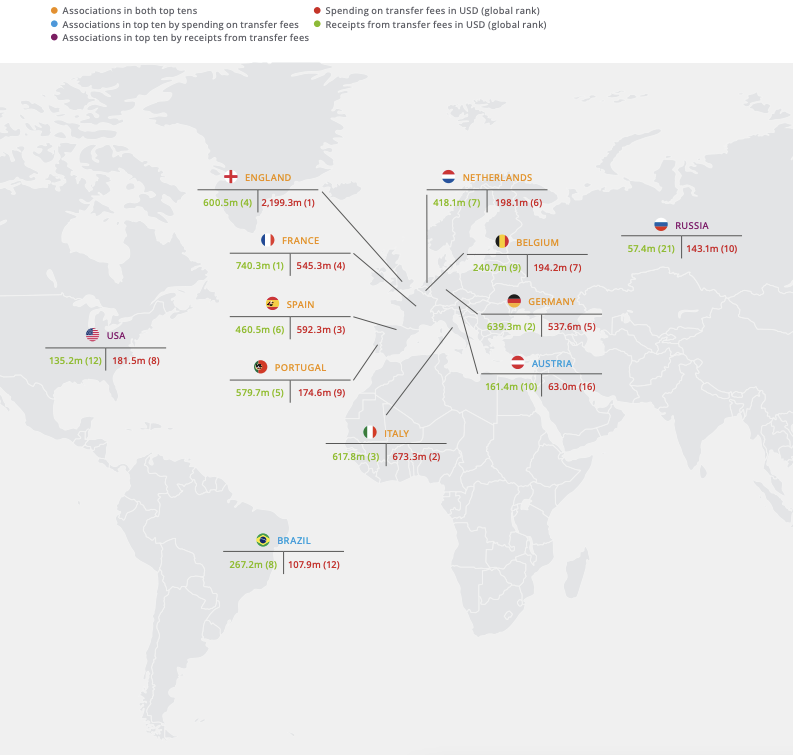
Figure 1: Distribution of associations by spending on and receipts from transfer fees in USD (2022) I Source: FIFA Global Transfer Report 2022

Navigating the German football transfer system involves not only understanding the transfer windows and their timing but also recognizing the varying landscapes within different divisions. While top-tier clubs rely heavily on established scouting networks, agents can find their niche in the lower divisions, presenting promising players to clubs eager to discover new talents. It’s important for agents to stay well-informed about the unique dynamics of each division and tailor their approaches accordingly.

Financial and payment details

When it comes to orchestrating football transfers in Germany, agents can enhance their success by strategically timing their deals, understanding the financial landscape, and navigating unique aspects of the German football market. In this comprehensive exploration, we delve into the intricacies that define successful transfer deals in Germany.

The optimal window for agents to strike deals in Germany is undoubtedly the summer transfer window. German clubs operate under a rather sustainable model, diverging from the trend of significant mid-season transfers observed in other countries. The January window sees German clubs reluctant to invest heavily in players unless major injuries or exceptional opportunities arise. The summer window, stretching from July to September, becomes the focal point for clubs to revamp their squads and secure talents for the upcoming season.

Figure 2: Top associations spending on and receipts from transfer fees in USD (2022) I Source: FIFA Global Transfer Report 2022

Player employment contracts in Germany share a standardized structure provided by the DFB (German Football Association). However, clubs customize these contracts by adding and modifying financial terms such as bonuses, image rights agreements, sell-on clauses, and agent commissions. Agents must navigate these intricacies while ensuring the contracts remain legally sound and aligned with German contractual and employment laws. Outsourcing specialized legal advice becomes crucial to avoid any surprises or disappointments.

A distinct feature of the German football market is its adherence to quoting financial details as ‘gross’ values. This varies from the net values often used globally. Agents negotiate gross deals, encompassing all financial elements. This can lead to unfamiliarity for agents accustomed to net deals, potentially causing confusion and costly mistakes. Clear understanding and mastery of this difference are pivotal for agents navigating the German football market effectively.

Professional footballers in Germany pay regular taxes as employees of a football club. Although their salary is by no means equivalent to that of an average employee, the same tax conditions also apply to them. The personal tax rate is then well above the average, so that professional footballers in Germany pay up to 45% in taxes. While subject to regular employee taxes, they also earn substantial income through advertising revenue. They structure this income as part of a sole proprietorship, leveraging their increased notoriety to amortize personal rights annually. This strategic move effectively reduces taxable income, allowing footballers to save on taxes. The intricate interplay between income, taxation, and advertising revenue creates unique opportunities and complexities in managing financial aspects for both players and agents.

Working Visa Requirements

The dynamics of foreign player regulations in the Bundesliga have undergone a significant transformation over the years, reflecting the shifting landscape of international professional sports and legal decisions that have shaped the playing field. Delving into the historical context, we unravel the journey of foreign player regulations in the Bundesliga, highlighting pivotal moments and legal decisions that have shaped the current framework.

At its inception, the Bundesliga had strict limitations on the number of non-German nationals allowed to participate. Initially, only two foreign players were permitted to play in the Bundesliga. This number increased to three in 1992, gradually hinting at a potential opening of doors for international talent.

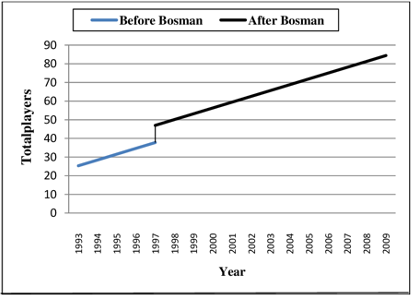
A landmark moment in the realm of European professional sports, the Bosman decision by the European Court of Justice (ECJ) in 1995 was a watershed moment. This ruling granted professional footballers within the European Union the fundamental freedom of movement for workers, effectively overturning existing regulations that placed restrictions on foreign players from other EU countries. This decision not only impacted football but also had far-reaching implications for foreign player regulations in various other professional sports.

Figure 3: The Impact of the Bosman-Ruling on the Number of Players Under Contract in Germany (Bundesliga) I Source: The Bosman Ruling: Impact of Player Mobility on FIFA Rankings, 2010

A pivotal turning point came during the 2006/07 season when restrictions on foreign player usage were generally lifted. An agreement between the League Association and the DFB facilitated the use of players from EU and UEFA member countries without limitations. While restrictions on EU players were lifted, the situation was different for non-European players.

The landscape further evolved with the introduction of regulations to promote local talent. Clubs were mandated to have a certain number of licensed German players under contract. In 2006/07, each club was required to have a minimum of four locally trained players under contract, and this number increased to six in 2007/08, and eventually to eight (4+4) since 2008/09. The definition of a club-trained player also stipulated specific criteria regarding eligibility during formative years, highlighting the commitment to nurturing talent within the local ecosystem.

Additional Points to Note

At the heart of German football lies a unique principle that sets it apart from many other leagues worldwide – the 50+1 rule. Embedded within the statutes of the DFL., the association representing 36 German professional clubs, this rule shapes the ownership structure of football clubs and ensures a distinctive approach to club governance and management.

The 50+1 rule was introduced in 1998 as part of a broader initiative to open license leagues to corporations. As football clubs spun off their professional operations into corporations to explore financing options and organizational integration with sponsors and stakeholders, the rule was established to maintain a balance between competitive sport and mass sport while preventing undue influence from external parties.

The essence of the 50+1 rule revolves around the principle of majority control and ownership. In essence, the rule stipulates that a corporation seeking a license to participate in the Bundesliga or 2. Bundesliga must have its parent club hold a majority stake in the corporation. This entails that the parent club must possess at least 50 percent of the voting shares along with an additional voting share in the shareholders’ meeting of the corporation. This ensures that the majority of decision-making power remains with the parent club, preserving the club’s intrinsic values and identity.

When a partnership limited by shares (KGaA) serves as the licensee, further nuances come into play. In this scenario, the parent club or a subsidiary entirely controlled by it must occupy the position of the general partner within the KGaA. Even if the parent association’s share of votes is less than 50 percent, the 50+1 rule can be satisfied if the parent association holds a comparable position to a shareholder with a majority interest in the corporation. This necessitates that the general partner holds comprehensive powers of representation and management granted by law.

Figure 4: Ownership structure in the Bundesliga I Source: KPMG Football Benchmark Research, 2020

The 50+1 rule is emblematic of German football’s commitment to maintaining a balanced and equitable approach to club ownership. By preserving majority control with the parent club, the rule mitigates the risk of external influences compromising the core values and long-standing traditions of the club. It ensures that the interests of fans, local communities, and the broader footballing ecosystem are prioritized over the pursuit of profit.

Contrary to initial perceptions, the Bundesliga’s position in terms of overall revenues is not as lagging as it might seem when compared to other prominent European leagues that have opened their doors to investors. While the gap in aggregate revenues compared to the English Premier League is considerable, the Bundesliga proudly stands as the second-highest revenue generator, surpassing both La Liga and Serie A, despite the latter leagues accommodating two more teams than the Bundesliga’s 18. This achievement is attributed to a distinct revenue distribution structure within the Bundesliga that ensures a more equitable distribution across its three primary sources of income. This balanced approach mitigates the clubs’ dependency on the substantial earnings derived from European club tournaments.

The Bundesliga’s unique stance in empowering fans plays a pivotal role in its success. Unlike other leagues, the Bundesliga allocates significant influence to fans, creating an environment that fosters a distinct stadium atmosphere, widely regarded as unparalleled among the top five European football leagues. This commitment to involving fans has yielded remarkable results, enhancing the overall experience for both supporters and players.

One of the remarkable hallmarks of the Bundesliga is its unparalleled attendance figures. With an impressive average of 43,000 tickets sold per game, the Bundesliga reigns as the world’s most well-attended football league. This speaks volumes about the league’s ability to draw fans to the stadiums, creating an electric atmosphere that resonates with the passion and dedication of football enthusiasts.

Summary

Completing a football transfer in Germany involves a deep understanding of the country’s specific regulations and practices. From the structured transfer system to financial considerations and high taxes, agents must navigate various complexities. This blog post serves as a starting point, offering valuable insights for experienced and aspiring football agents seeking success in the German football market.

Stay tuned for the next installment of our series, as we explore the unique intricacies of football transfers in different countries around the world. Whether you’re a seasoned agent or just beginning your journey, we’re here to equip you with the knowledge you need to succeed in the dynamic world of football transfers.

Guía Definitiva Para Escoger el Agente de Fútbol Adecuado Para Su Hijo

En este blog abordamos la agencia deportiva desde una perspectiva diferente. A través de los ojos de un jugador juvenil y su padre o representante legal que buscan firmar con un agente por primera vez.

La responsabilidad y decisión de firmar el primer contrato de representación con un agente es una de las decisiones más importantes para un jugador y su familia; particularmente sí es el primer agente con el que están firmando, siendo un jugador juvenil. Hemos notado que los recursos disponibles para que los padres y representante legal o guardián basen su decisión son incompletos. Por lo tanto, el objetivo de este blog es brindar una guía completa sobre el proceso de investigación, consideración, y firma con el primer agente para el jugador y su representante legal.

¿Cuándo Tener un Agente?

Antes que todo, es importante que el jugador y su familia entiendan cual es el momento indicado para tener un agente. La necesidad de tener un agente nace cuando hay detalles fuera de la cancha que tienen la necesidad de ser manejados y negociados. La responsabilidad del agente está en aliviar esta molestia del jugador y ayudar al desarrollo de la carrera de una forma calculada y direccionada. Por ejemplo, sí un jugador juvenil es muy bueno y varios clubes importantes ya están hablando con él, es probable que necesite un agente para asegurarse de obtener el mejor resultado de la situación. De la misma manera, un jugador que acaba de ser liberado por una muy buena academia y que esté buscando oportunidades en otros lugares, divisiones más bajas, o fuera del país, puede necesitar de un agente que lo ayude a encontrar la mejor opción. Sin embargo, es posible que algunos jugadores juveniles que ya obtuvieron una beca y no necesitan asistencia adicional, no firmen con un agente; pero pueden comenzar a establecer relaciones con los mismos para el futuro.

Un factor muy importante en el proceso ya sea por parte del jugador o su representante legal, es la paciencia. No existe una regla general o universal por parte de la FIFA que gobierne y dicte cuando un jugador puede firmar con un agente. Cada asociación miembro crea sus propias regulaciones. Por ejemplo, en Colombia no hay restricciones de edad; un jugador juvenil puede tener un agente a cualquier edad siempre y cuando su padre o representante legal este de acuerdo y firme el contrato de representación. Sin embargo, es importante tener en cuenta las reglamentaciones de cada asociación, ya que en algunas se exige una edad mínima para que los agentes puedan acercarse legalmente a jugadores juveniles. El factor común a lo largo de todas las asociaciones y el mayor error es que los jugadores y los padres se entusiasman con la perspectiva de tener un agente y se apresuran a firmar un contrato de representación inadecuado o con un agente que no está preparado para representar al jugador.

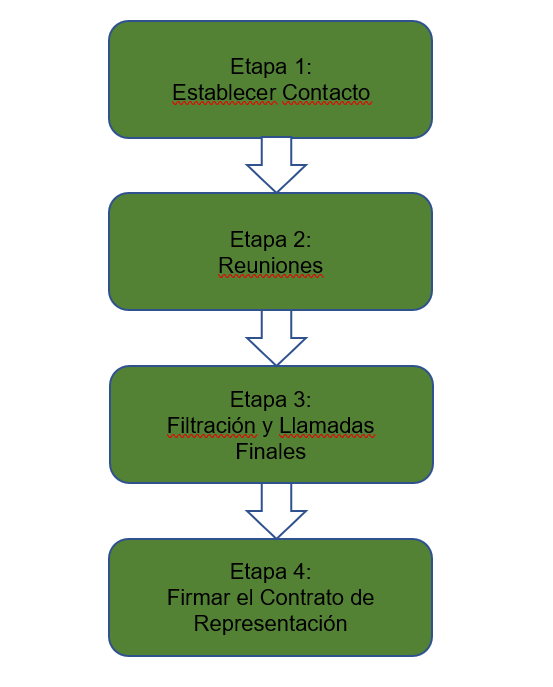
Etapa 1: Establecer Contacto

El proceso debe empezar contactando varios agentes que tengan un interés genuino en representar al jugador. En algunos casos, el agente contacta a los padres del jugador con el fin de tener una conversación, o posiblemente, son los padres quienes contactan al agente que ellos han escuchado, tenido referencias y consideran que es la persona correcta para representar a su hijo. Usualmente, los padres de otros jugadores que ya tengan agente dan referencias sobre el servicio del agente y lo recomiendan a otros padres. Es vital considerar diferentes opciones y entender la manera en la que los diferentes agentes y agencias operan, y la manera en la que cada una puede ofrecer diferentes servicios y beneficios. Las agencias grandes y pequeñas tienen sus ventajas y desventajas, todo depende de las circunstancias del jugador.

En este punto es importante plantear algo vital. En ninguna etapa del proceso de contratación debe intercambiarse dinero o regalos exorbitantes, ya que esto es una forma de ‘soborno.’ Algunos agentes les ofrecen dinero inmediato a los padres para que sus hijos firmen con ellos o algunos padres incluso lo solicitan.

Esto es sumamente peligroso y debe ser evitado por muchas razones. Primero, sí el dinero es superior a cierta cantidad, debe ser declarado a las autoridades fiscales ya que está sujeto a impuestos. Además, puede ser peligroso para los agentes ya que da una mala impresión para relaciones futuras y los padres puede que muevan a su hijo a otro agente a cambio de una cantidad más alta de dinero. Recuerden, el propósito de firmar con un agente es solo por el beneficio del jugador y no de los padres ni del agente, y el soborno lo contradice. Las consecuencias de esta decisión no valen la pena y el hecho de ‘vender’ el jugador a una agencia que paga la mayor cantidad de dinero por tenerlo, debilita el propósito de encontrar el mejor agente que beneficie la carrera del jugador.

Etapa 2: Reuniones

Durante el periodo de tiempo en el que el jugador y su familia encuentran el agente correcto, probablemente conocerán muchos agentes. En el caso de un jugador juvenil, debería ser mayor la responsabilidad de los padres encargarse de esto. Los 16 años son una etapa importante para el desarrollo de los jugadores, usualmente es cuando se les ofrece una beca en la academia y la necesidad de firmar inmediatamente con un agente no es del todo necesaria. De todas maneras, es importante que los jugadores y sus padres empiecen a conocer y a establecer amistades con agentes de interés para tener un mayor conocimiento del trabajo y las ofertas, en vez de que sea un acuerdo forzado justo antes de que el jugador firme su primer contrato profesional.

En esta etapa es fundamental empezar a desarrollar un conocimiento sobre el agente. Esto puede ser mediante reuniones en persona o reuniones digitales. Algunos de los aspectos fundamentales para fijarse son, que el agente sea una persona en la cual se puede confiar, transparente; que sea el tipo de persona con el cual el jugador y el padre o representante legal se sientan cómodos para trabajar, que el agente sea sociable e interesado en conocer padres, jugadores, y personas. También, que el agente tenga una extensa red de contactos en la industria, y que haya una estrategia clara para el trabajo que se hará con el jugador. La investigación informada es responsabilidad del jugador y su familia, lo cual les ayudara a tomar está importante decisión de la mejor manera. Esta investigación puede incluir contactar a otros padres que conozcan o trabajen con el agente y escuchar la experiencia de ellos y la calidad de los servicios ofrecidos. Por esta razón, es vital para los agentes tener una reputación intachable y darle la dedicación necesaria a cada cliente.

El fútbol es solo una parte de lo que un agente puede ofrecer. Los mejores agentes podrán demostrar que ellos brindan valor en otras áreas como la educación y desarrollo personal del jugador, construir y desarrollar las redes sociales al igual que otros tipos de mercadeo necesario para crecer la imagen personal del jugador, el apoyo mental que le dan a su cliente cuando tiene alguna lesión, y en el entorno de alta presión. En general, ayudarlos a convertirse en una buena y mejor persona.

Las reuniones con el fin de desarrollar las relaciones deben continuar a lo largo del proceso de selección e incluso después de él. Es más probable que se tome la mejor decisión después de haberse reunido en repetidas ocasiones y haber conocido los comportamientos del agente. El fin de estas reuniones es para conocer el agente personalmente y entender sus creencias, motivaciones, e intenciones. También, la confianza se ve más fortalecida.

Etapa 3: Filtración y Llamadas Finales

Mientras el proceso avanza, es posible que se haya empezado con muchos agentes y gradualmente se disminuya hasta quedar 2 o 3 restantes que han mantenido el interés y apuntan a ser las mejores opciones. El proceso de filtración se hace teniendo en cuenta los intereses y cumplimientos del criterio esencial del cual el jugador y su familia están buscando. Este proceso puede tener cualquier duración de tiempo, un par de semanas, un par de meses, o un par de años. Siempre y cuando el jugador y su familia estén suficientemente informados, hayan visto y entendido los intereses y servicios que el agente puede ofrecer durante el tiempo que han estado en contacto; el momento de firmar con el agente puede ser el apropiado. Preguntar por opiniones a entrenadores, familiares y amigos es vital para poder completar el proceso.

Un punto importante para tener en consideración en esta etapa es distinguir los roles entre el agente personalmente y la agencia para la cual ellos trabajan. Por ejemplo, las agencias grandes usaran sus agentes más reconocidos en el proceso de reclutamiento. Es importante establecer que ellos sean los cuales van a ser el contacto principal siguiendo el proceso. A menudo, una vez que el jugador ya este firmado, un agente más nuevo y con menos experiencia será el principal punto de contacto, y puede que no pueda cumplir las expectativas y el nivel de servicio el cual el jugador y su familia pensaron que recibirían. Recuerde que las agencias más grandes tienen una mayor cantidad de jugadores firmados y no hay tiempo suficiente en el día para poder darle a cada jugador la dedicación, cuidado y atención que se necesita. Asegúrese de establecer que usted o su hijo firmarán con un agente que se dedicara al jugador, en lugar de firmar con una agencia donde se convierte en “uno más de la manada,” a no ser que sea uno de los mejores jugadores que tengan en la agencia.

Sí no ha sido el caso, las etapas finales del proceso y las llamadas finales deben involucrar también al jugador. Al final del día, es el agente del jugador. La edad del jugador afectara la influencia que ellos tengan en la decisión. Sí el jugador es más joven, la orientación de los padres tendrá prioridad, pero a medida que un jugador crece, es más probable que el sepa cual agente es mejor para su proceso. Independientemente, involucrarlos al menos en las llamadas finales los ayudara a entender cada opción, los beneficios y posibles inconvenientes de cada uno. Las llamadas o reuniones finales, deben ser una discusión completamente informada, que le brinde al jugador y su familia la oportunidad de hacer cualquier pregunta o expresar cualquier otra inquietud antes de tomar la decisión final.

Etapa 4: Firmar el Contrato de Representación

Eventualmente, sin ninguna sensación de apuro o presión, la familia y el jugador pueden decidir por la mejor opción y entrar en un acuerdo de representación al firmar un contrato de representación con el agente. Sin embargo, cuando esta etapa llega, los padres o el jugador, dependiendo de la edad, deben contratar los servicios de un abogado para revisar y ofrecer orientación sobre el contrato de representación. Esto evitara que accedan de manera accidental a clausulas y condiciones desventajosas que crearan dificultades en el futuro. Es importante resaltar que la decisión final depende del jugador que está siendo representado. A menudo, la familia, los entrenadores y amigos podrán ayudarlos y guiarlos brindándole consejos.

Conclusión

Los agentes tienen el potencial de desempeñar un papel importante en el éxito de un jugador a lo largo de su carrera y pueden influenciar su trayectoria futbolística y éxito fuera del campo. Por lo tanto, la decisión de firmar un agente, como se ha demostrado en este blog, es de suma importancia y no debe tomarse a la ligera. Hemos demostrado que son muchos factores que deben ser considerados e identificados por el jugador y su familia cuando firman por primera vez con un agente. A menudo, sí está decisión se toma correctamente, el mismo agente permanecerá junto al jugador a lo largo de su carrera y se desarrollará una relación increíblemente productiva. Sin embargo, antes de entrar en el primer contrato de representación, se debe establecer confianza, comprensión y creencia en las capacidades y habilidades del agente. La decisión no debe ser apresurada bajo ninguna circunstancia y siempre se debe tener una opinión de un abogado para asegurarse de tener el mejor resultado.

Doing a Deal in England: FA Women’s Super League

A women’s football team stands hand in hand on the pitch before kickoff, facing the referees during a pre-match ceremony.

In our next installment of ‚How to Complete a Football Transfer Anywhere in the World,‘ we turn our attention to the world of women’s football in England, with a particular focus on the FA Women’s Super League. We’ll be taking a look at intriguing aspects associated with the FA WSL and guide you with information to operate as a successful agent within one of the most popular leagues in women’s football.

Introduction

Women’s football in England has witnessed a remarkable upswing in recent years. With the England Lionesses achieving impressive feats and the arrival of star players, the spotlight on club football in England has intensified. This surge in attention has turned the English women’s football league into an appealing destination for players from around the globe. In this chapter, we’ll break down the nitty-gritty of facilitating player deals in English women’s football, providing insights and practical advice for agents navigating this thriving landscape. Whether you’re a seasoned agent or just entering the field, this chapter equips you with the knowledge you need to excel in the world of women’s football in England.

Competitions Structure

England’s women’s football landscape features a comprehensive multi-tiered league structure, mirroring the structure found in men’s football in the country. At the pinnacle stands the prestigious Barclays FA Women’s Super League (WSL), home to prominent clubs like Arsenal, Chelsea, Manchester City, and Manchester United. These clubs have not only made substantial investments in their women’s teams but have also attracted exceptional talent, both domestically and globally. Household names like Alessia Russo, Sam Kerr, and Chloe Kelly grace the WSL, showcasing their exceptional skills and elevating the league’s appeal. Grasping the club hierarchy and recognizing standout players is pivotal for agents and players, influencing career decisions and transfer strategies.

Beneath the WSL, you’ll find the Women’s Championship, a dynamic league that accommodates a blend of fully professional and semi-professional teams, exemplifying the evolving landscape of women’s football in England. Operating on a promotion and relegation system, this tier offers clubs the chance to ascend to the esteemed WSL or grapple with the risk of relegation. The Championship also plays a critical role in nurturing young talent, with numerous WSL clubs using these Championship teams for youth player development, bolstering the sport’s growth across all levels.

Extending further down the football pyramid is the Women’s National League, serving as the fourth tier of women’s football in England. This tier is a pivotal developmental platform for emerging talents and smaller clubs, fostering growth and progression within the league structure. The regional setup significantly contributes to nurturing the future stars of the game while enhancing the overall vibrancy and competitiveness of women’s football in the country. This multi-tiered system creates a robust foundation for the sport’s continued growth, offering a pathway for players to rise through the ranks and reach the pinnacle of women’s football in England.

Youth Football Development

Youth football development stands as a cornerstone in the ongoing evolution of women’s football in England. Similar to the men’s game, nurturing young talents, providing them with opportunities for skill enhancement, and guiding them toward professional careers is a central tenet for clubs, academies, and the sport’s governing bodies. England’s academy system forms the bedrock of this development, as leading clubs, particularly those with women’s teams competing in the FA Women’s Super League, operate youth academies designed to shape aspiring female footballers. These academies not only focus on honing the technical and tactical aspects of the game but also emphasize academic education, ensuring that young talents receive a well-rounded upbringing. Operating on an age group structure that typically commences at under-9 or under-10 levels and advances to under-16 or under-18, youth players progress through a structured pathway designed to prepare them for the senior level.

As future stars emerge within the academy system, the role of football agents in representing youth players takes on increasing significance. Agents work to identify promising talents and negotiate their first professional contracts, ensuring that the players and their families receive fair and advantageous deals. Beyond securing contracts, agents serve as mentors and advisors, guiding young talents as they navigate the transition from the youth setup to senior football.

Their expertise in contract negotiations, transfer deals, and commercial opportunities proves invaluable in helping young players achieve a seamless progression into the competitive landscape of women’s football in England. This support is pivotal for young players, ensuring that they receive the best possible opportunities to succeed as they embark on their professional careers. The involvement of agents in youth football development contributes to a brighter future for the women’s game in England, allowing emerging talents to maximize their potential both on and off the field.

Transfer Structure

The transfer structure in England closely mirrors that of most leagues around the world. In the FA Women’s Super League (FA WSL), primary transfer windows typically open in the summer, commencing in late June and extending until mid-September, allowing clubs to conduct their primary business. Additionally, a secondary transfer window operates throughout January, offering a mid-season opportunity to make necessary adjustments.

The transfer dynamics in the FA WSL are defined by several striking trends. Renowned men’s clubs like Arsenal, Chelsea, Manchester City, and Manchester United often extend their dominance into the women’s league, engaging in high-profile acquisitions and substantial investments. Notably, a significant portion of incoming talent originates from the Damallsvenskan in Sweden, the Division 1 Féminine in France, the Frauen-Bundesliga in Germany, or domestic clubs within the FA WSL itself.

Transfer fees in women’s football have seen a consistent uptrend, underscoring the surging demand for elite talent. The financial commitment to women’s football has significantly elevated the market, exemplified by major FA WSL clubs shattering transfer fee records in their pursuit of standout players. For instance, during the summer transfer window in 2023, Manchester City made history by smashing the national transfer record, investing £300,000 in securing Dutch midfielder Jill Roord. Additionally, the overall transfer record was eclipsed when Keira Walsh moved from Manchester City to FC Barcelona in 2022 for a reported fee exceeding £400,000. As clubs continue their vigorous competition for top-tier talent, it is anticipated that transfer fees will maintain their upward trajectory, signifying the enduring growth and investment in women’s football for the foreseeable future.

However, it’s crucial to acknowledge the disparity in transfer power within the league. While big clubs may have the financial clout to make substantial signings, smaller clubs in the FA WSL often find themselves in a different transfer landscape, seeking cost-effective deals and focusing on player development. This dichotomy creates an intriguing dynamic, where players and agents must consider a variety of factors when making transfer decisions, including the ambition and resources of the club, the opportunities for playing time, and the potential for career growth.

Player Earnings

In the FA Women’s Super League (FA WSL), player salaries have experienced a notable uptick in recent years, marking a positive trend in the financial landscape of women’s football. While the structure of player compensation may not be as regimented as in the NWSL, the league’s increasing allure has led to improved financial prospects for players. This transformation can be attributed to a surge in investments and sponsorships pouring into the league, bolstering the financial standing of both clubs and individual players.

Prominent clubs such as Arsenal, Chelsea, Manchester City, and Manchester United have recognized the talent and popularity of their players and have set a high bar for player salaries. For instance, top players like Vivianne Miedema, Lauren Hemp, and Ella Toone, Bethany England, have negotiated lucrative contracts that reflect not only their on-field excellence but also the marketability and growing fanbase of women’s football. These players serve as beacons of success for those aspiring to carve out a career in the FA WSL, demonstrating that significant financial rewards are attainable as the league’s prominence continues to ascend.

Moreover, the rise of endorsement deals and off-field prospects has become more conspicuous, enabling players to diversify their income streams beyond their playing contracts. As the FA WSL continues to draw the interest of prominent brands and media exposure, players who possess robust personal brands and marketability are poised to explore a wide array of lucrative off-field opportunities. A prime illustration of this phenomenon is evident in the case of Sam Kerr, the star forward for Chelsea and the Australian national team. Regarded as one of the league’s premier talents, Kerr’s reported annual salary of $3.3 million in 2022 is predominantly derived from partnerships with major corporate entities such as Nike, Electronic Arts, and Mastercard.

Visa Requirements

Eligibility for obtaining a visa to play in the FA Women’s Super League (FA WSL) is a crucial aspect that players and clubs must consider for a legitimate entry into the league.

To be eligible for an FA WSL visa, players must meet certain criteria. They must be affiliated with a club that holds membership in the FA WSL and has a valid Sponsor’s license, allowing the issuance of Certificates of Sponsorship for players.

For players themselves, international experience is a key factor. They should have represented their country in at least 75% of competitive women’s ‘A’ team matches during the two years before their visa application. The player’s home country should also have a FIFA World Ranking of 40th place or higher, indicating the country’s competitiveness in women’s football.

Obtaining a Governing Body Endorsement (GBE) is a necessary step. This endorsement confirms that the player meets the criteria for entry into the UK to participate in the FA WSL and can significantly contribute to the development of women’s football in England.

The length of the visa varies based on the player’s employment tier. Tier 2 Sportspersons may receive a visa for the length of their contract or up to three years. Tier 5 Temporary players usually receive visas for up to 12 months.

Players’ employment contracts are closely scrutinized. The contract terms, including salary and length, should match those offered to resident workers in similar positions.

Adhering to these requirements ensures a smooth visa application process, which is subject to thorough review by the Home Office and relevant governing bodies. Keeping track of changes in visa and immigration regulations is also essential for continued eligibility in the FA WSL.

Post Career Planning

For agents working closely with accomplished women’s football players in the FA Women’s Super League (FA WSL), a pivotal responsibility lies in orchestrating a seamless transition from their professional playing careers to life beyond the pitch. Even for the most successful athletes, football careers have a finite duration. Therefore, it’s imperative to ensure that your clients’ post-football lives are as enriching as their time on the field. This entails collaboratively crafting a comprehensive transition plan that encompasses various facets, including career options, educational pursuits, and investment strategies. By addressing these factors proactively, you can play a vital role in assisting your clients as they embark on a new, purposeful chapter in their lives.

Post-career planning is a facet that can easily be overshadowed by the demands of the current playing season. Nevertheless, for agents working with established women’s players in the FA WSL, it represents an essential aspect of their role. Ensuring that your clients are equipped with the necessary tools to navigate this transition gracefully is of utmost importance. This might involve identifying potential career paths, arranging internships, and work opportunities, or even exploring entrepreneurial ventures that align with your client’s interests and strengths. Furthermore, placing a strong emphasis on financial planning is essential to secure their future and ensure a comfortable post-football life.

Many established players in the FA Women’s Super League (FA WSL) naturally gravitate towards coaching or management roles within the women’s football realm as a logical step in their careers. As their agent, you play a crucial role in facilitating this transition by providing them with opportunities to acquire coaching licenses and enroll in management courses. This proactive approach not only allows your clients to extend their footballing legacy but also nurtures their post-playing careers purposefully and constructively.

A shining example of this transition is the remarkable journey of former England and Arsenal player, Casey Stoney. She successfully navigated the shift from her illustrious playing career to a coaching career by starting at the helm of the Manchester United women’s team. Today, she is widely celebrated as one of the most esteemed coaches in women’s football, with her talents recognized as she coaches at San Diego Wave FC in the National Women’s Soccer League (NWSL). Casey Stoney’s story underscores the incredible potential for your clients to thrive in coaching and management roles after their playing days in the FA WSL.

Another common industry many players transition into is the media side, where players often serve as pundits, presenters, or analysts. Leveraging their deep understanding of the game, these former athletes provide insightful commentary and expert analysis, enhancing the viewer’s understanding of the sport. Their unique perspective as former professionals adds authenticity and credibility to their roles. In doing so, they not only stay closely connected to the sport they love but also contribute to its growth and popularity by engaging fans and enhancing the overall viewing experience. Prominent examples of successful transitions into the media include former FA WSL stars like Jill Scott, Alex Scott, and Eni Aluko, who have become household names in the football broadcasting world. Their journeys serve as inspiration for players looking to make a smooth transition to a fulfilling post-playing career in the media.

In the world of women’s football, players and agents must remain proactive in seeking out skill development opportunities. For established players in the FA WSL, the continual growth and refinement of their footballing knowledge and skills are of paramount importance. This may entail enrolling in advanced coaching courses, participating in mentorship programs, or exploring other avenues for professional development. As an agent, you must connect your clients with these opportunities, guaranteeing that they continue to evolve as football professionals and set the stage for a flourishing post-playing career.

Future Outlook

The FA Women’s Super League (FA WSL) stands at the forefront of the global women’s football landscape, driven by increasing popularity and substantial financial growth. From the league’s inception to its contemporary status, women’s football in England has witnessed an inspiring transformation. The journey from being considered an afterthought to a burgeoning football powerhouse has been nothing short of remarkable.

Today, the FA WSL boasts some of the world’s most illustrious clubs, with Arsenal, Chelsea, Manchester City, and Manchester United leading the way. These clubs not only invest heavily in their women’s teams but also attract remarkable talents from around the world. Players like Vivianne Miedema, Lauren Hemp, and Ella Toone exemplify the pinnacle of women’s football, both in terms of their on-field prowess and marketability.

In the coming years, we can anticipate a continued rise in the prominence of the FA WSL. As young talents continue to ascend, they will not only shine on the pitch but also leverage the league’s growing reputation to secure lucrative endorsement deals and explore a multitude of off-field opportunities. The idea of seeing these players on magazine covers, endorsing major brands, and inspiring the next generation of female footballers is within reach. As the FA WSL flourishes, the future holds great promise for the league’s players, offering a dynamic environment for their careers to thrive.

For agents, being involved in the FA WSL is an important opportunity to shape the careers of these emerging stars, navigate the evolving landscape of women’s football, and facilitate groundbreaking deals. The league’s transformation presents an exciting challenge for agents who aim to connect their clients with top clubs, lucrative endorsements, and other off-field ventures. The commitment to gender equality demonstrated by the Football Association’s announcement of equal pay for both England’s men’s and women’s national teams adds another layer of significance to the journey of women’s football, making it more critical than ever for agents to play a pivotal role in fostering equity and inclusivity.

In conclusion, the FA Women’s Super League continues to evolve and serve as a powerful beacon of progress in women’s football. Its past achievements and present successes are the foundation upon which the future of the sport is being built. As the league’s popularity surges and finances grow, it not only elevates the players but also promises a brighter, more equitable future for women’s football, where dreams are nurtured and champions are celebrated, both on and off the pitch. For agents, the FA WSL is not only an arena of opportunity but a platform to contribute to the continued rise of women’s football.


The Parents Week – Edition 66

Delivered every other Wednesday.

Subscribe