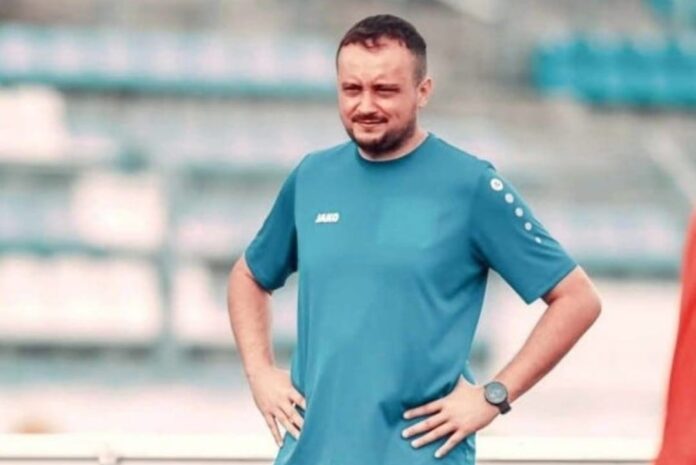
Coach Slawomir Morawski applying cognitive training principles during a professional football session.
Modern football has evolved far beyond physical prowess and technical skill. At its highest level, the game is increasingly defined by something less visible yet equally decisive: cognitive ability. Slawomir Morawski, an expert in player development, has dedicated his career to exploring how cognition influences performance and how targeted training can unlock untapped potential in elite players.
Understanding Cognitive Training
Cognition encompasses the mental processes that allow us to perceive, process, store, and use information. In football, it forms the foundation of communication between a player and their environment. The game is a constant exchange of information — space, time, teammates, opponents, and the ball all interact in real time. Without mastering the flow of information, achieving consistent high-level performance becomes nearly impossible.
Morawski’s approach departs from traditional training methods that rely heavily on replication and pre-scripted solutions. Instead, his methodology stimulates players to analyze, observe, and discover solutions collaboratively. “It’s about stimulating development through simulation and shared analysis rather than instructing players to simply repeat patterns,” Morawski explains. “We aim to help them understand the game in its real conditions.”
The Crucial Skills: Vision and Decision-Making
Among all cognitive tools, scanning the field stands out as fundamental. Effective decision-making begins with a constant search for information — reading the environment, adjusting body positioning, managing space, and anticipating physical contact. According to Morawski, isolated drills often fail to produce lasting improvements because they lack real-game logic. “Simply telling a player to scan before receiving the ball creates a short-term effect,” he says. “Without understanding why scanning matters, players revert to old habits. That’s why we use video analysis to recreate real contexts, discuss alternative solutions, and then simulate these situations during training sessions.”
This integrated approach ensures that cognitive tools are not learned in isolation but in direct connection with in-game realities, enabling players to make decisions more accurately and swiftly under pressure.
Inside Individual Sessions
While Morawski prefers not to disclose specific drills, he offers insight into his 1-on-1 sessions with professionals. Post-match analyses serve as a foundation, focusing on a dozen or so pivotal moments. The process is collaborative: rather than prescribing solutions, Morawski and the player explore possibilities together, examining which cognitive tools might have been missing and how they can be applied moving forward.
Confronting Cognitive Limitations
Developing football intelligence is a demanding journey. Unlike physical training, where results can be measured quickly, cognitive progress requires a cycle of experience: playing, analyzing, understanding, adapting, and playing again.
“For some players, this process feels overwhelming, as breaking old habits is never easy,” Morawski observes. “But for many, it’s like discovering a missing piece of the puzzle. A small change in cognitive awareness can have a huge impact on the quality of their game.”
The Future: Technology and Authentic Training Environments
Looking ahead, Morawski sees significant potential in technology, particularly artificial intelligence and advanced video analysis. Tools that visualize game situations with greater clarity can accelerate learning and make complex concepts accessible. Yet, he cautions against relying solely on technology.
“Football intelligence develops best in environments that mirror the real nature of the sport,” he emphasizes. “True progress requires the pressure of time, space, teammates, opponents, and the constant pursuit of scoring goals. Technology should support this process, not replace it.”
Vural Durmuş, a leading athletic performance coach for Galatasaray and the Turkish National Team, has built a career shaping elite players’ fitness and development.
Vural Durmuş Kimdir?
Amatör seviyelerdeki futbolculuk geçmişinden sonra Spor Bilimleri alanında üniversite eğitimini tamamlayıp atletik performans antrenörlüğüne adım attım. Yaklaşık olarak 15 yıldır profesyonel seviyedeki üst düzey futbol takımlarda çalışmaktayım. Şu anda Galatasaray Futbol A Takımı’nda tam zamanlı olarak, A Milli Futbol Takımında ise kamp dönemlerinde çalışmaktayım.
Öğrencilik dönemimde her yaş grubu ve seviyedeki amatör kulüplerde antrenör görev yaptım. Üniversite mezuniyeti sonrasında okuldan çok değer verdiğim bir hocamın öncülük ettiği bir projeyle birlikte 2013 yılında Galatasaray Futbol Akademisinde atletik performans antrenörü olarak göreve başladım. Yaklaşık altı aylık süre zarfından sonra Roberto Mancini döneminde A Takımdaki ekibe destek vermeye başlayarak profesyonel seviyeye ilk adımlarımı atmış oldum. Devam eden süreçte beş yıl boyunca a takım teknik ekiplerinde kulüp adına atletik performans antrenörü görevini üstlendim.
Bu dönem içerisinde sırasıyla Roberto Mancini, Cesare Prandelli, Hamza Hamzaoğlu, Mustafa Denizli, Jan Olde Riekerink, Igor Tudor, Fatih Terim gibi üst düzey teknik adamlarla ile birlikte göre yaptım. Süreç içerisinde 2 Türkiye Süper Ligi, 2 Türkiye Süper Kupası ve 4 Türkiye Kupası şampiyonlukları yaşadım.
2017-2018 sezonu sonunda kazanılan şampiyonluk sonrası Galatasaray’dan ayrıldım. Kasımpaşa’da Mustafa Denizli ve Tayfur Havutçu teknik ekiplerinde atletik performans antrenörü olarak görev yaptım.
Pandemi başlangıcıyla birlikte bir buçuk yıl boyunca sadece profesyonel seviyedeki futbolcularla özel antrenman ve sakatlık sonrası sahaya dönüş programlarına yoğunlaştım.
Ekim 2021’de, dönemin Milli Takımlar Sorumlusu Hamit Altıntop’un davetiyle A Milli Futbol Takımı’nda, teknik direktör Stefan Kuntz yönetimindeki ekibe katıldım. Daha sonra göreve gelen Vincenzo Montella ve ekibiyle birlikte de çalışmalarımı sürdürdüm. Bu dönemde yalnızca A Milli Takım Atletik Performans Antrenörlüğü değil, aynı zamanda Milli Takımlar Atletik Performans Departmanı Sorumluluğu görevini de üstlendim.
2024 Avrupa Futbol Şampiyonasından sonra Galatasaray’dan almış olduğum teklifi değerlendirerek Okan Buruk liderliğindeki teknik ekibe katıldım ve görevime devam etmekteyim.
UEFA A Lisansı ve TFF Atletik Performans Antrenörlüğü diplomasına sahibim. Ayrıca, Hareket ve Antrenman Bilimleri alanında yüksek lisans eğitimimi tamamlamış bulunmaktayım.
Milli Takım’da çalışmak nasıl bir duygu?
Milli Takım’da görev almak, kelimelerle tam olarak ifade edilmesi zor, içinde birçok özel duyguyu barındıran çok kıymetli bir deneyim. Bu mesleğe ilk adım attığımda, hedeflerimin en üst sıralarında Milli Takım’da görev almak vardı. O hayalin gerçekleştiği an, hayatımda unutamayacağım anlardan biridir.
İlk kamp davetini aldıktan sonra, Riva’daki Milli Takımlar Tesisleri’nde bana özel bir oda tahsis edildi. Malzemelerim gelene kadar odada beklerken heyecan içindeydim. Ardından antrenman ekipmanlarını giyip aynaya baktığım o anda, ne kadar büyük ve anlamlı bir sorumluluğun beni beklediğini daha derinden hissettim. O anı hiçbir zaman unutamam.
Benim için bu görev sadece bir mesleki başarı değil; aynı zamanda çok büyük bir onur ve sorumluluk. Ay-yıldızlı formayı temsil etmek için mücadele eden oyuncularla aynı sahada olmak, o atmosferi solumak tarif edilemez bir motivasyon kaynağı. Her kamp dönemi hem fiziksel hem de duygusal anlamda yoğun geçiyor. Ülke adına sahaya çıkan bir yapının bir parçası olmak, yaptığımız her çalışmaya farklı bir anlam yüklüyor. Bu bilinçle, görevimi layıkıyla yerine getirmek için elimden gelenin fazlasını vermeye çalışıyorum.
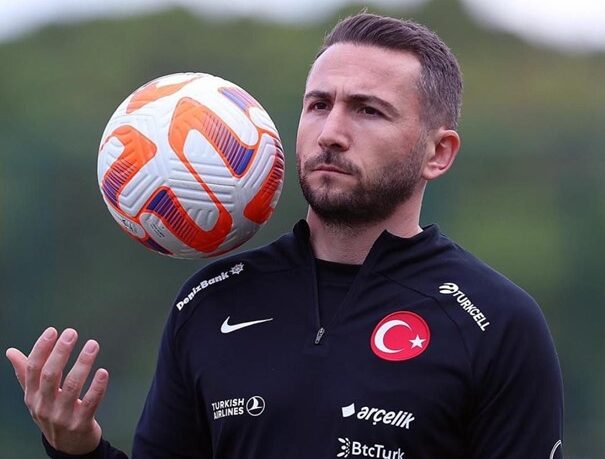
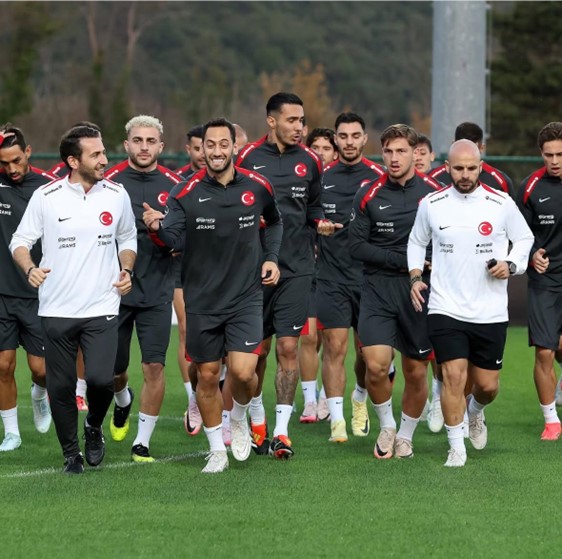
Hakan Çalhanoğlu ve A Milli Takım ile hazırlık kampında
Milli Takım’da sadece oyuncular değil, teknik ve destek ekipleri de kendi alanlarında en iyi isimlerden oluşuyor. Türk pasaportuna sahip en iyi futbolcularla çalışıyorsunuz ve bu da işin çıtasını her anlamda yukarıya taşıyor. Her oyuncunun gelmek istediği, her anının kıymetli olduğu özel bir yer burası.
Son olarak şunu da söylemeden geçemem: Tarihimizde ilk kez Avrupa Şampiyonası’na grup lideri olarak katıldık. Şampiyonaya hazırlık sürecinde 45 gün boyunca kamptaydık ve bir an bile yorulduğumu hissetmedim. Genç, potansiyeli yüksek, birbirine bağlı bir oyuncu grubuyla bir hedefe yürümek, insana çok büyük bir güç ve motivasyon veriyor.
Paylaştığınız bu değerli ve birleştirici bilgiler için teşekkür ederim. Ancak dışarıdan bakıldığında, zaman zaman eleştiriler de gündeme geliyor. Özellikle sezon içinde birbirleriyle tartışma yaşayan oyuncuların Milli Takım’da başarılı olamayacağına dair bir algı oluşuyor. Siz bu konuda ne düşünüyorsunuz?
İlk olarak şunu çok net ve altını çizerek ifade etmek gerekiyor ki: Milli Takım ortamı, kulüplerdeki yarışma rekabetlerinin ya da kişisel anlaşmazlıkların çok uzağında, ülke için bir araya gelinen ve tüm paydaşların ortak bir hedefe hizmet ettiği çok özel bir yapıdan oluşmaktadır. Kulüp sezonu boyunca rekabet yaşanması ve bu doğrultuda doğal olarak sahada zaman zaman gerilimler yaşanabilir. Ancak profesyonel seviyedeki oyuncular bu ayrımı yapabilecek ve bu süreçleri en iyi şekilde yönetebilecek olgunlukta ve bilinçte oluyorlar.
Tüm bu durumları göz önünde bulundurarak biz teknik ekip olarak, oyuncularımızın bireysel özelliklerini, saha içi ve dışı davranışlarını çok iyi tanıyor ve gözlemliyoruz. Kampa gelen her oyuncu, oraya hangi formayla geldiğiyle değil, Ay-Yıldızlı formayla mücadele etmek için geldiğinin farkında oluyor. Zaten Milli Takım kültürü dediğimiz şey tam da bu farkındalık üzerine, inşa edilmiş durumda.
Elbette takım içinde zaman zaman problemler yaşanabilir. Bu kaçınılmaz ve dünyadaki bütün takımlar için geçerli bir durum. Zira 35 kişilik oyuncu kadrosu ve teknik idari ekiple birlikte yaklaşık 60-70 kişiden oluşan bir ekipte, herkesin birbirini sevmesi mümkün değil ama saygı gösterip aynı hedefe yürümesi mümkün olabilecek bir durum. Önemli olan, bu farklılıklardan oluşan bu ekibi nasıl yönettiğiniz.
İyi bir yönetim anlayışı, başarıya giden yolda belirleyici oluyor. Oyuncularımızın hepsi çok yetenekli ve yüksek seviyede performans gösterme potansiyeline sahipler. Ancak yalnızca yetenek yetmiyor; takımın dinamiklerine uyum sağlamak, oradaki ortama adapte olmak ve aidiyet duygusunu hissetmek de en az teknik kapasite kadar önemli. İşte bu duyguyu oluşturabildiğinizde, saha içinde de gerçek bir bütünlük ve organizasyonla birlikte başarı kendiliğinden geliyor.
Galatasaray’da ve A Milli Takım’da aynı anda görev yapıyorsunuz. Bu iki önemli sorumluluğu üstlenmek ve aralarındaki koordinasyonu sağlamak sizin için nasıl işliyor?
İki büyük ve üst seviyede mücadele edilen bir yapının içinde aktif görev almak, hem ciddi bir sorumluluk hem de çok özel bir deneyimler barındırıyor. Bu noktada en önemli unsur, zaman yönetimi, planlama ve iletişim. Galatasaray’daki tam zamanlı görevimle birlikte, A Milli Takım’da kamp dönemlerinde görev alıyorum.
Her iki yapı da profesyonellik düzeyi çok yüksek organizasyonlar. Bu da işimi kolaylaştıran bir faktör. İletişim kanallarımız açık, ihtiyaçlar net, roller belli. Milli Takım’da bulunduğum dönemlerde kulüp tarafıyla sürekli temas halindeyim.
Açık konuşmak gerekirse, bu iki yapı arasında görev yapmak, bazen yorucu olabilir ama mesleki tatmini çok yüksek. Çünkü her iki tarafta da ülkenin en üst düzey sporcuları, antrenörleri ve profesyonelleriyle birlikte çalışıyor olmak birçok anlamda fark yaratan bir durum. Böyle bir ortamda yer almak hem gelişim hem de kariyer basamaklarım açısından çok kıymetli. Bu görevlere layık olmak için sorumluluğumun farkında olarak hareket etmeye çalışıyorum.
Sezon içerisinde oluşan yoğun tempo içerisinde Milli Takım’daki görevimi sorunsuz yürütmem konusunda kulübümün desteğini her zaman hissediyorum. Milli Takım’da birlikte çalıştığım teknik ekipte bu konulara çok fazla saygı gösteriyor ve karşılıklı koordinasyonu sağlayarak sorunsuz çalışıyoruz. Galatasaray’dan teklif aldığımda görüşürken milli takım sürecini devam ettirmek isteğimi belirttim ve bu konu Okan Buruk tarafından memnuniyetle karşılanırken son kararımı vermemde etkili olan konuların başındaydı. Vincenzo Montella ve ekibi de, kulüp tarafında herhangi bir sorun yaşanmadığı sürece benimle devam etmek istediklerini açıkça ifade ettiler.
Zaten Milli Takım süreçleri, sezonun belli dönemlerine denk geliyor ve genellikle 8–10 günlük kısa kamplar şeklinde ilerliyor. TFF, kamp başlamadan önce kulüplere resmi yazıyla bilgilendirme yapıyor. Kulüpteki görevime devam ederken ekip arkadaşlarım bana büyük destek sağlıyor; kampta olmadığım dönemlerde gerektiği yerde uzaktan oyunculara destek vermeye devam ediyorum.
En kritik konu ise şu: Hem Galatasaray’da hem de A Milli Takımda teknik direktörlerin liderliğinde koordinasyon içerisinde işleyen belirli düzenler mevcut. Bu güçlü koordinasyon sayesinde her iki tarafla da verimli bir şekilde çalışmak mümkün oluyor.
Milli Takım’da yalnızca Türkiye’de oynayan oyuncularla değil, aynı zamanda Avrupa’nın en büyük kulüplerinde forma giyen oyuncularla da çalışıyorsunuz. Örneğin Hakan Çalhanoğlu (Inter), Kenan Yıldız (Juventus), Arda Güler (Real Madrid) gibi isimler… Bu oyuncularla Türkiye’deki futbolcular arasında ciddi farklar görüyor musunuz?
Bu soru aslında en çok karşılaştığım sorulardan biri. Avrupa’nın elit kulüplerinde forma giyen oyuncularla çalışmayı çok değerli ve özel bir deneyim olarak görüyorum. Bu oyuncular, sadece teknik-taktik olarak değil, mantalite ve çalışma kültürü açısından da belirli bir seviyeye ulaşmış oluyorlar. Ancak bu durum, kesin olarak “Avrupa’da oynayanlar daha iyi” gibi bir genellemeyle açıklanamaz. Türkiye’de de hem fiziksel hem de taktiksel olarak çok iyi seviyeye ulaşmış, kendine çok iyi bakan, yüksek profesyonellikte oyuncularımız var. Fiziksel anlamda değerlendirme yapacak olursak bahsettiğiniz oyuncularımızla Türkiye liginde mücadele eden benzer pozisyondaki oyuncular arasında ciddi farklılıklar görmüyorum. Tabii ki Avrupa takımlarındaki sistem ve oyun planı oyuncuları daha farklı seviyelere çıkartabiliyor.
Son yıllarda ülkemize gelen kaliteli yabancı teknik ekipler ve elit seviye futbolcuların öncülüğünde, Türkiye liginde mücadele eden oyuncularımızın da hem oyun kalitesi hem de profesyonel yaklaşımı ciddi anlamda gelişim gösterdi. Bundan yaklaşık 15 yıl öncesine baktığımızda, gerçekten Avrupa ile Türkiye arasında belirgin farklar vardı. Ancak son yıllarda ülkemize gelen kaliteli yabancı futbolcular ve teknik direktörler sayesinde, Türk futbolunun hem oyun kalitesi hem de profesyonel yaklaşımı ciddi anlamda gelişti.
Bu gelişim yalnızca oyuncu kalitesiyle sınırlı kalmadı; Türk antrenörlerin de farkındalık seviyesi yükseldi. Bu sayede modern antrenman teknikleri antrenman öncesi yada sonrası ekstra çalışmalar gerektirdiğinden oyuncularımız artık daha bilinçli ve birçok konuda eskiye göre daha açık durumdalar.
Basit bir örnek vermek gerekirse, Türkiye’de bir takımda oynayan bir oyuncu ile Avrupa’da top koşturan bir başka oyuncu Milli Takım kampında buluştuğunda, kendi aralarında doğal olarak deneyim ve bilgi paylaşımı yapıyorlar. Takımların nasıl çalıştığını, seyahat düzenlerini, kamp organizasyonlarını konuşarak öğreniyorlar ve bu da genel bilinç düzeyini artırıyor.
Galatasaray’da görev yaptığım dönemleri göz önünde bulundurarak birçok üst düzey teknik adamla çalışma fırsatı buldum. Onların uyguladığı antrenman sistemleri ve çalışma düzenleri, daha önce Türk futbolunda çok da yaygın olmayan yapılar sunuyordu. Bu sistemleri uygulayıp pozitif çıktılar aldığımızda, biz de bu düzenleri sahiplenmeye başladık. Aynı şekilde Avrupa’dan gelen bazı oyuncuların bireysel antrenman yaklaşımları ve alışkanlıkları, bizim için de örnek teşkil etti. Bu da doğal olarak antrenörlük pratiğimizi geliştirdi.
Son yıllarda ülkemizde UEFA ve TFF’nin birlikte düzenlediği antrenör eğitimlerinin güncellenmesiyle birlikte, Türkiye’deki antrenörlük yaklaşımı da ciddi anlamda modernize edildi. Antrenman sistemleri Avrupa standartlarına çok yaklaştı. Ancak bu noktada kültürel farklılıkları da göz ardı etmemek gerekiyor. Bizim doğuştan gelen ya da çevresel olarak şekillenen bazı alışkanlıklarımız var. Zaman zaman bu alışkanlıkları kırmakta zorlanıyoruz. Yani antrenman içeriği ve yoğunluğu açısından Avrupa ile benzer şeyler yapılıyor olabilir ama işin futbol dışı, kültürel kısmı süreci biraz zorlaştırabiliyor.
İyi futbol oynanan ve organizasyonu olan ülkelerle ne kadar fazla temas hâlinde olursak – ister teknik adam, ister oyuncu transferi, ister veri paylaşımı anlamında – bu durum Türkiye’deki ligin organizasyonel yapısını da o kadar olumlu etkiliyor. Altyapıdan başlayarak Süper Lig’e kadar uzanan yapı ne kadar doğru inşa edilirse, biz de ülke olarak o kadar ileri gidebiliriz. Ancak şu anda bu organizasyonel yapının hâlâ gelişim sürecinde olduğunu da belirtmek gerekir. Hâliyle bir tarafı toparlarken, başka bir tarafı eksik bırakmak gibi durumlar da yaşanabiliyor.
Teknik direktör, yardımcı antrenörler ve sağlık ekibiyle iş birliğinizi nasıl yürütüyorsunuz? Sizce performans odaklı bir ortamda ortak bir dil oluşturmanın ve güven inşa etmenin rolü nedir? Ayrıca karakter olarak birbirinden çok farklı teknik direktörlerle çalıştınız. Bu çeşitliliği nasıl yönettiniz?
Modern futbolda başarı artık sadece sahadaki 11 oyuncunun performans göstermesiyle değil, kulüp ya da milli takım çatısı altındaki görev yapan tüm birimlerin birbiriyle olan uyumuna ve çalışma düzenine bağlanmakta. Bu anlamda teknik direktör, yardımcı antrenörler, performans, analiz ve sağlık ile destek ekipleri arasında kurulan iletişim yapısı ve koordineli çalışma çok kritik ve belirleyici bir öneme sahip.
Ben kendi görev alanımda, her zaman bilgiyi objektif olarak paylaşan, açık iletişimi önceleyen ve şeffaf bir yaklaşımı tercih ediyorum. Performans verilerinin doğru değerlendirilmesi, oyuncu yüklemelerinin planlanması, sakatlık riskinin yönetilmesi, sakatlık sonrası sahaya dönüş gibi konular ortak bir anlayış gerektiriyor. Bu da ancak karşılıklı güven ve ortak bir dil ile mümkün. Teknik ekiplerle aramızda güvene dayalı bir köprü kurulduğunda, karar süreçleri de çok daha sağlıklı olup sürdürülebilir hale geliyor.
Roberto Mancini’den Fatih Terim’e, Prandelli’den Igor Tudor’a güncel olarak Okan Buruk ve Vincenzo Montella dahil olmak üzere farklı karakterde ve anlayışta teknik direktörlerle çalıştım. Bu süreçlerde çok farklı yaklaşımları deneyimleme şansım oldu. Bu deneyimlerin çıktıları benim için çok değerli öğretilerden oluşan ve adeta her zaman yanınızdan ayırmamanız gereken bir başucu kitabı gibiydi. Her teknik adamın oyun anlayışının, iletişim tarzının ve beklentilerinin birbirinden farklı olması, sizin bu farklılıklara uyum sağlayıp birlikte çalışabilmeniz birçok anlamda farklı pencereler açılmasına ve gelişiminize olanak sağlıyor.
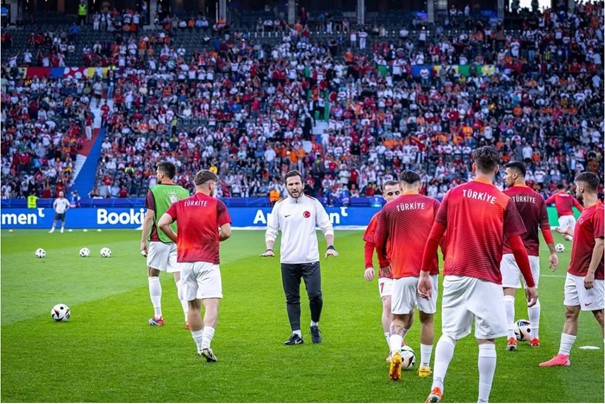
Vural Durmuş, Euro 2024 öncesi A Milli Takım ile maç öncesi ısınmada
Teknik ekiplerdeki işleyiş genellikle belli bir sistem üzerinden ilerler. Özellikle yardımcı antrenörler, teknik direktörler kadar önemli bir rol üstlenirler. Çünkü yardımcı antrenörler, teknik adamın iş yükünü azaltan, diğer birimlerle olan organizasyonu sağlayan ve hem ekip içi hem de oyuncularla iletişimi yöneten ana figürlerdir.
Sağlık ekibi yapısına değinecek olursak genel olarak sağlık kurulu sorumlusu doktor liderliğinde fizyoterapist ve masörlerden oluşmaktadır. Ekip olarak oyuncuların antrenman ve maçlara en iyi ve sağlıklı şekilde hazırlanmaları konusunda kritik bir öneme sahiptirler. Sakatlık riski bulunan oyuncuların tespiti, koruma programları, sakatlanan oyuncuların tedavileri, rejenerasyon çalışmaları gibi konularda teknik ekibe her zaman bilgi akışı sağlamaktadırlar.
Örneğin, sakatlık sonrası sahaya dönüş sürecinde bir oyuncunun o günkü antrenmanın hangi bölümüne katılacağını, hangi bölümde bireysel çalışmaya geçeceğini yardımcı antrenörle önceden konuşup planlıyoruz. Bu noktada sağlık ekibiyle olan iş birliği de büyük önem taşıyor.
Bu sürecin doğru işlemesi için ekip içindeki iletişim hayati öneme sahip. Hızlı, şeffaf ve profesyonel bir iş birliği olmadan bu geçişlerin verimli sonuçlar doğurmasını beklemek çok mümkün olmuyor. Milli Takım’da da benzer bir yapı geçerli, ancak oradaki kamp süreleri daha kısa olduğu için aksiyon planlarını daha hızlı şekilde hayata geçirmek gerekiyor.
Birçok farklı karakterde teknik direktörle çalıştım. Her biri kendi tarzına sahipti ve her biri bana farklı bakış açıları kazandırdı. Farklılıkları başarıyla yönetebilmek, ekip kültürüne uyum sağlamak ve iletişim dilini duruma göre esnetebilmekle mümkün. Bu da zamanla gelişen bir beceri.
Galatasaray’da antrenman çalışma organizasyonu nasıl işliyor? Günlük bir antrenman sürecini bize anlatabilir misiniz?
Antrenman çalışma organizasyonu belirli bir sistem ve düzen üzerinden işlemekte. Sağlık ve performans ekipleri oyuncuların durumlarını değerlendirir. Teknik ekip bir araya gelerek o gün için hazırlanan programlar üzerinde analizler yapılır. Sağlık ekibinden gelen bilgiler doğrultusunda antrenman kurgusu hazırlanır. Bu kurgu hazırlanırken o günkü antrenmanın içeriği; önceki günün yüklemeleri, oyuncuların fiziksel durumları, sakatlık riskleri ve yaklaşan maç programı göz önünde bulundurularak şekillenir.
Antrenman saatinden önce fitness da ve tedavi odasında oyuncuların antrenmana hazırlık süreçleri başlar.
Sahadaki programlar tamamlandıktan sonra bireysel olarak çalışmaları bulunan oyuncular saha ve salonda çalışmalarına devam eder. Antrenmanını tamamlayan oyuncular ise toparlanma uygulamalarına geçiş yaparlar.
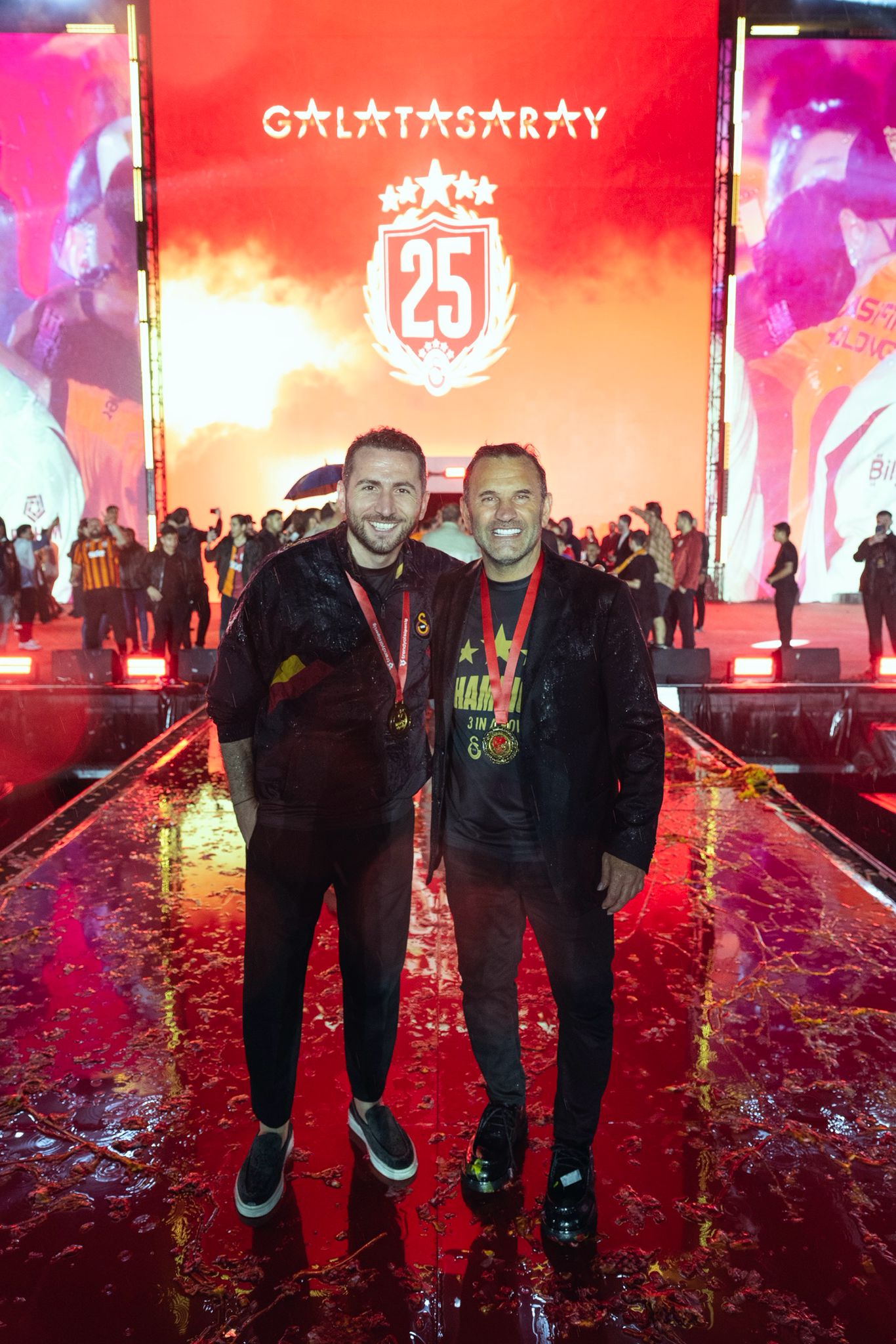
Galatasarayın 25’inci şampiyonluk kutlamasından Okan Buruk ve Vural Durmuş
Bütün bu süreçte performans ekibi, sağlık ekibi ve teknik ekip sürekli iletişim hâlindedir. Her yüklenme planlı olarak yapılır ve anlık olarak takip edilir, antrenmanlardaki veriler analiz edilir ve diğer günlerin planları bu veriler üzerinden oluşturulur. Dolayısıyla sahada gördüğünüz her çalışma, arkasında ciddi bir planlama ve ekip koordinasyonu barındırır.
Yüksek performans sporlarında sizin için özel anlam taşıyan bir mesaj ya da ilkeniz var mı? Bu bakış açısını sporculara ve geleceğin antrenörlerine nasıl aktarmak istersiniz?
Yüksek performans dünyası başlı başına özel ve yoğun bir alan. Burada sıradan bir çabayla ayakta kalamazsınız; ciddi bir özveri, istikrar ve adanmışlık gerekir. Ben bu alanı tek kelimeyle tanımlayacak olsam, “adanmışlık” derim. Çünkü hem fiziksel hem zihinsel anlamda ağır bir yükün altına giriyorsunuz. Bir yandan özel hayatınızı dengelemeye çalışırken, diğer yandan sizden beklenen yüksek talepleri karşılamanız gerekiyor.
Çalıştığım sporculara her zaman şunu vurgularım: Bu işin doğasında hem iyi performans hem kötü performans var ve bu ikisi arasındaki geçiş çok hızlı olabiliyor. Hepimiz insanız; bazen hata yaparız, bazen beklentilerin üstünde, bazen de altında performans sergileriz. Önemli olan, bu iniş çıkışları sağlıklı bir şekilde kabul edip yönetebilmektir. Zirvede olduğunuzda doğru kalabilmek ve düşüş yaşadığınızda tekrar ayağa kalkabilmek, gerçek disiplin ve mental olgunluk ister. Çünkü her iki durumda da kendinize karşı objektif olabilmek büyük öneme sahip.
Benim için bu mesleğin özü şudur: “Hedef =Çalışmak” Bugün şu hareketi yapmasam da olur” ya da “şu tatlıyı yesem bir şey olmaz” gibi düşünceler kısa vadede zararsız görünür, ama uzun vadede hedeflerinizden sizi uzaklaştırır. Aynı şekilde her şeyi aşırıya kaçırmak da sürdürülebilir değildir. Asıl mesele, dengeli, sistemli ve istikrarlı bir yaşamı prensip edinmektir. Bu durum özellikle bireysel sporlarda çok net görülebilir. Örneğin tenisçiler; bazen 5 saat süren maçlar oynuyorlar. Bu sadece fiziksel dayanıklılıkla açıklanamaz. Oradaki olağanüstü geri dönüşler, sahada verdiğiniz zihinsel ve duygusal mücadeleyle, stratejiyle birleşir.
Geleceğin antrenörlerine ve genç sporculara söylemek istediğim en net şey şu: Eğer bu işi gerçekten seviyorsanız, fedakârlık yapmaya, düzenli yaşamaya ve disiplinli olmayı kendinize ilke edinmelisiniz. Başarı sadece yetenekle değil; o yeteneği sürdürülebilir kılacak bir yaşam felsefesiyle mümkündür.
Eğitim, özellikle de genç antrenör adayları için sizce ne kadar önemli? Siz hâlâ kendinizi geliştiriyor musunuz?
Kesinlikle çok önemli. Ben de hâlâ aktif olarak eğitim alıyorum ve elimden geldiğince farklı alanlardan beslenmeye çalışıyorum. Çünkü jenerasyonlar değişiyor; insan değişiyor, futbolcu profili değişiyor, teknik adamların beklentileri ve oyuncuların yaklaşımları sürekli yenileniyor. Dolayısıyla bizim de kendimizi sürekli güncel tutmamız gerekiyor.
On yıl önce öğrendiğimiz bilgilerle bugün aynı şekilde ilerlememiz mümkün değil. Değişim ve gelişim süreçlerine açık olmak her zaman önemli ama bu değişim telaşla değil, zamanla ve sabırla yönetilmeli. Öğrenmek, okumak, araştırmak, kendine yatırım yapmak asla bitmeyen bir yolculuktur. Futbolu sadece “90 dakika, 11’e 11 oynanan bir oyun” olarak sınırlandıramayız; işin içinde taktik kadar, 30–35 kişilik farklı karakterlere sahip bir oyuncu grubunun yönetimi de var. Her oyuncuya aynı şekilde yaklaşamazsınız; bu nedenle bakış açınızı ve rutinlerinizi sürekli gözden geçirmelisiniz.
Ben kendimi sadece futbolla ilgili eğitimlerle ya da kurslarla sınırlamıyorum. Sanatla ilgili okumalar yapıyorum, biyografilerden çok değerli çıkarımlar yapıyorum, hatta sinemadaki oyunculuk performanslarından bile ilham aldığım oluyor. Her detaydan bir anlam çıkarmaya çalışıyorum: “Bu bana ne katabilir?” sorusunu sık sık kendime sorarım. Çünkü oyuncular için söylediğim şey bizim için de geçerli: Eğer en yüksek seviyelerdeki kulüplerde görev yapacaksak, sadece bilgi olarak değil, vizyon olarak da hazır olmamız gerekir.
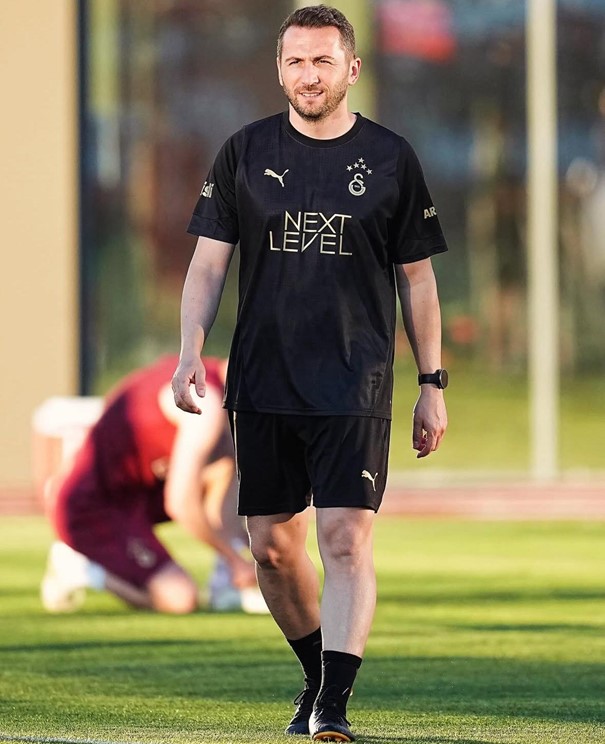
Galatasaray antrenmanında hazırlık sürecine odaklanan Vural Durmuş
Antrenörlükte en kritik becerilerden biri süreç yönetimidir. Her oyuncunun dünyaya bakışı, hayalleri, algısı, yaşanmışlıkları, tepki biçimi farklıdır. Dolayısıyla herkese aynı dille yaklaşamazsınız. Farklı profilleri anlayabilmek, analiz edebilmek ve doğru zamanda doğru tepki verebilmek; iyi bir antrenörün en önemli meziyetlerinden biridir.
Peki, dil öğrenmenin bu süreçteki yeri nedir?
Dil konusu, benim için “olmazsa olmaz” diyebileceğim bir alan. Hatta açıkça söylemem gerekirse, bu konuda kendimi en acımasız şekilde eleştiriyorum. Keşke daha önce bu alana daha fazla yatırım yapsaydım daha fazla zaman ayırsaydım. Şu an İngilizcem belirli bir seviyede olsa da, daha ileri düzeyde olmamasından dolayı zaman zaman zorluk yaşıyorum ve bu beni rahatsız ediyor. Bu yüzden hâlâ fırsat buldukça çalışıyorum.
Üstelik sadece İngilizce değil, mümkünse bir ikinci dili de öğrenmelerini öneriyorum. Çünkü bu, farklı kültürleri anlamak, yapılan bilimsel çalışmaları ve güncel yayınları takip etmek, sosyal hayata daha rahat entegre olmak için büyük bir avantaj. Özellikle genç antrenör adaylarına bu konuda çok net bir tavsiyem var: İngilizcenin yanında mutlaka başka bir yabancı dil öğrenin.
Aynı tavsiyeyi genç oyunculara da veriyoruz. Çünkü neredeyse her oyuncunun bir yurt dışında oynama hayali var. Ancak dili bilmeden, sosyal hayata karışmadan, yaşadığı ülkenin kültürünü anlamadan başarılı olmak imkânsıza yakın. Üstelik sadece başarısızlık değil, bu süreç psikolojik olarak da oyuncuya ciddi zarar verebilir. Bu yüzden erken yaşta dil eğitimi, hem sportif hem de kişisel gelişim açısından büyük bir yatırımdır.
Türkiye’de atletik performans gelişimini nasıl değerlendiriyorsunuz? Özellikle altyapılar özelinde, önümüzdeki yıllarda görmek istediğiniz yapısal değişiklikler neler olurdu?
Bu soruyu aslında ikiye ayırmak gerekir. A Takım seviyesinden başlarsak, son 10 yıla baktığımızda çok ciddi bir ilerleme kaydedildiğini söyleyebilirim. Kullanılan ekipmanlar, antrenman takibi, performans analiz sistemleri gibi birçok alanda Avrupa standartlarına çok yaklaştık. Özellikle Süper Lig düzeyinde kulüpler artık veri temelli çalışıyor, bireysel antrenman ve yüklenme planları yapılıyor ve gelişmiş analiz araçları kullanmayı tercih ediyor.
Ancak iş altyapı ve akademilere geldiğinde tablo ne yazık ki aynı ölçüde parlak değil. Özellikle pandemi sonrası yaşanan ekonomik daralma, birçok altyapı organizasyonunu derinden etkiledi. Antrenman koşullarından tutun da antrenörlerin maaş ve sosyal güvencelerine kadar pek çok temel konuda ciddi sıkıntılar yaşanıyor. Fiziksel şartlar da yeterli değil; örneğin bir sahayı aynı anda dört beş farklı takımın kullanmak zorunda kaldığı kulüpler var. Böyle bir ortamda kaliteli bireylerin, sporcuların ve antrenörlerin gelişimden söz etmek elbette çok zor.
Bir diğer önemli sorun ise çocukların okul saatleriyle antrenman programları arasındaki uyumsuzluklar. Aileler şu soruyla karşı karşıya kalıyor: “Bu çocuk okula mı gidecek, yoksa futbola mı yönelecek?” Ama iki tarafın da kesin bir garantisi yok. Sonuçta iki tarafa da tam olarak odaklanamayan, arada kalan ve kaybolan çok sayıda genç yetenek çıkıyor.
Özellikle büyük şehirlerde, kulüp sayısı fazla ama tesisleşme ve altyapı şartları oldukça yetersiz. Bu da altyapılardaki gidişatın çok daha derinlemesine ele alınmasını analiz edilmesini ve ihtiyaçlar doğrultusunda yeniden tasarlanmasını gerektiriyor. Dönem dönem farklı kulüpler örnek projeler geliştirdi, ancak ne yazık ki uzun vadeli olarak sürdürülememiş durumda. Genel tabloya baktığımızda, üzülerek de olsa bu konuda daha çok yolumuz olduğunu söylemek mümkün.
Genç milli takımlar düzeyinde birçok uluslararası turnuvada yer alarak ciddi rakiplere karşı üstünlük kurup galibiyetler alıyoruz. Ancak sürecin devamında rakiplerdeki oyuncular üst seviyelerde futbol oynamaya devam ederken ülkemizde bu oran maalesef çok düşük seviye kalıyor. Sürdürülebilir ve kendi içinde gelişime destek veren bir futbol akademisi organizasyonuna ihtiyacımız olduğunu düşünüyorum.
Peki bu sistem sizin elinizde olsa, neyi değiştirirdiniz?
İlk olarak altyapıya yatırımın ve gelişimin önündeki en büyük engellerden biri olan “fiziksel alan” sorununu çözmeye çalışırdım. Bugün özellikle büyük şehirlerde, bir karış toprak bile son derece değerli olduğu için spor tesisi yapmak yerine daha farklı projeler tercih ediliyor. Bu da oluşturulmak istenen ve ideal olan futbol altyapı organizasyonun oluşturulup geliştirilmesini ciddi şekilde sekteye uğratıyor.
Ülke futbolunun temel taşları olan büyük kulüplerimiz bile, maalesef akademi takımlarının ideal şekilde kullanabileceği tesis standartlarına sahip değil.
Bu noktada devletin spor politikalarının belirleyici rolü olduğuna inanıyorum. Son yıllarda birçok kulübümüze modern standartlarda stadyumlar kazandırıldı; bu çok önemli bir adım. Ancak benzer bir yaklaşımı, altyapı takımlarının kullanabileceği tesisler için de hayata geçirmemiz gerekiyor.
Bunun için seferberlik düzeyinde bir projelendirme ve ülke genelinde farkındalığı artıracak çalışmalar başlatılabilir. Böylece altyapı projeleri, spor tesisi planlamalarında öncelik kazanır ve futbolumuzun temeli olan genç oyunculara çok daha sağlıklı gelişim ortamları sunulabilir.
Eğer bu sorunlar çözülmezse, yetenekli oyuncularımızı doğru şekilde geliştirmekte zorlanmaya devam ederiz. Dolayısıyla değişimin sadece teknik-taktik olarak değil, altyapıdan başlayarak sistemsel ve yapısal olması gerekiyor.
Sizce altyapı akademileri bu zorluklar nedeniyle büyük şehirler dışına mı taşınmalı?
Evet, bu soruya kesin bir “evet” demek zor ama bu yönde bir eğilim olacağını düşünüyorum. Özellikle büyük şehirlerde arazi maliyetlerinin çok yüksek olması, altyapı projelerinin sürdürülebilirliğini ciddi şekilde zorlaştırıyor. Bu yüzden bazı kulüplerin daha uygun maliyetli alanlara yönelmesi kaçınılmaz hale geliyor.
Belki büyükşehirlere yakın bölgelerde işlevselliği yüksek yeni kamp ve altyapı merkezleri kurulabilir. Oyuncular bu merkezlerde belirli bir seviyeye kadar gelişip, sonrasında üst liglerdeki ve belli kriterleri sağlayan kulüplere entegre edilebilir. Bu sistem, hem oyuncu gelişimini destekler hem de şehir içindeki yoğunluğu azaltır.
Ancak tüm bunların gerçekten verimli bir sistem hâline gelmesi için daha radikal kararlar alınması gerekiyor. Belirli bir sistem dahilinde altyapı standartlarının oluşturulması, bu standartların denetimli bir şekilde korunması ve desteklenmesi, futbolumuzun uzun vadeli başarısı için kritik öneme sahip.
Son olarak eklemek istediğiniz bir şey ya da genç futbolculara, antrenör adaylarına vermek istediğiniz bir mesaj var mı?
Futbolcu ya da antrenör, hangi rolde olursanız olun; yaptığınız işe tutkuyla bağlanmak, gerekliliklerini yerine getirmek, gerektiğinde fazladan mesai yapmak ve fedakârlıklarda bulunmak bu yolculuğun doğal bir parçasıdır. Tüm bu emeklerin karşılığını aldığınızda, aslında ne kadar anlamlı bir iş yaptığınızı çok daha iyi anlıyorsunuz.
İlk kez bir kupa madalyası aldığımda yaşadığım duyguyu tarif etmem mümkün değil. Sezon boyunca verilen emekler, çekilen zorluklar, yapılan fedakârlıklar ve sonunda gelen başarı… Bu başarının bir parçası olmak, milyonlarca insanı sevindiren bir hikâyenin içinde yer almak gerçekten çok kıymetli. Ya da sezon boyunca bire bir ilgilendiğiniz bir oyuncunun gösterdiği gelişim, yaptığı çıkış, Milli Takım’a yeniden seçilmesi, iyi bir teklif alması… Bunlar sizin dokunduğunuz detaylardan, katkı verdiğiniz hikâyelerden sadece bazıları.
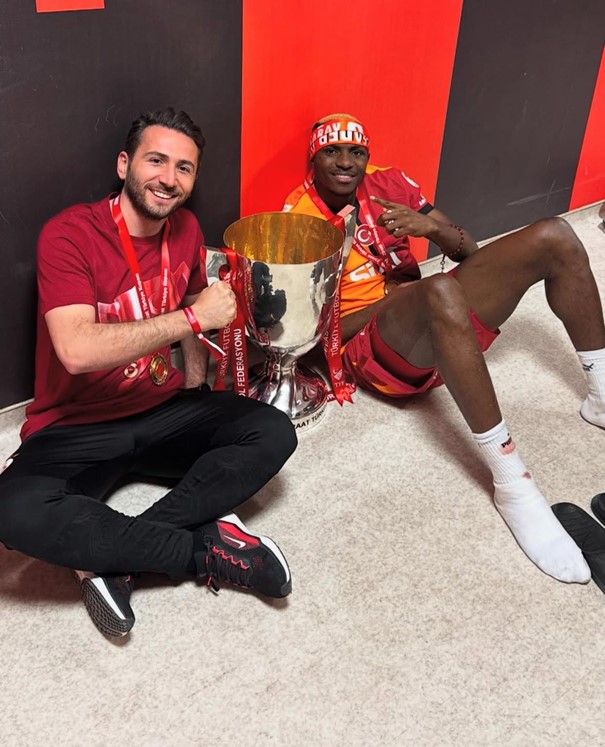
Vural Durmuş ve Victor Osimhen, Türkiye Kupası zaferinin ardından
Ben çocukluğu futbolcu olma hayaliyle yaşamış ama bu hayalden çeşitli nedenlerle uzaklaşmak zorunda kalmış biriyim. Belki o süreçte yeterince doğru yönlendirilmedim, belki kendim de bilinçli davranamadım. Ama bu süreç benim antrenörlüğe başlamamdaki en büyük motivasyon kaynağım oldu. Şimdi ise kendime şu soruyu soruyorum: “Ben olamadıysam, yapamadıysam olabilecek olanlara, yapabilecek olanlara nasıl destek olabilirim?” Bu düşünceyle hareket ediyorum. Nerede hata yaptıysam, hangi eksiklikleri yaşadıysam, alttan gelen antrenörlere ya da gençlere bunları aktararak onların zaman kaybetmelerinin önüne geçmeye çalışıyorum.
Çünkü biz; işini doğru yapan, ahlaklı, gelişime açık insanları bir araya getirdiğimizde, sadece bireylere değil, ülkemize ve hatta dünyaya faydalı işler yapmış oluyoruz. Bu inançla, emek veren herkesin yolunun açık olmasını diliyorum.
İster genç oyuncu olsun ister genç antrenör olsun yaptığınız işi anlamlı kılın. Çünkü başarı, sadece maddi kazançlar, kupalar kaldırmak değil, iz bırakmaktır.
Bugüne kadar Türkiye Ligi, Süper Kupa, Türkiye Kupası şampiyonlukları yaşadım. Milli Takım’da görev aldım, Avrupa Şampiyonası gibi uluslararası bir organizasyonda ülkemizi temsil etme şansını yakaladım. Geriye dönüp baktığımda; öğrencilik günlerimden başlayarak uykusuz kaldığım, yorulduğum, fedakârlık yaptığım, durmadığım her anın gerçekten değdiğini hissediyorum.
Diliyorum ki herkes – ister futbolcu ister antrenör olsun – bu duyguları bir gün yaşama fırsatı bulur. Çünkü bu duyguyu yaşamak, mesleğinizin ötesinde hayatınızın en anlamlı anlarından biri oluyor.
Peer Niclas Naubert, CEO of Bundesliga International, is leading the league’s global brand strategy through digital innovation and fan engagement.
About Peer Niclas Naubert
Shaping the Global Brand of the Bundesliga
Peer Niclas Naubert is a seasoned marketing executive and strategic leader in the international sports industry. With a career spanning two decades, Naubert has consistently worked at the intersection of brand growth, global expansion, and digital innovation. He currently serves as Chief Executive Officer at Bundesliga International GmbH, a position he has held since July 2022.
Before taking on the CMO role, Naubert held several senior positions within the DFL Deutsche Fußball Liga structure. From 2020 to 2022, he was Vice President of Marketing at the DFL, where he led brand strategy and global positioning efforts. Earlier, as Head of Global Marketing at Bundesliga International from 2018 to 2020, he established fan and market intelligence systems and developed scalable marketing strategies for both global and local markets. Under his leadership, the Bundesliga became the fastest-growing European top-flight league, supported by a dedicated marketing team and strong analytical foundations.
Earlier in his career, Naubert made a significant impact at Lagardère Sports. From 2017 to 2018, he served as Senior Vice President of Market Development, managing cross-functional teams to help European rights holders expand internationally. He had previously been Vice President of Product Management and Managing Director of Lagardère Sports Netherlands, where he drove digital product growth and led a commercial turnaround in the Dutch market.
Naubert began his professional journey at SPORTFIVE GmbH & Co. KG, where he spent over seven years in business development. His work there focused on executive-level strategic support, digital transformation initiatives, and mergers and acquisitions.
He holds a Master’s degree in Business and Marketing from the University of Münster, and in 2015 attended the Stanford Graduate School of Business to further develop his leadership capabilities.
With deep expertise in marketing, business development, and digital transformation, Peer Niclas Naubert plays a central role in defining the global presence of German football and driving innovation across the sports marketing landscape.
Our Exclusive Interview with Peer Niclas Naubert
Who is Peer Niclas Naubert outside of football? How do your personal values shape your professional life?
Outside of football, I’m first and foremost a dad and husband, a sports enthusiast, and someone who deeply enjoys spending time with friends, whether that’s playing or watching sports, travelling or somewhere with decent music and a solid espresso. I believe life’s best moments are often the simple ones, especially when shared with family and friends.
In my professional life, I’m driven by strong relationships, a sense of responsibility, and a belief that taking your work seriously doesn’t mean taking yourself too seriously. I value honesty, loyalty, and humour, which helps in building trust, staying calm in complex or difficult moments, and creating an environment where people can do their best work. At the end of the day, football is a people business, and I try to lead in a way that reflects that.
What inspired you to pursue a career in sports marketing, and how has your journey evolved over the years?
I’ve always been fascinated by the emotional power of sports. When my dad took me to my first Bundesliga game in 1990, it made an impression, the way a single moment can unite millions, spark conversations across continents, and create memories that last a lifetime. Early on, I enjoyed spending time on the pitch, court or course, but realised that I didn’t need to be an active player to be part of that magic. Sports marketing offered the perfect intersection of passion, creativity, and global business.
My journey has taken me from strategy and business development across various sports and markets to some of the most exciting global platforms in football. Along the way, I’ve learned that it’s not just about selling a product, it’s about telling stories that resonate, building long-term partnerships, and staying agile in a world that’s constantly changing. What hasn’t changed is my belief that sport is one of the few truly universal languages, and being able to help shape how it’s experienced around the world is a privilege I never take for granted.
As Chief Executive Officer at Bundesliga International, what has been your most defining project or initiative so far?
One of the most defining initiatives for me has been building a truly global and holistic approach to marketing the Bundesliga, one that connects the emotional power of football with long-term brand building, grassroots development, and commercial growth resulting in Bundesliga being the fastest growing league of all European top flights across the fan funnel.
That includes launching our first international marketing program, from Own & Operated, content partnerships to creator networks, but also extending our footprint on the ground globally: projects like Bundesliga Dream, which create real pathways for young talents to reach Germany’s top leagues, and Bundesliga Common Ground, where we are renovating football courts in local communities around the globe, turning brand love into real-world impact.
What makes me particularly proud is that we’ve managed to link football development, fan engagement and brand relevance in a way that’s authentic, measurable, and sustainable, and that we’ve been able to grow both our international media rights and our commercial partnerships in one of the most challenging market environments in recent memory. Of course, none of this would’ve been possible without the incredible team at Bundesliga International, who combine passion for football with a truly international mindset.
And while we’re not done yet, it’s been one hell of a ride already.
How do you approach building a global fanbase while preserving the Bundesliga’s local authenticity?
For us, it’s never about choosing between local roots and global reach, it’s about connecting the two. The Bundesliga’s authenticity, its fan culture, and community-driven clubs are not just our strengths at home, they’re what make the league unique on a global stage. So instead of trying to “translate” the Bundesliga into something it’s not, we bring international audiences closer to what it truly is: Football As It’s Meant To Be.
That means telling real stories, highlighting real characters, and giving fans around the world access to the energy inside our stadiums. But it also means being smart about formats, platforms, and languages, meeting fans where they are, not where we want them to be. Ultimately, global growth is not about becoming generic. It’s about being unmistakably Bundesliga, just with more people watching.
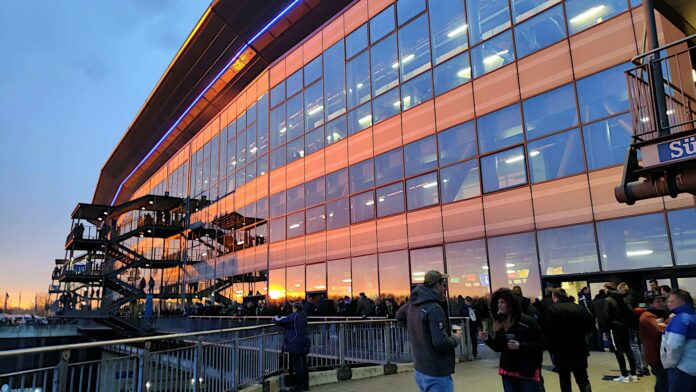
And let’s be honest: once you’ve experienced the electric Bundesliga atmosphere at a full Südtribüne on a Saturday afternoon, you don’t need much translation anyway.
What role does technology and data play in shaping your marketing strategies across different regions?
A central one. In a globalised, digital-first world, data is not just a tool, it’s a compass. It helps us understand who our fans are, what they care about, how they engage, and where we can add value. Whether it’s optimising content formats in Southeast Asia, personalising fan journeys in Latin America, or adjusting media strategies in MENA, data gives us the clarity to act with purpose, rather than assumption.
At the same time, we don’t let the numbers dictate everything. Technology and data are only as powerful as the human insights behind them. For us, it’s about using the best tools available to amplify what makes the Bundesliga special, our stories, our values, our fans. And ideally, turning a data point into a real emotional connection.
Who have been the most influential figures in your career, and how have they shaped your leadership style?
I’ve been fortunate to work with and learn from some truly exceptional people, managers and teammates alike. The ones who left the biggest mark were never the loudest in the room, but the ones who led with clarity, empathy, and consistency. They taught me that real leadership isn’t about knowing everything, it’s about asking the right questions, building trust, and empowering others to shine.
On a more personal level, my granddad, in regards to love for football. My parents shaped my view on responsibility and resilience early on. And becoming a father myself added another dimension: it reminds you daily that it’s all about presence, patience, and perspective, whether at home or at work.
What advice would you give to young professionals aspiring to work in sports business and global marketing?
Stay curious, stay humble, and be ready to roll up your sleeves. The sports industry looks glamorous from the outside, but behind every big moment are countless hours of hard work, coordination, and compromise. What sets people apart is not just passion for the game, but the ability to think strategically, work across cultures, and stay calm when things don’t go according to plan (which they rarely do).
Also, build relationships, not just résumés. This is a people business. Your network, your reputation, and how you treat others will shape your career more than any title ever will.
And finally, don’t wait for the “perfect” job. Get started, get your hands dirty, and learn fast. Football moves quickly. So should you.
What are your future plans and goals, both personally and professionally, as you look ahead in your career?
Professionally, I want to contribute to making the Bundesliga even more relevant, visible, and loved on the global stage. There’s huge untapped potential in how we connect with the next generation of fans across regions and cultures, and I see technology, data, and creativity as key drivers of that growth. From immersive content experiences to smarter fan engagement through AI and personalisation, I’m excited to help shape what the future of Bundesliga marketing can look like.
Personally, it’s all about keeping the balance and being more present at home. Spending quality time with my family and friends, staying active, and making sure I don’t lose the joy and curiosity that got me into this industry in the first place. I’ve learned that sustainable success doesn’t come from always going faster, it comes from knowing when to accelerate and when to breathe, and after all, even the best game plan needs a good halftime pause.
The final took place at St. Jakob-Park in Basel in front of a sold-out crowd of approximately 34,000. Spain opened the scoring in the first half through Mariona Caldentey. England responded in the 57th minute with a goal by Alessia Russo. After a 1–1 draw through 120 minutes, England won the penalty shootout 3–1. Hannah Hampton made two crucial saves, and England converted three penalties to secure their second consecutive UEFA Women’s EURO title.
England’s Historic Triumph
By winning the 2025 final, England became the first team in UEFA Women’s EURO history to retain the title. It was also the first time any English senior national team won a major tournament outside their home country. England’s journey to the trophy included tight knockout matches in which they led for a total of just 4 minutes and 52 seconds – the shortest lead time ever recorded by a champion in the tournament’s history. Coach Sarina Wiegman secured her third UEFA EURO title, remaining undefeated in all EURO finals.
Tournament Summary
Sixteen teams competed in 31 matches across eight cities in Switzerland. The tournament produced 106 goals – the highest total ever recorded at a Women’s EURO. Matches averaged over 3 goals per game. The highest-scoring match of the tournament was Spain’s 6–2 victory over Belgium.
Spectator Milestones
UEFA Women’s EURO 2025 set a new benchmark in audience engagement. 657,291 spectators attended the tournament — the highest attendance ever at a Women’s EURO. 22 of 24 group stage matches were sold out. The quarter-finals attracted over 112,000 fans, including 34,128 for France vs Germany in Bern.
UEFA Player Awards
Player of the Tournament: Aitana Bonmatí (Spain)
Young Player of the Tournament: Michelle Agyemang (England, 18)
Golden Boot (Top Scorer): Esther González (Spain, 4 goals)
Oldest Goalscorer: Jess Fishlock (Wales, 38 years, 176 days)
Youngest Multi-Goal Scorer: Signe Gaupset (Norway, 20 years, 22 days)
Goalkeeper of the Final: Hannah Hampton (England)
Broadcast and Global Reach
The 2025 edition achieved historic media reach. The final was watched by over 45 million viewers worldwide. Total broadcast and digital reach exceeded 500 million. Social media engagement increased by 55% compared to EURO 2022.
Host Cities and Infrastructure
Eight cities across Switzerland hosted matches: Basel, Zurich, Bern, Geneva, Lucerne, Thun, Sion, and St. Gallen. Each city offered fan zones and tournament branding. Public transport and accessibility initiatives supported inclusive attendance.
UEFA Records Set
Most goals in a Women’s EURO: 106
Most attended Women’s EURO: 657,291 spectators
Highest-scoring match: Spain 6–2 Belgium
Shortest lead by eventual champions: 4 minutes, 52 seconds (England)
First back-to-back champion: England (2022, 2025)
Most sold-out matches: 29 of 31
Organisation and Legacy
Over 200 volunteers contributed to successful event operations. UEFA’s “Time for Action” legacy programme supported youth and women’s football. The official mascot “Maddli”, a Saint Bernard puppy, promoted tournament branding and fan outreach. Host cities received long-term investment in grassroots and visibility initiatives for girls’ and women’s sport.
Conclusion
UEFA Women’s EURO 2025 delivered record-breaking results on and off the pitch. From historic attendance to high-level performances, the tournament proved the strength, depth, and momentum of the women’s game in Europe. With England crowned champions once again, the bar has been raised for future editions.
The Growing Popularity of Using Family Members as Agents
Unless you’ve been living under a rock in the last week, you’ll have heard that Lionel Messi is no longer a Barcelona player and has made the move to Paris Saint-Germain after 21 years at the Catalan club. The interesting part of this transfer that I will discuss in this week’s blog is Messi’s agent, Jorge Messi, is his father.
Employing family members as agents was first brought into the public spotlight in 1999 with Nicolas Anelka’s move from Arsenal to Real Madrid which was orchestrated by his brothers. In recent times, it is become increasingly common with players such as the now PSG trio Neymar, Mbappe and Messi all represented by their fathers.
In this blog I will discuss why using family members may be an attractive option for players but also the issues that may arise from doing so. I will then consider how family members should be treated compared to regular agents and how they might be regulated in order to ensure ethical and legal compliance.
Why Would a Player Prefer to Use a Family Member as Their Agent?
Football agents, whether applicable to each individual or not, carry the burden of a bad reputation that is associated with their profession. Players are cautious that the agent may not always act in their best interests but instead will be motivated by filling their own pockets.
The relationship and level of trust that a player places in an agent may never come close to what they have with their family members. A familial connection will mean that a player can be more confident that their agent wants the best for them. Particularly in young players who are wary of agents approaching them, using a family member is a more attractive option as the close, trusting relationship is already there, rather than having to develop a bond with an agent whose intentions may not be known or pure.
The obvious appeal of employing a family member as an agent is that any commission they receive for their services is kept within the family. For example, it is estimated that Neymar Sr has received £100million for Jr’s transfers whilst Jorge Messi has earned approximately £75million in contract commissions for his services. The success of sons and brothers also financially benefitting the rest of the family is a more attractive option than having to remunerate a stranger with a football agent license that may not have the player’s best interests at heart.
In a perfect world, the love and trust between a father and son or brothers would mean that each party is acting in a way that benefits each other as much as possible. Unfortunately, this is not always the case. There is a risk in mixing familial relationships with professional business. The combination may lead to big fall outs. Even family members can develop a hunger for money or power-grabbing from representing their relatives.
Can Family Members be Regulated as Agents
An additional risk that arises from using a family member as an agent is that they may not be qualified enough. Before the removal of an exam in FIFA’s regulations in 2015, family members were exempt from taking it. This made it easier for them to be registered as the representative of their son or brother.
In the case of Juan Mata, his father was a former player and obtained his agent license once he had retired. He now has a client list including players such as his son and Salomon Rondon. There are many other cases in which close relatives of the players are representing them. For example Eden Hazard’s agent is his father, the agent of Sergio Ramos is his brother René Ramos, agent of Mats Hummels is his father Hermann Hummels. We also have Mauro Icardi from PSG who’s agent is his wife Wanda Icardi or Dane Rashford as the brother and agent of Marcus Rashford. So are the brother of Liverpool defender Trent Alexander-Arnold and the father of Chelsea’s Christian Pulisic.
FIFA’s proposed changes to regulations coming into force next year will see family members treated in the same way as all other agents. The regulations contain a clause that prohibits family members from acting as agents unless they are fully licensed. Importantly, this includes the requirement of passing the agency exam. This is a step in the right direction as it will ensure that family members receive a level of education and qualification before they are able to represent their relatives. I expect that FIFA will emphasise that players should only use agents that have a proven level of aptitude in the industry and are qualified enough to serve them well.
Furthermore, a cap on commissions could minimize the ability of relatives to collect disproportionate fees for their services, reducing the risk that they will act on their own greedy interests rather than to seek what is best for the family member they are serving.
Transparency, once again, is vital. If a family member is representing a player, all transactions, commission fees and gifts should be recorded and accessible by FIFA. This will overcome the worry of many that an unnecessary amount of money leaves the game and cannot be accounted for through payments to agents.
Summary
Using family members as agents is becoming increasingly popular and will remain an attractive option for players. They may have a level of trust that can only be had with a family member and not the kind of relationship they could develop with a separate agent.
However, the risk of mixing family and business may not always lead to a beneficial outcome for both parties. Issues arise from greed and power and the lack of qualification that the family member representative may have. It is important that a system is in place that maintains the legal and ethical appropriateness of family members representing players.
FIFA’s proposals for agent regulations are certainly going to improve the dynamic and standard of family members acting as agents. By ensuring that they are sufficiently educated and qualified whilst also preventing them from receiving an unfair and extortionate level of remuneration, the standard of agents will rise and it will go some way in preventing the concerns that prevail from using brothers, fathers or wives as agents.
International transfers: Conducted via FIFA TMS; domestic transfers through the BFU platform.
Contracts: Professional contracts can be signed from the age of 18 (or 16 with parental consent and BFU approval); duration typically between 1–5 years.
Agents: Must be registered and licensed according to FIFA regulations.
Transfer windows: Summer (15 June–6 September), Winter (15 January–28 February).
Compensation and solidarity payments: According to FIFA regulations.
Medical checks: Mandatory before signing.
Work permits: Required for non-EU players.
1. Футболна сделка в България
Международни трансфери: чрез FIFA TMS; вътрешни – през платформа на БФС.
Договори: професионални договори от 18 г. (или 16 с разрешение); продължителност 1–5 години.
Агенти: регистрация и лиценз по правилата на FIFA.
In professional sports, success is not only determined by talent on the field but also by the right leadership off it. While executive recruitment has been an established practice in American sports-particularly in the NFL and NBA-the concept is still developing in football (soccer). However, this is rapidly changing.
Why Executive Recruitment Is Crucial in Football
The demands on sporting directors, CEOs, and other executives in football have increased significantly. Clubs today operate as global businesses, requiring strong financial management while remaining competitive on the field. Balancing these responsibilities is nearly impossible without professional support.
This is where executive recruitment plays a key role:
Strategic Career Planning: Top executives need a clear career strategy-what clubs or organizations align with their strengths and ambitions?
Networking & Positioning: Being in the right place at the right time can make or break a career. A professional management team ensures access to the best opportunities.
Negotiations & Security: One of the most critical roles of an advisor is to act as an intermediary between the executive and potential employers. Contract negotiations go beyond salary and duration-they involve long-term vision, decision-making authority, and the right working environment. A skilled advisor ensures their client secures the best possible conditions-professionally, discreetly, and the eye level with club decision-makers.
Continuous Development & Leadership: Even the most experienced executives need sparring partners to refine their leadership skills and adapt to the ever-evolving demands of the industry.
Lessons from American Sports
In the NFL or NBA, executives have long been managed just like players. Agencies handle their positioning, negotiations, and career development. The most successful teams don‘t just invest in their roster-they also invest in their leadership.
Football is now beginning to follow this path. More and more sporting directors and club executives are working with professional advisors to strategically manage their carers, optimize their positioning, and secure the best possible terms in negotiations.
The Next Step: Expanding Your Network
If you are an executive in football (soccer) – or aspire to be – now is the right time to take a professional approach to your career.
Dans le monde compétitif des agences sportives, établir une marque personnelle solide est crucial, surtout si vous travaillez dans une petite agence ou de manière totalement indépendante. Une marque personnelle bien conçue et ciblée peut vous différencier des autres agents similaires, attirer des clients et démontrer la valeur unique que vous apportez à la carrière de vos clients. Souvenez-vous que lorsque vous vous présentez pour la première fois à un client potentiel, il est probable qu’il consulte votre site web et vos réseaux sociaux. Il doit donc aimer ce qu’il voit ! C’est l’occasion de faire bonne impression ; bien qu’un joueur ne signe pas avec vous uniquement à cause de votre marque personnelle, il pourrait vous écarter immédiatement en raison de son absence. Ce blog expliquera pourquoi se concentrer sur votre marque personnelle est essentiel et comment la construire efficacement en ligne et hors ligne.
L’importance d’une marque personnelle
En tant qu’agent sportif ou plus spécifiquement de football, votre marque personnelle représente votre réputation, votre expertise et les services uniques que vous offrez. Cette marque ne se résume pas à un logo ou un slogan ; elle est l’essence même de ce que vous êtes en tant que professionnel. Elle englobe la manière dont vous communiquez, les résultats que vous obtenez et les relations que vous établissez avec les clients, les parties prenantes et les autres professionnels de l’industrie. Une marque personnelle forte est multifacette, reflétant votre éthique professionnelle, vos réalisations et la valeur que vous apportez à vos clients.
L’un des principaux avantages d’une marque personnelle solide est sa capacité à créer de la confiance et de la crédibilité. Dans le monde du football, où la confiance est primordiale, les clients et les parties prenantes sont plus susceptibles de collaborer avec des agents ayant une présence bien établie et un bilan éprouvé. Votre marque personnelle sert de témoignage à votre professionnalisme et à votre fiabilité, rassurant les clients potentiels qu’ils sont entre de bonnes mains. En obtenant constamment des résultats et en maintenant des normes éthiques élevées, vous renforcez votre crédibilité et favorisez une confiance à long terme avec ceux avec qui vous travaillez.
De plus, une marque personnelle efficace peut attirer des clients. Dans une industrie où les connexions et l’expertise sont essentielles, avoir une marque reconnaissable et respectée peut attirer des clients potentiels recherchant quelqu’un avec vos compétences et votre expérience. Lorsque les joueurs et les clubs voient votre nom associé à des accords réussis et à des clients satisfaits, ils sont plus susceptibles de vous considérer pour leurs besoins de représentation. Votre marque personnelle devient donc un outil marketing puissant, mettant en avant vos succès et votre capacité à naviguer dans les complexités de la gestion du football.
Dans un marché saturé, la différenciation est la clé. Votre marque personnelle vous distingue en mettant en avant votre approche unique et la valeur ajoutée que vous apportez à vos clients. Que ce soit vos compétences en négociation, vos services de gestion complets ou votre dévouement au développement des clients, ces facteurs distinctifs vous font ressortir parmi la myriade d’agents de l’industrie. En articulant clairement ce qui vous rend différent et meilleur, vous pouvez attirer des clients recherchant précisément l’expertise et le service que vous offrez. Cette différenciation ne consiste pas seulement à être différent ; il s’agit d’être distinctement meilleur de manière significative pour vos clients.
Construire votre présence en ligne
Créer un site web professionnel
Un site web professionnel et convivial sert de carte de visite numérique et est fondamental pour établir votre présence en ligne. Ce site web doit être bien conçu pour refléter votre marque et fournir des informations complètes sur vos services. Bien qu’il puisse être difficile de dépenser beaucoup pour des concepteurs de sites web de haute qualité, vous devez considérer cela comme un investissement essentiel pour votre carrière d’agent. Avoir un site web de mauvaise qualité vous coûtera beaucoup plus à long terme !
Votre site web doit clairement décrire les services que vous offrez et vos domaines d’expertise. Détaillez l’étendue et la profondeur de vos services, de la négociation de contrats à la gestion de joueurs en passant par la planification de carrière et le branding commercial. Les clients potentiels doivent comprendre exactement ce que vous pouvez faire pour eux et pourquoi vous êtes leur meilleure option.
Les histoires de succès sont un moyen puissant de démontrer votre impact. Incluez des études de cas détaillant les défis rencontrés par vos clients, les solutions que vous avez apportées et les résultats réussis obtenus. Les témoignages de clients satisfaits peuvent renforcer davantage votre crédibilité et montrer les avantages tangibles de vos services.
Nous recommandons également de fournir des informations détaillées sur les joueurs, entraîneurs ou clubs que vous représentez. Mettez en avant leurs réalisations et votre rôle dans leur succès. Cela non seulement présente votre portfolio, mais démontre également votre capacité à gérer et soutenir des talents de haut niveau. Une autre façon de le faire est de maintenir une sorte de blog ou de section d’actualités régulièrement mise à jour avec des analyses de l’industrie, vos dernières activités et histoires de succès. Cela garde les visiteurs et les clients potentiels engagés et informés sur vos efforts et réalisations continus. Cela vous positionne comme un profil établi dans l’industrie, contribuant continuellement avec des informations et perspectives précieuses.
Utiliser les réseaux sociaux
À l’ère moderne des agences de football, les plateformes de réseaux sociaux sont des outils essentiels pour construire votre présence en ligne et vous connecter à un public plus large. Vous devez vous rappeler que l’agence est une « entreprise de référence » et vous pouvez créer plus de références positives en établissant et en maintenant des profils actifs sur les principales plateformes pour maximiser votre portée et votre engagement.
LinkedIn est particulièrement précieux pour se connecter avec d’autres professionnels de l’industrie et établir des relations professionnelles. Utilisez LinkedIn pour partager des nouvelles de l’industrie, des analyses et des mises à jour sur vos activités. Publier régulièrement et interagir avec votre réseau peut vous aider à vous établir comme un participant informé et actif dans l’industrie.
Des plateformes telles que X (anciennement Twitter), Instagram et Facebook peuvent vous aider à atteindre un public plus large. Utilisez ces plateformes pour partager des contenus en coulisses, des analyses de l’industrie et des mises à jour sur votre travail. Publier des mises à jour régulières et interagir avec les abonnés peut aider à construire une communauté en ligne forte. Partagez des photos et des vidéos de vos interactions avec les joueurs, entraîneurs et clubs, votre présence à des événements de l’industrie, et tout jalon ou réalisation personnelle. Cela non seulement humanise votre marque, mais garde également votre audience intéressée et investie dans votre parcours. Une mise en garde toutefois, souvenez-vous que le client doit être au centre de tout ce que vous faites. Si votre principal objectif lors d’un accord est de vous assurer d’obtenir une bonne photo de vous posant devant le stade avec un maillot, vos priorités sont mal placées et cela nuira à la qualité du service que vous offrez à votre client. Par conséquent, la majorité de votre travail doit se faire en coulisses, mais vous pouvez équilibrer cela en veillant à montrer le travail exceptionnel que vous faites aux autres clients potentiels qui vous voient sur les réseaux sociaux.
En utilisant efficacement ces plateformes de réseaux sociaux, vous pouvez créer une présence en ligne dynamique et engageante. Cela aide à attirer des clients potentiels, à informer et à engager vos clients existants, et à construire un réseau de professionnels de l’industrie qui respectent et reconnaissent votre expertise.
Construire votre présence hors ligne
La priorité d’un agent pour construire sa marque personnelle doit être un engagement sans relâche et continu dans le réseautage. Sans aucun doute, le réseautage actif est vital pour construire votre présence hors ligne et développer des relations significatives dans l’industrie du sport ou du football. Assister à des matchs, conférences et événements de l’industrie offre des opportunités de se connecter avec des figures clés et des parties prenantes. Engager avec des individus importants dans le monde du football vous permet de bâtir des relations pouvant mener à des recommandations précieuses. Ces connexions peuvent ouvrir des portes à de nouvelles opportunités et partenariats, améliorant considérablement votre réseau professionnel. Souvenez-vous, le football, et en particulier l’agence, est une entreprise de référence ! Plus votre réputation est bonne, construite à travers votre présence hors ligne, meilleures seront vos références tierces, meilleure sera votre carrière !
Se tenir informé des nouvelles opportunités et des tendances de l’industrie est un autre aspect crucial du réseautage. En assistant à ces événements, vous pouvez obtenir des informations sur les derniers développements dans l’industrie du sport, ou plus spécifiquement du football, des talents émergents aux stratégies de gestion innovantes. Ces connaissances non seulement vous gardent en avance sur la courbe, mais montrent également votre engagement à rester à jour et informé, ce qui peut être un argument de vente pour les clients potentiels.
Échanger des informations de contact, comme des cartes de visite, est une partie fondamentale du réseautage. Cependant, la véritable valeur réside dans le suivi. Après avoir rencontré de nouveaux contacts, faites-en une priorité de les recontacter et de cultiver ces relations. Des messages de suivi personnalisés, des rencontres pour un café ou des discussions informelles peuvent aider à solidifier ces connexions, transformant des rencontres initiales en relations professionnelles durables. Un engagement constant avec votre réseau peut mener à des opportunités et collaborations continues qui bénéficient à la fois à vous et à vos clients. Plus de connexions ne peuvent qu’être bénéfiques !
Conclusion
En résumé, votre marque personnelle en tant qu’agent sportif est un atout puissant. Elle construit la confiance et la crédibilité, attire des clients et vous différencie dans un marché compétitif. En investissant dans et en nourrissant votre marque personnelle, vous pouvez améliorer votre réputation professionnelle, élargir votre clientèle et atteindre un plus grand succès dans votre carrière. Finalement, une marque personnelle robuste englobe à la fois votre présence en ligne et hors ligne, reflétant votre professionnalisme, vos réalisations et votre engagement envers vos clients. En investissant dans votre marque personnelle, vous vous positionnez non seulement comme un agent de football réputé et influent, mais vous posez également les bases d’un succès à long terme dans l’industrie. Gardez vos clients au centre de vos préoccupations, démontrez continuellement votre valeur et regardez votre marque personnelle propulser votre carrière. Enfin, n’oubliez jamais que le football et le sport sont des entreprises de référence, donc plus vous pouvez améliorer les références que vous recevez, mieux ce sera !
Perhaps one of the hardest stages of being a football agent is when you are looking to recruit your very first client, particularly if you are working alone and not as part of a larger agency. It can be a tense time that requires patience and dedication to find the right opportunity and then capitalise upon it and turn it into a successful agent-client relationship.
In this blog we will consider the kind of things you should be doing if you are in this position and how to go about finding that very first client. We will also look at the stages of progression towards signing a representation contract and the must-do’s and don’ts for upcoming agents.
Finding the Opportunity
Depending upon your age and previous experience in the football industry, initially finding an opportunity to try to recruit a player can vary in difficulty. For younger agents, the likelihood is that such an opportunity will only arise on the back of attending as many games as possible. By identifying the kind of clientele you are hoping to work with and other specifics can help you to narrow down the kind of fixtures you will attend. For example, a young agent may attend academy fixtures to engage and interact with scouts and parents of players below first team level. Younger academy games are important as this is an opportunity to build up relationships with parents and others which can grow over two years or so before they may be looking for an agent.
As per FIFA Regulations concerning the protection of minors, agents are not able to enter into representation agreements until the player is within six months of when they may legally sign their first professional contract. Hence, agents must be aware that this varies between countries. For example, in associations such as Germany they may sign a professional playing contract as young as 16, so agents will be trying to represent them at 15 and a half. Alternatively in other countries, agents cannot sign representation agreements until they are 17 and a half, before signing their first playing contract at 18. Attending fixtures prior to this age gives you the window of opportunity to establish the foundations of a relationship for when the time comes.
Football fixtures can also be an intimidating environment. There were many occasions when I was just starting out with attending fixtures that I would try to talk myself into approaching parents watching games or even scouts, but found it difficult when the time came to know the best way of instigating a conversation with them and making that first connection. It is particularly important that an upcoming agent quickly becomes accustomed to and comfortable with making initial contact and striking up a conversation in such an environment.
This comes down to repetition. The more you put yourself into an uncomfortable position and force yourself to take steps to speak directly to people, the more comfortable it will become over time and it won’t be long before you have no hesitation in doing so. Although every conversation may not always go the way that you’d hoped, as sometimes others may not be interested in speaking with you, the worst possible outcome is that you fail to build a relationship with them. However, the chances are, the majority of conversations you have will lead to future conversations and could open up various possibilities to you, including the chance of signing your first client. The main aim of these first conversations is to leave a good impression and to obtain the contact details of the other person so you can keep in touch.
The hope is that eventually, after spending long enough putting the hard graft in and making the effort to continue, even at times when it may seem to not be getting you anywhere, an opportunity may arise where you come to learn of a player that may be looking for representation and you have a contact or other way in which you can make contact with their parents or even with the player themselves if they over 18. The next steps are of utmost importance and maybe sometimes comes down to making sure you don’t do certain things rather than what you do do.
An important point to note when finding an opportunity is whether you are operating as an agent alone, as part of a smaller agency or perhaps as a recruitment employee of a larger agency. Each has different advantages and disadvantages, it is up to the individual as to how they would rather work. For example, those working for larger agencies will have greater access to a wider network as well as being able to include senior agents in discussions and demonstrate the services they have provided to star players in the game once they begin discussions with the players and their parents. However, in such situations, they are employees of larger agencies and will be paid a salary. Alternatively, agents may work in more of a commission based partnership under a smaller agency which may give more power and influence to the individual agent. The way in which you are working as an agent will affect the methods you use to identify opportunities to sign players and how you work with them.
What not to do
To summarise what you absolutely must not do, it can be put as simply as: DO NOT ACT UNPROFESSIONALLY.
Expanding on this, once there may be an opportunity for you to sign a first client, it is vital not to become overexcited and to rush into trying to progress the chance quicker than is appropriate. Some agents will want to grab the opportunity as soon as possible, but if this is done unprofessionally, the likelihood is that it will not produce the result you are hoping for.
There are some simple rules for certain things that you should avoid. We will then go onto look at the advisable alternatives later on in the blog.
Firstly, do not use social media platforms to approach players or their families. In the modern era, it is likely that you will be able to find both the players and their close relatives on at least one form of social media. Whilst this may help you in identifying who their parents are and who to look out for on the side of a football pitch, approaching them directly through social media is unprofessional and is unlikely to be looked upon kindly by those you are trying to engage with.
If you have identified the parents or an alternative method to make contact with the player, you must not abuse this position and utilise it in the wrong way. Repetitive pestering and impatient messaging is only likely to irritate the contact and will not help you build a relationship with the player in any way. Do not insist on spending entire games watching with them and making them feel pressured themselves. Presenting yourself as someone who will make the player and their family uncomfortable will subsequently undermine your chances of building a strong relationship and going on to represent the player.
One way in which an agent may also inadvertently discourage the family from allowing you to represent the player is if you give the impression that you are ‘taking them away’. Particularly for younger clients, agents should attempt to integrate themselves as part of the wider support team of the player, almost as another family member. By providing your expertise as well as broader encouragement, you can develop the relationship into a feeling that everyone is working together for the best of the player rather than separately.
In some instances, the opportunity may have arisen with a younger academy player who shows great potential. There is a tendency to assume that if a player has high potential for a future in the game, a lot of agents will be vying for their signature. However, you must not approach them if they are not of the legal age. Not only does this infringe upon FIFA and National Association regulations, but it will also demonstrate that you are unprofessional in your approach to your work as an agent. Consequently, the family and player are likely to remove you from consideration for future representation as they will much rather work with a professional individual.
Since the new FIFA Agent Regulations came into force, there has been some confusion around when you can approach players or families as an agent. In short, you must not present yourself to a player or their families as an agent if you have not yet obtained your FIFA licence. There is a clear distinction between how a licenced and unlicenced individual must behave. Although you may attend games and talk with people freely without a licence, you must not do so in the capacity of an agent nor speak to families or others about your intentions as an agent.
One final point on what not to do is something that is surprisingly common in the agency profession. Our advice would be that you should never pay the player or their families to encourage them to sign with you or your agency. Occasionally, parents may ask for money for themselves rather than for the benefit of the player and if they originally sign for money, the chances are that one day they may move on to another agency for more money. It is not advisable to begin your professional relationship between you as the agent and the player and their families upon the foundations of financial reward. The only instance where sharing money could be appropriate is if there is a family member who is also an officially licenced agent that is representing their relative but would like to partner with you to improve the services they can provide. In such cases, all financial details will be based upon previously agreed shared commission.
The Essentials
On the other side of this is the ‘must-do’s’. To simplify this; DO ACT PROFESSIONALLY.
The professional way of initiating conversation with the player or their families, rather than social media, is to approach them appropriately at a game. This is by far the best way of beginning to build the relationship as in-person interaction is the most efficient method of leaving a positive first impression. You can introduce yourself and briefly acknowledge your position as an agent. From then you will recognise each other at future games and can give simple pleasantries as you walk by or strike up further conversations if the circumstances suit. It is a matter of making a judgement as to when is the right time to make conversation and when it is best to not go beyond a quick “hello”. At some point along the relationship, you may be able to obtain a phone number or other contact details and can then engage in conversation with them professionally and it may get to the stage of having phone calls or a zoom call once the topic of your interest in representing the player as a client has been discussed.
Timing is essential. If you encroach on the subject of representation prematurely, it may be of detriment to your relationship. It is essential to accurately assess your relationship with the player and their family and focus more on building a good and trusting connection with them before discussing the possibility of representing the player as a client. In some cases, if it is permissible and appropriate, agents have entered into purely commercial agreements with players and their families to source them a boot deal at a younger age than they would be able to sign a representation deal. Although you must ensure this complies with regulations, it may be another way of progressing your relationship up until the point of finding the right time to sign a representation contract.
Once you have identified a target and have initiated that first point of contact and addressed the topic of representing the player, you can then move onto the stages of recruitment. Depending on the exact circumstances this may vary; ultimately it comes down to your personal judgement as to the best next steps in each situation and depending upon the point the relationship has reached. However, below is an outline of how a typical appropriate recruitment process may play out:
The Approach: Being introduced to or approaching the player and/or their family and making initial contact and building the relationship.
Organised meeting: This is your first chance to demonstrate where you can add value as an agent to the player and to his family. In a comfortable and neutral environment such as a cafe or restaurant, you can initially pitch your attributes as an agent and present an individualised assessment of the player. The goal of this stage is to generate initial interest, intrigue and engagement in the hope of leading to further conversations in the future. This is an introductory meeting rather than a contract signing meeting! The next step may also then be to have a meeting with just the player to develop your personal relationship with him and gain a better understanding of his ambitions and goals in his career as well as what he is looking for in an agent.
Attending games: Throughout the process it is important to continue to attend games and monitor the recruitment target. As mentioned, this gives you further chances to interact with the family and also to make further assessments on the player. Additionally, the family and the player will appreciate your dedication and interest in attending and following the games, which can boost your chances of impressing. It is vital that throughout the process you are demonstrating how and where you can add value to the player’s career.
Closing: The entire process may take anywhere from a couple of weeks to even up to a year to run its course. It really depends on the situation of the player and their family and the relationship you are able to build in the space of time. However, once you have judged that it is an appropriate time, or perhaps the player and their family have enquired about it, you can ask if they are looking to make a decision and they may wish to see the representation contract. It is a necessity that you insist on them seeking independent legal advice and are also willing to answer any questions or queries they may have. Significantly, just because the process has progressed this far does not guarantee a decision either way. The important thing to remember is to remain patient and professional. Do not rush the family into making a decision, assist them in any way you can but remember that it is ultimately their decision and you can only give the best possible account of yourself.
Summary
Without clients, an agent is not able to do the very purpose of their job. Hence, recruiting the first client is a major milestone in the career of an upcoming agent. Whilst perhaps a daunting and sometimes even frustrating task, it is also part of the excitement and should be a cherished opportunity. It is the platform to launch your agency career and therefore, approach it with utmost professionalism and a willingness to accept failures and learning curves but with the determination to keep persevering and a belief in your own abilities and aptitude that the right opportunity will materialise.
Welcome to the latest installment of our blog series, “How to Complete a Football Transfer Anywhere in the World.” In this edition, we’ll be delving into the intricacies of completing a football transfer deal in Germany. Whether you’re an experienced football agent looking to expand your knowledge or an aspiring agent eager to learn the ropes, this series aims to provide comprehensive insights into the unique regulations and practices of football countries across the globe.
The main differences
When it comes to football transfers in Germany, understanding the intricate structure is essential for both experienced and aspiring football agents. The German football transfer system operates within two main windows each year, offering unique dynamics and challenges for agents, clubs, and players alike.
Germany follows a well-defined transfer calendar, with two crucial transfer windows each year. The first, a mid-season window, opens in January and lasts for a month. The second, more extensive window, takes place between seasons and runs from the 1st of July until the 1st of September, lasting approximately 60 days. These designated periods allow clubs to register players into their squads for the upcoming season, providing a structured framework for player movements.
The top two divisions of German football, namely the 1. Bundesliga and 2. Bundesliga, stand out for their high level of professionalism. Clubs within the first division have honed their transfer strategies over years of experience. Many possess well-established scouting networks, making it challenging for agents to propose unknown players. These clubs often rely on their internal scouting departments to identify potential talents in the most interesting markets. As a result, agents find that proposing unfamiliar players to these clubs can be a daunting task due to their robust existing networks.
In the 2. Bundesliga and 3. Liga, however, agents encounter different dynamics. These divisions offer a better chance for agents to present players who might not be on the radar of clubs yet. With fewer resources and potentially less extensive scouting networks compared to the top division, clubs in the lower tiers are more open to considering player proposals from agents. This presents agents with a valuable opportunity to bridge the gap between players seeking opportunities and clubs looking for fresh talent.
Germany’s football ecosystem is marked by its commitment to nurturing young talents. The country boasts an extensive network of youth academies, training facilities, and development programs that provide aspiring players with the resources and opportunities they need to grow. From grassroots football to top-tier clubs, the emphasis on skill enhancement, tactical understanding, and holistic player development creates an environment where young talents can thrive. The Bundesliga’s fast-paced style of play and tactical diversity further hones players’ skills, equipping them to face challenges at domestic and international levels.
Germany’s football model goes beyond nurturing talent: it also emphasizes strategic investments and shrewd player transfers. Lots of clubs invest significantly in developing their squads, focusing on identifying and acquiring players with high potential. This investment not only enhances the competitive edge of the league but also positions clubs to maximize their returns through player sales. The Bundesliga’s global reputation for quality football and player development attracts scouts, agents, and clubs from around the world. This international interest results in robust transfer markets, where players often attract lucrative offers.
Figure 1: Distribution of associations by spending on and receipts from transfer fees in USD (2022) I Source: FIFA Global Transfer Report 2022
Navigating the German football transfer system involves not only understanding the transfer windows and their timing but also recognizing the varying landscapes within different divisions. While top-tier clubs rely heavily on established scouting networks, agents can find their niche in the lower divisions, presenting promising players to clubs eager to discover new talents. It’s important for agents to stay well-informed about the unique dynamics of each division and tailor their approaches accordingly.
Financial and payment details
When it comes to orchestrating football transfers in Germany, agents can enhance their success by strategically timing their deals, understanding the financial landscape, and navigating unique aspects of the German football market. In this comprehensive exploration, we delve into the intricacies that define successful transfer deals in Germany.
The optimal window for agents to strike deals in Germany is undoubtedly the summer transfer window. German clubs operate under a rather sustainable model, diverging from the trend of significant mid-season transfers observed in other countries. The January window sees German clubs reluctant to invest heavily in players unless major injuries or exceptional opportunities arise. The summer window, stretching from July to September, becomes the focal point for clubs to revamp their squads and secure talents for the upcoming season.
Figure 2: Top associations spending on and receipts from transfer fees in USD (2022) I Source: FIFA Global Transfer Report 2022
Player employment contracts in Germany share a standardized structure provided by the DFB (German Football Association). However, clubs customize these contracts by adding and modifying financial terms such as bonuses, image rights agreements, sell-on clauses, and agent commissions. Agents must navigate these intricacies while ensuring the contracts remain legally sound and aligned with German contractual and employment laws. Outsourcing specialized legal advice becomes crucial to avoid any surprises or disappointments.
A distinct feature of the German football market is its adherence to quoting financial details as ‘gross’ values. This varies from the net values often used globally. Agents negotiate gross deals, encompassing all financial elements. This can lead to unfamiliarity for agents accustomed to net deals, potentially causing confusion and costly mistakes. Clear understanding and mastery of this difference are pivotal for agents navigating the German football market effectively.
Professional footballers in Germany pay regular taxes as employees of a football club. Although their salary is by no means equivalent to that of an average employee, the same tax conditions also apply to them. The personal tax rate is then well above the average, so that professional footballers in Germany pay up to 45% in taxes. While subject to regular employee taxes, they also earn substantial income through advertising revenue. They structure this income as part of a sole proprietorship, leveraging their increased notoriety to amortize personal rights annually. This strategic move effectively reduces taxable income, allowing footballers to save on taxes. The intricate interplay between income, taxation, and advertising revenue creates unique opportunities and complexities in managing financial aspects for both players and agents.
Working Visa Requirements
The dynamics of foreign player regulations in the Bundesliga have undergone a significant transformation over the years, reflecting the shifting landscape of international professional sports and legal decisions that have shaped the playing field. Delving into the historical context, we unravel the journey of foreign player regulations in the Bundesliga, highlighting pivotal moments and legal decisions that have shaped the current framework.
At its inception, the Bundesliga had strict limitations on the number of non-German nationals allowed to participate. Initially, only two foreign players were permitted to play in the Bundesliga. This number increased to three in 1992, gradually hinting at a potential opening of doors for international talent.
A landmark moment in the realm of European professional sports, the Bosman decision by the European Court of Justice (ECJ) in 1995 was a watershed moment. This ruling granted professional footballers within the European Union the fundamental freedom of movement for workers, effectively overturning existing regulations that placed restrictions on foreign players from other EU countries. This decision not only impacted football but also had far-reaching implications for foreign player regulations in various other professional sports.
Figure 3: The Impact of the Bosman-Ruling on the Number of Players Under Contract in Germany (Bundesliga) I Source: The Bosman Ruling: Impact of Player Mobility on FIFA Rankings, 2010
A pivotal turning point came during the 2006/07 season when restrictions on foreign player usage were generally lifted. An agreement between the League Association and the DFB facilitated the use of players from EU and UEFA member countries without limitations. While restrictions on EU players were lifted, the situation was different for non-European players.
The landscape further evolved with the introduction of regulations to promote local talent. Clubs were mandated to have a certain number of licensed German players under contract. In 2006/07, each club was required to have a minimum of four locally trained players under contract, and this number increased to six in 2007/08, and eventually to eight (4+4) since 2008/09. The definition of a club-trained player also stipulated specific criteria regarding eligibility during formative years, highlighting the commitment to nurturing talent within the local ecosystem.
Additional Points to Note
At the heart of German football lies a unique principle that sets it apart from many other leagues worldwide – the 50+1 rule. Embedded within the statutes of the DFL., the association representing 36 German professional clubs, this rule shapes the ownership structure of football clubs and ensures a distinctive approach to club governance and management.
The 50+1 rule was introduced in 1998 as part of a broader initiative to open license leagues to corporations. As football clubs spun off their professional operations into corporations to explore financing options and organizational integration with sponsors and stakeholders, the rule was established to maintain a balance between competitive sport and mass sport while preventing undue influence from external parties.
The essence of the 50+1 rule revolves around the principle of majority control and ownership. In essence, the rule stipulates that a corporation seeking a license to participate in the Bundesliga or 2. Bundesliga must have its parent club hold a majority stake in the corporation. This entails that the parent club must possess at least 50 percent of the voting shares along with an additional voting share in the shareholders’ meeting of the corporation. This ensures that the majority of decision-making power remains with the parent club, preserving the club’s intrinsic values and identity.
When a partnership limited by shares (KGaA) serves as the licensee, further nuances come into play. In this scenario, the parent club or a subsidiary entirely controlled by it must occupy the position of the general partner within the KGaA. Even if the parent association’s share of votes is less than 50 percent, the 50+1 rule can be satisfied if the parent association holds a comparable position to a shareholder with a majority interest in the corporation. This necessitates that the general partner holds comprehensive powers of representation and management granted by law.
Figure 4: Ownership structure in the Bundesliga I Source: KPMG Football Benchmark Research, 2020
The 50+1 rule is emblematic of German football’s commitment to maintaining a balanced and equitable approach to club ownership. By preserving majority control with the parent club, the rule mitigates the risk of external influences compromising the core values and long-standing traditions of the club. It ensures that the interests of fans, local communities, and the broader footballing ecosystem are prioritized over the pursuit of profit.
Contrary to initial perceptions, the Bundesliga’s position in terms of overall revenues is not as lagging as it might seem when compared to other prominent European leagues that have opened their doors to investors. While the gap in aggregate revenues compared to the English Premier League is considerable, the Bundesliga proudly stands as the second-highest revenue generator, surpassing both La Liga and Serie A, despite the latter leagues accommodating two more teams than the Bundesliga’s 18. This achievement is attributed to a distinct revenue distribution structure within the Bundesliga that ensures a more equitable distribution across its three primary sources of income. This balanced approach mitigates the clubs’ dependency on the substantial earnings derived from European club tournaments.
The Bundesliga’s unique stance in empowering fans plays a pivotal role in its success. Unlike other leagues, the Bundesliga allocates significant influence to fans, creating an environment that fosters a distinct stadium atmosphere, widely regarded as unparalleled among the top five European football leagues. This commitment to involving fans has yielded remarkable results, enhancing the overall experience for both supporters and players.
One of the remarkable hallmarks of the Bundesliga is its unparalleled attendance figures. With an impressive average of 43,000 tickets sold per game, the Bundesliga reigns as the world’s most well-attended football league. This speaks volumes about the league’s ability to draw fans to the stadiums, creating an electric atmosphere that resonates with the passion and dedication of football enthusiasts.
Summary
Completing a football transfer in Germany involves a deep understanding of the country’s specific regulations and practices. From the structured transfer system to financial considerations and high taxes, agents must navigate various complexities. This blog post serves as a starting point, offering valuable insights for experienced and aspiring football agents seeking success in the German football market.
Stay tuned for the next installment of our series, as we explore the unique intricacies of football transfers in different countries around the world. Whether you’re a seasoned agent or just beginning your journey, we’re here to equip you with the knowledge you need to succeed in the dynamic world of football transfers.