
Home Blog Page 80

The Major Differences for Agents Representing Football/Soccer Coaches


Introduction

Representing a football coach or manager is becoming increasingly common in the modern football environment. These individuals are in a position to require representation in their particularly volatile roles and some agents have formed focusing on representing coaches alone rather than players. In this blog we will assess the concept of representing football coaching staff, the most important things to be aware of and the major differences from representing players.

Licensed Coach Agents

Prior to the transition to the new FIFA Agent Regulations beginning in January of 2023, it was not required that a representative acting on behalf of a coach or manager in football must have an agent licence. The former licensing system only applied for agents representing players. 

The new regulations, which will be fully enforced from 1st October 2023, have now combined the representation of football coaches into the same bracket as players and hence, agents will need to obtain their official FIFA Football Agent licence before they are able to enter into a representation contract with a coach. The representation of the coach will then also have to comply with the FIFA agent regulations regarding commission caps, multiple representation and other legal requirements. 

One significant difference that this will make is that currently, many coaches are represented by family members. The requirement to now pass the agent exam in order to legally represent a coach will present a barrier to family members wishing to represent their relative. This is likely to mean more coaches will be seeking agents further afield than their immediate family.

Being the Agent of a Coach and the Differences from Representing Players

Much like football players, coaches in the modern era require professional representation. The majority of top coaches will have agents who are tasked similarly to player agents; to identify potential opportunities in the market and to make the deals materialise. Even though coaches are less likely to sign lucrative sponsorship deals, there are still financial opportunities for agents through the contracts that they sign with clubs. 

An important point to note is that coaches will usually be inclined to work with relatively older agents that have greater experience and a long-established network within the industry. It is a very different service required of the agent to represent an older person rather than a younger player. Coaches will often have families and children which need to be considered and hence, an agent in a similar life circumstance may be able to relate to the coach in a way that improves their professional relationship and productivity. For an agent to successfully represent a coach, they must be aware of the major differences and priorities of the client, as with any.

Media work is a significant component when it comes to representing coaches. For coaches this is a vital area to master. Coaches are recruited based upon their reputation and often the public’s perception of them. Generally, clubs are more lenient towards coaches that come across well in public-facing situations; they may get a few more games to redeem themselves whilst coaches that are not so strong in this area may be sacked without such an opportunity. It is a key responsibility as the agent to help a coach client to develop and improve their reputation through arranging interviews and helping them with media training.

Ultimately, as with any client an agent may work with, their role is to find and secure the best opportunities. For coaches, agents need to proactively seek possible opportunities for job interviews and offers in any market where the client could succeed and is willing to go to. Agents will be proactive in finding and identifying clubs where there may soon be a managerial vacancy and then formulating how best to move forward to position their client as an attractive replacement. A strong relationship with clubs is vital for agents representing coaches, arguably more so than for representing players, as it will mean agents are able to find more opportunities for the client. This goes beyond just having a strong contact with the Sporting Director or Head of Recruitment; it is often the owners and other board members who are key decision makers in the managerial position at a club. Therefore, if agents have a good relationship with them, they enhance their chances of finding a suitable placement for their client.

Agents that represent both players and coaches view the opportunity of a coach client as potentially collaterally beneficial for the services they can offer to their playing clients. For example, if an agent represents the coach of a club which may be well-suited as an opportunity for some of their playing clients, this is a potential gateway into creating a link and deal to move the player into the club. Coaches and other staff will usually have an influence on the transfer strategy and recruitment targets of the club and hence, representing a coach will mean they will already be aware of your playing clients and their chances of success if coming into the club. However, on the other side of this is that caution must be taken to avoid a conflict of interest. The agent needs to prioritise the best interests of each client without causing a problematic overlap. Furthermore, an issue is created if an agent establishes too much control within a club, this can cause greater problems and difficulties for the wider football industry. This is something to be considered when speaking with clubs and it is important to understand their situation. 

In the modern football landscape, agents also sometimes work with coaches working at youth level and may be coaching academy u16-u23 age group teams. The reason for doing this is two-fold. Firstly, the coach could be at the beginning of their own career and perhaps they might go on to coach at the highest level. Secondly, it provides a good link into discovering the next best talent coming out of the academy system. 

Managerial Contracts

Most recently, as well as the high profile dismissals of Brendan Rodgers, Graham Potter and Antonio Conte, the sacking of Julian Nagelsmann dominated the football news after Bayern Munich sacked the coach despite averaging 2.31 points per game and reaching the UEFA Champions League quarter-final. Phrases like ‘sacking season’ are a common tongue-in-cheek jibe towards the volatility and vulnerability of a managerial situation. For example, 12 managers have been sacked in the 2022/23 season in the English Premier League alone, over half of the clubs in the league and including two sacked by Southampton in the space of four months and two at Chelsea within six months. Watford, now in the English Championship have had 20 managers in the last 10 seasons and a reflection of the instability of a coach’s position at a club at any time. The table below shows the managerial dismissals in the 2022-23 English Premier League season, including Graham Potter’s departure from Brighton as Chelsea bought him out of his contract there:
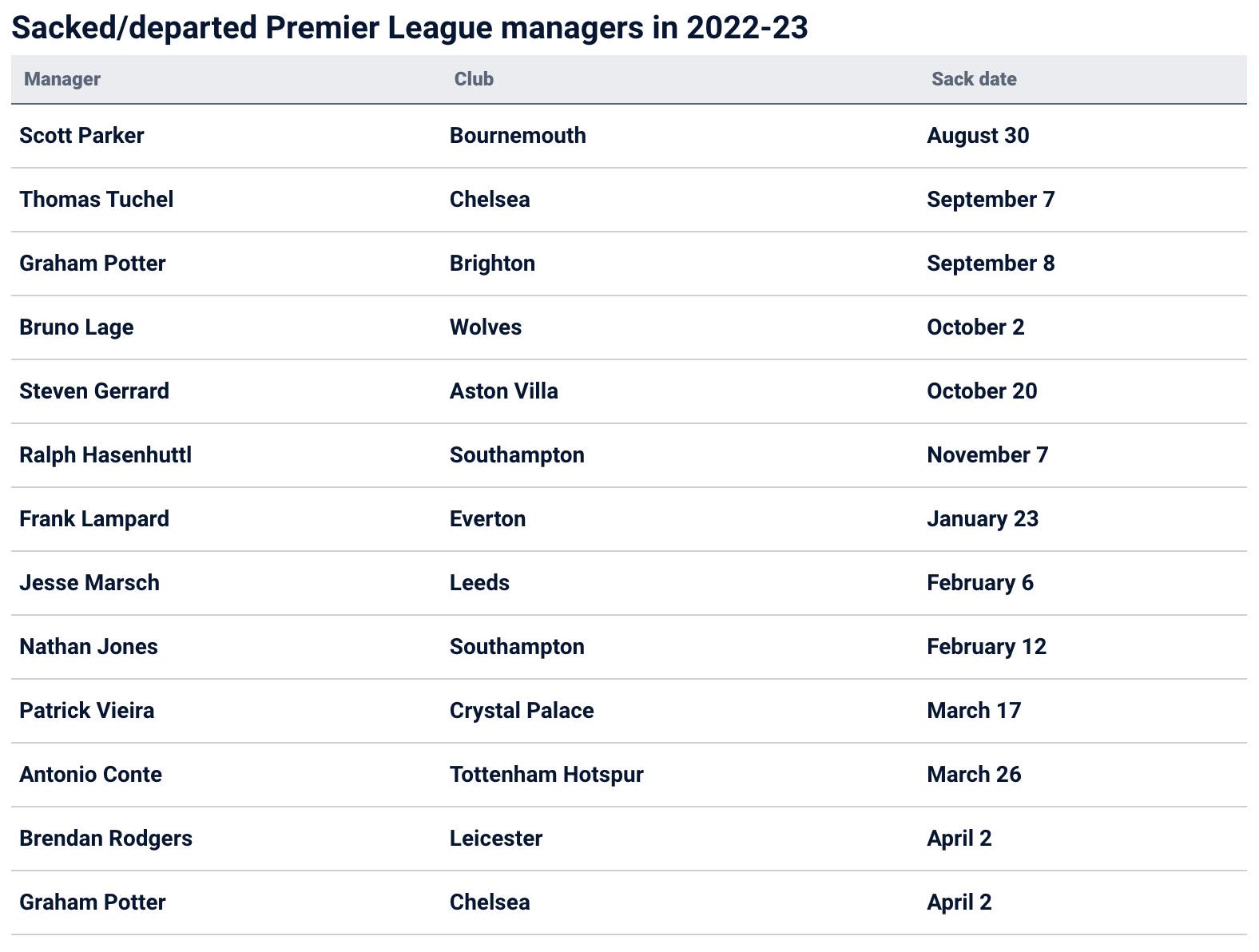
Source: footballtransfers.com

This is a major point of difference from the employment contracts given to players. It is far more uncommon for players to just simply be sacked at the whim of a club’s board whilst coaches are often chopped and changed in an almost constant revolving door of managers in the top football leagues. Whilst some clubs buck the trend and managers can survive a decent tenure based upon results and success, the average duration of a coach is no longer than two seasons in the top European leagues. Failure to meet the objectives of the owners and the board, ‘losing’ the changing room as players can turn against the coach, a lack of connection with the fans, and consistently poor results will, more often than not, result in the ruthless sacking of the coach.

In light of this, perhaps the most important aspect for agents to be aware of is the termination clauses within a coach’s contract. The majority of employment contracts with coaches in the modern football era will contain termination clauses which will be negotiated by the agent. If these terms are clearly outlined within the contract signed at the beginning of the tenure, the coach should not suffer financially from being sacked. The termination terms will usually ensure that the coach is adequately compensated for the remaining time left on their contract when they are dismissed. This will often be awarded as a one-time large payment made to the coach by the club. For example, when Jose Mourinho was sacked by Manchester United in 2018, he received a payout of £15million as he had two years left on his contract. Antonio Conte and his backroom staff, received a share of £26million in the same year from Chelsea after he was dismissed despite winning the Premier League in his first season and then the FA Cup in the year he was sacked for finishing 5th in the table. 

Agents must be aware that termination clauses can be as specific or broad as is desired and ultimately, agreed upon. For example, the club may wish to negotiate that the coach will have the termination fee reduced if they have been knocked out of all domestic cups and, if they finish in the bottom half of the league, they will not receive any compensation payout at all if they are dismissed as a result. The agent may compromise and agree that their client will be entitled to compensation regardless of their position in the league but accept a reduced fee if they do not meet certain objectives in domestic cups. Whatever is agreed upon at the time of the contract signing will most likely be enforced once the coach is sacked and the agent must ensure their client is not harshly financially penalised.  

If termination clauses were omitted from the original employment contract, it should be the responsibility of the agent to rectify the situation if a coaching client is sacked. Fortunately, all hope is not lost as in the majority of countries there are employment, contract and labour laws which prevent the termination of contracts without just cause or a minimum level of financial compensation. The agents will be able to negotiate what is known as a ‘termination settlement’ with suitable legal advice and assistance which will make the coach financially stable and the agent and client can then move on to finding the next opportunity. The more amicable the departure and the brevity of the legal battle, the lesser the damage to a coach’s reputation and hence, a greater chance of finding another coaching role in the future.

Summary

The employment status and job security of a coach is almost unlike any other profession in the world. Agents that wish to represent coaches must have an in-depth understanding of the way in which a club operates and the relationships they have with managers. It can be very volatile and the agent must ensure their client is not placed in a difficult situation if the worst is to happen and they are dismissed by a club. Implementing termination clauses and reassuring clients they will be financially secure will help the agent provide the best service to their client as a coach. In return, representing a coach or multiple coaches will reward the licensed agent and open up new gateways and access points into football clubs around the world. 

Neue Lizenzierungssystem der FA – Das deutsche Lizenzierungsverfahren im internationalen Vergleich

Der englische Fußballverband (FA) hat kürzlich ein neues Lizenzierungssystem für Fußballklubs in England angekündigt. Das neue System, das ab der Saison 2024/25 in Kraft tritt, soll mehr finanzielle Stabilität und Nachhaltigkeit im englischen Fußball fördern und mehr Schutz bieten. Daher werden in diesem Blogbeitrag das neue Lizenzierungssystem der FA vorgestellt und mit dem deutschen Lizenzierungsverfahren verglichen. 

Neues FA-Lizenzierungssystem

Nach dem neuen Lizenzierungssystem müssen Fußballklubs eine Reihe finanzieller und Governance-Kriterien erfüllen, um eine Lizenz zur Teilnahme am englischen Fußball zu erhalten. Zu diesen Kriterien gehören Anforderungen an die Klubs. Beispielsweise müssen sie eine gesunde Finanzlage aufrechterhalten. Dabei müssen die Klubs nachweisen, dass sie in der Lage sind, ihren finanziellen Verpflichtungen nachzukommen und langfristig nachhaltig zu wirtschaften.

Das neue Lizenzierungssystem wird auch mehr Wert auf gute Führung und Transparenz legen, wobei die Klubs verpflichtet sind, auf faire und transparente Weise zu operieren und eine Reihe von regulatorischen Anforderungen einzuhalten. Dazu gehören das regelmäßige Veröffentlichen von Finanzberichten und die Unterhaltung solider Systeme der internen Kontrolle und des Risikomanagements.

Der “Owners’ and Directors’ Test” gilt für alle Vereine der Premier League, English Football League, National League, Isthmian League, Northern Premier League, Southern Football League, WSL und Women’s Championship. Der Zweck des Tests besteht darin, dass die Eigentümer, Direktoren und Amtsträger von Vereinen in diesen Ligen Standards erfüllen, die über die gesetzlich vorgeschriebenen hinausgehen, um den Ruf und das Image des Spiels zu schützen. Die Premier League und die English Football League führen den Test für Klubs in ihren Ligen durch.

Darüber hinaus bietet das neue Lizenzierungssystem einen besseren Schutz für Fans und Gläubiger für den Fall, dass ein Verein in finanzielle Schwierigkeiten gerät oder von Insolvenz bedroht ist. Die FA wird größere Befugnisse haben, um in die Angelegenheiten von Vereinen einzugreifen, die sich in einer finanziellen Notlage befinden, und sie wird in der Lage sein, Sanktionen und Strafen gegen Vereine zu verhängen, die ihren finanziellen Verpflichtungen nicht nachkommen oder die neuen Lizenzierungsanforderungen nicht erfüllen.

Das neue Lizenzierungssystem wurde von Fans, Vereinen und Branchenexperten allgemein begrüßt, die es als positiven Schritt zur Förderung einer größeren finanziellen Stabilität und Nachhaltigkeit im englischen Fußball sehen. Das System soll helfen, zu verhindern, dass Klubs zu hohe Ausgaben tätigen und unhaltbare Schulden anhäufen.

Einige haben jedoch Bedenken geäußert, dass das neue Lizenzierungssystem für kleinere Klubs, die Schwierigkeiten haben könnten, die strengen Finanz- und Governance-Anforderungen zu erfüllen, übermäßig belastend sein könnte. Es gibt auch Bedenken, dass das System schwierig durchzusetzen sein könnte, insbesondere wenn Klubs versuchen, die Regeln zu umgehen oder Schlupflöcher in den Vorschriften finden.

Vorbilder für ein solches Lizenzierungssystem gibt es einige. Jedoch sind vor allem das deutsche Lizenzierungssystem der DFL und das UEFA Financial Fair Play immer wieder im Fokus. 

Der deutsche Weg mit der 50+1-Regel

Das Lizenzierungssystem der DFL soll sicherstellen, dass alle Vereine der 1. und 2. Bundesliga finanziell stabil, nachhaltig und transparent agieren. Das Lizenzierungssystem basiert insbesondere, aber nicht ausschließlich, auf drei Schlüsselbereichen: Infrastruktur, Finanzen und sportliche Kriterien.

Die Infrastrukturkriterien konzentrieren sich darauf, sicherzustellen, dass die Vereine über angemessene Einrichtungen verfügen, um in einem professionellen Umfeld tätig zu sein. Dazu gehören Anforderungen wie ein geeignetes Stadion, das bestimmte Standards erfüllt, einschließlich einer Mindestsitzplatzkapazität und anderer technischer Anforderungen. Die Vereine müssen auch über angemessene Trainingseinrichtungen, medizinische Einrichtungen und Sicherheitsmaßnahmen verfügen.

Die Finanzierungskriterien konzentrieren sich darauf, sicherzustellen, dass die Vereine finanziell stabil sind und über ein nachhaltiges Geschäftsmodell verfügen. Die Klubs müssen einen detaillierten Finanzplan für die kommende Spielzeit vorlegen und nachweisen, dass sie über ausreichende finanzielle Mittel verfügen, um ihre Ausgaben zu decken. Sie müssen auch finanzielle Transparenz nachweisen und strenge Vorschriften in Bezug auf Finanzberichterstattung und Rechenschaftspflicht einhalten.

Die sportlichen Kriterien konzentrieren sich darauf, sicherzustellen, dass die Vereine über eine konkurrenzfähige Mannschaft verfügen, die in der Lage ist, auf höchstem Niveau zu konkurrieren. Die Klubs müssen über ein Nachwuchsförderungsprogramm verfügen und ihre Mannschaft muss in den vergangenen Spielzeiten ein bestimmtes Leistungsniveau aufweisen. Sie müssen auch nachweisen, dass sie über geeignetes Trainerpersonal und medizinisches Personal verfügen, um die Gesundheit und Sicherheit ihrer Spieler zu gewährleisten.

Das Lizenzierungssystem der DFL wird jährlich überprüft: Die Vereine müssen zu Beginn jeder Saison eine Lizenz beantragen. Die Einhaltung der Lizenzierungsvoraussetzungen durch die DFL wird vor Erteilung der Lizenz von jedem Verein gründlich geprüft. Wenn ein Klub die Lizenzierungsanforderungen nicht erfüllt, kann ihm die Lizenz verweigert oder es drohen Sanktionen.

Großer Bestandteil der finanziellen Kriterien ist die 50+1-Regel. Die 50+1-Regel sieht vor, dass mindestens 50 % plus eine Aktie eines Fußballvereins seinen Mitgliedern gehören müssen. Das bedeutet, dass die Fans ein bedeutendes Mitspracherecht bei der Führung des Vereins haben, einschließlich der Ernennung des Vorstands und des Managements. Es stellt auch sicher, dass der Verein nicht im Besitz einer einzelnen Person oder eines Unternehmens ist, was dazu führen könnte, dass der Verein zum Vorteil des Profits und nicht des Sports betrieben wird.

Die Ursprünge der 50+1-Regel lassen sich bis in die 1990er-Jahre zurückverfolgen, als sich der deutsche Fußball stark veränderte. Mit dem Aufkommen der Bundesliga versuchten Vereine, ihr kommerzielles Potenzial zu maximieren, und viele versuchten, Investitionen von wohlhabenden Privatpersonen und Unternehmen anzuziehen. Es wuchs jedoch die Sorge, dass dies zu einer Machtkonzentration in den Händen einiger weniger führen könnte, was möglicherweise zum Zusammenbruch kleinerer Vereine und zur Kommerzialisierung des Sports führen könnte.

Um dies zu verhindern, führte der Deutsche Fußball-Bund (DFB) 1998 die 50+1-Regelung ein, die später in die Satzung der DFL aufgenommen wurde. Die Regel stellt sicher, dass die Vereine im Interesse der Mitglieder geführt werden und nicht im Interesse externer Investoren.

Die 50+1-Regel hat erhebliche Auswirkungen auf den deutschen Fußball, und viele argumentieren, dass sie zum Erfolg und zur Stabilität der Bundesliga beigetragen hat. Vereine sind nicht den Interessen externer Investoren verpflichtet und können sich auf ihre langfristige Entwicklung und ihren Erfolg konzentrieren. Es stellt auch sicher, dass der Sport erschwinglich und für die Fans zugänglich bleibt, die ein wesentlicher Bestandteil der Kultur des deutschen Fußballs sind.

Die 50+1-Regel ist jedoch nicht unumstritten. Einige argumentieren, dass dies das finanzielle Potenzial von Klubs einschränkt und sie daran hindert, mit Vereinen wie Manchester City und Paris Saint-Germain zu konkurrieren, die von erheblichen Investitionen wohlhabender Eigentümer profitiert haben. Andere argumentieren jedoch, dass die Regel gleiche Wettbewerbsbedingungen gewährleistet und verhindert, dass der Sport von einigen wenigen wohlhabenden Personen dominiert wird.

In den letzten Jahren gab es einige Herausforderungen für die 50+1-Regel, da einige Vereine versuchten, sie zu ändern oder abzuschaffen. Die Regel bleibt jedoch ein grundlegender Bestandteil des deutschen Fußballs, und ihr Fortbestehen wird als entscheidend für die Zukunft des Sports angesehen.

UEFA Financial Fair Play

Das UEFA-Reglement zum Financial Fair Play (FFP) wurde 2011 eingeführt, um die finanzielle Stabilität der europäischen Fußballklubs zu fördern. Diese Vorschriften wurden als Reaktion auf die wachsende Besorgnis über die finanzielle Lebensfähigkeit von Fußballvereinen und das Potenzial für finanzielles Missmanagement und nicht nachhaltige Ausgabenpraktiken eingeführt, die dem Sport langfristigen Schaden zufügen könnten.

Die UEFA-FFP-Reglemente verlangen von den Klubs, im Rahmen ihrer Möglichkeiten zu wirtschaften und sicherzustellen, dass sie keine übermäßigen Schulden anhäufen. Klubs müssen der UEFA regelmäßig Finanzberichte vorlegen, und sie können mit Strafen und sogar mit dem Ausschluss aus UEFA-Wettbewerben rechnen, wenn sie die Vorschriften nicht einhalten.

Das Hauptziel des UEFA-FFP-Reglements ist die Förderung der finanziellen Nachhaltigkeit im europäischen Fußball. Die Vorschriften sollen sicherstellen, dass Vereine nicht über ihre Verhältnisse hinaus Geld ausgeben und untragbare Schulden anhäufen. Dies wird erreicht, indem von den Klubs verlangt wird, ihre Bücher auszugleichen, um sicherzustellen, dass sie genügend Einnahmen generieren, um ihre Ausgaben und Schuldenrückzahlungen zu decken.

Das UEFA-FFP-Reglement zielt auch darauf ab, das finanzielle Fairplay im europäischen Fußball zu fördern. Die Vorschriften zielen darauf ab, gleiche Wettbewerbsbedingungen für alle Klubs zu schaffen, indem Klubs daran gehindert werden, ihre finanziellen Ressourcen einzusetzen, um sich einen unfairen Vorteil gegenüber ihren Konkurrenten zu verschaffen. Dies wird erreicht, indem die Geldbeträge begrenzt werden, die Vereine für Spielertransfers und Gehälter ausgeben können, und indem Klubs daran gehindert werden, ihre finanziellen Ressourcen zur Manipulation des Transfermarktes einzusetzen.

Die UEFA-FFP-Regelungen haben seit ihrer Einführung im Jahr 2011 erhebliche Auswirkungen auf den europäischen Fußball. Die Regelungen haben zu einer deutlichen Reduzierung der Verschuldung der europäischen Fußballklubs geführt und auch zu einer größeren finanziellen Stabilität des Sports beigetragen. Die Vorschriften haben auch dazu beigetragen, die Wettbewerbsbedingungen für kleinere Klubs anzugleichen, die gegenüber ihren größeren, wohlhabenderen Rivalen nicht mehr erheblich benachteiligt sind.

Das UEFA-FFP-Reglement ist jedoch nicht unumstritten. Einige Vereine haben argumentiert, dass die Vorschriften ihre Fähigkeit einschränken, in ihre Kader zu investieren und mit ihren Rivalen zu konkurrieren. Einige haben auch argumentiert, dass die Vorschriften zu komplex und schwer durchzusetzen seien, wobei einigen Klubs vorgeworfen wird, Schlupflöcher in den Vorschriften gefunden zu haben.

Zusammenfassung

Das Lizenzierungssystem der DFL stellt erfolgreich sicher, dass die deutschen Fußballvereine finanziell stabil, nachhaltig und transparent agieren. Es fördert einen fairen Wettbewerb und trägt zum Gesamterfolg der Bundesliga und 2. Bundesliga bei. Das System ist ein Vorbild für andere Fußballligen auf der ganzen Welt und ist für seine Effektivität und Effizienz anerkannt.

Die 50+1-Regel ist ein einzigartiger und kritischer Aspekt des deutschen Fußballs, der dazu beigetragen hat, die Integrität des Sports zu wahren und sicherzustellen, dass die Vereine gemeinschaftsorientiert bleiben. Obwohl es in den letzten Jahren einige Herausforderungen für die Regel gab, wird ihr Fortbestehen als wesentlich für die Zukunft des deutschen Fußballs angesehen. 

Das UEFA-Reglement zum Financial Fair Play wurde 2011 eingeführt, um finanzielle Stabilität und Fairplay im europäischen Fußball zu fördern. Die Vorschriften zielen darauf ab, sicherzustellen, dass die Vereine im Rahmen ihrer Möglichkeiten arbeiten. Sie hindern die Vereine daran, ihre finanziellen Ressourcen einzusetzen, um sich einen unfairen Vorteil gegenüber ihren Konkurrenten zu verschaffen. Obwohl die Vorschriften umstritten sind, hatten sie bisher einen erheblichen Einfluss auf den europäischen Fußball, indem sie eine größere finanzielle Nachhaltigkeit fördern und die Wettbewerbsbedingungen für kleinere Vereine bis zu einem gewissen Maß ausgleichen.

Das neue Lizenzierungssystem für Fußballvereine in England stellt einen bedeutenden Schritt zur Förderung größerer finanzieller Stabilität und Nachhaltigkeit im englischen Fußball dar. Auch wenn es einige Bedenken hinsichtlich der möglichen Auswirkungen auf kleinere Vereine geben mag, wird das System weithin als positive Entwicklung für den Sport insgesamt angesehen und dürfte Fans und Gläubigern langfristig einen besseren Schutz bieten.

An Expanded World Cup and Club World Cup: FIFA’s Changes and What it Means for Agents


Introduction

For every audience and finance-led industry, evolving to fit with the interests of modern society is imperative. Football is one of these and FIFA is one of the bodies that has the responsibility of structuring the beautiful game around the world to continue to attract the largest fanbase of any global sport. 

Over the recent months there have been some major changes to international competitions that FIFA have made. In this blog we will explain exactly what these changes are, the reasons for them, the immediate criticism that they have come under, and the implications for football agents managing the players that may be involved.

The Club World Cup

The current Club World Cup is an international FIFA competition that has been held every year since 2005 after the first edition in 2000. It has consisted of seven teams, winners from different confederations across the footballing world, and spans across around two weeks before deciding a ‘club world champion’. Real Madrid are the most recent winners, having claimed the title in Morocco in 2022 and the next tournament will take place in Saudi Arabia in December of this year.

FIFA have now announced that this year’s edition will be the penultimate. As of 2025, a new Club World Cup format will begin. The rejuvenated tournament will consist of 32 clubs divided into eight groups, a large increase for just the seven teams competing for the title before. These teams will be selected from title winners and highly ranked clubs in the different confederations; four teams from the AFC (Asian Football Confederation), another four from CAF (Confederation of African Football) and CONCACAF (Confederation of North, Central American and Caribbean Association Football). There will then be six clubs from the CONMEBOL (Confederación Sudamericana de Fútbol), one from the OFC (Oceania Football Confederation), and twelve teams from UEFA (Union of European Football Associations). The final club will be chosen from the host nation of the competition. The supposed plan at the moment is for the United States of America to host the newly formatted competition in 2025 as a trial event before they then also host the 2026 International World Cup alongside Canada and Mexico. 

Positives and Criticism

The argument given by FIFA for introducing a revamped and expanded Club World Cup is that it will generate enormous sums of money which can then be reinvested into world football and to improve accessibility and opportunities within the game in all corners of the globe. There is also a proposal for a women’s version of the competition, once again aimed at enhancing the exposure and attractiveness of the sport, helping women’s football to grow.

On the other hand, FIFA has received a lot of criticism for the decision and the manner in which it was made. FIFPro, the Union for Professional Footballers have been outspoken in claiming that the planning and restructuring of the tournament was conducted ‘unilaterally’ and without the consultation of national associations and the players and clubs that will be involved. This is not the first time that FIFA have been questioned for a lack of collaboration with others in making decisions which impact global football. Other stakeholders, governing bodies and national associations may feel they should have a voice in finding the best proposals to improve the future of football.

The new tournament could threaten and degrade historic and traditional domestic and other international club competitions. National associations may be concerned that this affects their domestic tournaments by taking attention and priority away from them and diverting a club’s focus to winning the new Club World Cup tournament. This will distort the competitiveness of domestic leagues and cups and place further pressure on national associations trying to grow the game in their own country.

Another aspect that has been cited by critics is the already clustered schedule for modern football players playing at the highest level. The footballing calendar is busier than ever before and, as we discussed previously regarding increasing player injuries, the welfare of players could be threatened. Additional congestion in the schedule means less time away from high-pressure situations for the players and greater chance of injury and mental health issues. This has led well-known British pundit, Jamie Carragher, to call for European clubs to actually boycott the Club World Cup as it renders players being ‘overused’ and comparable to ‘cattle’. 

The FIFA World Cup

We have known for a while that FIFA planned to make similar expansion changes to international football and most significantly, the number of nations represented in the World Cup. The 2026 US, Canada and Mexico edition of the tournament will consist of 48 nations, increased from 32. In 2017, FIFA had said that the FIFA Council had decided upon 16 groups of three but after a very successful and exciting Qatar World Cup in 2022 with the traditional 4-team groups, FIFA has now stated that they will re-discuss this. The possibility is that FIFA will still have groups of four and hence, there will be 12 groups rather than the traditional eight. However, this will then impact their original plan to promote the top two of each 3-team group to a knockout stage of 32 nations which then dwindles to 16, 8, 4 and 2 in the final. This is another element which FIFA will likely deliberate over before making a final decision. 

The positive thinking behind the expanded tournament is to provide the opportunity to nations and its players to represent their countries and people in the world’s biggest competition when previously they may never have had this opportunity. The same can be said for FIFA’s proposal to expand the women’s Olympic tournament to 16 teams rather than just 12 as well. Increased opportunity, exposure and accessibility is the main driving force behind FIFA’s proposals. However, once again this decision has not gone without criticism. There is a concern that an expanded World Cup not only reduces the seriousness and competitiveness of the qualification process but will also dilute the talent and excitement of the actual tournament. Fears are that major teams will record huge margins and wins over minor countries and the rise in one-sided games will reduce the attraction of the early stages of the World Cup.

FIFA are also considering changes to the international calendar away from just the World Cup. From 2025, there will be an extended four-match international break in late September and early October rather than two separate breaks. There will continue to be international fixtures and therefore, league breaks in November, March and June. The hope is that this will enhance the integration of the international fixtures within domestic league or cup campaigns. This will take place alongside expanded youth international tournaments and competitions to promote youth football and provide greater opportunities for development on the international stage. 

What this Means for Agents

The new changes by FIFA will impact every aspect of football. However, it is important for us to consider the implications for agents, both positive and negative. Firstly, expanded top competitions means more players participating in the most watched and important tournaments in football. Hence, there is a greater possibility that an agent’s client(s) will have the opportunity to demonstrate their talent at the highest level. This has the benefit of increased exposure and, if they perform well and are well supported by their agent, better opportunities may arise. These opportunities will not just be sporting but also commercially, for players appearing on televised fixtures viewed by millions will have more of a commercial value. Agents need to be aware that these new expanded formats may present greater chances to capitalise on on behalf of clients and provide services for them by bringing them improved sporting and financial possibilities.

There are also areas of caution with the new changes that echo the concerns of many in terms of increased congestion and an overloaded schedule. It is important for agents to communicate openly with clients once these new changes come into force. The mental health and physical well-being of clients will be under pressure and agents should understand if their client is struggling and ensure that they receive the required attention. 

Summary

FIFA continues to make changes to global football and its top competitions, both internationally and at club level. There are various arguments in support of such changes as well as criticism regarding the negative effects it may have on domestic competitions and the players involved. It is an ongoing development that agents need to be aware of and ensure they are well prepared to capitalise on any positive benefits for clients that come with the changes and to avoid the risks and drawbacks that clients may face. 

Comprensión y Aplicación de la Compensación por Formación de la FIFA y el Mecanismo De Solidaridad: Explicado

Introducción

Con la proximidad del nuevo examen de la FIFA para Agentes de Fútbol, hay muchos puntos de discusión y aprendizaje dentro de los documentos y materiales claves de la FIFA que deben entenderse por completo. Es probable que la compensación por formación y el mecanismo de solidaridad se aborden de alguna manera dentro del examen y, por lo tanto, son un área importante para que los agentes no solo desarrollen una comprensión profunda, sino que también adquieran la capacidad de aplicarla en la vida real.

La compensación por formación y los pagos solidarios son mecanismos que se utilizan para garantizar que el club que ha formado al jugador durante su desarrollo juvenil se beneficie económicamente de forma adecuada de su éxito futuro. En este blog, empezaremos describiendo exactamente qué es la “compensación de formación” y el “mecanismo de solidaridad”. A continuación, daremos ejemplos individuales de cómo la FIFA puede examinar estas áreas y daremos una guía detallada paso a paso a través de la interpretación de la pregunta, el cálculo correcto y, en última instancia, la obtención de la respuesta correcta.  

Compensación Por Formación

El Articulo 20 del Reglamento Sobre el Estatuto y la Transferencia de Jugadores (RETJ) dice: 

“La indemnización por formación se pagará al club o clubes formadores de un

jugador: 1) cuando el jugador se inscriba por primera vez como profesional y 2) por cada transferencia del jugador profesional hasta el fin del año natural en el que cumple 23 años. La obligación de pagar una indemnización por formación surge, aunque la transferencia se efectúe durante o al término del contrato. Las disposiciones sobre la indemnización por formación se establecen en el anexo 4 del presente reglamento.” (FIFA)

¿Cuándo se Debe la Compensación por Formación?

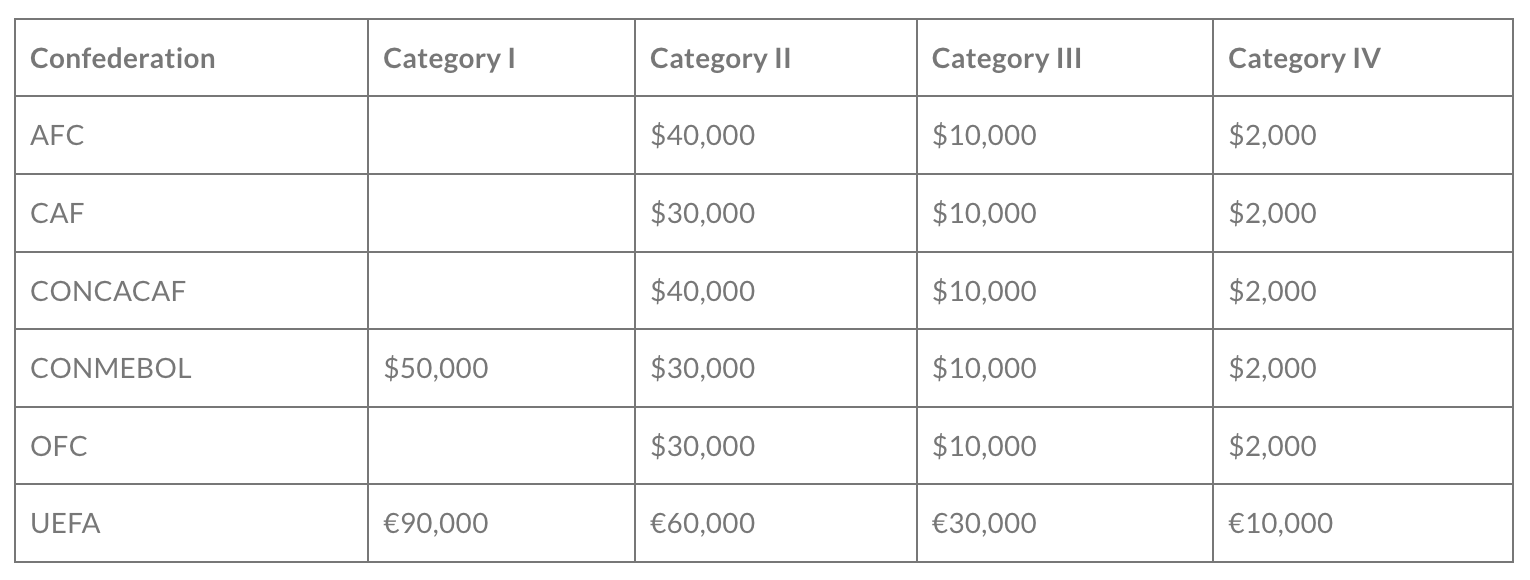
En términos simples, la compensación por formación se debe al club o clubes formadores del jugador cuando el firma su primer contrato profesional o cada vez que sea transferido hasta el final del año calendario en el que cumple 23 años. Para los agentes, la compensación por formación es algo que deben entender, ya que es importante cuando se analizan las tarifas de transferencia y deberá tenerse en cuenta en las negociaciones cada vez que el cliente se transfiera hasta la edad de 23 años. Para garantizar que la indemnización por formación de jugadores muy jóvenes no se fije en niveles irracionalmente altos, los costos de formación de jugadores de los años naturales de sus 12 a 15 años de edad, es decir, cuatro años naturales, se basarán en los costos de formación y educación de clubes de la 4.a categoría. No obstante, para los años calendario desde que cumple 16 años hasta el año calendario que cumple 21 años, la compensación por formación adeudada dependerá de la categoría del club en el que firme su primer contrato profesional o que sea transferido. Usted debe aprender y comprender la categorización de los clubes de compensación por formación como se describe a continuación:

Confederacíon Categoría I Categoría II Categoría III Categoría IV
AFC   $40,000 $10,000 $2,000
CAF   $30,000 $10,000 $2,000
CONCACAF   $40,000 $10,000 $2,000
CONMEBOL $50,000 $30,000 $10,000 $2,000
OFC   $30,000 $10,000 $2,000
UEFA €90,000 €60,000 €30,000 €10,000

El pago de una indemnización por formación se efectuará en el plazo de los 30 días siguientes a la inscripción del jugador profesional. Además, “una asociación tendrá derecho a recibir la indemnización por formación, la cual en principio se debería a uno de sus clubes afiliados, si logra aportar prueba irrefutable de que el club en el cual el profesional estuvo inscrito y se formó ya no participa en el fútbol organizado y/o ya no existe; en particular, por motivo de bancarrota, liquidación, disolución o pérdida de afiliación. Esta indemnización se destinará a programas de desarrollo del fútbol juvenil de la asociación o asociaciones en cuestión.” (Anexo 4, RETJ)

Nota: Articulo 20 del RETJ de la FIFA, Los principios de la indemnización por formación no serán aplicables al fútbol femenino.

¿Alguna vez no se Debe la Compensación por Formación?

Hay 3 situaciones en las cuales no se debe una indemnización por formación y debes conocerlas: 

  • si el club anterior rescinde el contrato del jugador sin causa justificada (sin perjuicio de los derechos de los clubes anteriores);
  • si el jugador es transferido a un club de la 4.a categoría, o
  • si el jugador profesional reasume su calidad de aficionado al realizarse la transferencia.

Estos escenarios anulan la compensación a pagar de transferencia. 

Disposiciones Especiales Para la UE/EEE

Además, existen disposiciones especiales para la compensación por formación cuando la transacción se produce dentro de la Unión Europea (UE) y/o el Espacio Económico Europeo (EEE). Estas disposiciones son las siguientes:

  • Si el jugador pasa de un club de una categoría inferior a otro de categoría superior, el cálculo se realizará conforme a los gastos promedio de los costos de formación de los dos clubes. 
  • Si el jugador pasa de una categoría superior a una inferior, el cálculo se realizará conforme a los costos de formación del club de categoría inferior. 
  • Si el club anterior no ofrece al jugador un contrato, no se pagará una indemnización por formación a menos que el club anterior pueda justificar que tiene derecho a dicha indemnización. El club anterior debe ofrecer al jugador un contrato por escrito, remitido por correo certificado, a más tardar 60 días antes del vencimiento de su contrato vigente, sujeto a la siguiente excepción temporal. Esta oferta deberá ser, al menos, de un valor equivalente al contrato vigente. Esta disposición no será en perjuicio de los derechos a una indemnización por formación de los clubes anteriores del jugador. (Anexo 4, RETJ)

NOTA: El EEE son los 27 miembros de la Unión Europea y también incluye los países de Noruega, Liechtenstein e Islandia de la Asociación Europea de Libre Comercio. Tenga cuidado con su conocimiento de qué países no son parte de esto, incluso si espera que lo sean, como Suiza.

Pregunta de Practica – Examen 

Jugador X es un jugador de fútbol profesional nacido el 17 de Enero de 2004. Está previsto que firme su primer contrato profesional con TipTop Town el 17 de enero de 2024, cuando cumpla 20 años. Tiene el siguiente currículum futbolístico:

1 de Julio de 2013 – 31 de Diciembre de 2017: Brasilia City CF (Brasil – Categoría 3)

1 de Enero de 2018 – 31 de Diciembre de 2023: Istanbul United (Turquía – Categoría 3) – se aprobó que sus padres se mudaran por motivos laborales y no futbolísticos

1 de enero de 2024: TipTop Town (Inglaterra – Categoría 2)

¿Cuánta compensación por formación le corresponderá a sus clubes anteriores?

PASO 1: Calcula las edades en las que estuvo en cada club:

Brasilia City CF: de 9 a 14 años

Istanbul United: edades 14-19

PASO 2: Calcule la compensación por formación relevante según la categoría correcta:

Brasilia City CF: 2 años relevantes desde la edad de su cumpleaños número 12 hasta el comienzo del año calendario de su cumpleaños número 14. Calculado como un club UEFA de categoría 4 (Istanbul United es parte de la UEFA) ya que tiene entre 12 y 15 años. Por lo tanto, 2 x €10,000  = €20,000

Istanbul United: 2 años relevantes completos del año natural de su cumpleaños número 14 y 15 como club de categoría 4: 2 x €10,000 = €20,000. Luego, el año calendario de su cumpleaños número 16 hasta el año calendario de su cumpleaños número 19, en el Istanbul United antes de transferirse a un club de categoría 2. Por tanto, 4 x €60,000 = €240,000. Total €240,000 + €20,000 = €260,000

Asegúrese de que el total de años = 8

PASO 3: Seleccione la respuesta correcta. El examen presentara cuatro opciones como las siguientes:

a) Brasilia: €20,000 & Istanbul: €160,000

b) Brasilia: €20,000 & Istanbul: €240,000

c) Brasilia: €20,000 & Istanbul: €260,000

d) Brasilia: €30,000 & Istanbul: €260,000

Como hemos calculado en los pasos 1 y 2, la respuesta correcta seria la opción c.

Pregunta de Práctica Explicada:

El Jugador X que firma su primer contrato profesional con TipTop Town requiere el pago de una compensación por formación según el Articulo 20 del RETJ de la FIFA. El nivel de compensación adeudado a Brasilia City es de €20,000 y de €260,000 a Istanbul United calculado utilizando los costes de formación correspondientes a TipTop Town como club de categoría 2 multiplicado por el número de años que el Jugador X estuvo inscrito en estos clubes durante sus años de formación. El Jugador X estuvo en Brasilia City durante 2 años entre el año calendario de su cumpleaños número 12 y su cumpleaños número 13. Esto se multiplica por €10,000 (según un club de categoría 4 de la UEFA) por un total de €20,000. Luego, estuvo en el Istanbul United el año calendario de su cumpleaños número 14 y su cumpleaños número 15, que se calculan utilizando el costo de categoría 4. Luego, durante los años calendario desde su cumpleaños número 16 hasta su cumpleaños número 19, también estuvo en el Istanbul United. Por lo tanto, la indemnización por formación se debe a un club de categoría 2 de la UEFA (€60,000 al año) multiplicada por 4 años. Se calcula como un club de categoría 2 ya que el nuevo club (TipTop Town) al que va es de categoría 2, no se utiliza la categoría de Istanbul United. Este cálculo suma €20,000 y €240,000 para igualar los €260,000 adeudados a Istanbul United.

Mecanismo de Solidaridad

El Artículo 21 del Reglamento sobre el Estatuto y la Transferencia de Jugadores (RETJ) de la FIFA establece que:

Si un jugador profesional es transferido antes del vencimiento de su contrato, el club

o los clubes que contribuyeron a su educación y formación recibirán una parte de la indemnización pagada al club anterior (contribución de solidaridad). Las disposiciones sobre la contribución de solidaridad se establecen en el anexo 5 del presente reglamento.” (FIFA)

Si bien se requieren pagos de solidaridad para cumplir un propósito similar, existen claras diferencias con la compensación por formación. En primer lugar, las contribuciones solidarias se calculan para las edades del año calendario de su cumpleaños número 12 al año calendario de su cumpleaños número 23 en lugar del año 21. El pago solidario también solo es relevante si se ha pagado una tarifa de transferencia. Es decir, un agente libre que se fiche no supondrá una aportación solidaria. Sin embargo, si se paga una tarifa de transferencia, se deberá pagar el 5 % de la tarifa total en proporción al club o clubes en los que jugó el jugador durante su etapa de “desarrollo juvenil” de 12 a 23 años.

Es probable que en el nuevo examen para agentes, la FIFA pueda hacer una pregunta que brinde un escenario de un jugador que se mueve entre algunos clubes durante estos años y, por lo tanto, le pedirá que calcule cómo se distribuye el 5% y la suma de dinero que se debe a cada club.

Los puntos clave a tener en cuenta para las contribuciones solidarias son que entre las edades de 12 y 15 años, se deberá a los clubes el 5% del 5% de la tarifa de transferencia total por año (0,25% de la tarifa total por año). A partir de entonces, durante los ocho años hasta el año calendario del cumpleaños número 23 del jugador, se deberá a los clubes el 10 % del 5 % de la tarifa de transferencia total por cada año que el jugador estuvo con ellos (0,5 % del total cuota por año).

NOTA: Se debe una contribución solidaria a su(s) club(es) formador(es) cada vez que el jugador se transfiere, independientemente de su edad. Ya sea que el jugador se transfiera antes del vencimiento de su contrato a los 20, 25 o incluso 30 años, sus clubes de formación hasta los 23 años recibirán este pago.

Pregunta de Practica – Examen 

El Jugador Y acaba de cumplir 21 años. Su pasaporte de jugador es el siguiente:

Años calendario de sus cumpleaños número 10 a 15: Ghana Juniors (Ghana)

Años calendario de su cumpleaños 16 a 20: Accra FC (Ghana)

El jugador Y ha sido transferido de Accra FC a Beverly Hills FC en los EE. UU. por una tarifa de transferencia de $100,000 el 1 de Enero en el año calendario de su cumpleaños 21. ¿Cuál es el monto de la contribución solidaria adeudada a Accra FC y Ghana Juniors FC por la transferencia del jugador Y?

PASO 1: Calcule cuál será el 5% de la tarifa de transferencia total. 5% de $100,000 = $5,000.

PASO 2: Calcule la cantidad por año adeudada al club entre los años calendario de su cumpleaños número 12 y 15. A Ghana Juniors se le deberá el 5% de $5,000 ($250) por cada año. 4 x $250 = $1,000.

PASO 3: Calcule el monto adeudado para el año calendario de su cumpleaños número 16 incluyendo hasta el año calendario de su cumpleaños número 20. Se debe el 10% de $5,000 ($500) por año durante cinco años a Accra FC. 5 x $500 = $2,500.

PASO 4: Seleccione la opción correcta a continuación:

a) Ghana Juniors: $2,000 y Accra FC: $2,000

b) Ghana Juniors: $1,000 y Accra FC: $2,500

c) Ghana Juniors: $1,000 y Accra FC: $2,000

d) Ghana Juniors: $2,000 y Accra FC: $2,500

Como se calculó en los pasos 1 a 3, sabemos que la respuesta correcta en este caso es la b.

Extensión

Imaginemos que después de 2 temporadas en el Beverly Hills FC, el Jugador Y luego se transfiere permanentemente a San Francisco United, otro club en los EE. UU. por $5,000,000. Los clubes de Ghana (Accra FC y Ghana Juniors) recibirán su aporte solidario. Sin embargo, a pesar de estar dos temporadas en Beverly Hills antes del año natural de su 23 cumpleaños, el club no recibirá ninguna aportación solidaria. Esto se debe a las disposiciones que figuran en el anexo 5 del RETJ de la FIFA con respecto al mecanismo de solidaridad.

Los clubes formadores tienen derecho a percibir (una parte proporcional) del 5 % de la contribución de solidaridad en los siguientes casos:

  • se realiza el traspaso definitivo o en calidad de préstamo de un jugador profesional entre clubes afiliados a asociaciones distintas;
  • se realiza el traspaso definitivo o en calidad de préstamo de un jugador profesional entre clubes afiliados a la misma asociación, siempre que el club formador esté afiliado a una asociación distinta.

Por lo tanto, no se debe una contribución solidaria a los clubes formadores pertenecientes a la misma asociación nacional del nuevo club. En este caso, Beverly Hills no recibirá una contribución solidaria.

Conclusión

Aprender los diferentes factores y componentes clave que se tienen en cuenta al calcular la compensación por formación o los pagos de solidaridad debidos a los clubes de formación de un jugador, no es negociable para aprobar el examen de agente de la FIFA, pero también para garantizar que pueda ajustar adecuadamente las negociaciones para la transferencia de un cliente. Acostúmbrese a practicar los cálculos y la precisión porcentual para asegurarse de que se sienta cómodo al abordar cifras grandes.


The Legal Case Against the New FIFA Football Agent Regulations and What Happens Next?


Introduction

Earlier this year, the new FIFA agent regulations were implemented to the extent of a transition phase with the plan being by the 1st of October 2023, they will be fully enforced. The regulations detailed provisions and restrictions to the activity of football intermediaries such as a new licensing system including an examination process, multiple representation and commission caps.

It has always been discussed amongst the world of agents, those most affected by the changes, that there would be grounds to bring a legal case against the new regulations for a variety of reasons, mainly regarding the non-compliance of the new regulations with international and national laws. In this blog, we will aim to help you understand the legal basis which these cases will call upon, how this may develop, FIFA’s most likely defence, the possible outcomes and the wider effect this may have upon football agents and the sport as a whole. We will do this without entering into any of the complicated aspects of International Employment and Competition Law.

Background

Put simply, there are many different levels at which disgruntled agents can bring a case against the new FIFA agent regulations. There are different areas of law that agents consider are infringed upon by these new regulations and hence, if true, there is a good basis for a robust legal case. Regardless of FIFA’s all-powerful position in the world of football, they must consider national and international laws and therefore, the new agent regulations must be compliant and compatible with these legal systems. This is because in the legal pyramid, national and international laws are treated as superior to FIFA laws. They will take precedence over FIFA laws if there is any conflict with national or international laws such as employment laws in European Law within the European Parliament.

Firstly, potential issues with the new FIFA regulations lie in European Competition Law. This concerns preventing a body being able to develop a ‘monopoly’ over an industry and acting against the interests of the public. For the FIFA agent regulations, agents could possibly argue that FIFA have breached European Competition Law and that it is facilitating an anti-competitive industry. The commission cap is the biggest contradiction against Competition Law as it prevents agents conducting their business competitively against other agents. Furthermore, this could also be an illegal restriction of trade and limits the earning potential of agents. This could be brought to court and argued against on legal grounds. 

Another major point of legal discussion is around what is known as an “Abuse of Dominance”. To break this down, firstly we must acknowledge that FIFA possesses a position of power, or ‘dominance’, over the football industry. Whilst the laws of football are produced by IFAB, FIFA are the governing body that makes, amends and removes rules and regulations within the sport and across the world, their regulations are implemented on a national level. Therefore, FIFA satisfies the first criterion of dominance, that there is a dominant organisation in the industry.

For an abuse of dominance to be successfully argued in court, it must be shown that the dominant organisation, in this case FIFA, has abused their position. For it to be said that their actions are an ‘abuse’ of their position in the football industry, agents will aim to argue that the new agent regulations are damaging to market competition as well as the general well-being of the industry. Additionally, the agents’ case will try to prove that any alleged attempts of FIFA to avoid abuse of dominance, such as the consultation process they conducted with agents as discussed later, were futile. So, for example, agents will attempt to demonstrate that the hard commission cap and other objectionable aspects of the regulations are detrimental to the welfare of football as a whole as well as the profession of agents. 

The new regulations have restricted the earning potential of agents by only allowing a commission service fee of 3% if a client’s annual remuneration is above $200,000. The maximum an agent could possibly earn in any deal under the new regulations is 10% of the individual’s remuneration (if under $200,000) or 6% (if over $200,000) if they act on behalf of the client and the engaging club. However, realistically this is never guaranteed and often agents will only be able to earn a smaller, restricted service fee from a single party. It is also very common in football that agents will split commissions between two or three agents when trying to find their best deal for clients. This will mean individual agents will receive a maximum of 1% or 1.5% in these deals which is not financially viable. This will form part of the legal case against the regulations and argue that it damages competition and the well-being of the industry.

The cases against the new agent regulations may point to the recent implementation of a new format for a ‘Club World Cup’ as evidence that FIFA commit abuses of dominance in their governance of football. National associations, the European Leagues Association and the World Leagues Forum have already issued complaints about the new 104-game format of the Club World Cup that will take place every four years as they were not consulted by FIFA despite the effect this will have on both international and national competitions. La Liga described FIFA’s unilateral decision making as a ‘complete disregard’ for the football community. 

FIFA have received numerous accusations that their lack of external consultation and respect for other stakeholders is damaging for football. However, the lack of consultation before making a major decision which alters the landscape of club football could also be used within the legal battles as a strong example of FIFA’s abuse of dominance which the European Leagues Association stated has become a ‘habit’ of FIFA in recent years. 

There are then several legal issues surrounding the aspect of the new regulations and the FIFA Clearing House requiring agents to publicly declare their earnings. The concerns around this are not only based on the right to privacy of agents but also the dangers this may present to agents in certain parts of the world. Agents will hope that courts will consider that breach in privacy and an effect on the safety of agents to be a valid argument against this part of the new regulations.

Ultimately, agents feel as though at least some parts of the new FIFA agent regulations, particularly the commission cap, are unfair. Agents that aren’t in the top bracket of earners are likely to be driven out of business and this could have drastic consequences for players in lower leagues and the wider football landscape. However, ‘unfairness’ is often not enough, the cases that will be brought to court at different levels in different legal systems globally will rely upon evidence and well thought-out arguments that the regulations undermine laws that are in place nationally and internationally and that should apply to FIFA.

What has happened so far?

So far, agents from competing companies have united together into representative associations and groups to join forces in creating a robust legal argument against certain elements of the new FIFA Agent Regulations. For example, the ‘Association of Football Agents (AFA)’ held a meeting in London to discuss possible legal action and plan for the next steps for agents. 

In some places, legal cases have already commenced. We know FIFA and the KNVB (Dutch football board) have been summoned to the Dutch Courts to begin the first legal proceedings disputing the new regulations. Furthermore, following a German Agency suing the DFB (German football board) the national court has escalated this to a higher European court who will take the case further before reaching a conclusion as to whether or not the new FIFA agents regulations are compatible with wider International laws. The Professional Football Agents Association (PROFAA) have also brought a case to the Court of Arbitration for Sport (CAS) and a case is set to begin in Belgium as well. Evidently, there is a wide array of legal battles ongoing against the FFAR.

Agents originally objected to the claims that FIFA had properly consulted agents when devising the new regulations as we will explain further in the next section. This can contribute to the strength of the ‘abuse of dominance’ argument as agents are considering how best to demonstrate that FIFA implemented the new regulations without proper collaboration with those that the regulations were going to impact the most. The decisions made by FIFA to introduce regulations such as hard commission caps have consequences and collateral damage on many stakeholders within the game of football. Agents have begun to point to this as legal cases are built and brought to courts. 

Importantly, many agents welcome and are supportive of introducing regulations for the profession. For example, lots of agents have given positive feedback on reintroducing an exam to raise the quality and standard of the profession and the notion of increasing transparency within the game is mostly agreed with. However, the belief is that the new FIFA agent regulations as a whole, the manner in which they have developed, the contents of certain major points and the nature of the implementation has not been practically reasonable and raises legal issues.. 

FIFA’s Position

To defend the new regulations successfully in court, FIFA’s legal representatives will have to convincingly justify the reasons and basis for each questionable aspect of the regulations. For example, they must show that their reasons for restricting commissions and the amount of money that agents can make has such a benefit for football that outweighs the case against them. Their main argument will be that agents take money away from the football industry. In itself, this will be too vague and only reflects the small proportion of agents that take large sums from single transactions, so FIFA will have to reinforce this with evidence within court to show that it is enough of an issue to bring in hard commission caps. 

FIFA will also have to defend their position as to why agents representing the selling club can earn more than a player agent, hence seemingly valuing these agents above player agents. The court will then decide whether, under international and national free market, competition laws and more, there is sufficient grounds for certain regulations. 

As we briefly touched upon, there are claims in defence of FIFA that they conducted a consultation process and purposeful meetings with global agents in order to better inform their development of the new regulations. If they were able to prove that these meetings were what they are saying they were, this may act as a defence against the claim of ‘abuse of dominance’. 

Since 2018, FIFA has held several so-called ‘consultations’, supposedly bringing together agents from around the world to voice their opinions and concerns regarding their proposed regulations which have now come into force. The fundamental premise of this was positive, if FIFA were to have openly collaborated with agents to find the best possible solution, compromise and regulation for agents as ‘stakeholders’ in football, it would have most likely benefited the sport as a whole.

The entire process may have appeared positively to the public as a proper and thorough consultation but this contrasts the fact that many agents left this process and disagreed with how they were conducted. A particular concern was that apart from the very first meeting, FIFA sent representatives rather than stakeholding decision-makers (ECA/FIFPro). It gave the impression that agents were just there to listen whilst they simply outlined the new regulations they had already decided upon. 

A further issue that could be raised within the court cases against the new regulations is that the agents that were in attendance at these consultations were ultimately not accurately reflecting agents worldwide. FIFA selected a handful of agents from different continents to form ‘unions’ but none of the big agencies were represented. The cohort represented less than 0.5% of active global agents. This is also further proven within the agent group that has been formed by FIFA.  

The courts will also consider the suggestion that the new regulations could have a completely adverse effect from the justifications given by FIFA. There is an argument that the new agent regulations will actually create new ways around the laws and that agents will try to find different ways of getting paid. Hence, the burden may move from the club to the player in many circumstances and the losing party out of all of this could be the player. 

Potential outcomes

It is assumed that agents do not want to achieve complete immunity from regulation as a result of challenging the new Regulations in court. In reality, the aim of battling against FIFA is to protect the agency profession and ensure that unfair and legally problematic regulations are not enforceable. 

Instead of total deregulation, the desired outcome is for feasible, reasonable and practical regulations. This may mean that FIFA are legally obliged to amend their new regulation proposals. The best possible outcome is to find a ‘middle-ground’ compromise that still achieves the enhanced transparency in the agency and football industries but does not have damaging consequences for the game as a whole and for the livelihoods of working professionals, especially for players.

Summary

In summary, this is a volatile topic that is likely to have several twists and turns along the way over the next few months and maybe even years. It is expected that the legal cases will be taken seriously and there will be some extent of success in the hope of legally encouraging FIFA to revise certain objectionable elements of the new agent regulations. Any outcome that improves the agency profession is the kind of result that all parties will be hoping for rather than a botched solution which burdens players and encourages finding loopholes within the laws and therefore, malpractice that is damaging to the well-being of football.


FIFA Ausbildungsentschädigung und Solidaritätsmechanismus: Ein faires System für Spielerentwicklung und -transfers

Fußball ist ein globaler Sport, der Millionen von Fans anzieht und Einnahmen in Milliardenhöhe generiert. Doch hinter dem Glanz und der Aufregung des Profifußballs steckt ein komplexes System der Spielerentwicklung und der Spielertransfers. Die FIFA Ausbildungsentschädigung und der Solidaritätsmechanismus sind zwei wichtige Vorschriften, die ein faires und nachhaltiges System für die Entwicklung und den Transfer von Spielern gewährleisten.

Was ist die Ausbildungsentschädigung?

Die Ausbildungsentschädigung ist ein System, das von den Klubs verlangt, die Jugendklubs zu entschädigen, die einen Spieler ausgebildet haben, wenn dieser Spieler seinen ersten Profivertrag unterzeichnet. Die Entschädigung soll dem Jugendklub helfen, junge Spieler weiterzuentwickeln und in seine Infrastruktur zu investieren.

Artikel 20 des FIFA-Reglements bezüglich Status und Transfer von Spielern (RSTP) besagt: „Trainingsentschädigungen werden an den/die Trainingsklub(s) eines Spielers gezahlt: (1) wenn ein Spieler seinen ersten Vertrag als Profi unterschreibt, und (2) jedes Mal, wenn ein Profi bis zum Ende der Saison bis zu seinem 23. Geburtstag wechselt. Die Verpflichtung zur Zahlung einer Ausbildungsentschädigung entsteht unabhängig davon, ob der Wechsel während oder am Ende des Spielervertrags erfolgt. Die Bestimmungen zur Ausbildungsentschädigung sind in Anhang 4 dieses Reglements festgelegt.“ (FIFA)

Die Höhe der Entschädigung wird anhand einer komplexen Formel ermittelt, die das Alter des Spielers, die Zeit, die er oder sie im Jugendklub verbracht hat, und die vom neuen Verein gezahlte Ablösesumme berücksichtigt. Die Entschädigung wird in der Regel vom neuen Verein an den Jugendverein gezahlt, der den Spieler entwickelt hat.

Ein Bild, das Tisch enthält.

Automatisch generierte Beschreibung

Die Ausbildungsentschädigung wird innerhalb von 30 Tagen nach Registrierung des Spielers fällig. Wenn der Verein aufgrund von Insolvenz oder aus anderen Gründen aufgelöst wurde und daher nicht mehr existiert, kann die Ausbildungsentschädigung stattdessen an den Nationalverband gezahlt werden. Dies jedoch unter der Bedingung, dass sie ausschließlich für die Reinvestition in den Jugendfußball des Landes bestimmt ist.

Hinweis: Artikel 20 des FIFA RSTP bezüglich Trainingsentschädigung gilt nicht für den Frauenfußball.

Darüber hinaus gelten Sonderregelungen für die Ausbildungsvergütung, wenn das Geschäft innerhalb der Europäischen Union (EU) und/oder des Europäischen Wirtschaftsraums (EWR) erfolgt. Diese Bestimmungen lauten wie folgt:

  1. Erfolgt ein Transfer von einem Klub einer niedrigeren Kategorie zu einem Klub einer höheren Kategorie, basiert die Berechnung auf der durchschnittlichen Entschädigung, die beiden Klubs zustehen würde.
  2. Erfolgt der Transfer von einem Klub einer höheren Kategorie zu einer niedrigeren Kategorie, erfolgt die Berechnung gemäß der Entschädigung, die dem Klub einer niedrigeren Kategorie zusteht.
  3. Eine Ausbildungsentschädigung wird nicht fällig, wenn dem Spieler 60 Tage vor Ablauf des Vertrages beim bisherigen Verein kein schriftliches Angebot vorliegt, sofern der Vertragswert beim wechselnden Verein mindestens gleich ist der bisherige Vertrag.

Hinweis: Der EWR besteht aus den 27 Mitgliedern der Europäischen Union und umfasst auch die Länder Norwegen, Liechtenstein und Island aus der Europäischen Freihandelsassoziation. Manche Länder, wie bspw. die Schweiz gehören nicht dazu.

Es gibt auch drei Fälle, in denen keine Ausbildungsvergütung fällig ist, die Sie möglicherweise beachten müssen:

  1. Wenn der Vertrag mit dem verkaufenden Verein ohne wichtigen Grund gekündigt wurde
  2. Wenn der Spieler von einer höheren Kategorie zu einem Verein der Kategorie 4 wechselt
  3. Wenn der Spieler durch den Transfer den Amateurstatus wiedererlangt

Was ist der Solidaritätsmechanismus?

Der Solidaritätsmechanismus ist eine weitere FIFA-Regelung, die sicherstellt, dass Jugendklubs für ihre Rolle in der Spielerentwicklung fair entlohnt werden. Der Solidaritätsmechanismus verlangt von den Klubs, einen Prozentsatz der Transfersumme, die sie für einen Spieler erhalten, an die Klubs zu zahlen, die ihn oder sie im Alter zwischen 12 und 23 Jahren entwickelt haben.

Artikel 21 des FIFA-Reglements bezüglich Status und Transfer von Spielern (RSTP) besagt: „Wird ein Profi vor Ablauf seines Vertrages transferiert, erhält jeder Verein, der zu seiner Aus- und Weiterbildung beigetragen hat, einen Anteil der an seinen ehemaligen Verein gezahlten Abfindung (Solidaritätsbeitrag). Die Bestimmungen über den Solidaritätsbeitrag sind in Anhang 5 dieses Reglements aufgeführt.“ (FIFA)

Der Prozentsatz der an die Jugendklubs gezahlten Ablösesumme wird anhand einer Staffelung festgelegt, die von 0,25% bis 5% reicht – je nach Alter des Spielers, als er oder sie vom Jugendklub entwickelt wurde. Der Solidaritätsmechanismus stellt sicher, dass Jugendklubs für ihre Rolle bei der Entwicklung von Spielern entschädigt werden, selbst wenn diese Spieler im Laufe ihrer Karriere mehrmals transferiert werden.

Die wichtigsten Punktesind, dass dem/den Klub(s) im Alter zwischen 12 und 15 Jahren 5% von 5% der Gesamttransfersumme pro Jahr (0,25 % der Gesamtsumme pro Jahr) geschuldet werden. Danach werden dem/den Verein(en) für die acht Jahre bis zum 23. Jahres 10% der 5% der Gesamtsumme pro Jahr (0,5% der Gesamtsumme pro Jahr) geschuldet. 

Hinweis: Bei jedem Wechsel des Spielers wird unabhängig von seinem Alter ein Solidaritätsbeitrag an den/die ausbildenden Verein(e) fällig. Unabhängig davon, ob der Spieler vor Ablauf seines Vertrags im Alter von 20, 25 oder sogar 30 Jahren wechselt, erhalten seine Ausbildungsvereine bis zum Alter von 23 Jahren diese Zahlung.

Zusammenfassung

Zusammenfassend sind der Ausbildungsentschädigungs- und der Solidaritätsmechanismus wichtige Vorschriften, die dazu beitragen, ein faires und nachhaltiges System für die Entwicklung und den Transfer von Spielern zu gewährleisten. Diese Regelungen stellen sicher, dass Jugendklubs für ihre Rolle bei der Entwicklung junger Spieler angemessen entlohnt werden und dass der Transfer von Spielern nicht ausschließlich von finanziellen Interessen bestimmt wird. Durch die Sicherstellung eines fairen und nachhaltigen Systems für die Entwicklung und den Transfer von Spielern tragen diese Vorschriften dazu bei, die langfristige Gesundheit und den Erfolg des Profifußballs zu fördern.

Explained: Understanding and Applying FIFA Training Compensation & the Solidarity Mechanism

Introduction

With the nearing of the first sitting of the new FIFA Football Agent Exam, there are many points of discussion and learning within the key FIFA documents and materials that need to be fully understood. Training compensation and the solidarity mechanism are likely to be addressed in some manner within the exam and hence, they are a major area for agents to not only develop an in-depth understanding of, but also gain the ability to apply it to a real life scenario.

Training compensation and the solidarity payments are mechanisms that are used to ensure that the club which has trained the player during their youth development is adequately benefiting financially from their future success. This blog will begin by outlining exactly what ‘training compensation’ and the ‘solidarity mechanism’ is. We will then go on to give individual examples of how these areas may be examined by FIFA and give detailed step-by-step guidance through interpreting the question, calculating correctly and ultimately, reaching the correct answer.

Training Compensation

Article 20 of the FIFA Regulations of the Status and Transfer of Players (RSTP) states that:

“Training compensation shall be paid to a player’s training club(s): (1) when a player signs his first contract as a professional, and (2) each time a professional is transferred until the end of the calendar year of his 23rd birthday. The obligation to pay training compensation arises whether the transfer takes place during or at the end of the player’s contract. The provisions concerning training compensation are set out in Annexe 4 of these regulations.” (FIFA)

When is Training Compensation Due?

In simple terms, training compensation is due to the player’s training club(s) when they sign their first professional contract or each time they are transferred until the end of the calendar year of their 23rd birthday. For agents, training compensation is something that you must understand as it is relevant when discussing transfer fees and will need to be accounted for in negotiations every time your client transfers up until the age of 23. For the calendar years of the ages between the player’s 12th birthday and 15th birthday, the training club will be owed a sum per year at the rate of a category 4 club. However, for the calendar years of their 16th birthday until the calendar year of their 21st, the training compensation owed depends upon the category of the club where he is signing his first professional contract or is transferred to. You need to learn and understanding the categorisation of training compensation clubs as outlined below:

Confederation Category I Category II Category III Category IV
AFC   $40,000 $10,000 $2,000
CAF   $30,000 $10,000 $2,000
CONCACAF   $40,000 $10,000 $2,000
CONMEBOL $50,000 $30,000 $10,000 $2,000
OFC   $30,000 $10,000 $2,000
UEFA €90,000 €60,000 €30,000 €10,000


The training compensation is due to the clubs within 30 days after the player is registered. If the club has folded due to bankruptcy or otherwise and therefore no longer exists, the training compensation can be paid to the national association instead on the condition that it is solely for reinvestment into youth football in the country. 

NOTE: Article 20 of the FIFA RSTP regarding training compensation does not apply to women’s football.

Is Training Compensation ever not Due?

There are also three instances where training compensation is not due which you may need to be aware of:

  1. If the contract with the selling club has been terminated without a just cause
  2. If the player is moving to a category 4 club from a higher category
  3. If they reacquire amateur status as a result of the transfer

These scenarios nullify the payable transfer compensation.

Provisions within the EU and the EEA

Additionally, there are special provisions given for training compensation when the transaction occurs within the European Union (EU) or/and the European Economic Area (EEA). These provisions are as follows:

  1. If a transfer occurs between a lower category club to a higher category club, the calculation is based upon the average compensation that would be due to both clubs.
  2. If the transfer is from a higher category club to a lower category, the calculation is made according to the compensation due to the lower category club.
  3. Training compensation will not be due if the player has not received an offer in writing 60 days prior to the expiration of their contract and if they have received an offer they have received it must be at least the same value as their contract with their current club.

NOTE: The EEA is the 27 European Union members and also includes the countries of Norway, Liechtenstein and Iceland from the European Free Trade Association. Be careful as to your knowledge of which countries are not a part of this even if you might expect them to be, such as Switzerland.

PRACTICE EXAM QUESTION

PLAYER X  is a professional football player born on the 17th January 2004. He is due to sign his first professional contract with TipTop Town on his 20th birthday, 17th January 2024. He has the following football CV:

1st July 2013 – 31st December 2017: Brasilia City CF (Brazil – Category 3)

1st January 2018 – 31st December 2023: Istanbul United (Turkey – Category 3) – it was approved that his parents moved for work and not footballing reasons

1st January 2024: TipTop Town (England – Category 2)

How much training compensation will be due to his previous clubs?

STEP 1: Work out the ages at which he was at each club:

Brasilia City: ages 9 to 14

Istanbul United: ages 14-19

STEP 2: Work out the relevant training compensation as per the correct category:

Brasilia City: 2 relevant years from the age of his 12th birthday until the beginning of the calendar year of his 14th birthday. Calculated as a category 4 UEFA club (Istanbul United is part of UEFA) as this is between the ages of 12 and 15. Hence 2 x €10,000 = €20,000

Istanbul United: 2 full relevant years of the calendar year of his 14th and 15th birthday as a category 4 club:  2 x €10,000 = €20,000. Then the calendar year of his 16th birthday until the calendar year of his 19th, at Istanbul United before transferring to a category 2 club. Hence, 4 x €60,000 = €240,000. Total €240,000 + €20,000 = €260,000

Make sure the total years = 8

STEP 3:  Select the correct answer. The exam will present four options such as the below:

a) Brasilia: €20,000 & Istanbul: €160,000

b) Brasilia: €20,000 & Istanbul: €240,000

c) Brasilia: €20,000 & Istanbul: €260,000

d) Brasilia: €30,000 & Istanbul: €260,000

As we have calculated in steps 1 and 2, the correct answer will be c.

Practice Question Explained: 

PLAYER X signing his first professional contract with TipTop Town requires the payment of training compensation as per article 20 of the FIFA RSTP. The level of compensation due to Brasilia City is €20,000 and €260,000 to Istanbul United calculated using the training costs relevant to TipTop Town as a category 2 club multiplied by the number of years that PLAYER X was registered with these clubs during his training years. PLAYER X was with Brasilia City for 2 years between the calendar year of his 12th birthday and 13th birthday. This is multiplied by €10,000 (as per a category 4 UEFA club) totalling €20,000. Then he was at Istanbul United the calendar year of his 14th birthday and his 15th birthday which are calculated using the category 4 cost. Then for the calendar years of his 16th birthday through to his 19th birthday he was also at Istanbul United. Therefore, training compensation is owed as per a category 2 club in UEFA (€60,000 per year) multiplied by 4 years. It is calculated as a category 2 club as the new club (TipTop Town) he is going to is category 2, it does not use the category of Istanbul United. This calculation adds €20,000 and €240,000 to equal €260,000 owed to Istanbul United.

Solidarity Mechanism

Article 21 of the FIFA Regulations of the Status and Transfer of Players (RSTP) states that:

“If a professional is transferred before the expiry of his contract, any club that has contributed to his education and training shall receive a proportion of the compensation paid to his former club (solidarity contribution). The provisions concerning solidarity contributions are set out in Annexe 5 of these regulations.” (FIFA)

Whilst solidarity payments are required to serve a similar purpose, there are distinct differences with training compensation. Firstly, solidarity contributions are calculated for the ages of the calendar year of their 12th birthday to the calendar year of their 23rd rather than 21st birthday. The solidarity payment is also only relevant if a transfer fee has been paid. In other words, a free agent that is signed will not entail a solidarity contribution. However, if a transfer fee is paid, 5% of the overall fee will be due in proportion to the club or clubs for which the player played during their 12-23 ‘youth development’ stage. 

It is likely that in the new agent exam, FIFA could ask a question which gives a scenario of a player moving between a few clubs during these years and hence will require you to calculate how the 5% is distributed and the sum of money that each club is owed.

The key points to note for solidarity contributions is that between the ages of 12 and 15, the club(s) will be owed 5% of 5% of the overall transfer fee per year (0.25% of the total fee per year). From thereafter, for the eight years up until the calendar year of the player’s 23rd birthday, the club(s) will be owed 10% of 5% of the overall transfer fee for each year the player was with them (0.5% of the total fee per year).

NOTE: A solidarity contribution is due to their training club(s) every time the player transfers, regardless of their age. Whether the player transfers before the expiry of their contract aged 20, 25, or even 30, their training clubs up until the age of 23 will receive this payment.

PRACTICE EXAM QUESTION

PLAYER Y has just turned 21. His player passport is as follows:

Calendar years of his 10th – 15th birthday: Ghana Juniors (Ghana)

Calendar years of his 16th – 20th birthday: Accra FC (Ghana)

He has been transferred from Accra FC to Beverly Hills FC in the USA for a transfer fee of $100,000 on the 1st January in the calendar year of his 21st birthday. What is the amount of solidarity contribution due to Accra FC and Ghana Juniors FC from PLAYER Y’s transfer?

STEP 1: Work out what 5% of the overall transfer fee will be. 5% of $100,000 = $5,000.

STEP 2: Calculate the amount per year due to the club between the calendar years of his 12th and 15th birthday. Ghana Juniors will be owed 5% of $5,000 ($250) for each year. 4 x $250 = $1,000.

STEP 3: Calculate the amount due for the calendar year of his 16th birthday up to and including the calendar year of his 20th birthday. 10% of $5,000 ($500) is owed per year for five years to Accra FC. 5 x $500 = $2,500.

STEP 4: Select the right option below:

a) Ghana Juniors: $2,000 & Accra FC: $2,000

b) Ghana Juniors: $1,000 & Accra FC: $2,500

c) Ghana Juniors: $1,000 & Accra FC: $2,000

d) Ghana Juniors: $2,000 & Accra FC: $2,500

As calculated in steps 1 to 3, we know that the correct answer in this case is b. 

Extension

Let’s imagine that after 2 seasons at Beverly Hills FC, PLAYER Y then permanently transfers to San Francisco United, another club in the US for $5,000,000. The clubs in Ghana (Accra FC and Ghana Juniors) will receive their solidarity contribution. However, despite being at Beverly Hills for two seasons before the calendar year of their 23rd birthday, the club will not receive any solidarity contribution. This is because of the provisions given in annexe 5 of the FIFA RSTP regarding the solidarity mechanism. 

A solidarity contribution is due when either: 

  1. The player is transferred or loaned between clubs belonging to different national associations or; 
  2. Between two clubs in the same national association as long as the training club(s) to which the contribution is due belongs to a different association.

Hence, a solidarity contribution is not due to training clubs belonging to the same national association of the new club. In this case, Beverly Hills will not receive a solidarity contribution.

Summary

Learning the different components and key factors accounted for in calculating the training compensation or solidarity payments due to a player’s training clubs is a non-negotiable for passing the FIFA Agent Exam but also for ensuring that you can adequately adjust negotiations for a client’s transfer. Get used to practicing calculations and percentage accuracy to ensure you feel comfortable in approaching large figures. 

Transferencias de Préstamo en el Fútbol: ¿Que Son? ¿Como Funcionan? ¿Quién está Implicado?

Introducción

El mundo del futbol tiene dos periodos al año en el cual los clubes de las diferentes ligas y asociaciones abren un periodo de inscripción de jugadores en el cual pueden comprar, vender, o ceder, los servicios de jugadores para armar los equipos de la mejor manera posible en base a las estrategias y necesidades del club y sus directivas. En estos periodos de mercado de invierno y verano es donde se dan las llamadas transferencias. 

Es una necesidad comprender lo que realmente implican las ofertas de préstamos y como funcionan. También, es un tema del cual se ha hablado mucho durante el último año debido a algunos cambios que la FIFA y la confederación UEFA han realizado con respecto a la cantidad de acuerdos de préstamo que puede realizar un solo club. Clasificaría los acuerdos de préstamo en tres diferentes categorías o tipos; El préstamo estándar, préstamo con opción de compra y préstamo con obligación de compra. Cubriré cada uno de estos en este blog. 

¿Que son los Prestamos Y Porque son Relevantes en las Ventanas de Transferencia?

Para empezar, el punto más importante para entender; una transferencia de préstamo estándar es la transferencia temporal de un jugador de un club a otro club. Estos acuerdos son tan populares, especialmente durante la ventana de invierno, que algunos clubes tienen su propio departamento donde se contrata a personas solo para cuidar a los jugadores cedidos (prestados) y visitarlos durante la temporada para comprobar su desarrollo. Por ejemplo, el Chelsea está dentro de los clubes que son mundialmente reconocidos por sus departamentos de préstamo. De igual manera, muchos equipos tienen un “club de alimentación” en otro país o ciudad al cual prestan jugadores juveniles o que no estén jugando en la platilla. Casos conocidos de esta situación incluyen la relación anterior del Chelsea con Vitesse ya que los propietarios eran amigos cercanos; la conexión de propiedad común y los vínculos de préstamo entre Watford y Udinense; y la relación del Manchester City con los otros miembros del “City Football Group.” 

Las transferencias de préstamo son muy comunes. Aunque es posible que no se hable con tanto detalle como las transferencias que involucran grandes sumas de dinero; son una parte integral del mercado de transferencias de fútbol y pueden involucrar a jugadores de alto valor. Esto se muestra en el siguiente gráfico que muestra el valor de los jugadores cedidos por el club actualmente:  

(Fuente: Transfermarkt.co)

Los prestamos pueden ser muy útiles para los clubes por muchas razones, ya sea para prestar a un jugador en el equipo o enviar a una persona a préstamos a otro lugar. Las razones más comunes se describen a continuación:

  1. Prestar a un jugador para permitir que los jugadores sin experiencia se trasladen a otro lugar para ganar un valioso tiempo de juego que de otro modo no podrían tener en el club actual. Esto significa que el club puede juzgar sí está listo para ascender al primer equipo en el momento de su regreso sí se ha desarrollado de la manera correcta como resultado del préstamo.
  2. Para reemplazar las brechas evidentes en un equipo a mitad de temporada. En algunos casos, los clubes pueden haber tenido una desafortunada serie de lesiones que han mermado la disponibilidad y la fuerza de su primer equipo y los movimientos de préstamo temporal pueden ayudar a mitigar las consecuencias de esto. Alternativamente, puede haber una clara debilidad en un área del campo con el equipo actual del club y un acuerdo de préstamo puede fortalecer está área hasta que se encuentre una solución permanente. 
  3. Los clubes que luchan por el ascenso, un campeonato, la clasificación o que luchan por el descenso pueden usar acuerdos de préstamo para traer jugadores temporalmente para aumentar sus posibilidades de alcanzar su objetivo relevante. La ventaja de usar un préstamo en este escenario es que no es un compromiso financiero importante sino un intento temporal de aumentar la probabilidad de tener éxito. Esto significa que, si el club falla en algo como la lucha por el descenso, no ha asumido obligaciones financieras costosas a largo plazo al traer a un jugador de primer nivel en un contrato permanente.
  4. Evaluación inicial de un jugador antes de firmar un contrato permanente. Explicaré esto con más detalle en una sección posterior sobre dos tipos diferentes de traspasos de préstamo que incluyen obligaciones y opciones de compra.

La duración de un préstamo puede variar siempre y cuando cumpla con las normas de la FIFA que se describen a continuación y, por lo general, depende de lo que acuerden los dos clubes. Normalmente, los contratos de préstamo son por la duración de la temporada o por la segunda mitad de una temporada. Es muy común que el ‘club matriz’ pida una contribución o la totalidad del salario del jugador. Alternativamente, el club liberador recibirá una suma de dinero por adelantado por la duración del período de préstamo. También se pueden incluir cláusulas basadas en el desempeño en los contratos de préstamo para determinar la remuneración que se debe al club de origen. En algunos casos, dependiendo del contrato vigente, los clubes pueden retirar a los jugadores de sus préstamos antes de su finalización. Las cláusulas del acuerdo pueden permitir esto en determinadas circunstancias, como problemas de lesiones en el club de origen.

Reglas y Regulaciones

Existen reglas y regulaciones específicas sobre préstamos en diferentes asociaciones nacionales y en jurisdicciones más amplias por parte de la FIFA u otros órganos gubernamentales. Por ejemplo, recientemente la UEFA ha implementado medidas que restringen la cantidad de jugadores prestados que un club puede firmar y ceder en cualquier momento. Esto ha sido diseñado para tratar de evitar que los clubes más ricos acumulen jugadores, aunque ha afectado la estructura y el sistema de transferencia en el que se basaban los clubes anteriormente. Como agente, es importante estar al tanto de las regulaciones relacionadas con los préstamos y cualquier cambio que ocurra. A continuación, se describen las nuevas normas de préstamo de la FIFA más importantes:

  1. Los clubes deberán firmar un acuerdo por escrito en el que se definan los términos del préstamo («contrato de préstamo»), en particular, su duración y condiciones económicas.
  2. Se podrá firmar un contrato de préstamo con una duración mínima equivalente al tiempo entre dos periodos de inscripción y una duración máxima de un año.
  3. Se prohibirá al nuevo club llevar a cabo un subpréstamo o transferencia permanente de un profesional a un tercer club.
  4. Bajo las nuevas regulaciones, en cualquier momento de la temporada, un club podrá ceder en préstamo a un club especifico un máximo de tres profesionales. Consecuentemente, en cualquier momento de la temporada, un club podrá tener en plantilla un máximo de tres profesionales cedidos en préstamo por un club especifico. Por ejemplo, sí dos clubes tienen una relación particularmente fuerte y existe un patrón común de cesiones (transferencias a préstamo) entre ellos, está nueva regla estipula que ahora solo tres jugadores pueden moverse en una dirección y no más. 
  5. Durante la temporada 2022/2023, un club puede ceder un máximo de ocho jugadores y este número se reducirá en un jugador cada temporada. En pocas palabras, la FIFA ha establecido este reglamento para que un máximo de seis jugadores puedan salir cedidos en la temporada 2024/25. El objetivo de esto es promover la competitividad, el desarrollo de jugadores jóvenes y evitar el acaparamiento de jugadores por parte de ciertos clubes que tienen fama de tener una plantilla grande y que están cediendo jugadores año tras año. Por ejemplo, el Chelsea es el ejemplo más publicitado de esto; a menudo presta alrededor de 20 jugadores cada temporada, por lo que esto puede tener un efecto sustancial en dichos clubes.
  6. Las restricciones anteriores no se aplicarán al préstamo de un profesional sí el préstamo se produce antes del final de la temporada del club anterior en la que el profesional cumpla 21 años, y si es un jugador formado por el club anterior. Las limitaciones no se aplican a ellos para evitar la restricción de la libre circulación. 

Ventajas Especificas de los Contratos de Préstamo para el Jugador y el Agente

Desde la perspectiva de un jugador y agente, los préstamos pueden ser de gran utilidad y beneficio:

  1. Tiempo de Juego: si al cliente de un agente se le da más tiempo de juego en otro club, podría mostrar su valor potencial para el “club matriz” en el futuro, o aumentar su valor de transferencia si está buscando mudarse permanentemente a otro club. Es una forma de hacerse notar y ganar experiencia en los partidos.
  2. Listas de Partidos Internacionales: usando la MLS (Major League Soccer) de EE. UU. como ejemplo, la temporada comienza en momentos completamente diferentes a los de Europa y, por lo tanto, los jugadores pueden ser prestados de EE. UU. a Europa durante su “temporada baja”. Un ejemplo bien conocido de esto es Landon Donovan quien, mientras estaba en LA Galaxy, fue cedido al Bayern Munich y al Everton mientras la MLS estaba inactiva. Esto fue beneficioso tanto para LA Galaxy, ya que significó que se mantuvo en forma, así como para el Bayern de Múnich y el Everton, ya que era una buena opción para tener en el campo. Además, para el jugador (y, por lo tanto, el agente) significó que Donovan se convirtió en un nombre más conocido en toda Europa, lo que aumentó no solo su valor futbolístico y sus experiencias, sino también el alcance de los acuerdos comerciales dada su notoriedad más global.

El siguiente gráfico demuestra la importancia que pueden tener los préstamos para el desarrollo de un jugador, su exposición en el mercado futbolístico y que los préstamos pueden conducir a acuerdos permanentes. Se muestran los 10 mejores jugadores según el aumento de su valor de mercado como resultado de un período de préstamo:

(Fuente: Transfermarkt.co)

Opciones & Obligaciones de Compra

Hay dos tipos ligeramente diferentes de contratos de préstamo de los que puede haber oído hablar en varias plataformas de información y noticias de fútbol; son, “préstamo con opción de compra” o “préstamo con obligación de compra.” Ambos se utilizan en el fútbol en las negociaciones entre clubes como parte de un acuerdo de préstamo realizado para un jugador en particular.

El supuesto término medio entre un préstamo y un contrato permanente a menudo se considera la “cláusula de opción de compra”. Esto implica que un club acepte prestar a un jugador por un cierto período de tiempo, con un acuerdo también vigente para una transferencia completa, incluida la tarifa de transferencia que también se negociará por adelantado. Esta estrategia es cada vez más común para los clubes, ya que pueden probar al jugador, sin tener la obligación de un acuerdo permanente y el jugador puede juzgar si es el entorno adecuado para ellos. Ejemplos recientes de esto se pueden encontrar con los mejores jugadores europeos, como James Rodríguez (Real Madrid y Bayern Munich), Philippe Coutinho (Barcelona y Bayern Munich) y Douglas Costa (Bayern Munich y Juventus). Una vez vencido el período de cesión, los clubes ya tienen el acuerdo en vigor y si están dispuestos a convertirlo en un acuerdo permanente, se cerrarán los términos y se concretará en un contrato de trabajo y transferencia permanente. A veces, si la transferencia definitiva se lleva a cabo o no se debe a las cláusulas basadas en apariciones y el desempeño que se acordaron inicialmente. Estas cláusulas se habrían aclarado durante las negociaciones y se habrían incluido en el contrato de préstamo.

Este tipo de préstamo también se ha adaptado en ventanas de transferencia recientes. El acuerdo entre el Mónaco y el Paris Saint-Germain por Kylian Mbappé se calificó como un “préstamo con obligación de compra” en lugar de una “opción”, y este último club está obligado por contrato a seguir adelante con el acuerdo después de que finalice el período de préstamo. llegado a su fin. La tarifa de transferencia se acuerda antes del préstamo y luego el jugador se convierte en miembro permanente del club una vez que expira el préstamo. Otro ejemplo de esto es el traslado de Danny Ings de Liverpool a Southampton. Southampton acordó un préstamo de un año con obligación de compra y, por lo tanto, se finalizó la transferencia al final de la temporada 2019 por 25 millones de euros.

Hay muchas razones detrás de un acuerdo de préstamo de este tipo que a menudo se relacionan con factores como problemas de efectivo, juego limpio (fair play) financiero y limitaciones de transferencia. En pocas palabras, es posible que un club no pueda pagar la tarifa de transferencia o el salario del jugador en ese momento debido al juego limpio financiero, pero están convencidos de que será un buen fichaje para el club. El contrato de préstamo con obligación de compra le permite al club comprar algo de tiempo sabiendo que la transferencia está asegurada una vez que puedan pagarla el año siguiente. Este tipo de préstamo tiene sentido para mantener los libros financieros equilibrados y de conformidad con el juego limpio financiero.

Conclusión

La mayoría de los fanáticos del fútbol comprenderán bien las transferencias permanentes de jugadores entre clubes. A menudo se habla mucho menos de los préstamos y se entiende mucho menos a pesar de ser una normativa en el mercado del fútbol moderno. Este blog ha explicado que los préstamos son valiosos para los clubes por muchas razones y pueden materializarse de muchas maneras diferentes. Este tipo de acuerdos pueden brindar oportunidades a jugadores, clubes, gerentes, agentes y más, por lo tanto, es importante comprenderlos y tenerlos en cuenta al monitorear el mercado del fútbol.


A New Independent Regulator to Protect the Forgotten Value of English Football/Soccer


Introduction

This week saw the UK Parliament in London meet to approve and finalise a white paper proposing the formation of an independent regulator for English football following a fan-led review. The English FA has approved of the intentions and strategy of the implementation of such a party. Many top ministers and advisers have commented on the benefits that the regulator will bring and advocate for it as a necessary amendment to protect the most important principles and history of English football. 

In this blog we will endeavour to answer some important questions around the independent regulator and to provide a concise summary which explains everything you need to know including, why it is supposedly needed, what it will actually look like and explore the possible ramifications and consequences it will have for the rest of European football. 

Why is an independent regulator needed?

Since the inception of the English Premier League in 1992, 54 clubs have been put into administration, some of which were unable to be saved and eventually folded completely. Most recently, significant clubs such as Derby County, Bury, and Macclesfield have faced particularly difficult periods and the latter two have had to completely reform. They are not alone, either. During the COVID-19 period, clubs in the Premier League and Championship (second tier) recorded a combined net debt of almost £6billion in the 2020/21 season, several teams failed to pay player and staff wages on time and many well-known clubs had a sense of vulnerability about them in a volatile financial landscape. The high numbers of administration amongst EFL clubs has often been attributed to financial mismanagement and a lack of careful commandeering of the clubs by owners, who are accused of mishandling the responsibilities they hold in caring for the club.

It is a shared feeling amongst the football fan population in the UK that there has been a growing disconnect between the clubs and the fans. Most people would agree that without the fans, football anywhere in the world would be nothing and hence, the government has decided to consider an independent regulator to shift the power to the fans to some extent. 

The fan-led review into the state of English football was conducted last year and this further emphasised the ill-feeling towards the direction in which the beautiful game was moving. Modern football in England is said to prioritise the commercialisation of the sport, attracting incredibly wealthy investors to own clubs and sponsors to bring more money into the game. Clubs have become more ‘commodities’ rather than integral parts of local communities. 

Part of the reason for the fan-led review was the European Super League controversy which involved some of the biggest clubs in England; Arsenal, Chelsea, Liverpool, Manchester United, Manchester City and Tottenham Hotspur were all a part of the first plans for the ESL. This heightened fears that the fundamental foundations of English football were under threat and it took a bold and widespread protest from fans across the country to condemn the proposal. The fans objected heavily to the idea and it was enough for the owners of these clubs to reverse their decision of joining the ESL but it was an early warning sign that indicated that something was needed to protect English football from wider dangers.

Importantly, it is not just the financial situation of the clubs and the competitions they play in that are said to have become alienated from the fans, there are other key components and decisions that makeup a club that now seem to be disconnected from the fans and drastic changes can be made arbitrarily. This includes things like changing the names of the club, their crest and their kit colours; a further danger to the historic traditions of English clubs. 

What will the regulator actually do?

There are many objectives that the independent regulator will aim to fulfil. Arguably the most important of these is to bring some extent of power back to the fans and to reposition them as the core and heartbeat of their local football clubs that they dedicate their own time, money and emotion to. In doing this, the regulator aims to safeguard clubs from the risk of administration.

The first part of this change to the UK football landscape is to remodel the ‘directors and owners’ proper persons test’. A form of this test is already in place that ensures any owners and club directors do not have a criminal record, any history of bankruptcy nor any illegal involvement in other areas of football. However, the current test is very surface-level and doesn’t go into any kind of extensive depth in scrutinising prospective club owners and directors. The independent regulator is going to change this. Moving forward, the Directors and Owners test will carry out far stronger due diligence on the source of wealth of individuals that are looking to run an English football club and will require them to not only demonstrate robust financial stability and planning but they will also have to present sound business models for the club in question. This will be seen as a ‘licensing system’ for owners and directors in order for them to qualify to take over a club. 

If the individual is approved as a new owner or director of the club, the independent regulator will also implement measures to ensure that the power they are granted over the club avoids disconnecting the fans. Fans will be given their own voice in the strategic running of their club. For example, it has already been stated that one area in which fans will be properly consulted is in the sale and relocation of club stadiums which will then have to be further approved by the independent regulator. The hope is that this will reduce the sense of commodification and overcommercialisation of clubs and highlight their cultural value whilst reinforcing their longstanding heritage within the English football pyramid.

The independent regulator is also making additional considerations concerning the VISA system for English football and the attractiveness to global talents. This will be devised and amended with a priority on developing and supporting the improvement of young domestic players at the forefront. 

What does this mean for the rest of Europe?

The integrity of English football competition was brought into question when several major clubs agreed to be a part of the new plans for an exclusive and closed European Super League. Hence, one of the core principles being advocated as part of the Independent Regulator’s plans for the future is that they will possess the ability to block clubs from joining any further attempts to create a European super League or any equivalent projects. 

This is significant not just for the protection of English football but it also has knock-on ramifications and consequences for other major European leagues, clubs and football associations. Without some of the biggest, most decorated and global clubs in football such as Manchester United and Liverpool, any form of European breakaway league will struggle to ever establish itself. The independent regulator prohibiting these clubs even considering joining such a league protects English football and perhaps even European football leagues who may follow suit.

Conclusion

To summarise, it remains to be seen what impact an independent will have on the English football landscape. Fans losing touch with their beloved club is a valid concern in the modern football climate and the government believes that redistributing power away from owners will reconnect fans with their local community football clubs and allow them to have an adequate voice in its future which may be integral to safeguarding the English football pyramid.  


Importance of Languages for Football/Soccer Agents: Most important Languages and What Agents Need to Know in Turkish

Futbol Menajerleri İçin Dilin Önemi: En Önemli Diller ve Menajerlerin Türkçe’de Bilmesi Gerekenler.

In this blog, we will discuss the importance of languages in football, with more emphasis towards the Turkish. Next, we are going to introduce a list of words and phrases that are essential for agents who want to operate in the Turkish market.

Turkish 101 for Football Agents

Regarding Football Contracts:
English Turkish
 Player Oyuncu/Futbolcu
 Youth Player Genç Oyuncu/Altyapı Oyuncusu
 Agent Menajer
 Club Futbol Kulübü
 Contract Kontrat
 Employment Contract Çalışma Sözleşmesi
 Mandate Vekaletname
 Signature İmza
 Registration Tescil
 Written Yazılı
 Transfer Transfer
 Loan Kiralık
 Representation Contract Temsil Sözleşmesi
 Sporting Director Sportif Direktör
 Owner Kulüp Sahibi
 President Başkan
 Head Coach/Manager Teknik Direktör
 Salary Maaş
 Bonus Bonus
 Signing on fee İmza Parası
 Insurance Sigorta
 Loyalty Bonus Bağlılık Primi
 Image Rights İmaj Hakları
 Sponsorship Sponsorluk
 Gross Salary Brüt Maaş
 Net Salary Net Maaş
 Commission Komisyon
 Agreement Sözleşme
 Solidarity Payment Dayanışma Tazminatı
 Training Compensation Yetiştirme Bedeli
 Academy Akademi/Altyapı
 Mutual Agreement Contract Termination Karşılıklı Sözleşme Feshi
 Termination due to Just Cause Haklı Nedenle Fesih
 Buyout Clause Satın Alma Maddesi
 Release Clause Serbest Kalma Maddesi
 Termination Fesih/Son Verme
All Positions On The Field:
English Turkish
 Goalkeeper Kaleci
 Centre Back Stoper
 Left Back/Right Back Sol Bek/Sağ Bek
 Defensive Midfielder Defansif Orta Saha/Ön Libero
 Midfielder Orta Saha
 Left Midfield/Right Midfield Sol İç/Sağ İç
 Attacking Midfielder Ofansif Orta Saha/On Numara
 Left Wing/Right Wing Sol Kanat/Sağ Kanat
 Striker Forvet
 Centre Forward Santrafor
 Second Striker Gizli Forvet
General Knowledge:
English Turkish
 Appearance Maça Çıkma
 Team Takım
 Score Skor
 Win Galibiyet
 Draw Beraberlik
 Lose Mağlubiyet
 Playing Time Oynama Süresi
 National Team Milli Takım
 Official Games Resmi Maç
 Registration Period Tescil Süresi
 Registration Request Tescil Talebi
 Season Sezon
 Football Passport Hizmet Pasaportu
 Loan Transfer Kiralık Transfer
 Performance Performans
 Goal Gol
 Assist Asist
 Penalty Penaltı
 First Half İlk Yarı
 Half Time Devre Arası
 Second Half İkinci Yarı
 Corner Korner
 The Near Post Ön Direk
 The Far Post Arka Direk
 Counterattack Kontra Atak
 Throw In Taç Atışı
 Booked Kart Görme
 Foul Faul
 Yellow Card Sarı Kart
 Red Card Kırmızı Kart
 Sent off Oyundan Atılmak
 Free Kick Frikik
 Defend Defans
 Attack Atak
 Substitute Yedek Oyuncu
 Offside Ofsayt
 To Shoot Şut Çekmek
 Pitch Saha
 Squad Kadro
 Kick off Maça Başlamak
 Changing Room Soyunma Odası
 Bench Yedek Kulübesi
 Handball Elle Oynama
Phrases
English Turkish
 I want to propose you a player. Sana bir oyuncu önermek istiyorum.
 I need more playing time for my player. Oyuncumun daha fazla oyunda kalması gerekiyor.
 What is the score Maçın skoru ne?
 How much time is left? Maçın bitimine ne kadar kaldı?
 Which positions are you looking for? Hangi pozisyon için oyuncu bakıyorsun?
 Do you want to sell players? Oyuncularını satmak istiyor musun?
 Do you have some players on loan? Kiralıkta olan futbolcun var mı?
 Do you have any player looking to go on loan? Kiralık olarak gitmek isteyen oyuncun var mı?
 Which substances count towards doping? Hangi maddeler doping olarak sayılır?
 Have your player done any doping test? Oyuncun hiç doping testine girdi mi?
 Do you work in media? Basında mı çalışıyorsun?
 Do you want to have an interview with my player? Oyuncumla röportaj yapmak ister misin?

Conclusion

Languages are definitely one of the main tools that agents need to be able to operate fluently and effectively in different markets around the world. In addition to being of great help on contractual issues, languages serve to connect in a deeper and more genuine way with international players and their families.

In this blog, we highlighted the importance of languages for agents and made a complete list of some of the most used words in the world of football in the Turkish language. Additionally, we included some phrases that can be useful for agents traveling to a foreign country in which the native language is Turkish. This enables agents to have the possibility of communicating and understanding the players, the game, and what is happening around the field.