The front of a football shirt is among the most valuable pieces of real estate in global sports marketing. It’s seen by millions each week, on TV, in stadiums, and across social media, turning players into walking billboards for global brands. For clubs, front-of-shirt sponsorships are a critical pillar of commercial revenue, often second only to broadcasting rights. But how these deals are negotiated, structured, and challenged by regulation is an evolving story.
Big Money, Bigger Reach
Over the past two decades, shirt sponsorships have evolved from modest local deals into multimillion-pound global partnerships. For top-tier clubs, a single front-of-shirt deal can now be worth £50 million+ per year. Here are some of the most significant examples:
Manchester United x TeamViewer: In 2021, United signed a five-year deal with German software firm TeamViewer worth £47 million per year. The partnership was one of the largest in football at the time, replacing Chevrolet after a seven-year, £64 million per year deal, still one of the most lucrative ever signed.
Real Madrid x Emirates: Emirates has been on Real Madrid’s shirts since 2013, with the latest extension reported to be worth €70 million per season, including performance bonuses. Emirates also sponsors Arsenal and AC Milan, aligning with its global visibility strategy.
Manchester City x Etihad Airways: The City-Group-wide deal with Etihad, which includes shirt sponsorship and stadium naming rights, is estimated to be worth over £400 million across multiple years. It helped transform City into a commercial powerhouse.
Barcelona x Spotify: In 2022, Barcelona struck a landmark deal with Spotify for both front-of-shirt sponsorship and naming rights to Camp Nou. The total package is estimated at €70 million per season, marking a new era in sports and tech collaborations.
Chelsea x Infinite Athlete: After a chaotic summer of negotiations in 2023, Chelsea signed a one-year deal with data-tech firm Infinite Athlete, reportedly worth £40 million. The deal marked a shift toward emerging sectors like AI and sports data.
Industries Dominating the Front of the Shirt
Different sectors have strategically used football shirt sponsorships to build brand equity, particularly in the following categories:
1. Airlines
Emirates (Real Madrid, Arsenal, AC Milan, formerly PSG)
Etihad Airways (Manchester City)
Qatar Airways (Barcelona, AS Roma, Boca Juniors)
Airlines favour clubs with global audiences to build brand visibility across continents.
2. Financial Services
Standard Chartered (Liverpool – £50m/year deal extended to 2027)
Allianz (Juventus, FC Bayern – kit and stadium naming in some cases)
American Express (Brighton – integrated stadium and shirt deals)
These companies often target football to gain trust, reach high-income viewers, or support regional expansion.
Tech brands use football to boost consumer awareness and credibility, particularly in emerging markets.
4. Betting and Gambling (Controversial)
com (Everton, Watford)
Fun88 (Newcastle United, historically)
Dafabet (Celtic, Fulham)
Betway (West Ham United)
At one point, over half of Premier League clubs had betting sponsors on their shirts. These deals were lucrative, often in the £6-10 million per season range, but also drew public criticism due to gambling addiction concerns and targeting of younger fans.
Gambling Ban: The Shift Away from Betting Sponsors
In 2023, the Premier League announced a voluntary ban on front-of-shirt gambling sponsorships, effective from the start of the 2026/27 season. Clubs will still be able to sign gambling partners for sleeve or training kit placements, but the main shirt front, the most visible spot, will be off-limits.
The move followed increasing pressure from campaign groups, fans, and government. Italy and Spain have already implemented stricter bans on gambling sponsors in football, and similar conversations are ongoing in other countries.
While the financial hit may affect smaller clubs more significantly, the shift is opening up new categories, including crypto (though also volatile), fintech, e-commerce, and sustainability-focused brands, looking to fill the gap.
How These Deals Are Structured
Front-of-shirt sponsorship deals are typically multi-year contracts (3–5 years standard, sometimes longer) negotiated between a club’s commercial team and a brand’s marketing/partnerships department. Agents or specialist agencies often facilitate introductions and negotiations.
Key elements include:
Annual Fee: Fixed payments, often escalating yearly.
Bonuses: Based on performance (Champions League qualification, trophy wins, etc.)
Image Rights: Use of players in advertising, campaigns, or activations.
Global Rights: Many deals include rights to use the club’s branding across international campaigns.
Digital Integration: Increasingly includes social media campaigns, AR/VR activations, and data-sharing agreements.
Kit Inventory: Clubs also offer branding on training kits, warm-up gear, and youth squads as part of bundled packages.
Premium brands (like Emirates or Standard Chartered) often require brand exclusivity clauses and may include values alignment or reputational protection clauses, which allow the sponsor to walk away if the club becomes embroiled in scandal.
The Commercial Value
For elite clubs, shirt sponsorships can account for 10-25% of annual commercial revenue. For clubs with smaller broadcast deals or without European football, that percentage can be even higher.
For example:
Manchester United reportedly earns £200m+ annually from commercial revenue, with shirt sponsorship making up nearly a quarter of that.
Everton’s £10m/year deal with Stake.com represented a significant portion of its commercial income before the Premier League’s gambling clampdown.
Final Thoughts
Front-of-shirt sponsorships are no longer just about slapping a logo on a kit, they are long-term strategic partnerships that link club identity with brand equity. As football’s commercial landscape evolves, clubs must balance financial gain with values, fan sentiment, and growing regulatory scrutiny.
The smartest deals are those that go beyond visibility, offering fans meaningful activations, global engagement, and alignment with the club’s brand. In a world where everything is under the spotlight, especially on the pitch, the logo on the chest is both a statement and a story.
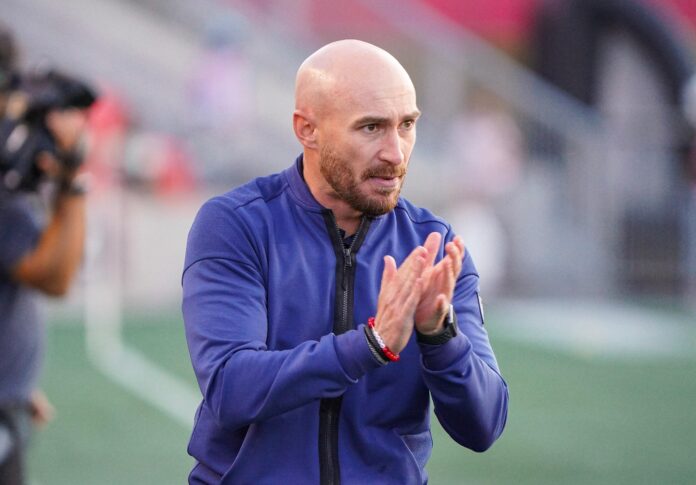
Carlos González, CPL Coach of the Year, leading Atlético Ottawa with passion and tactical clarity on the sidelines.
CPL Coach of the Year. Canadian Premier League regular-season champion. The architect behind Kuwait’s historic AFC U-23 qualification. A developer of future LaLiga stars at Atlético Madrid.
Few coaches in modern football embody adaptability and tactical intelligence like Carlos González. From transforming Atlético Ottawa into title contenders in Canada to guiding Kuwait to a historic milestone in Asia, and shaping elite players in Spain, González has built a global reputation as a coach who delivers both immediate results and long-term development.
Conquering Canada with Atlético Ottawa
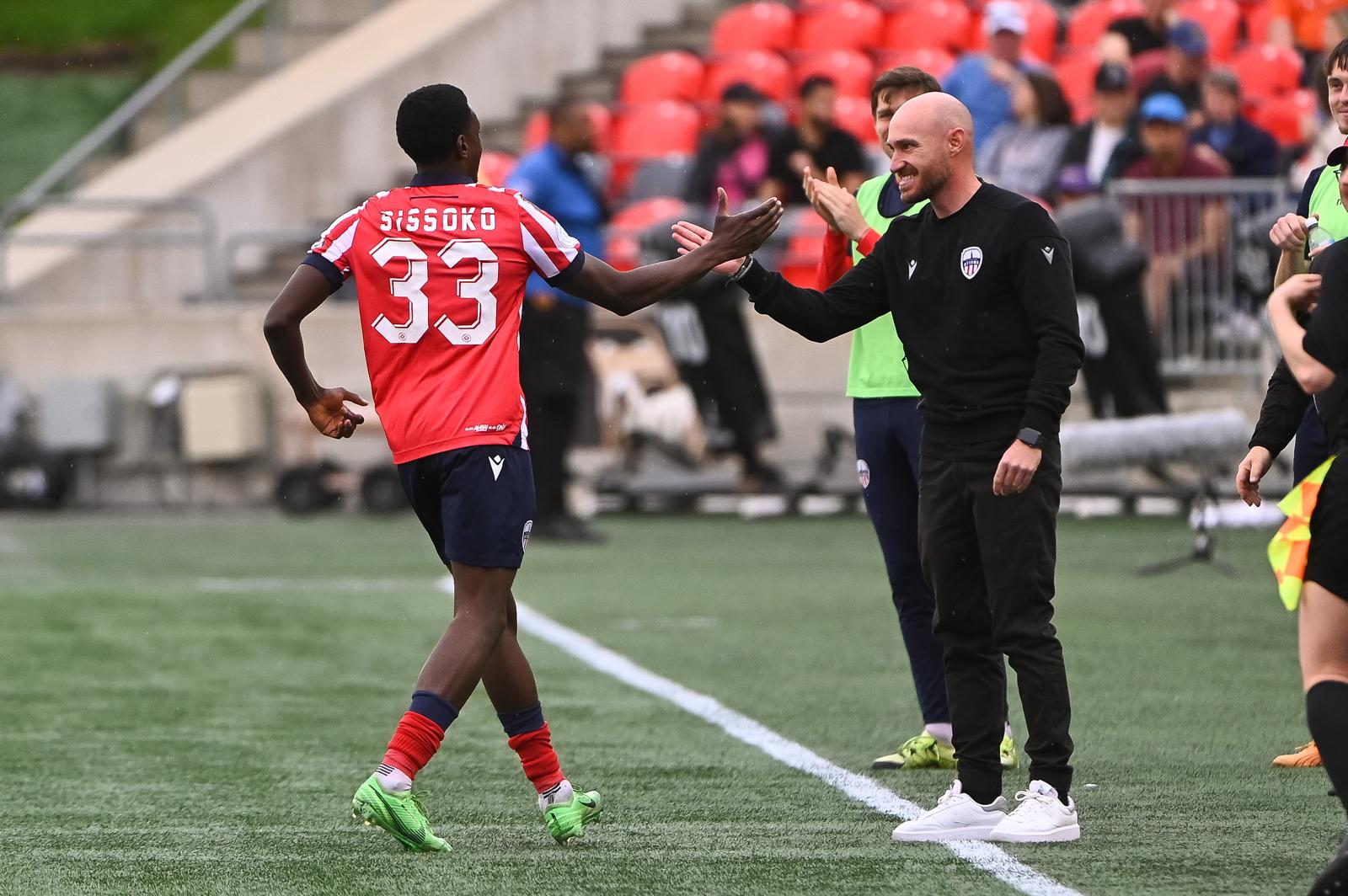
Carlos González shares a celebratory moment with Atlético Ottawa’s Aboubacar Sissoko during a CPL match.
In 2022, González crossed the Atlantic to lead Atlético Ottawa, a struggling team that finished last place the previous season, owned by Atlético Madrid. One season later, they were Canadian Premier League regular-season champions, and he was CPL Coach of the Year.
His success came down to what he calls the formula:
“Success = Talent + Work x Time.”
They built a balanced squad of youth and experience, implemented a flexible tactical identity, and created a culture of ambition and accountability. At home, Ottawa was proactive, dominating possession and controlling tempo. On the road, where travel distances and fatigue were major factors, his side became compact, disciplined, and deadly on the counterattack. This balance between principles and pragmatism defined Ottawa’s rise to the top.
González also emphasized player development within the collective framework. Young Canadian players thrived under his guidance, gaining confidence and technical improvement, while experienced internationals found renewed purpose in his system, resulting in a team that combined youthful energy, tactical structure, and competitive edge.
Kuwait: A Masterclass in Adaptability
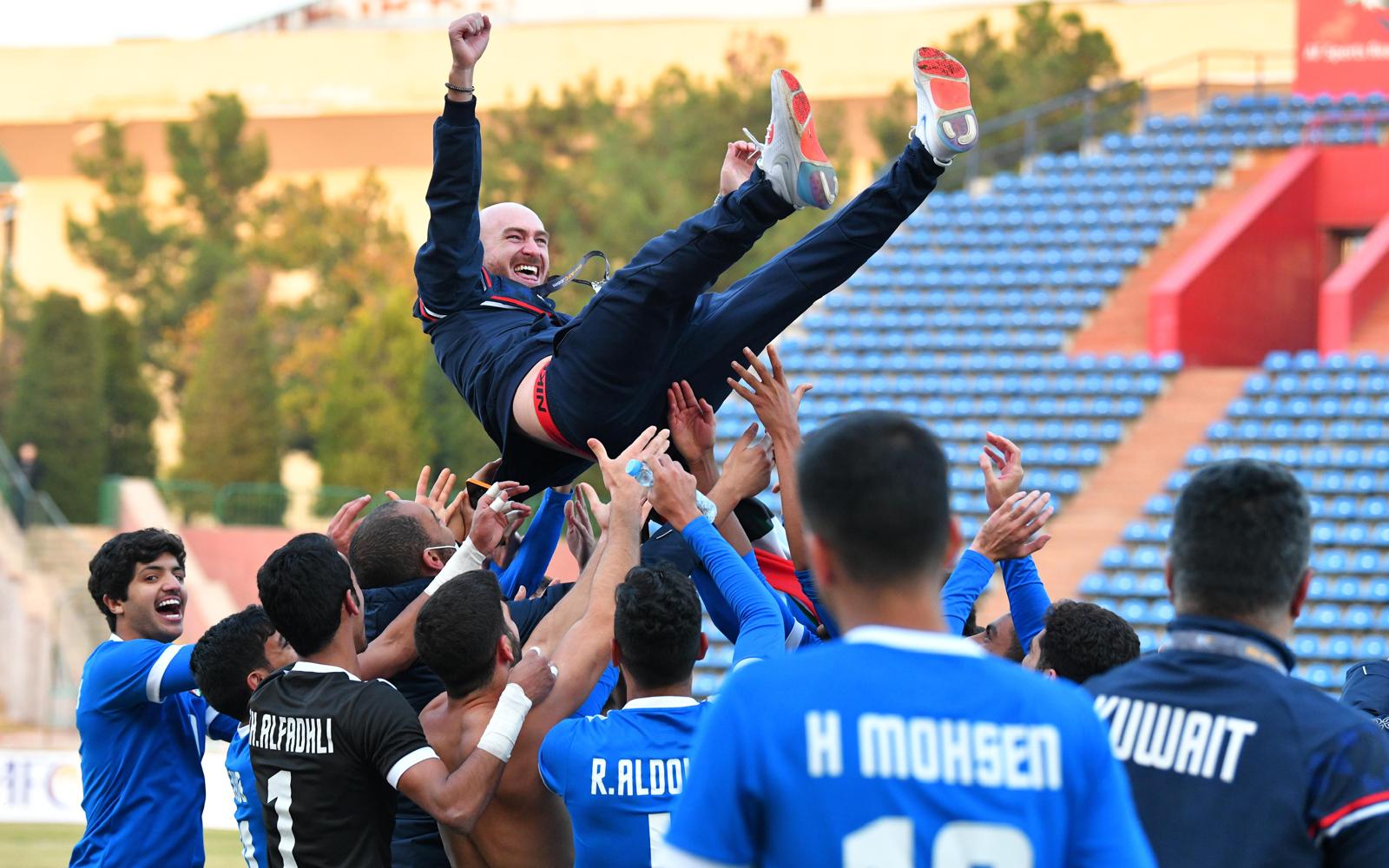
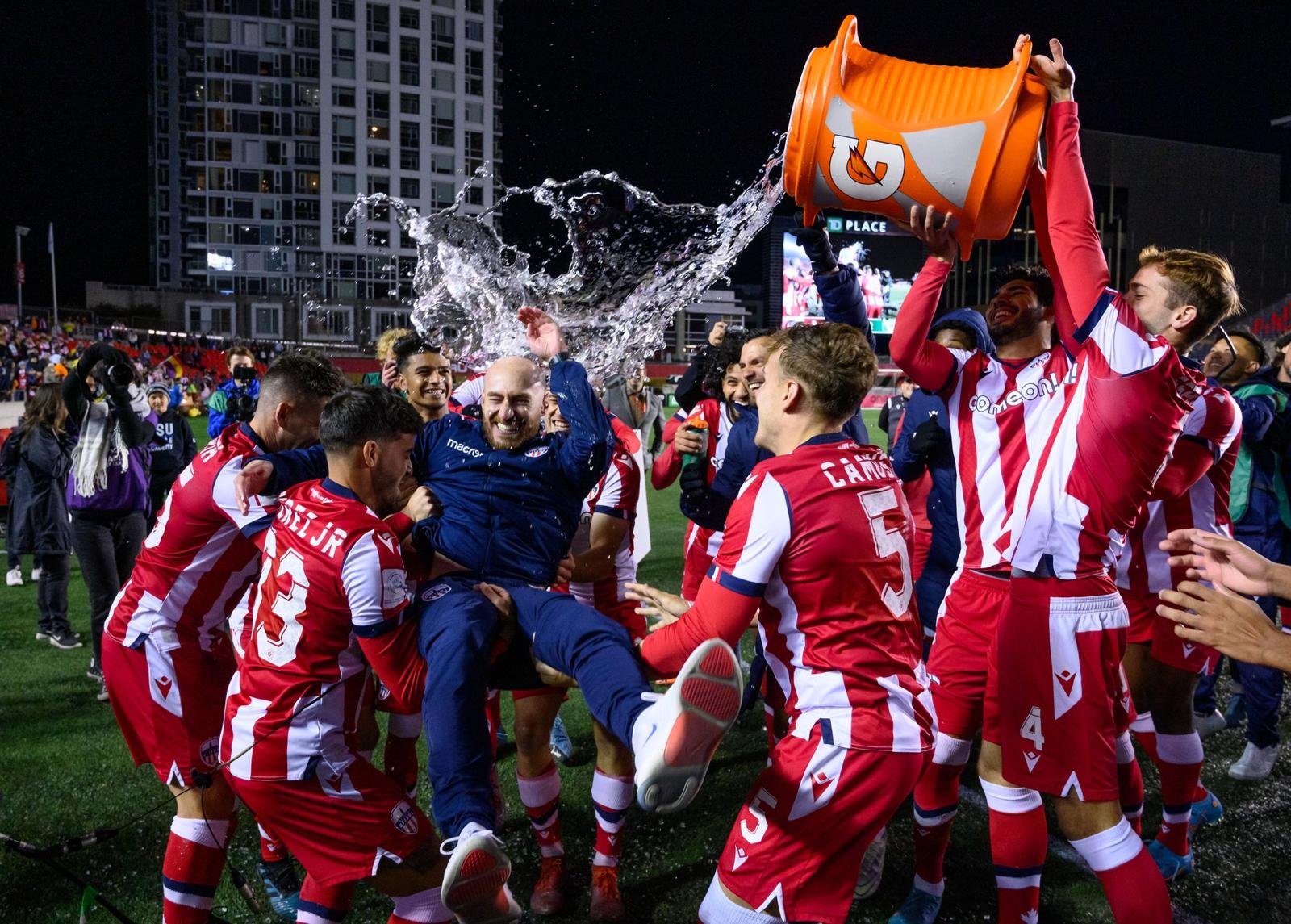
Carlos González is lifted by Kuwait U-23 players after leading the team to historic AFC U-23 Asian Cup qualification.
In 2021, González made a bold move: taking charge of Kuwait SC while simultaneously coaching the U-23 national team. His impact was immediate. Kuwait SC’s results improved dramatically, and the U-23s achieved a historic milestone, qualifying for the AFC U-23 Asian Cup and defeating Saudi Arabia for the first time in history.
Later, as interim senior national team coach, he faced European opposition in friendlies against Bosnia and the Czech Republic, gaining insights into the physical and tactical demands of top-tier international football.
“Adaptability is everything,” he reflects. “A good coach is someone who gets the best out of what they have in any context.”
Academic Foundation: Science Meets Tactics
Before stepping into professional coaching, González pursued Sports Science degrees at Alfonso X El Sabio University and the University of Granada. He also earned an RFEF degree in Fitness Coaching. This academic foundation became his competitive edge.
“Training in any sport involves teaching. Those years gave me the tools to develop a method aimed at improving teams both individually and collectively.”
His first professional role came at Rayo Vallecano, where he started applying those principles. It wasn’t long before his name was associated with some of Spain’s most prestigious youth academies
Developing LaLiga Talent at Málaga & Atlético Madrid
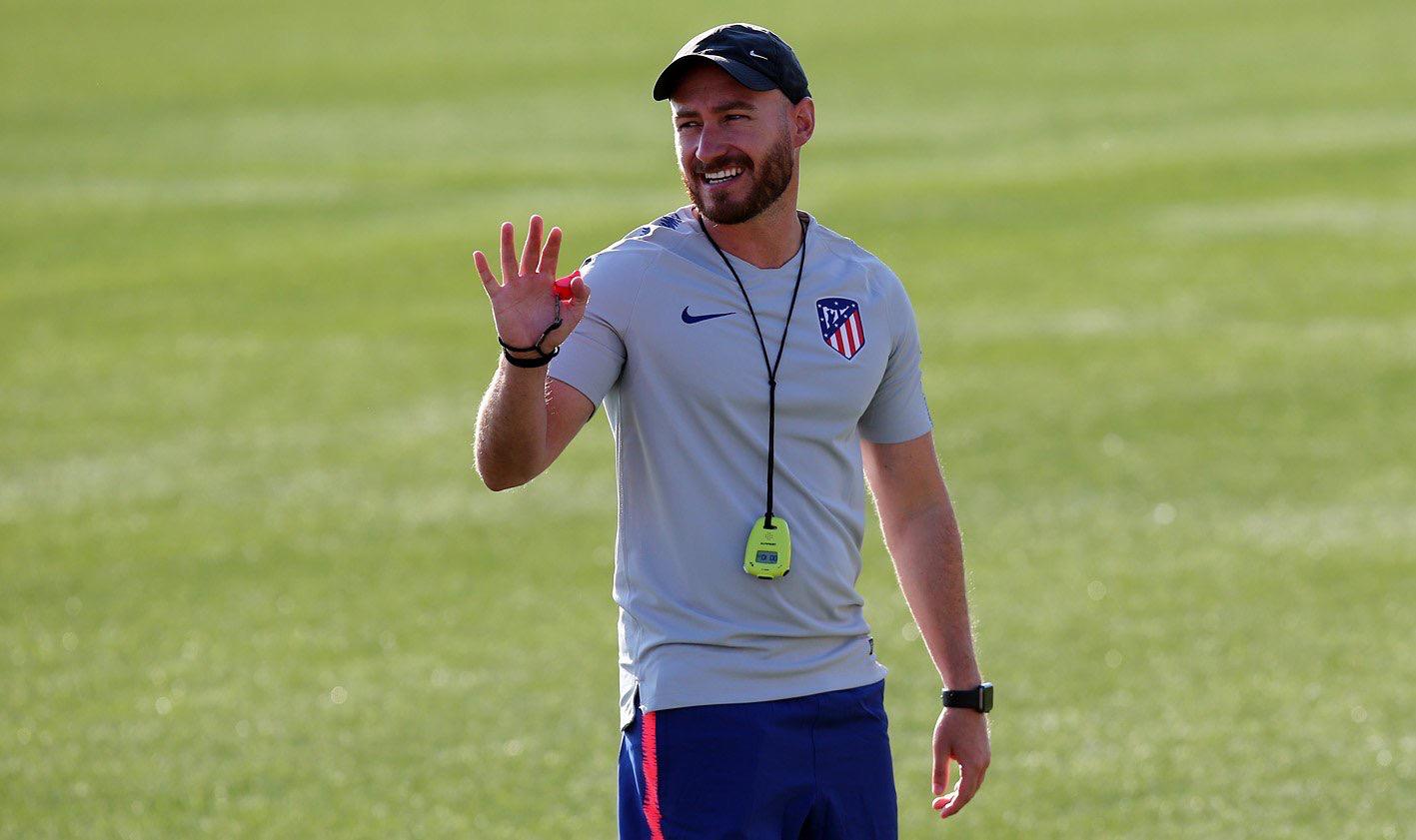
Carlos González on the training ground with Atlético Madrid’s academy, where he developed future LaLiga stars and built his coaching philosophy.
At Málaga CF, González worked under respected academy leaders like Manel Casanova and Francesc Arnau, learning high standards, discipline, and how to shape “street players” into structured, competitive professionals.
Then came Atlético Madrid, where González thrived in an environment that demanded excellence. Rising through the ranks, he adapted his philosophy to Atlético’s DNA: high pressing, intensity, and vertical play. His crowning achievement came with the U-19s, leading them to an undefeated league title and Copa del Rey final, all while promoting players who now feature in LaLiga.
“Bringing together a team with so much individual talent around the same goal was my proudest moment,” he says.
The Philosophy: Combinative, Vertical, and Player-Centric
González’s approach blends modern principles with pragmatism:
In possession: A combinative but vertical style, ensuring fluidity and unpredictability.
Out of possession: Aggressive pressing and compact defensive organization.
Adaptability: Systems tailored to the strengths of his players and the competitive context.
Crucially, González believes individual development drives team performance. “Once the team’s game philosophy is clear, excellence depends on improving players individually,” he says.
Global Perspective, Future Vision
Carlos González celebrates with Atlético Ottawa after a landmark win, a moment that reflects his philosophy of combining ambition, adaptability, and collective spirit.
Having succeeded in Spain, the Middle East, and North America, González has mastered the art of cultural adaptation. “I always analyze what works locally and introduce my ideas without creating resistance,” he explains. Language skills and strong communication have been his key assets in bridging cultures.
Looking ahead, his ambition is clear:
“My goal is to embark on an ambitious project that challenges me and helps a club achieve great things. I’m not limited by geography; my methodology adapts anywhere.”
With a track record of winning titles, developing elite players, and transforming organizations, Carlos González is more than a coach, he’s a strategist, a builder, and a leader for the modern game.
Our Exclusive Interview with Carlos González
How did growing up in Granada influence your early passion for football and your eventual transition into management?
I was born and raised in a town on the coast of Granada (southern Spain) called Almuñécar, where there was a strong football culture. From a very young age, I started playing on the street, on the beach, at school and later in federated clubs, probably influenced by my father, who was passionate about the sport.
You pursued sport science studies at Alfonso X El Sabio University and the University of Granada. How have these academic experiences shaped your approach to coaching?
I believe that training in any sport involves teaching. It was during my time as a student that I began to develop my methodological and teaching skills. I had good teachers who worked with high-level athletes, and I soon began to put these skills into practice at Rayo Vallecano, where I started working. These studies gave me a solid foundation for developing a method aimed at improving my teams both individually and collectively.
What did you learn during your time at Málaga’s academy, and how did that environment prepare you for future roles?
Málaga was a period of great learning, where I took important steps in my formation, as the people who ran the academy were top experienced and proven professionals. Manel Casanova and Francesc Arnau gave me the opportunity to move from assistant to head coach, and Andrés Carrasco was a role model in many ways, especially in terms of discipline and high standards at work. Thanks to them and the working environment they created, I realized how to train players with the determination to win, as competing and the results are very important aspects in elite players formation. I also started to have a deeper understanding of the needs of the “street” player, how to help them better understand the game with the aim of exploiting their natural strengths more often during a match. Andalusia, and Málaga in particular, are still places where children continue to play football in the streets.
Can you walk us through your progression at Atlético Madrid’s academy and how you adapted to greater responsibilities?
At Atlético de Madrid, I felt at home from the start. It was a familiar city and a club with values that were deeply rooted in me, which accelerated all the processes and made me feel very comfortable at work.
The idea of football that I brought with me from Málaga was effectively adapted to the style of play at Atlético de Madrid, creating an intense and pressing style of football without the ball and a combinative but vertical style in attack that was in tune with the academy’s philosophy and the profile of players they wanted to develop for the club’s first team.
Emilio Gutierrez & Miguel Angel Ruiz (Academy Director & Sporting Director) quickly began to trust me to promote within the structure, while I helped, as part of the methodology department where the guidelines and working principles for all the teams were set.
Leading Atlético Madrid’s U-19s to the 2019 final was quite an achievement. What strategies or leadership tactics did you employ throughout that tournament, and how did you reflect on the final outcome?
It was an exceptional season. By creating a very demanding work environment, we managed to win the league (undefeated). This was against great rivals such as a great generation of Real Madrid players. We had a good run in the UEFA Youth League, and as you asked, we also reached the final of the Copa del Rey despite the large number of players who were unable to compete for a very good reason: to rest and prepare for the new pre-season with the first team. Without a doubt, the greatest achievement of that season for me was bringing together a team with so much individual talent around the same goal. We played great football, being brave and showing personality with the ball, but also being very ambitious in pressing and disciplined when we were losing. The vast majority of that generation now play at the highest level, and for me that is a greater source of pride than the trophies we won.
Your first senior role came with Kuwait SC in February 2021. What motivated you to take this bold step, and what were your initial objectives?
That’s right, and I was very clear about it. For me, it was a step with a great area of opportunity. The club requested my loan from the Kuwait FA while I remained in my position as U23 coach. They wanted me and the federation allowed it, so I took that step.
It was undoubtedly a great experience and personal challenge, taking over a team mid-season that was in a negative dynamic in terms of results and expectations, and at the same time testing my level by coaching and convincing experienced players. Those were very demanding months where we combined two FIFA dates with the national team while we were in charge of the club, but with great support from my staff, and good organisation, we were able to move everything forward. The club improved its dynamic significantly, remaining in contention for the title until the last two league games, and we later qualified the team in the group stage of the AFC Cup continental competition played in Jordan.
Simultaneously managing Kuwait SC’s first team and the U-23 national side must have been demanding. How did you manage priorities across both roles?
Absolutely, as I said, we were able to do it successfully thanks to having a high-caliber and relatively large staff, with some staying at the federation and others staying at the club. Only one of my assistants and I would go to the national team’s training camp for 10 days and do both jobs at the same time. My other assistant stayed at the club with the fitness coach and goalkeeping coach. The work carried out at the club during this period was mainly maintenance, as a large number of players from the squad were away with their national teams, which is why we left the work for this period planned prior to the FIFA breaks. At that point, the priority shifted to the national team, although without neglecting the work at the club.
At the end of those dates, we reversed the equation, and the club became the priority. For me, both occupations were very important, but we did pay more attention to the urgent matters, which were what we had at hand at any given moment.
You guided Kuwait’s U-23 squad to qualify for the 2022 Asian Cup final tournament. What were the key challenges and pivotal moments during that qualification campaign?
All houses are built from their foundations, and in this case, as a national team manager, the foundations are choosing the right players for the style of play that you believe will work in the context in which you are competing. There was a good generation of young players, and I believe we made the right choices in the selection process for what we were looking for. Convincing the federation that we had to play with a back three to get the most out of the team was not easy, as these systems were no longer in use in Kuwait.
In this type of group qualifying tournament, for me, you just must think about playing one match, the first one, as that is what will determine your mental state going into the next ones. That’s why we tried to instill in the team from the preparation phase onwards that they should only think about the match in front of them. And it worked. We beat Bangladesh, which gave us a big morale boost going into the match against the favorites, Saudi Arabia. We played a very intelligent second match, taking them where we wanted them to go, controlling the first half and creating a bit more chaos in the second half, where we were able to punish them when they took more risks. It was a historic milestone for the country, as it was only the second time in history that this had been achieved, and the first time we had beaten Saudi Arabia.
Your appointment as Kuwait’s senior national team coach came with a busy friendly schedule. How did those matches against the Czech Republic, Lithuania, and Libya help you assess the team’s development and your own adaptability?
It was certainly unexpected, but at the same time a huge opportunity in a very complex context. I think you touch on the key word in the question, which is “adaptability”. I see a good coach as someone who is able to get the best out of what they have in different working contexts, and for me, that is only possible if you are adaptive.
We took a continuity approach with the senior team, promoting some players from the U23s and backing them up with experienced players who were in great form with their clubs. This proved to be a good combination when it came to competing in the demanding matches we had. The first was against Bosnia and Herzegovina, and we put in an incredible performance, losing 1-0 at the end of the match but having chances to come away with a draw. The match against the Czech Republic was a reality check, highlighting the significant physical difference that still exists between top teams and countries such as Kuwait. We then played against teams of a more similar level, such as Lithuania and Libya, where the team showed periods of dominance, and we were very satisfied with the level of play.
On February 24, 2022, you became head coach of Atlético Ottawa, a team owned by Atlético Madrid. What drew you to this role, and how did the club’s philosophy resonate with your own managerial outlook?
I felt very comfortable in Kuwait, but the truth was that I often missed the day-to-day work with a team, having the ability to improve a player and evolve the team throughout the week, and as a national team coach, I didn’t have that.
Several aspects of this proposal attracted me. First, of course, where I came from (Atlético Madrid). And second, the great challenge it would entail in turning around a project that wasn’t achieving the expected results.
After accepting the proposal and analyzing the problems the team was having, the competitive environment we were in, and, above all, examples of successful teams there, we opted for an idea that would allow us to be competitive in every game and get us closer to winning.
Maintaining the essence of vertical football, given the profile of the athleticism of Canadian players, we wanted to be a team that handled different resources depending on where we played or the moments of the game we were in. At home, we were more proactive with and without the ball, taking risks in many situations. And away from home, mainly due to the handicap of long journeys and the muscle fatigue they caused, we opted to be more reactive, conceding very little and moving forward to counterattack as soon as possible.
Leading the team to first place in the Canadian Premier League’s regular season and earning CPL Coach of the Year honors, what were the reasons behind that stellar campaign?
I think many things were done well that season, of course the design of the squad. It was balanced in terms of youth and experience, not too long (everyone committed and involved), and complete in terms of player profile to meet all the team’s needs and demands throughout the season.
For me, and based on my experience, you’re usually near to win when you follow this formula, “the formula for success”: Success = T+WxT. The first T stands for “Talent”, and in that squad there was definitely; W, for “Work”, the idea, and the ability to convince players with the philosophy of work and football we conveyed on the field; and finally, the T for “Time”… prolonging that idea and work over the months, and that can only be achieved if there’s hunger and ambition in the group. This team had all of that throughout the year, a great talented group of players who bought into the idea and the working method we proposed and who showed great ambition as the weeks went by.
How would you describe your overall chapter in the Canadian Premier League?
I think we can rate this stage as a high or outstanding achievement. We were entrusted with bringing Atlético Ottawa to the level of the best clubs in Canada, and we did so, in both the most visible aspects (results) and the lesser-known aspects (protocols, work processes, professional working context, etc.). I think that, of course, together with Fernando López, the great reference of that project, and Canito from a distance, we were able to help create a very solid foundation for the club to continue competing for great things in the future.
On a personal level, it has been a stage I will always remember with a smile, as I only take away positive things. I believe that working abroad, both in Kuwait and Canada, has made me a much better coach, not only because of the language challenge but also because of my ability to adapt to different cultures and work environments. I see this as a differentiating factor for my professional future.
Across your roles, from youth setups to senior teams, how has your tactical philosophy evolved? Do your methods/ philosophies need to change with different age groups and countries?
Of course, my approach to football has evolved, and I consider myself a much more versatile and adaptable coach than I was during my formative years at Málaga and Atlético Madrid.
Back then, I stuck to classic formations such as 1-4-4-2 or 1-4-3-3, which I used to maintain in both offensive and defensive phases. Throughout my evolution to the present day, I have used a multitude of systems, adapting them to the strengths of the players we had. I believe that in order to perform well, it is essential to position players in a way that facilitates their performance, where they can show their strengths more naturally.
Today, I seek to ensure that, from a starting position, our attack is fluid and dynamic in order to be less predictable and better able to attack our opponents’ weak points. The main premise is to always occupy certain mandatory spaces, so that we can threaten the opponent between the lines (base and pockets) while also threatening in width and, of course, depth.
All this while maintaining a style of play that I identify with most: combinative but vertical play, being a pressing team when we lose the ball and compact once we are overtaken. I believe that the key as a coach is to provide your team with the tools to be highly competitive and able to win games in different ways.
Working with youth players and national squads, how do you prioritise individual development alongside team performance?
I believe that the margin for improvement for a footballer as a national team coach is minimal; a national team coach is a performance maximiser. You have little time, and you are looking for immediate collective results. Of course, you can have a small impact on the player and help them with some details that could potentially improve them, but you lack time and process.
As a club coach, you do have that time, especially in the pre-season, to lay the foundations for the player’s development. We usually create a strategy for their individual improvement, both in terms of understanding the game (based on our model) and understanding and demands of their position, and of course technical and physical improvement.
I firmly believe that much of a team’s improvement comes from individual development. Once the team has an established game plan, executing it correctly or doing so in an excellent manner will come down to the individual development you have achieved in the different players and the internal competition that this generates on a daily basis.
You have coached and developed many great Laliga players. What qualities did you see from the top professional players compared to a regular academy player?
Individual talent, whether offensive or defensive, and the audacity to execute it regardless of who you are facing, therefore mentality. All the players I have coached and seen evolve to the top level have one or more abilities that make them stand out when facing teammates and opponents at their level.
But those who really make it and establish themselves are the ones who break down doors, that is, those who are promoted for their abilities and continue to demonstrate them in much more demanding contexts. Whether it is when they train at higher levels, but especially when they compete in categories above those they are supposed to be in.
That is why I believe in the rapid promotion of players, as this will improve their speed of decision-making and execution when they are involved in the game.
How do you balance the strategic demands of club ownership (e.g., Atlético Madrid in Ottawa) with the on-field realities and player capabilities?
At the end of the day, when you start a new project, you have some goals set from the top down, and other process goals that you set yourself on a day-to-day basis. In my opinion, both should be ambitious but realistic, so that once you’ve completed the cycle, all or most of them have been achieved. I sincerely believe that this is the only way you can leave feeling satisfied with the work done.
For a project to work, I believe in transparency to communicate those goals from the board to the players, and that all the pieces of the machine are aligned from day one so you know where the club wants to go. Fortunately, I’ve achieved success in every project I’ve been involved in, and for that, it’s essential not only to have tools that match the goal but also an ambitious mindset and a focus on the here and now.
You’ve worked in diverse environments such as Spain, Kuwait, Canada. What have been the biggest cultural and professional adjustments, and what skills did they help you cultivate?
The changes or differences I’ve experienced in these three different continents have been substantial, ranging from religion, language, climate, food, or even Football styles.
To do this, the most important thing for me has been to analyse what worked in the place I’ve been, and how to introduce my idea and method without making abrupt changes that would provoke rejection. Knowing what I wanted to do and executing it while adapting to the environment I found myself in.
To do this, the skill that has undoubtedly helped me the most has, of course, been my language skills and the ability to communicate and convey my message.
Looking ahead, are you aiming to return to Europe, continue exploring international roles, or pursue projects in emerging leagues?
My goal is to embark on an ambitious project that will help me continue to advance and grow in my professional career, where I can face new challenges and help the club achieve its objectives.
I am not closed off geographically, as I believe that my personality and methodology can be adapted to different cultures and working contexts.
The number of Japanese players moving to Europe has been growing, and it doesn’t look like it will be slowing down anytime soon. The question I look to answer is one of developmental factors for a player looking to make their move into Europe. What does the journey to the topflight of European football look like for a Japanese player?
The export model/transfer window of Japanese football
When does the Japanese transfer window open and is it different to the rest of the Europe?
Currently the Japanese transfer window (player registration period) opens in two main periods. One in the winter and another in the Summer. The Winter period opened this year from January 20th, 2025, to March 6th ,2025. It opens very close after the end of its previous season and the market is often overloaded with many players looking to find a move to a new club.
The January transfer window is notoriously hard for deals to be struck. Most major European leagues will have clubs looking to strengthen their squad to help with a final push to the end of the season. This makes it hard for transfers to be made between Japan and the major European leagues, as many European clubs may not favor taking major risks on players which they feel are not proven within the level of competition, they are playing in. However, for Japanese clubs it can be the best time to shift their players as it gives them time to organize and prepare their squad as best as possible for the new season.
The summer transfer window (player registration period) opens from July 7th, 2025, to August 20th, 2025. With the Japanese season being in progress during this time.
The J league and JFA both often encourage, and support overseas moves to help with the national team development.
Major changes are now coming to the timings of Japanese football and the transfer market
The J. League is moving the timings of the transfer window to be better in line with the timings of the rest of Europe. This transition will start in the 2026/2027 season where the season will begin approximately in the first week of August 2026, with a winter break from the second week in December to around the third week of February 2027. The season would then end in the final week of May 2027. The decision is of great significance and are a major opportunity for growth.
“We’ve come to a conclusion that it’s necessary to implement the change in order to compete in global markets” said J. League Chairman Yoshikazu Nonomura.
With the Season now expected to be in line with the rest of Europe it shifts the timings of the opening and closing of both the Summer and Winter transfer windows as well. This opens many more doors to Japanese players looking for a club in the rest of Europe as it combats the reason which previously were halting the progress of a transfer for Japanese players to the Major European leagues. It gives players time to settle in with their new club and to follow the same process of preparation for the upcoming season. There will also be less Japanese players scattering to look for a club during the Winter transfer window because of the previous season ending shortly before it and more players will have better opportunities to look for a transfer abroad once their season ends.
Best European Leagues for importing Japanese talent
Belgium – With over 40+ players moving from Japan to Belgium since 2018/2019 it is important to understand the reasons behind a such figure. Belgium is seen as an attractive league within Europe which can help boost the development of a player’s career in Europe with a track record to prove it.
The platform that Belgium provides cannot be understated. Its legal accessibility is a highly influential factor, as well as the impact which Sint-Truidnese has played in providing a platform, through its Japanese ownership.
So, let us break it down, Belgium’s clear legal pathway (Work Permit system)
The minimum age requirement: 18
For a non-EU professional athlete, they will need a single permit. This permit is valid for one year and is specific to the employer.
The single permit combines: Work authorization (Work Permit Type B) + Residence authorization (Long stay visa/residence permit)
In addition to the clear legal pathway Belgium holds a relatively low salary threshold in respect to other European countries. This makes it a viable option for Belgian clubs to be able to afford the recruitment of Japanese players. The salary threshold can be dependent of the region and as of January 1st, 2025, these are the thresholds.
Flemish Region: €101,019 per year
Brussels Region: €88,320 per year
Walloon Region: €51,613 per year
Analyzing success coming out of Belgium
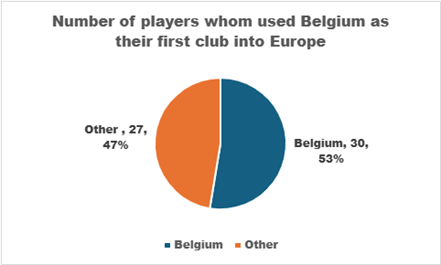
When analysing the success of Belgium as an export country for Japanese players it is clear to see that it is a highly popular location for Japanese talent to make their first step into Europe and break the first deadlock out of the J League (60%). It can help with being development focused and a great opportunity as a stepping stone into European football.
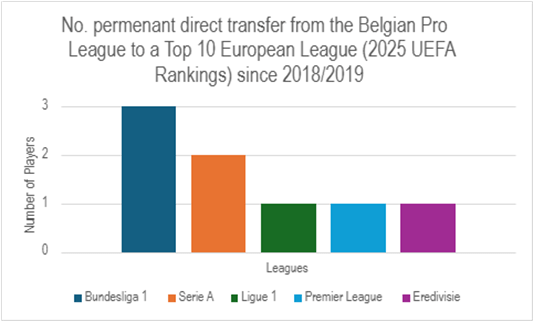
However, from the second Graph it is hard to suggest that the visibility and level of the Belgian Pro League is enough to earn a player a direct move into the highest stage of European football. Therefore, the Belgian Pro League might be better used effectively, as a place to loan out talent.
Successful players who have followed the path from a J League team, directly to Belgium as their first European club can be seen in the likes of players such as Takehiro Tomiyasu and Wataru Endo. Therefore, the opportunity is certainly there for players to make a successful direct move to the top of European football from the Belgian Pro League.
Whilst European clubs who have bought talent from Japan and sent them out on loan to get a taste of European football is evident and have arguably had a higher success rate with the likes of Kaoru Mitoma and Daichi Kamada.
Mitoma was bought by Brighton from Kawaski Frontale and then sent on loan that season to Union SG. He then returned after his loan spell to Brighton where he had a groundbreaking following season.
The presence of Japanese ownership at Sint-Truidense
Sint-Truidense undoubtably plays a significant role in providing a clear pathway for Japanese players into Europe with its Japanese ownership. Sint-Truidense is majority-owned by the Japanese e-commerce company DMM.com. This ownership, led by CEO Takayuki Tateshi, has allowed its management to shift its transfer profile towards developing Japanese players into Europe.
Through the platform Sint-Truidnese has been able to provide it has also helped elevate the perception of Japanese footballers in Europe and especially towards other Belgian clubs to recruit. Growing the popularity of Japanese players into Belgium and contributing to the reason for such high figures as previously seen in the data.
Belgium as a location
On a more human level, Sint-Truiden and many other Belgian cities can be a suitable location for Japanese players to settle down and adapt. It is near Düsseldorf which is seen as a “little Tokyo,” having one of the largest Japanese communities in Europe. With players knowing it can find comfort nearby it makes many Belgian clubs an attractive choice for players and their families.
Germany – Bundesliga
The Bundesliga has always been a consistent location for Japanese talents to make a name for themselves.
Why? – Tactical similarities – The Bundesliga is often seen as a high-pressing, technical league which requires discipline. Traits which are carried and instilled throughout Japanese players from a young age.
Having played in Japan myself, I can say the attention to technical detail cannot be understated. Especially as Japanese are not seen to have an extremely physical template, every technical detail helps with giving themselves an edge over their opponent.
A positive track record – With an abundance of talent having already played in the Bundesliga it only helps to grow trust for clubs. Players such as Yasuhiko Okudera and Shinji Kagawa have proven that Japanese players can thrive in Germany.
Looking past the performances on the pitch
A simple legal framework – Germany possesses a relatively accessible pathway for non-EU players. Professional athletes are often fast tracked for a residency permit as they fall within a special category.
The wage threshold is not publicly fixed for athletes however the wages must reflect a ‘comparable domestic wage’ which tends to be easy to overcome as an average salary in the Bundesliga can range often between Often €500K – €2M+
Why is the Bundesliga not used more?
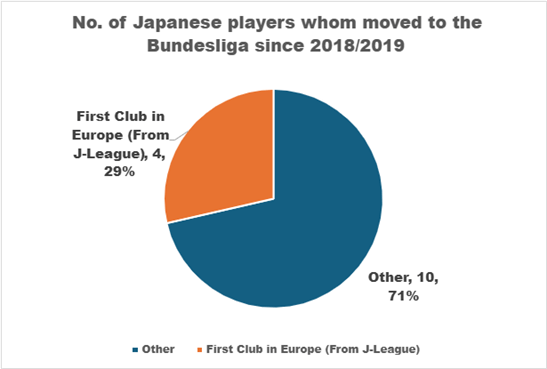
Compared to the Belgian Pro League, the figures above may seem small. With such a clear legal pathway and substantial amounts of success in the past, why is the Bundesliga not used more commonly compared to Belgian Pro League This can be attributed to a few factors. The Bundesliga is seen as less of a developmental league compared to the Belgian Pro League; therefore, players who do arrive would want to be closer to the ‘finished product’ with a substantial amount of European experience under their belt. Hence, only 23% (3 Players) have made the move directly from the J-League to the Bundesliga since 2018/2019. The Bundesliga can be seen to buy Japanese players who lack European experience and loan them out to Belgium (as seen by Wataru Endo and Daichi Kamada).
Providing a great gateway for Japanese players to get to the top of the European game, such as the Premier League. Acting as the ‘middle ground’ between a lower European league such as the Belgian Pro League and the top of European football.
Some of the most well-known and successful Japanese players have played in the Bundesliga:
Shinji Kagawa – Borrusia Dortmund → Manchester United
The best pathway to the Premier League and the topflight?
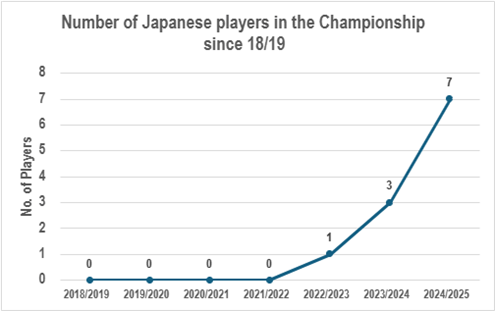
The ever-growing numbers of Japanese players in the Championship has put Japan as the 15th largest nationality in the Championship as of the 2024/2025 season. This makes it hard to ignore, raising questions on why such a sudden shift.
Improved access into the UK (Work Permit) ESC+GBE
Are Championship clubs becoming more effective in recruitment through ESC and GBE methods?
Primarily the GBE is a great path when recruiting established Japanese talent especially within the Japan national senior team.
The J League is a Tier 5 League (6 points for regular starting minutes towards GBE)
The Japan national team is well ranked (usually within top 20 – top 30 global therefore usually significant/automatic qualification for a national team player)
Continental competitions (AFC Champions League) add points
Rewards players from clubs who qualify for the AFC Champions League
Through the data seen above, the steep increase in popularity of Japanese players in the championship is evident and I believe the numbers will continue to increase. (As of July 24th, 2025, the number of Japanese players has increased further to 9). However, a young Japanese player without a senior national team appearance may struggle to qualify for a GBE.
Example of a typical j league player
METRIC
GBE POINTS
Regular starter in J1 (Band 5)
4 Pts
AFC Champions League appearances
3 Pts
U23 national team caps
2 Pts
Total
9Pts
The player is just under the 15pts required for a GBE therefore, the ESC route could be taken for approval.
The ESC route:
ESC Criteria
Played in at least one competitive youth or senior international match for a FIFA top 50 ranked nation (Qualififes for Japan NT)
Played in at least one continental youth or senior competition match
Played in at least five domestic youth or senior competition matches
*All of the domestic clauses require the club to be in Band 1-5* (Which the J-League qualifies for)
Although ESC allows a route in, the ESC Conversion still means that for Under 21 and 21 and over ESC players are still required to play 50% of available minutes to makes the ESC conversion in the Championship
This makes the routes for Japanese players entering the UK still accesible compared to the past however, the key still remains to find the balance between recruitment and available minutes + finding ESC strategies such as using the player for on loan.
Player
Club (2024-2025)
Arrival Source
Likely entry route (ESC or GBE?)
Ao Tanaka
Leeds United
Joining from Fortuna Düsseldorf
GBE
International Senior Appearances + Played sufficient minutes in Europe – Bundesliga 2 (Band 4 league)
Yuki Ohashi
Blackburn Rovers
From Sanfrecce Hiroshima
ESC (direct from J1, no senior caps with national team at time of transfer)
Tatsuhiro Sakamoto
Coventry City
From Cerezo Osaka
GBE- Played in Belgium Pro League (Band 2 League) with sufficient minutes
Yu Hirakawa
Bristol City
From Machida Zelvia → Loan → Permenant
ESC – Direct from J1 + no senior international caps at time of transfer
Ryo Hatsuse
Sheffield Wednesday
From Vissel Kobe
ESC – Direct from J1 + Continental Competition experience → still short of 15 points
Tomoki Iwata
Birmingham City
From Celtic
ESC – played for Celtic, with no senior national team experience
Iwata likely still falls short
Tatsuki Seko
Stoke City
From Kawasaki Frontale
ESC – No international caps → J1 + ACL experience not enough for GBE
Results here show how important the ESC has become to provide a route in for young/unproven japanese talents to be given the opportunity to solidify their place as an established Japanese talent in a league like the Championship
Best pathway for players to the top of European football?
The Championship is arguably one of the most competitive second divisions in the world, often considered just below the top European Leagues in intensity and quality.
This means indirect visibility is present from scouts from the Bundesliga and most other top European leagues including the Premier League.
For players joining a Championship club with the goal of promotion it can be a direct way into the Premier League.
Increased Scouting & Agent Networks
With the growing reputation for Japanese players and the demand increasing clubs have made sure to strengthen scouting networks for Japan.
Examples: Manchester City & Yokohama F. Marinos and clubs liked Red Bull are investing in intergrating a club such as Omiya Ardija into their global network.
As the demand continues to grow the desire for agents to obtain clients in Japan would be high. European agents will want to bring the connections between their clients and European clubs. Increasing the visibility of their client and being able to help them push for a move into at times.
The Japanese culture
The values often attributed to Japanese players are those of – humility, hard work and discipline. Often key attributes that clubs look for in a player. They are often seen as value players who don’t rock the boat and can have good acceptance into dressing rooms quickly.
The Japanese culture is something which is a positive for every club looking for a player, as they know they have a player whom they can trust to give their best everyday. With recent track records to prove it the fact is undeniable.
Japanese media & Marketing potential
Japanese players bring media attention and marketing values that English clubs can’t ignore. Even in the Championship, there’s money to be made from Japan’s domestic fan base, especially if the player has connections with the Japan National team. Asian broadcasting rights, merchandise sales, and preseason tours are some large ways in which they bring value.
Pre-season fixtures this summer:
Liverpool FC – (Have Japanese player in Wataru Endo)
Tottenham Hotspur – (Just signed Kota Takai)
Borussia Dortmund – (Strong connections in the past with Japanese players – Shinji Kagawa)
These are just a few of the teams looking to play preseason games in Japan this summer. With links to Japanese players for many clubs it can be a vital selling point in making a successful preseason tour in Japan. This can be a driving point for Championship teams to create a stronger connection with the marketing potential of Japan, especially for the future opportunities which may arise with preseason tours and additional sponsorship deals.
Conclusion
I hope my article has helped you to better understand how the market for Japanese players can best operate for Japanese talents to develop and fulfill their maximum potential. Understanding patterns and structures can be a simple way to do so. However, at the end of the day every career is unique and will be different. There is no set path to success but understanding how it has been achieved in the past is a starting point, to be able to best maximize a player’s career and avoid any obvious developmental mistakes.
The Premier League (PL) has made the US and Canada a top priority as it expands globally. With tens of millions of soccer fans across the region, the league has adopted a multi-pronged approach combining media rights, corporate partnerships, live events, and localized content. This integrated strategy has driven record TV audiences and strong fan engagement. During the 2023–24 season, NBC averaged about 546,000 viewers per broadcast, with a March 2024 match between Manchester United and Liverpool drawing 1.78 million viewers, the largest American audience for any PL game.
Key Initiatives (2021 to 2025):
2021 – NBC Rights Renewal: NBCUniversal secured exclusive English- and Spanish-language TV and streaming rights in the US through the 2027–28 season. In November 2021, it signed a six-year extension worth approximately £2 billion ($2.7 billion), covering all 380 matches per season across NBC, NBC Sports, USA Network, Peacock, and Telemundo.
2022 – Canada Streaming Deal: Premier League rights in Canada moved to Fubo for the 2022–23 season. In April 2025, the agreement was extended through 2028, ensuring that all matches and studio shows remain on the platform.
2023 – US Preseason (Summer Series): The PL launched its first official US preseason tournament in July 2023. Six clubs played eight games across five cities, using major stadiums like MetLife and Lincoln Financial Field. The series was designed to deepen local fan connections.
2023 – Digital and Social Expansion: The league introduced localized content through dedicated accounts like Premier League USA and provided broadcasters with customized highlights and clips for North American audiences. NBC and other partners integrated these assets into studio programming and social campaigns.
2024 – Fan Festivals (Mornings Live): The PL and NBC hosted large-scale match weekend events in major US cities. In April 2024, the Nashville edition of Premier League Mornings Live attracted around 15,500 fans. Over nine events since 2018, nearly 90,000 fans have attended.
2024 – Viewership Records: NBC averaged about 546,000 viewers per match during the 2023–24 season. On May 19, 2024, Championship Sunday averaged 2.9 million viewers. The United vs Liverpool match on April 7, 2024, drew 1.78 million, setting a new US record. Peacock’s exclusive games averaged over 800,000 viewers.
2024 – Club US Tours: Around half of PL clubs toured the US in summer 2024. Liverpool, Arsenal, Manchester United, and others played high-profile friendlies, often against each other or European teams, drawing strong local interest.
2025 – Summer Series (Second Edition): Scheduled from July 26 to August 3, 2025, the second Summer Series will feature Bournemouth, Everton, Manchester United, and West Ham playing six matches in New Jersey, Chicago, and Atlanta. Tickets were sold via Ticketmaster, and NBC Sports will broadcast the games.
2025 – New Sponsorship Deals: The league signed major North American-focused sponsors. Coca-Cola returned as the Official Soft Drink Partner starting in 2025–26, promoting multiple brands like Coke Zero and Powerade. PUMA replaced Nike as the Official Ball Supplier and will support marketing and community programs. Other partners such as EA Sports, Guinness, Microsoft, and Oracle continue to be prominently featured at US events.
2025 – Hispanic Market and Localization: Telemundo retains exclusive Spanish-language rights through 2028. By aligning content with cultural preferences and broadcasting in prime time, the league continues to grow its Hispanic audience. Social content is also tailored for regional languages and tastes.
Media Rights and Broadcasting
At the heart of the North America strategy are broadcast and streaming deals. NBCUniversal has held Premier League rights since 2013 and renewed them in 2021 through 2028. This deal covers all matches, shown across NBC platforms including Peacock. It also includes exclusive Spanish-language rights via Telemundo and Universo. In Canada, Fubo took over from previous carriers in 2022 and extended its deal through 2028.
These arrangements ensure near-total market reach. NBC’s platforms make the league accessible to nearly every American household with cable or broadband. Studio shows like Premier League Mornings and consistent match coverage have helped boost visibility. Average viewership grew 4 percent in 2023–24, and even mid-level matchups on Peacock regularly drew more than 800,000 viewers. Telemundo also reported strong growth, averaging around 244,000 viewers per match. In Canada, Fubo offers both English and French commentary and has become the go-to streaming service for soccer.
Commercial Partnerships and Fan Engagement
The league has activated a robust sponsorship network tailored to the US market. Brands like EA Sports, Coca-Cola, Microsoft Azure, and Guinness leverage the league’s reach across digital, broadcast, and live events. At the Nashville fan fest, sponsor booths provided immersive experiences: Nike hosted an agility challenge, EA Sports presented FC24, and Coca-Cola ran branded fan zones.
The new Coca-Cola agreement emphasizes engagement across multiple product lines, with fan-focused campaigns and giveaways. PUMA’s involvement as a ball supplier includes community programs in US cities. Sponsorship activations often include youth clinics, contests, and charity events. These efforts go beyond traditional branding to deliver hands-on experiences that deepen fan loyalty and enhance sponsor ROI.
Fan Events and Tours
Live experiences are central to the PL’s fan outreach. The Premier League Mornings Live series has brought free matchday events to major cities. These feature big screens, club legends, trophies, sponsor booths, and entertainment, turning match viewing into a full-day festival. By April 2024, nine events had attracted nearly 90,000 attendees.
Preseason tours expand this momentum. The 2023 Summer Series introduced PL teams to new American audiences. In 2024, roughly half of the league’s clubs returned, playing friendlies against one another, MLS sides, and international teams. Fans had rare opportunities to see top players in person. Clubs also organized youth clinics, local promotions, and trophy tours to build year-round engagement.
Localized Content and Digital Reach
The Premier League has tailored its content for the North American market. Broadcasts emphasize US-relevant narratives and offer commentary that guides newer fans through the season. Social media channels like Premier League USA share regionally timed content, memes, and highlights. Features include American players, USMNT references, and cross-league comparisons that appeal to US viewers. Spanish-speaking audiences are reached via Telemundo’s programming and additional NBCUniversal content.
These efforts have helped cement the Premier League as the top European soccer league in North America. By 2025, its mix of media deals, sponsorships, fan events, and localized digital content is delivering record engagement. The expanding US fan base offers a valuable platform for both clubs and commercial partners, making North America one of the Premier League’s most strategically important regions.
Jamie Swinney, the driving force behind Falkirk FC’s fan-owned resurgence and back-to-back promotions.
Jamie Swinney (b. 1986) is a Scottish sports executive best known as the Chief Executive Officer of Falkirk Football Club. A University of Stirling graduate, he began his career in football through community and youth roles. While at Stirling he wrote for the student newspaper Brig and began volunteering within the Scottish FA community football programme, later using that experience to advance through football administration. He initially joined Stenhousemuir FC in 2009 as the club’s Community Officer, working on youth coaching and outreach programmes. Over the following decade he built a reputation in Scottish football development including roles at the Forth Valley Football Academy and as a Scottish FA Performance Coach before returning to Stenhousemuir as CEO in 2018.
Stenhousemuir FC (CEO, 2018–2021)
In February 2018 Swinney was appointed Chief Executive at Stenhousemuir, a lower-league club where he had already served in youth and community roles. Under chairman Iain McMenemy, he helped implement a long-term vision for the club. McMenemy praised Swinney for playing a key part in delivering the club’s vision and achieving the targets set over several years. Notable milestones during Swinney’s tenure included the establishment of the club’s Warriors Community Trust and a successful fan-share initiative. In April 2020, for example, the club announced that all 679 offered shares were sold, raising over £25,000 to bolster the club’s finances. Stenhousemuir also became known for its community programmes under Swinney’s leadership, earning recognition as a community anchor initiative by the Scottish Government. By mid‑2021, after helping to rebuild the club’s structure and fan engagement, he stepped down to take on a new role at Falkirk FC.
Appointment and Early Falkirk Tenure (2021–2023)
In summer 2021 Swinney returned to his hometown club as Falkirk’s CEO. The club was then in turmoil. Swinney later described 2021 as the worst year the club had ever had in its 143-year history. Within two months of his arrival under the previous board, all directors resigned, and a new board was installed. On the pitch Falkirk finished in the bottom half of League One (third tier) in 2021–22. Swinney openly acknowledged the emotional challenge this posed and vowed to steer the club back on track.
As CEO, he emphasized financial sustainability over quick fixes. Early on he worked to stabilize revenues and set pragmatic targets. In 2022 the new-look Falkirk board publicly announced an ambitious goal: to return to the Scottish Premiership by the club’s 150th anniversary season (2026/27). Swinney endorsed that plan and supported a gradual rebuild. He also oversaw a shift toward a fan-focused ownership model. Under a three-legged stool approach, he advocated involving supporters alongside any private investor. As he put it, having three stakeholders means if one is struggling a bit, the other two can help. You are not relying on one individual and the fans still own the club. In practice this meant the Falkirk Supporters Society significantly increased its stake. By 2023 the Society had used a government-backed loan to acquire 875,000 shares (over 50 percent of the club), making fans majority owners with smaller shareholders collectively holding around one third of equity. Swinney has since cautioned that while fan-ownership limits having someone with deep pockets, it reinforces the club’s identity and requires strict fiscal discipline.
Sporting Success and Strategic Initiatives
Under Swinney’s management, Falkirk achieved rapid on-field progress. After losing in the playoffs in 2021–22, the club won promotion from League One in 2022–23, doing so unbeaten and becoming the first side outside of Celtic and Rangers to achieve an Invincible league season. The very next season (2023–24) Falkirk finished as Championship winners, clinching a second successive promotion back to the Premiership. Swinney celebrated the turnaround as beyond his wildest dreams, noting with pride that the club had done it in a self-sustainable way without the heavy overspending common in other teams’ promotion bids.
Alongside on-field results, Swinney has overseen significant growth off the pitch. He reports record-breaking commercial income and attendance figures. According to his statements, Falkirk’s 2023–24 income set a new club record, and 2024–25 was on track to blow last year out of the water. Matchday crowds have dramatically increased with the club boasting the 7th highest season ticket base in Scotland. Swinney notes the atmosphere is the best he’s seen, with supporters backing us and the connection is really special. In public comments he has repeatedly attributed this growth to the club’s fan-owned model and community rapport. He reflects that in the 15 years since Falkirk’s last top-flight season, there were seven really poor years yet fan loyalty has never wavered.
On the strategic front, Swinney has championed long-term projects. A foremost initiative is rebuilding Falkirk’s youth academy. He has spoken of restarting the club’s full academy to Scottish FA Performance level, calling it an important part of the club’s strategy that means a lot to him personally. With Premiership status secured, the club has now re-introduced it’s full academy pathway, achieving performance status for season 2025-26.
Infrastructure is also on the agenda. The Falkirk Stadium currently lacks a fourth stand, and Swinney has ruled out expensive short-term fixes. In May 2025 he confirmed the club had considered installing a temporary bleacher but decided instead to focus on a permanent solution. We will work hard to make a fourth stand a reality. That is our big ambition. Financially, Swinney maintains careful budgets. He has warned that Falkirk, being fan-owned, cannot match the big spending of richer clubs or recently relegated teams with parachute money. As one board commentary noted, Falkirk cannot do the kind of cash losses that some Championship winners incur, so Swinney’s management prioritizes sustainable growth.
Leadership and Community Focus
Swinney’s leadership style is characterized by passion, pragmatism and a fan-first outlook. He often notes that running a club is not that different from any other business, except for the weekly matchday event that everyone works towards. Despite this business perspective, he clearly cares deeply about Falkirk’s fortunes. Reflecting on early struggles, he said he and his team struggled a little bit to cope with relegation pains precisely because they cared about the club. This emotional commitment drives his approach. In 2021 he stated his excitement comes from trying to make a real difference and restoring Falkirk to the level where he believes it can be in Scottish football.
Transparency and planning are also hallmarks. Preparing for the Premiership competition, Swinney emphasized that Falkirk has been working for months on its plans, while acknowledging they might not get everything right but will be transparent and learn. He communicates openly with supporters, as seen when he admitted his initial promotion expectations and later lauded fans for backing a low-budget bid. Teammate coaching experience has shaped his style too. He has credited youth coaching with teaching leadership and people skills that benefit his CEO role.
Community engagement remains a core value. From his earliest role as community officer at Stenhousemuir to initiatives at Falkirk, Swinney insists the club’s local connection must endure. He often highlights Falkirk’s outreach: free tickets given to local groups, the work of the Falkirk Foundation, and other programs that link the club with schools and charities. As Swinney put it in 2021, the club’s commitment to the community and engagement in the local community, does not change even as people at the club change. Under his tenure Falkirk’s fans have been formally empowered through the Supporters Society, reflecting the idea that football is deeply rooted in its community.
Media Profile and Public Commentary
Swinney’s influence and vision have been highlighted in sports media. Local outlets like the Falkirk Herald have featured extensive interviews with him on the club’s plans, particularly around the Championship title and Premiership promotion. The University of Stirling’s Brig newspaper (which Swinney once wrote for) has profiled him as a young, ambitious CEO giving the club back to the fans. In these and other interviews he comes across as thoughtful and articulate, discussing both business and football aspects of the role. On industry issues, he has not shied from taking stands. For example, in 2024 Swinney publicly defended Falkirk’s modern artificial turf against calls for a blanket ban on plastic pitches. He led a multi‑club proposal to regulate pitch standards (requiring high-quality surfaces and strict maintenance) rather than force clubs like Falkirk to abandon their 3G field. This episode underscored his willingness to engage in broader Scottish football debates on behalf of the club.
In summary, Jamie Swinney is seen as a young, energetic football executive whose tenure at Falkirk FC has been marked by stability, sustainable success and an insistence on fan and community involvement. Through back-to-back promotions, financial growth and strategic planning, he has helped reposition Falkirk both on the field and in business. His leadership style, blending professional management with genuine club loyalty, has won public praise, with supporters noting the special atmosphere and unity at matches and analysts observing Falkirk’s upward momentum under his guidance.
Our Exclusive Interview with Jamie Swinney
Who is Jamie Swinney outside of football? How do your personal values influence your professional approach?
The values that are important to me are centered around honesty and integrity, humility and compassion. I care for people, and I enjoy helping people, which is why I enjoyed coaching and coaching young people for 16 years. I believe listening to people and genuinely caring about them is a strong leadership skill.
What are the most critical skills a CEO needs to lead a football club in today’s industry landscape?
At a club like Falkirk, you must be involved in every aspect of the club – football, finance, commercial, operations, communications and community. You are required to add value across the club and to show passion, conviction and ambition. You need to have a very broad set of skills and experiences.
How do you balance the football department’s ambitions with the financial and operational responsibilities of running a club?
That is an on-going challenge. To be successful a club must provide the manager with a competitive budget, however this must be balanced with sustainability and long-term progression. We invest everything that we can into the football department, however we do not put the club at risk.
What metrics or indicators do you focus on when evaluating the club’s performance off the pitch?
Primarily we focus on performance targets for the year and by using year on year comparison. We also carry out a full supporter survey annually and regularly seek feedback from our largest shareholder, the Falkirk Supporters Society, and from supporters’ groups. We also run comparisons against similar sized clubs within the league.
How do you build alignment between ownership, executive leadership, coaching staff, and the wider club team?
A key performance indicator for me has been to deliver a high-performance culture within the club, both within the football department and in the non-football department. Clear and concise communication both internally and externally is crucial as is key messaging in how we market the and position the club. For us ‘doing it together’ and ‘Together as One’ have been critical to positioning the club as a fan owned club and one where everyone is contributing to its success and progress.
What’s the biggest challenge in managing a club in a competitive and financially diverse football environment like Scotland?
A high majority of clubs in the top level of any country do so unsustainably in that they require regular and on-going investment over and above operating income to survive. As a fan owned club we are required to run a break-even business model whilst still aiming to compete with clubs who overspend. This would represent our biggest challenge.
How do you assess and choose the right sponsors, partners, or investors for a club with strong community values?
The majority of our sponsors and partners are local and they are therefore invested in the club and community. Decisions on partnerships with local businesses is generally an easy decision. Investors are a more complex decision as any investor must be fully supportive of the fan ownership model and be comfortable with our governance. Alignment is critical, while we receive a lot of notes of interest regarding investment we rarely proceed beyond an initial conversation due to there being no alignment.
What are your future plans and goals, both for Falkirk FC and in your own career in football leadership?
I want Falkirk FC to be seen as the most well-run club in Scotland, consistently competing at the top level of the game in the country and one which consistently outperforms its budget. I aim to continue to grow the club in all areas to ensure long-term sustainability and success. From my own perspective, I hope to continue to grow and develop as a leader and to work at the highest level of the game.
In today’s football landscape, where results are measured instantly and every move is under the microscope, one truth remains unshakable: a club that communicates with honesty builds long-term strength.
Clubs are no longer distant institutions observed from the stands. They are living communities where players, fans, staff, media, and partners expect transparency, clarity, and consistency. Communication is no longer a department; it’s a leadership tool. And at the heart of that tool lies honesty.
When a club chooses to speak truthfully, even when the news isn’t popular, it lays the groundwork for trust, credibility, and resilience. Here’s why this matters more than ever.
1. Trust: The Foundation of Every Relationship
Football clubs thrive on emotion, but they are sustained by trust. Whether addressing a controversial transfer, explaining financial adjustments, or facing a tough run of results, being honest shows respect for everyone involved.
Clubs that communicate proactively and transparently avoid misunderstandings and speculation. Fans appreciate being treated as intelligent stakeholders. Staff feel more committed. And the club’s image is shielded from unnecessary damage.
2. Reputation and Institutional Credibility
In an era of instant media, controlling the narrative is essential. But control doesn’t come from spin, it comes from truth.
A club that consistently aligns its words with its actions gains credibility not only with fans, but with media, sponsors, and governing bodies. This reputational capital can make the difference when negotiating deals, defending a position, or building long-term alliances.
3. Stronger Engagement with the Community
Honesty creates engagement. When clubs explain the context behind decisions, such as financial restructuring, strategic signings, or youth development focus, they invite the community to be part of the process.
This doesn’t mean sharing every detail, but rather committing to sincere, timely, and empathetic communication. Informed fans become more loyal. Internal teams work with greater alignment. And public perception shifts from suspicion to support.
4. Preventing Crisis and Managing Expectations
No club is immune to adversity. Injuries, defeats, budget constraints, or internal changes will happen. The question is: How prepared is your communication team to handle it with honesty?
Transparent communication is a shield. It defuses rumors, avoids speculation, and shows leadership in challenging times. A club that admits mistakes and explains its decisions is often met with more empathy than one that hides or deflects.
5. A Modern Leadership Standard
Today’s supporters are not passive and their voice is heard all over the world (we can blame social media for that). They ask questions, demand accountability, and connect through multiple channels. For clubs to thrive in this environment, communication must evolve from guarded statements to meaningful dialogue.
Speaking with honesty isn’t a vulnerability, it’s a strength. It demonstrates maturity, inspires confidence, and sets the tone for how the institution wants to be seen in the world.
Leading with Integrity Pays Off
A football club’s legacy is built on trophies, but most importantly on the values it upholds. Speaking with honesty builds a stronger club culture, a more resilient organization, and deeper bonds with everyone who wears the badge.
Because when a club leads with truth, it wins more than games, it earns respect, loyalty, and long-term success.
تشهد كرة القدم تحولًا عميقًا، ليس فقط على أرضية الملعب، بل أيضًا في غرف الاجتماعات. ففي الوقت الذي تكافح فيه النماذج التقليدية للأندية تحت وطأة الضغوط المالية المتزايدة، بدأت صناديق الاستثمار والأسهم الخاصة بالتدخل، معيدة رسم الخريطة الاقتصادية للعبة.
يمثل هذا المقال الجزء الأول من سلسلة بعنوان: “الاستثمار الخاص في كرة القدم: تغيير جذري أم مخاطرة محفوفة؟”، والتي تستكشف كيف أصبحت كرة القدم أقل ارتباطًا بالمجتمع وأكثر تحولًا إلى منتج مالي، تقوده تقييمات الأصول، والنمو التجاري، واستغلال العلامات التجارية.
إن الآثار المترتبة على هذا التحول واسعة النطاق، وتطرح سؤالًا جوهريًا: هل هذا هو مستقبل اللعبة؟ أم بداية لأزمة هوية أعمق؟
1.1 الاضطراب المالي المتزايد في كرة القدم
خلال العقد الماضي، شهدت التكاليف التشغيلية لأندية كرة القدم الأوروبية النخبوية ارتفاعًا حادًا. وتشمل هذه التكاليف: أجور اللاعبين ورواتب الموظفين، رسوم الانتقالات، التكاليف الإدارية والتشغيلية، تشغيل وصيانة الملاعب، مصاريف أيام المباريات، مرافق التدريب والأكاديميات الشبابية.
ووفقًا للمراجعة السنوية لمالية كرة القدم الصادرة عن شركة Deloitte، ارتفع إجمالي الإنفاق على الأجور لدى أندية الدوري الإنجليزي الممتاز بنسبة 10%، متجاوزًا لأول مرة 4 مليارات جنيه إسترليني خلال موسم 2022/2023. وخلال نفس الفترة، ورغم نمو الإيرادات بمقدار 603 ملايين جنيه، متجاوزة الزيادة في الأجور البالغة 377 مليونًا، إلا أن ارتفاع مصاريف الرواتب وتكاليف الإهلاك ساهم في زيادة الخسائر قبل الضرائب بنسبة 14% بين أندية الدوري، لتصل إلى 685 مليون جنيه إسترليني.
وقد كانت هذه الزيادة في الأجور، المدفوعة برواتب اللاعبين المرتفعة والعقود المربحة، عاملًا رئيسيًا في تصاعد التكاليف التي تواجهها الأندية. كذلك، تراجعت الأرباح التشغيلية لأندية الدوري الإنجليزي الممتاز (باستثناء صفقات انتقال اللاعبين) بنسبة 18% لتصل إلى 393 مليون جنيه، في وقت ارتفعت فيه التكاليف التشغيلية الإجمالية إلى نحو 1.6 مليار جنيه، ويرجع ذلك جزئيًا إلى التضخم.
وفي الوقت ذاته، ارتفع صافي الدين بمقدار 473 مليون جنيه، من 2.7 مليار إلى 3.1 مليار جنيه في موسم 2022/2023، نتيجة الاستمرار في الاستثمار بمشاريع البنية التحتية.
بالإضافة إلى ذلك، شهدت رسوم الانتقالات ارتفاعًا كبيرًا أيضًا. فعلى سبيل المثال، بلغت قيمة الصفقة القياسية لانتقال لاعب في عام 2022 نحو 200 مليون جنيه إسترليني، دفعتها باريس سان جيرمان مقابل نيمار جونيور، مما يبرز الاستعداد المتزايد للأندية لدفع مبالغ ضخمة مقابل المواهب.
إن هذا التضخم في رسوم الانتقالات يثير القلق بشأن الاستدامة المالية للأندية. كما أن الفجوة بين الدوريات آخذة في الاتساع، حيث تتمتع أندية الدوري الإنجليزي الممتاز بموارد مالية تفوق بكثير ما تمتلكه العديد من نظيراتها الأوروبية.
علاوة على ذلك، تسببت جائحة كوفيد-19 في ركود اقتصادي حاد للعديد من أندية كرة القدم، خاصة من حيث إيرادات أيام المباريات. ووفقًا لتقرير الاتحاد الأوروبي لكرة القدم (UEFA) المالي، تجاوزت الخسائر الصافية المجمعة للأندية الأوروبية 7 مليارات يورو (5.95 مليار جنيه إسترليني) خلال فترة الجائحة (2020 و2021)، حيث سجلت أندية الدوري الإيطالي (السيري آ) والدوري الإسباني (الليغا) بعضًا من أكبر العجز المالي.
وترجع هذه الخسائر الكبيرة بشكل أساسي إلى الانخفاض الحاد في إيرادات أيام المباريات نتيجة الملاعب الفارغة، ما أدى إلى عجز يُقدّر بـ 4.4 مليار يورو (3.74 مليار جنيه إسترليني)، إلى جانب انخفاض في الإيرادات التجارية ورعاية الأندية، والتي يُتوقع أن تتراجع بمقدار 1.7 مليار يورو (1.45 مليار جنيه إسترليني). كما تأثرت عائدات البث التلفزيوني بدرجة أقل، مسجلة خسائر إضافية تقارب مليار يورو (850 مليون جنيه إسترليني).
كما أثّرت الجائحة على الاتحادات الوطنية، مما دفع بالاتحاد الأوروبي لكرة القدم (UEFA) إلى تخصيص 236.5 مليون يورو (201 مليون جنيه إسترليني) لدعم الاتحادات الـ55 الأعضاء في مواجهة التحديات الناجمة عن الأزمة الصحية.
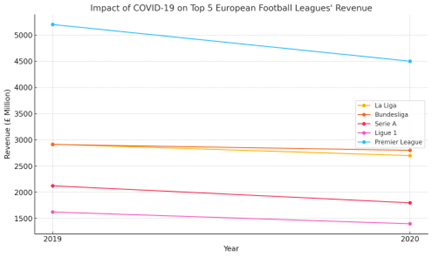
خلال موسم 2019/2020، كانت الآثار المالية لجائحة كوفيد-19 قاسية على الدوريات الأوروبية الكبرى. ووفقًا لتقرير Deloitte، انخفضت إيرادات الدوري الإنجليزي الممتاز بنسبة 13%، من 5.2 مليار جنيه إسترليني إلى 4.5 مليار، مما أدى إلى خسائر متوقعة كبيرة.
أما الدوري الألماني (البوندسليغا)، فقد شهد تراجعًا أكثر اعتدالًا بنسبة 4%، لتصل إيراداته إلى 2.8 مليار جنيه إسترليني. وفي إسبانيا، تراجعت إيرادات الدوري الإسباني (الليغا) بنسبة 8% إلى 2.7 مليار جنيه.
في المقابل، ألغت فرنسا موسمها بالكامل، وسجلت انخفاضًا بنسبة 16%، لتصل الإيرادات إلى 1.4 مليار جنيه. أما الدوري الإيطالي (السيري آ)، فقد شهد التراجع الأكبر، بانخفاض بلغت نسبته 18%، لتصل الإيرادات إلى 1.8 مليار جنيه إسترليني.
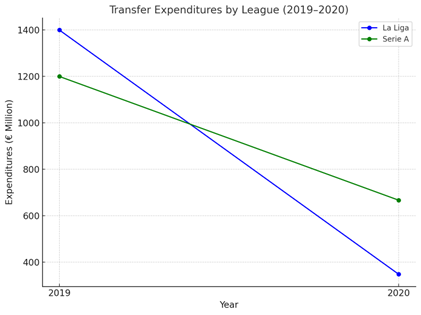
كما أثّرت هذه الأزمة على سوق الانتقالات الصيفية لعام 2020، حيث خفضت أندية الدوري الإيطالي (السيري آ) والدوري الإسباني (الليغا) نفقاتها بشكل كبير.
ووفقًا لمرصد كرة القدم CIES، تراجعت نفقات أندية الليغا من 1.4 مليار يورو (1.19 مليار جنيه إسترليني) في عام 2019 إلى 348 مليون يورو (296 مليون جنيه) في عام 2020. أما نفقات أندية السيري آ، فقد انخفضت من 1.2 مليار يورو (1.02 مليار جنيه إسترليني) إلى 667 مليون يورو (567 مليون جنيه) خلال نفس الفترة.
طرحت هذه التحديات المالية تساؤلات حول نماذج الأعمال التي تعتمد عليها أندية كرة القدم. وقد أجبر ذلك العديد منها على البحث عن مصادر تمويل جديدة، في حين بدأت صناديق الاستثمار الخاص ترى في كرة القدم فرصة مربحة، رغم ما تنطوي عليه من مخاطر.
تاريخيًا، كانت أندية كرة القدم تعتمد على الاكتفاء الذاتي المالي، من خلال إيرادات أيام المباريات، وعقود الرعاية المحلية، ونماذج الملكية الجماهيرية. لكن صعود الأندية النخبوية المملوكة من قبل مليارديرات وعقود الرعاية العالمية وضع ضغطًا متزايدًا على الأندية التقليدية.
وباتت القدرة على المنافسة في أعلى المستويات تتطلب ضخّ رؤوس أموال كبيرة، وهو ما لم تعد النماذج المجتمعية قادرة على توفيره في ظل متطلبات المنافسة الحديثة.
1.2 ظهور صناديق الاستثمار كلاعبين جدد في مراكز القوة
أصبحت شركات الأسهم الخاصة (Private Equity) لاعبين رئيسيين في سوق كرة القدم العالمي. فعلى سبيل المثال، قامت شركات مثل RedBird Capital Partners، وCVC Capital Partners، وSilver Lake، و777 Partners باستثمارات كبيرة في أندية كرة القدم عبر أوروبا.
ويُطلق على هؤلاء الفاعلين الجدد في المشهد الكروي مصطلح “الملكية المتعددة للأندية” (Multi-Club Ownership – MCO). ويميّز الاتحاد الأوروبي لكرة القدم (UEFA) بين الملكية المتعددة، حيث تمارس جهة واحدة السيطرة أو التأثير الحاسم على عدة أندية، وبين الاستثمار المتعدد، والذي يقتصر على الحصص المالية دون تدخل مباشر في الإدارة التشغيلية.
في السنوات الأخيرة، تسارعت وتيرة التوسع في شبكات الأندية المتعددة بشكل لافت.
ومع ذلك، فإن مفهوم الملكية المتعددة ليس ابتكارًا حديثًا. ففي التسعينيات، بدأت شركة ENIC (شركة الاستثمار الوطني الإنجليزي) بشراء حصص في أندية مثل توتنهام هوتسبر، ورينجرز، وسلافيا براغ، وآيك أثينا، معتبرة كرة القدم وسيلة استثمارية بالدرجة الأولى.
ثم تطور هذا النموذج مع استحواذ شركة Red Bull على عدة أندية ضمن استراتيجية تسويقية، تلاه بروز مجموعة City Football Group (CFG)، والتي تُعتبر أول نموذج منظّم واستراتيجي للملكية المتعددة الحديثة. وتضم محفظة CFG العالمية اليوم 13 ناديًا موزعين على خمس قارات.
ما بدأ كاستراتيجية استثمارية محدودة النطاق، تطوّر ليُصبح ظاهرة عالمية، حيث يوجد اليوم أكثر من 125 مجموعة ملكية متعددة (MCO) نشطة تُشرف على نحو 380 ناديًا وحوالي 13,000 لاعب حول العالم.
وتُعد الملكية المتعددة للأندية إحدى الاستراتيجيات الرئيسية التي تعتمدها شركات الأسهم الخاصة لتعظيم العائدات. ويُبرز هذا الاتجاه المتصاعد الحضور المتنامي لصناديق الاستثمار في عالم كرة القدم، واعتبارها هذه الصناعة أصلًا ماليًا قويًا وجديرًا بالاستثمار.
1.3 ما الذي يعنيه هذا لمستقبل اللعبة؟
1.3.1 التحول من كرة قدم يقودها المجتمع إلى كرة قدم يقودها رأس المال
إن تدفّق رؤوس الأموال الخاصة إلى عالم كرة القدم يُحوّل اللعبة من جذورها التقليدية القائمة على الأندية المجتمعية، إلى نموذج تقوده رؤوس الأموال. فلم تعد صناديق الاستثمار معنية بالحفاظ على الهوية المحلية، بل تركّز بدرجة أكبر على العائدات المالية. وقد أدى ذلك إلى احترافية أكبر في إدارة الأندية، لكنه في المقابل يثير مخاوف بشأن فقدان الروح المجتمعية التي لطالما ميّزت كرة القدم.
وغالبًا ما تختزل نماذج الملكية المتعددة للأندية (MCO) الأندية العريقة إلى مجرد أصول ضمن محفظة تجارية أوسع، مما يتعارض مع القيم التقليدية المرتبطة بالمجتمع والهوية والتراث المحلي. فقد تأسست أندية كرة القدم لخدمة مجتمعاتها المحلية، لا لتكون أدوات للامتياز التجاري أو لتعظيم الأرباح.
وعلاوة على ذلك، يبقى العائد المالي من استثمارات الملكية المتعددة موضع شك. فندر أن تتطوّر مسارات فعّالة لانتقال وتطوير اللاعبين بين الأندية ضمن نفس الشبكة، كما أن الحفاظ على القدرة التنافسية يتطلب استثمارات مستمرة وضخمة. ولهذا، فإن استدامة هذا النموذج على المدى الطويل تبقى محل تساؤل لدى الكثيرين.
1.3.2 إدارة وعمليات مُحسّنة
تجد الرياضة الاحترافية الأوروبية نفسها عند مفترق طرق هيكلي. فأندية كرة القدم تُعد من ركائز الثقافة والمجتمع، ومتجذرة بعمق في مجتمعاتها المحلية، ومع ذلك، فإن العديد منها لا يزال يعاني من عدم الربحية المستمرة. وفي معظم القطاعات، يُسمح للشركات غير القادرة على الاستمرار بالإفلاس؛ أما في كرة القدم، فإن الارتباط العاطفي يجعل من الفشل أمرًا شبه مستحيل.
لكن هذه القيمة العاطفية تُخفي واقعًا اقتصاديًا مقلقًا. ففي عام 2022، سجّل أكثر من 55% من الأندية الأوروبية خسائر صافية، رغم تعافي السوق بعد الجائحة.
ويُدخل نموذج الملكية المتعددة للأندية (MCO) هيكلًا تجاريًا عقلانيًا، من خلال تطبيق استراتيجية الأسهم الخاصة الكلاسيكية. ويتكوّن هذا الإطار من:
مع تولي شركات الأسهم الخاصة زمام الأمور، أصبحت الأندية تُدار بمزيد من الاحترافية، مع تركيز أكبر على تحسين مصادر الإيرادات والسيطرة على التكاليف. ويشمل ذلك خفض النفقات غير الضرورية، وتعظيم الشراكات التجارية، والتركيز على تحقيق العائد المالي.
كما أصبح اعتماد القرارات المبنية على البيانات أكثر شيوعًا، حيث يسعى المستثمرون إلى تحسين تتبع الأداء المالي، ومؤشرات الأداء الرئيسية (KPIs)، وتعظيم الإيرادات.
ولا يُنظر إلى هذا النهج كمحرّك للنمو فحسب، بل يُعتبر بشكل متزايد وسيلة إنقاذ لضمان الاستدامة طويلة الأمد.
1.3.3 المخاطر المحتملة
يكمن الخطر الرئيسي في هذا التحول في احتمال فقدان أندية كرة القدم لهويتها الجوهرية. فقد تُمنَح الأولوية للمساهمين على حساب المشجعين. وقد يتم استبدال الجانب المجتمعي في كرة القدم — حيث تلعب مشاعر الجماهير وتقاليدهم دورًا جزئيًا في اتخاذ القرارات داخل النادي — بنموذج مالي يكون فيه تعظيم الأرباح هو الهدف الأسمى.
وقد يؤدي ذلك إلى عقلية قصيرة الأمد، تُفضّل العوائد السريعة على حساب النجاح المستدام، مما قد يُلحق ضررًا بالجانب الرياضي للعبة.
ورغم جاذبيته المالية، فإن نموذج الملكية المتعددة للأندية يطرح تحديات هيكلية وثقافية كبيرة. فالأندية الواقعة تحت ملكية مشتركة قد تجد صعوبة في الحفاظ على هويتها الفردية، مما يُهدد بإضعاف إرثها وتقليص ولاء جماهيرها.
والتحدي الحقيقي يكمن في تحقيق التوازن بين الطموحات التنافسية، والتاريخ، والهوية الفريدة لكل نادٍ داخل المجموعة. ومن الضروري أن يحتفظ كل نادٍ بطموحه الخاص، سواءً من أجل دعم تطوير اللاعبين في أعلى المستويات، أو لضمان أن يرى المشجعون دائمًا أفضل نسخة ممكنة من فريقهم.
1.4 الخُلاصة
مع التطلّع نحو المستقبل، يبدو أن صعود نموذج الملكية المتعددة للأندية سيستمر بوتيرة متسارعة، مع سعي المزيد من المستثمرين إلى تنويع أصولهم واستغلال أوجه التكامل التشغيلي بين الأندية التابعة. غير أن هذا التركّز المتزايد في الملكية بدأ يثير اهتمام الجهات التنظيمية مثل الاتحاد الأوروبي لكرة القدم (UEFA)، وخصوصًا فيما يتعلق بنزاهة المنافسة وإمكانية تضارب المصالح.
ومع ذلك، إذا نجح هذا النموذج، فقد لا يظل حكرًا على كرة القدم، بل قد يمهّد الطريق لاعتماده في رياضات احترافية أخرى ضمن توجّه عالمي نحو تملّك متعدد في قطاعات رياضية مختلفة.
فهل يُعد تزايد نفوذ صناديق الاستثمار الخاصة في كرة القدم أمرًا حتميًا؟ أم أننا نشهد بداية ثورة خطيرة قد تقوّض الإرث التاريخي للعبة؟ هذا السؤال يبقى محوريًا في ظل التحوّلات المتسارعة التي تشهدها كرة القدم تحت ضغط الضرورات المالية.
في المقال القادم من هذه السلسلة حول الاستثمار الخاص في كرة القدم، سنُلقي نظرة أعمق على بروز نموذج الملكية المتعددة، ونبحث في الكيفية التي ترى بها صناديق الاستثمار هذه الرياضة كوسيلة لخلق قيمة طويلة الأمد، وتوسيع العلامات التجارية، وتنويع المحافظ الاستراتيجية.
Quteco is reshaping the future of football through AI-driven data intelligence, in collaboration with IBM.
From Scouting Room to Stadium – Digital Innovation for the Beautiful Game
Football is changing – faster, more global, and increasingly data-driven. Clubs, associations, and federations face the challenge of making smarter decisions both on and off the pitch. That’s where Quteco, together with IBM watsonx, comes in: turning complex sports data into actionable insights that deliver real competitive advantages.
From talent identification and squad planning to fan engagement, Quteco combines deep sports expertise with world-class technology platforms to provide tailored solutions for the modern game.
Key Benefits
Scouting Optimisation: Analyse tens of thousands of match and scouting reports in seconds – instead of hundreds of hours of manual work.
AI-Driven Squad Planning: Automated player recommendations with explainable reasoning, based on performance and fitness data.
Fan Personalisation: Deliver customised content, live stats, and automated highlights that boost loyalty, sponsorship value, and reach.
Fast Implementation: Cloud-based solutions that integrate seamlessly into existing systems.
End-to-End Partnership: From needs assessment to technical delivery and training – powered by IBM technology, implemented by Quteco.
Real-World Examples
Sevilla FC – Scout Advisor: Generative AI supporting scouting and transfer decisions, adaptable for women’s and men’s teams.
Empoli FC – Talent Scouting Portal: Data-driven clustering for more accurate and efficient player selection.
Fan Engagement Cases: Automated highlight commentary and match reports delivered within minutes – a gamechanger for visibility and fan loyalty.
Spotlight on Women’s Football
Women’s football is on the rise – athletically, commercially, and in global visibility. Quteco and IBM are at the forefront of this growth, providing tools that unlock the global women’s talent market, support data-backed squad planning, and deliver engaging fan experiences that help the women’s game reach new audiences.
Why Quteco?
IBM delivers world-class technology platforms, while Quteco translates them into practical, high-performance solutions for the sports world. Together, they empower football to:
scale faster,
become more data-driven,
and engage fans in smarter, more personalised ways
Whether for a top-flight club, an international team, or a federation, Quteco x IBM enables football to move confidently into the digital future.
Marian Otamendi, Co-Founder and CEO of World Football Summit, delivers a keynote speech at Women’s Football Week in Bilbao, emphasizing leadership and visibility in the women’s game.
Marian Otamendi is not only the Co-Founder and CEO of World Football Summit, but also one of the most influential voices shaping the future of the game. With her international background, a strong vision for sustainability, inclusion, and gender equality, and a deep understanding of football’s economic and social dimensions, she has turned WFS into a truly global platform that connects decision-makers from every corner of the industry.
In this conversation with The Football Week, she shares her insights on the rapid growth of women’s football, her personal journey as a female leader in a traditionally male-dominated space, and why she firmly believes football has the power to drive meaningful social change.
Our Exclusive Interview with Marian Otamendi
Part I – Women’s Football & the World Football Summit
Women’s football has been experiencing remarkable growth worldwide. How is the World Football Summit contributing to ensuring that this momentum extends beyond the pitch and into leadership, sponsorship, and media visibility?
It is key indeed that the momentum is sustained in time and that it impacts not just women on the pitch but also the entire football ecosystem.
Our ESG department, with Gender Equality as a main pillar, has the mission to ensure that women are present and have strong voices at every level of the game and to improve the growth, impact and visibility of women’s football and women in football and sports in general.
Our Female Leaders Program, for example, provides dedicated spaces and activities for women – both emerging professionals and pioneers – to connect, exchange insights, and build robust networks.
Our target is to have at least 30% women speakers and 20% women attendees at our events. So a few years ago, we created our Female Leaders Pass, a special discount designed to increase female representation in all of our events. The future of football is discussed and decided at World Football Summit – and women need to be part of the conversation and claim their place in the industry.
And continuous visibility is essential for us. Rather than limiting recognition to International Women’s Day, we work year-round to highlight women in sports via our panels, editorial content, podcasts, activations, education grants.
WFS has launched initiatives such as the Female Leaders Program and Project Menina to empower women in football. Could you share some tangible outcomes or success stories that you are particularly proud of?
There are several outcomes I’m particularly proud of. Since 2022, for example, we’ve surpassed our target of 30 percent female speakers at WFS Europe, reaching 34 percent, which demonstrates the effectiveness of our efforts to amplify women’s voices on the global stage.
Our Female Leaders Gatherings, which we’ve taken to Europe, Africa, Asia and the Americas, have become a powerful platform for peer-to-peer support during our events, creating safe spaces for women in the industry to share experiences and build lasting professional relationships. Seeing young students being able to connect with top leaders in the industry, to ask, learn and share, is always one of my favourite moments at our events.
La Menina Project has also grown far beyond a campaign – it has become kind of a movement. We’ve taken our Menina to several cities but I particularly remember our visit to Seville last year. We kicked off a training program in Las 3 Mil Viviendas, one of the most disadvantaged neighborhoods in Seville, for more than 50 children. You can truly see that football is not just a sport, it is a tool for inspiring and empowering young girls (and boys).
And of course, one of our most significant milestones came in March 2025, when we hosted Women’s Football Week Bilbao, alongside UN Etxea and BBK. For an entire week, women’s football took over the streets of the city with activations, free workshops, games. We had over 1000 people from 38 countries gather in Bilbao for a women’s football event…yet there are still people saying no one cares about women’s football! As part of the week we held our second Women’s Football Summit in the beautiful San Mamés and launched our Female Leaders Awards. Athletic Club Legends, for example, were celebrated as true Pioneers of the Pitch and the energy in the room was incredible.
Many players and stakeholders in women’s football highlight the urgent need for greater investment and long-term strategies. In your view, what role can WFS play in attracting decision-makers and investors to the women’s game?
The business case for women’s football is stronger than ever. There is a shift indicating serious commercial momentum and we can see it in each of our events too. Look at the attendance numbers, viewers and impact of the latest Euros for example.
WFS is becoming the go-to platform where decision-makers and investors meet to support and scale the women’s game, driving investment and long-term strategies. We are the connectors.
At Women’s Football Summit Bilbao, for example, we brought together leaders, innovators, brands, public institutions or investors from across the globe to explore emerging commercial models and opportunities that can sustain this growth.
In each of our events, we also showcase pioneering initiatives, brand partnerships, and success case stories. In our last WFS Monterrey for example, we held a panel discussion focused on investment in the women’s game alongside Club America and AB InBev. Visibility is key and our role is to provide a space to have it.
At the same time, recognition is important. At the WFS Awards and Honors, we ensure that trailblazers in the women’s game receive the credibility and recognition they deserve.
Football is often described as a powerful tool for inclusion and empowerment. How does WFS integrate women’s football into broader initiatives around education, sustainability, and social responsibility?
Our claim is “The football we want, the football we need”. Education, sustainability, social responsibility, gender equality, inclusion are not only integrated in WFS…they are our DNA.
In that sense, we view football, particularly the women’s game, not only as a sport, but as a powerful catalyser for change. Women’s football is inclusive, modern, open, rooted in the communities so it is key to create impact beyond the pitch.
Programs like La Menina, bring football to underprivileged communities, using the sport as a tool to teach teamwork, leadership, and personal development to young girls. We often bring female football leaders to inspire girls through activations and discussion spaces. It is fundamental to create and visibilise role models and break barriers early on. Through our Female Leaders Program, we also offer scholarships with business schools of sports.
Let me give you a recent concrete example of how we integrated women’s football into sustainability, social impact, and education in our work. At WFS Monterrey, we brought together our Female Leaders Program with local community-focused initiatives from our Purpose Partner Common Goal to create a 360° program addressing gender equity.
Girls at the Academia de Fútbol para Niñas experienced football as a tool for confidence, leadership, and empowerment, while the photo exhibition ‘En la Cancha: Mil Mujeres, Mil Historias’ gave cultural visibility to women in football across Latin America. Complementing these initiatives, during the Summit, we held a panel on gender equity and social responsibility and we hosted an open workshop with Common Goal Co-Founder Jurgen Griesbeck and footballer Natalia Gaitán. Together, these actions fostered strategic dialogue within the industry but they also had an impact outside the walls of our Summit, creating lasting social impact.
Looking ahead, where do you see women’s football in the next five to ten years, and what role do you envision WFS playing in shaping that future?
Looking ahead, I see women’s football becoming fully mainstream, both in terms of commercial investment and global recognition. Over the next five to ten years, we should expect stronger leagues, bigger audiences, and more equitable opportunities for players, coaches, and professionals across the sport.
At WFS, we aim to be at the heart of this transformation – providing opportunities for learning, networking, and investment that accelerate growth and the professionalisation of the women’s game. Through initiatives like the Female Leaders Program, Women’s Football Week, or La Menina, we will continue creating visibility, nurturing talent, and connecting stakeholders, while championing gender equality and inclusion on and off the pitch.
Part II – Personal Journey & Leadership
You have an impressive background spanning business development, renewable energy, and now global football. What personal experiences most shaped your journey to becoming CEO and Co-Founder of the World Football Summit?
Thank you. My journey to becoming CEO and Co-Founder of WFS was shaped by a combination of professional experience and personal passion. Early in my career, working in business development and renewable energy taught me the importance of strategy, innovation, and creating impact that goes beyond immediate results.
At the same time, living in many places, I quickly recognized the power of football to connect people, inspire communities, and drive social change. Also its economical potential and the need for shared learning and professionalisation. Bringing these worlds together, naturally led me to create a platform like WFS. It’s a space where business, sport, and purpose intersect, a space to do something truly transformative for the football industry.
The one person who has made me go forward without any sort of hesitation or fear is my grandmother, a role model, to whom I was very close. She was a really empowered woman, a great businesswoman who did amazing things for the time she was living in. She has
always been an inspiration for me, and has made me see female leadership like a very natural thing.
Leading an international platform like WFS requires vision and resilience. What have been the biggest challenges in your career so far, and how have they influenced your leadership style?
I would say the biggest has been balancing rapid growth with purpose-driven goals. Football, like many industries, has historically been male-dominated, so ensuring women’s voices are represented in leadership, on panels, and across our events has required persistence and creative problem-solving. At the same time, growing WFS globally while staying true to our values of inclusion, sustainability, and social impact has meant making tough decisions and prioritizing long-term vision over short-term gains.
This has consequently made my leadership style collaborative, resilient, and values-driven. I try to focus on creating impact while empowering the people around me to lead, innovate, and challenge the status quo. I never take no for an answer, and this is something I strive to get to the team. I know I am at times too exigent and perfectionist, but those traits are precisely the ones that have allowed me to get far in life. This, and the fact I never buy nonsense – widely spread these days, I am afraid.
As a female leader in a traditionally male-dominated industry, what advice would you give to young women who aspire to build a career in sports management or football business?
Do it, claim your space, believe in yourself, don’t be afraid. Don’t wait for permission or for the industry to make room for you – be proactive, take opportunities, study, trust your skills and step confidently into roles where women have been underrepresented. The industry needs bold, determined voices, so take the leap and make your impact. We need you, it’s the only way the game will evolve. Men rarely question themselves. Neither should we.
Beyond football, what inspires and motivates you in your daily life, and how do these passions influence the way you lead WFS?
I am a very enthusiastic person. I love changing things, I always try to make them better. I believe we could have a better and happier society if we truly fought for it. Conformist people will never make a difference. I feel I have been very lucky in life, and it is only fair I try to give back to society, and there are many ways to do it. Create jobs, help people, pass on values, fight against dogmatism and nonsense…there are so many things I could do I feel I lack time. Life goes by quickly, we have no time to waste, we have to make the best out of this journey and live life at its fullest.
A VfB Stuttgart U19 player steps up for a penalty. Moments like these mark critical turning points in a young footballer’s journey, where the right guidance from parents and agents can make all the difference.
In initial conversations with parents, I often hear the same phrases:
“We’re going to try it on our own for now.”
“We’ll reach out at the end of the season.”
“We don’t need an agent at the moment – maybe next May.”
“I’m taking care of everything myself – we don’t need anyone.”
This mindset is understandable. Parents want to protect their children, stay in control, and avoid early commitments. But what many don’t realize is that waiting too long to bring in professional support can lead to missed opportunities, poor decisions, and long-term setbacks for the child’s development, both in football and in life.
Players Agents Are Not Just for Transfers
One of the most common misconceptions is that a players agent is only relevant during transfer windows. In reality, good advisory work starts well before a contract offer arrives and accompanies a player step-by-step through all phases of development.
A professional agent supports young players and their families with:
Strategic career planning
Support in athletic development and evaluation of training environments
Assessment of club options and sporting opportunities
Academic decisions and mental well-being
Preparation for conversations with clubs
Contract review and negotiation
Guidance on media presence, sponsorship, social media and branding
Professionally run clubs think long-term. They scout, plan, and initiate contact with players throughout the year, not just in July or January. Those who wait until the season ends to “see where things stand” are often reacting too late.
Experience Shows: Many Parents Misjudge the Market and Their Child Pays the Price
Over the years, one pattern is clear: Many parents are poorly advised or not advised at all. Not because they mean harm, but because they lack real insight into how football decisions are made at the professional level.
They underestimate how clubs operate, misread signals, overestimate verbal promises, or play the wrong hand at the wrong time. Often, they wait too long or gamble without understanding the risks.
The one who ends up paying the price is not the parent – it’s the player.
Don’t Be Impressed by Flashy Promises – They Rarely Lead to Real Value
Another thing I often hear:
“Another agent promised us a deal with a sportswear brand.”
“He knows someone at Nike or Adidas.”
“They offered us sponsorships right away.”
It sounds exciting – but in most cases, it’s just a sales pitch.
A sponsorship deal at age 14 or 15 rarely brings real benefits. More often, it ties a player to long-term commitments they don’t fully understand, in exchange for minimal rewards and maximum distraction.
The real danger? It pulls attention away from what really matters: training, performance, everyday structure, and school.
A good agent doesn’t make loud promises, they guide with clarity, experience, and perspective.
A Lesson from the Startup World: Would You Let a Teen Run a Business Alone?
Let’s take a look at a different industry: startups and entrepreneurship.
Imagine your 17-year-old is building a tech startup – highly talented, innovative, getting attention from investors. Would you, as a parent, negotiate investment terms alone, structure growth strategy, and navigate legal and financial frameworks?
Probably not.
You’d bring in someone experienced – a coach, a lawyer, a business mentor. Someone who understands the landscape and helps avoid costly mistakes. The same logic applies to football.
Anyone who understands the system can act early, protect development, and make sound decisions. Anyone who doesn’t is flying blind and risks the long-term path for short-term illusion.
Early Support Beats Last-Minute Crisis Management
Too many families only reach out when things aren’t going well – lack of game time, no offers, or loss of confidence. But by then, critical time and positioning may already be lost.
Good advisory work begins early. When there’s time to explore, build trust, and make calm, strategic decisions. Not under pressure – but with foresight.
A players agent is not a dealmaker. They are a long-term partner who understands both the business and the human side of the game.
A Message to Parents: Get Informed
Not every agent works professionally. Not every promise is sincere. So please:
Ask whether they are FIFA licensed.
Get a clear breakdown of what services are offered.
Question anything that sounds too good to be true.
Choose based on values, not marketing.
A FIFA license isn’t just a piece of paper – it’s a standard of accountability, quality, and ethical conduct. It means the agent is bound to rules, transparency, and oversight.
Final Thought: Trust Isn’t Claimed – It’s Earned
As a parent, you want the best for your child. But the best doesn’t mean doing everything yourself. It means knowing when expert support adds real value and choosing that support wisely.
A professional players agent doesn’t replace your role, they complement it, with structure, insight, experience, and the ability to challenge decisions when necessary. Because a successful career isn’t built on logos or luck. It’s built on planning, integrity, and the right team behind the scenes.