
Home Blog Page 83

The Details and Intricacies of a Representation Contract for Football/Soccer Agents


Introduction

Last week, we journeyed through the process of finding and selecting the right agent for a youth player. We briefly touched upon the final stage of signing with an agent; the representation contract. However, this is a complex and important element in its own right and hence, this week’s blog is dedicated to helping you understand everything involved with representation contracts.

We will begin by outlining what exactly a representation contract is, before identifying the key clauses that should be considered when assessing a representation contract. Finally, and perhaps most importantly, we will address common issues that arise with representation contracts and how to avoid problematic commitments to agents.

The Representation Contract

Once a decision has been made as to which agent a player would like to sign with, the representation contract will be signed by both the player and the agent. The purpose of this contract is to create a legal and enforceable agreement between the parties. A contractual agreement of this manner stipulates different clauses for both engaging parties to act in adherence with and hence it is important to ensure it is favourable and agreeable for the player.

The representation contract offers an element of legal safety and security for each party. If the contract contains all relevant information and requirements, it prevents either party acting wrongly within the relationship. Breaching such a contract can lead to termination with just cause and hence, protects the player if the agent does not behave in a professional manner as the player can then exit the relationship. Alternatively, it provides an element of protection for the agent contained within the exclusivity clause and prevents the player dealing with other agents.

In most national football associations, there will be a template layout of a representation contract. However, agents and agencies are able to adapt the clauses and include any additional obligations specific to the work that they do. Nonetheless, the majority of a representation contract is universal and replicated in each country.

In the following section I will outline the most important considerations that should be made regarding individual clauses. For now, it is important to know that in the Agent Regulations, FIFA have published a required list of clauses that must be included within the representation contract. These must be incorporated into every version of a representation contract in any FIFA member association. However, national associations can then also include further clauses. Importantly, FIFA stipulates that the Representation Contract must detail and specify the legal relationship between the player and the agent. Therefore, the minimum clauses to be included must refer to:

  1. The names of the parties: Make sure these are spelt right!
  2. The scope of services provided: think about what the duties of the agent are, what services does the player need them to help with.
  3. The duration of the legal relationship: covered further below.
  4. The remuneration due to the intermediary: the level of commission owed to the agent.
  5. The general terms of payment: how the agent will be paid.
  6. The date of conclusion: it must be clear the exact date on which the representation contract ends.
  7. The termination provisions: how can the contract end and if it is premature, what reasons would constitute a just cause.
  8. The signature of the parties: remember that if the player is a minor, their legal guardians also need to sign the contract.

Important Clauses to Consider

There can be a variety of clauses within the representation contract that are part of the minimum to be included set by FIFA or additional clauses included legally under the National Association. Each one needs to be read and understood fully. In this section, we will highlight a handful of specific clauses that are the most prominent factors of a representation contract. They are the clauses that stipulate the financial commitments of the agreement and also the clauses that outline the obligations that the player is under whilst in the period of the contract. As the next section will develop upon, the player must ensure that they are not entering into an unreasonable, unfair or problematic contract. The following are the kind of clauses that may lead to this undesirable outcome and need to be properly assessed.

  1. Duration: In some national associations such as the UK, the representation contract can only be for a maximum of two years before requiring renewal. However, in some countries this is not the case and in some circumstances, two years may still cause issues if the player is unable to terminate a contract if it has been breached by the agent
  2. Termination: The player needs to be satisfied that there are exit clauses within the contract that allows them to leave the agent without penalty if certain situations arise, or breaches of contract occur or even when it comes to deciding against renewing with their current agent and changing to another. There must not be a clause that requires the player to pay an agent when leaving them or a similarly detrimental obligation.
  3. Exclusivity: This is a very important part of a representation contract for a player to be aware of. It will state that the agent must be solely and exclusively responsible for representation of the player in any agency activity. However, it is important that the contract allows for the agents to obtain mandates if there is an opportunity in another territory that another person is better suited to represent the player for. Significantly, some countries such as Germany, have banned exclusivity of representation for agents. This is a risky situation for the agents but means that the players are not restricted or bound to sole representation. It is important to note that agents based in Germany have found ways around this by registering their companies in different FIFA countries. This trend means that they can bind the player to exclusivity.
  4. Remuneration & Commission: An obviously integral clause to consider and make sure is favourable to each party is the commission owed. This will often be written with a percentage of a player’s gross or net salary that will be owed to the agent for their services. The player must be certain that if they are obliged to pay a certain percentage of their salary to the agent, they must be fully trusting that they are paying a fair rate for the benefits and value of the services that the agent is providing. This is generally often around 10% of a player’s gross salary but may be slightly lower in leagues where the finances for players are higher such as the Premier League in the UK. Other factors such as whether the player pays the commission themselves or if it is the responsibility of the club as well as tax implications are all a part of this. There is a rule from FIFA that permits clubs to play the agent on the player’s behalf which is the norm. Importantly, the contract is still between the player and the agent and therefore, if the club does not pay, it is fundamentally the player who is liable to remunerate the agent according to the representation contract.
  5. Image Rights: Image rights and commercial commission will often be implemented into the representation contract and this once again needs to be assessed and agreed to in full knowledge of what it entails. Commercial commission is often a higher percentage (usually around 20%) than for playing contracts and once again, the player needs to understand how much money they are liable to pay the agent in commercial deals. In some countries, agents are finding a way to sign younger players below the legal age for a representation contract by instead signing an ‘image rights contract’ with them. Brands such as Nike and Adidas pick up players below the U16 level and agents are capitalising upon this. This image rights contract acts as an entry into a relationship with the player which will then transition into a representation agreement once the age is right. This is becoming more common in countries such as the UK.
  6. Territories: The representation contract will detail the extent of the jurisdiction for each agent. For example, in most cases the contract will specifically and expressly state that they represent you globally to ensure their exclusivity of your representation cannot be undermined, if exclusivity is permitted.

Avoiding Problems

If the representation contract is not carefully considered then there may be problematic consequences that affect the player’s career and beyond. It is clear from the previous sections that representation contracts are complex and intricate documents that form the basis of the agreement between the player and the agent. Hence, the meaning and understanding of each clause must be ascertained. It is essential that the contract is not signed without fully understanding the ‘terms and conditions’.

Seeking the guidance and assistance of a lawyer is strongly recommended. Their legal knowledge and expertise will be helpful throughout the signing process and prevent the player entering into a contract that is difficult to leave and is disadvantageous to them financially or otherwise. Hopefully, this issue may never arise as if the player and the family have gone through the right process of selecting an agent and carried out appropriate due diligence as we explored last week, the trusted agent is unlikely to create such problems. However, it is a possibility and therefore, the importance of understanding and thoroughly considering the representation contract cannot be underestimated.

A final suggestion I would make is that the representation contracts will never automatically renew. It is up to the player and the agent to come to a new agreement after the contract expires and to sign a renewed representation contract. However, I believe that as the contract expires, particularly if it is the end of the very first with that particular agent, the player and their family should ‘re-interview’ and reconsider the agent and other agents. By reevaluating the current agent it is possible to see if they are delivering upon the expectations they had set and adding the value the player had hoped for. Being open minded rather than fixed upon resigning with the same agent can enable finding the best opportunities for the player moving forward.

Summary

Following the stages outlined in last week’s blog, you will eventually reach the point at which a representation contract will be signed. After filtering through every potential option, the worst thing that can happen is to rush into a representation contract that creates one or more unforeseen disadvantages to the player. This blog has hopefully provided a useful insight into the structure and general contents of such a contract as well as pointing out some possible supplementary clauses that may be included. The player and their guardians must carefully review and understand the contract before signing and in most cases, a lawyer should be consulted for extra security as their expertise will ensure no detrimental obligations or requirements are contained within the contract.

Que Significa ser un Agente de Fútbol: El trabajo que hacemos, las habilidades necesarias y lo que ha cambiado

Desde el inicio de la representación deportiva en el mundo del fútbol, los roles necesarios, responsabilidades, y demandas han cambiado de una gran manera. Los agentes de fútbol ya no son simples agentes que negocian el contrato laboral y transferencias de sus clientes, la responsabilidad es mucho mayor, por ende, se debería exigir mayor preparación para poder deliberar un gran servicio durante la corta carrera de los futbolistas.

En este blog, primero discutiré en mayor detalle las diferencias del trabajo de los agentes tradicionalmente y lo que demanda ser un agente hoy en día. Seguidamente, describiré la cantidad de responsabilidades que implican ser un agente moderno.

Agente Tradicional Versus Agente Moderno

Para empezar, definiremos que es un agente, la Real Academia Española define a un agente como “persona que obra con poder de otra para gestionar algo en su nombre.” Tradicionalmente, el agente actúa como representante legal de su cliente en las negociaciones de extensiones de contratos entre el club y el jugador, las transferencias y exploran oportunidades potenciales. La gran diferencia con el agente moderno es la cantidad de oportunidades las cuales deben considerar para conseguir mejores opciones laborales para sus clientes, aparte de tratar solo con la parte contractual con el club.

El rol que desempeña un agente se ha vuelto global. Un agente tiene la habilidad y responsabilidad de actuar como representante legal, y de hacerlo de manera leal, sincera y transparente en el mayor interés de su jugador. Sin embargo, el trabajo va más allá y exige mucha demanda por parte del agente, es un trabajo de tiempo completo.

Hoy en día, las grandes agencias de representación están uniéndose, mientras que en el pasado los agentes solían operar de manera independiente. Ahora existen agencias de tamaño medio, como Family & Football que opera en más de 6 países; y de tamaño grande, que cuentan con más de 50 agentes trabajando juntos, con abogados internos, departamento de mercadeo, entre otras cosas, y oficinas en diferentes países. En el pasado, los agentes solían operar en un solo país, usualmente en el de origen, pero ahora es un trabajo global, todo está más conectado entre sí. 

La FIFA reconoció por primera vez la profesión de los agentes en 1991 y los comenzó a regular. Previamente, los agentes lo hacían más como consultores. Luego, en 1995, después del caso Bosman, los agentes se volvieron más poderosos. Esto es debido al “free agent” o agente libre como estatus de jugador. El dinero creció en el negocio ya que se volvió global con la libre circulación de jugadores a través de ligas y países. Hoy en día, están volviendo más regulaciones por parte de la FIFA.

En la siguiente gráfica, se muestra un reporte hecho por la FIFA en los últimos diez años de traspasos internacionales.

El agente moderno debe tener conocimiento no solo de temas contractuales sino financieros, legales, de inversión a corto y largo plazo, oportunidades comerciales, redes sociales, mercadeo y branding, conocimiento de idiomas, entre otras, además de un entendimiento avanzado del fútbol. Hoy en día, el agente es responsable de encontrar oportunidades para su jugador no solo dentro de la cancha sino también fuera de ella.

La Era de la Comercialización y las Redes Sociales

Las redes sociales ciertamente han cambiado la manera en la que interactuamos unos con otros, la manera en que vivimos y la manera en la que se hacen/nacen los negocios. Las personas ya tienen el poder de tener una voz ante el mundo con ‘total’ libertad de expresión y apoyar las causas con las cuales cada individuo se identifica. Los atletas, en especial los jugadores de fútbol profesional, por ser el deporte más conocido mundialmente, tienen el poder de mover, motivar y tener millones de seguidores alrededor del mundo. Esto es muy interesante e importante comercialmente para las marcas y todas las empresas.

Dentro de las habilidades necesarias del agente moderno están, encontrar oportunidades comerciales a sus jugadores usando la imagen y el poder de sus redes sociales. El hecho de tener una gran presencia digital significa nuevos contratos, nuevas oportunidades de negocio e incluso un mayor ingreso con el club actual. Por estas razones los agentes necesitan desarrollar la presencia digital de sus jugadores, tener conocimiento y entendimiento sobre las redes sociales, mercadeo, legal sobre derechos de imagen y branding para poder aprovechar las oportunidades que resulten.

La globalización del fútbol es un fenómeno que aporta mucho al crecimiento de los jugadores como personalidades ante el ojo público. Esto requiere y exige a los agentes a desarrollar diferentes habilidades para poder conseguir buenas oportunidades para su cliente.  A medida que la popularidad, la riqueza financiera y el valor comercial del fútbol va creciendo en todo el mundo, más corporaciones y empresas lideres en la industria están dispuestas a invertir sumas sustanciales de dinero en el deporte. Este fenómeno comenzó con importantes acuerdos de patrocinio para patrocinadores de camisetas, derechos de denominación de estadios y trasmisiones televisivas. El alcance de patrocinios ahora se ha extendido a casi todos los elementos del sistema de fútbol, como materiales de entrenamientos, ofertas de botines, en Colombia guayos, programas de partidos y publicidad en estadios, y vincula el fútbol con las marcas de ropa, las aerolíneas, casas de apuestas y bebidas alcohólicas. Estos acuerdos de patrocinio pueden beneficiar a los jugadores y es la responsabilidad del agente moderno identificar con cuales conviene interactuar.

Ejemplo en la siguiente imagen del delantero de la selección Colombia, Radamel Falcao en referencia a ganancias basadas en marcas patrocinadoras en años anteriores.

Para ser un agente exitoso es importante entender la persona con la que se está trabajando, conocer la personalidad, las motivaciones, y aspiraciones que hay detrás del individuo complementada con el atleta de alto rendimiento. Es de gran importancia para el agente tener ese conocimiento para así poder desarrollar la marca personal del atleta en base a los rasgos reales de la persona y no una personalidad falsa. Esto es para presentar a la persona ante el ojo público y encontrar las oportunidades de patrocinios apropiadas y nuevos flujos de ingresos. Está marca personal se complementa y potencializa con la presencia digital.

Responsabilidades del Agente Moderno

Hoy en día, los agentes siguen cumpliendo los deberes fundamentales de la profesión adicionando las nuevas responsabilidades. Se encargan de la negociación de contratos laborales con el club, re-negociación o extensión de contratos, transferencias, identificación de oportunidades comerciales con marcas, manejar las relaciones publicas de su cliente, desarrollar las redes sociales, la marca personal, explorar nuevas oportunidades de negocio, asesoría financiera, apoyo en educación, en especial si son jugadores juveniles, ayuda en los planes post carrera deportiva, apoyar a la comunidad haciendo trabajo de caridad, apoyo a la familia, ser un mentor, encontrar apoyo de coach personal y mental, ser motivador, necesidades y seguimiento diario al desarrollo del jugador, entre otras funciones.   

La función principal del agente es asegurarse de que su jugador sea valorado de la manera correcta por parte de los clubes. Tradicionalmente, el club comprador basaría el fichaje de un jugador en la capacidad para desempeñarse en el campo de fútbol. En la era moderna, ya no es el caso. Los jugadores tienen su propio valor comercial que pueden llevar a un club, lo cual crea oportunidades que el agente debe entender para garantizar que se llegue a un acuerdo justo. Un jugador que tenga una gran base de fanáticos e influencia global puede atraer grandes patrocinadores y diferentes fuentes de ingreso para el club a través de ventas de camisetas, entre otras. Esto es porque los fanáticos ya no son tan fans del club, hoy en día, siguen más a los jugadores que al mismo club, lo cual en algunas ocasiones puede resultar en el jugador teniendo poder de toma de decisiones dentro del mismo club. El conocimiento sobre los derechos de imagen y el valor comercial, así como la aptitud financiera general, es imprescindible para que un agente logre un resultado deseable para su cliente en estas situaciones.

Tipos De Agentes

La mayoría de las transferencias incluyen a varios agentes. En tiempos recientes se ha vuelto más común que los clubes compradores y/o vendedores simplifiquen el proceso usando el mismo agente en un acuerdo de representación múltiple. Sin embargo, las nuevas regulaciones por parte de la FIFA buscan prohibir esto. Cabe mencionar que la nueva legislación impide la representación múltiple en todas las circunstancias, excepto para actuar en nombre del jugador y el club comprador. Cualquier otro conflicto de intereses no será posible y alterara la forma en que los agentes operan dentro de los acuerdos.

Una de las maneras en la que las responsabilidades de los agentes han cambiado es que hoy en día hay una mayor tendencia a que los operativos asuman el papel de representar a los clubes involucrados en un acuerdo. Han creado una versión alternativa de la profesión a la que se puede denominar como ‘agentes de club.’ La esencia del trabajo bajo este modelo sigue siendo la misma, actuar en el mejor interés del cliente, pero con el fin de lograr el resultado más deseable para el club comprador o vendedor.

Figura en referencia al pago de comisiones para agentes de clubes.

Los mandatos se han convertido en una norma dentro de la agencia del fútbol. Los clubes identifican jugadores de interés y otorgan mandatos a los agentes para que intenten conseguir un acuerdo que se adapte al club. Está es otra razón que enfatiza la importancia de que los agentes establezcan amistades dentro de los clubes ya que les da acceso y credibilidad para estar bien equipados para llevar a cabo el contrato. Si bien los agentes que representan jugadores siguen siendo los más comunes, al igual que los que representan directores técnicos, entrenadores; la aparición de agentes de clubes ha ampliado cada vez más el alcance de las demandas sobre la capacidad de los agentes de fútbol en la era moderna. A pesar de ello, los principios de la profesión siguen siendo los mismos; procurar y negociar un contrato en el mejor interés del cliente, ya sea para un jugador, club, o director técnico.

Conclusión

En este blog se ha explicado lo que significa ser un agente de fútbol, las diferencias entre los agentes tradicionales y el agente moderno. Ciertamente, para ser un agente exitoso hoy en día se necesita un rango de habilidades y conocimiento extenso, que permita que el agente opere y logre los mejores resultados posibles para sus clientes, ya sean jugadores o clubes.

Es importante tener en cuenta que a pesar de que los agentes tengan conocimientos y habilidades en las extensas facetas en las que están involucrados los jugadores de fútbol modernos, es de gran importancia reconocer que, para poder ofrecer un mejor servicio a su cliente, el agente debe aprender y estar dispuesto a subcontratar a expertos para que hagan trabajos en ciertos campos. Esto es necesario particularmente para los jugadores ‘top.’ Formar un equipo adecuado a su alrededor para apoyar el rango de sus servicios. Por ejemplo, usar empresas especializadas en redes sociales, marketing, abogados y asesores financieros para mejorar el servicio que recibe el jugador. Todo esto siendo apoyado, construido y administrado por el agente, quien tiene un conocimiento sencillo de cada área especializada, por lo cual lo más probable es que solo brinde consejos preliminares básicos antes de contratar expertos.   

The Ultimate Guide to Selecting the Right Football/Soccer Agent for Your Child


Introduction

A lot of what we have looked at in this series is the agents themselves and the industry system. However, this blog approaches agency from an alternative perspective; through the eyes of a youth player and their parent or guardian looking to sign with an agent for the first time.

The decision of signing a representation contract with an agent is a major decision for a player and the family, particularly if it is the first agent they are signing with as a youth player. Our impression is that the resources available to parents and guardians are not entirely comprehensive. Hence, the aim of this blog is to provide a complete guide to the process of researching, considering and signing with the first agent, for the player themselves and their guardian.

In the next blog, we will look into the slightly different approach to changing agents during a player’s career, if a situation arises where they wish to or are forced to leave their current agent. However, this blog specifically focuses on ensuring the reader is well-equipped to select the right agent to represent themselves or their children. For those readers who are considering a career as a football agent, this blog will also help inform you as to which areas are important to focus upon to provide players with the best possible service if you are hoping to become their first agent.

Why Have an Agent?

First and foremost, a player and their family need to assess when is the right time to have an agent. It is important to begin working with agents once there are extraneous off-field details that need to be managed and negotiated. The agent’s role is to relieve the burden of this away from the player and to help continue the player’s career progression in a calculated and directed manner. For example, if a youth player is highly-rated and already being spoken to by several top clubs, it is likely they will need an agent to ensure they obtain the best outcome from the situation. Similarly, a player that may have just been released by a top academy but is looking for opportunities elsewhere, in lower tiers or abroad, may require an agent to help them find the best option. However, some youth players who have already secured a scholarship and do not need additional assistance may not sign with an agent but may begin to build relationships with agents for the future.

A key factor in the process, as the guardian or the player, is patience. There is no general, universal rule from FIFA that governs when a player can sign with an agent. Each member association creates their own regulations. For example, in the UK a player can legally be approached by an agent with parental consent from the beginning of the calendar year in which they turn 16. However, in some football associations such as Germany and the US, these age restrictions do not apply; a player can have an agent at any age and all that is required is the parent’s signature. The common factor across any association is that the biggest mistake is to become excited by the prospect of having an agent and rushing into an unsuitable representation contract or with an agent that is not best-equipped to represent the player.

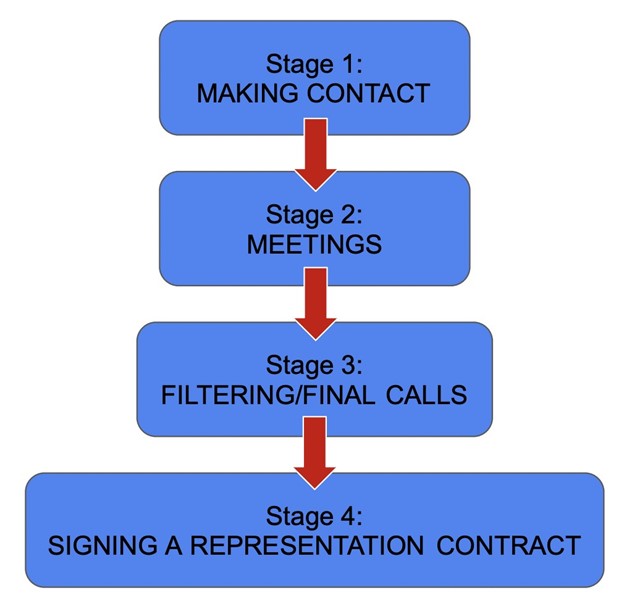
Stage 1: Making Contact

The process should begin with contact with several agents that may be interested in representing the player. In some cases, the agent may reach out to the parents of the player in order to strike up a conversation or possibly, it may be the parents who reach out to an agent that they have heard about and believe will look after their child well. Parents who may have already signed with an agent with their child will be able to recommend certain options to them. It is important to consider several options to understand how different agents and agencies work and how each one can offer a different service and benefits. Meeting with smaller and larger agencies is important too as they often have distinct advantages and disadvantages, of which some are more relevant in certain circumstances and for certain players.

At this step I think we must raise a vital point. At no stage throughout the recruitment process should money or extortionate gifts exchange parties. This is a form of ‘bribery’. Some agents may offer parents an immediate payment for their child to sign with them or some parents may even request it.

This is incredibly dangerous and must be avoided for many reasons. Firstly, if it is over a certain amount it must be declared to tax authorities as it is taxable. Furthermore, it can be dangerous for agents as well as it sets a bad precedent for future relations and the parents may move their son to another agent for more money. Remember, the aim of signing an agent is to benefit the player and not the parents or the agent and bribery undermines this. The consequence that may result are not worth the risk and “selling” the player out to an agency that pays the largest sum defeats the purpose of finding the best agent that will benefit their career the most.

Stage 2: Meetings

Over the period of time in which the player and his family finds the right agent, you may meet with a handful of agents. For a youth player it may be more of a responsibility for the parents to deal with this rather than involve the player to avoid extra hassle for them. The age of 16 is an important part of a player’s career development. They will often be set to begin the scholarship stage of youth football and officially signing with an agent immediately may not be necessary. However, some players may want to be involved as building relationships with interested parties at this age can allow a longer duration of time to best understand each offer rather than being forced into a rushed agreement immediately before the player may sign their first professional contract.

During this period, developing an understanding of the agent is vital. This can happen through in-person or digital meetings. I will explain the criteria that should be looked for in each potential interest in the next section but the fundamental aspects are that the agent can be trusted, is the kind of person the player and their guardian want to work with, and that they have a clear and focused strategy for working with the player. Additional and sufficient due diligence and informed research is the responsibility of the player and their family to obtain and assist them in making the right important decision. This supplementary research can also involve things like speaking to other parents or other players who know the agent or may even be looked after by them and hearing about the quality of services they provide. This is why reputation and dedication to each client is vital for agents.

Remember that football is just a part of what an agent can offer. The best agents will be able to show you that they can add value in other areas such as through the player’s educational pathway, by building their social media and other personal marketing or branding, support them mentally through injuries and the high pressures scholar environment and generally help them to become a well rounded and good human being.

Meetings to build relationships should continue throughout the selection process and even beyond. It is common sense that you are more likely to make the best decision on an agent if you have met them several times and have a greater understanding and insight into them as a person and as a professional. These meetings build trust and will often be a major factor in deciding upon the right agent. Once the agent is signed, I would argue that review and planning meetings should continue to ensure that targets are being met and that the agent is providing the value that they had promised.

Stage 3: Filtering and finally calls

As the process unfolds, it is likely that what may have started as a handful of agents gradually depletes to a maximum of two or three of the best options. This filtering process takes place by assessing the interested parties’ compliance with essential criteria that the player and their family are looking for. Remember this process can last any amount of time; a couple of weeks, a couple of months or a couple of years. As long as the player and the family are informed enough and have seen and understood what the agent can offer during their time in contact then the time to sign with an agent may be appropriate. Speaking with friends, family, coaches and getting the opinion of others is vital to further this.

An important point of consideration at this stage is to distinguish exactly the roles between the agent themselves and the agency they work for. For example, in some cases, bigger agencies will use their top agents in the recruitment process. It is important to establish they will be the main point of contact moving forward. Often, once the player is signed, a more junior and inexperienced agent will be the main point of contact and may not be able to fulfil the promises and level of service that the player and their family were under the impression they would receive. Remember that the bigger agencies have numerous players signed with them and there are not enough hours in the day to be able to give each player dedicated and personal care and attention. Be sure that you have established that you or your child or sibling will be signing with an agent that will be dedicated to them rather than signing with an agency where they become a ‘small fish in a big pond’ and are just another number unless they are the top players under the agency.

If it has not been the case before, the final stages of the process and the final calls should involve the player. After all, it is the player’s agent. The age of the player will affect the influence they have in the decision. If they are young it is the guidance of the parents that will take priority but as a player gets older they are likely to be more likely to know which agent is best for them. Regardless, involving them in at least the final calls will help them understand each option and the benefits and possible drawbacks of each one. The final calls should be fully informed and developed discussion which gives the player and his family the chance to ask any final questions or express any other queries before making the final decision.

Stage 4: Signing a Representation Contract

Eventually, without any sense of rush or pressure, the family and the player can decide upon the preferred option and enter into a representation agreement by signing a representation contract with the agent. However, when this stage arises, the parents or the player depending upon the age, should recruit the services of a lawyer to review and offer guidance on the representation contract. This will prevent them incidentally agreeing to disadvantageous clauses and conditions that will create difficulties in the future. Importantly, the ultimate decision lies with the player themselves who is being represented but often the family and friends or other mentors, such as coaches, will be able to help guide them and input their own advice.

I will explore representation contracts in detail in the next blog as it is important for a player and their family to have an in-depth understanding and awareness of all the dangers and issues that can arise from them as well as any benefits and opportunities that could come with it. It deserves its own blog to be able to fully explain the intricate details of such a contract.

Essential Criteria

A lot of factors that will be considered when deciding upon signing with an agent are subjective to the individual player and their family. This is understandable as the values and principles of each person differs and will likely align with the values and principles of different agents. This will also differ in terms of backgrounds of course. For example, the nationality, language, religion or other personal circumstance of the agent may be an important factor that matches them with a player and their family. There will then be additional considerations for them to meet to then reach the stage of representation.

Despite this element and extent of subjectivity, I believe there are fundamental, essential criteria that a player and their family ought to be aware of when judging prospective agents. The most important of which I have outlined below:

  1. Trust: An absolute imperative. A player and the family must be able to trust the agent. They must consider the integrity, motivations and intentions and ensure that they wish to represent the player in order to provide the best possible service and to be of benefit to the player’s career. Any indication that an agent is more motivated by financial gain or otherwise is likely to undermine their trustworthiness and professional integrity.
  2. Priorities: The generic term is an objective criterion to look for in an agent. However, this may materialise in different ways. The player and the family will assess the priorities that the agent may have in advancing the player’s career. This may include factors such as education, off-field commercial opportunities, on-pitch development, mentorship and international transfers. The player and the family will have a good idea themselves of where they want an agent to add value to their career and they can judge whether the priorities of the agent and their professional strengths are consistent with this.
  3. A Clear Strategy and Plan: Even at a young age, direction and guidance for a player’s career path is important. During meetings, the agent should be able to provide and outline a structured and targeted strategy for the career and can obviously identify where they will be able to enhance the player’s progress and prove their value.
  4. The Extent of their Involvement: Once again, the expectations of an agent’s involvement is subjective to each player but it is an essential consideration to be made. Some players would benefit most from their agent being in attendance at most of their games and having a very hands-on approach as a mentor figure for the player’s career, this is more likely with smaller agencies for example who can provide a more personal touch. For others, they want their agent to leave them to the football side and to take care of business away from the game, only involving the player once it is relevant and a necessity. The player can gauge this approach through meetings with the agent and the agency they work for.
  5. Professional Strengths: As mentioned in point 2, in order to fulfil the priorities which a player is looking for in an agent, the skills of the agent are important. A player needs to understand the extent of capabilities that the agent possesses. For example the player and their family may ask the following questions; Is the agent a qualified lawyer with a high-level knowledge and understanding of contracts? Do they have a financial background with a good understanding of money and handling finances? Were they previously a footballer themselves with an in-depth knowledge and insight into the game to be able to provide on-pitch advice? Has their background given them access to a vast network in football and with possible commercial endorsement opportunities? For some players, some of these things may not be important and it is up to them to decide which areas they are hoping their agent can add value in.
Conclusion

Agents have the potential to play a significant role in the success of a player during their career and can influence their footballing path and off-field success. Hence, the decision to sign with an agent, as this blog has demonstrated, is one of utmost importance. We have shown that many different factors are needed to be considered and identified by the player and their families when they first sign an agent. Often, if this decision can be made correctly, the same agent will stick by the player throughout their career and an incredibly productive relationship begins. However, prior to entering the first representation contract; trust, understanding and belief in the agent’s capabilities and skills must be established and the decision must not be rushed or based upon problematic aspects. Even if this is in place, the representation contract must also not be rushed; as we will explore in next week’s blog, considering every implication of what it entails and seeking legal advice is another essential part of the process to ensure the best outcome for the player when entering a professional agreement with the agent.

FIFA’s Clearing House: The Impact Upon Football/Soccer Clubs and Agents


Introduction

          It is reported that the global football transfer market is worth around $7billion. In the modern era, with broadcasting rights, more valuable endorsements and increasing external investment, this figure is continually rising. Hence, it is a vital area of football and with such enormous transactions taking place, it is an area that might need to be monitored and regulated with great scrutiny to reinforce proper conduct.

          Only recently have FIFA decided to implement a formulated system that they believe will improve the landscape of the transfer market and the financial incomings and outgoings involved. Part of this reform is the idea of a FIFA Clearing House. In this blog, I will outline exactly what this Clearing House entails and how this is likely to impact world football both positively and negatively. As the great reform and new regulations are likely to be brought in by FIFA in the near future, this is an important change to note and to understand.

What is the Clearing House?

          The concept of a FIFA Clearing House has been borne out of the notion that a lot of money is lost from transactions that take place during player transfers. Each transfer involves a large number of payable parties; namely the player, the clubs, the agents, the lawyers and the training club, as well as others. Hence, this provides difficulty in overseeing exactly where each payment goes from and to and how the payments are made. Furthermore, additional considerations such as taxes on the remuneration and benefit in kind payments complicate the situation further. Consequently, millions of Pounds, Euros and Dollars are mismanaged and ‘lost’ during the process.

          For example, regarding training compensation and solidarity payments, it is alleged that currently only around $70million is paid annually to training clubs despite $400million being owed in total as part of the training compensation for the player. FIFA have shown that often this money ends up in strange locations, peculiar bank accounts and in unexpected forms of remuneration connected with the transfers that take place. Hence, the argument for a centralised FIFA Clearing House emerged and could be a possible solution to the issue. Importantly, the Clearing House will not make profit, it solely serves to reduce ‘lost’ finances.

          The primary underlying problem with the current environment is that a lot of money is being ‘lost’ from the game of football and ending up in the wrong places or is not being sufficiently paid. The fundamental aim of the Clearing House is to prevent this. All transactions that take place during the transfer of a player across the football world will pass through the centralised system. This facilitates for FIFA to have greater control in overseeing payments that are made and ensuring that they are being paid to the right clubs. This is important as the graph below shows the sheer size of the football market and the value of transactions that can take place. The graph below is for the European football market alone:

European Football Market: 2011 to 2021 (€ billion)

As part of the Clearing House, agents are one of the parties that will have to disclose the fees they receive from each deal. Agents are a part of the transfer process and will be remunerated for the role they play in the deal. This has been an area where fans have expressed particular interest in being visible to understand how they benefit financially and whether or not it is done in an appropriate and proper manner. I will go on to consider the issues that this may create in the following section.

          The new reforms are directed towards enhancing transparency in football and improving the game as a whole. There are several components of the Clearing House that are required to reinforce the objectives of its implementation. FIFA are using an independent payment institution in Paris to receive and review the information provided regarding transactions through transfers. The aim is to run a centralised, streamlined, predictable and automated process. This independent and non-biased body prevents any accusation that FIFA may not be implementing and operating the new system properly. The institution is also tasked with carrying out retrospective due diligence and risk analysis on the compliance of clubs with international financial regulations over the last few years. This serves the purpose of immediately enhancing the transparency of the transfer market as a mark of the Clearing House beginning to make a difference.

          FIFA have also stated that the requirement for provision of information on transfers and transactions is burdened upon the member associations in which a transfer takes place. It is the responsibility of each national football association to provide reliable and accurate information to the Clearing House that can then be judged as to whether or not they meet the correct procedures and payments for a transfer. The information provided will give FIFA, the Clearing House and the independent financial body, the resources and understanding to ensure that the appropriate parties are sufficiently remunerated for their role in the deal.

          FIFA have outlined a distinction to be made between domestic and international transfers in accordance with the new Clearing House as well as the FIFA Regulations on the Status and Transfer of Players. It has been stipulated that member associations must also implement their own electronic domestic transfer and registration system integrated into the FIFA Transfer Matching System. This will be used by the FIFA Clearing House for assessing domestic transfers. The details of international transfers however, will use the International Transfer Matching System to assist the Clearing House in registering details.

          One of the main beneficiaries of the Clearing House therefore will be smaller clubs at the lower end of the football pyramid. If they receive the full sum of training compensation they are entitled to, this will make a significant difference to their financial stability. With less money being lost out on by them, the Clearing House will likely transform the operations of the lower clubs in football and help them in developing into a stronger entity. This is an admirable and desirable outcome that FIFA hopes to achieve as simply as illustrated below:

          As well as preventing money being lost out of the game, the Clearing House should also have the benefit of enabling fans to understand where the money passes into from football transfers. This kind of interaction can enhance fan engagement and lessen any worries regarding the financial situation of football. An increased perception of integrity, financial accountability and a public approach to avoiding fraudulent conduct and activity is likely to improve football as a whole if the system is implemented reasonably and in the understanding of any issues that may arise and the adverse impact it may have. FIFA will likely implement additional measures and requirements in order to avoid such problems.

The Issues

          The most significant point of contention to raise regarding the implementation of the FIFA Clearing House is that it requires individuals and bodies to publicly disclose their earnings throughout the year. Whilst it is agreeable and beneficial that football and the transfer landscape is transparent, demanding the public disclosure of individual income sets a dangerous precedent. Article 8 of the European Convention of Human Rights and Article 12 of the Universal Declaration of Human Rights concerns an individual’s right to privacy and private life. In other words, we have a fundamental right to have personal information kept securely and not shared publicly without our expressed permission.

          To look at this from another perspective, it is commonly deemed socially unacceptable to inquire about how much a person earns in their line of work. Friends and associates will rarely ask you to disclose your income or salary for a year. In any line of profession this is usually socially unacceptable as it can give rise to problems, especially in certain regions. For example, if we consider an area that struggles with poverty issues and a low average income, forcing an agent in these locations to declare their earnings, may leave them vulnerable to social condemnation, resentment, persecution and also places them at risk of burglary or other forms of crime and theft.

          Publicly disclosing one’s income is an uncomfortable situation to be in in any case and it is important for FIFA to account for this consideration if they are to ask agents and other individual parties to detail this. Whilst FIFA have acknowledged that they intend for this public information to be necessary and proportionate, it could be deemed that this idea contradicts common social and public policy and interest for this to be a requirement of the FIFA Clearing House. The worst possible outcome of implementing the system would be that certain parties involved in transfers are then placed into a difficult predicament and forced to put themselves into a vulnerable position in society.

Summary

          The fundamental principles, values and objectives underlying the concept of the FIFA Clearing House system is admirable and agreeable. For the elements of accountability, centralisation, cleanness and the extent of transparency that it will provide, it will be a system that should benefit world football. However, there are wider considerations to be made regarding the protection of individual parties that are involved within a transfer transaction. The consequences of forcing a party to declare individual earnings is against common societal standards and is likely to create issues resulting from such a level of publicly available information and financial figures.

De Vuelta al Estudio: La FIFA Planea Reintroducir la Educación y el Examen para Agentes de Fútbol.

some tools like notebook, pen and camera are put over a map

Como parte de la desregulación de agentes por parte de la FIFA en 2015, el examen obligatorio para ser agentes fue eliminado. El examen duraba 75 minutos y consistía de 20 preguntas de selección múltiple basadas en diferentes casos de estudio y situaciones. 15 de esas preguntas venían directamente de la FIFA y las otras 5 eran creadas por la Asociación Nacional de Fútbol. El examen estaba disponible en el idioma local de la Asociación de Fútbol. El objetivo era evaluar el conocimiento del candidato sobre los principios de la FIFA y para aplicar las regulaciones en diferentes situaciones de una manera apropiada. Para que el candidato obtuviera la licencia de agente, se necesitaba que aprobaran el 80% del examen; un total de 16 preguntas correctas de las 20 en total. Era un examen difícil que exigía a los aspirantes a agente a examinar de una manera vigorosa y entender todas las regulaciones de la FIFA, desde el registro de jugadores hasta la transferencia de los mismos, incluyendo el estatus de los jugadores. El examen no era uno para subestimar, esto se reflejaba en un 8-15% de tasa de aprobación anual. Consecuentemente, los números de agentes difícilmente subían. Antes de la de-regulación en 2015, habían alrededor de 500 agentes con licencia que operaban en el Reino Unido (UK), de acuerdo a The Independent.

Luego, en Abril de 2015, el examen fue abolido como parte de los cambios de la FIFA a las regulaciones de agentes con el fin de mejorar la industria y el fútbol en general. La motivación de la desregulación estaba basada en la esperanza de que la transparencia incrementara de tal manera que todos los agentes se convirtieran licenciados. Anteriormente, los que no podían o no querían pasar el examen, optaban por operar sin licencia alguna, incrementando la dificultad para que la FIFA  pudiera monitorear. Lo cual llevo a la FIFA a decidir que era mejor dejar la responsabilidad de la manera en la cual se podría adquirir una licencia de agente independientemente a las Asociaciones Nacionales de Fútbol. En algunos países, como Francia e Italia, un examen estaba siendo utilizado, combinando las regulaciones de la FIFA y de las asociaciones de fútbol de manera independiente.

Sin embargo, en otros países de Suramérica como Colombia, Paraguay, Brasil, y Argentina, entre otros, es diferente. Para ser agente, o Intermediario como se refieren a los agentes, en Colombia es necesario procesar una solicitud de registro de aspirantes a intermediario en uno de los dos periodos establecidos por la Federación Colombiana de Fútbol. Entre los requisitos exigidos para la solicitud de registro se encuentran, certificado judicial, declaración juramentada ante notario, comprobante de pago por derechos de registro, personas naturales cinco smmlv, alrededor de U$S 1.000, para el año de la solicitud, entre otros más. La lista completa de los requisitos está en la página web de la FCF. Consecuentemente, en Paraguay, es necesario cumplir con los siguientes requisitos para el registro y concesión de licencia; dirigir una solicitud por escrito al Presidente de la Asociación Paraguaya de Fútbol acompañada de la Declaración de Intermediarios cuya firma debe ser autenticada ante escribano público, certificado de antecedentes policiales y judiciales, entre otros, disponibles en la página web de la APF. Adicionalmente, el aspirante deberá aprobar un curso de conocimientos básicos acerca del Reglamento sobre el Estatuto y Transferencia de jugadores de la FIFA. Se requiere un puntaje mínimo del 70%. El curso y examen tienen un valor de U$S 1.000 y cuando se apruebe el examen deberá abonar a la APF la suma correspondiente a U$S 5.000. En Brasil, es necesario enviar ante la Junta de Registro, Transferencia y Licenciamiento de la CBF, una solicitud de registro acompañada de documentos judiciales, encontrados en la página web de la CBF. Una vez la solicitud sea aprobada por la CBF, el aspirante recibirá una boleta de inscripción por el valor de R$ 8.000,00. En Argentina, el aspirante a intermediario deberá presentar una solicitud escrita dirigida a la Gerencia del Registro de Jugadores. Una vez la solicitud sea admisible, la AFA convocara al aspirante a una entrevista personal; si la entrevista se considera positiva, el aspirante deberá enviar los requisitos exigidos por la AFA incluyendo el pago de la matricula, la cual el valor depende de lo establecido anualmente por el Comité Ejecutivo.  

The Independent estima que el número de agentes licenciados en el Reino Unido es de aproximadamente 6,000 individuales, un incremento del 1200% desde que era obligatorio pasar el examen de la FIFA. Este es un aumento extraordinario en el número de agentes que operan bajo la FA. Esto no era exclusivamente visto en el Reino Unido; tuvo el mismo impacto en la industria del fútbol alrededor del mundo. La siguiente tabla muestra el aumento de las tarifas de las agencias alrededor del mundo del fútbol (Statista, FIFA). La tabla puede dar la falsa impresión de que el hecho de que hayan más agentes, ellos crean más comisiones. La realidad es que el aumento en la tarifa de agentes es lo que está atrayendo el gran aumento en los números, pero muchos se dan cuenta de que no pueden hacer dinero. La FIFA ha reconocido esto y está planeando en poner un límite al número de nuevos agentes para prevenir un mayor aumento.

Source: Statista

Inevitablemente, con un mayor rango de personas involucradas en la industria que no han probado un mínimo estándar de conocimiento y educación, la competencia media de los agentes ha disminuido. La FIFA ha decidido reevaluar las regulaciones para trabajar con intermediarios y están proponiendo reintroducir el examen de agente con el fin de combatir este problema. La propuesta final está hecha, solo falta que sea aprobada por el Comité Ejecutivo de la FIFA. Desafortunadamente, durante la conferencia de prensa del Consejo de la FIFA nº20 el pasado mes de Octubre en Auckland, Nueva Zelanda, se pospuso nuevamente la decisión en cuanto a las regulaciones de los agentes. Nadie sabe la razón por la cual se sigue posponiendo la decisión al igual que en el los previos consejos a lo largo del año.

Por lo que se sabe hasta ahora, es probable que el examen tenga una apariencia ligeramente diferente a la que se eliminó en 2015. Todas las preguntas de opción múltiple serán de aplicación universal, basado en las normas de la FIFA. También cambiara y pasara de estar traducido a cualquier idioma a estar disponible solamente en cuatro idiomas, Inglés, Español, Francés y Alemán. El examen se tomara digitalmente en lugar de papel. Esto le permitirá a la FIFA tener in mayor control y prevenir las trampas. La nota de aprobación aún no se ha declarado oficialmente, pero es probable que sea alrededor del 80%.  

Ante todo, la reintroducción de un examen disminuirá el número de agentes licenciados que operan en el fútbol. Sin embargo, hay otras ventajas en el sistema propuesto. Al hacer que los candidatos se eduquen y alcancen cierto nivel de conocimiento y sabiduría de la industria para poder ser parte de ella, el estándar y la experiencia de los agentes mejorarán. Al tener agentes más preparados, debería haber más transparencia, y con mayor competencia viene un mayor profesionalismo.  Se espera que la propuesta beneficie tanto a los agentes como a los jugadores y al fútbol en general.

Espero que la FIFA considere e intente resolver los problemas que pueda generar su nueva propuesta de examen para asegurarse de que sea un éxito. El examen se eliminó originalmente en 2015 con la creencia (desde que se falsificó) de que la transparencia de la industria aumentaría al reducir la cantidad de agentes sin licencia. Si bien no se discute que el estándar de los agentes que aprueben el examen aumentara, ¿no habrá un aumento de agentes sin licencia una vez más? Parece un círculo vicioso que plantea una difícil solución. Si se va a reintroducir el examen, ¿cómo se puede minimizar el riesgo de perder transparencia o un nivel de control sobre la industria?  

Además, está el problema inevitable de los ‘agentes no examinados.’ Si bien aquellos que aprobaron el examen antes de 2015 no tendrán que volver a tomar el nuevo examen, ¿cuál es el mejor enfoque para tener con los agentes que obtuvieron su licencia desde 2015 al aprobar el chequeo de persona apta y están pagando su tarifa anual? Si la FIFA exigiera que estos agentes ahora pasen un examen, habrá objeciones en la cohorte. Estos agentes pueden haber trabajado hasta seis años, desarrollando su base de clientes y operando dentro de la industria. Si luego ellos no pueden aprobar el nuevo examen, su sustento se verá debilitado y disminuido. Tiene sentido que estos agentes deban aprobar un examen, pero sería justo que las personas en esta posición se les permitieran múltiples repeticiones y un acceso adicional a la educación formal para ayudarlos a aprobarlo. 

En mi opinión, la educación debería ser primordial, debe ampliarse y desarrollarse con un mayor volumen de contenidos específicos del trabajo de los agentes. Para que un agente sea exitoso y profesional, debe tener una mayor comprensión de todas las regulaciones, estudios de casos, culturas, sistemas, historia, ligas, legislación, y todas las facetas incluyendo campos de la industria. Se espera que la FIFA proporcione un sistema educativo continuo que inevitablemente producirá un nivel de competencia mayor y en constante crecimiento entre los agentes.

En conclusión, apoyo la implementación y reintroducción de un examen FIFA formal y universalmente aplicable. Establece un estándar único de competencia que los agentes deben cumplir para obtener su licencia. La FIFA estructurara el examen de manera que exija a los candidatos a tener una comprensión adecuada y detallada de la industria y sus regulaciones. Esto pondrá un énfasis distinto en la educación de los agentes, el cual tendrá un impacto positivo en el mundo del fútbol. Esperamos que la FIFA anuncie pronto la aprobación del nuevo reglamento para agentes y la fecha de la introducción del examen para aspirantes a agente FIFA.

All Shapes and Sizes: The Structure of Football & Soccer Agencies Around the World


Introduction

According to leading football platform Transfermarkt, there are around 15,000 agents operating globally and almost 7,000 established agencies. The clientele of these agencies varies greatly based upon nationalities, value, standard and leagues. Some agencies boast extensive lists of players whilst others adopt a different approach and have a smaller, more selective portfolio.

There are advantages and disadvantages for agencies approaching the industry in their own way. This blog will look into specific examples of agencies around the world that operate differently. I will begin by assessing the world’s biggest and most well-known global agencies before looking at the more exclusive and niche agencies that keep their market narrow, specialising in specific areas of football.  Finally, I will look at the agents who have paved their way using their own name, unattached to an agency brand and the unique elements of this approach, including that of family members and friends. 

The aim of this blog is to give you as the reader an insight into the particulars and intricacies of football agents and agencies. The table below outlines some of the agencies that will be referred to throughout this blog and their particular clients:                                   

Football agency Operating Region/Markets Clients represented
GROW Europe and USA Mesut Özil, Kieran Gibbs, Kerem Aktürkoğlu, Eren Elmali, Amadou Dante
Gestifute (Jorge Mendes) Europe/Portugal Cristiano Ronaldo, Ederson, Bernardo Silva, Rúben Dias, Darwin Núñez, Diogo Jota, Fabinho
ICM Stellar Football Ltd (Jonathan Barnett) Global Jack Grealish, Kalvin Phillips, Eduardo Camavinga, Ibrahim Konate, Ben Chilwell, Yéremy Pino
CAA Base Global Heung-min Son, Richarlison, James Maddison, Raphael Varane, Trevoh Chalobah, Kyle Walker
Wasserman Global/US Aymeric Laporte, Harvey Barnes, Federico Valverde, Curtis Jones, Nathan Ake, John Stones, Alex Morgan
Rafaela Pimenta (Formerly Mino Raiola’s clients) Global Erling Haaland, Matthijs de Ligt, Marco Verratti, Gianluigi Donarumma, Paul Pogba, Donyell Malen
Elite Project Group Global Jadon Sancho, Bukayo Saka, Roméo Lavia
Lian Sports Europe Federico Chiesa, Leroy Sané, Kalidou Koulibaly
Rogon Sportmanagement Global Roberto Firmino, Joelinton, Marcel Sabitzer, Lucas Nmecha
ROOF Europe Kai Havertz, Sadio Mane, Serge Gnabry, Marc-André ter Stegen
Unique Sports Group Europe/UK Reece James, Dayot Upamecano, Anthony Gordon, Marc Guehi, Tyrick Mitchell
Pini Zahavi Europe Robert Lewandowski, Christopher Nkunku, Yannick Carrasco, Pierre-Emile Höjbjerg, Aleksandar Mitrovic
Sports Entertainment Group Europe Cody Gakpo, Viktor, Tsygankov, Marten de Roon, Kasper Dolberg
Octagon Global Roberto Martinez, Tajon Buchanan, Gianluca Busio
HCM Sports Management Europe/Netherlands Frenkie de Jong, Denis Zakaria, Donny van de Beek, Ramy Bensebaini
PLG UK Trent Alexander-Arnold, Andrew Robertson, Jarrod Bowen
Promoesport Spain/Europe Carlos Soler, Pervis Estupiñán, Jhon Córdoba, Marc Roc
Pascal Pavel Czech Republic Patrik Schick, Tomas Soucek, Adam Hlozec
Hernan Berman Argentina Manuel Lanzini, Sebastián Driussi
Fernando Felicevich South America/Chile Alexis Sanchez, Eric Pulgar, Marcelino Núñez, Sebastián Vegas
PROSTAR Ukraine Ruslan Malinovskyi, Vitaliy Mykolenko, Mikola Matvienko
Sport Profile France Baptiste Santamaria, Niels Nkounkou


The Big Players

There are some global giants that exist within the world of agency. These companies will have players in leagues in all corners of the footballing world. Consequently, they will employ a considerably-sized range of staff and personnel. These agencies may employ their own scouts, lawyers, tax advisers, marketing specialists and consultants as well as many agents that work in certain jurisdictions and additional employees that help with social media, legal matters and other areas of the profession.

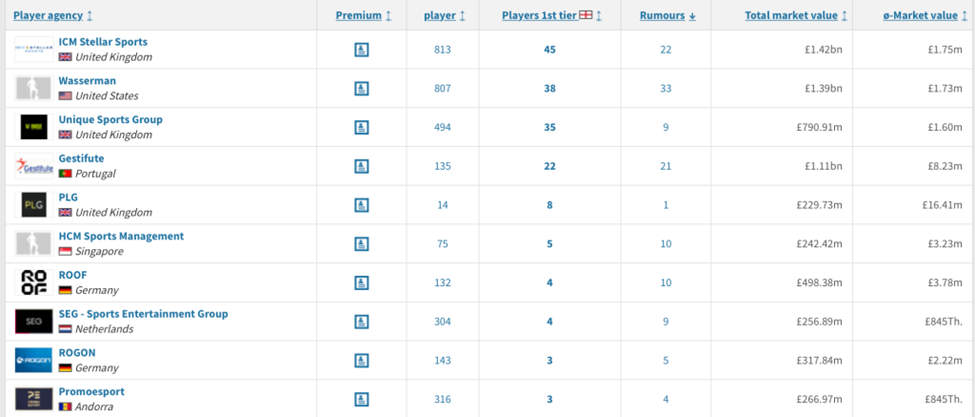
An extensive client base means an equally large number of sources of income. The companies that operate at this level are able to generate enormous revenue from their clients and have become powerful entities in the world of football and of sport in general. For example, ICM Stellar have established themselves as the most valuable agency in the world over the last few years. They have almost 800 players in their books that accumulate a market value of almost £1.5billion. They have also negotiated comfortably over €1billion worth of contracts including Jack Grealish’s £100million British-record transfer from Aston Villa to Manchester City.

Their main competitors operating at this level are the likes of CAA Base (formerly Base Soccer before merging with the Creative Artists Agency), Jorge Mendes’ Gestifute, Unique Sports Group, Wasserman and some individuals that I will discuss further later.

CAA Base have over 500 players with an average individual market value of over €1million per player and has several major clients such as Heung-min Son, Richarlison, James Maddison, Raphael Varane, Trevoh Chalobah and Kyle Walker. Base Soccer was a UK based agency which entered into a merger with the Creative Artists Agency. If you are interested further in this, you may be interested in reading our previous blog entitled “Uniting Forces, Power and Income: Why Do Football Agencies Merge?” which explains this merger in more detail. Similarly in Europe, the likes of Lian Sports, ROOF, and Rogon have developed a similar reputation and dominance across the continent and will pick up players which are not signed by the biggest players in the game.

Whilst Base Soccer began as solely a football agency, its merger with CAA reflected a growing trend in the industry. Football is the most popular sport globally and commercially and financially sits at an extraordinarily high level. Multisport agencies and even agencies in other industries such as music and entertainment are venturing into football to further broaden their power within the industry. Often these are US-based agencies who look at the ever-increasing potential of ‘soccer’ and have the facilities and financial capabilities to try out this new arm of business as a lucrative source of income.

Whilst CAA made a significant expansion decision in merging with an already established football agency, they are not alone in doing so. Large agencies such as Wasserman, whose $1billion+ clientele list includes top-level athletes in Baseball, Basketball, Golf and American Football as well as Olympians and Musicians such as Drake. Wasserman merged with SFX soccer agency as part of their bid to begin in football and took on clients such as Steven Gerrard, Michael Owen and Jamie Carragher. Since their foray into football grew, they have looked after clients such as Aymeric Laporte, Harvey Barnes, Federico Valverde and US female star, Alex Morgan.

Another US-based global giant, Octagon, are in the process of establishing themselves in soccer. Currently their biggest clients include Tajon Buchanan, Gianluca Busio and Roberto Martinez but they may just be the beginning. Similarly to CAA and to Wasserman, Octagon employ hundreds of staff and have divisions that specialise in sports from ice hockey to tennis and boast major clients such as Basketball superstar Steph Curry. Football is their next project and their soccer division is likely to grow substantially.

A summary of the top 10 most valuable football agencies is screenshotted in the graphic below from Transfermarkt:

Source: TransferMarkt

The advantages of being a global and giant agency are plentiful. As I mentioned, there are multiple sources of income to capitalise upon. This is coupled with a vast network and countless contacts in global sport, allowing these agencies to take on new possibilities and challenges and experience further growth in power, reward and dominance. Their global presence makes them the most reputable and well-respected names around and it can be seen as a privilege for players to be approached by them regarding representation. However, as we will go on to explore in the following sections, this does not mean there isn’t space for boutique agencies and even individuals to make major inroads into the industry.

Boutique Agencies

I speak from personal experience when detailing the benefits and challenges of being a part of an agency that operates in an entirely different nature to the global giants mentioned in the previous sections. My agency, Family & Football has always had a relatively narrow clientbase. Although our client base spans across Europe between countries such as Turkey, the UK, Germany and Austria, we are limited in number in both players and in agents. Despite this, we have managed to grow into a well-respected agency which prides itself in its broad network and ethical values and principles.

We are not the only ones who have spotted the potential of this structure. Many companies across football operate on this kind of level with a particular clientele that is limited in number and may be represented by just a handful of agents. The advantage of this is that the agencies are able to find their niche in the market. They conduct their business in a certain manner and in a specific area of the industry that allows them to thrive regardless of their size. Below I have provided a short list and brief summary of some examples of these kinds of agencies. Note that this is far from exhaustive and simply aims to depict the kind of company I have described in this section, there are countless agencies that fit the characteristics I mentioned:

  1. Leaderbrock: A Spanish specialist. They have a particular stronghold in La Liga and in top Spanish football talent. They prioritise ensuring they are able to successfully represent players in this market and to understand its intricate nuances and opportunities. Leaderbrock represents clients such as Pedri and Ferran Torres on the back of the reputation they have built in their unique speciality.
  2. GR Sports: Dominant force in Italy. Once again, whilst perhaps not a globally recognised name, GR sports look after over 50 players in the Italian leagues as well as Italian national team players. Their clients include Sandro Tonali and Gianluca Mancini and they are involved in numerous deals within their territory.
  3. ND Sports Management: French-African Players. As you may have realised in the previous two examples, these medium-sized companies find a particular area of the industry to specialise in. They capitalise on their own expertise and network in order to best serve a very particular clientele demographic. The previous two examples focused on a national jurisdiction. ND Sports Management, however, look after clients of a certain race. Their major client is Arsenal’s William Saliba who reflects the rest of their clientbase in his mixed-race ethnicity. All of their clients are French citizens with African backgrounds and the agency has successfully built themselves up as the go-to agent for such players.
  4. Haspel Sportconsulting (Ingo Haspel): Individual expertise. Haspel represents a notable collection of German players, best known for looking after André Schürrle. We will look at individuals more closely in the next section but he is a great example of targeting a specific niche market to grow business as an agent.

It is also a significant factor to mention that the size of these agencies does not necessarily restrict the magnitude of transfers, deals or contracts they may be involved in. Although an all-encompassing network and limitless access may not be readily available to them, they will often still be able to find a way to engage with the desired party. Often, agencies of this size will utilise the network they do already have to collaborate with others and manufacture and complete the desired deal.

Going Solo

Some of the best known individuals in football agency have built their reputations and achieved their success because of the exact nature of their business; conducted as an individual. Names such as the late Mino Raiola and Pini Zahavi, known by some as the ‘Godfather of Agency’ may be the first that spring to mind. Both of these agents have built their empires as individuals and have represented the cream of the crop.

Raiola’s clients included Erling Haaland, Matthijs de Ligt, Marco Verratti, Gianluigi Donarumma and Paul Pogba. He was involved with major international transfers and deals throughout his career and was a globally-respected agent. He was never a part of a major agency but built himself a close team with an extensive network that enabled them to experience success across the footballing world. His clients are now represented by Rafaela Pimenta who had been a longstanding part of Raiola’s team.

Zahavi is also a solo operator that has always had a clientbase limited in numbers but exclusively represents a select and exclusive calibre of player. His current clients include Robert Lewandowski, Christopher Nkunku, Pierre-Emile Hojbjerg and Aleksander Mitrovic. Zahavi and Raiola are rare examples of special characters that are able to conduct the business and services of an agent as well as personally develop a worldwide network to best serve their clients.

Another example of an agent who began alone is Jorge Mendes, the agent of Cristiano Ronaldo. Although he now has his own company, Gestifute, he is a noteworthy example in this section. Of course, he was in the fortunate position of starting out by representing a future Ballon d’Or winner, but he has utilised and developed his position to maximise his success in the industry. Rather than purely leaning on CR7’s success, Mendes has found his own niche just like some of the companies mentioned in the previous section. He is another example which shows how an individual who experiences such success can also create a company to aid their further growth in the industry. Below is a list of some further notable examples of solo agents who have established themselves across different football markets:

  1. Ingo Haspel has successfully implemented a similar operation in Germany as mentioned before.
  2. Pascal Pavel dominates the Czech Republic market with 60 top players from the region.
  3. Hernan Berman has over 40 Argentinian players.
  4. Fernando Felicevich in the Chilean market.

Lone-operating agents may also be the family or friends of players. For them, there is less of a need to be a part of a company. They will often just represent their relatives. However, they will likely have to collaborate with other agents who can give them access to a wider network and opportunities. In some cases, as with Mendes and Cristiano, the agent may use this as a platform to continue and to develop in football agency. For example, the brothers of Danny Welbeck have taken on additional clients as well as their brother and have set up their own company. Others have done the same including the brother of Sergio Ramos or the father of Lionel Messi; the father of Neymar is also his agent and it is becoming a more common pattern in modern football. The family agents often work with other agents with wider networks to manufacture and complete major deals.

Conclusion

This blog has hopefully given you an insight into the variety of structures, systems and approaches of agencies and agents in the world of football. From world-dominating multi-sport agencies to individuals who build themselves up alone, there are many ways of achieving success in the industry. The integral part of the success of these agencies is their commitment to building a network and the principles they conduct themselves by.

All Shapes and Sizes: The Structure of Football & Soccer Agencies Around the World


Introduction

According to leading football platform Transfermarkt, there are around 15,000 agents operating globally and almost 7,000 established agencies. The clientele of these agencies varies greatly based upon nationalities, value, standard and leagues. Some agencies boast extensive lists of players whilst others adopt a different approach and have a smaller, more selective portfolio.

There are advantages and disadvantages for agencies approaching the industry in their own way. This blog will look into specific examples of agencies around the world that operate differently. I will begin by assessing the world’s biggest and most well-known global agencies before looking at the more exclusive and niche agencies that keep their market narrow, specialising in specific areas of football.  Finally, I will look at the agents who have paved their way using their own name, unattached to an agency brand and the unique elements of this approach, including that of family members and friends. 

The aim of this blog is to give you as the reader an insight into the particulars and intricacies of football agents and agencies. The table below outlines some of the agencies that will be referred to throughout this blog and their particular clients:                                   

Football agency Operating Region/Markets Clients represented
Family & Football Europe and USA Mesut Özil, Kieran Gibbs, Kerem Aktürkoğlu, Eren Elmali, Amadou Dante
Gestifute Europe/Portugal Cristiano Ronaldo, Ederson, Bernardo Silva, Rúben Dias, Darwin Núñez, Diogo Jota, Fabinho
ICM Stellar Football Ltd Global Jack Grealish, Kalvin Phillips, Eduardo Camavinga, Ibrahim Konate, Ben Chilwell, Yéremy Pino
CAA Base Global Heung-min Son, Richarlison, James Maddison, Raphael Varane, Trevoh Chalobah, Kyle Walker
Wasserman Global/US Aymeric Laporte, Harvey Barnes, Federico Valverde, Curtis Jones, Nathan Ake, John Stones, Alex Morgan
Rafaela Pimenta (Formerly Mino Raiola’s clients) Global Erling Haaland, Matthijs de Ligt, Marco Verratti, Gianluigi Donarumma, Paul Pogba, Donyell Malen
Elite Project Group Global Jadon Sancho, Bukayo Saka, Roméo Lavia
Lian Sports Europe Federico Chiesa, Leroy Sané, Kalidou Koulibaly
Rogon Sportmanagement Global Roberto Firmino, Joelinton, Marcel Sabitzer, Lucas Nmecha
ROOF Europe Kai Havertz, Sadio Mane, Serge Gnabry, Marc-André ter Stegen
Unique Sports Group Europe/UK Reece James, Dayot Upamecano, Anthony Gordon, Marc Guehi, Tyrick Mitchell
Pini Zahavi Europe Robert Lewandowski, Christopher Nkunku, Yannick Carrasco, Pierre-Emile Höjbjerg, Aleksandar Mitrovic
Sports Entertainment Group Europe Cody Gakpo, Viktor, Tsygankov, Marten de Roon, Kasper Dolberg
Octagon Global Roberto Martinez, Tajon Buchanan, Gianluca Busio
HCM Sports Management Europe/Netherlands Frenkie de Jong, Denis Zakaria, Donny van de Beek, Ramy Bensebaini
PLG UK Trent Alexander-Arnold, Andrew Robertson, Jarrod Bowen
Promoesport Spain/Europe Carlos Soler, Pervis Estupiñán, Jhon Córdoba, Marc Roc
Pascal Pavel Czech Republic Patrik Schick, Tomas Soucek, Adam Hlozec
Hernan Berman Argentina Manuel Lanzini, Sebastián Driussi
Fernando Felicevich South America/Chile Alexis Sanchez, Eric Pulgar, Marcelino Núñez, Sebastián Vegas
PROSTAR Ukraine Ruslan Malinovskyi, Vitaliy Mykolenko, Mikola Matvienko
Sport Profile France Baptiste Santamaria, Niels Nkounkou


The Big Players

There are some global giants that exist within the world of agency. These companies will have players in leagues in all corners of the footballing world. Consequently, they will employ a considerably-sized range of staff and personnel. These agencies may employ their own scouts, lawyers, tax advisers, marketing specialists and consultants as well as many agents that work in certain jurisdictions and additional employees that help with social media, legal matters and other areas of the profession.

An extensive client base means an equally large number of sources of income. The companies that operate at this level are able to generate enormous revenue from their clients and have become powerful entities in the world of football and of sport in general. For example, ICM Stellar have established themselves as the most valuable agency in the world over the last few years. They have almost 800 players in their books that accumulate a market value of almost £1.5billion. They have also negotiated comfortably over €1billion worth of contracts including Jack Grealish’s £100million British-record transfer from Aston Villa to Manchester City.

Their main competitors operating at this level are the likes of CAA Base (formerly Base Soccer before merging with the Creative Artists Agency), Jorge Mendes’ Gestifute, Unique Sports Group, Wasserman and some individuals that I will discuss further later.

CAA Base have over 500 players with an average individual market value of over €1million per player and has several major clients such as Heung-min Son, Richarlison, James Maddison, Raphael Varane, Trevoh Chalobah and Kyle Walker. Base Soccer was a UK based agency which entered into a merger with the Creative Artists Agency. If you are interested further in this, you may be interested in reading our previous blog entitled “Uniting Forces, Power and Income: Why Do Football Agencies Merge?” which explains this merger in more detail. Similarly in Europe, the likes of Lian Sports, ROOF, and Rogon have developed a similar reputation and dominance across the continent and will pick up players which are not signed by the biggest players in the game.

Whilst Base Soccer began as solely a football agency, its merger with CAA reflected a growing trend in the industry. Football is the most popular sport globally and commercially and financially sits at an extraordinarily high level. Multisport agencies and even agencies in other industries such as music and entertainment are venturing into football to further broaden their power within the industry. Often these are US-based agencies who look at the ever-increasing potential of ‘soccer’ and have the facilities and financial capabilities to try out this new arm of business as a lucrative source of income.

Whilst CAA made a significant expansion decision in merging with an already established football agency, they are not alone in doing so. Large agencies such as Wasserman, whose $1billion+ clientele list includes top-level athletes in Baseball, Basketball, Golf and American Football as well as Olympians and Musicians such as Drake. Wasserman merged with SFX soccer agency as part of their bid to begin in football and took on clients such as Steven Gerrard, Michael Owen and Jamie Carragher. Since their foray into football grew, they have looked after clients such as Aymeric Laporte, Harvey Barnes, Federico Valverde and US female star, Alex Morgan.

Another US-based global giant, Octagon, are in the process of establishing themselves in soccer. Currently their biggest clients include Tajon Buchanan, Gianluca Busio and Roberto Martinez but they may just be the beginning. Similarly to CAA and to Wasserman, Octagon employ hundreds of staff and have divisions that specialise in sports from ice hockey to tennis and boast major clients such as Basketball superstar Steph Curry. Football is their next project and their soccer division is likely to grow substantially.

A summary of the top 10 most valuable football agencies is screenshotted in the graphic below from Transfermarkt:

Source: TransferMarkt

The advantages of being a global and giant agency are plentiful. As I mentioned, there are multiple sources of income to capitalise upon. This is coupled with a vast network and countless contacts in global sport, allowing these agencies to take on new possibilities and challenges and experience further growth in power, reward and dominance. Their global presence makes them the most reputable and well-respected names around and it can be seen as a privilege for players to be approached by them regarding representation. However, as we will go on to explore in the following sections, this does not mean there isn’t space for boutique agencies and even individuals to make major inroads into the industry.

Boutique Agencies

I speak from personal experience when detailing the benefits and challenges of being a part of an agency that operates in an entirely different nature to the global giants mentioned in the previous sections. My agency, Family & Football has always had a relatively narrow clientbase. Although our client base spans across Europe between countries such as Turkey, the UK, Germany and Austria, we are limited in number in both players and in agents. Despite this, we have managed to grow into a well-respected agency which prides itself in its broad network and ethical values and principles.

We are not the only ones who have spotted the potential of this structure. Many companies across football operate on this kind of level with a particular clientele that is limited in number and may be represented by just a handful of agents. The advantage of this is that the agencies are able to find their niche in the market. They conduct their business in a certain manner and in a specific area of the industry that allows them to thrive regardless of their size. Below I have provided a short list and brief summary of some examples of these kinds of agencies. Note that this is far from exhaustive and simply aims to depict the kind of company I have described in this section, there are countless agencies that fit the characteristics I mentioned:

  1. Leaderbrock: A Spanish specialist. They have a particular stronghold in La Liga and in top Spanish football talent. They prioritise ensuring they are able to successfully represent players in this market and to understand its intricate nuances and opportunities. Leaderbrock represents clients such as Pedri and Ferran Torres on the back of the reputation they have built in their unique speciality.
  2. GR Sports: Dominant force in Italy. Once again, whilst perhaps not a globally recognised name, GR sports look after over 50 players in the Italian leagues as well as Italian national team players. Their clients include Sandro Tonali and Gianluca Mancini and they are involved in numerous deals within their territory.
  3. ND Sports Management: French-African Players. As you may have realised in the previous two examples, these medium-sized companies find a particular area of the industry to specialise in. They capitalise on their own expertise and network in order to best serve a very particular clientele demographic. The previous two examples focused on a national jurisdiction. ND Sports Management, however, look after clients of a certain race. Their major client is Arsenal’s William Saliba who reflects the rest of their clientbase in his mixed-race ethnicity. All of their clients are French citizens with African backgrounds and the agency has successfully built themselves up as the go-to agent for such players.
  4. Haspel Sportconsulting (Ingo Haspel): Individual expertise. Haspel represents a notable collection of German players, best known for looking after André Schürrle. We will look at individuals more closely in the next section but he is a great example of targeting a specific niche market to grow business as an agent.

It is also a significant factor to mention that the size of these agencies does not necessarily restrict the magnitude of transfers, deals or contracts they may be involved in. Although an all-encompassing network and limitless access may not be readily available to them, they will often still be able to find a way to engage with the desired party. Often, agencies of this size will utilise the network they do already have to collaborate with others and manufacture and complete the desired deal.

Going Solo

Some of the best known individuals in football agency have built their reputations and achieved their success because of the exact nature of their business; conducted as an individual. Names such as the late Mino Raiola and Pini Zahavi, known by some as the ‘Godfather of Agency’ may be the first that spring to mind. Both of these agents have built their empires as individuals and have represented the cream of the crop.

Raiola’s clients included Erling Haaland, Matthijs de Ligt, Marco Verratti, Gianluigi Donarumma and Paul Pogba. He was involved with major international transfers and deals throughout his career and was a globally-respected agent. He was never a part of a major agency but built himself a close team with an extensive network that enabled them to experience success across the footballing world. His clients are now represented by Rafaela Pimenta who had been a longstanding part of Raiola’s team.

Zahavi is also a solo operator that has always had a clientbase limited in numbers but exclusively represents a select and exclusive calibre of player. His current clients include Robert Lewandowski, Christopher Nkunku, Pierre-Emile Hojbjerg and Aleksander Mitrovic. Zahavi and Raiola are rare examples of special characters that are able to conduct the business and services of an agent as well as personally develop a worldwide network to best serve their clients.

Another example of an agent who began alone is Jorge Mendes, the agent of Cristiano Ronaldo. Although he now has his own company, Gestifute, he is a noteworthy example in this section. Of course, he was in the fortunate position of starting out by representing a future Ballon d’Or winner, but he has utilised and developed his position to maximise his success in the industry. Rather than purely leaning on CR7’s success, Mendes has found his own niche just like some of the companies mentioned in the previous section. He is another example which shows how an individual who experiences such success can also create a company to aid their further growth in the industry. Below is a list of some further notable examples of solo agents who have established themselves across different football markets:

  1. Ingo Haspel has successfully implemented a similar operation in Germany as mentioned before.
  2. Pascal Pavel dominates the Czech Republic market with 60 top players from the region.
  3. Hernan Berman has over 40 Argentinian players.
  4. Fernando Felicevich in the Chilean market.

Lone-operating agents may also be the family or friends of players. For them, there is less of a need to be a part of a company. They will often just represent their relatives. However, they will likely have to collaborate with other agents who can give them access to a wider network and opportunities. In some cases, as with Mendes and Cristiano, the agent may use this as a platform to continue and to develop in football agency. For example, the brothers of Danny Welbeck have taken on additional clients as well as their brother and have set up their own company. Others have done the same including the brother of Sergio Ramos or the father of Lionel Messi; the father of Neymar is also his agent and it is becoming a more common pattern in modern football. The family agents often work with other agents with wider networks to manufacture and complete major deals.

Conclusion

This blog has hopefully given you an insight into the variety of structures, systems and approaches of agencies and agents in the world of football. From world-dominating multi-sport agencies to individuals who build themselves up alone, there are many ways of achieving success in the industry. The integral part of the success of these agencies is their commitment to building a network and the principles they conduct themselves by.

The Chaotic Economy of the UK and its Broad Impact Upon Football/Soccer


Introduction

For anyone with a vested or general interest in the political and economic situation of the UK, you will be aware of the current turbulence in the country amongst the government and the weakening of the Pound Sterling (£) currency. A cost-of-living crisis has been declared due to the significant increase in basic living costs. Many families and a majority of the population will struggle to afford sufficient heating and other necessities during the upcoming winter months.

The conflict in Ukraine has had a widespread impact on Western European countries and beyond. For the UK, it has meant that fuel and other products that are sources from the conflicted region have become more expensive. Consequently the living costs have risen. Furthermore, instability within the government has led to several inconsistent and detrimental measures being taken by various authorities to try and combat and mitigate against the challenges. This includes the raising of interest rates to stem inflation, changes to the taxation structure and other government intervention.

In this blog, I will focus on a specific impact of the financial situation in the UK; that on football. Football is the region’s most popular sport and is a staple feature during the Christmas period. However, fans and EFL clubs alike are impacted by the economic crisis. Players themselves are also affected by changes in the structure of taxes and otherwise. I will endeavour to explain these consequences within the blog.

The Proposed Changes to Income Tax

In September of 2022, Kwasi Kwarteng, who held the position of Chancellor of the Exchequer for a grand total of 38 days, proposed changes to taxation schemes and tax cuts to attempt to counteract the effect of rising living costs and the disposable income of the general population.

The suggestion of lowering basic income tax to 19% from 20% will not affect football players at the highest level and Premier League footballers are always in the highest-threshold tax bracket of 45%. However, such a change may assist the heart of the game of football; the fans. In the current economic climate, people are forced to give up certain luxuries that are not considered necessities. Unfortunately for some, this may mean less room for buying tickets and attending football games and even giving up season tickets. This will have a knock-on effect to less financially stable clubs within the EFL who rely on gate income from fans. Lowering the basic tax rate may help these fans continue to attend and support their local and adored clubs.  

Another significant change that was proposed in the mini-budget was the abolition of the 45%  income tax rate. This would reduce the effective tax rate for Premier League players to  40%. As mentioned previously, with an annual income of well over £150,000, the top players are in the top income tax-bracket of 45%. After the  changes were announced on September 23rd that the proposal to abolish the 45% tax rate  was scrapped on October 3. The decision was swiftly reversed due to widespread criticism that this reduction in the top bracket of income tax served only to protect the wealthy. Consequently, the value of the pound plummeted, particularly against the US dollar, and the Bank of England again threatened to hike interest rates.  Below I explain the impact that the 45% tax rate cut would have had on English football were it to be set at 40%:

  1. Players, who average wages in excess of £3million in the Premier League, would have  seen significant net (after-tax) wage increases
  2. This would have been great for player  recruitment and could have led to even more talent being drawn to the UK.
  3. On average, every starting XI Premier League player would have received a net pay rise of £2,700 a week, totalling £144,000 annually. This is based on their average salaries.
  4. In an extreme example, Cristiano Ronaldo with a reported salary in excess of £26million would have received a  £1.3 million raise.
  5. This net wage increase alone would have been more than 3.5 times the average UK wage before tax.
  6. These numbers only consider first-team players and ignore academy and staff salaries.

For the UK treasury, the Premier League tax cuts alone would have cost more than £72m.  To some extent, this may illustrate why the decision was reversed as the government wishes to protect their tax income. Furthermore, football players  already have a reputation in some circles for being “overpaid”. This change in taxation would only fuel the fire and create a further economic inequality between the general public and these athletes.

Corporation Tax & National Insurance

In addition to the proposed income tax changes, the government and His Majesty’s Revenue and Customs (HMRC) announced additional changes to other taxable assets and income, such as repealing the proposed corporate income tax hike. In other words, the Government is hoping to raise corporation tax in order to increase their revenue sourced from the profits of corporations.

Presently, this would only have a limited impact on football clubs as they have traditionally made taxable losses. However, with profitability for clubs in English football increasingly sought after, clubs could become corporate taxpayers in the future. Increasing players wages, stadium maintenance costs and other expenditures may result  in clubs deferring their taxpayer status for a while. Energy bills are a significant consideration for clubs that are not financially powerful. Some EFL clubs have trialled and advocated for earlier kick-offs to avoid the cost of floodlighting that is required during the winter when darkness sets in earlier. This is just one example of measures being taken by clubs to try and be financially sustainable against the economic crisis and avoid bankruptcy, administration and worst case scenario, liquidation. EFL clubs will inevitably feel the impact of the financial crisis greater than Premier League clubs due to their financial foundations being far inferior to these bigger clubs already, as demonstrated in the graph below which shows the average revenue across a single season for clubs according to their division:

Source: Deloitte

There may be one welcome change from the club’s perspective.  The government has proposed removing the 1.25% social security cost increase. If it remains approved, this will come into force on November 6th. Providing clubs with relief of £1m a year, particularly in the lower tiers of English football, will provide an economic boost to the clubs. This is based on the average payroll. Clubs with bigger payrolls like Manchester United and Manchester City, despite no realistic financial fears, are expected to benefit from savings of around £4million from the change. The reduction in national insurance benefits all employers (clubs) and employees (players  and non-playing staff) to some extent. However, the benefit to top-level players will not be as significant as getting  rid of the previously proposed 40% income tax rate!

The State of the Economy 

As outlined, the UK economy is currently in a fragile state, experiencing inflation and the pound is  weak. Foreign players are interested in the value of the pound, the currency in which they are likely to be paid with. A weak pound means a devaluation in a currency that a foreign player might have previously preferred and sought after an opportunity at a UK club. This could cause recruitment problems or drive up the cost of  player salaries in the UK going forward in order to continue to attract players. If the current economic situation were to continue this could materialise quite dramatically in the future and UK clubs will struggle to compete in European competitions as they are unable to recruit foreign talents as easily as currently.

The graphs below show the exchange rates between the Pound and the Euro and the Pound and the Dollar respectively over the last 40 years. Note the general pattern of decreasing value for the Pound Sterling (GBP):

Pound to Euro Exchange Rate.
Source: Google Finance


Pound to Dollar Exchange Rate.
Source: Google Finance

This would have another knock on consequence as the weakening pound will lead to an increase in the value of prize money in other currencies. For example, Premier League clubs may struggle to compete in the UEFA Champions League which is a major source of income for the top clubs. The money is also paid in Euros so it becomes even more valuable to these clubs to reach the latter stages of the competition as the Pound Sterling declines. This will also have a notable impact upon Financial Fair Play statements and clubs will have to be careful when navigating around the value of losses when converted into Euros.

US investors already have significant holdings in the Premier League, including  Manchester United (Glazers), City Football Group (Silver Lake), Arsenal (Kroenke) and  Chelsea (Todd Boehly/Clearlake Capital) to name a few.. With a weakening  pound, we may see more US investment in the Premier League. Everton FC is the latest  club to attract interest from US investors. It makes sense that as the Dollar grows stronger, investors with the financial capacity will look to purchase shares and invest in clubs in the Premier League for less of an expense.

Summary  

This blog has demonstrated that football is not immune from the fragile and erratic financial situation in a country. All through the footballing pyramid from owners, to clubs, to players, to fans at the very core of the game will be affected in some way by financial changes and measures taken to mitigate against a cost-of-living crisis. For some this may be positive benefits although on the whole, if the rest of the country is suffering, so will football. It is an ongoing situation that may play out over several years before the full extent of its effect upon UK football is understood in its entirety.

A Modern Investment: Footballers and the Rising Appeal of Non-Fungible Tokens and Cryptocurrency


Introduction

          The chances are you may have heard or seen the acronym ‘NFT’ in some capacity and almost certainly it has been impossible to avoid the term ‘Cryptocurrency’. For many, these can be daunting and futuristic sectors whilst for others, they have created a new obsession and fascination and have become a part of their lives. One area that these concepts have integrated into is the World of Football and soccer.

          The theme is mirrored within football too; some players have so far avoided becoming involved in such an area as they view it as a riskful, unknown entity. For others, especially those in the fortunate position of financial comfort, these sectors present an exciting modern opportunity away from the football pitch.

          In this blog, I will endeavour to help you as the reader to comprehend not just what NFTs and Cryptocurrency are but also, more specifically, I will explain their applicability to and place within football. I will include a case study of how a footballer can benefit from these areas as well as considering the risks involved, as is the case to some extent with any investment.

What are NFTs?

          To simplify the idea, imagine buying a piece of art. However, this art happens to only be available digitally. On a purpose-built network you are able to purchase and sell the ‘data’ that makes up this piece of art. There is only one very specific data coding that creates this officially authenticated version of the art. Therefore, you will be the sole owner of this piece of art and any copies that are made of it will not be the ‘official’ version. This can be an investment as this piece of digital art may rise in value and can be sold on for profit to interested buyers. Another way to think about this concept is to imagine they are similar to football trading cards that you may have collected before, with the caveat that only one person can have each card in the world and that the card is digital.

          The graph below demonstrates the rise of NFTs since the beginning of 2021 to give you an idea of why it has suddenly become such a major discussion point:

Source: Dune

What About Cryptocurrency?

          Cryptocurrency is a slightly older concept than NFTs. You have most likely heard people, news platforms or social media discussing the likes of Bitcoin, the infamous Dogecoin, and Ethereum, amongst others, since the beginning of the last decade. Crypto, as it is often referred to, comes under many titles or ‘coins’ as digital currency which can be bought and sold. Just like any currency around the world, the different crypto ‘coins’ can rise and fall in value. The medium of exchange for cryptocurrency is only through a digital network where all transactions pass through rather than via a bank or other institution.

NFTs and Crypto in Football

          I have decided to cover both of these concepts within this single blog as they are both interlinked. Often, NFTs are purchased using Cryptocurrency such as Ethereum. Footballers, particularly those at the top, are in a position financially and socially to get ahead in these markets. These sectors present a new and exciting opportunity for investing their money into.

For NFTs, players can leverage their public following and fanbase to increase the value of their digital art and produce a successful investment, made financially possible from their high salaries at the top level. NFTs can certainly be a significant financial opportunity as some can be worth enormous amounts. Players may pay hundreds-of-thousands of pounds, dollars or euros to secure a piece of digital art, in the hope that it will rise in value.

          The most common area of NTFs that players engage with is known as ‘Bored Ape Yacht Club’ and you may have seen this in the form of well-known players changing their social media icons to a cartoon ape. These include current and retired footballers such as Bobby Zamora, Tammy Abrahm, Reece James, Ashley Cole, Trent Alexander-Arnold and John Terry. The BAYC, as it is abbreviated to, uses Ethereum and charges a minimum of £163,000 for one of its specific ‘bored ape’ icons.

          The record sale for a football player is Mesut Ozil who sold a single piece for £75,000. Elsewhere, an Mbappe GIF is believed to have sold for £47,000. Paul Pogba has purchased ‘NFT eggs’ and has partnered with the Cryptodragons Project as an official ambassador. This is a rising theme in football as the likes of Antoine Griezmann, Gerard Pique and Rio Ferdinand have also invested into various platforms that deal with NFTs or Cryptocurrency. It presents another off-field opportunity during and post-career to partner and collaborate with a modern and unique commercial endorsement.         

          It isn’t just players either; clubs are also engaging with these sectors. Seventeen Premier League clubs currently have commercial deals with a Cryptocurrency company and so do Paris Saint Germain and UEFA – a true sign that this digital phenomenon is firmly embedded into football. Even clubs like Southampton and Championship team Watford, sport Cryptocurrency platforms as their front-of-shirt sponsor. Another argument in favour of these concepts is that they are a new space to engage with fans around the world through a new and exciting medium.

          The table below shows just how valuable some of these deals can be for football associations and clubs in 2022:

Source: Mondaq

Case Study: Mesut Özil

          My client, Mesut Özil, has been a successful pioneer in these sectors for football. As well as holding the record sale for a player, he was also the very first individual across any sport to create NFT ‘genies’, an idea that was only otherwise previously emulated by Justin Bieber and Cardi B. These avatars were similar to the concept of ‘bitmojis’ and had its own digital custom clothing range. This generated enormous interest and goes to show the influence and impact that top-level football players collaborating with digital platforms such as NFTs and Cryptocurrency can have globally. The range sold out in 6.7 minutes and generated over $500,000, demonstrating Özil’s global reach and fanbase. To acknowledge this extraordinary achievement he wore the number 67 after his move to Fenerbahce.

          Özil also formulated the idea of selling 1% of his ownership stake in Mexican football club, Club Necaxa, to the public and the fans through digital NFTs. An exciting opportunity for fan engagement which was unfortunately blocked by the Mexican Football Federation although it is possible that this may be an indication as to the direction in which football is going alongside NFTs and Cryptocurrency.

The Risks Involved

          This section differs little from any that may be written about investments of any kind. Particularly in Cryptocurrency and NFTs, the market is highly volatile. These are modern concepts that are still unknown entities to an extent. Furthermore, the regulations and laws governing the markets are not fully formed nor comprehensive. This means that there are many aspects of these sectors that create risks for those investing within it. Players may be in the fortunate position of financial stability and can afford to take such a risk but they must be aware of this before investing.

          Another risk that players and their agents ought to be aware of is rogue coin-creators who pitch an idea to a player and try to take advantage of their popularity in the public eye. These creators will make some quick money from the players building hype as ambassadors before exiting with their own profit, leaving the player behind. This is sometimes referred to as the “pump and dump” concept, using false and misleading information and using a players face to inflate the value of their coin and creating what is known as a ‘buying frenzy’ before selling their own shares. The most infamous sports example of this involved Floyd Mayweather allegedly being a part of a pump and dump scheme with the EthereumMax coin. These scams must be avoided if possible and due diligence and research is imperative in order to mitigate against the risk of entering such deals.  

          There is a similar risk with smaller clubs who relied upon cryptocurrency and coins as an important stream of income, particularly over the last couple of years and during COVID. Many cryptocurrency companies failed to compensate these clubs as they were obliged to and no money was received. This caused a significant and unexpected void in the predicted sponsorship finances for these clubs. As this industry is unregulated it does mean that instances such as this are a risk for those in sport and in football that engage with this sector.

          The Cryptocurrency market alone has experienced a 500% growth during the years of COVID-19 and this is likely to continue to rise. Whilst this presents a significant financial opportunity and the possibility of dramatic investment returns, it also raises the level of risk of the loss of money. After all, this is a modern form of speculative trading and profit is never guaranteed. The graph below shows the extraordinary rise and also the possibility of loss of cryptocurrency since 2015:

Source: CoinGecko

Summary

          In this modern era of football, Cryptocurrency and NFTs are certainly something one should be aware of, and not just in the football sector. They may be slightly alien concepts still but their continuing rise in society is unavoidable and hopefully this blog provides some understanding as to their place within football. Players and clubs will engage more and more with these sectors and the extent to which they will become an integral part of the world of football is still unpredictable. Watch this space!

Not Just a Boot Deal: The Commercial, Financial Importance and Future of Boot Deals for Football


Introduction

This may well be the third episode in this series but this must not be understood to mean that boot deals fall lower down on the priority list for agents to manufacture and for the commercial opportunities for a player. In reality, boot deals are arguably the most important sponsorship contract that a player will sign and that an agent will negotiate. It is also the most common. As I will go on to explain, usually all high-level professionals, even some semi-pro footballers, will have some kind of boot deal or arrangement during their playing career.

This may well be the third episode in this series but this must not be understood to mean that boot deals fall lower down on the priority list for agents to manufacture and for the commercial opportunities for a player. In reality, boot deals are arguably the most important sponsorship contract that a player will sign and that an agent will negotiate. It is also the most common. As I will go on to explain, usually all high-level professionals, even some semi-pro footballers, will have some kind of boot deal or arrangement during their playing career.

In this blog I will analyse boot deals and their true significance. I will aim to assess different clauses that can become a part of more complicated boot deals depending on the player that is being sponsored and the lucrative remuneration that can arise alongside it. These are of particular importance to agents to understand and ensure they achieve the best deal for their client. The blog will also outline some of the further extensions of boot deals that can become a part of a treasured boot deal for the top players.

What is a Boot Deal?

The term is fairly self-explanatory. Put simply, it refers to a deal that is made between a player and a boot manufacturer in order to supply the player with boots. This also often includes shinpads and, in the case of goalkeepers, gloves. Of course, as with almost all contracts in football, it can become far more complicated than this.

First and foremost, it is important to understand that boot deals span far across the world of football. The majority of players at a professional level will have a boot deal unless they have deliberately chosen not to, all will at least have been offered or approached for one. Even several semi-professional footballers will have a boot deal of some kind. This may be what is known as a ‘boot supply deal’ where, for example, one or two pairs of boots are provided per season free of charge but with no additional monetary fee paid to the player.

In top level football, however, these deals can be enormously lucrative as well as providing a new pair of boots every few weeks if the player so desires. Furthermore, and arguably more importantly, for a player it is vital that their agent finds a deal with a boot manufacturer that they are comfortable with wearing and can perform to the best of their ability in. This can also include ensuring their boots are customised to perfectly suit their performance. For example, James Milner had special support plates fitted into his boots to soften impact. Other examples include customised stud structures and specially personalised laces. These are all nuanced aspects of boot deals that can be negotiated and implemented.

The deals can be made via negotiation from the boot manufacturer with the player’s agent. However, more common is for a player’s agent to delegate this responsibility to a commercial team or lawyers that specialise in commercial contracts. The contracts themselves are complicated and can include an array of clauses such as performance-based add-ons on top of a fixed ‘base’ sponsorship compensation. This may include terms such as bonuses for televised appearances for the player’s club or country; the percentage of minutes they play per game; the category of the club for which they play for and whether or not they are competing in international and continental competitions such as the UEFA Champions League.

One point to note for boot deals is the concept of exclusivity which we analysed in last week’s blog. Some of the biggest boot-manufacturing brands will also have their own wider range of sports apparel, accessories and other equipment. This can create issues when boot deals cause unintended limitations to other commercial opportunities that a player might have. Namely companies such as Nike, Adidas, Puma, Underarmour and New Balance will include exclusivity clauses within boot deals that binds the player to a full ambassadorial role to promote not just the boots, shinpads and playing kit but also leisurewear and accessories from headphones to watches to backpacks (see last week’s blog). Agents must note this when they are negotiating these deals to ensure that, if the player does have broader obligations of exclusivity to the brand that is providing them with a boot deal, then they must be appropriately and sufficiently remunerated.

Exclusivity is an important factor in boot deals. Often there are disputes that result in percentage losses for players if, for example, they are playing for an Adidas sponsored club whilst in a boot deal with Nike. This gives them less financial leverage when negotiating a boot deal. However, for a player like Harry Kane who plays for club and country sponsored by Nike as well as having a Nike deal himself. This puts him in a great position to negotiate a higher compensation fee for his boot deal.

Some players avoid this problem and will oppose boot deals by choosing to be free from being contractually tied down to a singular boot-manufacturer. They would prefer to have the freedom of choice to wear whichever boots they like the most or may even design their own boot brand. Usually, the temptation of the financial reward of a boot deal is too strong but it has been known for players to prefer to opt out of a boot deal. The most well-known examples of this are Dani Alves and Mesut Ozil; the latter went on to create their own distinctive boot collaboration with Concave.

In this section we can see that boot deals can be separated into three ‘categories’ which I will summarise below:

  1. A supply contract:
    A common form of boot deal for youth or lower league semi-professionals. If we consider that a youth player or their parents must source around £250 per pair of top quality boots, this is a significant expense each year. Brands or the agents themselves will usually assist with this by providing supply contracts to distribute boots to upcoming players. This could be a good opportunity for agents to show the player what they can provide and to build a relationship. The brand may also be willing to include other bits of sports apparel such as tracksuits.

  2. Boots + Budget:
    The next step up also does not include a sponsorship fee for the player. Instead, players will be given complimentary boots as per a supply contract, as well as a non-cash budget for the brand. For exciting young players this may be between £5,000 and £10,000 to spend on the wider range that the brand sells from trainers to caps and other apparel. This type of contract may occur for a player who has signed their first professional contract or is playing in the middle divisions of national football.

  3. Full Sponsorship Boot Deal:
    For the top players, this kind of deal involves a cash fee as remuneration on top of free boots and a higher budget to spend with the manufacturer. The value of this sponsorship deal depends on the categorisation of the club for which the player plays which are ranked as a, b, c, and d. The categorisation varies according to the exposure the club receives. For example, when Mesut Ozil was at Real Madrid, they were competing in one of Europe’s top leagues, on television every week and competing in the Champions League. They were an obvious category A club. This was the same when he moved to Arsenal although since Arsenal are now no longer in the Champions League they have become a category B club. This can ultimately affect the transfer of players between clubs as it could cause a large financial loss to the player. For example, a category A club player may have a contract for £2million annually from their boot deal but if they move to a category B club, as per the terms stated in their contract, this may be halved or even quartered! Agents should be aware of this when considering whether a transfer is the right option for their client.

The graphic below shows the distribution of boots and hence, boot deals, across the English Premier League:

A Financial Boost

As mentioned in the previous section, boot deals can be lucrative, particularly so for the top players with the greatest public presence and commercial acumen. These top-end boot deals incorporate the image rights agreements that we discussed last week and will include clauses for players that bind them to appearing in photoshoots, doing personal public appearances, posting on social media and other brand activations. Brands are willing to invest significant sums into these contracts to have the biggest names in football donning their boots in globally televised football games. The biggest boot deals (per annum) are shown in the graphic below and I have provided a summary of the notable top-four beneath:

  • The £23million-a-year that Puma agreed to pay to Neymar to convince him away from Nike is the world record for a boot deal. It was, and still is, an eleven-year contract which has provided Neymar with long-term financial comfort. Part of this deal was Neymar’s own boot line named the Future Z range, a personalised collaboration that some of the world’s biggest players will have the opportunity of engaging with. Neymar publicly spoke about how Puma had appealed to him due to the legacy of players such as Johan Cruyff and Diego Maradona as well as Brazilian compatriots, Pele and Eusebio; who were all major ambassadors of the Puma brand.

  • Lionel Messi is second with an £18million annual deal with Adidas and was the first footballer to collaborate with their boot sponsor to form a sub-brand, namely Adidas Messi. It is the same form of collaboration as the now worldwide iconic Air Jordan brand and may reap the same rewards once Messi has retired. The Argentinian seven-time Ballon d’Or winner was also the first footballer to sign a lifetime contract as part of their boot deal.

  • It may surprise some that Cristiano Ronaldo, AKA CR7, is third on the list with a £15million fee per annum with Nike. However, his lifetime deal is valued at an enormous £780million and he was Nike’s third athlete to sign such a deal following the decent company of Lebron James and Michael Jordan.

  • Finally, Kylian Mbappe has signed a £140million deal with Nike over ten years. As a young player with years ahead of him, most likely spent at the very top of football, he is positioned to be the face of Nike, particularly once CR7 has retired.

As we can see from the above examples, boot deals of this magnitude are often long-term deals as this provides great financial security to the players and attracts the biggest names to these brands. It would be an impossible risk and unfeasible investment for any smaller brand but the biggest world-renowned brands that can afford to commit such a large sum of money commit themselves to these players to help keep themselves at the top of the industry.

In these cases, there are also often collaborations between the player and the manufacturer that will release a range that is directly affiliated with and usually named after their top endorsed athletes. As well as their usual release of new boots every year or so, these collaborations will be uniquely designed and promoted and royalties will be paid directly to the player as part of their deal.

The Future of Boot Deals

I believe and predict that the future of boot deals is altered from the modern situation we currently see. It makes sense to me that more and more players will move away from the contractual obligations that arise with boot deals. In the modern era, footballers have become celebrities and influencers and can develop their personal brands through social media and otherwise. The ability of players to grow, develop and promote their own personal brand is significantly restricted by signing a boot deal with a single brand.

Players like Alves and Ozil may slowly become more of the norm by removing boot deal contracts and giving themselves more freedom. The biggest names will instead create their own brand and enter into agreements with manufacturers. For example, Mesut Ozil’s M10 brand now has a contract with manufacturer, Concave, in order to design and sell his own range of boots. A consequence of this may be that brands offer larger sums for boot deals to convince players to stay but in the age of personal brands, it will most likely make more social and financial sense for the biggest players to go their own way through their personal brands. Rather than being contractually obliged to always wear a single brand in all of their apparel and accessories, they will be able to express themselves and their personal brand freely.

Do you recognise any of these player brands below?

Summary

Boot deals are the most common form of off-pitch opportunity for players. They are a form of commercial deal that almost all professional football players will have during their career. It is vital for agents to have an in-depth comprehension of different clauses, important points to note, potential hiccups and unique extensions that arise with boot deals. If managed correctly, they can be a significant source of income for the player and should be regarded with great value and importance. However, the future of boot deals may look slightly different and instead manufacturers may strike agreements with personal brands of the biggest players in order to release a personal range without forcing them to engage with other contractual clauses which restrict them.

It is also important to note that whilst boots are an important aspect of a sports manufacturer’s business, they are not their biggest income generator. Companies such as Nike, Adidas, Puma, Underarmour and New Balance make the most financial reward from selling trainers which are worn by everyone around the world, including non-football fans. However, boot deals are struck to use footballers as promotional celebrities in order to push out the brand and simultaneously generate further sales of trainers and their other apparel.