
Home Blog Page 83

Keeping the Money in the Family

The Growing Popularity of Using Family Members as Agents

Unless you’ve been living under a rock in the last week, you’ll have heard that Lionel Messi is no longer a Barcelona player and has made the move to Paris Saint-Germain after 21 years at the Catalan club. The interesting part of this transfer that I will discuss in this week’s blog is Messi’s agent, Jorge Messi, is his father.

Employing family members as agents was first brought into the public spotlight in 1999 with Nicolas Anelka’s move from Arsenal to Real Madrid which was orchestrated by his brothers. In recent times, it is become increasingly common with players such as the now PSG trio Neymar, Mbappe and Messi all represented by their fathers.

In this blog I will discuss why using family members may be an attractive option for players but also the issues that may arise from doing so. I will then consider how family members should be treated compared to regular agents and how they might be regulated in order to ensure ethical and legal compliance.

Why Would a Player Prefer to Use a Family Member as Their Agent?

Football agents, whether applicable to each individual or not, carry the burden of a bad reputation that is associated with their profession. Players are cautious that the agent may not always act in their best interests but instead will be motivated by filling their own pockets.

The relationship and level of trust that a player places in an agent may never come close to what they have with their family members. A familial connection will mean that a player can be more confident that their agent wants the best for them. Particularly in young players who are wary of agents approaching them, using a family member is a more attractive option as the close, trusting relationship is already there, rather than having to develop a bond with an agent whose intentions may not be known or pure.

The obvious appeal of employing a family member as an agent is that any commission they receive for their services is kept within the family. For example, it is estimated that Neymar Sr has received £100million for Jr’s transfers whilst Jorge Messi has earned approximately £75million in contract commissions for his services. The success of sons and brothers also financially benefitting the rest of the family is a more attractive option than having to remunerate a stranger with a football agent license that may not have the player’s best interests at heart.

In a perfect world, the love and trust between a father and son or brothers would mean that each party is acting in a way that benefits each other as much as possible. Unfortunately, this is not always the case. There is a risk in mixing familial relationships with professional business. The combination may lead to big fall outs. Even family members can develop a hunger for money or power-grabbing from representing their relatives.

Can Family Members be Regulated as Agents

An additional risk that arises from using a family member as an agent is that they may not be qualified enough. Before the removal of an exam in FIFA’s regulations in 2015, family members were exempt from taking it. This made it easier for them to be registered as the representative of their son or brother.

In the case of Juan Mata, his father was a former player and obtained his agent license once he had retired. He now has a client list including players such as his son and Salomon Rondon. There are many other cases in which close relatives of the players are representing them. For example Eden Hazard’s agent is his father, the agent of Sergio Ramos is his brother René Ramos, agent of Mats Hummels is his father Hermann Hummels. We also have Mauro Icardi from PSG who’s agent is his wife Wanda Icardi or Dane Rashford as the brother and agent of Marcus Rashford. So are the brother of Liverpool defender Trent Alexander-Arnold and the father of Chelsea’s Christian Pulisic.

FIFA’s proposed changes to regulations coming into force next year will see family members treated in the same way as all other agents. The regulations contain a clause that prohibits family members from acting as agents unless they are fully licensed. Importantly, this includes the requirement of passing the agency exam. This is a step in the right direction as it will ensure that family members receive a level of education and qualification before they are able to represent their relatives. I expect that FIFA will emphasise that players should only use agents that have a proven level of aptitude in the industry and are qualified enough to serve them well.

Furthermore, a cap on commissions could minimize the ability of relatives to collect disproportionate fees for their services, reducing the risk that they will act on their own greedy interests rather than to seek what is best for the family member they are serving.

Transparency, once again, is vital. If a family member is representing a player, all transactions, commission fees and gifts should be recorded and accessible by FIFA. This will overcome the worry of many that an unnecessary amount of money leaves the game and cannot be accounted for through payments to agents.

Summary

Using family members as agents is becoming increasingly popular and will remain an attractive option for players. They may have a level of trust that can only be had with a family member and not the kind of relationship they could develop with a separate agent.

However, the risk of mixing family and business may not always lead to a beneficial outcome for both parties. Issues arise from greed and power and the lack of qualification that the family member representative may have. It is important that a system is in place that maintains the legal and ethical appropriateness of family members representing players.

FIFA’s proposals for agent regulations are certainly going to improve the dynamic and standard of family members acting as agents. By ensuring that they are sufficiently educated and qualified whilst also preventing them from receiving an unfair and extortionate level of remuneration, the standard of agents will rise and it will go some way in preventing the concerns that prevail from using brothers, fathers or wives as agents.


The Gatekeepers – “No deal without me”

THE CURRENT SITUATION

As I have mentioned in previous blogs, the current situation allows agents to act on behalf of the player, signing club or releasing club or all three parties in a single deal. However, some agents specialise in acting for a single party. The majority of agents will act for a single party, but it is possible for certain agents to represent more than one, including the player and the clubs. In this episode I will discuss the difference between agents that only represent clubs (club agents), those that represent players (player agents) and why clubs would use agents for themselves. Furthermore, I will propose the argument that agents that only represent clubs should be regulated differently to player agents.

At the moment there are three types of agent. The kind that mainly represents players in deals, then others that represent mainly clubs and finally those that work under a dual or multiple representation contract for two or more parties. See my previous blogs for more details on this.

            There is a significant difference in the day-to-day work of a club agent and a player agent. Whilst they are both bracketed under the same license of the football association they are a part of, their actual responsibilities are far apart. Player agents take on the role of scouting young footballers, build a relationship with them and their families and support them through their career, on and off the pitch and beyond. They are tasked with protecting the interests of their client and maximizing their potential and earnings from their football career and their endeavours afterwards. A player agent often covers a 360° array of components of their client’s career: from marketing, media and PR, to holidays and house insurance, to charity work and business ventures. Not to mention the slightly important task of negotiating employment contracts, transfers and salaries!

            Ultimately, club agents are brokers. They do not have to take on the variety of tasks that a player agent has to as they do not have a duty of care or responsibility for a player. Instead, they are directly representing the club. A club that is looking to sign a player will often not go directly to the agent of the player. Instead, they will provide an agent with the information of the player they’re after and an offer that they can take to the player’s agent.

            It is a common strategy that is regularly seen in transfer deals in the world of football. It has become the norm for a club to have a specific relationship with one or, at most, a handful of agents that they will bring into every deal.

THE PROBLEM

Many of these ‘club agents’ are very experienced and used by the clubs after establishing themselves in the industry, developing strong relationships with clubs and creating a network that gives them the ability to benefit a football club. However, the issue lies with the fact that interestingly many of these club agents are friends or relatives of officials in the club. The sporting director, head of recruitment, board members, president and even the coach can influence which agent the club uses.

It seems an obvious solution for football clubs to minimize their expenditure on agency fees by going to the agent of the player directly with an offer. However, a club official can bring a friend or family member into the deal as well in order to benefit themselves from the fees.

For example, club A wants to sign Player Z. An official at club A notifies his brother who is given the authority, under the umbrella of an agent’s license, to act on behalf of the club in the deal. The club gives a mandate to the agent for his services and may offer a commission as part of the mandate contract which would be classed as a club expense. Alternatively, they would offer no remuneration directly but encourage the agent to share the commission that is earned by the player’s agent.

The brother of the club official then approaches the player’s agent and explains that he would be able to help the agent move his client to club A. If the club was not giving the agent commission, he would then also negotiate with the player’s agent a percentage of the final agency fee paid which could be as much as a 50% share and would likely drive up the value of commission that would be negotiated with the club and player. In some cases, it is possible for the club agent to receive double payment from the player’s agent and the club, further increasing the attraction for a club official of bringing in a close associate. It is estimated that if a club did not use an agent and went to the player’s agent directly, commissions and agency fees would fall an average of more than 50%.

From this example, it is clear that the club would save money if they went to the player’s agent directly. However, by appointing an agent themselves, the club official sometimes benefits from the deal themselves. They are able to provide a payout to their friend or family member and may even take some of it for themself as part of the deal. This method of using a club agent facilitates for kickbacks and acts as a vehicle for the club official to make money for themselves.

How many fans knew that this was part of the money that their club spent on agents each year? How many fans knew that their club even had its own agent? Some clubs are fully owned and under control of these stakeholders who have the right to choose their agent. However, in clubs where the fans are majority stakeholders, such as Bayern Munich or Barcelona, it is not understandable that the clubs can choose to use an agent and waste money on their commissions. The numbers must be publicly documented for fans, especially in these clubs that are structured as a members’ association.

SOLUTIONS

In my opinion, the extent of the differences between club agents and player agents must be established and understood. The consequences of this would cause football authorities to create a new regulatory approach to club agents that is separate from the rules for player agents. The roles of each profession are different so why should the regulations be the same?

I believe that FIFA should only regulate agents that are representing the players. A club should use the agents that represent them in the same way as they lawyers, consultants and tax advisors. This happens in both the signing and releasing clubs. The agents are working on behalf of the club to pursue their interests just as these other parties would.

By changing these regulations, the football associations and authorities would be able to separate player and club agents. They would gain increased transparency into the market. This would give clubs the power to decide for themselves how club agents can be used and if they really need to use one. This also provides protection for the agents who represent the players.

If FIFA were to take it upon themselves to regulate club agents then they should consider implementing a completely separate set of regulations to that of player agents as they do entirely different things!

SUMMARY

            In conclusion, club agents and player agents are very different. The contrast lies in the extent and variety of their responsibilities and day-to-day work. Currently, both of these professions are regulated under the same umbrella, despite the differences.

            I believe that there is a problem in football with clubs, club officials and their relatives or friends. Officials are maneuvering their close ones into positions as club agents and hiding behind the agent umbrella in order for them to make monetary gains themselves.

            For this issue to be solved the differences between the two types of agent must be understood in order to create separate regulations to monitor and improve the standard.


Show me the Money: Who should pay the Football Agent and how is it taxed?

key documents and a calculator used by a fifa footbal agent

The Current Situation

A player’s representation contract (a written agreement between player and agent) contains a clause that commits them to paying their agent a percentage of the gross salary in their employment contract. This seems an ordinary requirement as in most things in life it is the customer of the services that pays for them. However, it is commonplace for the signing football club to pay the agent’s commission on behalf of the player as negotiated by the agent. They can arrange for the club to cover the player’s agent’s commission cost and ensure that they receive the right remuneration for their service, this is known as a ‘benefit in kind’ payment. Some players may be under the impression that the club is paying for them and are shocked when they’re hit with the added fee on their tax return. They are required to pay income tax on their salary and then the ‘additional income’ of the benefit in kind paid by the signing club. This is still beneficial for the player as they only pay a percentage of tax on the amount that the club pays to their agent rather than having the personal responsibility of fully remunerating their agent.

Clubs and players can establish clauses in the employment contract that gives bonuses to compensate the player for this tax. For example, a ‘loyalty bonus’ is a set fee that is paid on a certain date to a player if they remain at the club for a specified period of time. This can be set at enough to cover the tax that the player has to pay from the ‘benefit in kind’ payment by the club. The intermediary may negotiate a loyalty bonus or other performance bonuses in order to ensure that their client makes a net gain. 

Tax authorities benefit hugely from football. For example, in the UK, the Premier League generates around €900million of tax returns per year with a large proportion coming from player salaries. Paying agents as a benefit in kind also creates a significant taxable pool of money. It is estimated that almost €600million is spent on agent fees by clubs globally, 80% of this happens in Italy, England, Germany, Portugal, Spain and France combined. Astonishingly, in Portugal, clubs spend more on agency commissions than they do on transfer fees. If these are paid on behalf of the player and is taxable under the country’s tax laws, then the government can generate a generous contribution of tax from football.

Why Would the Club Pay?

            There are several reasons why it has become the norm for clubs to pay on behalf of the player. The primary reason is that if the clubs did not pay the agent on the player’s behalf, they would lose money rather than the player. The market would adjust so as to raise the players’ asking wages high enough to safeguard their income, making an overall gain, even after tax. The clubs would have to spend more money on their players’ salaries to compensate for this. With a higher salary the player would be able to pay the agent as an ‘absolute cost’, which is not taxable whilst also not losing overall on what their wages would have been if the club paid the agent on their behalf instead. It is estimated that if the players were to pay their agents in the Premier League, this would cost clubs an additional €200million per year. So, despite the impression that the clubs have huge expenditure on paying agents on the player’s behalf under the current system, they would be hit with greater financial pressures if they had to pay the players more to be able to cover the fees themselves.

            A second reason why it is beneficial for agents for the clubs to pay on the players’ behalves is that it guarantees they are appropriately remunerated. The finance departments of football clubs are more qualified to handle commissions, expenses and taxes than the footballers themselves. Therefore, it is more common that the burden of payment to the agent lies with the club who are more likely to use the correct legal and payment procedures.

 In instances of dual representation in England, it is undoubtedly simpler for one party to pay the entire fee and incorporate this into negotiations. If the agent is representing both the player and the buying club, both parties will owe a certain percentage of commission to the agent. The club can pay on behalf of the player as well as themselves and will factor these payments into the employment contract and transfer of the player. This has the added benefit of lowering the amount of tax that is payable by the player as the benefit in kind is smaller. For example, if the club paid the 3% commission that they supposedly owed the agent themselves, plus the 3% that the player owed, the player would only be taxed on that 3%. The target of the agents’ services would be stipulated in the dual representation agreement which is agreed upon by all three parties as consent for the agent to act on behalf of the buying club and the player.

The Problems

            The issues that arise from this system of the signing clubs remunerating the agent on behalf of the player are centered around tax. In 2018, the British tax authority, HMRC, investigated 171 players over questionable tax payments. The doubt lies in how much a player owes as a result of the benefit in kinds paid by their clubs as often players and clubs try to find a way to minimise their tax demands.

            The FA estimate that the 80% of the 1400 agent negotiations between 2015 and 2018 in which the buying club and the player claimed to use the same agent is a false representation of reality. In most of these cases the agent was acting for just the player. However, when the transfer was recorded, the agent apparently provided his services to the club as well and therefore was owed a proportion of his commission from the club that the player could not be taxed upon.

In countries such as Germany, it is not uncommon for the player to deny that they used the agent at all. The clubs of the Bundesliga spent almost €200million on agency fees in the 2019/20 season but the tax authorities would have lost out on the correct value of tax that should have been paid by players who relied on the clubs’ benefits in kind to pay the agents on their behalf. If it is possible to show that the agent worked for the club and that his services benefitted them rather than the player then there would be no taxes due. The agent would be registered in the transfer as acting on behalf of the club rather than the player so their commission would be classed as a ‘club expense’ rather than a benefit in kind to the player. It may be difficult for the tax authorities to prove that the player owes the agent for his services rather than or as well as the club.

For some cases, agents may not even sign a representation agreement with the player. They are still able to have the player as a client but persuade them that a representation agreement is not necessary because the agent ‘trusts’ them. In theory there would still be a certain level of commission that is agreed upon despite a lack of a legally binding contract. This would actually benefit the agent and negotiations as it is likely that the buying club would pay on behalf of the player. However, the player would not be taxed as according to official records, the agent does not represent the player and his services were for the club. It is a system that troubles tax authorities as it is very difficult to monitor and accurately know the tax that they are entitled to claim from these transactions.

An additional issue with the clubs paying on the player’s behalf is that the player may be ‘kept in the dark’ about certain factors of the deal. The player may not know exactly what they are paying the agent for and how much. Are they getting good value for money? Do they even know what they are being taxed for? How much money is the agent taking?

Solutions

            Similarly, to the topics I have discussed over the last few weeks, the solutions to the question of who should pay the agent and the issues with taxation lie in the need for greater transparency.

            The United States have adopted a system that could help football and agents. Commissions and agency fees are open for the agent and the player to agree upon and is then payable by the player. This means that the agent has the responsibility to make sure that the player is aware of exactly what services they will provide to them and how much commission they are entitled to. The contracts also clearly stipulate how the player will be taxed and allows the player and agents to adjust the negotiations for this.

            For this to be successfully implemented into football, it would be expected that FIFA will devise a process that ensures the agents are remunerated. It would not be an effective solution if there was not a system in place that protects agents and guarantees they will not be taken advantage of and underpaid.

It would be imperative for clubs to attain a high level of transparency and work in conjunction with the relevant tax authorities. Providing formal documents, data and accurate records of intermediary interactions may be an arduous task but would heighten transparency and allow for the tax authorities to monitor tax returns from players and clubs accurately and effectively.

Summary

            In conclusion, the uncertainty and complexity of who pays the agents and the issue of tax evasion tactics through methods such as players denying the use of agent services creates a problem for football and for the tax authorities.

I would argue that football should adopt an ‘agent-remuneration’ system similar to that which is already in effect in the United States. This would create transparency within the industry whilst working with tax authorities to make the system simpler and more accurate. The players would be able to understand and control what they are paying for and the value of commission and this would be complimented by a protective mechanism for agents to prevent mispayments. 

There is a suggestion that the new FIFA regulations are considering prohibiting benefit in kind payments, even in dual representation contracts. The club will be required to pay the agency fee that they are contracted to whilst the player must pay their commission percentage directly to the agent. This would be a step towards the American model.


Back to School: FIFA’s Plans to Reintroduce a Football Agent Exam and Education

a classroom of fifa agent exam preparation

As part of FIFA’s deregulation of agents in 2015 they removed the compulsory agent exam. The exam lasted 75 minutes and consisted of 20 multiple choice questions based upon various case studies and scenarios. 15 of these questions came from FIFA directly and the other five were created by the national football association. The exam was available in the local language of the national football association. The aim was to test the candidate’s understanding of FIFA’s principles and to appropriately apply the regulations in different situations. In order for the candidate to be awarded an agent’s license, they were required to achieve 80% on the exam; a total of 16 correct answers out of a possible 20. It was a difficult exam that forced aspiring agents to vigorously examine and understand all of FIFA’s regulations, from player registration to transfers and status of players. The exam was not to be underestimated, reflected in just an 8-15% annual pass rate. Consequently, agent numbers were hardly booming. Prior to the deregulation in 2015, there was only around 500 licensed agents operating in the UK, according to The Independent.

            Then, from the April 2015, the exam was abolished as part of FIFA’s changes to agent regulations in an attempt to improve the industry and football as a whole. The motivation for deregulation was in the hope that transparency would increase as all agents would become licensed. Previously, those that could not or did not want to pass the exam resorted to operating without a license, making it difficult for FIFA to monitor. They decided it was best to leave the responsibility of deciding how to award an agency license to the independent national football associations. In some countries, such as France and Italy, an exam was still used, combining FIFA’s and the independent football associations’ regulations. However, in other countries such as the UK and Germany, the absence of an exam reduced the criteria for obtaining an agent license to a criminal record check and an affordable annual payment. 

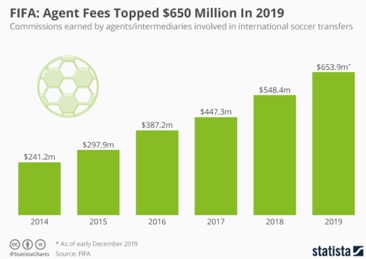
            The Independent now estimates the number of licensed agents in the UK to be around 6000 individuals, a 1200% increase from the time when passing the FIFA exam was mandatory. This is an extraordinary rise in the number of agents under the umbrella of the FA. This was not exclusively seen in the UK; it had the same impact on the football industry worldwide. The table below shows the rising agency fees across the football world (Statista, FIFA). The table may give the false impression that because there are more agents, they create more commission. The reality is that the rising agent fees are what is attracting the large rise in numbers but many find that they are unable to make money. FIFA has recognised this and is planning on limiting the number of new agents to prevent a further increase.

Inevitably, with a wider range of individuals involved in the industry that have not proven a certain standard of knowledge and education, the average competency of agents has fallen. FIFA have decided to reevaluate their regulations for working with intermediaries (RWI) and are proposing to reintroduce an agent exam in order to combat this issue. According to FIFA’s Chief Legal and Compliance Officer (CLCO) they are in the final stages of consultation with all the relevant parties. The final proposal is set to be made in the near future, before the new regulations will come into effect in the summer of 2022.  The CLCO has made it very clear that this is not intended to be a project to oppose agents but to help them by improving the standard within the industry. FIFA are also determined to ensure that the new regulations comply with EU legislation and that the exam can be introduced globally.

From what is known so far, the exam will likely take a slightly altered appearance to the one that was scrapped in 2015. All of the multiple-choice questions will be universally applicable, based upon FIFA regulations. It will also change from being translated into any language to only being available in four languages, English, Spanish, French and German. The exam will be taken digitally rather than on paper. This allows FIFA to have more control and prevent cheating. The pass mark is yet to be officially stated but it is likely to be around 80%.

Reintroducing an exam will, first and foremost, decrease the number of licensed agents operating in football. However, there are many other advantages to the proposed system. By making candidates educate themselves and reach a certain level of knowledge and wisdom of the industry in order to become a part of it, the standard and expertise of agents will improve. With better educated agents should come more transparency, and with greater competency comes greater professionalism. It is hoped that the proposal will therefore benefit the agents themselves as well as the players and football in general.

I expect that FIFA will consider and attempt to overcome any issues that their new exam proposal may endure to ensure that it is a success. The exam was originally eradicated in 2015 on the (since falsified) belief that it would increase the transparency of the industry by reducing the number of unlicensed agents. Whilst it is not disputed that the standard of agents that pass the exam will increase, will there not just be a rise in unlicensed agents once again? It seems a vicious circle that poses a difficult solution. If the exam is to be reintroduced how can the risk of losing transparency or a level of control over the industry be minimised?

Furthermore, there is the unavoidable issue of the ‘unexamined agents’. Although those that passed the exam prior to 2015 will not have to retake the new exam, what is the best approach to have with the agents that obtained their license since 2015 by passing the fit person check and are paying their annual fee? If FIFA were to demand that these agents now pass an exam, there will be objections from this cohort. These agents may have worked for up to six years, developing their client base and operating within the industry. If they are then unable to pass the new exam their livelihood will be undermined. It makes sense that these agents should need to pass an exam, but it would be fair to individuals in this position to be allowed multiple retakes and extra access to formalised education in order to help them to pass it.

In my opinion, education should be paramount, and should be expanded and developed with a greater volume of content that is specific to the work of agents. For an agent to be successful and professional they must have a wider understanding of all regulations, case studies, cultures, systems, history, leagues, legislation and every facet and field of the industry. It is expected that an ongoing education system will be provided by FIFA that will inevitably produce a greater and constantly growing level of proficiency amongst agents.

In conclusion, I support the implementation and reintroduction of a formal, universally applicable FIFA exam. It sets a single standard of competency for agents to meet to obtain their license. FIFA will structure the exam in a manner that demands candidates to have an adequately detailed understanding of the industry and its regulations. This will place a distinct stress on agents educating themselves which will have a positive impact on the football world.


Can I Negotiate with Myself? Football Agents & Multiple Representation

Currently, multiple representation is very common in the football world. The term refers to an instance where the agent represents more than one party in a transfer negotiation: at least two out of the selling club, the buying club and the player themselves. These agreements may occur in order to simplify a transfer deal by directing it through a single negotiator. The agent may have a particularly good relationship with each of the clubs and knows or represents the player involved. A multiple representation agreement may result in larger payouts to the agent, but the clubs are not forced to use this method, they may choose to do so in order to successfully acquire a player they desire.

In this week’s episode of the blog, I will discuss the changes that FIFA are proposing that will restrict multiple representation to no more than one particular scenario of dual representation. I will explore the legal and ethical implications of multiple representation and consider how the regulator will be able to handle some of the challenging situations that may arise despite the changes in regulation.

At the moment, FIFA’s regulation of agents, that came into force in 2015, gave some guidance but delegated the policing of agents to the individual national football associations. For example, the FA in England or the DFB in Germany have been responsible for setting out their own clear regulations surrounding the legalities of an agent engaging in multiple representation. The practice of multiple representation of up to all three parties has been possible during this time and has offered big opportunities to agents who could receive remuneration from the player, the buying club and the selling club in a single transfer. 

The transfer of Paul Pogba from Juventus to Manchester United in 2016 is the most publicly well-documented case of multiple, tripartite representation. In order for the agent, in this particular case Mino Raiola, to have legally acted as the agent of all three parties, he must be in compliance with the multiple representation regulations of the English FA and the Italian FIGC. To been seen as adhering to these regulations, he was required to have lodged his representation agreements with the FA as well as obtaining written consent from all three parties accepting the issues of multiple representation. Prior to this, both clubs and the player must have been made explicitly aware of the inevitable conflict of interest that would arise as a result of acting on behalf of each interested party as well as disclosing the terms of representation and the fees that he was entitled to from each contract. The FA referred to this as the ‘duty of disclosure of the full particulars’ of each agreement to the others in order to fulfil the obligations of transparency demanded under the regulations for multiple representation. As long as the agent is not concealing information or could be accused of misrepresentation then no rules are being broken. 

At this point you may be asking why there is an issue with multiple representation if the practice is legal under the regulations of a football association. FIFA is proposing changes because of a number of issues that arise from such transfers. There are ethical implications surrounding conflicts of interest as well as legal difficulties, separate from football legislation, such as tax problems. In order to analyse the effectiveness of FIFA’s proposals in solving these problems it is important to understand exactly what FIFA intends to change. The suggested new regulations concerning representation are outlined below:

  1. An intermediary should only perform his/her services on behalf of one party. There is only ONE exception to this rule (2)
  2. The agent can legally act on behalf of the individual player and the engaging club ONLY if the following criteria is met:
    – Both parties are made aware of the conflict of interests that will arise as a result
    – The details of both contracts, including the terms of service and the terms of remuneration are fully disclosed to each party
    – Both parties have the right to seek independent legal advice on the matter
    – The player must have a preexisting representation contract with the agent, lodged with the National Association
  3. This means that the agent is not entitled to simultaneously represent the buying club and the selling club; the selling club and the player; nor ALL THREE PARTIES

First and foremost, the primary purpose of these new regulations would be to prevent instances where the agent is able to represent all three parties. The regulators are also aiming to minimise the conflicts of interest that would occur in dual representation agreements. They have suggested these changes as a sign of intent to achieve the fundamental principles that must be met in order to improve the football industry. As I discussed in last weeks episode of the blog, it is important for FIFA to increase the transparency of agents in football. Instead of relying upon National Associations to make their own judgements on dual representation, FIFA wants to harmonise and coordinate the regulations to create a more robust and consistent system. The new regulations would incur sanctions and penalties if they are violated, and if the agent is found to have committed a ‘misconduct offence’. Penalties would include punishments such as loss of remuneration for the agent from affected parties.

The ethical foundations behind the new regulations are centred upon the conflicts of interests. When an Agent signs a representation agreement, they are obliged to fulfil the fiduciary, contractual duty of acting in the best interests of the party that he or she represents. For example, representing the buying and the selling club would be prohibited by the proposal as there is an obvious contradiction in trying to negotiate the lowest price for the buying club whilst pursuing the highest price possible for the selling club. By representing the buying club and the player, these conflicts might not be as prominent and has become an established system used by agents and clubs especially in the United Kingdom. However, once an agent is responsible for more than one party, there is an ethical dilemma in being able to satisfactorily act in the best interests of both parties within a dual representation contract. Even though FIFA would rule out the possibility of the most contradictory relationships, there is still a level of difficulty in achieving the best for the player and the buying club. This would become evident when an agent is trying to achieve the highest salary possible for the player whilst also trying to minimise the expenses for the buying club that they are also representing.

A challenge that FIFA might face is the possibility of parties finding ways around the system. For example, ‘party switching’ is currently a prominent issue in German football. This is where an agent will terminate their contract with a player just before a transfer and then act on behalf the buying club instead. The player then declares that they did not use an agent in the transaction. FIFA will prevent this by capping the commission of an agent to only 3% if acting on behalf of the buying club. To maximise their commission to 6%, the agent must have an acceptable dual-representation agreement. This will have a positive effect on the transparency of the agency industry, especially in the German market.

There are many other instances that FIFA must consider for their proposals to be ethically and legally sound. How would they regulate scenarios such as if three agents represented the buying club, the selling club and the player in a single deal but each of these agents were part of the same agency firm? There seems to be a conflict of interests and a valid legal question to be raised here, but they are officially independently registered agents so would seemingly comply with FIFA’s rules around multiple representation, despite working for the same company. 

What about when an agent represents the player, the buying club and the coach of the buying club? How does this create conflicts of interest?

Another legal consideration that FIFA must make is how this new system will affect tax payments. Players and clubs are taxed differently. In many cases the club will pay the 3% commission owed to the agent by the player on their behalf. The player is then shocked when they are taxed on this payment that was paid by the club. In the future, it will become more commonplace for the agent to be paid directly by the player. FIFA might find a way of regulating this by introducing a minimum income threshold that places the responsibility of agent remuneration on the player. It must be ensured that their new proposals do not allow for clubs to place the tax burden of agent commissions onto the players without their knowing. 

In conclusion, the proposals of FIFA to completely ban the ability of a single agent to represent the buying club, selling club and the player is a move in the right direction. They are showing an admirable desire to solve the problems around conflicts of interests and unethical practice. Attempting to create universal regulations on the matter shows promising intention to increase the transparency and legality of agents in football. The theoretical foundations for these improvements will be in place but it remains to be seen as to whether they will be practically successful and effective as solutions. In my opinion, it is important to prioritise the education of agents and club officials to encourage them to fully understand conflicts of interests and other issues that may arise from dual representations. Perhaps in the future the best option may be to completely restrict representation to a single party. However, this is easier said than done and FIFA would have to find a method of enforcing the law and appropriately sanctioning the agents that break such laws or try to find alternative, ethically questionable methods of multiple representation.


Can I Negotiate with Myself? Football Agents & Multiple Representation

Currently, multiple representation is very common in the football world. The term refers to an instance where the agent represents more than one party in a transfer negotiation: at least two out of the selling club, the buying club and the player themselves. These agreements may occur in order to simplify a transfer deal by directing it through a single negotiator. The agent may have a particularly good relationship with each of the clubs and knows or represents the player involved. A multiple representation agreement may result in larger payouts to the agent, but the clubs are not forced to use this method, they may choose to do so in order to successfully acquire a player they desire.

In this week’s episode of the blog, I will discuss the changes that FIFA are proposing that will restrict multiple representation to no more than one particular scenario of dual representation. I will explore the legal and ethical implications of multiple representation and consider how the regulator will be able to handle some of the challenging situations that may arise despite the changes in regulation.

At the moment, FIFA’s regulation of agents, that came into force in 2015, gave some guidance but delegated the policing of agents to the individual national football associations. For example, the FA in England or the DFB in Germany have been responsible for setting out their own clear regulations surrounding the legalities of an agent engaging in multiple representation. The practice of multiple representation of up to all three parties has been possible during this time and has offered big opportunities to agents who could receive remuneration from the player, the buying club and the selling club in a single transfer. 

The transfer of Paul Pogba from Juventus to Manchester United in 2016 is the most publicly well-documented case of multiple, tripartite representation. In order for the agent, in this particular case Mino Raiola, to have legally acted as the agent of all three parties, he must be in compliance with the multiple representation regulations of the English FA and the Italian FIGC. To been seen as adhering to these regulations, he was required to have lodged his representation agreements with the FA as well as obtaining written consent from all three parties accepting the issues of multiple representation. Prior to this, both clubs and the player must have been made explicitly aware of the inevitable conflict of interest that would arise as a result of acting on behalf of each interested party as well as disclosing the terms of representation and the fees that he was entitled to from each contract. The FA referred to this as the ‘duty of disclosure of the full particulars’ of each agreement to the others in order to fulfil the obligations of transparency demanded under the regulations for multiple representation. As long as the agent is not concealing information or could be accused of misrepresentation then no rules are being broken. 

At this point you may be asking why there is an issue with multiple representation if the practice is legal under the regulations of a football association. FIFA is proposing changes because of a number of issues that arise from such transfers. There are ethical implications surrounding conflicts of interest as well as legal difficulties, separate from football legislation, such as tax problems. In order to analyse the effectiveness of FIFA’s proposals in solving these problems it is important to understand exactly what FIFA intends to change. The suggested new regulations concerning representation are outlined below:

  1. An intermediary should only perform his/her services on behalf of one party. There is only ONE exception to this rule (2)
  2. The agent can legally act on behalf of the individual player and the engaging club ONLY if the following criteria is met:
    – Both parties are made aware of the conflict of interests that will arise as a result
    – The details of both contracts, including the terms of service and the terms of remuneration are fully disclosed to each party
    – Both parties have the right to seek independent legal advice on the matter
    – The player must have a preexisting representation contract with the agent, lodged with the National Association
  3. This means that the agent is not entitled to simultaneously represent the buying club and the selling club; the selling club and the player; nor ALL THREE PARTIES

First and foremost, the primary purpose of these new regulations would be to prevent instances where the agent is able to represent all three parties. The regulators are also aiming to minimise the conflicts of interest that would occur in dual representation agreements. They have suggested these changes as a sign of intent to achieve the fundamental principles that must be met in order to improve the football industry. As I discussed in last weeks episode of the blog, it is important for FIFA to increase the transparency of agents in football. Instead of relying upon National Associations to make their own judgements on dual representation, FIFA wants to harmonise and coordinate the regulations to create a more robust and consistent system. The new regulations would incur sanctions and penalties if they are violated, and if the agent is found to have committed a ‘misconduct offence’. Penalties would include punishments such as loss of remuneration for the agent from affected parties.

The ethical foundations behind the new regulations are centred upon the conflicts of interests. When an Agent signs a representation agreement, they are obliged to fulfil the fiduciary, contractual duty of acting in the best interests of the party that he or she represents. For example, representing the buying and the selling club would be prohibited by the proposal as there is an obvious contradiction in trying to negotiate the lowest price for the buying club whilst pursuing the highest price possible for the selling club. By representing the buying club and the player, these conflicts might not be as prominent and has become an established system used by agents and clubs especially in the United Kingdom. However, once an agent is responsible for more than one party, there is an ethical dilemma in being able to satisfactorily act in the best interests of both parties within a dual representation contract. Even though FIFA would rule out the possibility of the most contradictory relationships, there is still a level of difficulty in achieving the best for the player and the buying club. This would become evident when an agent is trying to achieve the highest salary possible for the player whilst also trying to minimise the expenses for the buying club that they are also representing.

A challenge that FIFA might face is the possibility of parties finding ways around the system. For example, ‘party switching’ is currently a prominent issue in German football. This is where an agent will terminate their contract with a player just before a transfer and then act on behalf the buying club instead. The player then declares that they did not use an agent in the transaction. FIFA will prevent this by capping the commission of an agent to only 3% if acting on behalf of the buying club. To maximise their commission to 6%, the agent must have an acceptable dual-representation agreement. This will have a positive effect on the transparency of the agency industry, especially in the German market.

There are many other instances that FIFA must consider for their proposals to be ethically and legally sound. How would they regulate scenarios such as if three agents represented the buying club, the selling club and the player in a single deal but each of these agents were part of the same agency firm? There seems to be a conflict of interests and a valid legal question to be raised here, but they are officially independently registered agents so would seemingly comply with FIFA’s rules around multiple representation, despite working for the same company. 

What about when an agent represents the player, the buying club and the coach of the buying club? How does this create conflicts of interest?

Another legal consideration that FIFA must make is how this new system will affect tax payments. Players and clubs are taxed differently. In many cases the club will pay the 3% commission owed to the agent by the player on their behalf. The player is then shocked when they are taxed on this payment that was paid by the club. In the future, it will become more commonplace for the agent to be paid directly by the player. FIFA might find a way of regulating this by introducing a minimum income threshold that places the responsibility of agent remuneration on the player. It must be ensured that their new proposals do not allow for clubs to place the tax burden of agent commissions onto the players without their knowing. 

In conclusion, the proposals of FIFA to completely ban the ability of a single agent to represent the buying club, selling club and the player is a move in the right direction. They are showing an admirable desire to solve the problems around conflicts of interests and unethical practice. Attempting to create universal regulations on the matter shows promising intention to increase the transparency and legality of agents in football. The theoretical foundations for these improvements will be in place but it remains to be seen as to whether they will be practically successful and effective as solutions. In my opinion, it is important to prioritise the education of agents and club officials to encourage them to fully understand conflicts of interests and other issues that may arise from dual representations. Perhaps in the future the best option may be to completely restrict representation to a single party. However, this is easier said than done and FIFA would have to find a method of enforcing the law and appropriately sanctioning the agents that break such laws or try to find alternative, ethically questionable methods of multiple representation.


Will FIFA Cap Football Agent Commissions?

In 2015, FIFA made the decision to deregulate the football agent industry. Whilst they recommended that clubs and players implement a commission cap for agents of 3%, this was rarely adhered to. In the years that have followed the football world has seen enormous transfer fees and rising agency commissions.

         In general, transfer prices and player salaries have risen, and therefore, so have agent commission fees. In 2019, USD $653.9million was paid in agency fees (FIFA TMS). A significant proportion of these payments came out of the pockets of the clubs rather than directly from the players themselves. Consequently, FIFA has decided to address the worry of many clubs and football stakeholders that too much money is flowing out of the game and into the agents’ wallets. FIFA accepted that the 2015 deregulation did not have the intended effect upon the industry and have proposed a set of reforms in agency regulation that I will be exploring within this series of blogs. I will begin here by outlining the commission caps that FIFA are intending to implement and discuss whether it is a practical and effective way of solving the issues it aims to address.

         FIFA have decided to install commission caps, primarily to keep as much money as possible in the game. This stems from the feeling amongst some major figures in the football world opposing the disproportionately high level of remuneration that agents are currently receiving. The intended commission restrictions proposed by FIFA are as follows:

  1. An agent is entitled to a maximum of 3% of the player’s gross salary when they are acting on behalf of the player
  2. An agent is entitled to a maximum of 3% of the player’s gross salary when they are acting on behalf of the buying club
  3. If the agent is representing both the buying club and the player, where both parties are aware of the possible conflict of interest and written consent has been given, they are entitled to a maximum of 6% of the player’s gross salary
  4. An agent is entitled to a maximum of 10% of the gross transfer fee when they are representing the selling club

The secondary aims of these reforms for FIFA are centered around the desire to maintain and protect the integrity of the sport and align agency fees with solidarity and training compensation payments that are currently far below the figures paid for agency fees.

My view is that the biggest issue that would arise from capping agent commissions is the effect that it will have upon the industry. By looking at the current statistics for agency fees across the FIFA TMS it is clear to see how these regulations would cause such a problem. For context, I have outlined some of these statistics below:

  1. Currently, the average agent commission for transfers over $5million is 5.8%
  2. Currently, the average agent commission for transfers between $1-$5million is 8.8%
  3. Currently, the average agent commission for transfers under $1million is 16.6%
  4. There were 3558 transfers that used at least one intermediary in 2019, 148 of those transfers accounted for $430million worth of commission out of the total agency fees of $653.9million for the year
  5. That equates to 4.5% of transfers amounting for 65.7% of the total agency commissions

There lies the problem. The football agent industry already shows the typical characteristics of an oligopoly. The small number of agents that dominate the industry are largely responsible for the staggering value of fees paid to agents. These agents would not be hugely affected by the new FIFA regulations as shown by statistic 1, as their average commission is only 2.8% above what FIFA intend to cap it at (3%). The damage would be done through its impact upon young agents trying to break into the industry or on those that have established themselves in the lower divisions of football. If the FIFA commission cap is approved, it would have a drastic effect on this side of the agency industry. The dominant agents would survive and gain a further oligopoly on the market whilst those at the other end would struggle to continue and make enough of a living. If they were suddenly limited to 3% commission when previously they could earn an average of 16.6%, they would then have to make an extortionate, unrealistic number of transfers in a year to be able to succeed and continue as an agent. The huge discrepancies in agency fee figures from 2020 across each of the English football leagues demonstrate this problem:

  1. The Premier League paid £272million to agents
  2. The Championship paid £40million to agents
  3. League 1 paid £3million to agents
  4. League 2 paid £1million to agents

The figures for the lower leagues are particularly low, especially considering that it is likely that most of the agents dealing with league 1 and certainly league 2 players would currently be aiming to collect around 16% commission. If they can barely amass a few million amongst them currently, there is no chance they will be able to survive if their commission is lowered by 13% as a result of FIFA’s new regulations.

If FIFA truly feel that it is unavoidable to have to introduce a capping system, I would argue in favour of a gradual capping model. Placing commission caps into a tiered system is a preferable approach to tackling the issue of huge agency fees. For example, dominant agents that are dealing with transfers above a certain value may be limited to 5% but FIFA must consider that this is not sustainable or feasible for agents dealing with much lower transfer fees and so their commission cap should be adjusted accordingly in order to ensure they are entitled to enough to survive.

Another major problem that FIFA will encounter is whether a hard cap is in line with European competition law. It will be interesting to see if the proposal will survive the legal challenges that it will inevitably face. Within a free market, the agency fees have grown simultaneously with the rise in transfer fees and player salaries. It seems that it will be difficult for FIFA to convince a European court of law that their proposal is legitimate, necessary and doesn’t undermine the laws of competition and unfairly restrict the amount that agents are able to earn. Especially after the FIFA TMS statistics have shown that this would not appropriately reflect the market.

It is highly likely that agents and agent associations will oppose the commission cap and the appeal may be processed in court to judge whether the proposals are in line with European Law. In 2015, a German agency took the Deutscher Fussball-Bund (DFB, the German Football Board) to the national court over a similar attempt to limit the money that agents were able to make through German football clubs and players. The German court voted in favour of the agency as it agreed that regulating and restricting earnings was not coherent with European competition law. It is possible that FIFA will face the same legal proceedings and outcome with their current proposal. In the future, different regulations may come into place in different countries. The national law will always take precedence over the FIFA laws and national associations may take it upon themselves to control agent commissions. For example, the German court has ruled against exclusive representation of a player whilst in England and other countries most contracts give exclusivity rights to the agent. The same thing may happen with commission fees, regardless of the rules that FIFA bring in.

It seems to me that the clubs themselves are strong advocates for the lowering of commission fees for agents. This is likely because they are often the ones who pay the agents. Despite the common contract stating that the players are the ones who pay the agents out of their salary, in reality, it is often the club who pays, and the player’s salary is not affected. The European Club Association (ECA) may view the proposed regulations as an opportunity to minimise the expenditure of clubs on agents’ fees and will want the cap to be approved.

It really doesn’t make sense however that an agent representing the selling club is able to make more from commission than an agent who is acting on behalf of the individual player. That undermines the services of an agent who is there to seek the best interests of his player and offer a wider service of care to them. The new commission caps would encourage agents to act on behalf of selling clubs if they wish to earn the most money. The implications of this are that players are reduced to commodities, traded between clubs. Most agents would aim to earn the 10% remuneration from selling a player rather than 3% commission for looking after a player. So, who is left to care for them?

FIFA believe that the new regulations will protect the integrity of football as commission figures will be disclosed to increase transparency. I worry that this may actually have an adverse effect upon football’s transparency. Agents will turn to alternative methods of collecting their remuneration, such as one-off payments from players or clubs rather than through commission from a transfer. This will lead to shady, potentially unethical activity, damaging the integrity of the sport rather than upholding it as FIFA intend to do. It is not a fair solution to only cap the agents and not look for opportunities elsewhere within football that may help solve the problem. Unfortunately, agents are not stakeholders in football which makes it difficult for them to have an influence. Consulting the agents for feedback is good but is not enough to produce a desirable outcome for everyone and for football. For this to be possible, agents must become stakeholders in the industry. Currently, players and clubs are represented by their respective boards and associations whilst agents are left to fend for themselves.

In conclusion, the basis of FIFA’s proposal for new agent regulations is legitimate. Agency fees are particularly high and FIFA’s desire to protect the integrity of football, increase transparency and keep money within the game is admirable. However, hard caps create more problems than they solve. The current suggestion of capping commissions is unfair, unreasonable and unrealistic. It has a major obstacle in its way to begin with in getting past the agents and the European court of law unopposed. If they were approved, it would result in a variety of problems in the agency world such as an overwhelming oligopoly in the industry, immoral methods of earning more money and the commodification of players. FIFA failed in their deregulated approach in 2015 and I hope that there will not be a repeat of this if they go ahead with hard caps on commission fees for agents. Perhaps improving education for agents, implementing a good licensing system and looking at other methods of increasing transparency, rather than hard caps, would go a substantial way to overcoming some of the problems FIFA wish to solve.