


Heat could become one of the defining stories of the 2026 World Cup, with the first 48-team World Cup held between 11 June and 19 July 2026. Researchers have warned that 14 of the tournament’s 16 host venues across three regions are expected to face extreme temperatures, including England’s base camp in Kansas City. In some regions of the southern United States and northern Mexico, daytime temperatures during June and July can soar to 40°C.
A few numbers to note for this year’s tournament:
- Four time zones,
- located at up to 2,800 miles apart and
- 104 matches played (40 more than the 2022 Qatar World Cup).
Here are the groups:
- Group A: Mexico, South Africa, South Korea, Czech Republic
- Group B: Canada, Bosnia & Herzegovina, Qatar, Switzerland
- Group C: Brazil, Morocco, Haiti, Scotland
- Group D: United States, Paraguay, Australia, Turkey
- Group E: Germany, Curacao, Ivory Coast, Ecuador
- Group F: Netherlands, Japan, Sweden, Tunisia
- Group G: Belgium, Egypt, Iran, New Zealand
- Group H: Spain, Cape Verde, Saudi Arabia, Uruguay
- Group I: France, Senegal, Iraq, Norway
- Group J: Argentina, Algeria, Austria, Jordan
- Group K: Portugal, Congo DR, Uzbekistan, Colombia
- Group L: England, Croatia, Ghana, Panama
To determine whether conditions remain safe for competition, FIFA uses the Wet Bulb Globe Temperature (WBGT) scale, which measures more than just heat. Humidity, direct sunlight and wind speed are all factored into the calculation. Under FIFA regulations, a WBGT reading of 32°C before kick-off is considered severe enough to prompt discussions about delaying or suspending play.
England’s 1-0 victory over New Zealand in Tampa ahead of the World Cup, was a test of how players adapt to different climates. Harry Kane’s goal secured the result, but the real objective was preparation for the most physically demanding World Cup football has ever staged.
For Thomas Tuchel and his staff, the match was less a friendly, rather a live environmental test. With the match played in Florida heat and humidity approaching conditions expected throughout the tournament, England used the fixture to assess:
- player responses to climate stress,
- workload management and
- tactical execution under fatigue.
Thomas Tuchel rotated two largely different teams across the two halves, prioritising adaptation over continuity.
The approach mirrors many of the recommendations emerging from the latest research published by Aspetar Orthopaedic and Sports Medicine Hospital ahead of the 2026 FIFA World Cup.
England’s World Cup headquarters is Swope Soccer Village in Kansas City, a training complex renowned for hosting elite domestic and international football. The facility combines high quality natural grass and synthetic pitches with the performance and recovery infrastructure required by modern national teams.
The New Opponent: Environmental Stress
Aspetar’s World Cup review published in the March edition of Aspetar’s Sports Medicine Journal was contributed to by Dr. Andrew Massey, President of the FIFA Medical Commission and guest edited by Professor Cristiano Eirale, Chief of Sports Medicine, and Dr. Celeste Geertsema, Sports Medicine Physician in Aspetar. I had the privilege to hear first-hand of the insights of Professor Cristiano Eirale’s and Dr. Celeste Geertsema’s work at the Aspetar World Conference 2025 in Doha, Qatar.
The journal features a collection of excellent papers reflecting current knowledge and highlights how cumulative heat stress can progressively increase fatigue, compromise recovery and reduce physical output across a tournament. Importantly, players do not respond to heat in the same way. Fitness levels, hydration habits, acclimatisation history and body composition all influence performance under extreme conditions.
For decades, coaches focused on opponents, formations and technical preparation. In 2026, teams must prepare for another opponent altogether: the environment. This explains England’s decision to arrive early in Florida and train in conditions designed to replicate those they will encounter throughout the tournament. Reports from camp suggest the FA has incorporated environmental monitoring, GPS tracking and recovery protocols specifically aimed at developing what staff describe as a “heat-proof” game model.
The New Zealand match therefore provided valuable information beyond tactics:
- Could players maintain pressing intensity?
- How quickly would they recover between high-speed actions?
- How would decision-making change after prolonged exposure to heat and humidity?
These are questions that could determine knockout-stage success.
Lessons from the Club World Cup
Football has already received an early warning. Last year’s expanded FIFA Club World Cup in the United States exposed the physical challenges awaiting national teams. Several matches were played in temperatures exceeding 30°C, with players, coaches and unions raising concerns about heat stress and recovery demands. FIFA and FIFPRO both acknowledged the impact of extreme temperatures on performance and player welfare. The tournament effectively became a rehearsal for the World Cup.
Chelsea midfielder Enzo Fernandez said he felt dizzy while playing in “very dangerous” heat at the Club World Cup tournament.
One of the most significant outcomes was FIFA’s decision to introduce mandatory three-minute hydration breaks during every World Cup match, regardless of temperature. The breaks will occur around the 22-minute mark of each half and represent a major change to football’s rhythm.
England have already begun adapting. Earlier this year, Thomas Tuchel requested hydration breaks during a friendly specifically to replicate World Cup conditions and familiarise players with the interruptions.
A Tactical Revolution in Disguise
The hydration breaks are not merely medical interventions. For generations, football has been played in two uninterrupted 45-minute halves. Coaches now effectively receive two additional mini-team talks during matches (as we saw with Thomas Tuchel during this match). Tactical adjustments can be delivered immediately. Defensive structures can be reorganised. Pressing triggers can be altered. Momentum can be broken.
Several international coaches who tested the format during preparatory friendlies suggested the breaks fundamentally change match management and create opportunities similar to timeouts in other sports.
National teams preparing for these moments will likely gain an advantage over those that treat them simply as water stops.
National teams preparing for these moments will likely gain an advantage over those that treat them simply as water stops.
The Club vs. Country Challenge
Another challenge highlighted by Aspetar’s work is the transition players face when moving from club football into international tournaments. Players arrive from vastly different tactical environments.
Some spend the season in possession-dominant systems demanding constant ball circulation. Others play in transition-heavy teams built around sprinting and counter-attacks. Pressing intensity, recovery patterns, training loads and positional responsibilities vary enormously between clubs.
International managers on the other hand have only days to blend these players into a coherent collective structure and heat magnifies that challenge. A player accustomed to a controlled possession model may struggle when asked to execute repeated pressing actions in 32°C temperatures. Likewise, players arriving from different domestic schedules and competitive calendars may adapt differently to environmental stress.
The result is that World Cup preparation is no longer solely about tactics. It is increasingly about integrating tactical identity with physiological readiness.
The result is that World Cup preparation is no longer solely about tactics. It is increasingly about integrating tactical identity with physiological readiness.
Changes in playing style and training load can also raise injury potential.
Prevention Starts Long Before the Tournament
One of the central lessons from elite football is that injury prevention cannot be rushed during a pre-tournament camp. Instead, it begins months in advance through:
- Individualised workload monitoring
- Strength and conditioning programmes
- Recovery optimisation
- Sleep and travel management
- Early identification of injury risk factors
Modern performance teams track player data throughout the season, allowing national-team staff to understand physical loads before players even arrive in camp.
The objective is to ensure players reach the tournament in their best possible condition rather than attempting to rebuild fitness in a matter of weeks.
The Importance of Muscle Injury Prevention
Muscle injuries remain among the most common issues in elite football, particularly involving the hamstrings, quadriceps and calf muscles.
Aspetar has been a leading voice in promoting evidence-based prevention programmes combining strength training, neuromuscular exercises and carefully managed workloads. These interventions may seem routine, but their impact can be enormous.
A squad losing several key players to soft-tissue injuries during a tournament can quickly see its tactical plans unravel. Conversely, teams which maintain squad availability often retain consistency in selection, tactical cohesion and performance levels.
Recovery as a Performance Strategy
World Cup schedules leave little room for recovery. Teams can face multiple high-intensity matches within a short period, often combined with travel, media commitments and emotional stress.
Recovery is therefore no longer viewed as passive rest. It is an active process involving:
- Nutrition planning
- Hydration strategies
- Sleep optimisation
- Regeneration sessions
- Monitoring fatigue markers
Elite teams increasingly treat recovery with the same importance as training itself.
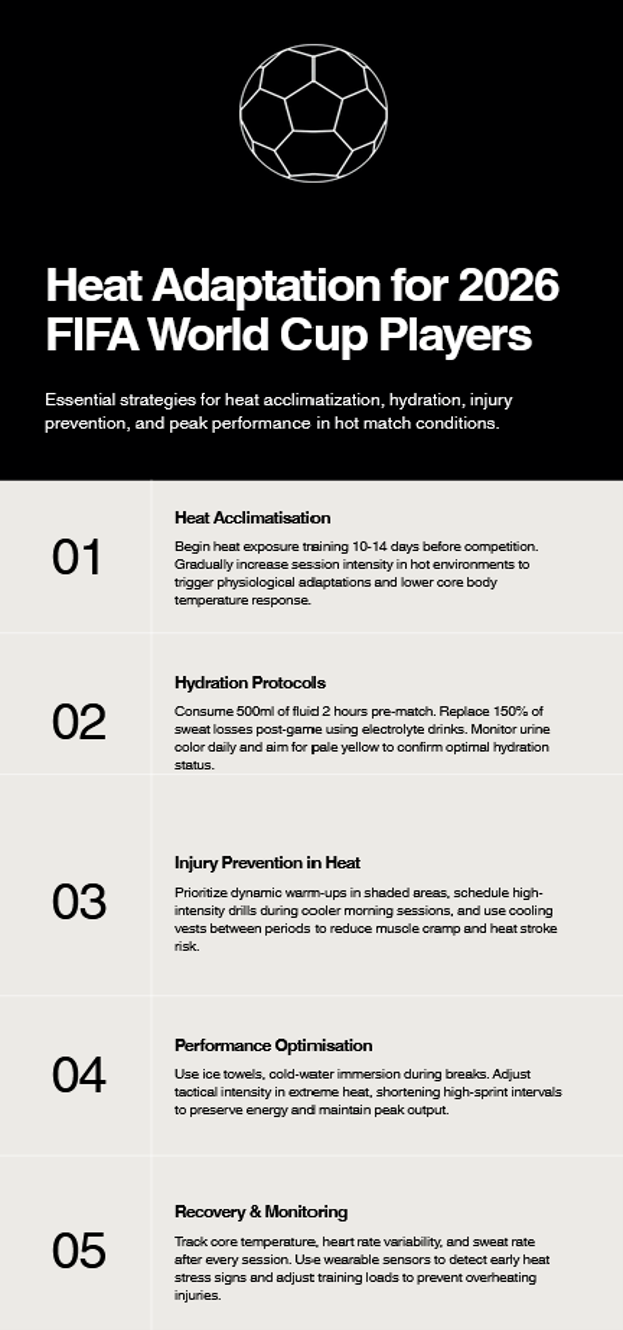
Here is my summary of essential heat adaptation strategies for the 2026 World Cup:
Availability Wins Tournaments
Availability = performance.
The team best managing heat exposure, recovery, travel, workload and injury risk may gain a decisive edge before a ball is even kicked. England’s friendly against New Zealand offered an early glimpse of that reality. The result mattered little and the data gathered may matter enormously.
In a World Cup expected to test players with unprecedented environmental demands, success could depend less on who is the fittest team on paper and more on who remains physically and mentally resilient by the time the tournament reaches its decisive weeks.
The battle for the World Cup has already begun. It is being fought in recovery rooms, climate-controlled training facilities and hydration stations as much as on the pitch.
The battle for the World Cup has already begun. It is being fought in recovery rooms, climate-controlled training facilities and hydration stations as much as on the pitch.
The Future of Tournament Preparation
Football continues to evolve, and so does tournament preparation. GPS tracking, biomechanical analysis, injury-risk screening and data-driven workload management are becoming standard practice across elite football.
The result is a shift in thinking, with success no longer determined solely by technical quality or tactical innovation, rather by the ability to keep the best players available when it matters most.
As World Cups become faster, more intense and more physically demanding, the lessons emerging from preparation begins long before the opening match and injury prevention may be one of the most decisive factors in determining who remains standing at the final whistle of the tournament.
You can read the special 2026 World Cup feature by Aspetar here.