

Introduction
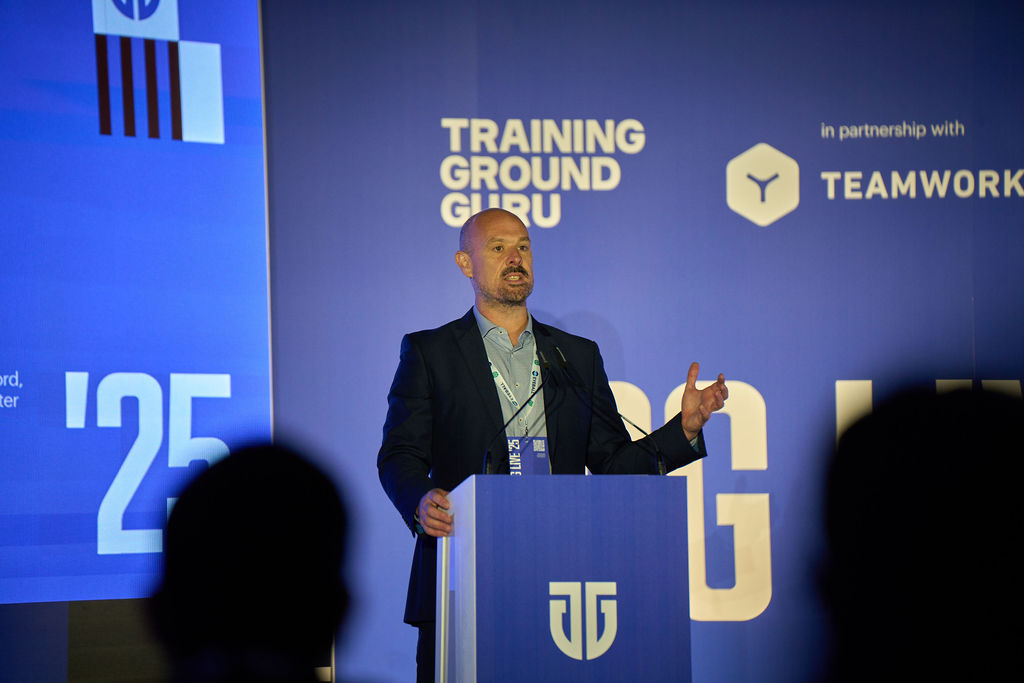
Training Ground Guru Live has established itself as a distinctive event within the professional football landscape by focusing on an area that is rarely brought together in one space: the collective intelligence of the backroom.
Created by Simon Austin as an extension of Training Ground Guru, the event reflects the same philosophy that underpins the platform itself. It is built around depth, insight, and meaningful connection rather than scale or surface-level exposure. In an industry where departments often operate in isolation, TGG Live offers a rare environment where coaching, performance, analysis, psychology, and recruitment intersect.
It is built around depth, insight, and meaningful connection rather than scale or surface-level exposure.
Since its early beginnings as a small, self-organised gathering, the event has evolved into a multi-day experience that attracts practitioners from across clubs, federations, and performance environments. Despite this growth, it has retained a clear identity: to create a space where ideas are shared openly, perspectives are challenged constructively, and learning can be directly applied to the realities of professional football.
Key Themes
What differentiates TGG Live is not only the calibre of its speakers, but the structure of the experience. By combining presentations, workshops, and informal networking moments such as the shared dinner, the event encourages both formal learning and organic conversation. This balance allows attendees to move beyond passive listening and engage with the nuances of the game through dialogue and collaboration.
This balance allows attendees to move beyond passive listening and engage with the nuances of the game through dialogue and collaboration.
In a modern football environment increasingly shaped by both data and human understanding, TGG Live sits at the intersection of these domains. It provides a platform for exploring how different disciplines can work together to create competitive advantage, offering insights that are directly relevant to clubs seeking alignment, innovation, and long-term performance development.
For professionals operating within the game, or those aspiring to enter it, the event represents more than a conference. It is a reflection of how football is evolving behind the scenes, and an opportunity to engage with the people shaping that evolution.
It is a reflection of how football is evolving behind the scenes, and an opportunity to engage with the people shaping that evolution.
Our Exclusive Interview About TGG Live
What was your original intent behind creating Training Ground Guru Live?
So we’ve been doing events for quite a while… I think we did our first one about seven years ago, and it was very small.
We did it in a co-working space… hired in chairs, got someone local to make coffees. It was all quite do-it-yourself really.
We had three speakers who had featured on the site, and it just grew from there.
How has the event evolved since those early beginnings?
The website’s been going nine years, and this will be our fourth TGG Live.
It’s grown into a two-day event now, with a dinner in the middle.
There’s someone I work with, Siobhan, who’s been the event manager, and she’s been brilliant in helping deliver that vision.
What is the core idea behind the event today?
The idea was to bring all the backroom staff together really.
We cover data, coaching, academies, psychology, nutrition, medical… and bring those areas together, because they don’t normally come together.
They normally have separate conferences.
“The idea was to bring all the backroom staff together really.
Who is the event really designed for?
I would say people who are working in professional football already, at a club or federation.
Or people who are aspiring to work in the game.
But really, anyone is welcome who is interested in the topics and the speakers.
What makes TGG Live different from other conferences in football?
I think it’s unique in bringing those different disciplines together.
You don’t normally get sporting directors with performance analysts and coaches in the same space.
I’d also hope the speakers are always high level, and that the insights are high level as well.
There seems to be an ongoing debate in football between data and the human side of the game. Does the event reflect that?
Yeah, definitely. I think that’s happening within clubs as well.
I was at Brentford FC recently… everyone talks about the data there, which is amazing, but they’re also massive on the human side.
Culture, relationships, how people interact day to day… that’s a big part of it too.
What do you want people to take away from attending the event?
Hopefully they can take ideas back into their daily work.
It’s about letting people meet the speakers, hear them in person, and make connections.
That’s a big part of it.
How important is the environment and experience of the event itself?
We do it over two days and have a dinner in the middle.
That’s quite important, because it gives people time to connect and have conversations outside of the talks.
How do you see the event developing in the future?
I’d like to develop the breakouts further.
Maybe introduce awards at the dinner.
But also keep it at a good size and maintain the quality… not just grow it for the sake of it.
But also keep it at a good size and maintain the quality… not just grow it for the sake of it.”
Who is Simon Austin?
Profile
Role: Founder of Training Ground Guru
Specialisation: Sports journalism, football insight, coaching, performance, analysis, psychology, and recruitment
Experience: BBC Sport, Features Editor, Training Ground Guru
Focus Areas: Backroom staff, elite football environments, performance, original thinking and football industry events
Biography
Simon Austin has built a distinctive position within the football industry by focusing on an area that is often overlooked yet fundamentally influential: the people and processes behind performance.
With a 13-year background at the BBC, where he worked extensively in sports journalism and rose to the role of Features Editor for the BBC Sport website, Austin developed a deep understanding of how the game is communicated, analysed, and interpreted at scale. However, rather than following the prevailing direction of the media landscape, he chose to step away from it. This decision was driven by a growing desire to move beyond surface-level narratives and create work that offered genuine insight into how elite football environments operate.
This shift led to the creation of Training Ground Guru, a platform that has become widely respected for its depth, access, and credibility within professional football. Through detailed interviews, long-form features, and industry-leading events, Austin has consistently highlighted the work of practitioners across coaching, performance, analysis, psychology, and recruitment. His work provides a rare window into the complexity of modern football, where success is shaped not only by players and results, but by structure, alignment, and decision-making behind the scenes.
His work provides a rare window into the complexity of modern football, where success is shaped not only by players and results, but by structure, alignment, and decision-making behind the scenes.
What defines Austin’s profile is his commitment to intellectual curiosity and original thinking. His work consistently challenges groupthink and explores emerging ideas within the game, often through conversations with individuals who operate at the edge of conventional practice. This approach has positioned him as a trusted connector between disciplines, clubs, and ideas, helping to bridge gaps that often exist within football environments.
What defines Austin’s profile is his commitment to intellectual curiosity and original thinking.
At a time when the game continues to evolve through the integration of data, science, and human performance, Austin’s work sits at the intersection of these developments. His ability to identify and communicate what truly drives performance makes him a valuable figure for clubs and organisations seeking deeper understanding, strategic clarity, and a more holistic view of the modern game.
Key Insights
- Simon Austin created Training Ground Guru after a 13-year background at the BBC.
- His work focuses on the people and processes behind performance in elite football.
- Training Ground Guru has become respected for its depth, access, and credibility within professional football.
Our Exclusive Interview with Simon Austin
What drove you personally to create Training Ground Guru?
I worked for the BBC for 13 years in sport… my final job was Features Editor on the sport website. I enjoyed it, but I became a bit frustrated with some of the places I was working.
There was quite a lot of what I call clickbait… producing a high volume of articles just to get people to click. It wasn’t very satisfying work, and it wasn’t very original or insightful.
I always had this idea that I’d like to do it myself and have my own website. Then I read an article about the science behind Leicester City’s Premier League win… and I just thought that would make a brilliant website.
So it kind of came from curiosity really, and wanting to focus on the back rooms of football.
Looking back, what has shaped your journey and the way you approach your work?
I think within journalism, I’ve always just wanted the reader to read something and say, ‘that was interesting’.
Quite a lot of journalism… you read the same thing in lots of places. It’s predictable. It’s not telling you anything new.
I’m quite inquisitive myself. I like talking to people, finding out about people and things. I’ve worked with a lot of good people as well, especially at the BBC, and you learn from them.
I’ve probably always been quite curious… maybe a bit nosy as well.
You’ve spoken about being drawn to people who think differently. What is it about those individuals that interests you?
I quite like doing things that are a bit surprising or counterintuitive… things that go against the grain rather than just groupthink.
I’m drawn to mavericks, people who do things a little bit differently.
I think I’ve always had that mindset myself. I don’t like just being told to do something because that’s how it’s always been done. It’s more stimulating to think of a new or better way.
I’m drawn to mavericks, people who do things a little bit differently.
Are there any individuals who stand out to you as examples of that “maverick” thinking?
A couple come to mind straight away. Brian Ashton… he was the England rugby coach in 2007. He’s definitely a maverick.
A big part of it is that he’s got no ego. He doesn’t make coaching about himself. He wants to bring the best out of players, give them freedom, not make them fit into a rigid structure.
Then Dave Reddin… he’s worked in rugby, the Olympics, and the FA. He brought in people from outside football, challenged the status quo, and had really interesting ideas.
He can be very blunt, but he’s focused on outcomes. I found him really inspiring.
How do you balance that idea of being a maverick with the need for alignment within a team?
You’ve got to be wary of going against the grain for the sake of it.
In certain situations, you’ve all got to get in the boat and row in the same direction. You can’t always be questioning things, especially in high-pressure environments.
There’s definitely value in challenging ideas, but also value in alignment.
From your perspective, what do people outside the game misunderstand about football?
A lot of the view from fans and media is very superficial.
People focus on transfers, money, who you sign… like a football manager game. They don’t realise the massive amount of things that go on behind the scenes.
There’s a lot of science, preparation, planning, and analysis.
And often it’s the clubs with the best long-term plan that succeed. That can seem boring, but continuity and stability are usually what lead to success.
And often it’s the clubs with the best long-term plan that succeed.
You seem to avoid imposing strong opinions in your work. Is that intentional?
Yes, definitely.
I don’t like to give too strong an opinion. I like people to make their own opinions.
I choose who I interview and what topics I cover, but I try to stay quite neutral in how I present things. I’m not saying that everyone featured is right for everyone.
I just try to give insight and let the audience decide.
How has your perspective on the game evolved through your access to elite environments?
I think you just realise how complex it all is.
There’s so much going on behind the scenes that people don’t see. Managers and staff are dealing with a huge range of responsibilities.
It’s not just about what happens on the pitch. It’s about alignment, planning, and long-term thinking across the whole club.
You’re approaching a new phase after nearly a decade with Training Ground Guru. How are you thinking about what comes next?
I’ve been thinking about that quite a bit recently.
I’m coming up to 50, and I’ve been doing this for nine years without really taking sustained time off. It’s been full on, and I’ve loved it, but I think you can get a bit jaded always trying to do more.
So, I think the next step is probably to have a bit of time off, reflect, and recharge.
Take stock before deciding what comes next.
FAQ
What is TGG Live?
Training Ground Guru Live has established itself as a distinctive event within the professional football landscape by focusing on an area that is rarely brought together in one space: the collective intelligence of the backroom.
Who created TGG Live?
Created by Simon Austin as an extension of Training Ground Guru, the event reflects the same philosophy that underpins the platform itself.
Who is Simon Austin?
Simon Austin is the founder of Training Ground Guru and a former Features Editor for the BBC Sport website.