

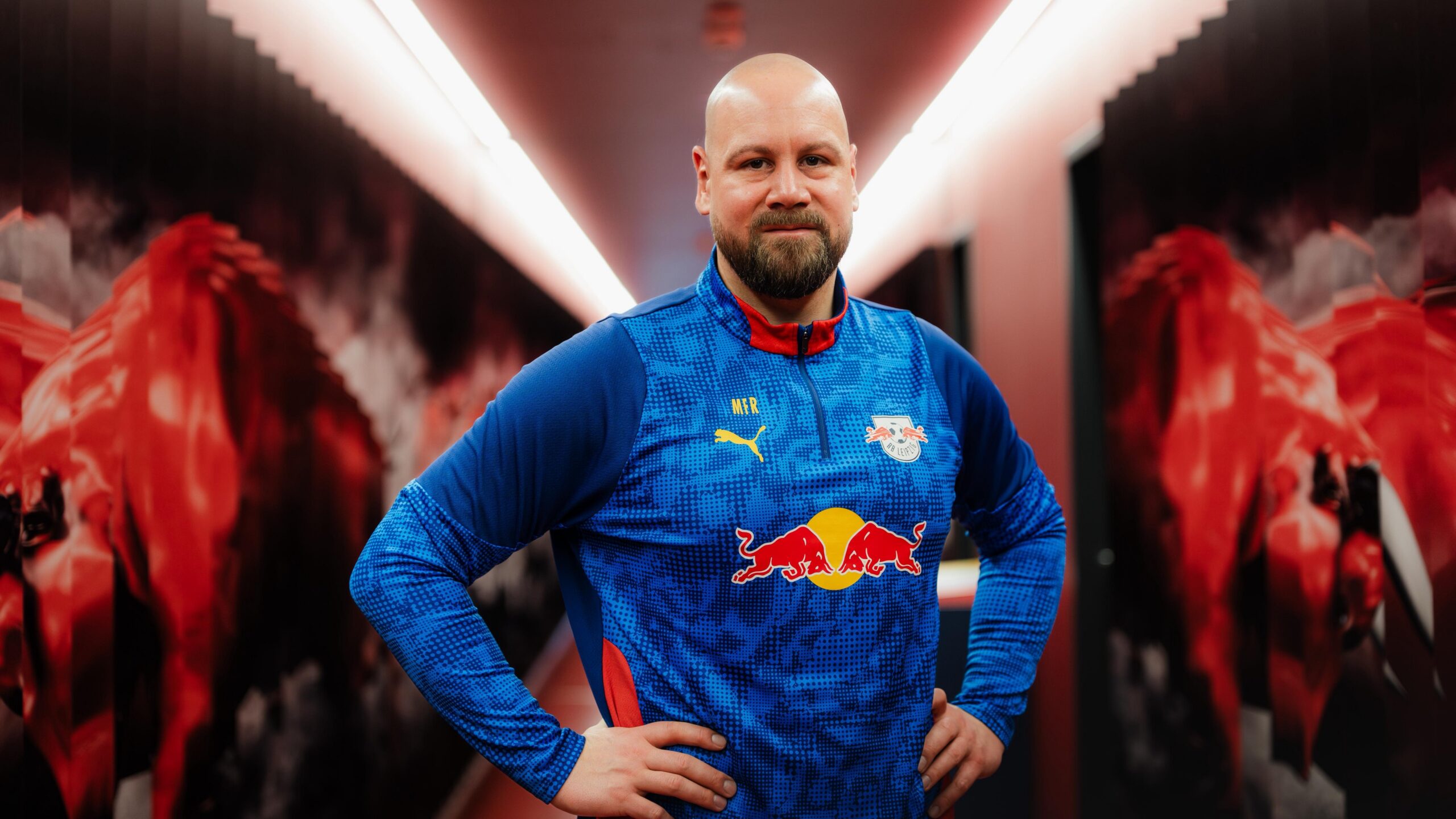
Profle
Role: Goalkeeper Coach, RB Leipzig Academy
Specialisation: Goalkeeper Development, Youth Coaching, High-Performance Preparation
Experience: RB Leipzig Academy, VfL Wolfsburg Academy, Domestic and International Internships
Focus Areas: Individual Development, Mindset, Video Analysis, Long-Term Goalkeeper Preparation
Biography
In elite football, development is decided long before matchday. In the goalkeeper position, where decisions are made in fractions of seconds, preparation, clarity and mindset matter more than raw talent. Marco Fritschka operates exactly in this space, where youth development meets high-performance demands and responsibility begins early.
Marco Fritschka is a goalkeeper coach in the academy of RB Leipzig, currently working with the U15 and U16 age groups. His pathway into professional football combines a completed vocational education outside the game, several years of academy experience at VfL Wolfsburg, extensive domestic and international internships, and a deliberate decision to pursue coaching education abroad. His work is defined by individual development, clear structures and the long-term preparation of young goalkeepers for the realities of elite football.
In elite football, development is decided long before matchday.
Key Insights
- Marco Fritschka focuses on individual goalkeeper development through structure, mindset and communication.
- His work combines academy coaching, international learning experiences and long-term high-performance preparation.
- Video analysis, physical testing and clear decision making are central to his goalkeeper development model.
Our Exclusive Interview with Marco Fritschka
You are currently working as a goalkeeper coach in the U15 and U16 age groups. What defines your day to day work and your development priorities?
A key element of my work is communication with the boys. It is essential to focus on the individual potential of each goalkeeper. Development does not only happen on the pitch. Video analysis from goalkeeper training sessions and matchdays plays an important role as well.
Another central factor is mindset. Through regular development talks, you can influence this to a certain extent, although the player’s environment is crucial. It is important to really know your goalkeepers. Where do they come from? What is their social background? How are things going at school? Showing interest and engaging with their needs is an important part of development.
That said, the primary focus remains goalkeeper-specific and football education. The additional aspects support the process and are very beneficial for development, but they do not replace the core work on the pitch.
You worked for several years in the U14 and U15 age groups. How did this shape your view on youth development?
In the U14 and U15 age groups, training can already be very specific. The basics are largely in place, which allows you to work with greater complexity so that processes also function under high pressure. The difference between U14 and U15 is not particularly large. The tempo increases and some players are physically more developed than others. I see the same dynamic now in the U15 and U16 age groups.
When it comes to youth development, I have a clear opinion. Players develop best when not everything is done for them and they are required to make decisions themselves. Especially in the goalkeeper position, decision making is central.
It does not matter whether a player is introverted or extroverted. What matters is having a clear structure, a clear goal, and working consistently towards it. You can be average in tactics, technique or physical attributes, but when it comes to mindset, you have to be strong if you want to reach the top.
You can be average in tactics, technique or physical attributes, but when it comes to mindset, you have to be strong if you want to reach the top.
Before fully entering football, you completed a professional apprenticeship outside the sport. How did this experience shape you?
I am very grateful that I completed a full professional education. I learned what life outside football looks like, and that experience grounded me. It made me appreciate what I have been able to do for the past ten years even more.
My time at Volkswagen was particularly formative. Doing something every day that you do not necessarily enjoy teaches you a lot. Football was always my anchor and my motivation during that period. I had a clear goal and pursued it consistently.
That is why I value what I have achieved and experienced in football so much. You appreciate things more when you have to work hard for them.
You completed numerous internships and observations at clubs across Europe. What impact did these experiences have on your work today?
Every internship gave me valuable impressions. It was always exciting to see how different clubs operate. It was not about whether I liked a specific training session or not. The exchange itself was the most valuable part.
At a high level today, those experiences do not directly shape my daily work, but they make it easier for me to integrate elements into our complex goalkeeper training. I adapt and modify content so that it fits our philosophy.
Another important aspect is the network that develops through these internships. In modern football, a strong network is indispensable.
You are currently completing further coaching education through the Football Association of Wales. Why did you choose this pathway?
My personal standard is continuous development. The decision to complete the UEFA Goalkeeper B Licence in Wales had several reasons. One was the opportunity to gain experience by completing a licence abroad. Another was that the structure of the Welsh programme aligns well with the Red Bull philosophy.
Language also played an important role. I took English lessons to prepare for the course. Stepping out of my comfort zone was a conscious decision and helped me develop mentally as well.
How do you integrate modern demands such as data, video analysis and physical testing into goalkeeper development?
First of all, goalkeepers need to clearly understand the requirement profile. Data can be used to analyse many aspects, but for the goalkeeper it must always be clear what is expected and how to behave in specific situations.
Video material from training sessions and matches allows us to analyse behaviour and decision making. From a physical perspective, we use running tests, jumping tests, strength assessments and cognitive units.
In the end, everything serves one purpose, preparing goalkeepers as well as possible for the demands of top-level football.
How do you balance individual development and competition in a high-performance environment?
I do not really see this as a tension. A lot of it comes down to mindset. Anyone working in this business knows that only a few will reach the very top.
What matters most is honest and clear communication within your environment, even if that creates friction. Having a clear opinion and standing by it is crucial. At the same time, it is equally important to be open to criticism and allow other perspectives.
When that balance exists, individual development is not blocked. This applies to us as coaches, but above all to the players.
What defines an effective goalkeeper coach today?
Every coach needs to develop their own signature. That signature exists independently of the club philosophy, but it is essential to fully identify with that philosophy.
Effectiveness comes from having a clear plan and structure and knowing exactly what to train, when to train it, and how to coach it. When goalkeepers work within clear principles and are coached consistently within that framework, development accelerates.
Effectiveness comes from having a clear plan and structure and knowing exactly what to train, when to train it, and how to coach it.
How important is cultural awareness in modern youth football?
Cultural awareness is essential. Academies today are highly multicultural, and professional football even more so. That diversity is a positive thing.
Players often communicate in English, and internationalisation supports development. Exposure to other cultures provides new perspectives and insights that contribute positively to personal and sporting growth.
Looking ahead, what are your long-term ambitions?
I have set clear goals for myself. Reaching them takes time and a lot of work, which I am happy to invest in order to achieve the best possible outcome.
I want to continuously improve my coaching so that the boys receive the best possible education. Change is constant in football. The game evolves, and as a goalkeeper coach you must adapt, stay curious and look beyond your own horizon.
I am convinced that continuous development and learning are essential. Football will never stand still, especially not for goalkeepers.
FAQ
Who is Marco Fritschka?
Marco Fritschka is a goalkeeper coach in the academy of RB Leipzig, currently working with the U15 and U16 age groups.
What is Marco Fritschka’s coaching focus?
His work focuses on individual development, mindset, clear structures and the long-term preparation of young goalkeepers for elite football.
What defines his approach to goalkeeper development?
He combines goalkeeper-specific coaching, video analysis, physical testing and communication to prepare young players for high-performance demands.