

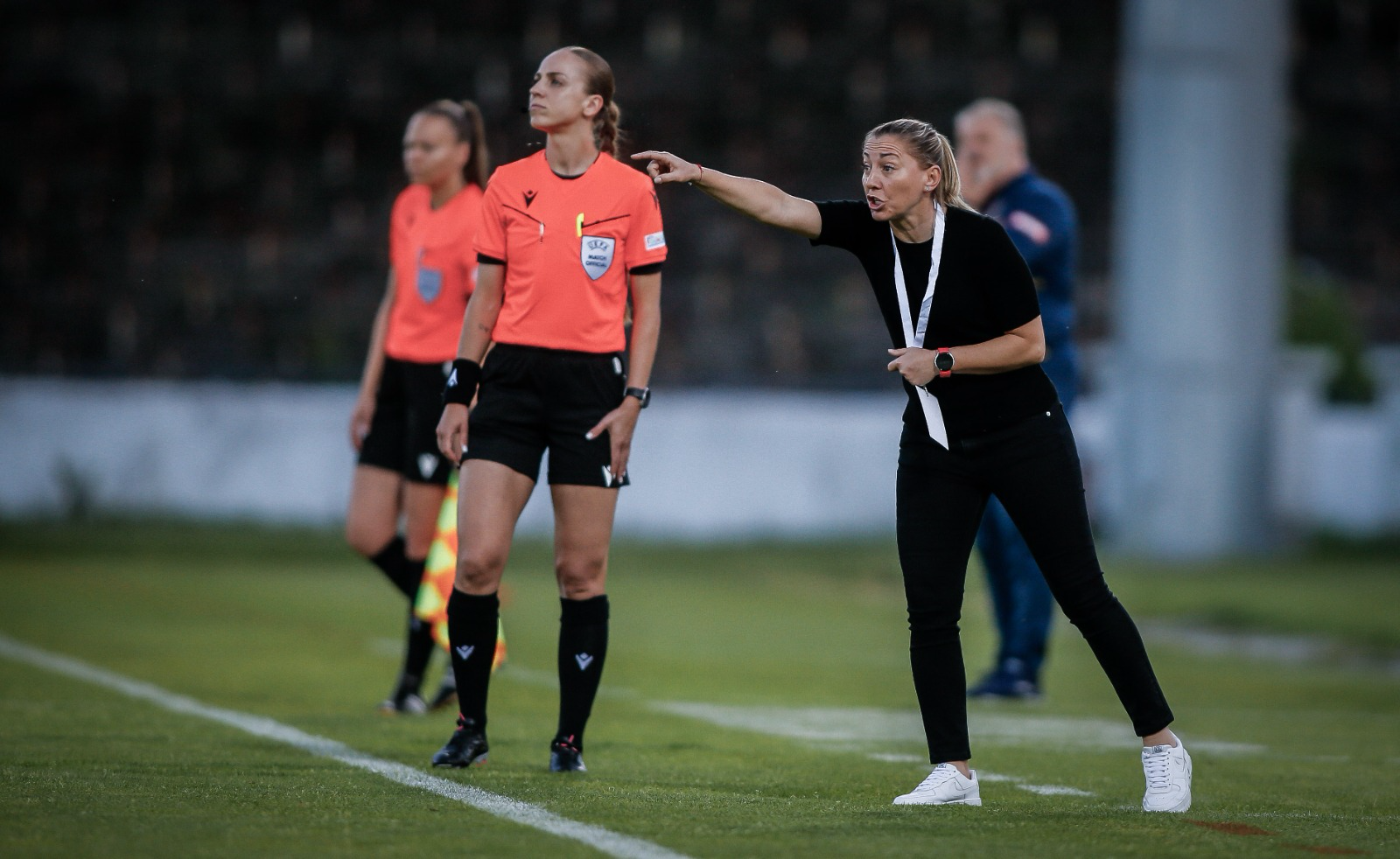
Profile
Role: Director of Women’s Football at PFC Ludogorets, Former Bulgaria Women’s National Team Head Coach
Specialisation: Women’s Football Development, Coaching, Leadership and Player Development
Experience: 17 UEFA Women’s Champions League campaigns, 150 international caps for Bulgaria
Focus Areas: Women’s Football Development, Education, Youth Development, Leadership and Inclusion
Introduction
Some careers demand your attention. Silviya Radoyska’s demands your respect.
Seventeen UEFA Women’s Champions League campaigns. One hundred and fifty caps for her country. Bulgarian Player of the Year. National team head coach. PhD. Director of Women’s Football at PFC Ludogorets. She has been a player, a captain, a scholar, a coach, and a leader.
At every single stage, she gave everything she had. She fought for respect when it was not offered. She built programmes when resources were scarce. She developed players, educated coaches, and carried a vision for Bulgarian women’s football long before anyone else could see it clearly.
Women’s football in Bulgaria has never been an easy path.
Now, with genuine investment behind her, now officially champions of Bulgaria, and a UEFA Women’s Champions League place on the horizon, the landscape is finally catching up with her.
The question Bulgarian football is asking is not what Silviya Radoyska has achieved. It is what she is about to do next.
Key Insights
- Silviya Radoyska has represented Bulgarian women’s football as a player, coach, academic and director.
- Her leadership focuses on long-term development, education and sustainable growth in the women’s game.
- PFC Ludogorets’ investment in women’s football could become a major turning point for the Bulgarian game.
Our Exclusive Interview with Silviya Radoyska
You have been inside Bulgarian women’s football your entire adult life as a player, a captain, a coach, an academic and now a director. Which version of yourself has surprised you the most?
The version of myself that surprised me most was the leader I became away from the pitch. As a player, I understood responsibility, discipline, and sacrifice. But when you become a coach, a lecturer, and later a director, you realise that leadership is no longer about your own performance. It becomes about creating an environment, inspiring people, protecting players, and helping others grow.
What surprised me most was discovering how resilient and adaptable I could be under pressure. Women’s football in Bulgaria has never been an easy path. Over the years I learned to lead not only with ambition, but with patience and persistence. Today I see football not only as a sport, but as a way to create opportunity and change lives.
Today I see football not only as a sport, but as a way to create opportunity and change lives.
From captain on the pitch to head coach on the touchline, you’ve led Bulgaria from both sides of the white line the same football, same country, two completely different worlds. How did you make that shift, and how did the second chapter feel different from the first?
The transition from captain to head coach was emotionally far more difficult than people imagine. As a player, you fight from inside the game. You influence moments directly with your energy, your voice, your decisions on the pitch. As a coach, the responsibility shifts entirely. You must guide, analyse, support, and make difficult decisions while standing outside the action.
The second chapter felt lonelier at times, but also more meaningful in a different way. Coaching forced me to understand football on a deeper level, psychologically, tactically, and educationally. It also taught me how much communication and trust matter. Being a captain taught me how to lead a team. Being a head coach taught me how to build one.
Behind your PhD on the “Selection and Initial Training for Adolescent Women Football Players “, was there a personal question driving it, something you experienced as a player that needed answering, and did you find what you were looking for?
My research was deeply connected to my personal experience as a football player growing up in Bulgaria. When I was young, there were very few structured development systems for girls, little scientific methodology, and almost no long-term vision for female players. One question stayed with me for years: how many talented girls are lost simply because nobody guided them correctly at the right age? That question became one of the driving forces behind my PhD research.
I wanted to understand how selection, education, and long-term development for adolescent female players could be improved, not only physically and technically, but psychologically. I believe I found many answers, but the most important lesson was this: talent alone is never enough. Young players need support, education, patience, and an environment that truly believes in them.
Talent alone is never enough. Young players need support, education, patience, and an environment that truly believes in them.
Women’s football still fights for recognition in many parts of Europe. What has been the hardest barrier you’ve personally had to break through the one people outside the game rarely see?
The hardest barrier is often not financial or structural. It is the mentality. In many places, women in football still have to prove their competence twice as much to receive half the trust. People see the matches, the results, and the public face of the game. What they do not see is the constant battle for respect, resources, and long-term belief.
There are moments when you feel you must continuously justify why women’s football deserves investment, attention, and professionalism. For me personally, one of the biggest challenges was refusing to let those limitations define my ambition. Instead of focusing on what was missing, I focused on building something meaningful with the opportunities we had.
Four years leading the Bulgarian women’s national team meant carrying the expectations of an entire football community. Was there a specific moment where you truly felt the emotional weight of that role?
There were many emotional moments, but one of the most powerful came during the national anthem before international matches. In those moments, you realise you are no longer representing yourself. You represent players, coaches, young girls dreaming of football, and an entire community pushing for progress.
There were also difficult periods. Defeats, criticism, and moments when results did not reflect the effort happening behind the scenes. Those moments carry real emotional weight because the care is genuine. But the role changed me in the best possible way. It taught me resilience, emotional control, and responsibility. Even in the hardest moments, I tried to protect the players and keep belief alive inside the team.
You have visited women’s football programmes across Europe through UEFA , did those experiences make you rethink everything you thought you knew about developing the women’s game, and if so, how?
Visiting clubs and programmes across Europe through UEFA was genuinely eye-opening. I saw environments where women’s football is treated with complete professionalism, from infrastructure and academy structures to sports science, analysis, and long-term strategic planning.
What shifted my perspective most was understanding that success in women’s football is never accidental. It is always connected to vision, education, and patience. But those experiences also reinforced something equally important: local identity matters.
Bulgaria should not simply copy other countries. We need to build our own model rooted in our culture, our mentality, and our realities, while continuing to learn from the best examples Europe has to offer.
Walking Football, Disability Football, Erasmus projects, international conferences you have never stayed inside the boundaries of the game. What pulls you towards the parts of football that others overlook?
I believe football belongs to everyone. That is what draws me most to projects like Walking Football, Disability Football, and Erasmus initiatives. These areas remind us that football is far bigger than competition and results. It can create confidence, social connection, education, and dignity for people who are too often overlooked.
Sometimes the purest values of the game exist exactly in those places, the ones without cameras, pressure, or financial interests. For me personally, these experiences always restore perspective and remind me why I fell in love with football in the first place.
Ludogorets investing seriously in women’s football is a significant moment for Bulgaria. What message does that send to the country and what pressure does it place on you personally as Director of Women’s Football?
First, I want to express genuine gratitude to the owners of PFC Ludogorets, Kiril and Georgi Domuschievi, for believing in the idea of developing women’s football within the club and giving us the opportunity to build it in a professional and sustainable way. What matters most to me is that behind this project there is not simply a desire to participate.
There is a clear vision, strong ambition, and genuine support. The environment, infrastructure, and working conditions created at the club demonstrate exactly what women’s football can become when it is taken seriously and approached with long-term commitment.
Today we stand one step away from achieving a historic first league title for the women’s team, which would give PFC Ludogorets the opportunity to compete in the UEFA Women’s Champions League, gain valuable international experience, and measure ourselves against some of the best clubs in Europe. That would be invaluable not only for the development of this team, but for the growth of women’s football in Bulgaria as a whole. It also brings greater responsibility. To keep raising the level, to build something sustainable, and to prove that success is never accidental. It is always the result of daily work, professionalism, and a clear long-term vision.
The fact that PFC Ludogorets is investing seriously in women’s football sends a powerful message to the entire country. When a club built on a winning mentality decides to back the women’s game, it changes perceptions. It raises expectations. And honestly, I welcome that pressure.
Pressure means responsibility, and responsibility means people are finally paying attention. My goal is not only to build a successful team, but to create a sustainable structure that inspires young girls and helps lift women’s football in Bulgaria to a completely different level.
If you could send one message to every decision maker in Bulgarian football, every chairman/chairwoman, every federation official, every sponsor, about what women’s football needs right now, what would you say?
I would tell them Women’s football does not need temporary attention. It needs long-term commitment. The talent, the passion, and the potential are already there. What the game needs now is belief, education, infrastructure, and consistency. Investment in women’s football should never be viewed as charity or obligation. It is an opportunity to develop the game as a whole.
And most importantly, think beyond today’s results. Real progress happens when you invest in young players, coaches, academies, and development structures over many years. Not just one season.
When you close your eyes and imagine Bulgarian women’s football ten years from now, what do you see and what is the one achievement that would make every single moment worthwhile?
When I imagine Bulgarian women’s football ten years from now, I see full academies, stronger infrastructure, professional environments, and far more young girls who genuinely believe that football can be their future. I want to see Bulgarian clubs competing consistently in Europe and the national team becoming a force internationally.
But beyond results, I want to see respect. Respect for female players, coaches, and every professional working within the game. If we reach a point where young girls in Bulgaria no longer have to fight simply for the right to dream about football, then every difficult moment along this journey will have been worth it.
FAQ
Who is Silviya Radoyska?
Silviya Radoyska is a former Bulgarian international footballer, coach, academic and Director of Women’s Football at PFC Ludogorets.
What is Silviya Radoyska known for?
She is known for her leadership in Bulgarian women’s football, including over 150 international caps and her work developing the women’s game in Bulgaria.
What role does Silviya Radoyska currently hold?
She currently serves as Director of Women’s Football at PFC Ludogorets.