

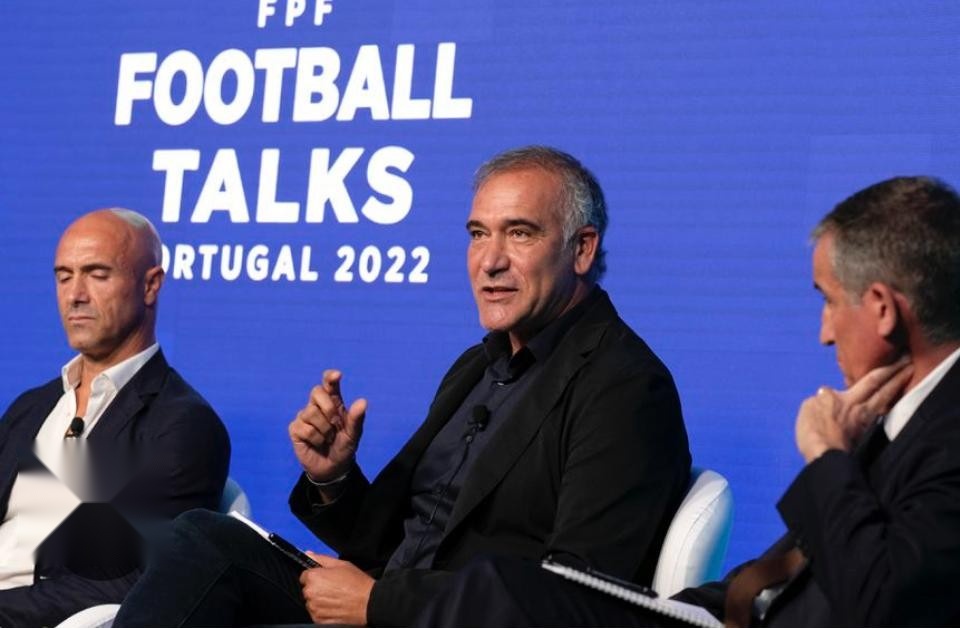
Profile
Role: Sporting Director at CSKA Sofia
Specialisation: modern player development, academy leadership, and club organization
Experience: elite European football environments, international academies, and top-level strategic roles
Focus Areas: strategy, evaluation, talent, academy excellence, and structural clarity
Biography
Paulo Noga represents one of the most experienced and structurally driven football executives when it comes to modern player development, academy leadership, and club organization. With a career spanning elite European football environments, international academies, and top-level strategic roles, he embodies a profile that combines technical expertise, organizational leadership, and long-term vision in football development.
Holding the Portuguese citizenship, Noga built his professional foundation both academically and practically. He has a strong sporting background, having played professional football for 12 years in the Portuguese first and second divisions. Alongside his playing career, he developed a robust academic profile with a university degree in Sport and Physical Education Sciences, specializing in high-performance football. He further strengthened his expertise through a Sports Director qualification and postgraduate studies in technical direction, creating a solid theoretical base that complements his extensive practical experience.
His career reflects a rare combination of academy excellence and executive leadership at top clubs. At FC Porto, one of Europe’s most respected talent development institutions, he served as Academy Director, leading the full restructuring and strategic direction of the club’s youth system. His work included implementing development models, scouting structures, coaching education, and international partnerships, contributing to one of the most efficient player production systems in European football.
“DEFINE WHAT WE WANT. UNDERSTAND WHAT WE HAVE. KNOW WHAT WE NEED. TEACH WHO MATTERS. EVALUATE WHAT WE DO. NURTURE WHAT WE CREATE.”
He later brought this expertise to the global stage through roles such as Academy Director at Shandong Luneng Taishan in China, where he built and coordinated large-scale development structures, and as Technical Coordinator at Paris Saint-Germain, where he developed the strategic plan for implementing the academy’s technical model and elite player development framework.
Most recently, at Sporting Clube de Portugal, Noga operated at executive level as Head of Strategy, Evaluation and Talent. In this role, he was responsible for organizing, training, and evaluating a structure of 370 staff members, including scouts, coaches, team managers, and sports psychologists. He oversaw national academy structures, evaluation models, and long-term player development strategies, focusing on aligning scouting, training methodology, performance analysis, and organizational processes into one unified system. His work reinforced Sporting’s position as one of Europe’s leading talent factories.
His work reinforced Sporting’s position as one of Europe’s leading talent factories.
In 2025, he took on the role of Sporting Director at CSKA Sofia, further expanding his leadership scope to the full club structure, strategy, and performance alignment. His responsibilities included building a highly competitive professional team, maximizing the potential of existing players, and helping them reach their full capacity. Recognizing that team performance is closely linked to organizational structure, he also led a broader restructuring of the club. This included creating clear career pathways within the organization, implementing strategic planning processes, and integrating sporting operations across all levels. His work emphasized establishing a culture of excellence, passion for success, and meritocracy across every department.
“I BELIEVE THAT THE LEVEL OF AN INSTITUTION CAN BE ASSESSED BY THE QUALITY OF ITS ORGANIZATION!”
What distinguishes Paulo Noga is not only the breadth of his experience but the consistency of his methodology. His approach is built on the belief that the quality of a football institution is defined by the effectiveness of its people, processes, and structure. He focuses on creating environments where talent is developed systematically, departments operate in alignment, and decisions are driven by both data and long-term strategic thinking.
Throughout his career, he has contributed to the development of high-level players such as Diogo Dalot, Vitinha, Diogo Costa, and Warren Zaïre-Emery, highlighting his impact within elite player pathways.
In addition to his operational roles, Noga has been active as an international speaker and contributor to football education. He has participated in UEFA and ECA programs, as well as international seminars across Europe, Asia, and the Middle East. His involvement in the ECA Academy Management Program further reflects his position within the highest level of strategic football leadership.
Across all stages of his career, a clear identity emerges. Paulo Noga is not only a football executive but a system builder with a holistic view of both the player and the process. He is a leader who understands that sustainable success in modern football is created through structure, alignment, and the continuous development of both players and people within the organization.
“I BELIEVE IN CONTINUOUS REGULATION!”
With his combination of international experience, academic foundation, and executive leadership, he represents a profile capable of shaping football institutions at the highest level, particularly in environments seeking long-term identity, academy excellence, and structural clarity.
Key Insights
- Paulo Noga combines academy leadership with executive football management.
- His work is centered on structure, alignment, and long-term player development.
- He has led strategic football projects across Europe and Asia.
Our Exclusive Interview with Paulo Noga
You have worked in some of the most respected development environments in world football, including FC Porto, PSG, and Sporting CP. What are the fundamental structural elements that differentiate elite academies from average academies?
There is a connection between these three major clubs, and I can say that the same applies to all the world’s leading organizations: the vision and ambition to truly be the best.
There are different development models and philosophies, but generally there is a triangle that reflects this vision: concept, staff, and structural conditions. I had the privilege of experiencing and building upon different concepts throughout my career.
This includes both physical and human structural conditions. On one side, the quality of infrastructure such as training fields, gyms, and facilities. On the other side, the quality of human resources, including coaches, technical staff, and support services. The concept itself is typically linked to the club’s culture.
All clubs face challenges and limitations. Sometimes they are financial, sometimes related to the internal structure or the early stages of a project, and sometimes connected to the competitive environment, which may not allow players or teams to reach their full potential.
What truly differentiates organizations is how they solve these challenges, how consistently the model is applied, and how well the process is respected. Creativity, combined with a results-oriented mindset, is essential to finding the right solutions and achieving defined KPIs.
Success is directly linked to the objectives and the club’s philosophy. Ultimately, the key difference lies in the ability to achieve the goals defined within each development project.
For some organizations, team performance is the main benchmark. For others, the focus is on maximizing individual player potential, even if short-term results are not the priority. Increasingly, and often driven by financial realities, there is a stronger emphasis on promoting academy players into professional football. Clubs that achieve this consistently tend to position themselves at the highest level.
Your career combines academy leadership and executive roles such as Sporting Director. How do you ensure alignment between long-term player development and short-term first-team performance demands?
This is an excellent question, and I believe it represents one of my key strengths. I understand the full lifecycle of a player, from early development to professional football and even life after a sporting career, as I have personally experienced each stage.
Using both practical experience and academic knowledge, I define structured pathways for each phase of a player’s career. This involves stratifying the development process, ensuring that every stage is clearly planned and aligned.
Even players approaching the end of their careers require a strategic approach. Clubs and sporting directors must always consider this phase, as it is important for both the individual and the organization.
From youth development to first-team integration and post-career transition, every stage should be supported by a clear strategy tailored to the individuality of each player.
At the same time, I believe youth development should not be driven by the volatility of professional football, which is heavily influenced by results. Instead, we must develop players who can adapt to different tactical models, as well as coaches and staff who are capable of understanding and applying multiple playing styles.
There is an important distinction between development models and playing models, and this is a topic that deserves deeper reflection.
The challenge is to separate these concepts without disconnecting them. A clear strategy for integrating players into the first team during the final phase of development is essential. Ultimately, each player should represent one of three outcomes: a sporting asset for the first team, a financial asset through transfer value, or a social asset as an individual with strong values who can contribute to the game in other roles.
At Sporting CP, you were responsible for strategy, evaluation, and talent across the entire system. How do you design a unified football identity that connects scouting, coaching, and performance departments?
In my view, the creation of this department was a very positive step.
I joined at a time when the board and president had a clearly defined objective, which I consider one of the fundamental pillars of success: knowing exactly where you are going. The club was emerging from a turbulent period and needed restructuring, particularly in its core identity as a talent development institution.
The department included 370 staff members, making it the largest within the club. I understood that if properly structured and organized, it could become the driving force of the entire organization, which ultimately proved to be the case.
I implemented seven hierarchical levels and four communication layers, introduced job grading aligned with the wider club structure, and defined maturity stages within the organization.
Working closely with the board, sporting director, and academy leadership, the academy once again became a central pillar of the club. This is clearly reflected in the number of young players reaching the first team.
Designing processes also means developing the people responsible for executing them. It is essential to understand both strengths and limitations. Tools such as SWOT analysis support decision-making and strategic planning.
If different departments can align their strengths toward a shared objective, it represents a major step forward. Adaptability within human resources plays a key role in implementation speed. Open and flexible structures allow for more agile organizations.
Misalignment between departments creates uncertainty and inefficiency. While shared decision-making is important, it is equally important that leadership is prepared to make final decisions when necessary.
Clear communication and process transparency allow for better understanding of both individual and team performance. Planning, collaboration, and integration between departments are essential, particularly when managing players transitioning to professional football.
You have built development structures across Europe and Asia. How do cultural and organizational differences influence the way you implement football methodologies?
This is a very common mistake in football: ignoring culture.
I do not believe in copying and applying concepts directly. In most cases, it does not work. Instead, I believe in adapting concepts while maintaining the same ultimate objective.
Even within the same country, differences can be significant. My experiences at FC Porto and Sporting CP clearly showed this. Two clubs in the same country, yet with very different models.
Respecting these differences is essential. Even small variations in work habits can lead to major challenges if not properly understood.
The correct approach is to fully understand the context, including the club’s philosophy, social environment, and competitive structure. Based on this understanding, and aligned with the vision of ownership or leadership, the strategy should be designed to maximize existing strengths and introduce necessary structural improvements.
In my view, the project should not adapt to human resources. Instead, human resources should adapt to the project. This distinction is critical.
Transitions must be carefully managed, as changes often create uncertainty. People need time to adapt to new processes, and this must be considered in any transformation strategy.
Modern football requires the integration of data, performance analysis, and human development. How do you balance analytical frameworks with the human side of leadership?
Technology is essential in modern football, and it is impossible to ignore its role in improving processes and performance. Players themselves are increasingly integrated into digital environments.
However, we must be careful in how we use data. Simplicity in interpretation is key. Data should support decision-making, not complicate it.
If data is not understood or used by coaches, it loses its value. Technology still lacks human sensitivity, which remains essential in leadership and player development.
Data should be used as a support tool, not as the final decision-maker. Performance can only be fully understood when data is contextualized.
Data storage and sharing platforms should be adapted to the user, providing clear and timely information. I strongly advocate for the individualization of these tools to maximize their effectiveness.
Having led large-scale projects at executive level, what type of environment would allow you to create the greatest long-term impact in your next role?
This is a difficult question, as many variables are involved. However, the vision I carry for my next project can be summarized clearly:
“A football club in the world of football, for the football world.”
In other words, a project that not only aspires to be among the best but also seeks to contribute to the development of the game itself.
FAQ
Who is Paulo Noga?
Paulo Noga is a football executive and Sporting Director with extensive experience in academy leadership, strategy, evaluation, and talent development.
Which clubs has Paulo Noga worked for?
He has held roles at FC Porto, Shandong Luneng Taishan, Paris Saint-Germain, Sporting Clube de Portugal, and CSKA Sofia.
What is Paulo Noga known for in football?
He is known for building structured football environments focused on player development, organizational alignment, and long-term strategic planning.