

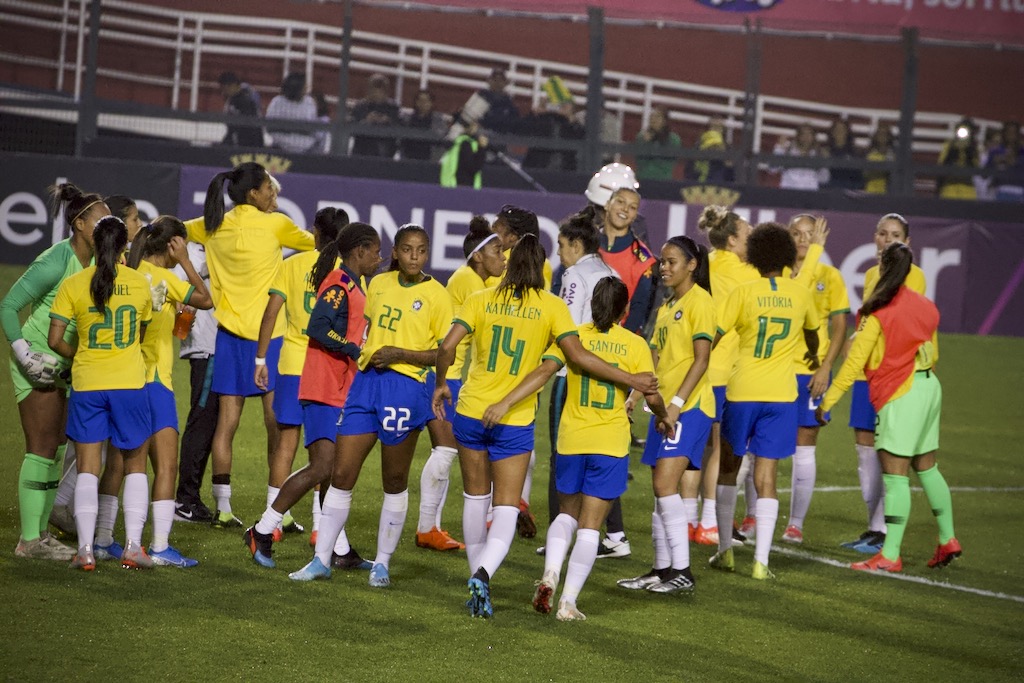

Previously, here at The Football Week, women’s football coverage focused on the South American U-20 Women’s Championship, in which the four best teams in the competition Brazil, Ecuador, Colombia, and Argentina, qualified to represent South America at the 2026 FIFA U-20 Women’s World Cup, which will take place from September 5 to 27 in Poland.
Latin American teams, especially Brazil and Colombia, already have a strong history of participation and competitive performances at the FIFA U-20 Women’s World Cup. The expansion of qualification spots and the gradual structural development of women’s youth football systems indicate a clear trend toward even stronger performances in the coming years.
The success of Brazil’s U-20 team comes from somewhere. In South America, Brazil stands out for having one of the most well-structured U-20 women’s national competitions: the Campeonato Brasileiro Feminino Sub-20. Today, this article analyzes the competition and its importance in the development of women’s football in Brazil.
Today, this article analyzes the competition and its importance in the development of women’s football in Brazil.
The competition featured 24 teams divided into six groups during the first stage. Across approximately 80 matches played between March and May, more than 370 goals were scored, resulting in an impressive average of 4.7 goals per game. In total, around 500 players were registered throughout the tournament. Among the main clubs competing in the Campeonato Brasileiro Feminino Sub-20 are Flamengo, Internacional, São Paulo, Corinthians, Palmeiras, and Ferroviária, strong and traditional clubs in Brazilian football.
What is important to highlight is that the tournament revealed some significant trends in the development of women’s youth football in Brazil. Matches became more physically intense, teams demonstrated greater tactical organization, and there was a strong presence of players regularly called up to youth national teams. In addition, clubs have increased their investment in women’s football development this year, especially in areas such as sports psychology, performance analysis, nutrition, and physical monitoring. These structural improvements show that clubs are beginning to treat women’s youth development with greater professionalism and long-term vision.
These structural improvements show that clubs are beginning to treat women’s youth development with greater professionalism and long-term vision.
In this context of growing investment, the Confederação Brasileira de Futebol confirmed a 10% increase in participation payments for the U-20 competition, along with a structural reorganization of the calendar for 2026. The federation also expanded live coverage of the tournament, mainly through CBF TV, with all matches streamed online for free, generating greater visibility for the women’s game. Today, the Campeonato Brasileiro Feminino Sub-20 has become one of the main showcases for the Brazil Women’s National Under-20 Football Team, opportunities in the international market, the transition from youth to professional football, and sports scholarship opportunities in the United States.
At the same time, clubs are increasingly recognizing the value and potential of women’s football by investing in more organized and professional structures. Palmeiras is one of the clearest examples of this movement.
Following the transfers of the players Amanda Gutierres, whose move in 2025 became a record deal worth 1.1 million dollars plus bonuses for 80% of her economic rights to Boston Legacy, the club invested approximately R$ 23.4 million in its women’s football department in 2026.
Palmeiras also introduced an innovative structure inspired by the club’s traditional “Academia de Futebol” and by leading Spanish clubs, featuring facilities focused on performance, recovery, and athlete development. The project includes a gym, recovery areas, and an auditorium, reinforcing how investment in women’s football is no longer limited to the field, but also extends to infrastructure, professionalism, and long-term development.
Women’s football in Brazil is clearly making progress, especially in the youth categories, and this evolution becomes more visible every year. The level of competition, club organization, athlete preparation, and professional opportunities continue to grow. However, it is still a slow process. While clubs such as Palmeiras are setting important examples through investment and structure, they remain exceptions rather than the standard. The potential of Brazilian women’s football is undeniable. The country continues to produce talented players, competitive national teams, and athletes capable of succeeding internationally. But the question remains: imagine how strong Brazil could become if more clubs invested in women’s football with the same seriousness, planning, and long-term vision. The future is promising, but the real transformation will only happen when this commitment becomes collective rather than isolated.
The future is promising, but the real transformation will only happen when this commitment becomes collective rather than isolated.
References
- https://www.cbf.com.br/futebol-brasileiro/noticias/campeonato-brasileiro/sub20/cbf-anuncia-novo-calendario-do-futebol-feminino
- https://ge.globo.com/futebol/times/palmeiras/noticia/2026/02/07/palmeiras-investira-r-23-milhoes-no-futebol-feminino-e-tem-centro-de-excelencia-perto-de-inauguracao.ghtml