

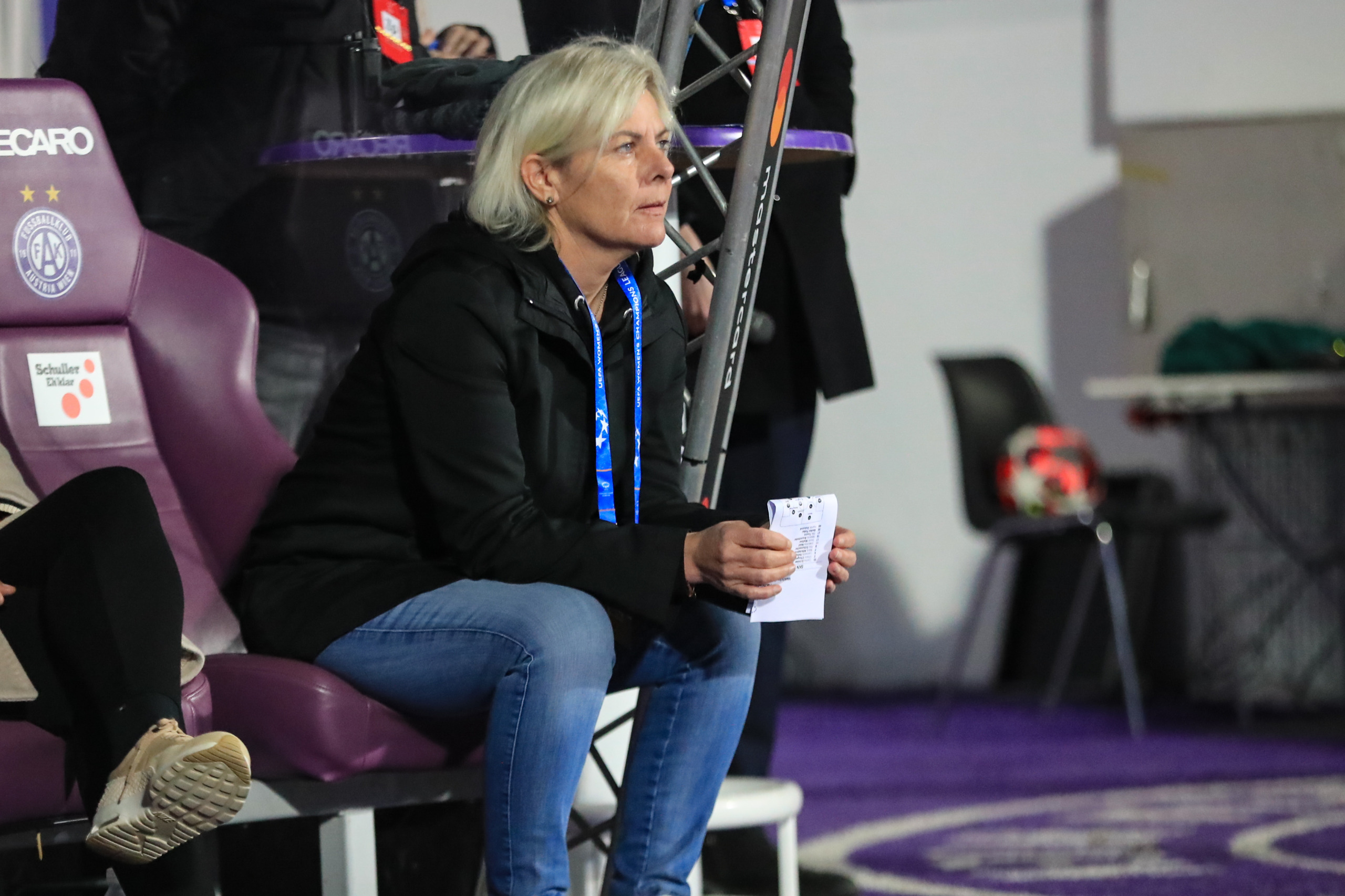
Profile
Role: Sporting Director and Managing Director at SKN St. Pölten Frauen
Specialisation: Strategic leadership, club building, sustainable success in women’s football
Experience: Player at second division level in Germany, head coach, Sporting Director, Managing Director, UEFA Women’s Champions’ League group phase, promotion to the 1. Bundesliga with three different clubs
Focus Areas: Institutional vision, squad planning, leadership, recruitment, long-term competitiveness
Biography
In women’s football, there are managers who win titles and then there are those who transform clubs entirely.
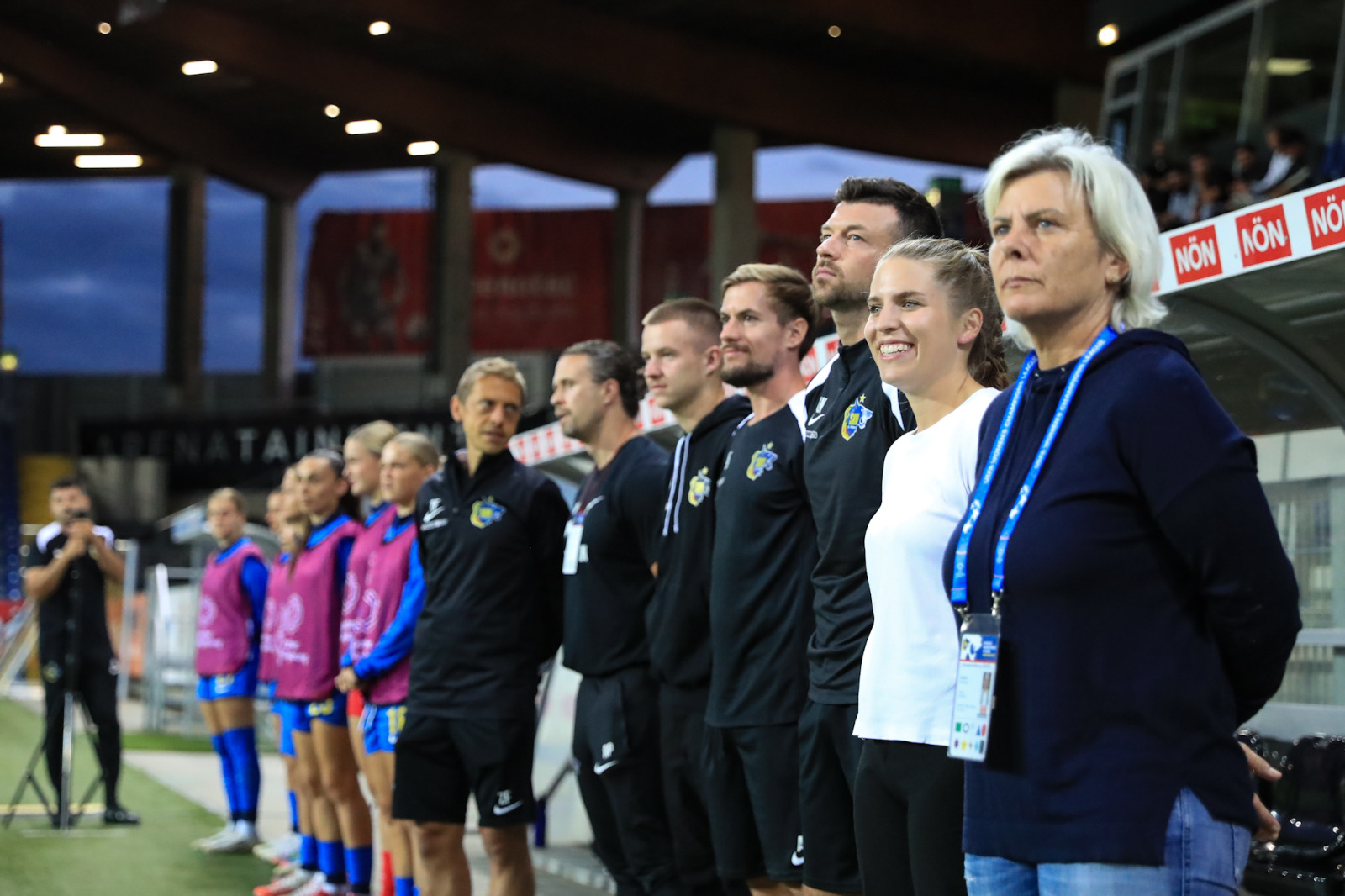
Because sustaining success at the highest-level demands far more than tactical knowledge. It requires strategic leadership, institutional vision, and the proven ability to build organizations that compete, season after season, on the domestic and European stage. Tanja Schulte has done both, repeatedly, and at every level of the game.
Tanja Schulte has done both, repeatedly, and at every level of the game.
She began her journey as a player, competing at second division level in Germany before stepping into coaching, where she wasted little time making her presence felt. Over the course of her career, she has achieved promotion to the 1. Bundesliga on three separate occasions, with three different clubs. Not once. Not twice. Three times. As Sporting Director and Managing Director at SKN St. Pölten Frauen, she has taken a club to the UEFA Women’s Champions’ League group phase for four consecutive seasons, establishing an Austrian side as a genuine force on the European stage. She is a builder. A strategist. A leader who has spent over two decades proving that sustainable success in women’s football is not a matter of luck, it is a matter of vision, structure, and an uncompromising commitment to excellence.
She is a builder. A strategist. A leader who has spent over two decades proving that sustainable success in women’s football is not a matter of luck, it is a matter of vision, structure, and an uncompromising commitment to excellence.
Key Insights
- Tanja Schulte has built sustainable success across coaching and executive leadership in women’s football.
- Her work at SKN St. Pölten Frauen reflects strategic planning, resilience, and long-term institutional vision.
- She believes trust, authenticity, and realistic targets are central to leadership and club development.
Our Exclusive Interview with Tanja Schulte
Running a club at this level sounds amazing and easy from the outside. Take us inside a typical day. What does it really demand of you? Are there any parts that still surprise you, and what are the pressures people never, see?
Running a club is far from a one-dimensional role, and it is certainly not delivered on individual effort alone. It is driven by a small, dedicated team of Michaela Rydl, Mike Kraaibeek as Team Manager, and me. Without support from other departments or specialist roles, all responsibilities and tasks inevitably fall to one of us.
Running the club is a constant demand with no real time to reset and with no quiet periods. Licensing runs from December through to March and demands close attention to detail throughout. As soon as it ends, the focus shifts straight to squad planning, assessing the current group, identifying gaps, and handling player registrations. It’s a demanding phase that requires strong organisation and clear, long-term thinking.
Then comes the season itself and organising the season, which brings a layer of complexity. Coordinating fixtures, match preparation, managing travel logistics and delivering the critical behind-the-scenes administration that underpins the entire competitive structure.
With the format of UEFA competition now incorporating multiple qualification rounds before reaching the league phase, we can be looking at as many as 24 matches before Christmas alone. So, when people ask whether it ever gets boring or whether there are quiet periods to recover, the answer really is no.
Running the club is a constant demand with no real time to reset and with no quiet periods.
You were released twice as a head coach, at Wattenscheid and Herforder SV, yet each time you returned and built something stronger. Those moments are rarely discussed publicly in football. How did those experiences shape your approach to leadership and decision-making.
Football has always been a results business, which is not a new reality. What has changed drastically is the speed, not just of the game itself, but of the decisions being made and how quickly judgments are formed, justified, and concluded. This accelerated pace is not limited to the women’s game. Patience is shorter than ever, which means you have to be clear from the start about what is realistically achievable and the timeframe to deliver it.
I accepted both dismissals without resentment because they were honest outcomes. We had not reached our sporting targets. When results do not come, the consequences follow.
In a results-driven environment, there’s no room for unrealistic targets or not staying true to yourself. What matters is clarity, honesty, and leadership that reflects who you truly are. For me, this experience presented me with a clear and obvious message: which was to set achievable and realistic targets and stay authentic.
You’ve won promotion to the Frauen-Bundesliga three times with three different clubs. There must be a clear method behind it. What does it take to build a team capable of promotion, and why do so many clubs struggle despite having similar ambitions.
If there is a method, relationships are at its core. With around 95% of the players I’ve worked with, the connection has been one of genuine, mutual trust. Enjoyment, fulfilment, and resilience drive them to fight not just for their own goals, but for the collective.
Many players have told me that they didn’t just enjoy playing, but that fulfilment came from fighting for the coaching staff. Fight, grit, resilience and enjoyment are key factors for a team that fights for each other; it is stronger than one that fights only for itself. Of course, relationships and resilience are not the whole picture. In decisive moments, you also need a bit of luck and recognising both realities is essential.
You transitioned from head coach to sporting director and now managing director. What did you have to sacrifice at each stage, and is there a moment from the dugout you still miss and carry with you?
The first transition was when I moved from head coach to sporting director in Germany. It meant appointing someone to take on the role I had occupied, and the person I chose was Imke Wübbenhorst, who at that time was still an active player, holding only an A-Licence. By most conventional measures I trusted what I saw and made a decision. She managed to get her UEFA Pro Licence and has since won titles in Switzerland. Moving into squad planning and organisational responsibility required me to let go of the direct involvement I had become accustomed to.
As managing director, the scope has expanded further, but the essential nature of the work is not entirely different. What has changed most profoundly is perception. I still sit on the bench. But from a different angle, I see the game in a way I simply did not when I was coaching. The view is clearer, more neutral, more complete. You notice things from a different lens. It is a perspective that cannot be taught, only earned through making the transition, and once you sit in that position, you truly understand this sensation and viewpoint. And once you experience it, you truly understand the profound difference that stepping back can make, not just in how you see the game, but in how you lead.
Before football became your full-time career, you spent nearly two decades in pharmacies, healthcare administration, and insurance. What did those years teach you that football alone never could, and where does it show up in the way you lead a club today?
Working with people has always been central to everything I do, no matter the industry. Accountability in these environments is a must, especially within such industries; getting things right truly matters.
Through all of this, I have led authentically. I don’t know if a harder approach, or if there is a more concrete style and method that would have delivered more success on paper or in reality, maybe it would. But I’ve never had to be someone I’m not, always sticking to who I am, and that has given me a sense of morality, authenticity and confidence. No matter the outcome, I can always look at myself in the mirror, and for me, that has always mattered more than anything else.
I’ve never had to be someone I’m not, always sticking to who I am, and that has given me a sense of morality, authenticity and confidence.
SKN St. Pölten faces European giants every season with far more resources. How do you build a squad and a structure that can compete on that stage? And what have you learned about smart recruitment that many bigger clubs seem to ignore?
For many years, SKN St. Pölten had the enormous advantage of Wilfried Schmaus as president, a genuinely strategic thinker. In his final years, I learned a great deal from him.
What we have built here, without serious financial backing, is something genuinely exceptional. Every season we battle through multiple UEFA qualification rounds while simultaneously meeting all the compliance and infrastructure requirements that European competition demands. If you simply compare the number of staff operating at our level internationally, the disparity is enormous, and that is before you even begin to look at budgets.
We have no financial umbrella to fall back on. Every euro this club spends is a euro this club has first had to earn. That is the reality we operate within, every single day.
Established clubs with deep roots and real financial power, the likes of Austria Wien being the obvious example, are fully committing to their women’s sections. We have always been clear about what that means for us: once that happens, competing for the same players and the same standards becomes extraordinarily difficult.
The market is moving too. Players are leaving earlier, drawn to leagues where the financial rewards are significantly higher. The pool we have always recruited from is shrinking, and the competition for what remains is intensifying. The pressure is coming from every direction at once. The question is no longer if things get harder, but how long we can maintain this level.
You hold a DFB A-Licence and have coached at every level. Yet the pathway for women in football leadership remains narrow. What needs to change most, and what would you say to a young woman aspiring to follow your path?
I have always had a straightforward view on quota systems, and the current FIFA coaching regulations are no different. The best person should get the job irrespective of gender. If the person is not the strongest candidate, then a quota should not be the thing that decides it. Merit is that standard and should be the only standard of justification. Quotas should never substitute for quality. This approach ensures quota systems are fair, non-discriminatory, and that every judgment upholds credibility and legitimacy. That is my view, it always has been, and it will not change.
You took a full sabbatical in 2020. What prompted that break, what did you discover about yourself, and did you return as a different person or simply with a clearer sense of purpose?
The pause in 2020 came as a result of COVID, rather than any professional issue or need to step back.
During the lockdowns, I spent extended periods away from my family. And over time, you recognise that something important has been missing, which made it a challenging period personally.
When restrictions eased, I made a conscious decision to address I took the time to reconnect and restore time lost. What I gained was that It provided an opportunity to reset, and I returned with renewed energy and a full tank. Stepping away fully, without compromise, allowed me to come back completely present and ready.
FAQ
Who is Tanja Schulte?
Tanja Schulte is Sporting Director and Managing Director at SKN St. Pölten Frauen and a long-standing leader in women’s football.
What is Tanja Schulte known for?
She is known for leading clubs to promotion, building sustainable structures, and establishing SKN St. Pölten Frauen on the European stage.
What defines Tanja Schulte’s leadership approach?
Her leadership is defined by authenticity, realistic target-setting, strategic thinking, and long-term institutional vision.