

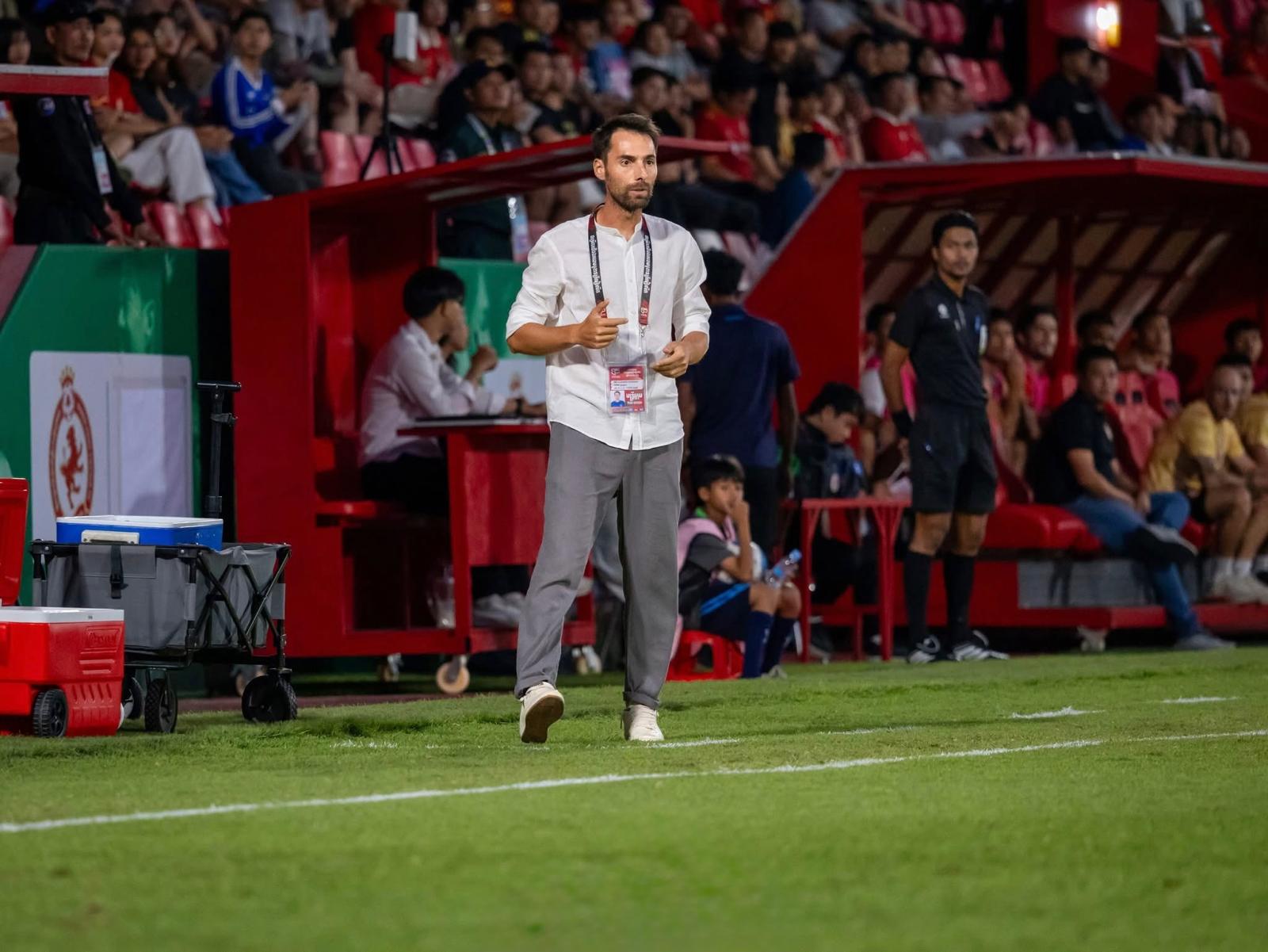
Alex Dorado has built his career by developing players who now compete in Europe’s top leagues. With over 20 years of technical experience, including six seasons at Real Madrid and work with the Spanish National Team, the Spanish coach combines a strong academic background, a UEFA Pro License, and a Master’s degree in Sports Science with hands-on experience across four continents.
His professional journey includes working alongside Rafa Benítez at Dalian Pro in China, Vesa Vasara at FC Honka in Finland, and Stephen Hart at HFX Wanderers in Canada, before taking on head coach roles in South Africa and, currently, Cambodia. Players developed under his guidance now represent clubs such as Real Madrid, Atlético de Madrid, Sporting CP, Getafe, and Lecce.
Alex Dorado’s philosophy is centered on individual development through a rigorous methodology. A specialist in talent identification and the application of big data to football, he builds teams with a clear offensive identity based on ball possession, mobility, and high pressing, while adapting tactical principles to the characteristics of the available players.
Fluent in Spanish, English, and Portuguese, and currently studying French, Dorado brings multicultural experience that facilitates the integration of South American, African, and Asian players into European contexts. In Cambodia, he leads a competitive team that has surprised local title favorites, reinforcing his track record of delivering results with limited resources.
His stated ambition is to return to Europe, where his technical education began and where he believes his methodology, tested across different continents and competitive levels, can generate sustainable impact.
Our exclusive interview with Alex Dorado
You started coaching at 16. What made a teenager decide he wanted to lead adults on the pitch?
Everything starts with the family environment. I grew up surrounded by football, and I believe that all coaches who reach a certain level share this. A passion that begins in childhood, whether through playing with friends or through family influence. That love for the game leaves a lasting mark.
When, at 16 or 17, you realize that your future as a player will not go much further than playing for passion and enjoyment, you start looking for a more professional path that allows you to stay connected to football for life. That is where this love for the sport takes shape and where that solution emerges. Deep down, it was less a rational decision and more a necessity. I needed to be on the pitch in some way. I discovered that leading, developing players, and building teams fulfilled me just as much as playing would have.
Deep down, it was less a rational decision and more a necessity. I needed to be on the pitch in some way.
Six years at Real Madrid developing generations of players. When you see Gonzalo García at Real Madrid, Pablo Barrios at Atlético de Madrid, or Iván Fresneda at Sporting, what does that represent for you as a developer?
For me, it represents the greatest joy, the greatest of trophies. Seeing players who passed through my hands, whom I worked closely with, achieve success and reach the goals they had set for themselves. But above all, because each of the three you mentioned shares values. Values that represent me as a coach and that represent the vast majority of players I have worked with. The value of hard work, the value of sacrifice, the value of humility.
Players who, from a very young age, were focused on daily improvement and personal growth. They were not the best players in our squads, but they fought to get there, they fought to improve. Seeing them where they are today makes me very happy.
Working with Rafa Benítez at Dalian Pro put you alongside one of the most analytical coaches in modern football. What was the biggest lesson you absorbed from him that you still apply today?
There are two very clear lessons I learned from him that I continue to apply on a daily basis. The first is understanding the environment, and the second is the management or control of everything surrounding a football team.
The first, understanding the environment, comes from a phrase he told me in 2007, during my first visit to England when I visited him in Liverpool. He said that the most important thing when arriving at a new club is to first understand the country, then the city, to understand the club, its surroundings, and what is happening around it. To understand the football culture of that environment. Not necessarily to adapt to it, but to take it into account when making future decisions as a coach.
The second lesson is having an overall understanding of the club for a simple reason. Football is not based solely on what happens on the pitch. It is based on a multifunctional working group, where the results achieved on the field are largely the sum of many other factors. How the player feels, how we behave, how we manage the relationship between player and club. The players’ needs, not only in daily training, but also at home, outside training hours. The player recruitment process, how we handle future contracts, salaries, and contractual decisions.
He is someone who oversees the club as a whole, what in England is referred to as a “manager.” He always made me understand that it was necessary to have awareness of everything happening around the team. Not to control in an authoritarian sense, but to understand what is happening in order to make better decisions or help in difficult moments, or to offer solutions in areas that go beyond football but can still create problems.
You have said it is important to act as both manager and head coach. How do you balance these two roles?
First, by building trusted working groups that have the freedom to carry out their functions, while you provide them with a global vision of what the club wants to be.
The difference between being only a coach and being a manager is understanding that the club is an organism. Marketing cannot work in isolation from scouting. The medical department must be aligned with physical preparation. When you have this global vision, you can anticipate problems before they explode in the dressing room or in the results.
It is not about controlling everything, but about knowing what is happening. That allows you to adjust direction before it is too late.
At Black Leopards, 75% of the squad had never played professionally. In Cambodia, you work with players who had no space at their previous clubs. How do you turn inexperienced players into competitive athletes?
First of all, when we as coaches decide which players should be part of the squad and which should not, the decision is based much more on technical and tactical aspects than on a player’s name or origin.
Both in South Africa at Black Leopards and in Cambodia at MOI Kompong Dewa, when I started selecting the players we would keep, I never considered whether they had played in stronger or weaker competitions. I focused on identifying which players I believed had the potential to be part of the team. In the end, the numbers appeared naturally. Around 70 to 75 percent of those players in South Africa had never played professionally. In Cambodia, most of our current players come from clubs we compete against, clubs where they had no space and were not wanted in the squad. With us, they are performing at a very high level.
I am extremely happy to have selected them and to see how they continue their careers.
We look for specific characteristics in these players, in South Africa, here, and in any future project. Technical qualities, mental strength, attitude. A desire to improve, to progress, to work. The player ultimately positions himself within the squad or moves out of it. In the end, the pitch, the training sessions, and the matches determine who plays and who does not, who evolves and who does not.
We can talk about specific players. Vanda is the perfect example. In pre-season, he was not among the starting players, and today he is the league’s top Cambodian scorer. The pitch decides who plays, not the player’s past.
Fluent in Portuguese, Spanish, and English, you have coached across four continents. How has this cultural versatility changed the way you lead dressing rooms?
At the end of the day, everything is built on the understanding that communication is the most important element in a dressing room. There is no translator filtering intensity or tone. When you correct a mistake in Portuguese with a Brazilian player, for example, the message arrives faster and more deeply.
I experienced this in China with foreign players, acting as the link between Brazilian players and Rafa Benítez. Today, I experience this directly within my own team. I am currently studying French to further expand this capacity for understanding and connection.
Your style is offensive, but you have worked with very different squads. How do you adapt attacking principles when you do not have the “ideal” players?
I believe there are certain principles in football that every player is capable of executing. Defensively, every player can evolve and improve their efficiency. Offensively, this is not always the case. Sometimes technical limitations prevent the creation of certain patterns within the group.
Above all, I try to be efficient as a coach and to ensure the group responds to the game in a way that produces positive results and daily improvement.
What are the key elements of my game model? For me, the main element is pressure. High pressing. Another fundamental point is having the ball or the capacity for ball possession. Not necessarily as a direct offensive tool to score goals, because we know many goals come from very fast transitions, two or three seconds, sometimes four or five at most, with two or three passes. Instead, possession is important to rest, to be well positioned, and to recover the ball as quickly as possible.
I always try to base possession on the players’ characteristics. If they are suited to keeping the ball in the opponent’s half, then we do it there. If not, we find the zones where they can keep possession, rest, and adapt as a group to individual characteristics. This allows each player to grow within the collective and within a game model that can change depending on the moment.
You have proven your methodology in very different contexts. What technical challenge still drives you? What type of project keeps you awake at night?
I have always said that I want to work in the Premier League. And I know that many people tell me no.
When I was 16, my father told me no, you cannot be a coach. At 19, when I arrived at university and said I wanted to coach Real Madrid, some professors told me no, you cannot coach Real Madrid. When I was around 28 and already working at Real Madrid, I said I wanted to work with Rafa Benítez. Colleagues told me no, you cannot work with Rafa Benítez.
I have always received no’s. I have always heard no’s. You will never be a head coach, you will not, you will not, you will not. And I have taken all those no’s, put them into a box, and I use that box as energy. It is my battery.
And I have taken all those no’s, put them into a box, and I use that box as energy. It is my battery.
It is my battery to achieve my goals. And my goal is to coach, to work, and to become a head coach in the Premier League. And I’m certain that very soon, we will achieve it and be working there.