

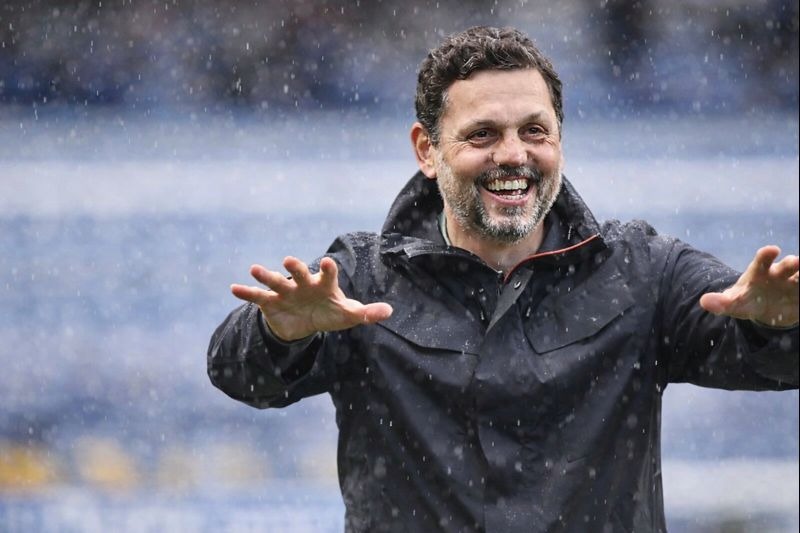
Background and playing career
Erol Bulut is a respected Turkish German professional football manager and former player with a wealth of experience across top tier leagues in Europe and beyond. Born on 30 January 1975 in Bad Schwalbach, Germany, he enjoyed a distinguished playing career as a left back and left midfielder, featuring in over 300 professional matches for clubs including Eintracht Frankfurt, Fenerbahçe, Olympiacos, Bursaspor, and OFI Crete.
As a player, he won major honours including the Turkish Süper Lig title with Fenerbahçe and league and cup successes in Greece with Olympiacos before retiring from professional football in 2012. After hanging up his boots, Bulut transitioned into coaching and quickly climbed the ranks. He began as an assistant coach at clubs such as Kartalspor, Yeni Malatyaspor, Elazığspor, and İstanbul Başakşehir before taking his first head coach role at Yeni Malatyaspor in 2017.
Managerial journey
There he notably kept the newly promoted club in the Turkish top flight and helped achieve a club record finish, qualifying for the Europa League playoffs. He then managed Alanyaspor, guiding them to the Turkish Cup final and a European qualification spot, and later took charge of his former club Fenerbahçe, one of Turkey’s biggest teams. His journey continued with Gaziantep FK and extended internationally when he was appointed head coach of Cardiff City in England’s Championship, achieving a respectable mid table finish in the 2023 24 season. After parting ways with Cardiff City in late 2024, Bulut returned to Turkish football, signing a two year contract with Antalyaspor in October 2025.
Coaching philosophy and credentials
His managerial experience reflects adaptability, tactical awareness, and a strong commitment to competitive performance across different football cultures. Known for his high tactical intelligence, focus on player development, and calm leadership, Bulut brings a blend of German structural understanding and Turkish football passion to his coaching.
With a UEFA Pro Licence and a preferred tactical approach that emphasizes balanced pressing and organised build up play, he is widely regarded as a coach capable of strengthening teams with clear identity and resilience. As of 2026, Erol Bulut is exploring his next professional opportunity, offering clubs a coach who combines international experience with a deep understanding of competitive league demands and long term player development.
Our exclusive interview with Erol Bulut
You have worked at different clubs in Turkey and abroad, from Yeni Malatyaspor to Cardiff City. How have these different experiences shaped your philosophy as a head coach and your approach to building teams?
Working in different leagues taught me that there is not only one correct way to play football. In Turkey, the game is often shaped by quick solutions and tactical flexibility, while in England the key factors are sustainable tempo and physical continuity. In the Championship, you must be able to play with the same intensity every week, which forces you to plan in a more realistic way.
In England, especially in the Championship, you play 50-55 matches in a season. This makes player rotation unavoidable. It is impossible to continue with the same players all the time. For this reason, you must build not only a strong starting eleven, but a squad of around eighteen to twenty players with very similar performance levels.
Building a team is not only about talent, but about continuity, physical endurance, and mental readiness.
This may sound easy in theory, but in practice it is extremely difficult. Players who come into the game must not lower the level of the team and ideally should maintain the same standard. This experience clearly showed me that building a team is not only about talent, but about continuity, physical endurance, and mental readiness.
Today, when building a team, I focus less on a player’s name or individual talent and more on how well he can perform his role with discipline and consistency over time. For me, the decisive factor is not whether a player plays well in one match, but whether he can carry the same responsibility throughout the season.
My experiences in different leagues also showed me that my football philosophy should not rely on a single culture. My current approach is based on a balanced and mature structure that combines the organizational discipline of German football with the creativity and problem solving ability of Turkish football. This allows me to build teams that control the game but can also react correctly in decisive moments.
At Alanyaspor, you reached the Turkish Cup final and qualified for European competition. What were the key principles behind that success, and how do you carry them into new projects?
The most important factor behind our success at Alanyaspor was that everyone clearly knew their role. Players understood when to take risks and when to stay patient. Our game plan was based on compact defending, stepping forward at the right moments, and being brave but organized when we had possession.
When I start a new project today, I first establish these basic principles. When a system is clear, players know what to do, when to do it, and why. This shortens decision making time and removes hesitation.
Players no longer play with the fear of making mistakes, but with the confidence of repeating the right actions. This confidence raises performance and reduces fluctuations. Players do not play one match very well and the next very poorly. They remain above a certain level. Once the system is established, individual performances also become more stable.
In modern football, leadership requires strong communication as much as tactical knowledge. How do you balance structure and flexibility during difficult periods in a season?
In modern football, no matter how good a tactical plan is, it can only be reflected on the pitch through communication. In difficult periods, what players need most is clarity and trust in what they are doing. For me, the priority is always to protect the main structure of the game.
Structure gives the team something to hold on to during uncertain times. Flexibility does not mean breaking the structure, but adjusting the details and the way the message is delivered. Not every player reacts the same way under pressure.
Some feel more comfortable with clear instructions, while others perform better when they are given responsibility. For this reason, while the system remains the same, the communication style must adapt to the player’s character.
In this context, the role of leaders on the pitch is very important. In difficult moments, the coach’s voice does not always fully reach the field. You need leader characters within the team who can stabilize and guide the group from inside the game.
Player psychology is at least as important as tactics in modern football.
Player psychology is at least as important as tactics in modern football. As a head coach, you must care not only about training and match plans, but also about the mental state of your players.
If there is no natural mentor in the team, the coach must take on this role. Following players’ psychology on a daily basis and intervening at the right moment is critical to overcoming difficult periods in a healthy way. This helps the team stay disciplined and united instead of falling apart. For me, leadership is not about changing rules, but about making sure everyone understands them correctly.
You have worked in different football cultures and environments. What have been the most valuable lessons for you in managing expectations from club management, players, and supporters?
Working in different environments taught me that expectations exist everywhere, but how they are managed differs from club to club. Club management looks for results and sustainability, players seek trust and clarity, and supporters want to see identity and fight on the pitch.
These three expectations do not always meet at the same point. The most important lesson for me was learning how to balance these expectations without completely giving up my own principles.
Open and realistic communication with management, clear roles for players, and showing supporters a team that reflects its identity on the pitch help create this balance.
It is very important to define goals clearly from the beginning to meet management expectations. Once a head coach is appointed, the transfer strategy must be planned according to the club’s short, medium, and long term goals.
Transfers should not be made based on names or short term needs, but on the desired playing identity and objectives. Without a transfer policy that fits the coach’s football philosophy, it is impossible to build a healthy and sustainable structure.
I also learned that if you constantly change direction based on external expectations, the team loses its identity. On the other hand, completely ignoring expectations creates a disconnect with the club and its community.
Therefore, the role of the head coach is not to pass pressure directly onto the team, but to filter it and deliver the right message to the pitch.
Looking ahead, what kind of club project and football philosophy best represent you, and how would you define your long term vision as a head coach?
The project that best represents me is one that does not lose direction under short term pressure, but aims to build a clear playing identity. What matters to me is not rewriting the story every season, but progressing step by step on a stable path.
My football philosophy is based on organized play, clear roles, and player development. I prefer to work in a structure that creates space for young players while maintaining balance with experienced ones.
Sustainable success is not measured only by results, but by the club’s football culture. My long term vision is to leave behind a system that can survive even after the head coach changes.
I want to build a structure where supporters know how the team plays, players understand why they have their roles, and the club’s identity is defined beyond results. For me, real success is building a football philosophy that continues after I leave.
Sometimes coaches are chosen because they fit an already functioning structure. In such cases, the expectation is not to change everything, but to protect and develop an existing culture.
Being able to analyze the current structure correctly, maintain its strengths, and make the right adjustments at the right time is just as valuable as building a completely new system. Wherever I go, I do not destroy everything. I analyze what works and try to improve it.