
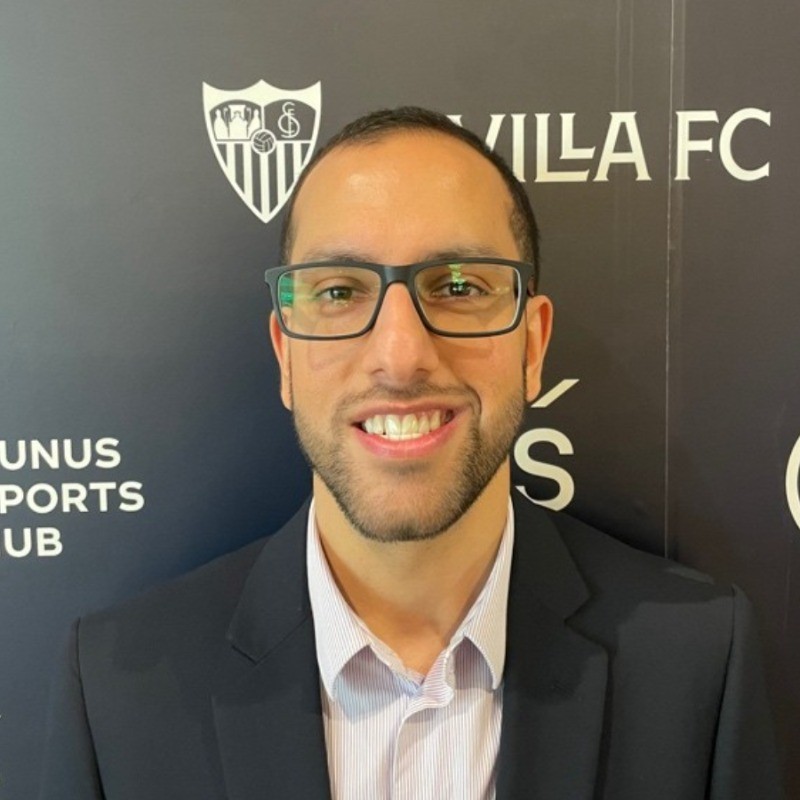
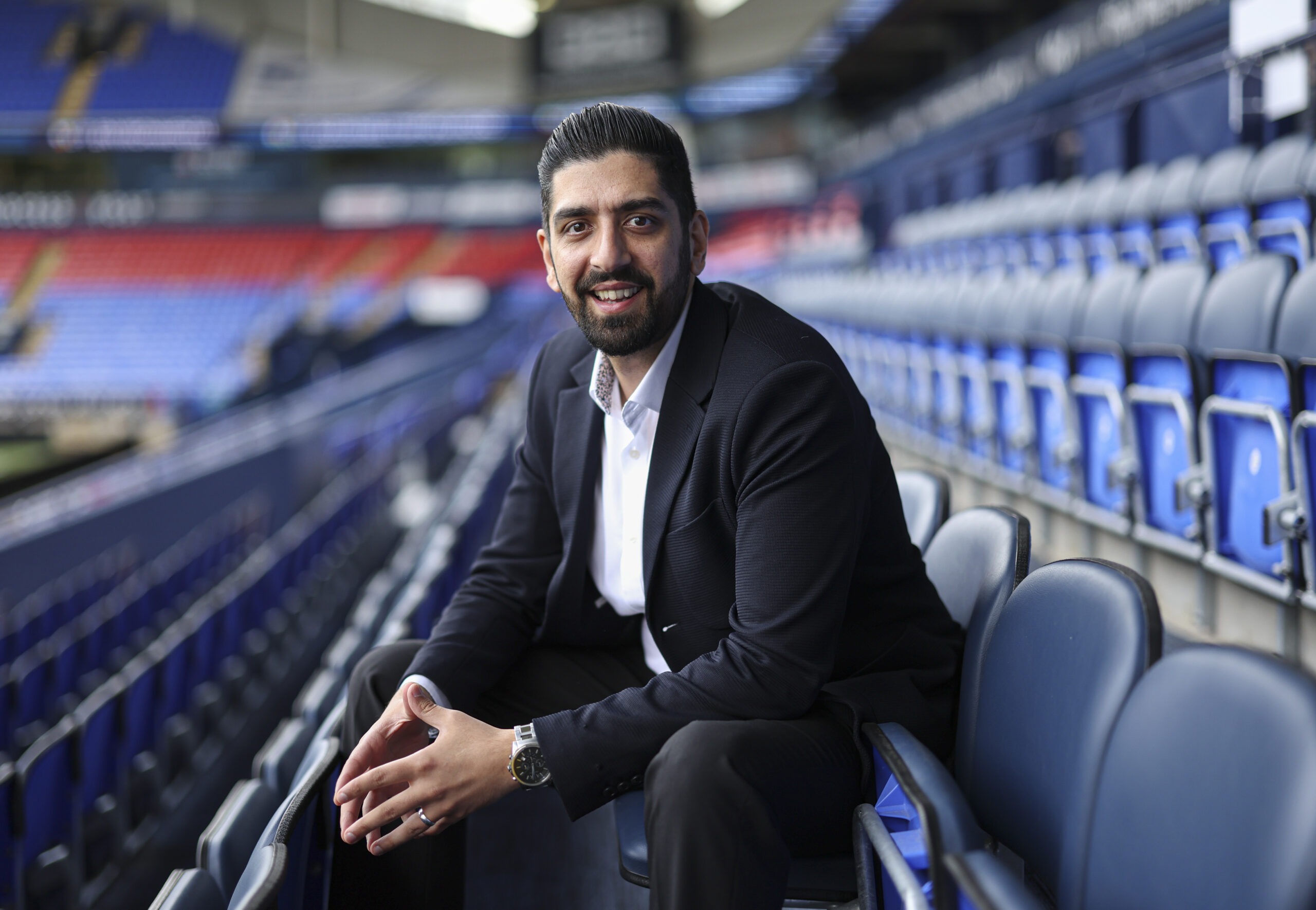
Who is Niaz Shazad?
Niaz Shazad is an accomplished CFO and football executive, most recently serving as Chief Financial Officer and Interim Co-Chief Executive at Bolton Wanderers Football Club. With over a decade of leadership experience across Premier League clubs, governing bodies, and sports organisations, he brings a rare blend of financial strategy, operational leadership, and sporting insight representing a new class of executive in the boardroom: values-driven, commercially astute, and unafraid to tackle the structural challenges holding the game back.
Chartered by ACCA and holding a Diploma in Global Football Sport Directorship from the PFA, Niaz has become a trusted figure in both financial and footballing circles, including the EFL, the FA, and UEFA. He stepped into dual leadership at Bolton during a pivotal period, driving a turnaround strategy centred on sustainability, innovation, and football-first operations.
Executive leadership across elite sport
Before Bolton, Niaz held senior positions at England Rugby and most recently City Football Group, where he worked closely with Manchester City’s executive team across both men’s operations and women’s football. He played a key role in structuring player transfers, commercial strategy, stadium development, financial governance, and landmark commercial events, including UEFA Champions League nights and world-record deals in the women’s game.
His professional journey also includes key roles across multiple sectors outside of football including retail, education, and fitness and leisure with organisations such as TES Global and Virgin Active, where he honed his skills in strategic finance, business transformation, and customer-focused operations.
Fluent in the language of both finance and football, and with experience across elite sport, commercial enterprise, and community-led strategy, he is well-positioned to contribute to forward-thinking organisations at home and abroad.
Advocacy, inclusion, and community impact
Beyond his club responsibilities, Niaz is a passionate advocate for representation and opportunity in football. He is currently mentoring several emerging leaders, graduated amongst the first alumni of the FA’s Kickstart programme, serves as a guest lecturer with the PFA, and designed work experience initiatives for underprivileged and underrepresented youth at CFG.Whether in the boardroom or the community, he leads with purpose, professionalism, and a belief in football’s power to create meaningful societal impact.
Fluent in the language of both finance and football, and with experience across elite sport, commercial enterprise, and community-led strategy, he is well-positioned to contribute to forward-thinking organisations at home and abroad.
Whether in the boardroom or the community, he leads with purpose, professionalism, and a belief in football’s power to create meaningful societal impact.
Our exclusive interview with Niaz Shazad
Who is Niaz Shazad outside of football?
I’m just a guy who loves sport. A Newcastle fan, a test-cricket tragic, and recently a bit obsessed with Padel. Outside of the spreadsheets and stadiums, I’m someone who values time with family and friends. I’ve got a newborn at home, so life’s been a bit of a blur lately in the best way possible. Football is my profession, but I try to stay grounded in the things that really matter.
You’ve held leadership roles across clubs, governing bodies, and commercial entities. What has shaped your executive approach the most?
It’s been a mix of great mentors and tough lessons. I’ve been lucky to work with great people across multiple sports from the Rugby Football Union to Manchester City, and now Bolton and each environment shaped me in different ways.
I try to take the best from leaders I’ve worked with, and those whom I admire from afar. Wasim Khan, for example, has been a huge influence and supporter. His calmness and clarity of vision is a tremendous asset in any room, which I’ve looked to adapt into my own style. Martyn Hawkins is another who I spent a great four years with and learnt much from in and out of the offices.
I’ve also worked under people whose styles didn’t necessarily align with mine, but that also teaches you something. Over time, you shape your own identity as a leader. Mine is very much built on listening first, making decisions second, and understanding that good leadership is about taking people on the journey with you, not just drawing up plans.
What was the biggest challenge you faced stepping into dual leadership at Bolton Wanderers, and how did you navigate it?
Well seeing the previous Chief Executive depart merely four weeks into my tenure, and subsequently being asked to step in for the foreseeable future wasn’t something I had envisaged ahead of joining.
Taking on both CFO and Interim Co-CEO roles meant wearing multiple hats and seeing the club from every angle. Inevitably, the biggest challenge was capacity, not just in time but in emotional and mental bandwidth.
What helped was doing a full audit when I joined, lifting the lid on everything from finance to football operations. It wasn’t about fixing things immediately, but acknowledging them, applying nuance and understanding the context of the specific environment before considering or proposing any recommendations.
It was then about building trust, working with good people who cared deeply about the club and giving them the clarity and tools to thrive and deliver.
From your time at City Football Group to Bolton, how do you adapt your financial and operational strategy to clubs at different levels of the football pyramid?
It’s like comparing a start-up to a global corporation. At City Football Group, everything is specialised and scaled. You’re working with huge global resources, and your focus is often narrow but deep. At Bolton, it’s broader, you wear more hats, but you also get to shape things more directly.
You can’t just copy and paste ideas from one club to another. Every organisation has its own assets, liabilities, culture, and community. What works at one club might fall flat at another. The key therefore is listening, learning quickly, and tailoring your approach. Some things translate like good governance, process, and accountability, but others need a fresh lens.
What do you believe is the biggest financial misconception clubs face in trying to balance competitiveness with sustainability?
Sustainability within Football is a nuanced conversation in itself, but sustainability doesn’t mean you cannot be ambitious. People often frame it as one or the other, but that’s a false assertion. You can be strategic and ambitious while still being responsible. It’s about timing, smart investments, and not chasing shortcuts. Every decision has to serve the long-term holistic health of the club, and key to that is finding the optimal balance between on and off-pitch. I’ve seen clubs throw money at player acquisitions / wages only for the player to visit a training ground and return in double quick time!
You’ve overseen everything from player trading strategies to major infrastructure projects. Which area of football operations do you think is most often undervalued by leadership teams?
The people. Honestly, it’s about investing in your staff, growing your people to grow your business. You can have the best mission/vision statements, the club’s motto plastered on walls, you can have the best strategy in the world, but without the right people in the right roles, it means little.
It’s also about recognising that leadership isn’t one-size-fits-all. You need to manage people differently based on who they are, not just what they do. That emotional intelligence (the soft skills) are just as important as technical know-how. Sir Bobby Robson used to illustrate the point expertly when he stated “some need an arm round the shoulder, other’s needed a kick up the ar*e!”.
Sometimes, tough unpopular decisions have to be taken, but it’s key there is alignment top-down, as well as support for said decisions. Football is a difficult industry with many an emotional reaction/decision, therefore calmness & clarity of vision and unity is all-important to ensure success, and that unity can only be achieved when trust is present amongst the people.
You’re a graduate of the PFA’s Global Sporting Directorship programme. How important is cross-functional knowledge (finance + sport) in today’s football leadership?
It’s essential. The days of staying in one lane are over. In my role, I’ve needed financial expertise, operational oversight, football knowledge, and leadership skills all in one. You’ve got to be able to talk to the head coach one minute, your finance team the next, and then a sponsor after that.
Being cross-functional is also about translation, helping different departments understand each other so they can row in the same direction. The language of finance is great, but if no-one understands your EBITDA’s and Amortisations, it’s of little value. I’m a big believer that leadership today is about alignment and empathy as much as it is about KPIs and budgets.
With Football operations evolving and becoming more sophisticated, it’s paramount you are able to understand the impact of a decision through multiple lenses as opposed to just your own lane.
Your involvement in The FA Kickstart and PFA mentoring initiatives highlights a commitment to inclusion. What change do you most want to see in football’s boardrooms?
I’m a big advocate of the need for greater representation. Not just for optics, but because it’s good business. The data’s there.
- Boston Consulting Group conducted a study in 2017 examining diversity and innovation. They found that companies with more diverse management teams have 19% higher innovation revenues.
- McKinsey conducted a comprehensive study in 2015 examining the relationship between diversity and financial performance. They found that companies in the top quartile for ethnic and racial diversity in management were 35% more likely to have financial returns above their respective national industry medians. In the UK, greater gender diversity on the senior-executive team corresponded to the highest performance uplift: for every 10% increment in gender diversity, EBIT rose by 3.5 percent.
- Within Football itself, Tottenham Hotspur, with their signing of Son Heung-min helped propel their global appeal significantly – around 12 million South Koreans, almost a quarter of the entire population – are estimated to be Spurs fans. Their friendly match against a K-League team in summer 2024 was the most streamed sporting event in the nation’s history, with 2 million viewers tuning in. South Korea is now the club’s second largest e-commerce market, making twice as many purchases as the USA.
These are not merely inclusive practices or statistics, it’s strategy.
But beyond numbers, it’s about opening doors. I’ve had moments in my career where someone took a chance on me. I want to be that person for someone else. We have to build boardrooms that reflect the communities our clubs serve, that’s how you build trust, relevance, and resilience.
What’s one leadership lesson you’ve learned from working in high-pressure environments?
Keep your head when others are losing theirs. Football is full of noise: results, emotions, media, and especially social media. But leadership is about clarity. It’s about separating the urgent from the important and not letting pressure push you into short-term thinking.
A further key learning personally over the last 18 months has been how as a leader, every moment counts. Walking to the office, going for lunch, into a meeting, or in the boardroom – your every action is being seen, heard and judged – the room often looks to you before you even speak. Your body language speaks way before you vocalise your thoughts, thus your composure in those moments sets the emotional temperature for everyone else.
Our receptionist pulled me up for walking in with a frown one morning, and asked if I’m ok. I wasn’t even aware, given I’d put in a 17hr marathon the day prior and was on limited sleep! But evident of the prior point, how you turn up at every moment is seen, so it’s paramount you bring your best version at every turn not to reflect any negative emotion or impact onto others.
If you do that, you’ll be well on the way to earning the trust and buy-in from those around you.
Looking ahead, what are your personal or professional priorities in football over the next few years?
Personally, continuing a progressive growth-oriented trajectory, whilst making time for those important moments with family & friends – I’ve been guilty in the past, as many others have, of sacrificing birthdays and key milestones, so finding a balance is important.
Professionally, I want to continue building environments that open doors. Whether that’s at Bolton or elsewhere in football, I want to create space for others like me to rise. I’d love to work abroad at some point, maybe in the Middle East, especially with everything happening around Vision 2030 and the 2034 World Cup.
And I want to keep using football as a platform to serve. At Bolton, we’ve done things like the BL1 initiatives, collaboration with MyLahore at the recent Bradford fixture, to bringing together hundreds from underrepresented communities to celebrate the game. That’s the kind of impact that lasts longer than a scoreline.
Final one, any book recommendations?
Many.
Legacy by James Kerr: essential reading. If you’re as fascinated by the All Blacks as I am, it’s a terrific read into the culture and psychology of what it means to put on that famous jersey.
Relentless by Tim Grover: it’ll challenge your mindset. Tim was the man who mentally built the likes of Michael Jordan and Kobe Bryant.
The 5 types of wealth by Sahil Bloom: A life manual of sorts on how to generate Time, Social, Mental, Physical, and Financial wealth. Great storytelling, great takeaways, and great wisdom.