
Profile
Role: Sporting Director of Atlético FC in Ecuador
Specialisation: Recruitment, player development, sporting methodology and the integration of internal management systems
Experience: More than two decades of experience in Ecuadorian and South American football
Focus Areas: Governance, financial sustainability, talent pathways, organizational culture
Building a football club is one challenge. Building an entire football ecosystem, capable of connecting social development, youth formation, professional competition and long-term sustainability, is something entirely different. It is precisely this challenge that has come to define the work of William Poveda.
With more than two decades of experience in Ecuadorian and South American football, Poveda brings a perspective shaped by both playing and managing the game. He played college soccer at Notre Dame College in Ohio, was part of Ecuador’s U17 national team preliminary squad, competed in Ecuador’s second division with Calvi FC and played in USL League Two with West Virginia Chaos. His subsequent career has extended well beyond the pitch: he served as Director of Competitions at the Ecuadorian Football Federation (FEF), worked as a CONMEBOL match delegate and acted as country coordinator for the FIFA/CIES executive programme in Ecuador. Together, those experiences exposed him to the sporting, regulatory, institutional, operational and academic dimensions of professional football.
Those experiences helped shape a conviction that continues to guide his work: football in Latin America needs less improvisation and more structure.
Today, as Sporting Director of Atlético FC in Ecuador, Poveda is applying that philosophy to a project whose ambitions extend far beyond the results of its first team.
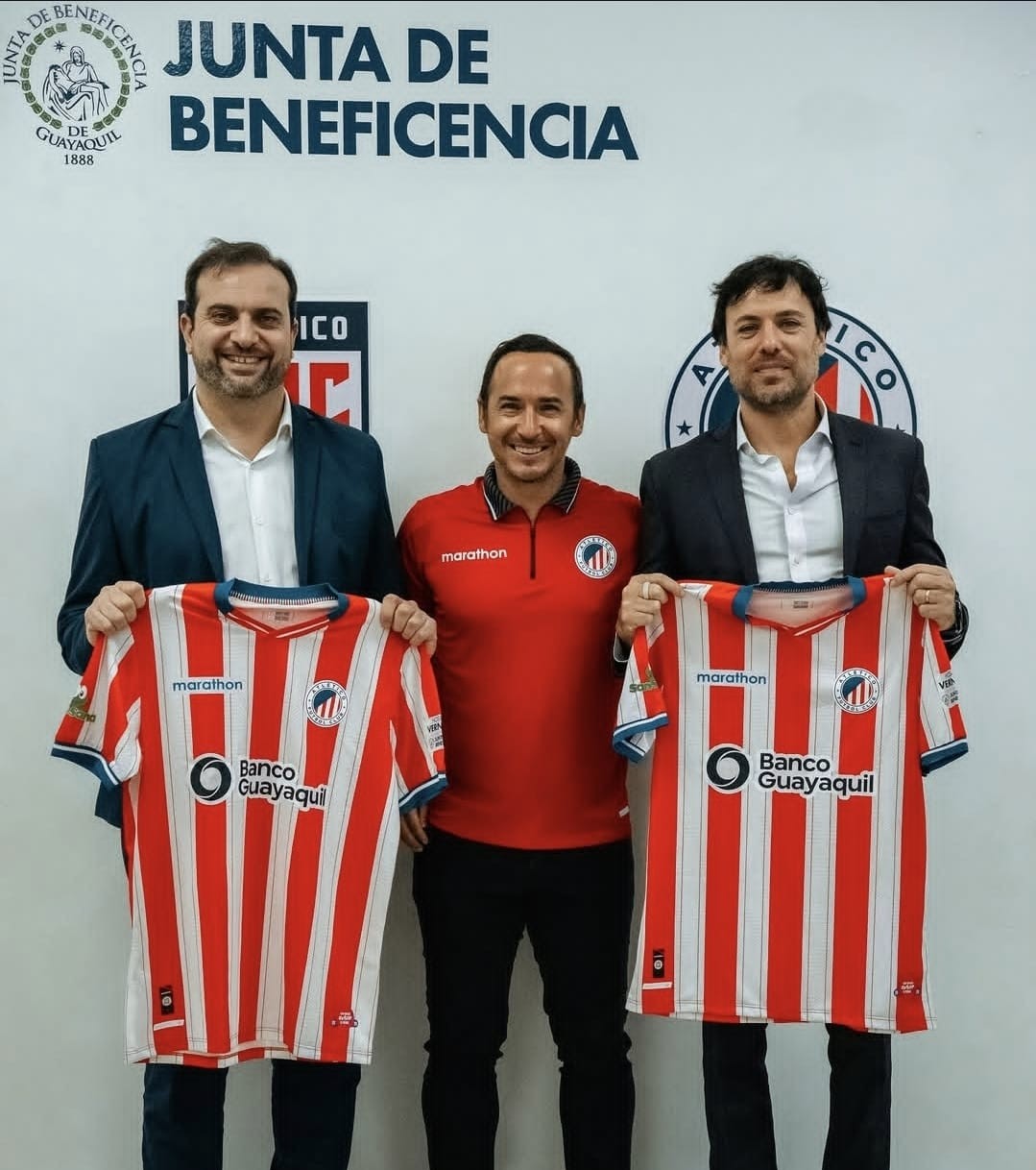
Developed within the broader social and institutional framework of the Junta de Beneficencia de Guayaquil, Atlético FC forms part of an initiative designed to use football as an instrument of opportunity and social transformation. The project has grown from community-based sporting programmes into an interconnected development structure that has reached more than 13,000 young people across Ecuador.
But its significance lies not simply in the number of participants.
The initiative connects grassroots football schools, higher-performance academies, youth teams and professional competition, creating a pathway through which young players can progress from their local communities towards the professional game. Its sporting structure also benefits from a relationship with Atlético de Madrid, incorporating elements of the Spanish club’s youth development methodology and international experience.
At the centre of this ecosystem is the Ciudad Deportiva Carlos Pérez Perasso in Guayaquil-Ecuador, a sporting complex featuring 14 football pitches and facilities dedicated to player development. Yet for Poveda, infrastructure represents only one part of the equation. The greater challenge is ensuring that every element of the organization operates within a coherent sporting, financial and institutional strategy.
His work therefore extends across recruitment, player development, sporting methodology and the integration of internal management systems. By connecting scouting processes, performance analysis and financial planning, Poveda is helping establish a decision-making structure in which competitive objectives and long-term sustainability are not treated as separate priorities.
This approach is particularly relevant in a region where football clubs frequently face financial constraints, institutional instability and pressure to deliver immediate results. For Poveda, the solution is not simply to identify better players or invest more resources, but to create organizations capable of making better decisions consistently.
That approach has now delivered an important sporting milestone. In its first season in professional football, Atlético FC won the Ecuadorian Serie B championship and secured promotion to the country’s top division. For Poveda, the achievement is not the end of the project but a test of whether competitive success can be sustained without compromising the developmental and institutional foundations on which the wider organisation has been built.
Poveda’s journey also reflects an increasingly important evolution in the role of the modern sporting executive. Beyond transfers, recruitment and first-team performance, football leadership now requires an understanding of governance, financial sustainability, talent pathways, organizational culture and the wider responsibilities clubs can assume within their communities.
For someone who has experienced football from its regulatory institutions to the daily realities of building a sporting organization, success cannot be measured exclusively through league positions, player sales or trophies.
It must also be measured through the structures left behind, the opportunities created and the ability of an organization to continue growing beyond the individuals responsible for building it.
William Poveda’s story is therefore not simply about guiding Atlético FC to a championship and promotion to Ecuador’s top division. It is about a broader question facing football across Latin America: how do you build institutions capable of winning today while creating lasting value for the generations that follow?
Key Insights
- Strong institutions and consistent decision-making connect sporting ambition with financial responsibility.
- Atlético FC links community programmes, youth development and professional football within a shared sporting philosophy.
- Technology supports recruitment decisions, while human expertise and contextual understanding remain essential.
Our Exclusive Interview with William Poveda
Your career has taken you from playing football in Ecuador and the United States to the regulatory and administrative side of the game, including the Ecuadorian Football Federation and CONMEBOL, and then to the development of a sporting project. What have those different experiences taught you about the structural weaknesses of football organisations in Latin America, and which principles have been most important when building Atlético FC?
Throughout my career, I have had the opportunity to experience football from different perspectives, from institutional governance and competition management at the Ecuadorian Football Federation to international football operations with CONMEBOL, academic leadership in the Ecuador FIFA CIES program and other several consultancy roles for local and regional companies, and now the responsibility of developing the sporting area of a professional football project.
These experiences have reinforced one fundamental conviction: Latin American football does not lack talent; it often lacks the institutional structures, strategic continuity, and professional management required to transform that talent into sustainable sporting and economic value.
Too often, clubs operate under short-term pressures, with sporting decisions disconnected from financial planning, youth development, and long-term institutional objectives. Leadership changes frequently translate into changes in philosophy, personnel, and strategy, preventing organizations from building continuity.
At Atlético FC, we have approached the challenge from a different perspective. Our priority has been to establish a clear sporting identity, professionalize decision-making processes, develop an integrated organizational structure, and align competitive ambitions with financial responsibility.
These experiences have reinforced one fundamental conviction: Latin American football does not lack talent; it often lacks the institutional structures, strategic continuity, and professional management required to transform that talent into sustainable sporting and economic value.
I strongly believe that successful sporting management requires a balance between football knowledge, institutional leadership, and business discipline. Having the right people, clearly defined responsibilities, measurable objectives, and a culture of accountability is just as important as identifying talented players.
Ultimately, my philosophy is that “strong institutions create the conditions for sporting success, rather than depending exclusively on sporting results to build an institution.”
Atlético FC is part of a broader ecosystem connected to the Junta de Beneficencia de Guayaquil, reaching more than 13,000 young people through football development programmes. How do you translate such a large social initiative into a genuine pathway towards professional football, and how do you measure success beyond the number of players who eventually reach the first team?
One of the most interesting aspects of our project is precisely the opportunity to connect social impact with professional football development through a structured and sustainable model.
Through the Junta de Beneficencia de Guayaquil, we have an ecosystem that has reached more than 13,000 young people, with the Ciudad Deportiva Carlos Pérez Perasso and its 14 football pitches providing an important infrastructure platform.
However, our objective is not simply to increase participation for social impact, the real challenge is transforming access into opportunity, and opportunity into a clearly defined development pathway while benefiting our local communities by providing a safe environment for our players that allows them to stay far from the dangers of the streets.
We are working to connect grassroots football schools, talent identification programmes, development academies, competitive youth categories, and ultimately professional football within a common sporting philosophy.
This requires consistent coaching methodologies, qualified technical staff, structured scouting processes, individual player development plans, and continuous evaluation. Our relationship with Atlético de Madrid represents an important opportunity to strengthen this model through knowledge exchange, international expertise, and the incorporation of proven development practices adapted to our local reality.
Success must be measured at different levels. Naturally, we want to develop players capable of competing professionally, representing Ecuador internationally, and eventually accessing international markets. But we must also evaluate player progression, educational development, retention, coaching quality, competitive exposure, and the opportunities we create for young people who may never become professional footballers.
Not every child will reach the first team, and that should never be the only definition of success.
If we can develop better footballers, create opportunities for families, strengthen our communities, and establish a consistent pipeline of Ecuadorian talent, we will have built something much more valuable than a traditional football academy.
At Atlético FC, you have worked on integrating scouting, performance analysis and internal management systems into the club’s sporting structure. How do you approach the challenge of turning information into better recruitment and squad-building decisions, and what role do you believe technology should play in helping clubs with limited resources become more competitive?
For me, the fundamental principle is that information only becomes valuable when it improves the quality and consistency of our decisions.
Football has evolved significantly in terms of technology, data collection, video analysis, physical performance monitoring, and scouting platforms. However, having access to more information does not automatically mean making better decisions.
At Atlético FC, our approach has been to integrate these resources into a coherent sporting management process, connecting scouting, coaching, performance analysis, medical and physical preparation and financial planning.
Recruitment, for example, should never be based exclusively on statistics, recommendations, or isolated performances. We evaluate players through a combination of technical and tactical characteristics, physical performance, competitive context, personality, development potential, economic feasibility and a deep player “due diligence” that includes learning more about the player’s behaviors, habits, family background and entourage.
For me, the fundamental principle is that information only becomes valuable when it improves the quality and consistency of our decisions.
Equally important is understanding how a player fits our playing model, the existing squad, and the club’s medium-term objectives.
Technology plays a particularly important role for clubs operating with limited budgets. It can help reduce uncertainty, identify undervalued talent, monitor player development, improve workload management, and support more efficient resource allocation.
Nevertheless, I believe technology should complement human expertise rather than replace it. Data provides evidence, but experience, observation, and contextual understanding remain essential. We have an exceptional team of talented individuals in the sporting area that supports this decision-making process.
In Latin America, where financial resources are often limited, competitive advantage will increasingly come from the ability to identify, interpret, and act on information more effectively than competitors.
The objective is not to have the largest scouting department or the most expensive technology, but to build an intelligent organization capable of making better decisions consistently.
Atlético FC has now won the Ecuadorian Serie B championship and secured promotion to the top division in its first professional season. Your wider philosophy, however, places considerable emphasis on long-term structures and sustainability. Looking five to ten years ahead, what would make you consider this project truly successful beyond these achievements, and what lessons could other clubs across Latin America take from its development?
Winning the Ecuadorian Serie B championship and earning promotion to the first division in Atlético FC’s first professional season is an important milestone for everyone involved in the project. It reflects the shared vision and work of the experienced executives leading the Junta de Beneficencia de Guayaquil and the many professionals who have contributed to building the club.
However, I have always believed that promotion should be understood as part of a larger process, not as the final destination.
Looking five to ten years ahead, I would consider this project truly successful if Atlético FC has established itself as a competitive and financially responsible professional club, with a recognizable sporting identity, a strong organizational culture, and a sustainable model for identifying, developing, and promoting Ecuadorian talent.
I would like to see an institution where youth development is genuinely connected to the first team, where players have opportunities to progress into international football, and where the sporting department operates through established processes rather than depending on individual personalities.
However, I have always believed that promotion should be understood as part of a larger process, not as the final destination.
Our relationship with Atlético de Madrid also provides an opportunity to build international connections, exchange knowledge, and progressively raise our professional standards.
From a financial perspective, success would mean creating a model where sporting performance, player development, commercial growth, and responsible investment reinforce one another and that ultimately the financial success goes towards a greater purpose of long term sustainability.
I also believe that the social dimension of the project must remain central. Through our relationship with the Junta de Beneficencia de Guayaquil, we have an opportunity to demonstrate that professional football and social development can coexist within the same institutional strategy.
For other clubs in Latin America, perhaps the most important lesson is that sustainability does not necessarily require the largest budgets; it requires clarity of purpose, strategic discipline, professional leadership, and continuity.
Our region has extraordinary football talent and enormous potential. The challenge is building institutions capable of developing that potential systematically.
On a personal level, my ambition as a sporting executive is to contribute to organizations that are competitive on the pitch, responsible off it, and capable of creating value beyond any individual season.
Ultimately, I would measure my success not only by the results achieved during my leadership, but by the strength of the institution, the professionals developed, and the opportunities created long after my involvement.
FAQ
Who is William Poveda?
William Poveda is the Sporting Director of Atlético FC in Ecuador, with more than two decades of experience in Ecuadorian and South American football.
What is William Poveda’s approach to sporting management?
His approach connects recruitment, player development, professional management and financial responsibility within a long-term institutional strategy.
How does Atlético FC connect football with social development?
Through its connection with the Junta de Beneficencia de Guayaquil, the project links community football programmes, youth development and professional competition in an ecosystem that has reached more than 13,000 young people.