

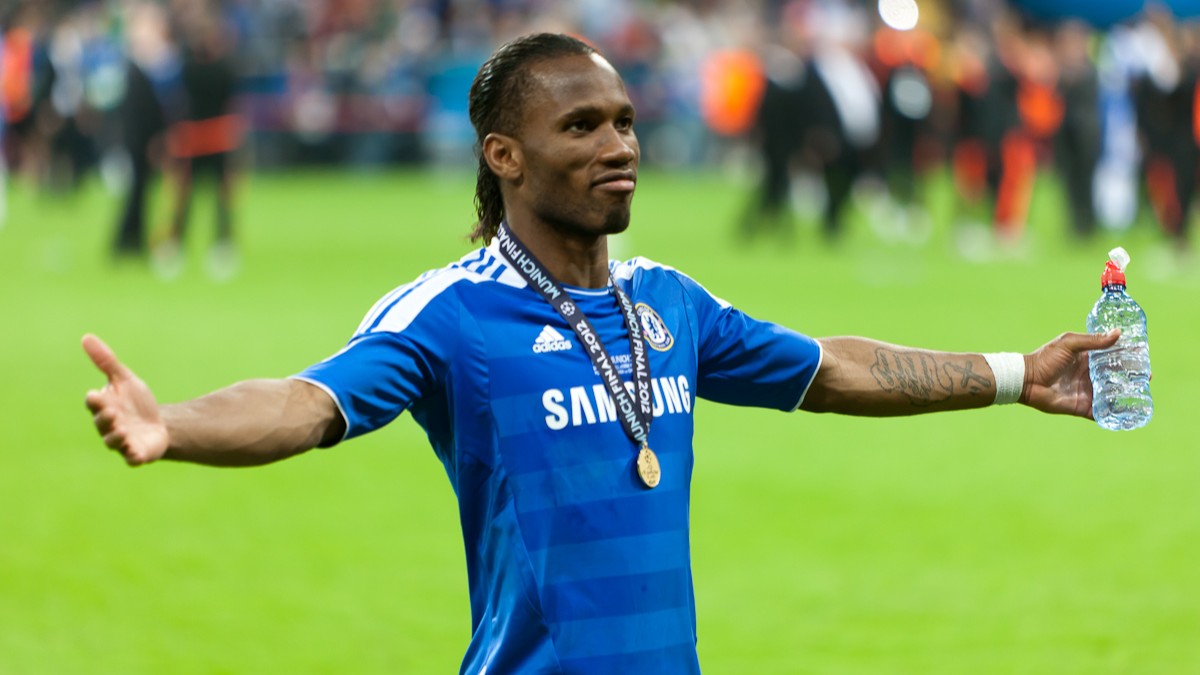

Some score goals. Others leave a legacy
Football has a curious memory. We talk about a goal for years. We watch the final minutes of a major final again and again. We count trophies, debate transfer fees and calculate the millions earned by footballers.
But how often do we discuss what all that success gives back to society?
Didier Drogba is a good reason to ask the question.
Born in Abidjan, Côte d’Ivoire, on 11 March 1978, he reached the summit of European football. He won league titles with Chelsea and lifted the UEFA Champions League trophy in 2012. His time at Galatasaray also left a lasting impression on Turkish football fans.
He was powerful, determined and decisive in big matches. But telling Drogba’s story only through his goals leaves out an important part of the picture.
Because for some footballers, the real story begins when the match is over.
What did you do with your fame?
In 2007, Drogba established his own foundation. He sought to use the opportunities and influence football had given him to support people in his home country.
The point is not simply that a famous footballer decided to help. The point is whether that help has a tangible result.
In Pokoukouamekro, in Côte d’Ivoire’s Gagnoa region, a primary school with seven classrooms was built through a project involving the Didier Drogba Foundation, Nestlé and the ICI Foundation. The project also included toilets, a canteen and work to provide electricity through solar energy.
Think about that.
On one side, there are football’s multimillion-euro transfers, astronomical salaries and luxurious lifestyles. On the other, there are children who need support to access educational opportunities.
Can the distance between these two worlds be reduced?
Drogba’s example suggests that at least a step can be taken.
One school cannot solve all of a country’s educational problems. Seven classrooms cannot perform miracles. But they can offer a new beginning to the children who study there.
Sometimes, you do not have to change the whole world to change someone’s life. You need to remove the obstacle standing in front of one child.
Scoring a goal is one thing. Supporting healthcare is another.
Among the initiatives supported by the Didier Drogba Foundation is the Laurent Pokou maternal and child health centre in Attecoubé, Abidjan. Its purpose is to support access to healthcare for women and children.
The foundation’s health work has also included cardiovascular screening through the Heart Mobile project, carried out in partnership with The Heart Fund and the Abidjan Cardiology Institute.
You score a goal. The crowd rises to its feet. Millions celebrate.
But what changes in the life of a mother who cannot reach healthcare in time, or a child whose illness goes undetected?
This is where the social responsibility of sport begins.
Sometimes, you do not have to change the whole world to change someone’s life.
Of course, a footballer is not responsible for building an entire healthcare system. Nor can a foundation replace the responsibilities of the state. But directing available resources towards people in need can make a meaningful contribution.
The real question is whether fame can create value not only through advertising contracts, but also through its impact on people’s lives.
Can a computer change a child’s world?
We live in a digital age. Access to information, learning and personal development has never been more important. Yet not everyone starts with the same opportunities.
A partnership between the Didier Drogba Foundation and the Ippon Foundation established four digital classrooms in Vitré, Cocody and Bingerville. The work later extended to Niablé.
In December 2020, the partnership supported the opening of three digital classrooms across a primary school and the Nanan Kouakou Kouao secondary school in Niablé. Project records state that 10 computers were provided to the primary school and 20 to the secondary school. Solar-powered schoolbags were also distributed to students.
Thirty computers.
A small number compared with the investments of major technology companies. But are they insignificant to the students who use them?
In Europe, many children see a computer as an ordinary educational tool. Somewhere else, access to one can change how a child connects with the world.
That is what equal opportunity is about: not guaranteeing the same outcome for every child, but reducing the inequalities that shape their starting point.
The value of these projects lies not only in the number of computers distributed, but also in what children are able to learn with them.
Give women the means to stand on their own feet
A project supporting women’s cooperatives in Dianoufla provided a multifunctional grinding machine. It also included plans for a production facility and training in management and accounting.
There is an important detail here. The project was not limited to handing over a machine. It also considered production, management and economic independence.
When women can generate their own income, develop their businesses and gain greater control over economic decisions, the benefits extend beyond the individual. Families and communities can also benefit.
The most meaningful form of assistance is not to leave people permanently dependent on support, but to help them stand on their own feet.
Of course, one machine cannot solve every economic problem. Without training, market access, financing and continuity, lasting results are difficult to achieve. The long-term impact of such projects therefore deserves attention.
But asking the right question is already important: does the assistance we provide create lasting change in people’s lives?
What happens when a footballer calls for peace?
Drogba’s story is not only about schools, healthcare and economic opportunity. It is also about peace.
During a period of internal conflict in Côte d’Ivoire, the national team qualified for the 2006 FIFA World Cup in 2005. Following that achievement, Drogba and his teammates made an appeal for peace in front of television cameras.
The result of a football match did not solve the country’s problems. It could not have done so.
But the message from players united under the same shirt brought people from different backgrounds together around a shared emotion.
Sometimes, that is where football’s social power becomes visible. A team does more than compete against an opponent. It can also remind people of something they share as citizens of the same country.
This does not mean placing the responsibilities of politicians and institutions on footballers. It simply means recognising the value of using a voice heard by millions to call for peace.
Football’s score is not kept only on the scoreboard
There is no need to turn Drogba into a flawless hero. One school does not solve every educational problem. One medical centre cannot replace a healthcare system. One digital classroom cannot eliminate every inequality between children.
What matters is evaluating the work honestly, understanding its limits and asking whether it can be sustained.
We talk a great deal about how money is earned in football. We know how much players earn, how many millions clubs pay in transfer fees and how much debt teams carry.
But do we examine, with the same seriousness, how much of this enormous economic power flows back into society?
Drogba’s story brings that question back into focus.
A footballer’s worth cannot be measured only by the goals he scores. No player can be expected to solve every problem in the world. But using the opportunities created by success to support children’s education, women’s economic independence and access to healthcare represents another dimension of achievement.
Lifting a trophy is wonderful. Helping shape a child’s future is wonderful, too.
The difference is that one begins and ends with a ceremony, while the other has the potential to leave an impact lasting for years.
A footballer’s worth cannot be measured only by the goals he scores.
A Drogba walked this earth.
He scored goals. He won trophies. He made millions of people celebrate.
But what makes his story meaningful is not only what happened in stadiums. A classroom opened for children, a mother seeking medical care, a student discovering computers and women working towards economic independence are also part of that story.
Perhaps football’s most important question is not:
How many goals did a player score?
It is this:
Who else benefited from the success he left behind?