

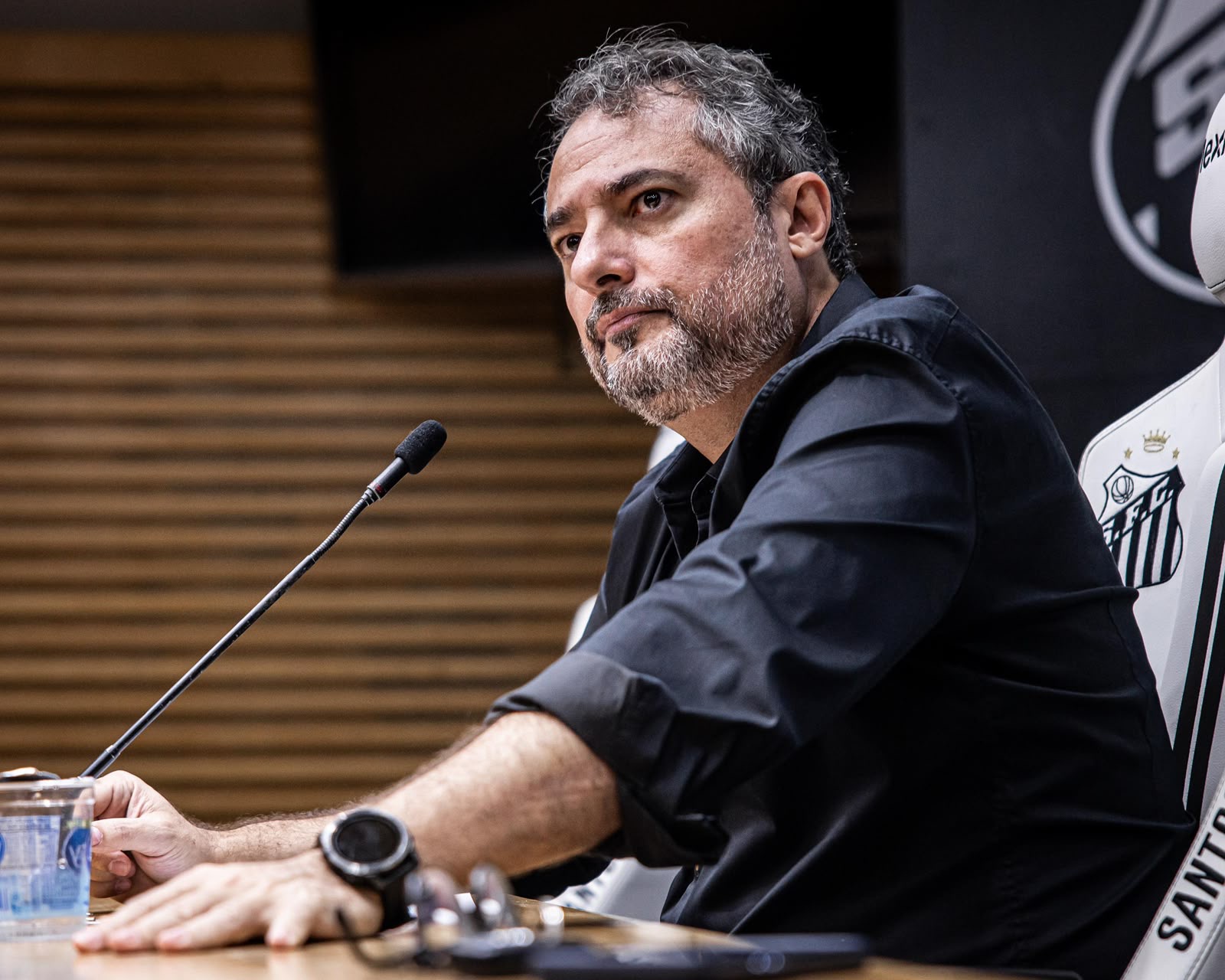
Profile
Role: Sporting Director of Santos
Specialisation: Squad building, player trading, recruitment and contract strategy
Experience: More than two decades in Brazilian football, including América Mineiro, Cruzeiro, Palmeiras, Atlético Mineiro, Athletico Paranaense and Santos
Focus Areas: Sporting performance, asset creation, squad renewal, academy pathways and organisational culture
Few football executives in South America can point to a career that combines sustained sporting success, large-scale squad building and player trading quite like Alexandre Mattos.
Across more than two decades in Brazilian football, Mattos has operated inside some of the country’s most demanding sporting environments, building teams expected not simply to compete, but to win. His career has taken him through clubs including América Mineiro, Cruzeiro, Palmeiras, Atlético Mineiro, Athletico Paranaense and, today, Santos, placing him at the centre of different sporting projects, ownership structures and competitive realities.
The results provide one measure of that journey. Mattos was part of consecutive Brazilian Série A titles with Cruzeiro in 2013 and 2014, before helping Palmeiras return to the top of Brazilian football, winning the Copa do Brasil in 2015 and league titles in 2016 and 2018. His later work at Athletico Paranaense included a run to the 2022 Copa Libertadores final and the 2023 Paraná state title, while his return to Cruzeiro formed part of another continental campaign that ended with a Copa Sudamericana runners-up finish in 2024.
But trophies tell only part of the story.
Mattos has been responsible for more than R$1 billion in player sales, operating in a market where sporting performance and asset creation increasingly have to coexist. Recruitment, contract strategy, squad renewal, academy pathways and understanding when to buy, develop or sell a player have therefore been central to his work. His record has earned him recognition as Brazil’s best football executive four consecutive times between 2013 and 2016, as well as being voted the country’s second-best executive in 2018.
His career also offers a window into the evolution of the sporting director itself. Brazilian football has changed considerably during Mattos’ time in the game: recruitment departments have become more sophisticated, data has entered decision-making, international investment has increased, club structures have evolved and Brazilian talent is being identified by global markets earlier than ever before. Yet the fundamental responsibility remains the same: make better football decisions than your competitors.
Now, as Sporting Director of Santos, Mattos operates inside one of world football’s most recognisable talent institutions, a club whose identity is inseparable from player development and whose history creates expectations that extend far beyond results alone.
An executive, dealmaker and author of Tudo Começa com um Sonho and Muito Mais que um Jogo, Mattos has spent his career experiencing football from the room where some of its most consequential decisions are made. His story is therefore not simply about the players signed, the players sold or the trophies won. It is about how sporting projects are built, how value is created and how an executive makes decisions when millions of reais, careers and the expectations of entire clubs can depend on them.

Key Insights
- Successful squad building starts with understanding a club’s finances, institutional structure and competitive reality.
- Player sales require judgement about development, market opportunities and the club’s financial needs.
- Technology supports recruitment, while personality, adaptation and the working environment remain essential to success.
Our Exclusive Interview with Alexandre Mattos
You have built championship-winning squads at different clubs, under different financial realities and different levels of expectation. When you first arrive at a club, what do you analyse before deciding what the squad actually needs, and what separates building a collection of talented players from building a team capable of winning?
The first thing I do when I arrive at a club is understand its reality. Before thinking about players, transfers or titles, you need to make a complete diagnosis of the institution.
In Brazilian football, there are very different types of clubs. Some have strong financial resources, established management structures and the infrastructure necessary to compete at the highest level. Others face significant financial limitations, institutional challenges and enormous pressure to deliver immediate results.
You also have to understand the political environment. Many Brazilian clubs have traditionally operated through elected presidents rather than private ownership structures. That creates a different dynamic because leadership mandates are limited, expectations are high and the time available to build a successful project can be very short.
Before thinking about players, transfers or titles, you need to make a complete diagnosis of the institution.
When a president hires a sporting director, the ambition is almost always the same: to win championships. But the real question is how you are going to achieve that ambition. What is the financial situation? How much can the club invest? What commitments already exist? What resources are available to strengthen the squad?
At Santos, for example, we operate in an environment where expectations are extremely high, while the club must also manage financial constraints and the pressure that comes with its recent sporting situation. Supporters understandably want to see Santos winning, but building a competitive team requires a realistic plan.
If you have the financial capacity to invest, your strategy may involve recruiting established players who can make an immediate difference. If you do not have those resources, you need to find other solutions. That means developing young players, identifying the right moment to introduce them into the first team, helping them perform and, when appropriate, generating value through transfers.
For me, successful squad building is not simply about signing talented footballers. It is about understanding the club’s circumstances and creating a sporting strategy that is financially realistic, institutionally aligned and capable of producing results over time.
You have to solve the problems in front of you, strengthen the organisation and build towards winning. Ambition is important, but it must be supported by a clear understanding of what the club can actually do.
You have been responsible for more than R$1 billion in player sales throughout your career. How do you balance the sporting objective of keeping your best players with the financial responsibility of creating and realising player value, and how do you determine the right moment to sell an important asset?
There is no formula that tells you exactly when to sell a player. It depends on the circumstances of the club, the player’s stage of development and what is happening around him.
In Brazil, many clubs operate under financial pressure, which means player sales are often an important part of maintaining the organisation. But selling a player is not simply a financial decision. You also have to understand what that decision means for the team and for the player’s future.
Sometimes, keeping a player for another season allows him to develop further and increase his value. In other situations, waiting too long can create risks. The player’s performances may change, the environment may become more difficult or the opportunity in the market may disappear.
Young players are especially vulnerable to expectations. At a club like Santos, where Neymar became a global star, supporters naturally dream of seeing another exceptional talent emerge. But not every young player can become Neymar, and expecting that from someone who is still developing can create enormous pressure.
This is where experience and intuition become important.
You have to be close to the daily reality of the club. Speak with the coaches, understand how the player is progressing, observe his performances and pay attention to the environment around him. You need to feel whether the player is ready for the next step or whether remaining at the club is still the best decision.
The financial situation also changes everything. A club with strong resources can afford to reject offers and wait for a player to develop further. A club that needs revenue may have to make a different decision, even if that player is important to the team.
Ultimately, the right moment to sell is not determined by a number alone. It comes from understanding the player, the market and the club’s reality at that particular moment. That judgement is one of the most difficult responsibilities of a sporting director.
Brazilian recruitment has changed enormously during your career, with data, international scouting networks and European clubs identifying players increasingly early. After more than two decades making recruitment decisions, what has technology genuinely improved, and which parts of evaluating a player still depend on human judgement, relationships and understanding the person behind the data?
When I started working in Brazilian football in 2005, the recruitment environment was very different from what we see today.
Brazil was traditionally a market that developed and exported players. Clubs from Europe and other countries came to Brazil to identify talent, follow players and eventually sign them. Today, Brazilian clubs are also increasingly active in international markets, recruiting footballers from different countries and building more diverse squads.
Technology has transformed how we evaluate those opportunities.
We now have access to tools, information and professional networks that allow us to analyse players in much greater detail. Technical ability, tactical understanding, physical performance and many other aspects of a player’s game can be studied before making a recruitment decision.
But there is one area that remains particularly difficult to evaluate: mentality and personality.
For me, these are among the most important factors in determining whether a player will succeed.
You can identify a footballer with excellent technical and physical qualities, but that does not guarantee he will perform in a new environment. Every player is a human being. He has a personality, emotions, habits and a personal background. Moving to a different club, city or country can affect him in ways that are difficult to predict.
Supporters often expect immediate results from a new signing, but adaptation does not always happen quickly.
That is why recruitment cannot be reduced to evaluating what a player does on the pitch. You have to understand the person behind the performances and consider whether he is prepared for the environment he is entering.
Every player is a human being.
Modern technology helps us make more informed decisions, and that is a major improvement compared with twenty years ago. But even with all the information available, mistakes will still happen.
In my experience, some of the most difficult recruitment mistakes are connected not to a player’s technical ability, but to factors involving personality, mentality and adaptation.
The objective is to use every tool available while remembering that footballers are people, not just profiles or numbers.
Santos represents something unique in world football because developing players is part of the club’s identity. At this stage of your career, what do you want to build at Santos, and when you eventually look back at this chapter, what would need to have happened for you to consider the project a success?
For me, one of the most important responsibilities in football is taking care of people.
When we speak about successful clubs, the conversation usually focuses on the players, the coach, the sporting director or the president. But there are many professionals working behind the scenes who are essential to everything that happens on the pitch.
These are the people who contribute to the daily functioning of the club, support the players and help create the environment in which everyone can perform at their best. Their work does not always receive public recognition, but it is fundamental to building a successful organisation.
For me, one of the most important responsibilities in football is taking care of people.
I believe that if you take care of these people and create a positive working environment, you significantly increase your chances of winning.
Football is not only about assembling a squad with talented players. It is also about the relationships within the club, the way professionals are treated and the culture you establish across the organisation.
I often say that around 80% of a club’s success comes from taking care of its people and creating the right environment, while the remaining 20% comes from what the players are able to achieve on the pitch.
Of course, you need quality players to win matches and championships. But talent alone is not enough if the organisation around those players is not functioning properly.
That is something I have learned throughout my career, and it is a principle I want to continue applying at Santos.
For me, building a successful football club means building an environment where people feel respected, supported and motivated to do their best work. When you achieve that, you create the foundations for sporting success.
FAQ
Who is Alexandre Mattos?
Alexandre Mattos is the Sporting Director of Santos, with more than two decades of experience in Brazilian football, championship-winning squad building and player trading.
Which clubs has Alexandre Mattos worked at?
His career includes América Mineiro, Cruzeiro, Palmeiras, Atlético Mineiro, Athletico Paranaense and Santos.
What is Alexandre Mattos’ approach to recruitment and club leadership?
He combines an understanding of the club’s financial and institutional reality with player evaluation, attention to personality and adaptation, and a working environment that supports people.