

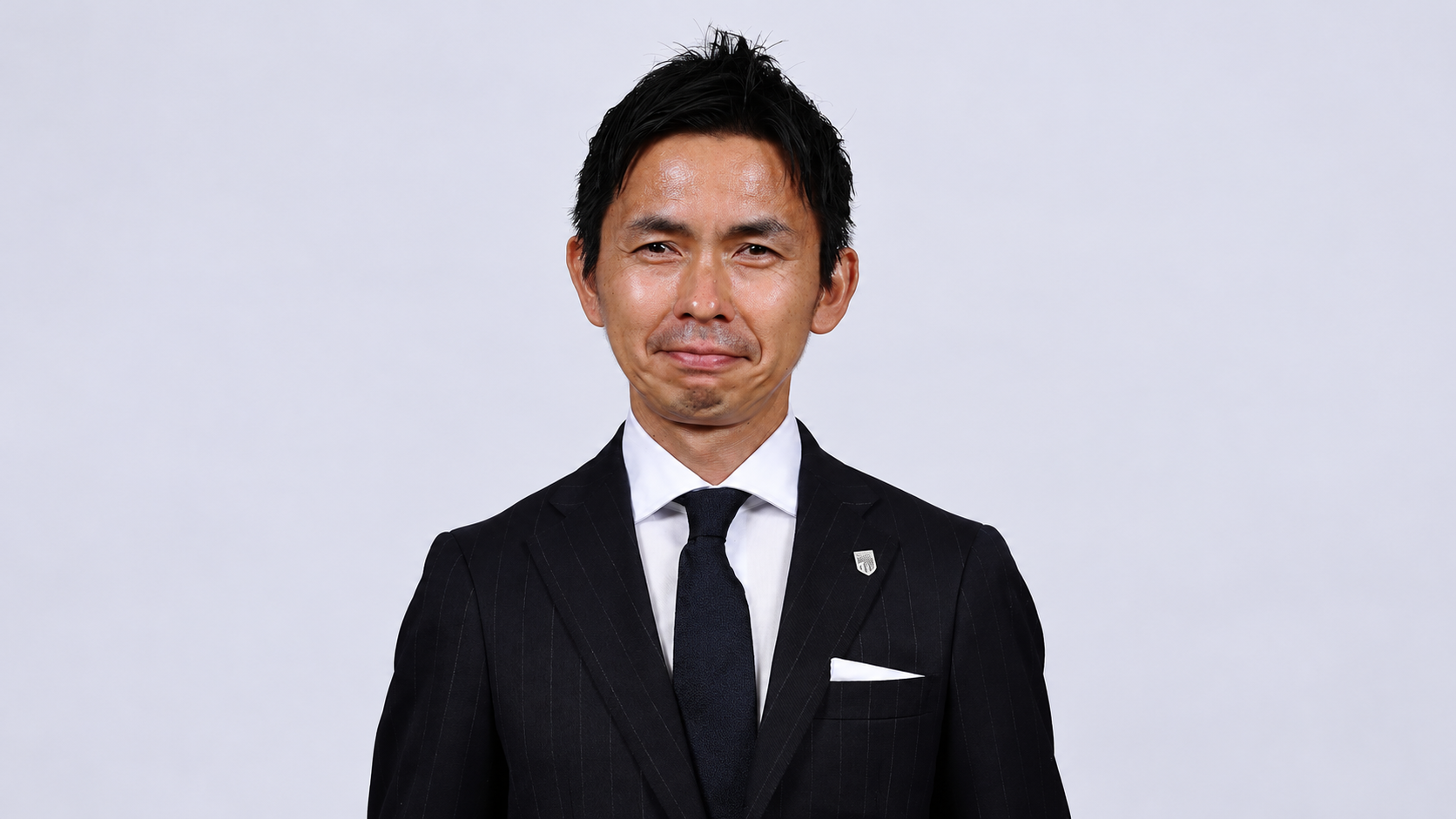
Profile
Role: Head of Scouting and Method Director at FC Tokyo
Specialisation: Coaching, analysis, scouting and academy development
Experience: Ten years at Hokkaido Consadole Sapporo, including seven years as Academy Director; coach educator and National Training Center Coach for the Japan Football Association
Focus Areas: Recruitment, player development, football identity, coach education and international development
Building Global Standards Through Scouting, Development and Method
A football leader shaped by coaching, analysis, scouting and academy development, Jiro Kitahara has built a career around one central question: how can a club create the conditions for people and performance to grow together?
Today, as Head of Scouting and Method Director at FC Tokyo, Kitahara brings together two areas that are often treated separately. Recruitment identifies the qualities a club needs, while method defines how those qualities are developed and connected to a consistent football identity. His experience across both first team and academy environments gives him an unusually broad view of that process.
Before joining FC Tokyo, he spent ten years at Hokkaido Consadole Sapporo, including seven years as Academy Director. Across his wider career, he has worked as a coach, analyst, scout and development leader. He has also worked with fourteen top level head coaches, divided equally between Japanese and international coaches, an experience that exposed him to contrasting football cultures and showed him that there is rarely one universal answer in the game.
That variety has not led him toward ambiguity. Instead, it has strengthened his belief in clear principles, transparent decision making and an organizational structure that allows different voices to contribute without losing a shared direction. For Kitahara, a strong football organization is not one in which everyone thinks alike. It is one in which discussion is encouraged, decisions are understood and responsibility is shared.
His approach to talent is equally thoughtful. He distinguishes between what a player can offer today and what that player may become tomorrow. Technical, tactical and physical qualities matter, but so do independence, resilience, courage and respect. He is particularly interested in players capable of turning a clear strength into a defining quality that can influence matches at the highest level.
At a moment when Japanese football is becoming increasingly connected to the global game, Kitahara represents a profile that links development with international ambition. His vision is not limited to producing more players for Europe. It also includes developing coaches, directors and club structures that can compete, collaborate and lead internationally. FC Tokyo, in his view, has the ambition to become one of the clubs driving that next stage of Japanese football.
Key Insights
- Clear principles and transparent decisions connect recruitment, development and a shared football identity.
- Environment, independence and potential are central to developing young players.
- Individual development and a global outlook can help Japanese football progress internationally.
Our Exclusive Interview with Jiro Kitahara
The FC Tokyo recruitment and methodology leader speaks about his path into football, the value of varied experience, academy development, player identification, coach education and the globalization of the J.League.
You were born and raised in Hokkaido. How did your journey in football begin, and when did you first realize that you wanted to build a professional career in the game?
My introduction to football was quite typical. I started playing with my friends and gradually became more passionate about the game.
From a young age, I dreamed of becoming a professional footballer, but unfortunately I was not able to make it as a player. While studying sports science at university, I began to see another path. I decided that instead of pursuing a career on the pitch, I wanted to build my professional future as a coach.
Throughout your career, you have worked as a coach, analyst, scout, Academy Director and now Head of Scouting and Method Director. How have these roles shaped the way you understand football and evaluate players?
Experience in many different roles has been extremely important in helping me develop as a leader and see football from different perspectives. Throughout my career, I have worked with fourteen top level head coaches, seven Japanese and seven from other countries.
Working with first teams taught me how diverse football can be. What is the right answer for a Brazilian coach may not be the right answer for a Serbian coach. I feel fortunate to have experienced the depth and complexity of the game through so many different approaches.
These experiences helped me develop a deeper understanding of football and the confidence to make decisions based on clear principles. That is essential if you want to build a consistent way of playing that can be reproduced over time.
Experience in many different roles has been extremely important in helping me develop as a leader and see football from different perspectives.
The same applies to player development. In academy football, I learned that development rarely follows a perfect plan and that predicting a young player’s future is extremely difficult. When I evaluate players, I therefore try to consider them from several perspectives and remain open to their full potential. My academy experience taught me to be patient and not to judge players too quickly.
I also learned that every member of staff brings different ideas and opinions. If an organization wants to benefit from those differences while moving in one direction, it needs a clear philosophy, a coherent strategy and a functional structure.
My ideal organization is one in which people can speak openly and discuss different opinions, but decisions are ultimately made through a clear and transparent process. That creates commitment. People feel involved, accept responsibility and are able to perform at their best.
You spent ten years at Hokkaido Consadole Sapporo, including seven years as Academy Director. What did that period teach you about developing young players and preparing them for professional football?
I learned three important lessons from academy football.
The first is that young players can develop enormously depending on the environment around them. People naturally adapt to their surroundings. If the environment never changes, they can stop learning and become comfortable. But when players develop a genuine desire to improve, they can grow beyond what the environment itself provides.
The second lesson is that independent players are the ones who ultimately succeed. There is no magic formula for creating independence. We cannot simply tell players to take responsibility and expect it to happen. Every player is different, so we need to find the right way to challenge and support each one, gradually helping them take ownership of their development.
The third lesson is the importance of recruitment. If we want to develop outstanding players, we first need to identify young people whose potential matches the profile we are looking for. However good the development system may be, the potential of the players entering the academy remains fundamental.
But when players develop a genuine desire to improve, they can grow beyond what the environment itself provides.
If an academy truly understands these three principles, environment, independence and potential, it can develop more players who progress to the first team and eventually perform at the highest level.
What qualities do you look for when identifying a player for FC Tokyo, both in terms of football ability and personality?
It is difficult to separate a player’s football ability completely from his personality. To simplify it, I would describe technical, tactical and physical qualities as football ability, while mental and social qualities belong to personality.
In football terms, I focus particularly on talent and potential. Talent is what a player can do now. Potential is what he may be capable of becoming in the future.
I am looking for players who can develop their strengths into super strengths, qualities that can eventually make a difference even at the highest level of European football.
In terms of personality, independence and responsibility are extremely important. Independent players have a strong ability to learn, which allows them to continue developing.
They also tend to be resilient. After difficult experiences, they can recover, learn and begin growing again.
They are also willing to challenge themselves. Because they are not afraid of mistakes, they continue trying new things and moving beyond their comfort zone.
Respect for others is another essential quality. Football is a team sport, so players must be able to work with other people. They need to respect their teammates, opponents, staff and everyone who supports them. I believe players with genuine respect for the people around them are the ones who can ultimately shine on the biggest stages.
Alongside your club career, you have worked as a coach educator and National Training Center Coach for the Japan Football Association. How important is coach education to the future of Japanese football?
I believe the level of coaching in Japan is very high, and one of the main reasons is the quality of coach education that has been developed here.
Many excellent Japanese players have emerged not only from professional academies, but also from high schools and universities. That is strong evidence of the quality of coaching throughout the football system.
Coaches are among the most important influences on player development. What they think and how they see the game have an enormous effect on the players they work with. If coaches have only a domestic perspective, it will be difficult to develop players who can succeed globally. To produce truly world class players, coaches themselves need a more international outlook.
I believe the level of coaching in Japan is very high, and one of the main reasons is the quality of coach education that has been developed here.
Coach education in Japan is also addressing another major challenge: how to develop each player as an individual. Japanese culture and education have historically placed greater importance on the group than the individual. In football, this has sometimes meant prioritizing collective results over maximizing the development of each player.
In academy football, however, individual development must be the highest priority. We need coaches who understand each player as a person, respect individuality, recognize distinctive strengths and potential, and create the right environment for that player to grow.
If we can build a stronger culture of individual development while giving coaches a broader global perspective, Japanese players can reach an even higher level and achieve more internationally.
Japanese football has made significant progress in recent years. Where do you see the greatest potential for further growth, and what role can FC Tokyo play in that development?
One of the biggest developments I expect is the globalization of the J.League. Japanese players have progressed rapidly in recent years, and I believe Japanese clubs will make similarly strong progress in the years ahead.
The alignment of the J.League season with the European football calendar creates an important opportunity. It can help Japanese clubs become more internationally competitive and accelerate their global development.
As this continues, I believe we will see not only more high quality players, but also more talented coaches and directors emerging from Japanese football. Hopefully, I can be one of them too.
If the coaches, directors and staff around the players develop a more global perspective, we will be able to produce even more world class footballers who can succeed internationally.
FC Tokyo is one of the clubs in Japan with the strongest ambition to become truly global. Over the next ten years, I believe we can continue strategically along a path toward becoming a club that competes internationally and earns respect not only in Japan, but also in Europe.
I also believe FC Tokyo can play a leading role in driving the globalization of the J.League as a whole.
FAQ
Who is Jiro Kitahara?
Jiro Kitahara is Head of Scouting and Method Director at FC Tokyo, with experience in coaching, analysis, scouting and academy development.
What does Jiro Kitahara look for in young players?
He considers talent, future potential and distinctive strengths alongside independence, responsibility, resilience, courage and respect for others.
What are Jiro Kitahara’s key principles for academy development?
He identifies environment, independence and potential as three essential principles for helping young players progress toward professional football.