

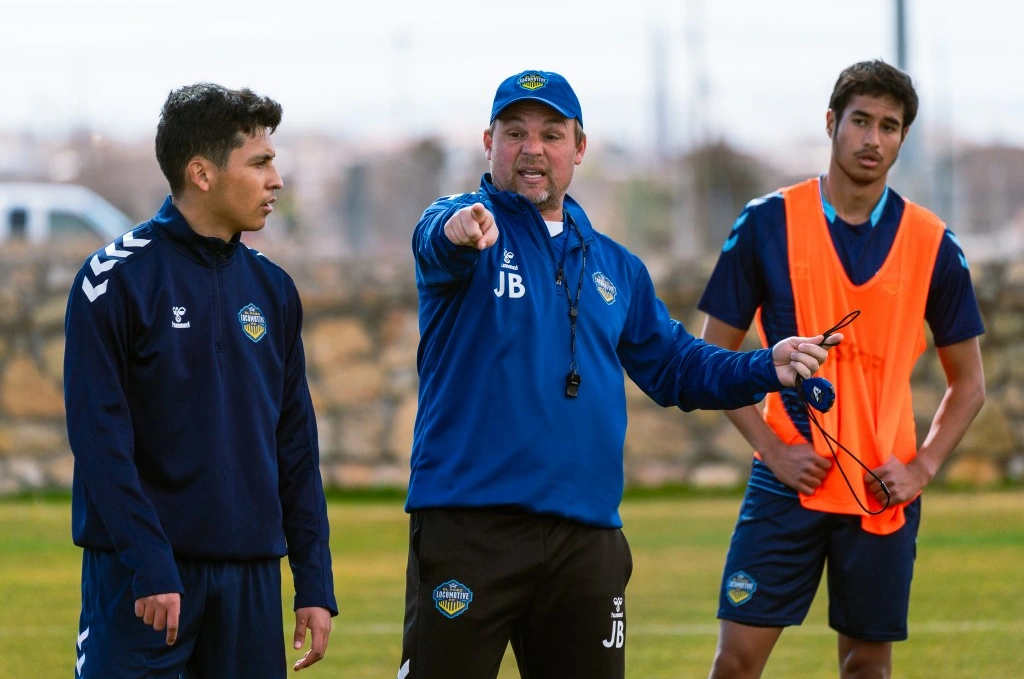
Profile
Role: Technical Director and U19 MLS NEXT Coach, Metropolitan Oval
Specialisation: Elite Youth Development and Player Pathways
Experience: Professional Playing Experience in the United States, Norway and Finland; Coaching Roles at Saint Louis FC/St. Louis Scott Gallagher, RISE Soccer Club, El Paso Locomotive and Metropolitan Oval
Focus Areas: Player Development, Personal Development, Coaching Relationships and Pathways into Professional Soccer
Introduction
For Jon Burklo, soccer has always been more than a game. It has been a constant in a life shaped by movement, change and a willingness to pursue opportunities wherever they appeared. Born into a military family, Burklo grew up moving between countries and states, eventually living in six countries and 10 states. Soccer became the way he built community wherever he went, eventually taking him from college soccer in the United States to a professional playing career in Norway and Finland before leading him into coaching and player development.
A former defender at Liberty University, Burklo earned Big South All-Conference recognition before pursuing professional opportunities with the Cincinnati Kings and in Europe. He played for Atlantis FC in Finland’s second tier before moving to RoPS in Rovaniemi and later JIPPO. Liberty’s records confirm his professional move to Cincinnati and his time with Atlantis, while his playing career ultimately brought him back to the United States with the Wilmington Hammerheads.
His coaching career has since taken him through a number of influential American development environments, including Saint Louis FC/St. Louis Scott Gallagher and RISE Soccer Club, where he served as an academy director. In 2023, he stepped into the professional game as an assistant coach with USL Championship side El Paso Locomotive before joining Metropolitan Oval in New York. Today, Burklo serves as the club’s Technical Director and U19 MLS NEXT Coach.
At Met Oval, Burklo’s work sits firmly at the intersection of elite youth development and creating meaningful pathways for young players. The club joined The League for Clubs in 2025, giving its older players an additional competitive environment alongside its MLS NEXT programs. Burklo has emphasized the importance of that pathway, arguing that high-level youth players benefit from competing against older and more experienced opponents as they prepare for the next stage of their careers.
His philosophy is equally focused on the person behind the player. Burklo believes a coach cannot separate player development from personal development, and that the relationships built through soccer often outlast championships, contracts and results. That perspective is rooted partly in his own journey: a career in which soccer opened doors around the world, introduced him to people who helped him when they had no obligation to do so, and ultimately became the profession he always hoped it could be.
In this conversation, Burklo reflects on chasing a professional career in Europe, the realities behind the romantic idea of playing abroad, the role of American pay-to-play academies, why professional clubs need to respect the development work happening outside their own academies, and the importance of creating genuine pathways for young players. He also discusses the kind of legacy he hopes to leave behind and his ambition to eventually lead a professional first team as a head coach.
Key Insights
- Strong youth development requires genuine pathways and a club philosophy that trusts young players.
- Pay-to-play academies make an important contribution within the economics of American youth soccer.
- Coaching involves developing the person alongside the player, with relationships that extend beyond results.
Our Exclusive Interview with Jon Burklo
Before we talk about soccer, take us back to the beginning. Who is Jon Burklo? What was your upbringing like, what shaped you as a young person, and how did the boy who dreamed of playing professionally become the man you are today?
I’ve lived in six countries and 10 states. When I was born, my dad was in the Air Force, so we moved around quite a bit. I actually started playing soccer in Okinawa, Japan, where I lived for three years. I also lived in Greece and Germany, played professionally in Norway and Finland, and have lived all over the United States.
Soccer became the way I established community. It was how I built friend networks and social networks because, every three years or so, we would move to a new home. In a lot of ways, that shaped who I am outside of my family. Moving constantly forces you into uncomfortable situations, it forces you into conflict sometimes, and it forces you to network and reestablish friendships.
There was also a negative side to that. I think it built some defense mechanisms in me. One thing I’ve probably always lacked is long-lasting, deep friendships, partly because I’m so used to moving on to the next place, whether that was because of my dad’s next job or eventually my own career.
My faith has also always been very important to me. As a Christian, that was something my parents instilled in me, and I went to Liberty University, an evangelical Christian school. That faith is very much an underpinning for how I view the world, how I choose to live my life and how I raise my own family.
Soccer became the way I established community.
Those are probably the three biggest things that have molded who I am: my family and upbringing, my faith and soccer. Soccer has always been my passion and the thing that helped me establish community and friendships. I always knew I wanted it to be my profession.
I earned my bachelor’s degree in molecular biology and later a master’s degree in theology, but I always wanted to play professionally for as long as I could. When that part of my career was winding down, I knew I wanted to stay in the game and make soccer my profession.
I’ve also been incredibly fortunate to have an amazing wife who has been willing to follow me and my passion, uproot our family and move as I’ve progressed through the coaching ranks. I’m very thankful to her and to our two kids, my 14-year-old son Harrison and my 11-year-old daughter Aila. That’s my current world.
You went from college soccer in the United States to pursuing a professional playing career in Europe, including Finland, where the reality of the game wasn’t always glamorous or secure. What was that experience like, and what surprised you most?
I had a decent college career, but I wasn’t somebody coming out of college with professional teams banging on the door. I had to go bang on their door. In 2005, I emailed teams all across Europe looking for an opportunity and hoping somebody would bring me in.
I eventually connected with a third-division team in Norway. Their general manager, Anders Gaarder, had spent time in the United States as a college student, and for whatever reason, he wanted to help an American going the other way. He arranged for me to train there over the summer with FK Oslo Øst. One of the sponsors owned a hotel, so they put me up there, and I lived in downtown Oslo for the entire summer before my senior year of college.
That experience really made me think, “This is what I want to do.” I didn’t care that it was a lower division. I wanted to go there and figure out how to make it happen.
Anders later helped set me up with a trial at Atlantis FC in Finland, which at the time was in the second division. I flew there in January 2007. Before going, because my faith was important to me, I had reached out to a Baptist missionary to get connected with a church. He essentially said, “Why don’t you come live with me and my family?” So I stayed with Mikko Sivonen, his wife Heidi and their family.
Again, they didn’t know me and had no real reason to help me other than our shared faith. I went on trial with Atlantis, they signed me after a few weeks, and I was there for just under 90 days. Then suddenly, I didn’t get a paycheck. I found out they had never applied for my work visa, and my 90 days were almost up. It felt like the whole thing was crashing down.
Fortunately, Scandinavia has an incredibly long preseason. I think I played 13 preseason games, which was exhausting when you’re used to a college season where you might play a maximum of 20 games. But I had done well enough that I’d established a reputation, and when word got out about what was happening at Atlantis, a club in Rovaniemi called RoPS reached out and signed me.
Rovaniemi is inside the Arctic Circle. At the time, it had the northernmost McDonald’s in the world right across the street from my apartment, and it’s the official home of Santa Claus. It was a town of around 25,000 to 30,000 people, but they absolutely loved their team.
For a little while, I got to experience a small version of the celebrity lifestyle. Everywhere you went, people knew who you were. I remember one night before a game, around 10:30, I was restless and thought I’d go to a bar and have a Coke. A teammate and I went, had a Coke, and somehow it ended up on the fan forums that I had been out drinking the night before the game. The coach called me, and I had to explain, “Look, I was just having a Coke.”
It was a really interesting lesson in what it means to live under a microscope. Obviously, it wasn’t anything like David Beckham or Lionel Messi, but it gave me a small sense of how everything those players do can be documented and scrutinized. Even if they’re not doing anything wrong, they have to be conscious of appearances.
Before that, I’d also gone through the professional-combine scene in the United States and played for the Cincinnati Kings in the USL in 2006. The whole journey was something I really made happen. Maybe there was a little bit of delusion involved, because I was an all-conference Division I player but wasn’t coming out of college with a huge name. I just decided, “No, this is what I want to try to make happen.”
I was incredibly fortunate to have opportunities come my way and people who reached out even though they had no obligation to help me. I’m very grateful and blessed to have had those experiences and those people in my life.
You’ve worked in academy environments at Saint Louis FC, St. Louis Scott Gallagher, RISE Soccer Club and now Metropolitan Oval. You’ve also spoken about how strong American development academies can be overlooked simply because they don’t have a professional first team. Why do you think that perception persists, and what would it take for professional clubs to recognize, trust and build meaningful relationships with those academies?
I think people always look at pay-to-play as this huge issue in American soccer. I’m not saying pay-to-play isn’t an issue, but people need to understand the system that exists around it.
Here’s a great example. Our goalkeeper coach at Met Oval has an Italian family. They moved to New York because his wife works for an Italian bank. Their son, Giacomo, is now playing at Seton Hall. When Giacomo graduated he told me, “I’m so glad that we came to the U.S., because my son would never have received this development back home in Italy.”
They lived near Turin, and realistically, he wasn’t going to play for the academies of Torino or Juventus. So there is a gap. You have professional academies that are clearly established as places where top players go, and then you have community programs. In some countries, those community programs can be very high quality. But the way club soccer is structured in the United States is different.
Originally, American youth soccer was largely built around pay-to-play programs before professional teams became heavily involved. So the perception becomes, “If it’s pay-to-play, it can’t be good.”
But without pay-to-play, we don’t have a solidarity or training compensation system that provides another mechanism for these clubs to generate revenue. So how are clubs supposed to provide quality coaching, facilities, frequent training, video analysis and all of the other things required for development? Outside of sponsorship, there isn’t another mechanism to bring that money into the club.
Pay-to-play is therefore a necessary product of the way the system is currently built in the United States. As much as we want to complain about it, ask yourself this: if we didn’t have pay-to-play clubs like Met Oval and RISE, how much worse off would American soccer be?
Without those clubs, you’re largely dealing with community programs that may have volunteer parent coaches who don’t necessarily have formal coaching education. There’s nothing wrong with that, but you’re not going to consistently develop players capable of moving into professional academies and professional clubs.
So I think some of the criticism comes from a misunderstanding of the basic economics of how youth soccer works in this country.
Pay-to-play is therefore a necessary product of the way the system is currently built in the United States.
There’s also, frankly, some arrogance on the professional side. Because they’re professional, and because their stated objective is often to develop players for their first team, there’s an assumption that they must inherently be more focused on development than the rest of us.
Unfortunately there have been some pay to play or non professional clubs who haven’t cared about development. Who have only cared about bringing more players and more money through the door
There are clubs that genuinely have to charge money because they need to pay their coaches, maintain their facilities and keep the organization running. That doesn’t mean meaningful player development can’t happen.
I’ve been fortunate to work at clubs that were very developmentally focused. Yes, there was a bottom line that had to be taken care of, but that didn’t always come at the expense of development.
I don’t think every pay-to-play youth club operates that way, but there are enough clubs across the country doing phenomenal work developing players. So when professional academies look down on clubs like ours, that gets me riled up. I’m going to speak out and say, especially where I’m at now, we do it as well as anyone in the country. I don’t care whether you’re a professional or non-professional club. From a developmental standpoint, the quality of what we provide is as good as any club in the country.
I’m incredibly proud of where I work, our staff and the group we have. I do think there needs to be more respect for what clubs like ours are doing because, without us, those professional academies aren’t getting many of the players they eventually develop.
Look at someone like Cavan Sullivan at Philadelphia Union. He spent three years in their academy, but there were eight years of football before that which were incredibly important to his development. We shouldn’t turn our noses up at those years simply because they happened outside a professional academy.
Your U23 team won a national championship with a 16-year-old starting in a back three against experienced forwards. In a country where young American players can sometimes struggle to find a clear pathway into the professional game, how much of the problem is a lack of talent and how much is clubs being unwilling to accept the risk of trusting young players?
It’s a very nuanced discussion. Ultimately, the player has to prove it. They have to show they’re good enough to step in.
But if you want a player to reach their highest ceiling, you also have to provide a pathway. If that pathway is closed, particularly at the first-team level, then it doesn’t matter how good your academy is.
First-team coaches have a job based on winning. I’m not saying that’s wrong. If they lose, their job is at risk. So if their philosophy is that they trust experienced players more, that may not be the best environment for a talented young player coming through.
A club can have a great academy, but if the first team doesn’t play those players, the ceiling of those players is capped. That’s why it ultimately comes down to the philosophy of the club as a whole.
If the philosophy is, “We want to trust young players, we want to develop young players, and that’s part of who we are,” then I think you’ll find those clubs do a really good job. They trust young players, they put them on the field and they rely on them to perform and help get results.
Historically, clubs such as Philadelphia Union and the New York Red Bulls have been among the strongest examples because that has been part of the philosophy of the club. People look at them and say, “Look how good they are at developing players.” Well, yes, because they have a philosophy that allows young players to step into the first team and contribute.
That’s where I think the issue really lies. Is there a genuine philosophy that extends throughout the entire club? In the vast majority of cases, I don’t think there is. Those clubs are still relatively few and far between.
For us as a youth club, of course we’re going to trust young players. That’s what we exist for. I wanted to win that national championship, and for me, the best way to do that was to put a 16-year-old in the center of a back three against a forward who, after the game, went on to play in Spain’s third division. He was an experienced player competing at a meaningful level. Philosophically, it made sense for us to give that young player the opportunity. That’s why I trusted him to do it. So I think the real question is: why do you exist as a club? What is your philosophy, and does that philosophy extend to how you build your roster and make decisions?
Met Oval exists to provide young players with an opportunity to develop and hopefully reach the highest levels of the game. That’s what we exist for. So my decisions come back to our mission. When that’s your mission, it’s much easier to say, “Yes, I’m going to put a 16-year-old in there,” because our purpose is to develop young players who can reach the highest level.
You’ve spent years moving between clubs, cities and different levels of football. When football eventually stops being your everyday life, what would you hope the players you’ve coached remember about you?
The first thing I’d say is that I can’t imagine football not being part of my everyday life.
I want to win championships and I want to develop players, but those things aren’t necessarily what last. Particularly because so much of my career has been in youth player development, you can’t separate the player from the person. I’m coaching soccer, but I’m also coaching a person. I have a responsibility to develop both.
I’ve been fortunate to be invited to a few weddings of former players. I’ve stayed in touch with players who now have children of their own, and some have reached back out to me because they’re putting their kids into soccer and looking for someone who had an impact on them. I’ve had some really cool experiences like that.
Maybe those players weren’t professionals and didn’t reach the highest level of the game, but they look back on the experience we had as formative in who they became as young men. That’s what I ultimately hope for.
I’m coaching soccer, but I’m also coaching a person.
Of course, if I can develop players who reach the highest level, if I can develop professionals and if I can win championships along the way, I want all of that. I’m a competitor. Every competitor wants to win. But I remember after we won the U23 national championship, I didn’t actually get the elation I was expecting. That feeling of massive elation never really hit me. I remember talking to the boys afterward and saying, “Guys, this is amazing, but I don’t know that this is what I’m going to remember.” What I’m going to remember is the journey, the season we had together and the relationships I built with those guys. That was a special group. They loved each other, they enjoyed being around each other, and the relationships I built with them are ultimately what I look back on. We have a trophy, and I’m proud of that, but that’s not the feeling I remember most.
For me, soccer is a vehicle to build relationships. It’s also a vehicle to impart life lessons that are going to be important for players long after they leave the game.
A player doesn’t make a roster, and I deal with that on a weekly basis. Players want to play, and not making a roster is difficult. But life is going to hit them much harder than not making a roster. If soccer can be a vehicle that helps them cope with disappointment, deal with something difficult, come back on Monday and give a full effort, then hopefully, when life hits them even harder, they’ve already had some experience dealing with adversity. They’ve learned how to step up the next day and start swinging again.
Ultimately, that’s what I’m looking for.
As your career evolves, what are your own career aspirations? Where do you see yourself in the near future?
I’ll always love the youth development space, but I was fortunate to step into the professional realm with El Paso Locomotive as the first assistant, and I absolutely loved my time there. There were also some family dynamics at that level that were surprisingly positive. It was the first time in my professional career when I could finish work at 4 or 5 p.m., have dinner with my family at 6 and help my wife take the kids to their activities.
It may seem counterintuitive that the professional environment could actually be better for the family than the youth soccer environment, but from a scheduling perspective, it was.
Obviously, the volatility is a separate issue. We were in El Paso for 18 months, so there is a different level of uncertainty that comes with professional soccer. But I loved that experience. So, ambitiously, I think finding the right professional first-team environment where I can step in as a head coach is my current goal. From there, I want to coach at the highest level I can. If that means reaching the MLS first-team level, or whatever that highest opportunity may be, I want to see how far I can go within the professional game.
Rapid Fire
City life or countryside?
City.
Talent or mentality?
Mentality.
Sea or mountains?
Sea.
Sunrise or sunset?
Sunset. I am not a morning guy.
Summer or winter?
Summer. I love both and I love having four seasons, but if I have to choose, I’ll take summer.
Early bird or night owl?
Night owl. I don’t do mornings.
Plan everything or go with the flow?
Since having kids, I’ve edged more toward going with the flow. In general, I’ve always been a bit of a planner, but as life gets more hectic with kids, you get used to going with the flow.
Instinct or analysis?
Analysis.
Road trip by car or flying somewhere?
Flying. I’ve spent a lot of time in a car, and I’m done with that.
Call or text?
It depends who it is. In general, I’d say call.
Win ugly or lose beautifully?
Win ugly. Ultimately, it’s a game and it’s about winning. I don’t think you can separate winning and development. As much as you want to play beautifully, if it doesn’t lead to winning, I don’t understand the point. The style should lead to the result. The objective isn’t the style; the objective is winning.
Clean sheet or last-minute winner?
Clean sheet.
Perfect pass or perfect tackle?
Perfect pass.
FAQ
Who is Jon Burklo?
Jon Burklo is the Technical Director and U19 MLS NEXT Coach at Metropolitan Oval in New York, with experience in professional playing, academy leadership and professional coaching.
What is Jon Burklo’s approach to player development?
He believes player development and personal development belong together, supported by meaningful relationships, clear pathways and opportunities for young players to compete.
What are Jon Burklo’s coaching ambitions?
He aims to become a professional first-team head coach in the right environment and progress to the highest level he can reach.