


American soccer loves a launch. A new crest, a new stadium, a new owner standing at a podium beneath carefully arranged lights, promising to build something that will last. The renderings are immaculate. The scarves are ready. The future has a sponsor. What American soccer is less practiced at doing is remembering what came before and asking why so many clubs, in so many cities, were unable to stay.
The country’s soccer story is usually told as a series of arrivals: the arrival of the immigrant game, the arrival of professional leagues, the arrival of Pelé, the arrival of Major League Soccer, the arrival of a new wave of expansion clubs and even until today these series continue as an example; “the arrival of Messi”. It is a story with a forward-facing camera. But look over your shoulder and the landscape gets crowded. There are industrial towns that once supported elite teams, clubs that won national trophies and then vanished, and professional sides whose communities discovered that a club can be both beloved and financially fragile.
These are not all the same kind of disappearance. Some clubs folded. Some moved, carrying their records and players elsewhere while leaving their original city with an empty space. Some survived in name, reappeared under new ownership, or returned in altered forms. The distinction matters. A franchise can relocate on paper; a community cannot be packed into a moving van. Its memories stay put.
To understand the clubs America forgot, start not with a modern expansion announcement but with the smell of an industrial town: wet wool, machine oil, river air, smoke from a mill. In the early twentieth century, soccer was not an exotic import waiting for America to discover it. In the Northeast and in pockets of the Midwest, it was already woven into the lives of immigrant and working-class communities. It had its own rivalries, its own stars, and, for a time, a professional league with real ambition.
Bethlehem: a steel town with a team to match
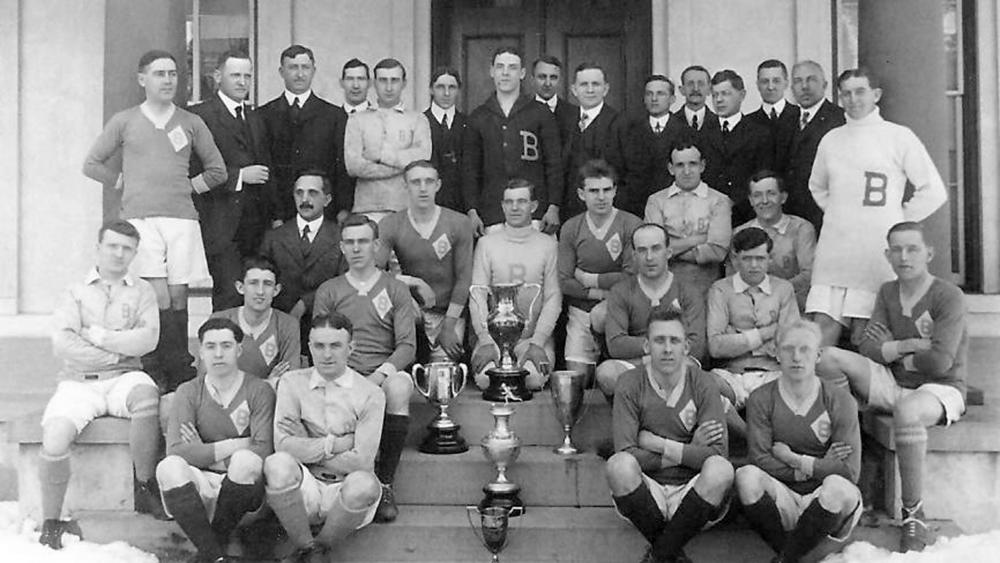
Bethlehem Steel FC was more than a club name borrowed from a corporate benefactor. It belonged to a company town whose industrial identity was written into its skyline and its working hours. The team became one of the dominant forces in early American soccer, winning the National Challenge Cup (today’s U.S. Open Cup) four times between 1915 and 1919. In 1921, the ‘original’ American Soccer League was formed, giving professional soccer a more coherent league structure in the Northeast. Bethlehem joined that world with a reputation already earned on the field.
The club’s story sounds, at first, like a tidy American sports fable: industry, community, success. But the crowd was never as dependable as the trophies. Historians have noted that Bethlehem struggled to draw spectators despite its achievements, in part because the city was smaller and less convenient for league travel than the larger markets around it. Success on the pitch did not automatically translate into a sustainable gate. The team could be one of the country’s best and still have trouble selling enough tickets to make the arithmetic work.
That is the first uncomfortable lesson of lost clubs: winning is not a business plan. A trophy can create a memory; it cannot, by itself, pay the train fare, the wages, the ground rent, or the next season’s bills.
In today’s game, we discuss stadium control, local sponsorship, ownership groups, and revenue models as if these are modern complications. They are not. The old clubs were wrestling with many of the same questions, only without the safety net of contemporary media deals or the promise of a billion-dollar sports market.
Bethlehem’s final chapter arrived in 1930. The Great Depression was battering industrial communities, and the earlier conflict known as the ‘Soccer War’ a bitter dispute between the American Soccer League and the U.S. Football Association over authority and cup participation had already damaged the league’s stability. Bethlehem Steel announced that it would disband at the end of April. Its last game came on April 27, 1930, a 3–2 defeat to Hakoah All-Stars in Brooklyn. One of the most decorated clubs in the country was gone.
That is the first uncomfortable lesson of lost clubs: winning is not a business plan.
There is something particularly American about this ending. The club was attached to an industrial giant, yet its future was not guaranteed by the company’s name or the city’s pride. Its story was vulnerable to economic forces much larger than the game. When the club disappeared, the record books retained its titles. The people who had gathered around it were left to decide what, if anything, could be carried forward.
Fall River: champions who left town
A few hours northeast, Fall River, Massachusetts, had its own soccer empire. The Fall River Marksmen were among the great teams of the late 1920s and early 1930s. They won American Soccer League titles in 1924, 1925, 1926, 1929 and 1930, and lifted the National Challenge Cup in 1924, 1927, 1930, 1931 and 1932. The last two cup triumphs, however, came after the club’s Fall River identity had effectively been left behind.
In 1930, the Marksmen were good enough to win the league, the National Challenge Cup, and the league’s Lewis Cup. Two of their stars, Billy Gonsalves and Bert Patenaude, were also among the leading players for the United States at the first FIFA World Cup in Uruguay. While part of the squad was away at the World Cup, other Marksmen players toured Central Europe, meeting strong sides in Austria, Czechoslovakia and Hungary. This was not a provincial curiosity. For a brief stretch, Fall River’s club was connected to the wider football world in a way that would look familiar to anyone who follows modern international club tours.
And then the economics turned. New England’s textile industry had been in decline for years, with production moving south; the Depression made a bad situation worse. Attendance and revenues suffered. In February 1931, owner Sam Mark moved the club to New York, where it merged with the New York Soccer Club and became the New York Yankees. The team’s identity shifted again, and by the fall of 1931 the players were competing as the New Bedford Whalers. The club’s cup campaign, however, had begun under the Fall River Marksmen name, so that name remained in the record as it won the 1931 cup. The team’s final game came in 1932.
Think about the strangeness of that. A club could win a national trophy while its original hometown watched its identity travel away. The name on the official record might say Fall River; the uniforms might say Yankees; the next chapter might unfold in New Bedford. Football has always had mergers, relocations and administrative oddities, but the emotional geography is simpler. The team that gave a town something to gather around was no longer there.
It is tempting to frame this as the failure of one owner or one league. That would be too easy. Sam Mark made a business decision, and it did not deliver the stronger crowds he hoped to find in New York. But the wider story is about an economy in retreat, a league still trying to stabilize itself, and a sport whose cultural strength in particular communities did not guarantee a national commercial structure. The Marksmen did not disappear because nobody cared about soccer. They disappeared in a period when caring was not enough.
The league that fought itself
The first American Soccer League, founded in 1921, was the most significant professional soccer league in the country at the time. It drew clubs from industrial and immigrant communities across the Northeast and built a level of professionalism that could compete for leading players. Yet it also became entangled in a struggle for control of the sport. In 1928, a dispute over whether league clubs should participate in the National Challenge Cup escalated into the so-called Soccer War between the ASL and the U.S. Football Association. The conflict involved suspensions, a rival league, and a fight over who had the authority to set the game’s priorities.
The timing could hardly have been worse. The Depression was approaching, club finances were already vulnerable, and the competition for players and fans was unforgiving. The dispute was settled in 1929, but the damage did not vanish with the agreement. The original ASL finally collapsed in 1933. This was not the end of soccer in America; the game continued through regional leagues, ethnic clubs, amateur teams and later professional experiments. But it was the end of a major early attempt to build a durable professional structure.
There is a familiar rhythm here: ambition, expansion, institutional conflict, financial pressure, collapse, then a new beginning narrated as if there had been no previous beginning. American soccer has done this often enough that forgetting can look like a strategy. Each generation builds its own origin story because the older one is complicated, embarrassing, or simply difficult to fit into a marketing deck.
The lesson is not that a modern league should copy the past. The economics, media environment, player market and geography are different. The lesson is that institutions are part of the sport, too. A league can weaken clubs through poor incentives; a federation and a league can damage the game by treating authority as more important than coexistence; an owner can mistake a city’s affection for a reliable revenue stream. The ball is round. The business around it is not simple.
Rochester: the outsider that beat the establishment
Fast-forward to a different America, in a different era of professional soccer. In 1996, the Rochester Raging Rhinos entered the A-League, outside Major League Soccer’s new top division. They did not have the glamour of an MLS launch or the advantage of belonging to the new national project. They had a city, a team, and an opportunity to make themselves impossible to ignore.
In 1999, Rochester won the U.S. Open Cup, defeating the Colorado Rapids 2–0 in the final. Since MLS began play in 1996, Rochester remains the only non-MLS club to win the tournament. The Open Cup’s great promise is that a cup tie can briefly flatten the hierarchy: a lower-division club gets a night against a better-funded opponent, and the badge on the shirt does not decide the score. Rochester made that promise real.
The win was not a charming footnote. It was a direct challenge to the assumption that the future of American soccer belonged exclusively to the new top division. Rochester showed that a club outside MLS could build a serious team, draw attention, and win a national trophy. The achievement still matters because it gives the American soccer pyramid a story that is not just about the top rung.
But a cup victory is a moment, not a permanent business model. The Rhinos continued through several league iterations, changed their name, and played in the second tier for years. They entered a hiatus after the 2017 USL season, returned as Rochester New York FC in MLS NEXT Pro in 2022, and did not continue in that competition for 2023. The club’s history is therefore not a clean obituary. It is a story of pauses, rebrands and attempts to find a sustainable place in a changing professional landscape.
That nuance matters. Calling the Rhinos simply ‘dead’ would flatten a complicated history and ignore the work of people who tried to keep the project alive. But pretending the club’s past success automatically created a secure future would be just as misleading. Rochester had a landmark trophy and a real place in American soccer memory. Turning that legacy into a stable institution proved much harder.
Rochester is the kind of story the sport should tell more often, not because every club outside MLS is a doomed underdog, but because it forces a better question. What does a city need in order to keep a professional club? A committed owner? A stadium that works financially? A league structure that rewards long-term investment? A youth pathway?
But a cup victory is a moment, not a permanent business model.
Local media that treats the team as a civic institution rather than a weekend novelty? Usually, it is not one thing. It is the combination, sustained for years, that separates a memorable run from a durable club.
Two MLS cities that were not allowed to keep the dream
The turn of the millennium brought another version of the same question. Major League Soccer had launched in 1996 with ten teams. By 1998 it had expanded to twelve, adding the Miami Fusion and Tampa Bay Mutiny. Four seasons later, both Florida clubs were contracted after the 2001 season, and the league returned to ten teams. Their removal was part of MLS’s early effort to address its financial difficulties and stabilize the competition.
The Mutiny and Fusion are different cases from Bethlehem Steel or the Marksmen. They were not remnants of an immigrant industrial soccer culture; they were clubs in a new league trying to establish itself in a crowded sports market. Their short lives are still essential to the history because they show that even the league that survived was not immune to the costs of getting the model wrong. A major-league label and a place on the schedule could not guarantee a lasting foothold.
Tampa Bay had moments of genuine sporting quality, including winning the Supporters’ Shield in 1996. Miami had a strong final season in 2001, winning the Supporters’ Shield and reaching the playoffs before the franchise was contracted. Their endings were not simply the result of poor football. The economics of the league, ownership, attendance, sponsorship and the difficulty of establishing a stable local base all mattered. The lesson is not that Florida cannot support soccer, today’s game offers ample evidence against such a sweeping claim. It is that a club’s existence depends on much more than the market’s population or the enthusiasm of a launch event.
For fans, contraction is a particularly brutal form of disappearance. There is no relegation to grieve, no lower division in which to follow the same badge, no guarantee that a new owner will arrive. The league makes a decision, and the club is removed from the map. A supporter can keep the shirt, the ticket stub, the memory of a goal; what they cannot do is buy a ticket for next Saturday.
What disappears when a club disappears?
The easy answer is the team. The harder answer is the network around it. A club gives a city a recurring place to meet, a set of shared references, a way for children to imagine a future in the game, and a reason for a local business to sponsor something more intimate than a billboard. It can connect generations who disagree about almost everything except the shirt. None of this is guaranteed by a crest or a stadium, and not every club achieves it. But when it happens, the club becomes more than the eleven players on the pitch.
When the club vanishes, some of that network dissolves quietly. Youth players lose a visible professional destination. Coaches and staff move elsewhere. Supporters scatter across other teams, lower divisions, or the national game. The local newspaper’s match report disappears from the weekend routine. The ground may be repurposed, redeveloped, or simply become another place people pass without knowing what happened there. The city continues. The club’s particular way of making the city feel different on match day does not.
This is why the archive matters. Old programs, photographs, newspaper clippings, club ledgers, supporter memories and stadium maps are not decorative memorabilia. They are evidence that soccer belonged to these places before the current wave of growth. The Society for American Soccer History and other historians have done important work documenting clubs and competitions that otherwise risk being reduced to a line in a database. Their work also reveals how much remains to be found, checked and preserved.
It can connect generations who disagree about almost everything except the shirt.
There is a danger in romanticizing the past. Early clubs were not all well-run community institutions, and the old leagues were not a lost golden age without flaws. Some teams struggled to draw crowds even when they won. Some owners moved clubs when the numbers failed. League politics could be destructive. Historical soccer was full of precarious finances, uneven schedules, and clubs that folded midseason. The past is not a ready-made blueprint for the future. It is a set of hard-earned warnings.
But there is also a danger in treating every new club as a blank slate. When a league announces a new market, it should ask what soccer already exists there: the amateur clubs, the youth networks, the old supporters, the abandoned grounds, the memories of a team that once mattered. Expansion is not only the act of planting a new flag. It can also be an opportunity to connect a new institution to a place’s existing soccer life.
The next chapter should remember the last one
American soccer is in a period of considerable growth and serious attention, but growth is not the same as permanence. New stadiums and new teams can be signs of health. They can also create the illusion that the difficult work has already been done. The history of Bethlehem Steel, Fall River, Rochester, Tampa Bay and Miami argues for a more demanding definition of success: not merely launching a club, but building the conditions that allow it to survive the first owner, the first downturn, the first disappointing season, and the first moment when the novelty wears off.
That means asking practical questions early. Does the club have a stadium deal that makes sense? Is ownership committed beyond a short cycle of attention? Are ticket prices and match-day rituals designed to bring people back, not just impress visitors once? Does the club develop local players and connect to the community’s existing soccer ecosystem? Is there a credible plan for years when results are poor? Does the league’s structure support continuity, or does it reward the next expansion announcement more visibly than the unglamorous work of keeping a club alive? Remember these are just a few of many important questions one must ask him or herself.
It also means telling the stories of clubs that failed without treating them as embarrassments to be hidden. Failure is part of the record. The Marksmen’s move from Fall River to New York and then New Bedford tells us something about the Depression, ownership and the limits of local loyalty. Bethlehem Steel’s demise shows that trophies cannot outrun economic gravity. Rochester’s long, complicated path shows that sporting achievement does not automatically secure institutional stability. Tampa Bay and Miami remind us that even a national league can decide that a city’s club is expendable.
These stories are not arguments against professional soccer. They are arguments for taking it seriously enough to remember its costs. The people who built these clubs were not foolish for believing in them. They were trying to make a sport permanent in a country where permanence has always been difficult to buy. Some succeeded for a while. Some left behind trophies and photographs. Some left behind a question that still hangs over the modern game: what does it take for a club to become part of a city rather than just a tenant in its sports calendar?
A new club can arrive with a polished identity, a launch video, and a stadium plan rendered in perfect sunlight. A lost club leaves behind less photogenic things: a faded scarf, a program in a drawer, an old supporter who can still tell you where they stood when the goal went in. Those are not small things. They are the raw material of a sporting culture.
The clubs America forgot deserve more than a nostalgic paragraph before the next expansion announcement. They deserve investigation, memory, and an honest accounting of why they disappeared. Because the real measure of a soccer nation is not only how many teams it can create. It is how many stories it can keep alive and whether, when the next club comes to town promising forever, anyone has the good sense to ask what happened to the last one.