


SkillCorner has introduced physical benchmarks specifically designed for women’s football. What convinced you that adapting existing benchmarks was not enough and that the women’s game required its own approach?
The clearest signal was that benchmarks developed for men’s football were masking differences between female players. Players with different physical profiles could look very similar in the data because meaningful actions fell below those thresholds.
A threshold determines which movements we recognise as high-speed running, sprinting or acceleration. If that threshold is inappropriate for the athletes being assessed, it affects the picture a scout or analyst sees.
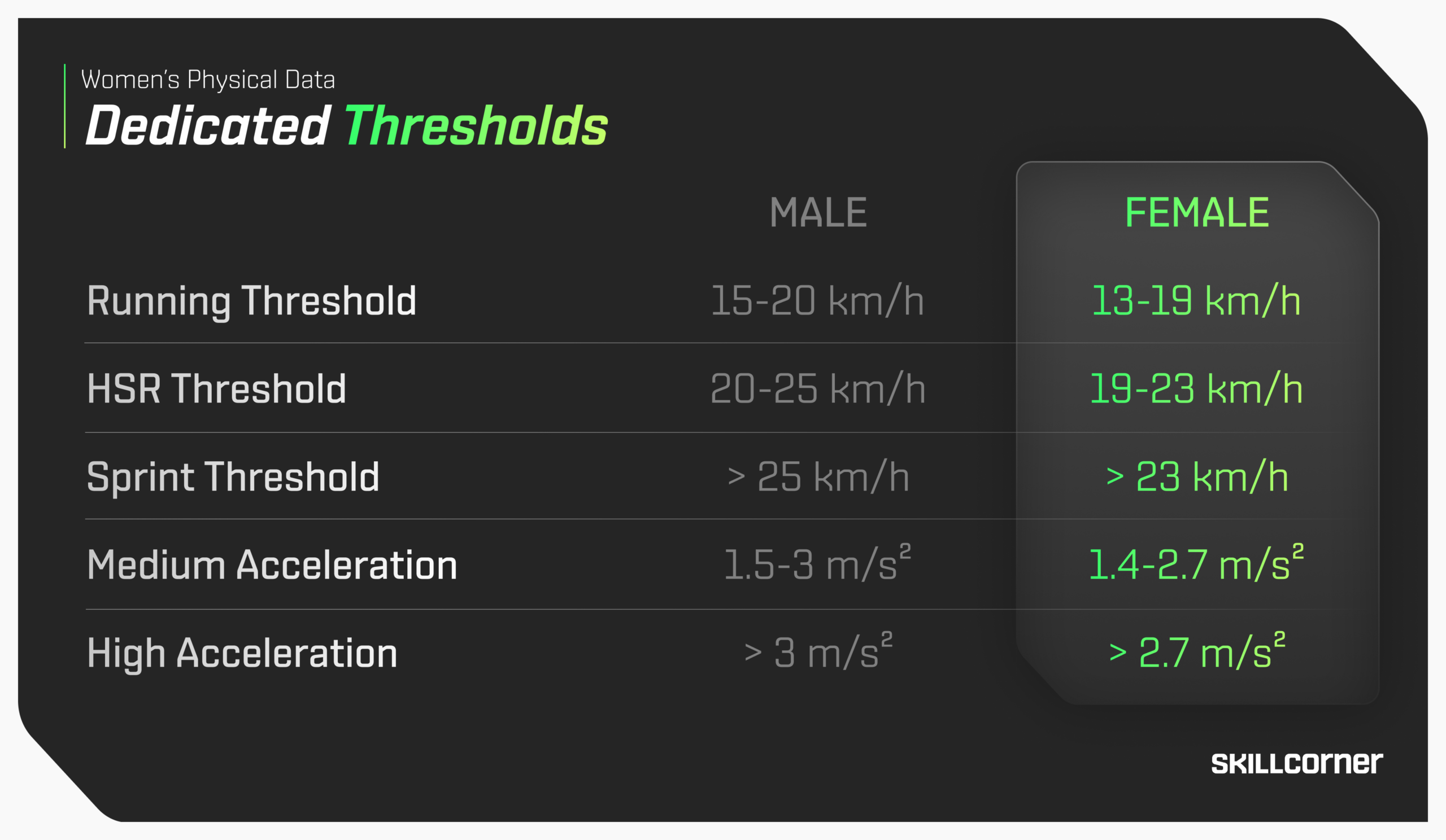
We therefore needed to reconsider both the thresholds and the underlying model in the context of women’s football. The objective was to capture physical output more meaningfully and give clubs a clearer basis for distinguishing players. Women’s football deserves analysis that reflects its own demands.
In this use case, when benchmarked against Centre Forwards in the WSL and NWSL using the new women-specific thresholds, Aggie Beever-Jones moves from registering zero explosive accelerations per match to a strong 77th percentile ranking.
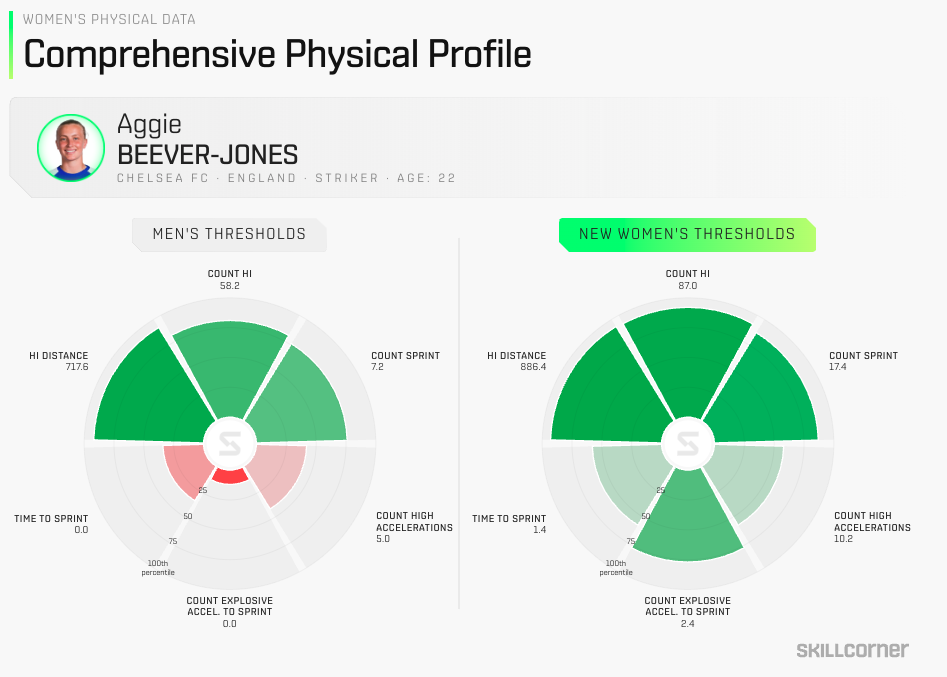
Developing women-specific physical metrics requires more than simply adjusting existing numbers. How did SkillCorner approach the development and validation of these new thresholds, and what were the most important considerations?
We brought together FIFA standards, scientific research and our own research and development. For running, high-speed running and sprinting, we used those inputs alongside a proprietary model recalibrated for women’s football.
Accelerations and decelerations required a different approach. Our R&D team used the statistical distributions in men’s data as a reference, alongside the recalibrated model, to establish dedicated thresholds. Changes in total distance and metres per minute also reflect the model recalibration, rather than simply a change to the boundaries between running categories.
The important consideration is what the resulting metrics allow people to understand. A useful framework needs to distinguish physical profiles meaningfully and support interpretation in the context of a player’s role and match demands. For clubs, understanding how the metrics are constructed is essential to using them confidently in player recruitment and performance analysis.
Your data shows that two players who appear physically similar when assessed using men’s thresholds can look significantly different when women-specific thresholds are applied. What could this change in practice for clubs when scouting and recruiting players?
It could change who reaches a club’s shortlist and which players receive closer attention.
In our published example, two players recorded 5.0 and 5.2 high accelerations per match under the men’s threshold. Using the women-specific threshold, those figures became 10.4 and 6.4. The players had performed the same actions; the new benchmark revealed a difference that the previous one obscured.
For a club looking for a forward who repeatedly accelerates to create separation, that distinction could be relevant. It gives scouts a more useful starting point for investigating whether a player meets the demands of a particular role.
It could change who reaches a club’s shortlist and which players receive closer attention.
It does not automatically establish that one player is better. Clubs still need to consider technical ability, tactical behaviour, opposition and playing context. But it can help them ask better questions, focus their video analysis and avoid overlooking candidates whose strengths were less visible in the previous data.
As investment and professionalisation in women’s football continue to grow, where do you still see the biggest gaps in the way clubs use data to support recruitment and performance decisions?
One of the biggest gaps is the difference in budgets and resources available to clubs. Access to advanced data requires investment, but clubs also need the people, time and expertise to turn that information into better recruitment and performance decisions.
We see this in men’s football too, where clubs with well-funded analysis departments have capabilities that others cannot match. As women’s football evolves, there is an opportunity to make access more equitable.
We believe the opportunity exists for a league-wide approach, centralised procurement by the leagues to help level the playing field by giving every team access to high-quality data. Alongside that access, shared training and support could help clubs with fewer resources build the confidence and skills to use it effectively.
Clubs would still bring their own football philosophy, expertise and judgement to the analysis. But a stronger shared foundation would give more teams the opportunity to make smarter decisions, supporting both individual clubs and the development of the league.
Looking ahead, how do you expect women-specific data to influence the way clubs identify, compare and ultimately value players over the next few years?
I expect it to broaden the pool of players clubs consider, both geographically and in terms of the physical qualities they recognise. Our women’s football data now covers 30 leagues and competitions globally, representing more than 13,000 players. That gives recruitment teams the opportunity to explore talent beyond their familiar markets and assess players against benchmarks designed for the women’s game.
The combination of wider coverage and more relevant benchmarks matters. It can help clubs identify players whose strengths were previously obscured by inappropriate thresholds, including candidates in competitions they may have fewer opportunities to watch regularly.
It should also support more precise conversations about fit. Rather than asking only whether a player is fast or physically strong, clubs can examine whether her movement profile supports the way they want to play, alongside her technical and tactical contribution. A recent blog titled; Contextual Scouting: A Pressing No. 8 in Women’s Football is a great example of SkillCorner’s Game Intelligence data and new dedicated Women’s Physical Data being used in tandem to identify players capable of performing as a number 8 in an active, high-pressing team.
I expect it to broaden the pool of players clubs consider, both geographically and in terms of the physical qualities they recognise.
Over time, I expect this to influence how clubs value players by making overlooked strengths more visible and providing stronger evidence for recruitment decisions. A player who receives limited attention in one market could emerge as a compelling candidate for a particular role elsewhere.
The ambition is to help clubs discover more talent, compare players more meaningfully and make smarter decisions across an increasingly global recruitment market.
Women’s Football: Dedicated Data, Smarter Decisions.
Join SkillCorner on 12th October for a live webinar exploring dedicated physical metrics for women’s football and practical scouting use cases.
Time: 15:00 CET
Location: Zoom Webinar
Duration: Approximately 30 minutes, with a concluding Q&A.