

The Evolution Framework: Driving a Competitive Edge through IDPs and Elite Learning Systems
Dave Conlon UEFA Pro Licence Diploma – Independent Research Project
Introduction
Within elite football, first-team environments are predominantly driven by performance outcomes, often prioritising short-term results over long-term player development. While winning remains the non-negotiable objective, sustained success is underpinned by continuous individual and collective improvement. As such, performance and development should not be viewed as competing priorities, but as interdependent processes.
Despite this, structured development practices, which are common within academy systems, are less systematically embedded at senior level. This creates a potential developmental plateau, where players are expected to perform, but not always supported to evolve.
Context
Player development has traditionally been associated with academy and youth coaching structures. However, modern elite football is beginning to recognise that development does not cease at first team level. Instead, continuous improvement within senior environments has become a competitive advantage. There is extensive research (e.g., Green and Kay, 2026) in academy football highlighting the benefits of Individual Development Plans (IDPs). Due to the EPPP (see Elite Player Performance Plan, English FA, 2011), every academy player has a development plan to meet their individual needs. These provide a tailored, structured, and goal-oriented approach to their growth, focused on the individual rather than just the team. Relatedly, IDPs serve as a personalised roadmap to maximise a player’s potential, covering technical, tactical, physical, and psychological aspects of the game. Such work is known as the Four Corner Model.
Despite evidence of these benefits in academy settings, research into first-team football remains scarce. Consequently, the value of applying such models to improve senior player development and asset valuation is not yet fully understood. The design, implementation and review of such a model/process, however, goes beyond the scope of this study.
As such, performance and development should not be viewed as competing priorities, but as interdependent processes.
Despite some recent progress, football frequently struggles with balancing immediate competitive pressure against long term player growth. In other sports (at senior/first team level) IDPs or Individual Performance Plans (IPPs) are common practice. For example, within Rugby, clubs support the international players’ development in conjunction with their respective union/federation. It is important for football to analyse what can be learnt from these sports to work alongside their NGB to support players. They acknowledge development continues within adulthood. This is supported by research that a person’s bio-psycho-social development continues through adulthood. Therefore, the limited attention to development for athletes at higher competitive levels is perhaps surprising. Research shows that structured programming for athlete development is needed at the professional sport level, arguably with the same rigor and importance as pre-professional sport (Baker et al., 2023). The assumption is senior players will continue to improve, but that’s unlikely without intentional practice.
The aim of the research is a comparative analysis of elite sports to identify transferable developmental practices for football. Evidence confirms that individualised, targeted training yields superior performance gains compared to generic programming. This is underpinned by deliberate practice, emphasising structured, goal-directed activities and feedback loops to address specific weaknesses (Ford et al., 2015; Ericsson et al., 1993). Additionally, tailored goal setting enhances performance when aligned with intrinsic motivation (Bird, et al., 2025; Healy, et al., 2018). Collectively, these factors underscore the necessity of personalised pathways and the coach–athlete relationship in optimising elite development.
Methodology
Open-ended interviews were employed to generate nuanced qualitative data and allow for detailed participant discourse. This facilitated an in-depth exploration beyond restrictive ‘yes/no’ frameworks (Lahmer and Lahmar, 2022). The questions addressed:
- Do you use IDPs (what are they called)?
- Why use them, what does it look like (own environment), what do you hope to achieve?
- How is it aligned to the organisations long-term plan?
- What’s the strategic approach (e.g. how often)?
- How does it move from admin tool to performance driver?
- How is success measured?
- Coach or Player led (how/why)?
- How do you get buy in (players perspective of the process)?
- Barriers/Constraints/what’s not worked (why)?
Participants
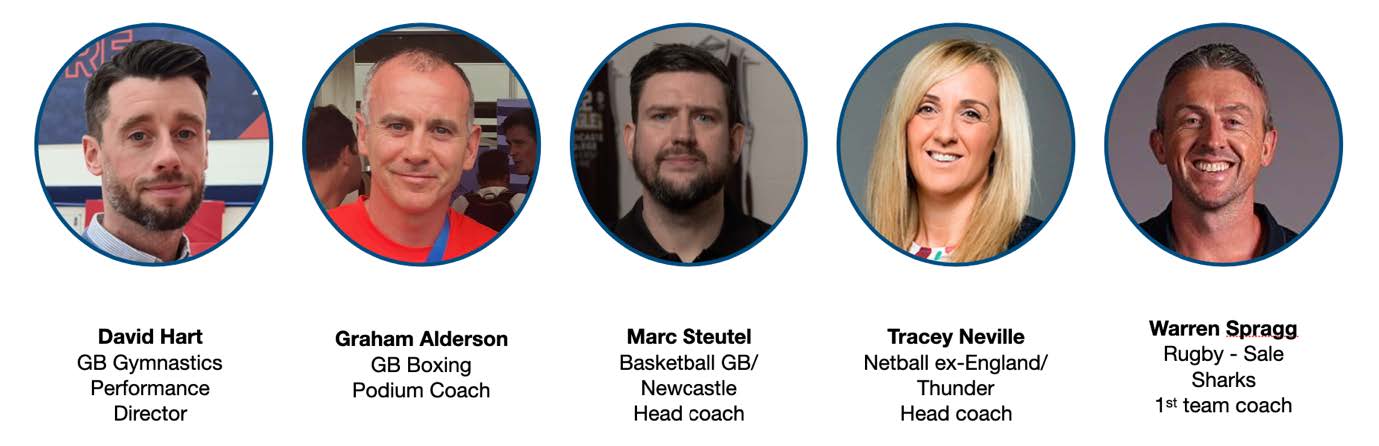
Five stakeholders from diverse elite sports were strategically interviewed to identify transferable insights for football’s individual development processes. Adhering to ethical protocols, participants provided formal informed consent and collectively elected to waive their right to anonymity for this study.
Findings
The findings have been summarised into six key themes below:
1. Club Philosophy
All sports commented that the development model must be intrinsically linked to the club’s overarching philosophy, through both standardised training protocols and competitive exposure (game time). Success metrics should adopt a dual-focus approach, evaluating technical performance indicators alongside traditional results-based outcomes to foster an environment of continuous evolution. Across all sports interviewed, the requirement for dedicated, individual-specific coaching windows was emphasised. By doing this, the club not only enhances internal asset valuation but also strengthens its market position when recruiting. Rugby stated:
Training must be planned and integrated into the weekly schedule not just a token add-on at the end of training where players can do extras.
2. Game Model
Basketball, Netball and Rugby commented developmental objectives must be tailored to the unique demands of the player’s role, focusing on the technical, tactical and physical attributes required to execute key game-model phases, such as the high press and counter-attacking transitions. This will vary on their positional requirements. In individual sports (Boxing and Gymnastics) this is related to their own game plan. Basketball emphasised this:
Training must be realistic and replicate the strategy and game plan (teams playing identity) of each positional requirement.
3. Performance Metrics
All participants believed Players/Athletes crave quantitative and qualitative feedback and the use of data enables them to see if they have not only improved, but also to measure themselves against a benchmark (for example individual improvement, the league’s average, or top 10% of performers in the league). This comparative analysis serves as a critical driver for intrinsic motivation and performance accountability. For example, Netball believed:
KPIs are essential to be able to benchmark the players against the league’s best to help with goal setting.
4. Multi-Disciplinary Team (MDT) Collaboration
The efficacy of the MDT relies on the total alignment of all specialist departments toward a joint blueprint (IDP). Using a sport specific framework such as the Four Corner Model allows for a multi-faceted intervention strategy where all aspects are interwoven. This integrated methodology ensures that individual KPIs are not viewed in isolation but as collaborative benchmarks that contribute to the player’s overall progression and performance. Gymnastics believed:
It is essential for the MDT to all know the individuals’ goals.
5. Holistic Support
All sports believed that player buy-in significantly increases not only when they have ownership, but when conversations are not only focused on results and performance but also the individual as a person. Discussions should include life away from sport (family, interests, commitments) or future career pathways. Performance could be considered as the tip of the iceberg; what’s under the water (mental health, sleep, nutrition, relationships) supports and can enhance it. This will also create psychological safety and trust. All sports acknowledged:
You don’t get the best out of the athlete until you’ve secured the best for the person.
6. Player Ownership
A shift from compliance to commitment can happen when the athlete helps to design their own learning plan and support is provided for them to reach their own goals. A conversation review with a feedback loop can be powerful; to ensure the individual feels supported and promotes a high-performance development culture. Boxing reiterated this:
The individual must drive their goals and training standards.
Summary of findings
The implementation of IDPs within first team senior football requires strategic planning and organisational/club commitment. This environment operates a temporal framework due to the demands of not only performance but also results. To be a success it requires long-term planning, consistent monitoring and whole club alignment. Team session plans need to include a focus on the individual (each player is unique with different needs). IDPs must be a dynamic process, not a document. It doesn’t just set goals; it provides clarity on where you’re heading and how to get there, which is tracked and monitored.
By integrating a permanent development philosophy, aligning goals with the club’s game model, leveraging performance data, and prioritising holistic support, clubs can maximise player potential and achieve sustainable competitive advantage. Ultimately, investing in the individual as both a player and a person underpins not only on-field performance but also the long-term success and culture of the club.
Recommendations
The following recommendations and conceptual framework have been developed to bridge the gap between the research findings and sustainable high-performance outcomes.
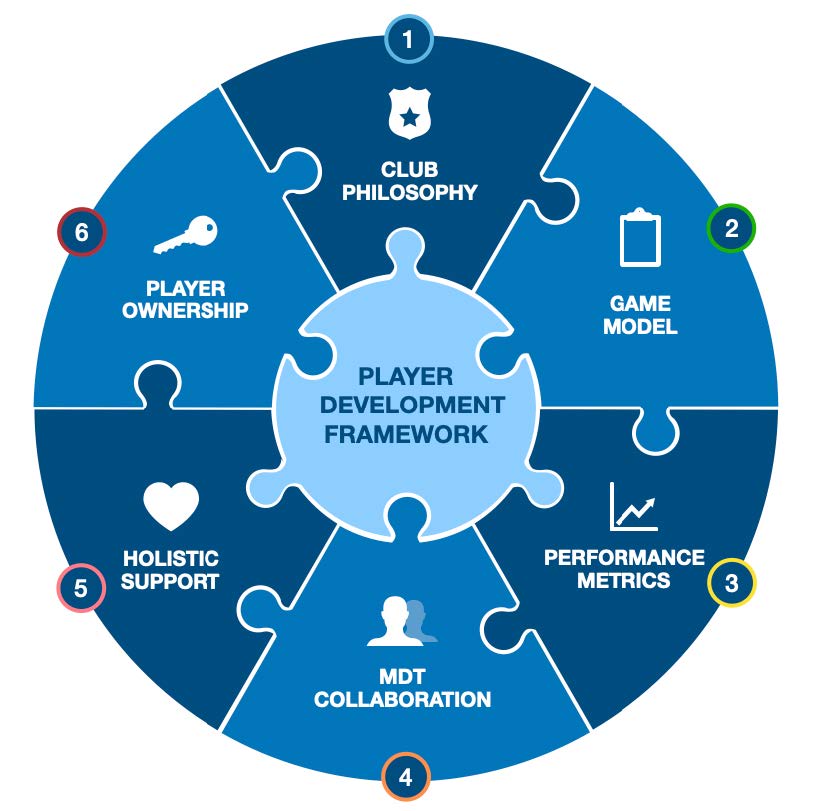
Club Philosophy = Development Philosophy
The club needs to prioritise long-term player development over short-term results. Time must be allowed and specific development blocks integrated into weekly micro-cycles to ensure consistent learning opportunities. This can be a strategic tool to increase the club’s value and enhance recruitment.
IDPs align with Game Model
The club’s game model and playing style must have clear positional requirements on all aspects of the game (technical, tactical, physical and psychological) that supports the team’s overall playing identity and tactical strategy.
Performance Metrics – for each individual player
Players must receive a combination of qualitative and quantitative feedback to track their progress and to set goals.
IDPs must be a dynamic process, not a document.
Players can be benchmarked against internal, league wide, and top-tier standards to encourage continuous improvement.
Strengthen MDT Collaboration
Planning must be integrated across coaching, medical, sports science, and psychological staff. Key Performance Indicators (KPIs) must be aligned across departments to support individual player goals.
Enhance Holistic Support
Whole player support is essential to get the best out of players. Address personal, mental, and lifestyle factors alongside performance metrics. There must be psychological safety and trust through conversations focused on the player as a person.
Promote Player Ownership and Commitment
Players must be involved in designing their own development plans. This must be reviewed at agreed points, with opportunities for feedback loops to build accountability, engagement, and motivation. The focus should be on long-term improvement to enhance competitive advantage.
References
- Baker J, Johnston K, Singh H, Farah L and Lablans D (2023) Excellence fulfilled? On the unique developmental needs of professional athletes.
- Bird, S., Chapman, M.T. and Jackman, P.C. (2025) ‘Psychological wellbeing in high-performance environments’, in S. Bird (ed.) Performance Psychology for Sport and Life. London: Routledge.
- Ericsson, K.A., Krampe, R.T. and Tesch-Römer, C. (1993) ‘The role of deliberate practice in the acquisition of expert performance’, Psychological Review, 100(3), pp. 363–406. doi: 10.1037/0033-295X.100.3.363.
- Ford, P.R., Coughlan, E.K., Hodges, N.J. and Williams, A.M. (2015) ‘Deliberate practice in sport’, in Baker, J. and Farrow, D. (eds.) Routledge Handbook of Sport Expertise. London: Routledge, pp. 347–362.
- Green, M. and Kay, A., (2026). The Development of Transferable Skills within Professional Football Academies. Football Studies, p.100036.
- Healy, L.C., Tincknell-Smith, A. and Ntoumanis, N. (2018) ‘Goal setting in sport and performance’, in Oxford Research Encyclopedia of Psychology. Oxford: Oxford University Press. doi: 10.1093/acrefore/9780190236557.013.152.
- Helsen, W.F., Starkes, J.L. and Hodges, N.J. (1998) ‘Team sports and the theory of deliberate practice’, Journal of Sport and Exercise Psychology, 20(1), pp. 12–34.
- Lahmer, M. and Lahmar, M., (2022). Analyzing open-ended questions for qualitative research. Retrieved from Researchget. net: https://www. researchgate. net/publication/365775711_Analyzing_Openended_Questions_ for_Qualitative_Research.
- Premier League (2011) Elite Player Performance Plan. London: Premier League.