

The £900 Million Question
What the Manchester City verdict teaches us about revenue, rules and brand value
More than £900 million. According to an independent commission, that is how much Manchester City’s arrangements between 2009–10 and 2017–18 inflated the club’s reported revenue and reduced its reported costs. Those nine seasons cover the years in which City won its first Premier League titles and grew into a global brand. The club denies any wrongdoing, calls the findings unsafe and has said it will appeal.
Most of the coverage so far has been about punishment: points, relegation, even expulsion. The accounting underneath has had far less attention, yet that is where the case teaches the most about how football money works. Below, we go through what was decided, how the spending rules work, how related-party deals are judged, what the numbers mean, how past cases compare, what each possible outcome would cost, and where the brand fits in.
Before you read
The findings discussed here are those of an independent commission and are subject to appeal. Manchester City denies any wrongdoing. No sanction has been decided. Information is correct as of 30 September 2026.
The Verdict in Brief
On 29 September 2026, the Premier League announced that an independent commission had found Manchester City guilty of all charges relating to serious breaches of its financial rules across nine seasons, and of most charges relating to failure to cooperate with the league’s investigation. The charges were brought in February 2023 after a four-year investigation.
The club denies any wrongdoing, calls the findings unsafe and has said it will appeal.
League chief executive Richard Masters called it the most significant decision in Premier League history. The club said it was “disappointed and surprised,” maintains that it is innocent, and must lodge its appeal by Friday, 2 October. A new three-person panel will hear the appeal, and sanctions will be set separately at a private hearing.
| Key fact | Detail |
|---|---|
| Period covered | 2009–10 to 2017–18 (nine seasons) |
| Number of charges | 115 |
| Charges brought | February 2023 |
| Verdict announced | 29 September 2026 |
| Appeal deadline | 2 October 2026 |
| Possible sanctions | From a fine to expulsion; to be decided at a separate hearing |
| Club position | Denies wrongdoing; will appeal |
How Spending Rules Turn Revenue into Spending Power
Premier League clubs operate under rules that limit how much money they may lose over a set period. The purpose is to protect clubs from overspending and to keep competition fair. Because the limit is based on losses, revenue sets the ceiling on spending: every extra pound a club earns allows roughly one extra pound to be spent on wages, transfers and operations while remaining compliant.
Under these rules, every pound of revenue is also a pound of spending permission
That is why regulators care so much about where the money comes from. An owner can put money into a club, but the rules treat that differently from money a club earns through genuine commercial deals.
A worked example
Consider a hypothetical Club X with a loss limit of £100 million. The numbers below are illustrative only and do not describe any real club.
- Scenario A: Club X earns £300 million from independent sources and spends £420 million. Its loss is £120 million, which is £20 million over the limit.
- Scenario B: Club X signs an additional £50 million sponsorship with a company connected to its owner. If that is recorded as commercial revenue, the loss falls to £70 million, comfortably within the limit, and the club now has £30 million of headroom to spend.
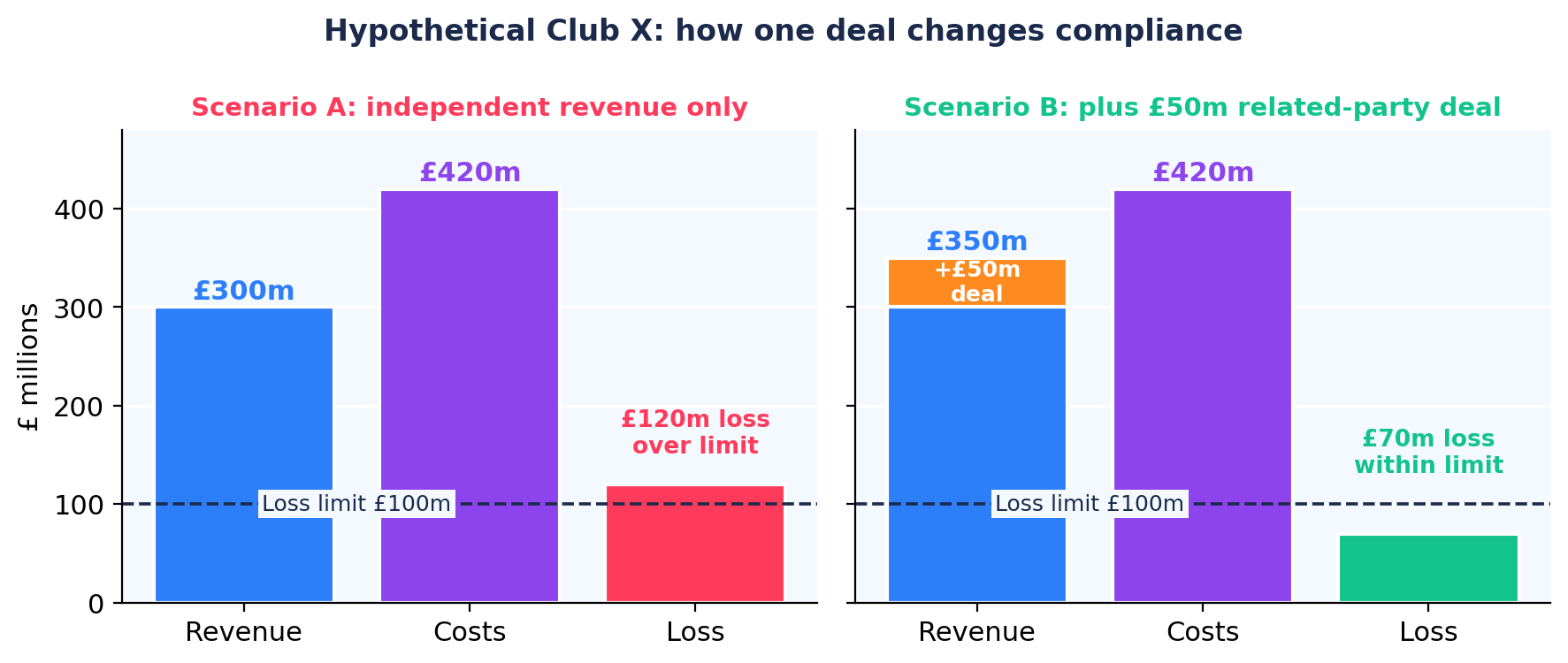
Figure 1. Illustrative example: a single £50m deal moves Club X from breach to compliance. Hypothetical figures.
One deal, recorded one way or the other, decides whether Club X is in breach and how much it can spend on its squad. That is exactly why regulators look hard at whether deals like this are priced at genuine market value.
Related-Party Deals and Fair Market Value
A related-party transaction is a deal between a company and someone connected to it, such as its owner or a business the owner controls. Such deals are legal and common in every industry. However, because the two sides are not independent, accountants and regulators check whether the price reflects what an unconnected party would pay. This is known as fair market value.
The three-question test
- Who is the sponsor? Is it independent of the club’s owner, or connected to it?
- Who is actually paying? Does the money come from the sponsor’s own commercial budget, or from elsewhere?
- Is the price in line with the market? How does the fee compare with similar deals at comparable clubs?
The Premier League introduced specific rules on associated-party transactions in recent years to formalise these checks, reflecting how important the issue has become across the game.
What the Commission Found, and What the Numbers Mean
According to the league’s statement, the commission found three main types of arrangement. Manchester City disputes each of these findings.
| Type of arrangement | What the commission found | Accounting effect |
|---|---|---|
| Sponsorship funding | Several sponsors paid only part of their fees, with the remainder funded by the club’s owner, Abu Dhabi United Group (ADUG) | Owner funding recorded as commercial revenue |
| Cost arrangements | An arrangement funded by ADUG allowed the club to report lower operating costs than it incurred | Reported costs lower than actual costs |
| Image rights | A circular arrangement with Fordham, an entity that acquired players’ image rights, funded by ADUG | Player-related costs moved off the club’s accounts |
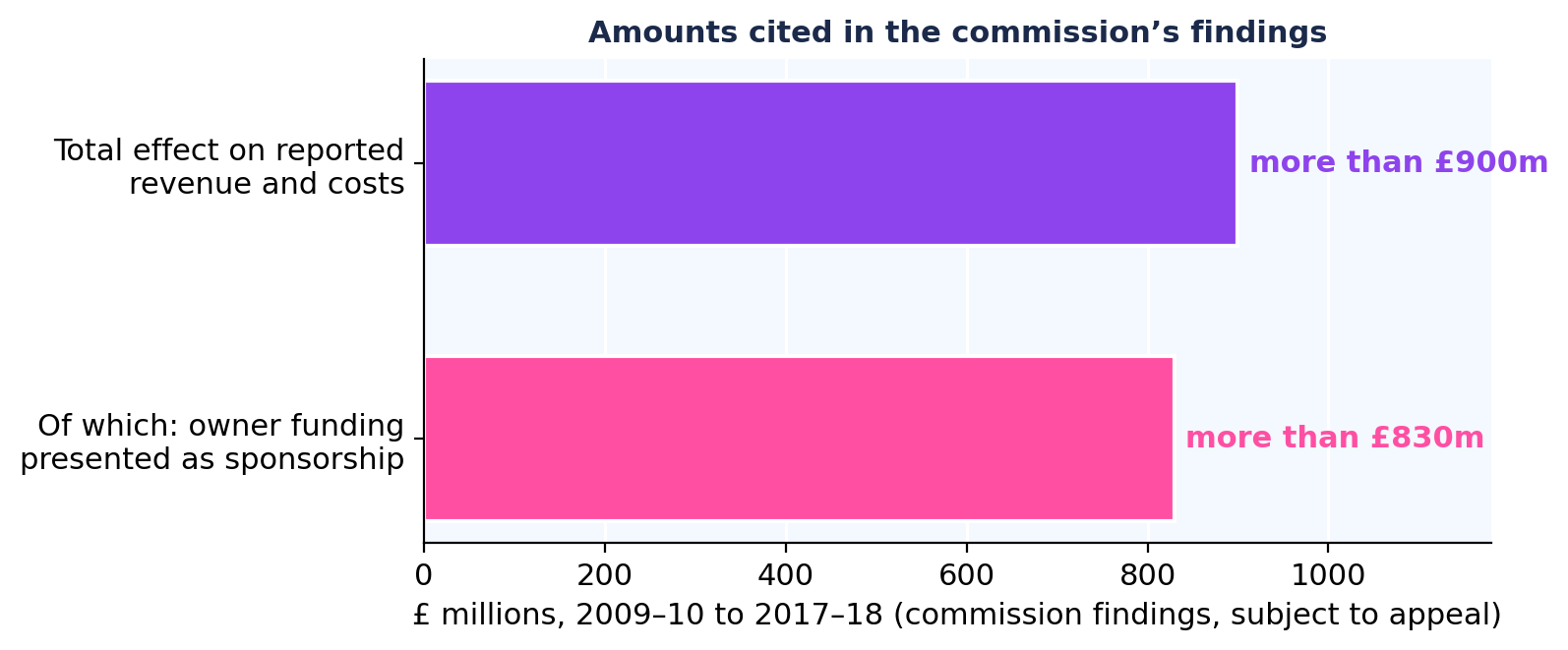
Figure 2. Amounts cited in the commission’s findings, as reported. Manchester City disputes these findings.
The commission found that, had the club reported accurately, it would have exceeded the spending limits by a very substantial amount. In the terms of the Club X example, the finding is that the club was operating in Scenario B when its genuine position was Scenario A.
How the Case Compares with Past Cases
There is no fixed tariff for sanctions, and no two cases are identical. However, previous cases give a sense of how the league and its commissions have acted.
| Case | Issue | Outcome |
|---|---|---|
| Everton (2023) | Overspending in a single three-year assessment period | 10-point deduction, reduced to 6 on appeal |
| Nottingham Forest (2023–24) | Breach of spending rules | 4-point deduction |
| Everton and Burnley (2026) | Burnley argued it would have avoided relegation in 2021–22 had Everton been sanctioned sooner | Everton ordered to pay Burnley more than £35 million |
| Manchester City and UEFA (2020) | UEFA imposed a two-season European ban | Court of Arbitration for Sport overturned the ban; €10m fine for failing to cooperate |
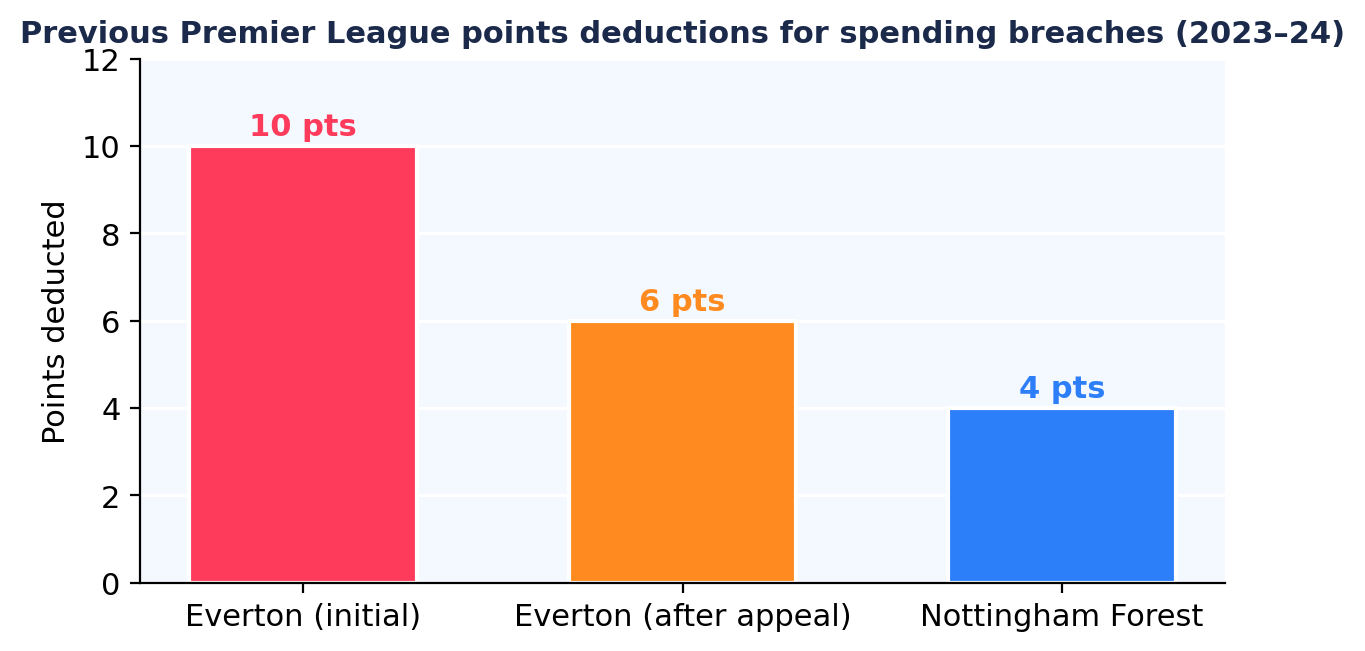
Figure 3. Previous Premier League points deductions for spending breaches, for scale.
The current case covers nine seasons and includes cooperation charges, which makes it much broader than the Everton and Forest cases. Some football finance commentators have suggested that any deduction could be several times larger than those previous cases, but this remains speculation until the commission rules.
Possible Outcomes and Their Financial Effects
Under Rule W64 of the Premier League Handbook, the commission can fine a club, deduct points or expel it, and it has discretion to make other orders. The framework below is educational and is not a prediction.
| Possible outcome | Main financial effects |
|---|---|
| Fine only | One-off cash cost; little effect on revenue, squad or commercial partners |
| Points deduction, club stays up | Possible loss of league-position prize money and European qualification, one of a club’s most valuable revenue streams |
| Deduction leading to relegation | Major fall in broadcast revenue; wage bill and player contracts under pressure; commercial deals may be renegotiated |
| Expulsion | The most severe scenario, affecting revenue, squad value and commercial contracts |
| Appeal succeeds | Findings overturned or reduced; uncertainty removed, generally supporting the club’s commercial position |
The timing dilemma
If sanctions apply before the appeal is heard, the club could be punished and later cleared. If sanctions wait until after the appeal, this season’s results could stand while the case remains unresolved, potentially affecting other clubs’ league positions and European places. Both options carry financial risk for someone, which is why timing is one of the most closely watched issues.
How compensation could be calculated
Media reports suggest other clubs may pursue compensation, and the Everton–Burnley case shows such claims can succeed. Damages in football are usually built on a counterfactual: what a club would have earned in the position it argues it should have finished. A simplified version of the calculation is:
Compensation ≈ revenue in the claimed position − revenue actually earned
In practice, this involves estimating prize money, broadcast income and European revenue, and in relegation cases the full value of Premier League status over several seasons. It is the same approach used in commercial litigation outside sport.
The Branding Perspective
For a club like City, the brand is among its most valuable assets, so the branding side of the case deserves a look of its own.
Brand equity
Brand equity is the value a brand adds beyond its physical assets: global fan loyalty, recognition, and the ability to attract sponsors and talent. Sustained success on the pitch builds brand equity, and uncertainty about how that success is viewed can affect brand perception.
Sponsors
Commercial partners generally assess the reputational risk of their associations, and sponsorship contracts across sport often include clauses covering reputational events. Responses usually depend on the final outcome, which is why the appeal matters commercially as well as legally. There is no public indication at this stage of how the club’s partners will respond.
Talent and fans
So far, the case has had little visible effect on the club’s ability to attract players: it completed a record transfer window this month, spending around £460 million. Football fans are also widely regarded as unusually loyal customers, which tends to protect a club’s core revenue during periods of uncertainty.
Crisis communication
Both sides are working hard on the public story. The league talks about the integrity of its rules, while the club talks about its innocence and its appeal.
Sustained success on the pitch builds brand equity, and uncertainty about how that success is viewed can affect brand perception.
Each is speaking to fans, sponsors, regulators and rival clubs at the same time, which is about as real a lesson in crisis communication as sport offers.
Five key takeaways
- Revenue sets spending power: Under loss-based rules, how revenue is recorded directly affects how much a club may spend.
- Revenue quality matters as much as size: Analysts ask who paid, and whether an independent party would have paid the same.
- Regulatory risk is a real cost: Past accounts can be revisited years later, so compliance history belongs in any club valuation or acquisition due diligence.
- Timing has financial consequences: When a sanction applies can matter as much as its size, for the club and its rivals.
- Brand value depends on trust: Commercial partners and fans respond to outcomes, which is why the appeal is as much a commercial event as a legal one.
Glossary
- Profitability and sustainability rules: Premier League rules limiting how much a club may lose over a set period.
- Related-party (associated-party) transaction: A deal between a club and a party connected to its owner.
- Fair market value: The price an independent buyer and seller would agree on.
- Image rights: The commercial rights to use a player’s name and likeness.
- Independent commission: The panel appointed under Premier League rules to hear disciplinary cases.
Conclusion
Take away the headlines and this is a case about how revenue gets recorded, and why that matters so much in a regulated sport. The commission has reached its view. City rejects it and will appeal. However it ends, few cases show as clearly how accounting, regulation and brand value are tied together in the modern game.
Citations
- Premier League. Statement on the independent commission’s decision regarding Manchester City, 29 September 2026. As reported by Al Jazeera and the Associated Press.
- Al Jazeera. “What will happen to Man City after the Premier League’s guilty verdict?” 30 September 2026. aljazeera.com.
- Al Jazeera. “Man City guilty of all serious financial breach charges: Premier League.” 29 September 2026. aljazeera.com.
- NBC News / Associated Press. “Man City guilty of almost all of the 115 financial charges, Premier League says.” 29 September 2026. nbcnews.com.
- Premier League. Premier League Handbook, Section W (Disciplinary), Rule W64. premierleague.com.
- Court of Arbitration for Sport. CAS 2020/A/6785 Manchester City FC v. UEFA, award of 13 July 2020. tas-cas.org.
Disclaimer: This article is for educational and analytical purposes only and does not constitute legal or financial advice. It does not take a position on the outcome of the case. All findings referred to are those of the independent commission as reported, are disputed by Manchester City, and are subject to appeal. Worked examples use hypothetical figures and do not describe any real club.