


Carmakers, app companies and a 1954 tax rule: the business behind J1
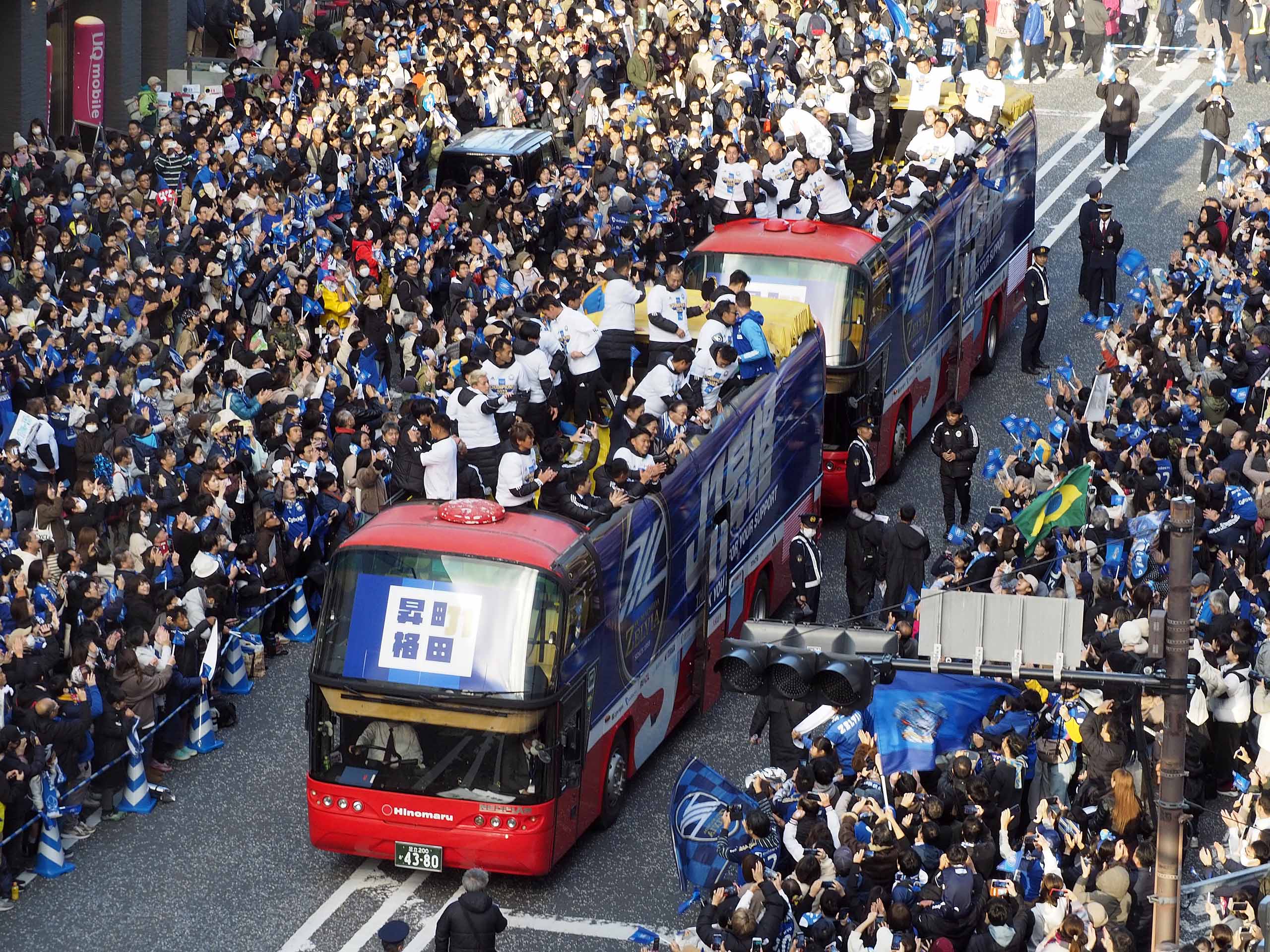
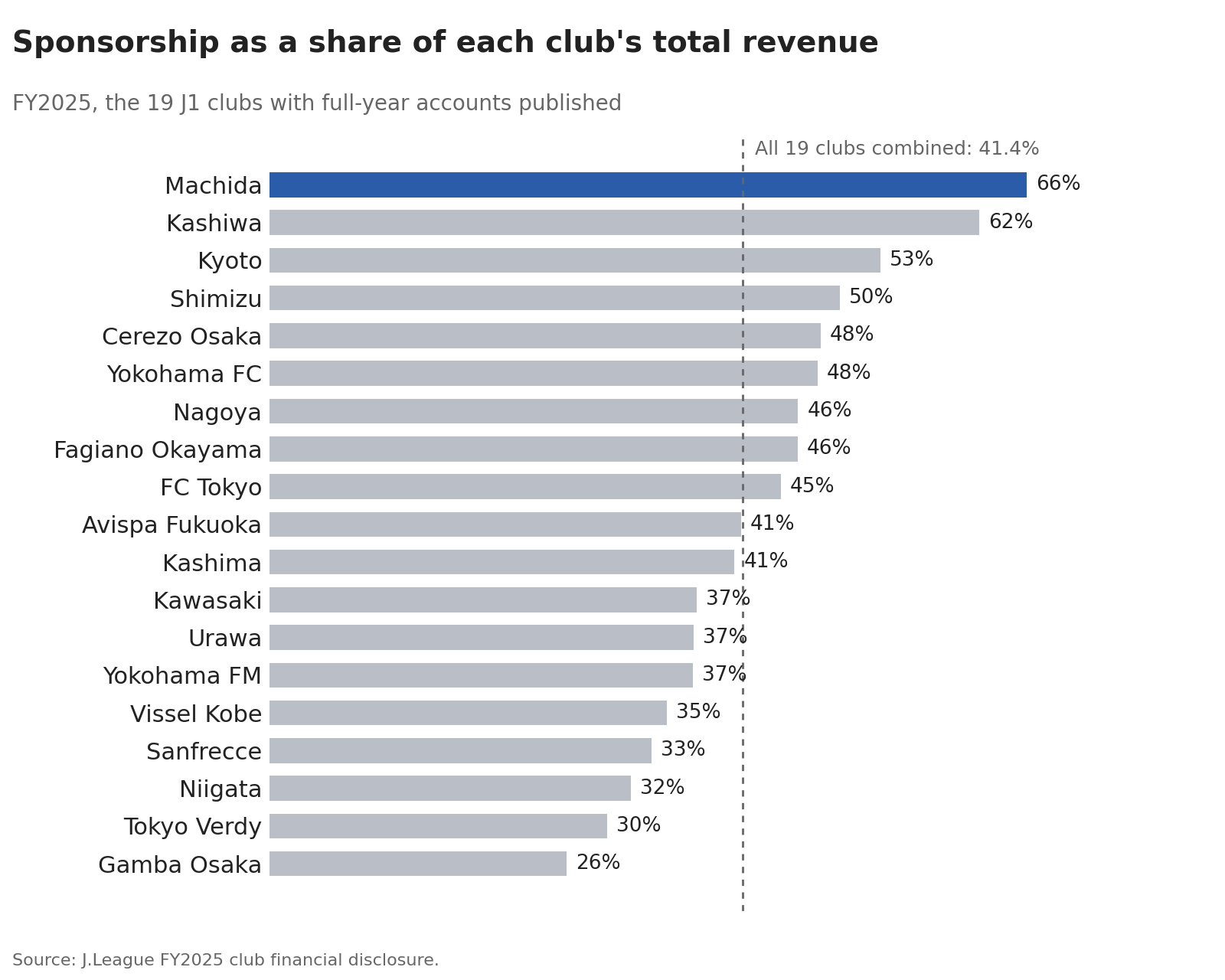
In 2025 Machida Zelvia earned more from sponsors than any other J1 club, including Urawa Red Diamonds, a club that brings in far more money overall.
The figures are in the J.League’s FY2025 club accounts. Urawa’s total revenue, meaning everything the club earned from tickets, sponsors, merchandise, league payments and transfers, was £54.3m (¥11,310m), the highest of any J.League club. Machida’s total revenue was £33.2m (¥6,914m). Sponsorship is one part of that total, and on that line alone Machida took £22.0m (¥4,581m) against Urawa’s £20.1m (¥4,195m).
CyberAgent, the Tokyo internet and advertising group, paid £5.5m (¥1.15bn) for 80% of Machida in October 2018. In 2022 the club were fifteenth in J2 and brought in £9.2m (¥1,919m) all year. Twelve months later they’d won the division, and in 2024, their first season in the top flight, they finished third.
In 2025 Machida Zelvia earned more from sponsors than any other J1 club, including Urawa Red Diamonds, a club that brings in far more money overall.
Sponsorship now makes up two thirds of Machida’s total revenue. Kashiwa are next at 62%, then Kyoto at 53%, and no other J1 club gets past half. The accounts don’t say how much of Machida’s sponsorship comes from CyberAgent itself, and I’m not going to guess; however, generally across the whole division, sponsorship is still the biggest single source of money. Machida just push it further than anyone else.
Where the money comes from
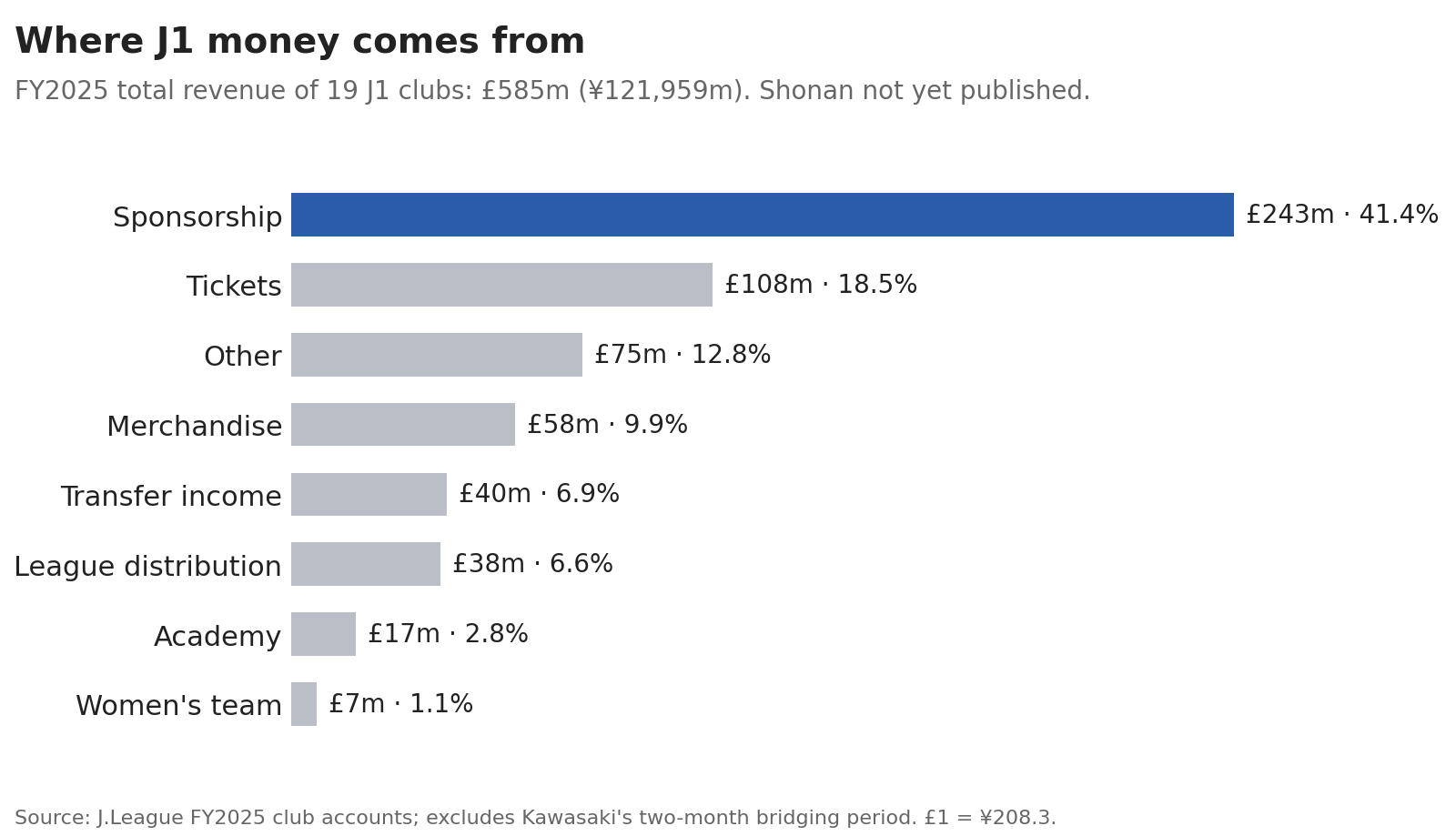
Machida’s two thirds only means something against the league as a whole. Nineteen of J1’s twenty clubs have now published full-year accounts for FY2025. Shonan’s year ends in June, so they’re still to come, and I’ve left out a two-month bridging period Kawasaki reported because of the calendar change. Between them the nineteen had total revenue of £585m (¥121,959m). Sponsorship brought in £243m (¥50,547m) of that, which is 41.4%. Ticket sales came to 18.5% and merchandise to 9.9%. Transfer income was 6.9% and the league’s distribution money 6.6%. Academy income made up 2.8% and the women’s teams 1.1%, and the remaining 12.8% sits under “other” in the accounts.
Set that against the Premier League. Deloitte’s 2026 Annual Review puts English top-flight revenue for 2024/25 at £6.8bn, with broadcasting worth half of it and the entire commercial line, sponsorship and merchandise included, worth 35%. In J1 sponsorship on its own is a bigger share than that. The two sets of accounts don’t use the same categories, so the comparison is rough. The J.League sells its media rights centrally and spreads that money across distributions, prize money and league activity, and the part that reaches clubs as distribution is 6.6% of their revenue. Broadcast money is half of a Premier League club’s. That leaves the obvious question of who those sponsors are.
Who’s paying
At most of the big clubs, the answer starts with the owner. At nine of the ten clubs with the highest total revenue, one company or its holding vehicle owns a majority of the shares, and Kawasaki are the exception.
Before the J.League started in 1993, Japan’s top flight was made up of company teams, and several of those companies still own the clubs today. Toyota own just over half of Nagoya Grampus, Panasonic Sports hold 70% of Gamba Osaka, and Kashiwa Reysol have long been almost entirely Hitachi’s. Urawa’s majority holder is Diamond F.C. Partners, a holding company Mitsubishi Heavy Industries and Mitsubishi Motors set up together in 2016, which owns just over half the club. Fujitsu, whose works team Kawasaki began as, are still among the club’s shareholders. Nissan owned around three quarters of Marinos for years, and since June they’ve also held the shares City Football Group used to own.
Several of the clubs that changed hands more recently went to internet companies. Mercari agreed in July 2019 to buy 61.6% of Kashima from Nippon Steel. MIXI own a little over half of FC Tokyo, and Rakuten agreed to buy all of Vissel Kobe in December 2014. The exception is Sanfrecce Hiroshima, where the electronics retailer Edion announced in July 2023 that it would raise its stake to 76.1%. Why a carmaker or an internet company keeps paying into a football club year after year is partly a question for Japan’s tax office.
Why a company pays for a football club
The answer starts with baseball. On 10 August 1954 Japan’s National Tax Agency told professional baseball that, subject to conditions, money a parent spent on its team could be treated as advertising, deductible like any other marketing cost, and that covering the team’s losses could be treated the same way.
Football spent most of its first three decades without the same explicit cover. In 2020 the J.League, through its then executive director Masaaki Kimura, asked the tax agency to confirm where football stood. The agency’s answer, dated 14 May, gave J.League clubs the same treatment as baseball. When a parent company sponsors its club, that counts as an advertising expense, and so does money it spends covering the club’s losses. The answer also confirmed the tax position on cheap or interest-free loans from a parent to a club struggling because of Covid-19. Kimura told REAL SPORTS that where football’s parent companies had previously been treated slightly differently, they would now be treated exactly as baseball’s were.
For clubs with a corporate parent, sponsorship can therefore double as a way for the owner to fund the club out of its advertising budget. The accounts don’t say how much of each club’s sponsorship comes from its owner, so parent support can’t be separated from ordinary commercial deals. The tax treatment still helps explain why corporate backing matters so much in the Japanese model.
On 10 August 1954 Japan’s National Tax Agency told professional baseball that, subject to conditions, money a parent spent on its team could be treated as advertising, deductible like any other marketing cost, and that covering the team’s losses could be treated the same way.
The cost of getting that wrong has been stated on the record. In 2020, discussing the club’s 2019 accounts, Sagan Tosu’s president Minoru Takehara explained a loss of about £9.6m (¥2.0bn) on total revenue of £12.3m (¥2,561m) in one sentence to Business Insider Japan: 「広告収入の増加に人件費を合わせてしまった」, “we matched personnel costs to the growth in advertising revenue.” Tosu had no parent to cover the gap. Their wage bill had grown alongside their sponsorship income, and then the sponsorship fell sharply. Having a parent solves that problem only for as long as the parent’s own business is healthy.
When the owner has a bad year
Marinos found out what that means in 2025. Nissan lost £3.2bn (¥670.9bn) in the year to March 2025 and said it would cut around 20,000 jobs. By the autumn the Nikkei was reporting that the company had asked several others whether they’d buy its stake in Marinos. On 3 October 2025 Nissan said it would remain the largest shareholder, while leaving open a sale of part of its holding.
Then the shares moved the other way. City Football Group, the owners of Manchester City, had held a minority stake in Marinos since May 2014. On 25 June 2026 the club announced that City Football Group had handed all of those shares to Nissan.
Nine months after asking around for a buyer, Nissan ended up owning a bigger share of Marinos than before. The episode also shows where a J1 club’s money doesn’t come from.
What selling players is worth
Player sales, for one. J1 clubs don’t live off selling players to Europe. In FY2024 transfer income was 6.7% of J1 revenue, slightly less than the league’s distribution money, and the division paid £9.6m (¥1,990m) more to overseas clubs than it received from them.
The 2025 accounts change one detail of that. Transfer income has now moved slightly ahead of the league’s distribution money, £40.1m (¥8,358m) against £38.4m (¥8,006m), but it’s still under 7% of J1’s total revenue. When a club sells its best 24-year-old to Belgium, the fee is useful. It isn’t what keeps the club running, and sponsors bring in about six times as much. If sponsorship is the money that matters, the useful question is which owners are putting more of it in.
Where the new money is going
The 2025 accounts give a first answer. Take the ten J1 clubs where one company, or its holding vehicle, owns a majority, and compare each one’s sponsorship income in 2025 with the year before. Among that group, the four whose owners made their names online recorded the largest increases. Mercari’s Kashima were up 27.9%, Rakuten’s Vissel 24.0%, CyberAgent’s Machida 13.3% and MIXI’s FC Tokyo 7.8%.
The six owned by manufacturers and electronics groups grew more slowly. Toyota’s Nagoya did best, up 6.1%. Nissan’s Marinos rose 3.9%, and Hitachi’s Kashiwa, Edion’s Sanfrecce, Urawa and Panasonic’s Gamba all grew by less than 3%.
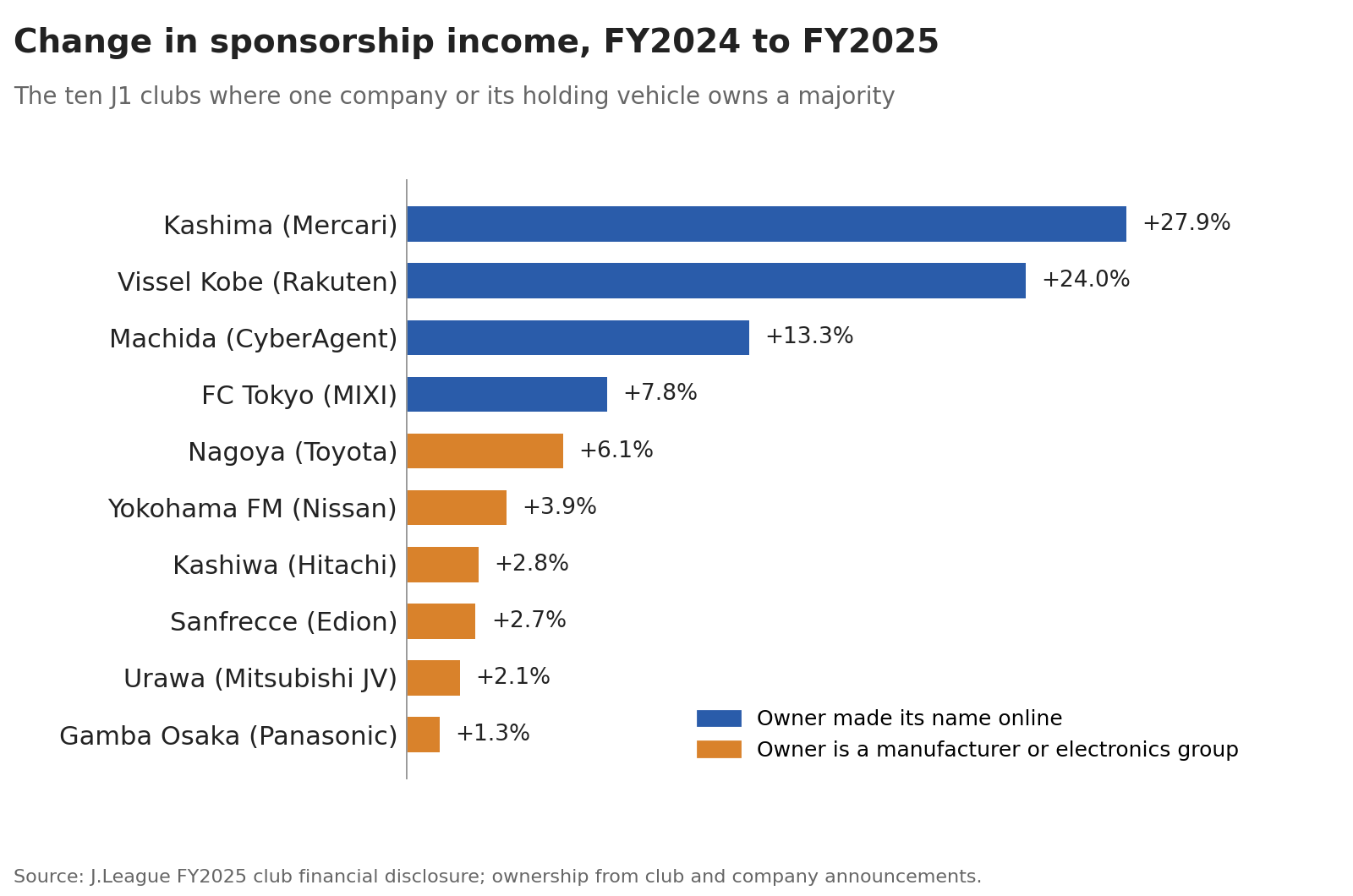
I wouldn’t build much on a single year. Kashima won the league in 2025, which will have helped their number, and results, stadiums and new sponsors all move these figures. The pattern is suggestive rather than conclusive.
Among that group, the four whose owners made their names online recorded the largest increases.
A European reader who asks who owns a J1 club expects to hear about a fund or a billionaire. The answer is usually a corporation, and its marketing department is often part of the story. If the pattern lasts beyond one year, it would suggest the internet companies see their clubs as a way to reach new customers and are spending to grow them, while the carmakers and electronics groups are keeping their support roughly where it was. I’d expect the next decade of J1’s money to be shaped by which of those two approaches is right.
So how much can an owner actually do? Quite a lot. A controlling shareholder has significant influence over who runs the club, and there’s no J.League-wide limit on owner funding and no club-wide salary cap. Clubs do have to meet financial licensing requirements, including rules designed to stop persistent losses and insolvency, although some of those tests have been relaxed while the league moves to its new calendar.
That money helps, but it doesn’t guarantee anything. Vissel Kobe, owned by Rakuten, went from thirteenth in 2022 to champions in 2023 and 2024. Yokohama F. Marinos, backed by Nissan, finished fifteenth in 2025. What bothers me is how much a club’s future can depend on the fortunes and decisions of its corporate owner, while ordinary supporters generally have little formal influence over shareholder decisions. The next set of accounts will show whether the internet owners are still putting more in, and Machida’s sponsorship line is the first one I’ll look at.