

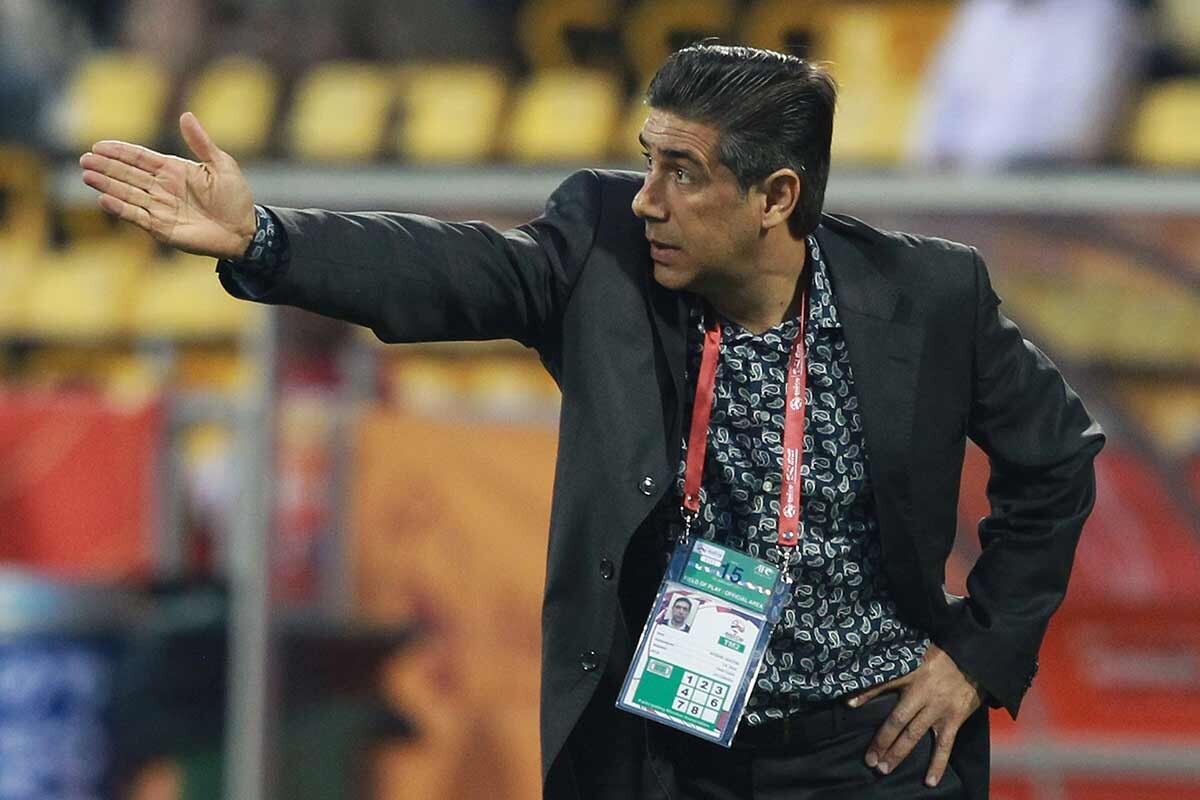
Profile
Role: Iranian-American coach, analyst and football educator
Experience: United States, South Korea, Iran, Japan, Thailand, China, Curacao and Canada
Focus Areas: Technology, analysis and visual learning
Afshin Ghotbi’s football journey began in Tehran and has taken him through some of the world’s most influential football cultures. An Iranian-American coach, analyst and football educator, he has spent more than three decades working across the United States, South Korea, Iran, Japan, Thailand, China, Curacao and Canada.
Born in Tehran in 1964, Ghotbi moved to Los Angeles with his father at 13. He studied electrical engineering and played soccer at UCLA, experiences that shaped his early interest in technology, analysis and visual learning. He later founded the American Global Soccer School near the Rose Bowl, combining daily technical work with international experiences for young players including John O’Brien, Peter Vagenas and Joey DiGiamarino.
His career includes three consecutive World Cup cycles: the United States in 1998 and South Korea in 2002 and 2006. He helped the LA Galaxy win the 2005 MLS Cup and U.S. Open Cup, led Persepolis to the 2007-08 Iranian league title, coached Iran at the 2011 AFC Asian Cup, took Shimizu S-Pulse to the 2012 J.League Cup final and won promotion with Shijiazhuang Ever Bright in 2019. In 2022, he became Vancouver FC’s inaugural head coach and helped the young club reach its first Canadian Championship semi-final in 2025.
The thread running through those clubs and countries is a relentless pursuit of knowledge and experience. Ghotbi sees football as something larger than any one person: a way to bring people together, help them grow and leave a positive mark on their lives.
Key Insights
- Technology helped me show the game more clearly and reach my players in a way they could feel and remember.
- Coaching across cultures taught me that football intelligence is not enough.
- Pursue knowledge and experience relentlessly, but never enter a friendship asking, ‘What can I gain from this?’
Our Exclusive Interview with Afshin Ghotbi
If you had 60 seconds to tell the world who you are, what would you say?
Very few people can truly tell you who they are in 60 seconds, but I’ll say this; I came from nothing, and I will leave with nothing. Between those two moments, I am simply a passionate human being who found his purpose in football. The game gave me a way to share that passion, influence people and do something positive in the world. Football has been my vehicle.
If you could go back to the beginning of your coaching career and give yourself one piece of advice, knowing what you know today, what would you say?
If I could go back, I would tell myself: listen first. Observe next. Try to understand the person before you act, then find a solution that brings out their best.
With time, you learn that you cannot change people as much as you think. However, you work with their strengths. When people experience success, confidence grows and performance follows. The best coaches learn to adapt to the individual, the culture and the personalities in front of them.
You were ahead of the curve using technology and match analysis with the U.S. national team around the 1998 World Cup. You even developed your own models and were later invited by the Dutch Football Association to present them to some of the country’s top coaches. What were you seeing in technology that others weren’t seeing yet?
I grew up with very little technology, almost nothing. We did not even have a television when I was young, so I listened to matches on an analog radio and built the game in my imagination. Later, I remember holding the antenna in exactly the right position so I could watch Franz Beckenbauer and Sepp Maier play for Bayern Munich.
My mother was my first-grade teacher and my father taught languages. I spent hours in their classrooms, surrounded by blackboards and when I was alone, I drew football pitches, players, balls and goals on those blackboards. Even then, I was fascinated by how a picture could communicate an idea.
Studying engineering at UCLA deepened that fascination. Before computers could capture moving images, I worked with two VCRs, editing from tape to tape. I cut clips, showed them to players and drew over the pictures.
Football has been my vehicle.
Footballers are visual. Most people learn by seeing, hearing, doing and repeating. Passion, knowledge and experience are essential, but they mean little if you cannot communicate. Technology helped me show the game more clearly and reach my players in a way they could feel and remember.
You built relationships with Dutch football through the American Global Soccer School and players such as John O’Brien, who eventually went to Ajax. Those relationships eventually helped lead you to Guus Hiddink. Looking back, did you realize those early connections were shaping the direction of your career?
Yes. I understood how difficult it would be for an Iranian-born, American-raised coach who had not been a World Cup star to break into the profession. I had to create my own path through player development and a constant desire to learn.
At 19, while playing for UCLA’s men’s team and coaching the women, I saw wonderful athletes who still lacked some basic technical qualities. I realized that if I wanted to influence American soccer, I had to begin younger. That is why I built the academy near the Rose Bowl. Southern California gave us an extraordinary mix of talent and cultures.
Leonardo Cuellar helped us bring Bora Milutinovic into an international program for leading young American players. I was 27, spending 10 hours a day beside a coach preparing for his third World Cup. I asked questions constantly: How do you see the game? How do you build a team? How do you make decisions? Steve Sampson later became another important mentor, with the U.S. national team around the 1998 World Cup and again with the LA Galaxy in 2004 and 2005.
John O’Brien’s move to Ajax introduced me to Co Adriaanse, Louis van Gaal, Piet Buter and Pim Verbeek. I returned to Amsterdam every summer. One image has never left me: on the building of perhaps the greatest football academy in the world was a huge poster of Michael Jordan dunking. Even the best were looking beyond their own sport for inspiration.
Pim became one of my closest friends. God bless his soul. He brought me onto Guus Hiddink’s staff for the 2002 World Cup, and we later worked together at the 2006 World Cup and the 2007 Asian Cup. I also worked with Dick Advocaat during the 2006 World Cup and alongside Patrick Kluivert with Curacao during qualifying for the 2018 World Cup.
Each relationship opened another door, but every step began with asking questions, listening and learning. They were unforgettable experiences.
You’ve built relationships with people all over football, but you’ve said it wasn’t about gaining something from those relationships. What do you think young coaches should understand about that?
Pursue knowledge and experience relentlessly, but never enter a friendship asking, ‘What can I gain from this?’ The real value is the knowledge you share and the friendship itself.
There was far less money in football when my generation started. Even at the national-team and professional-club level, salaries were modest compared with today’s game. We did not enter football for money, exposure or status. We came because we loved it and that is what mattered.
You’ve coached across so many different football cultures. What part of your identity has remained unchanged, and what part of you has had to evolve the most?
My passion has never wavered; it has only grown. So has my respect for football’s power. The game was played before we were born and will be played long after we are gone. While we are part of it, we should celebrate the privilege.
Each relationship opened another door, but every step began with asking questions, listening and learning.
What evolved is my understanding of people. Coaching across cultures taught me that football intelligence is not enough. You also need emotional and cultural intelligence. Learning that has made me a better manager, a better coach and, I hope, a better human being.
You’ve worked across almost every phase of the American soccer system, from youth soccer and high school to college, the USISL, MLS and the U.S. men’s national team. What advantage does that depth of experience give you?
Working at every level gave me a deep understanding of American culture and the American player. It also showed me how difficult it is to connect the game across a country this large. We have talented players emerge from this country without necessarily being identified by our system.
The difference between the teams competing at the very highest level and the rest of the world often comes down to a millimeter or half a second. In America, we often notice effort, speed and power before awareness: the ability to see a solution and execute it in one or two touches in an efficient manner.
John O’Brien was a perfect example. I believe he was one of the best players this country has produced, yet many coaches did not immediately understand what made him special. He could see and solve in one touch what another player might need three or four touches to understand. That experience taught me to look beyond the obvious and recognize the subtle details that make a player special.
Do you think that recognition has improved? Are American coaches and clubs better today at identifying awareness and technical intelligence, or do you think we’re still behind?
I think we are improving, but we are still far from our potential. Watching the U.S. national team recently, I found myself comparing today’s players with the 1994 team. Today’s group may be faster and more dynamic, but the earlier side may have been more tactically complete and balanced.
There is more money and opportunity now, yet the system remains too fragmented. A family’s ability to pay should never decide whether a talented child gets a chance. We also need to give players experiences that teach them how to become international footballers. Talent needs the right education and environment.
What kind of experiences do you think American players are missing?
In Europe, a young player can take a bus or train for an hour or two and enter a different football world: a new language, style, tactical priority and atmosphere. They collect those experiences from 11 or 12 through 18. In the United States, crossing a state line rarely gives you that same contrast.
That was why I built my academy in 1988. I wanted players such as Peter Vagenas and John O’Brien to experience international football while they were still 12, 13 and 14. We found ways to fund the trips and played teams such as Benfica, Ajax, PSV, JEF United and Leicester City which is an experience none of the players ever forgot, but equally important they have learned so much from those trips and the games that came with it.
I still remember being in the Olympic Stadium with those young players, watching Barcelona play Ajax. The day before, they had seen some of those stars train. They watched Dennis Bergkamp stay behind, receiving balls in the danger area and finishing into the side netting as if it were effortless.
Those journeys may have taught them more than hundreds of sessions in Southern California because they did not simply hear about the highest level. They lived it. Experiences like that stay with a player and they take it with them wherever they go.
After everything you’ve experienced, what still makes you genuinely curious about football?
The game is still 11 against 11, and it is still about who scores more goals. New metrics, technologies and slogans appear, but the essence remains.
What keeps me curious is football’s ability to connect people who may have almost nothing else in common. When visitors come to a World Cup in America, they may arrive with one idea of this country and leave surprised by its diversity and energy. Americans travel abroad and never forget the speed, emotion and culture of those stadiums.
They lived it.
In one year as a national-team coach, I traveled to 50 countries. I visited matches and training sessions and met people everywhere. The world began to feel very small. It did not matter where we came from, what language we spoke or what we believed. Once the ball rolled, everyone understood. Other than food and love, I know no better connector than football.
When your coaching career eventually ends, what do you want people you’ve worked with to say about you, not just as a coach, but as a person?
Coaching gives you thick skin. You make decisions, and only 11 players can start. Some people will be happy and others disappointed. The decision cannot be personal; it must serve the team.
I hope people remember that my passion inspired them, that they learned something different about football from me and that I cared for them as footballers and human beings.
Recently, a former academy player wrote to me. He never became a professional. He is now in his 40s, living in Idaho and coaching his three children. Decades later, he still described his time with us as one of the greatest experiences of his life.
That message brought a smile to my face and warmed my heart. I have coached players at World Cups, yet this was one of the greatest compliments I have received. Knowing that someone still remembers our time together and believes it changed his life is deeply rewarding. What I hope people remember is, first, that they were inspired by my passion for the game. Second, that they learned something different about football from me. And third, that as a person, I was always honest and straight with them. Those are simple things, but that’s what I hope people remember.
Rapid Fire
City life or countryside?
City life.
Talent or mentality?
Mentality.
Beach or mountains?
Beach.
Sunrise or sunset?
Sunrise.
Summer or winter?
Summer.
Early bird or night owl?
Early bird.
Plan everything or go with the flow?
Both. I planned everything when I was younger; now I go with the flow.
Dinner out or cooking at home?
Cooking at home.
Road trip or flying somewhere?
Driving. It depends on the distance, but I probably prefer driving.
Call or text?
Call.
Win ugly or lose beautifully?
Win ugly.
Books or movies?
Movies.
Five-star hotel or tent under the stars?
Five-star hotel.
FAQ
Who is Afshin Ghotbi?
An Iranian-American coach, analyst and football educator, he has spent more than three decades working across the United States, South Korea, Iran, Japan, Thailand, China, Curacao and Canada.
Which World Cup cycles has Afshin Ghotbi worked in?
His career includes three consecutive World Cup cycles: the United States in 1998 and South Korea in 2002 and 2006.
What has Afshin Ghotbi achieved with Vancouver FC?
In 2022, he became Vancouver FC’s inaugural head coach and helped the young club reach its first Canadian Championship semi-final in 2025.