

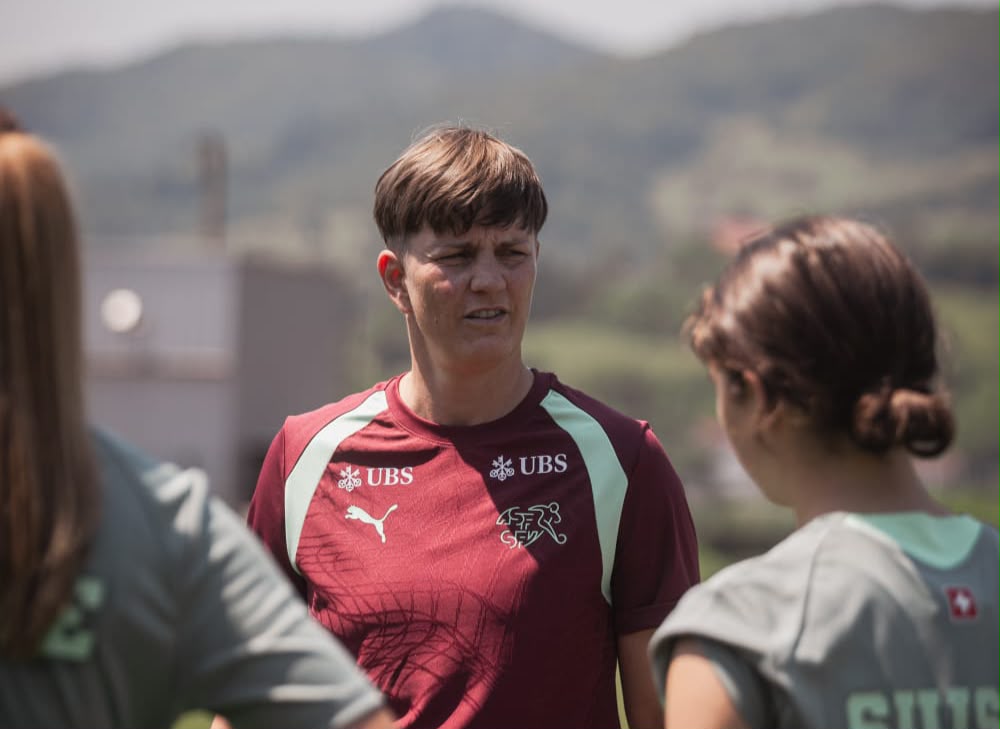
Profile
Role: German football coach currently working with Switzerland’s U19 women’s national team
Specialisation: Defensive coaching, prevention and rehabilitation
Experience: Academy football, senior head coach roles and international football
Focus Areas: Player development, coaching leadership, sports science and women’s football
Professionalisation has transformed women’s football, but better conditions have also brought greater pressure, higher expectations and less patience. Having spent more than two decades inside the game, Anne Pochert has experienced that evolution from the perspective of both a head coach and international football, while remaining guided by a consistent belief in authenticity, development and responsibility.
Anne Pochert is a German football coach currently working with Switzerland’s U19 women’s national team, where she leads the defensive side of the team and contributes to squad decisions within the coaching staff. Her career spans academy football, senior head coach roles and international football, supported by an academic background in sports science with a focus on prevention and rehabilitation. Beyond the pitch, she serves on the board of the Bund Deutscher Fußball Lehrer, giving her an additional perspective on the pressures and development needs of the coaching profession. In this interview, Pochert discusses Switzerland’s emerging generation, leadership within modern coaching staffs, the human responsibility of coaching and why professionalisation must not come at the expense of patience and long term development.
Key Insights
- Switzerland’s emerging generation has enormous potential, with young players increasingly attracting attention from major clubs.
- Trust, transparency and responsibility are central to effective leadership within modern coaching staffs.
- Professionalisation has improved conditions in women’s football but has also created greater pressure and less patience.
Our Exclusive Interview with Anne Pochert
You are currently working with Switzerland’s U19 national team. What does international football demand from a coach that club football does not?
First of all, I can say that working with the Swiss women’s national team gives me great joy. At this level, you prepare for every opponent from scratch, as the teams are constantly changing due to the different age groups coming through. For me, that is the biggest difference compared to working as a club coach.
You also have a significantly larger pool of players to choose from throughout the year. This allows you to react more effectively to injuries and different opponents. At club level, you mainly have the opportunity to make changes in the summer and, to some extent, during the winter.
At U19 level, coaches have to make decisions about players who may develop at very different speeds. How do you distinguish between current performance and genuine long term potential?
We always make decisions based on both. Ideally, a team consists of players who are performing at a very high level right now, as well as players who have enormous potential.
I am aware that performances can still fluctuate considerably at this age, so we have to give players a certain amount of time to develop. Through training camps and friendly internationals, we have opportunities to try different things and give players the chance to show what they can do. Ultimately, however, it comes down to which players perform best together as a team and fit the Swiss playing philosophy best.
You have been a head coach and are now working as an assistant coach at international level. How different is leadership when your responsibility is to influence rather than ultimately decide?
That is correct. I was previously always a head coach, and I do not work as a traditional assistant coach here in Switzerland either. We make squad decisions together and have divided the different areas of responsibility within the coaching staff.
I am responsible for the entire defensive side of the team and support our goalkeeper coach with set pieces. I am in regular communication with the head coach, and our work is based on an enormous level of trust. Without that trust, I would not have accepted the role.
I have never previously worked as an assistant coach, and I do not see myself in that role in the future either. The federation has given me the trust and freedom to contribute my own ideas and strengths, and that is exactly what I am doing in this position. I enjoy working with some of Switzerland’s biggest talents and developing things together.
Switzerland’s U19 team qualified for the 2026 European Championship. Working closely with this generation, what does it tell you about the current strength and future potential of Swiss women’s football?
Swiss women’s football has enormous potential and is growing. Naturally, the talent pool is not as large as it is in Germany, but the quality of the players coming through is extremely high. You can see that in the number of young Swiss players who are already playing abroad for major clubs.
Often, the players themselves do not yet realise just how good they are. That is why competing at international level is so important. It gives them the opportunity to measure themselves against the best.
Many major clubs are looking closely at Switzerland because they can see that something is developing here. It is worth paying attention. Qualifying for the U19 European Championship was no surprise to us. Looking at the qualification campaign, we did not lose a game last season and were at least competitive with the major nations, while also beating some of them.
As a former head coach, you know the pressure and isolation that can come with ultimate responsibility. What do you understand about the head coach role today that you did not understand before occupying it yourself?
I see my role as supporting young people in a holistic way. Transparency around decisions is always extremely important. As a player, I was not aware of just how extensive the responsibilities of a coach really are.
Players are not only footballers. They are friends, family members, students or already part of the professional world. All of that has to be taken into consideration. Appreciation and communication are important factors when working with athletes, and that is where I see my responsibility. When a player is doing well as a person, she can perform at her best.
When a player is doing well as a person, she can perform at her best.
As a board member of the Bund Deutscher Fußball Lehrer, you are involved in representing the coaching profession beyond the pitch. Which issues affecting coaches deserve significantly more attention within professional football?
The coach is always on the front line, and often the greatest pressure is placed on this position. I believe mental coaching for coaches is extremely important and should no longer be treated as a taboo subject.
A great deal of attention is given to team performance, club structures and players, but in my view, coaches themselves are often overlooked. The development of coaches, particularly in women’s football, needs to be given even greater importance. There should be a stronger focus on this position within clubs because the coach has a significant influence on the success of the team.
Coaching staffs are becoming larger and increasingly specialised. What should remain the responsibility of the head coach, and what should modern coaches be willing to delegate?
It is important to delegate responsibilities so that you can concentrate on what really matters. England provides a good example of this, particularly in men’s football, where coaches increasingly operate as managers. Coaching staffs are becoming larger in order to meet the demands of an increasingly complex game. I see that as a positive and necessary development.
As a coach, you cannot and do not need to know everything. You have to bring the right expertise into the team.
As a coach, you cannot and do not need to know everything. You have to bring the right expertise into the team.
However, I believe the team’s overall approach and playing philosophy should always carry the head coach’s signature. As a coach, you have to remain true to yourself while bringing specialists into the staff who can best implement that playing philosophy. In that sense, building a coaching staff is similar to building a squad.
Your academic background is in sports science, with a focus on prevention and rehabilitation. How much has sports science changed the way coaches should think about training and performance today?
Today, being a good footballer requires more than being technically and tactically well developed. A player is also an athlete who needs a strong body and a healthy mind. Sports science therefore plays a major role.
Recovery is also extremely important if players are to perform at the highest level consistently. As a qualified sports scientist, I understand what it takes to be physically prepared. Particularly in women’s football, the risk of serious injuries increases as the physical demands grow. This is where sports science has an important role to play and has already developed many approaches to address these challenges.
You have worked in women’s football for more than two decades and have experienced its professionalisation from inside the game. Which development has genuinely improved coaching, and where has professionalisation created new problems?
Women’s football has grown enormously in recent years. More money has naturally improved conditions for players, and increasingly they are able to make a living from football.
However, more money and greater attention also have their downsides. Clubs are increasingly losing patience when faced with short term setbacks and repeatedly changing their strategies and direction. That can slow down the development of teams and, particularly, young players.
After working in academy football, as a senior head coach and now in international football, which belief about coaching have you changed your mind about most during your career?
Throughout all these years, I have remained true to myself and worked authentically. That has brought me to where I am today. I do not regret any of the decisions I have made because each one has helped me become a better coach.
I have experienced highs and lows throughout my career. It has not always been easy, but I would not want to miss any step along the way. I have grown through every experience. As a coach, you should always believe in yourself and be willing to grow every day.
As a coach, you should always believe in yourself and be willing to grow every day.
I have already experienced a great deal in football, but I still work with mentors who support me. Daily feedback is extremely important in order to continuously reflect on yourself.
FAQ
Who is Anne Pochert?
Anne Pochert is a German football coach currently working with Switzerland’s U19 women’s national team.
What is Anne Pochert’s role with Switzerland’s U19 women’s national team?
She leads the defensive side of the team and contributes to squad decisions within the coaching staff.
What is Anne Pochert’s academic background?
Her academic background is in sports science, with a focus on prevention and rehabilitation.