


303 scholars tracked over 15 years and across 21 UK clubs. Dr Platts has built one of the most comprehensive datasets on youth football in the UK. What sets him apart is his ability to combine hard data with deep insight into sociology, psychology, and the lived realities of academy life for players, parents, and clubs alike.
As a professional coach and scout, Anthony McCool puts it:
“Chris has spent over a decade in research and is passionate about following the data to predictable outcomes and delivering it with humility. I’ve met plenty of people in football who are highly qualified and highly positioned, who, rather than carry an aura, instead carry a rather significant ego. This is certainly not the case with Dr Chris Platts, and the more I spoke to him, the more I felt that he is an incredible asset for football clubs, and should be made readily available to parents and players”
“The more I spoke to him, the more I felt that he is an incredible asset for football clubs”
A family man first, Dr Platts understands the emotional and practical realities of the football journey. His work aims to give families clarity, helping them navigate what is often an uncertain and misunderstood pathway.
Where the Journey began
Dr Platts’ interest began during his Sports and Exercise Science degree, where sociology helped him make sense of football through the lenses of class, race, and identity, which opened his eyes to understanding people and walking in their ‘football boots’.
He went on to complete a PhD titled Education and Welfare in Professional Football Academies, tracking 303 scholars (aged 16–18) across 21 professional clubs.
What started as a three-month data collection project in 2009 evolved into over 15 years of longitudinal research. Travelling across the UK, he gathered first-hand insights from players, parents, coaches, and welfare staff, revealing a system that, in many ways, has changed little.
Here is his work mapped out:
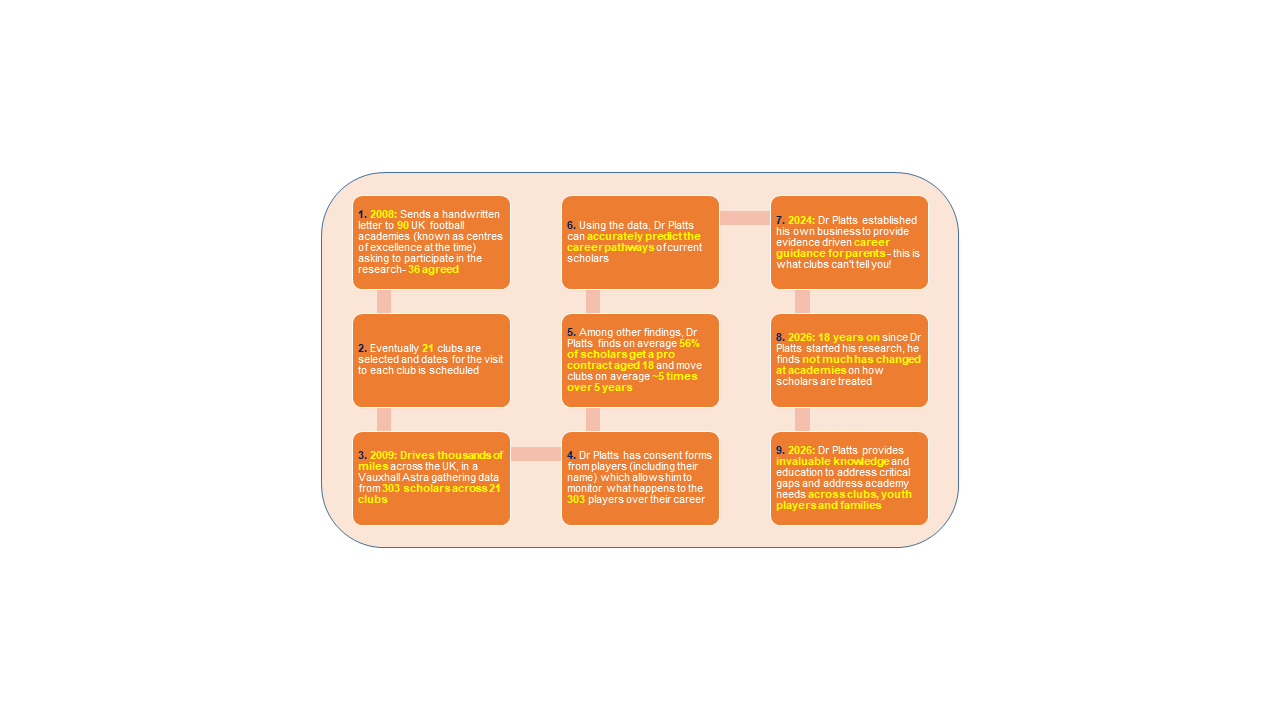
Back in 2010, before the Elite Player Performance Plan (EPPP) was introduced to academies (in 2012), Dr Platts looked at what happens with the welfare, education and policy of 16/17/18-year-old first & second year scholars and what happens when they sign up for scholarships.
Writing to them all by hand with a self-addressed envelope attached for replies, 32 clubs showed interest, of which 21 eventually participated. 3,000 Vauxhall Astra driving miles traversed the UK’s carbon footprint (thankfully not at today’s petrol prices!).
Questionnaires were handed to 303 scholars, and those scholars also participated in focus groups. Dr Platts spoke to coaches and education & welfare officers at clubs (now known as Player Care). This phase of the research took three months to complete; however, it led to 15 years of tracking what the reality is for scholars and professional footballers.
- 2008: Sends a handwritten letter to 90 UK football academies (known as centres of excellence at the time) asking to participate in the research- 36 agreed
- Eventually 21 clubs are selected and dates for the visit to each club is scheduled
- 2009: Drives thousands of miles across the UK, in a Vauxhall Astra gathering data from 303 scholars across 21 clubs
- Dr Platts has consent forms from players (including their name) which allows him to monitor what happens to the 303 players over their career
- Among other findings, Dr Platts finds on average 56% of scholars get a pro contract aged 18 and move clubs on average ~5 times over 5 years
- Using the data, Dr Platts can accurately predict the career pathways of current scholars
- 2024: Dr Platts established his own business to provide evidence driven career guidance for parents – this is what clubs can’t tell you!
- 2026: 18 years on since Dr Platts started his research, he finds not much has changed at academies on how scholars are treated
- 2026: Dr Platts provides invaluable knowledge and education to address critical gaps and address academy needs across clubs, youth players and families
Inside the Academy System
Dr Platts’ research highlights a deeply ingrained hierarchy within academies. Young players are often positioned at the bottom and expected to “earn” their place through compliance and endurance. From kit distinctions to canteen routines, status is constantly reinforced.
This culture can create fear: youth worry that speaking up will have consequences because “things get back.” Relationships with coaches can be strained, and many scholars feel like “second-class citizens.”
The broader issue is structural. With such a large talent pool, young players are often seen as replaceable. Dr Platts argues that energy would be better spent developing well-rounded individuals through education, community engagement, and real-world experiences, not just football performance.
The Reality Parents Need to Understand
Dr Platts brings home some realities all parents need to know about their child being in football. Academy football demands significant sacrifice and comes with real risks:
- Strong support networks are essential (both inside and outside football)
- Social circles often overlap with direct competition
- Injuries, especially during growth phases, are common
- Education can become secondary or superficial
- The environment is high-pressure and uncertain
- Parents must remain present, informed, and emotionally supportive
Many families enter the system with “romanticised” views. Dr Platts stresses the importance of asking honest questions early: What does success actually look like? What are the steps to get there?
The answer lies in the data. For example, it might surprise people to know that Dr Platts’ data shows there is an 80% chance of getting a professional contract for a scholar who is being developed at a Premier League Academy. However, getting a contract is not the same as having a career. Planning must start early by age 14 when thinking of where to be aged 18, with a clear understanding of the pathway ahead.
However, getting a contract is not the same as having a career.
Mental Health and Identity
The whole process of player development and career coaching is shrouded in the essence of sociology. Dr Platts believes that the reality of elite sports will result in some sort of mental strain, pushing mind, body and soul to the edge. Uncertainty is the defining pressure for young players. Football becomes central to identity, making setbacks particularly difficult. Academies can be isolating, and openness is often discouraged (without staff realising it).
Dr Platts highlights the importance of simple but powerful parental support:
Looking your child in the whites of their eye and saying, “I love you no matter what.”
Looking your child in the whites of their eye and saying, “I love you no matter what.”
When players are released, the consequences can be severe: loss of identity, mental health struggles, and difficult transitions. The system’s demands push young people mentally and physically, often without adequate psychological support.
Youth and first team players are afraid to be open as inevitably ‘’things get back’’. Last year, Brentford FC announced installing a collection of benches in West London to encourage its community to open up about mental health; Fábio Carvalho supported the initiative as part of the club’s ‘Talking is the Best Tactic’ campaign. The use of benches to create space for important conversations is inspired by the work of Brentford’s sports psychologist, Michael Caulfield, to give players, coaches and staff a safe, confidential place to talk, and they are encouraged not to wear kit when on the bench talking.
The BBC aired a documentary/series in 2025 called ‘What happens when football isn’t forever?’, which explored the intense, often heart-breaking reality for youth released from professional football academies. It focuses on the loss of identity, mental health struggles, and the challenging transition to new paths when a lifelong dream abruptly ends. Thousands of youth join UK football academies every year, yet less than 1% make it to the top tier.
Here is Dr Platts’s framework designed to help parents:
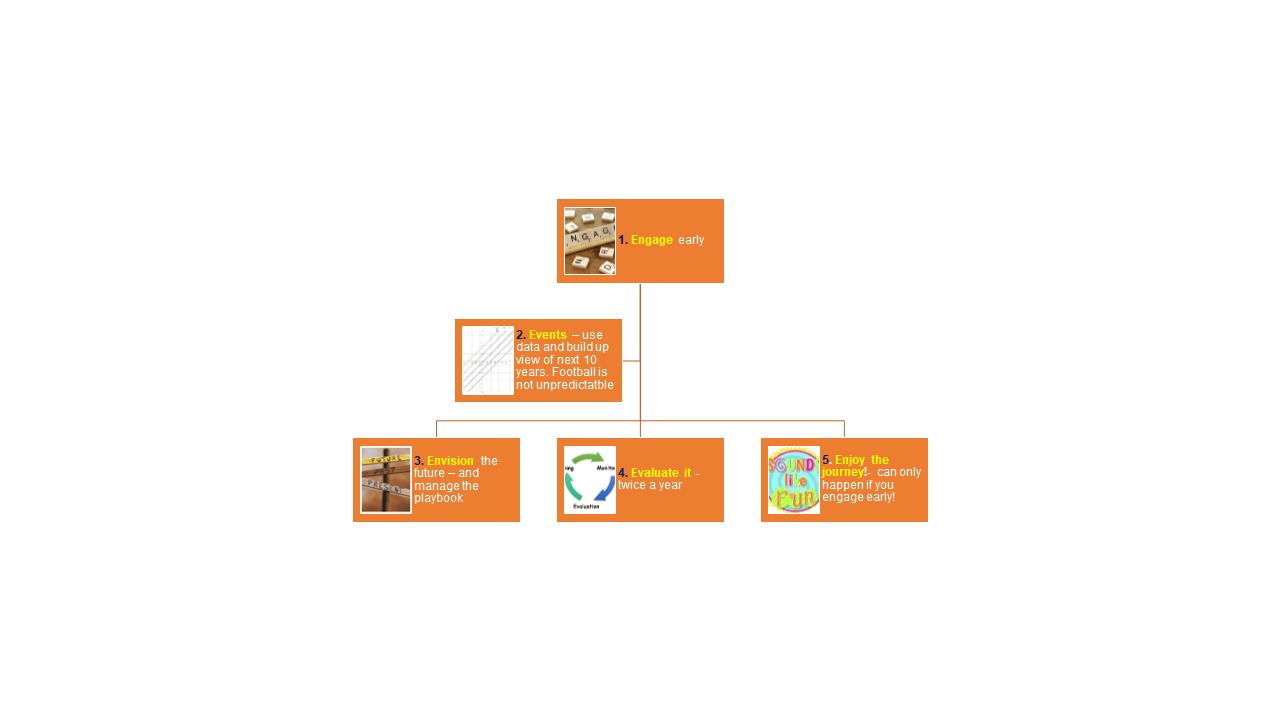
- Engage early
- Events – use data and build up view of next 10 years. Football is not unpredictatble
- Envision the future – and manage the playbook
- Evaluate it – twice a year
- Enjoy the journey!- can only happen if you engage early!
The Research
Of the 303 participants, 299 were in the final research data set, of which:
- 56% (167) of scholars were still in the game, aged 18, with a professional contract
- Players average 5.3 club moves and 1–2 loans in their first five years
- Only 2% remain at their original club
- Players often drop down the league pyramid early in their careers
Here is a summary of those still in the game aged 18 (56%) of the original 299 participants:
| League | Count of players with a pro-contract aged 18 | Average # of moves in 5 years | Average # of loans in 5 years |
|---|---|---|---|
| Premier League | 65 | 5.65 | 1.63 |
| Championship | 57 | 5.86 | 1.49 |
| League 1 | 19 | 5.89 | 1.37 |
| League 2 | 26 | 3.96 | 0.88 |
| Total / Average | 167 | 5.34 | 1.34 |
What is the Financial Value assigned to those in an Academy?
When looking at the financials, academy players are pure profit on the balance sheets, unlike first team players. This means that as youth in academies are developed rather than purchased, they have no initial transfer fee to amortise. As a result, any transfer fee received for an academy graduate is recorded as nearly 100% profit in financial fair play (FFP) calculations. What’s more, academy players are a replacement for expensive external signings. Using a home-grown player in the first team does provide a club with “savings” on wages and transfer fees, offering high internal Return on Investment (ROI). Yet despite this, many academies operate at a loss and the human cost is often overlooked.
Key Takeaways for Parents
Dr Platts offers a clear message:
- Separate the dream of a contract from the reality of a career
- Stay informed; data matters
- Prioritise your child’s wellbeing over external validation
- Encourage balance: education, health and relationships
- Be honest about motivations; whose dream is it?
The most successful youth in academies tend to be holistic; disciplined in football, committed to education, and supported by strong family foundations.
Final Thoughts
Football can be an incredible journey, but only when approached with clarity and preparation. As Dr Platts’ work shows, knowledge isn’t just power; it’s protection. For parents and youth players alike, understanding the realities of the system is the first step toward navigating careers successfully.
Hear More from Dr Chris Platts
Dr Chris Platts will join The Parents Week Summit to share his research and insights into academy football, career pathways and the realities facing young players and their families.