

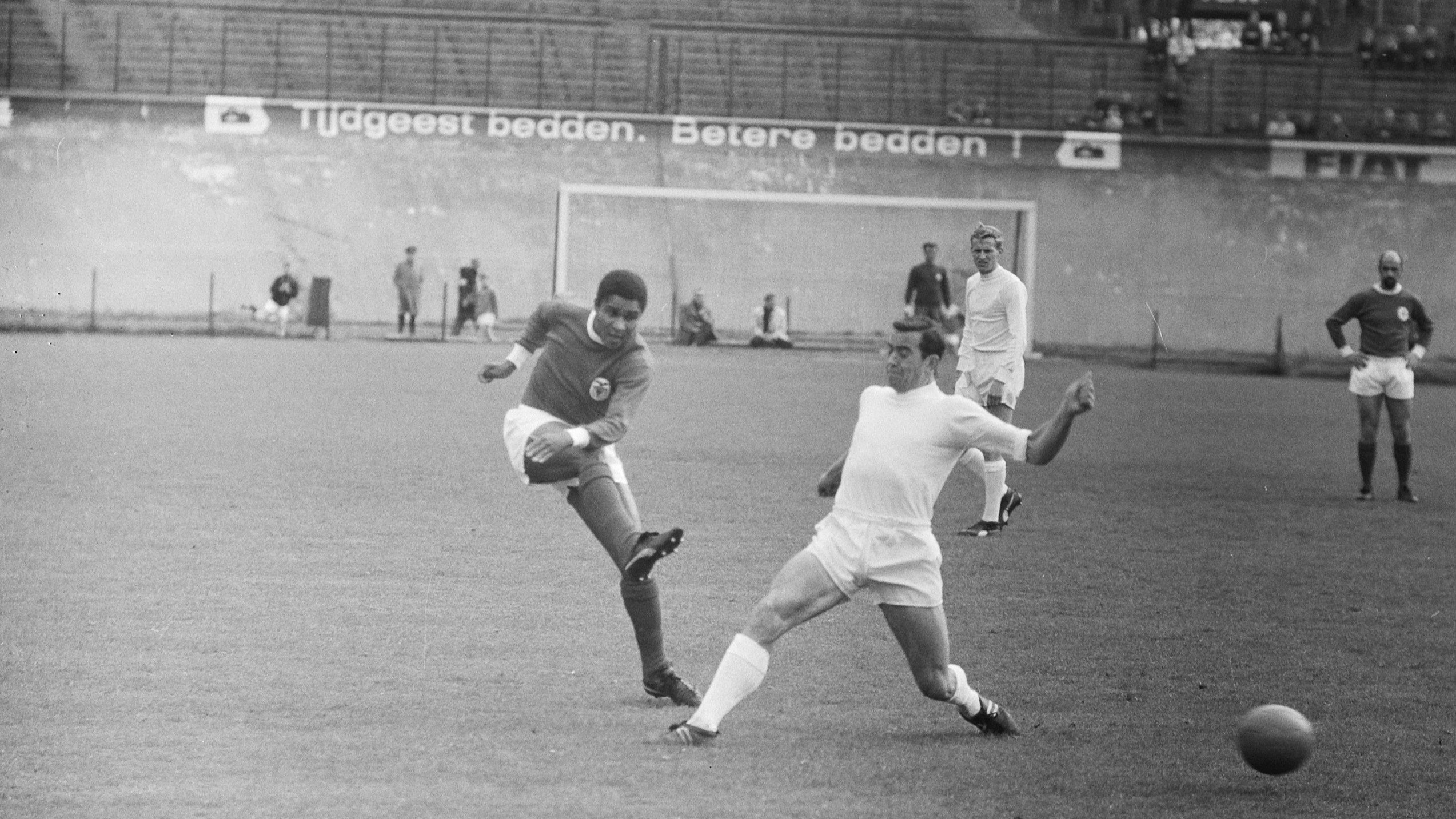

From Mozambique to Lisbon: the story of a football immortal
There are footballers who become stars of their generation. And then there are those who become part of football’s memory. Eusébio da Silva Ferreira belonged to the second category.
Born on 25 January 1942 in Lourenço Marques today Maputo, Mozambique Eusébio began his football journey at Sporting Clube de Lourenço Marques.
He was fast. Powerful. Fearless. And, above all, he had an extraordinary instinct for scoring goals.
But his story was never just a football story. It was the story of a young African boy who travelled to Europe and eventually became one of the greatest figures the game had ever seen.
It was the story of a young African boy who travelled to Europe and eventually became one of the greatest figures the game had ever seen.
From Mozambique to Portugal
In December 1960, at only 18 years of age, Eusébio arrived in Lisbon.
His transfer was anything but ordinary. Benfica brought him to Portugal in great secrecy because of a dispute involving Sporting. For a period, Eusébio was even hidden under the name “Ruth Malosso.”
Nobody yet knew that this young man from Mozambique was about to change the history of European football.
Benfica coach Béla Guttmann quickly understood his extraordinary potential. Eusébio had explosive acceleration, immense power, remarkable technique and a devastating shot.
But there was something else: He seemed to know where the goal was before anyone else did.
The Night a Star Was Born
Eusébio announced himself to world football in the 1962 European Cup final.
Benfica faced Real Madrid in Amsterdam the Real Madrid of Alfredo Di Stéfano and Ferenc Puskás.
Real Madrid led 3-2 at half-time. Then Eusébio took over.
He scored twice in the second half, in the 64th and 69th minutes, as Benfica won 5-3. He was only 20.
That night, Benfica retained the European crown. But something else happened: Eusébio became a world star.
The Benfica Years
Eusébio spent the majority of his career at Benfica, from 1960 to 1975.
He won 11 Portuguese league titles and five Portuguese Cups, while establishing himself as one of the greatest goalscorers in the club’s history. UEFA records credit him with 727 goals in 715 appearances for Benfica, while he scored 59 goals in 78 UEFA club competition matches.
The numbers are extraordinary. But numbers alone cannot explain Eusébio.
Those who watched him remember something else. His acceleration. His power. His balance. His ability to strike the ball with terrifying force. And the feeling that once he had space in front of him, the defender was already beaten.
1965: The Best in Europe
In 1965, Eusébio reached the summit of individual football. He won the Ballon d’Or.
He was also runner-up in 1962 and 1966, placing him among the defining players of the golden era of European football alongside Di Stéfano, Puskás and Bobby Charlton.
But his greatest international chapter was still to come.
1966: The Black Panther
Portugal arrived at the 1966 World Cup in England without being regarded as one of the tournament’s traditional superpowers. Eusébio changed that perception.
He scored twice against Brazil.
Then came North Korea. Portugal were 3-0 down in the quarter-final. Eusébio responded with four goals.
Portugal came back to win 5-3 in one of the greatest individual performances in World Cup history.
Portugal came back to win 5-3 in one of the greatest individual performances in World Cup history.
Portugal eventually lost 2-1 to England in the semi-final, with Eusébio scoring Portugal’s only goal.
They defeated the Soviet Union 2-1 in the third-place match, securing Portugal’s best World Cup finish at the time.
Eusébio finished the tournament as top scorer with nine goals, winning the Golden Boot.
The world had found its name for him: The Black Panther.
More Than a Goalscorer
Eusébio was not simply a goalscorer. Power and elegance lived together in his football.
His long-range shooting was extraordinary. His pace was frightening. His dribbling was graceful. And his instinct inside the penalty area was almost impossible to teach.
Yet perhaps his greatest quality was not technical at all. It was his character.
The 1968 European Cup final against Manchester United provided one of the most memorable examples.
With the score 1-1, Eusébio found himself one-on-one with United goalkeeper Alex Stepney. Stepney produced a magnificent save.
Eusébio could only applaud. He walked over and congratulated the goalkeeper.
Benfica eventually lost the final. But Eusébio won something far more enduring: the respect of football.
But Eusébio won something far more enduring: the respect of football.
A Legacy Beyond Football
Eusébio died on 5 January 2014 at the age of 71.
Portugal declared three days of national mourning. Because the country had not simply lost a footballer. It had lost a symbol.
Born in Mozambique. Immortalised in Portugal. Admired across the world.
Eusébio became one of the most powerful bridges between African and European football.
He left behind trophies, goals and records. But above all, he left behind a football character.
Fierce on the pitch. Humble away from it. Respectful of opponents. Loyal to the game.
And capable of showing that greatness is not measured only by how many goals you score, but also by how you behave when the game is over.
Eusébio was once an 18-year-old boy who travelled from Mozambique to Lisbon.
He became a European champion. A Ballon d’Or winner. A World Cup Golden Boot winner. A Benfica legend. A Portuguese icon. And eventually, a legend of world football.
Some footballers disappear when their careers end. Some disappear when they die. But a very few remain forever.
Eusébio was one of them.
A Eusébio once walked this earth.
And football has never quite been the same since.