

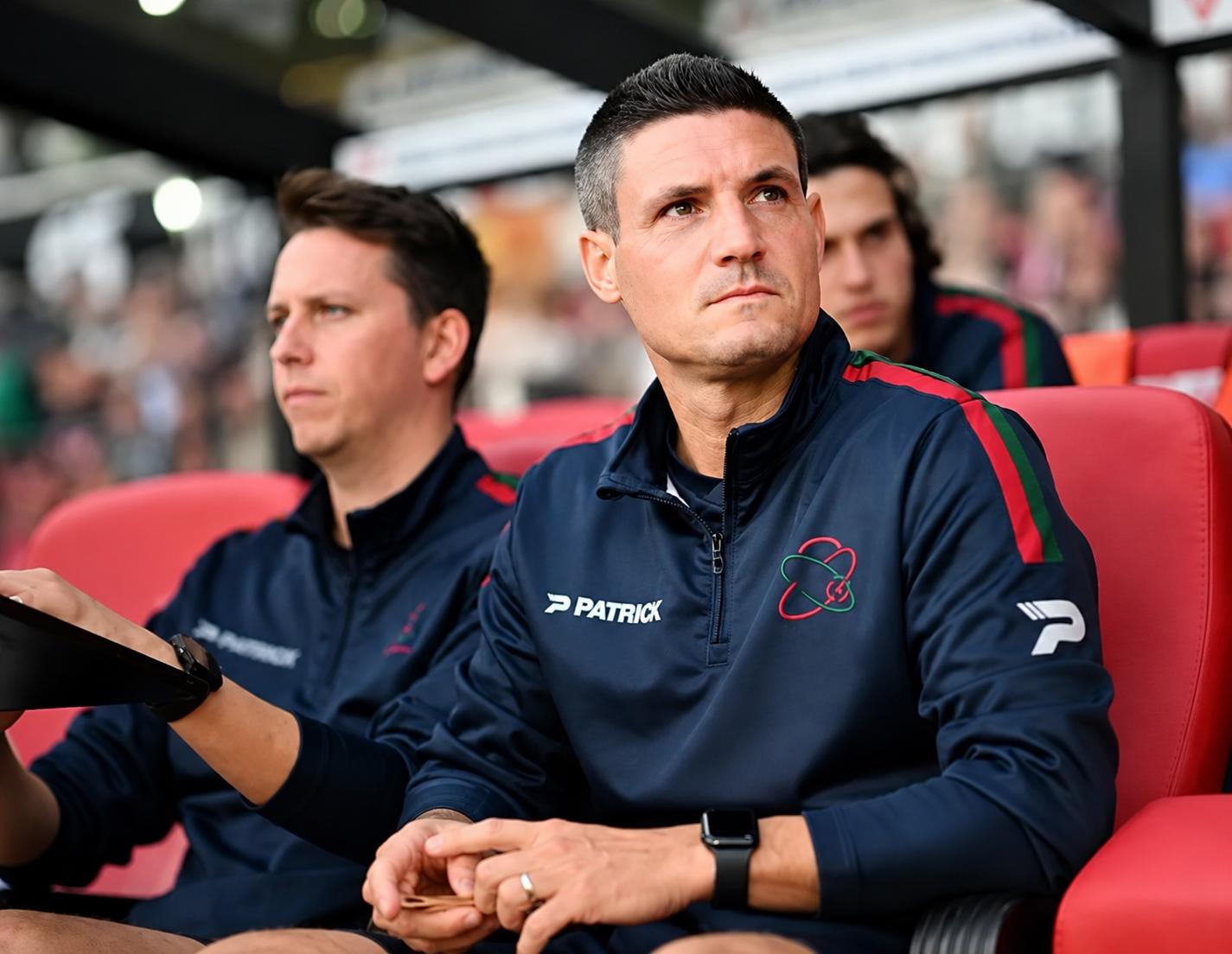
An exclusive conversation with Steve Colpaert, Assistant Manager at SV Zulte Waregem
Profile
Role: Assistant Manager, SV Zulte Waregem, Belgian Jupiler Pro League
Specialization: Tactical Coaching, Player Development & Team Management
Prior Experience: Club Brugge, KVC Westerlo & FCV Dender EH
Focus Areas: Tactical Development, Guidance, Player Development & Performance
Background: Belgian former professional defender and international. Colpaert played almost 380 professional matches and represented Belgium at youth level before earning a senior international appearance. After retiring from playing in 2021, he transitioned fully into coaching, gaining experience with Club NXT, KVC Westerlo and FCV Dender before returning to Zulte Waregem.
Some football careers are defined by the number of matches played.
Others are defined by what comes after the final match.
For Steve Colpaert, the transition from professional player to coach was not something that appeared suddenly after retirement. The ambition was there long before the playing career ended.
A former professional defender and Belgian international, Colpaert played almost 380 matches during his career at the highest levels of Belgian football. He also represented Belgium’s national youth teams throughout his development and earned a senior international appearance as a Red Devil.
But coaching was already somewhere in his mind.
At just around 18 years old, while still a young player himself, Colpaert began coaching U8 and U9 children. The experience was short-lived because his own playing career soon became his full-time focus, but the ambition had been revealed early.
And coaching young children taught him something important.
“How you treat kids sometimes to train at that age is not easy,” he recalls.
The children didn’t always listen. They were there to play. He had to learn how to find the balance between seriousness and enjoyment, understanding that ultimately, they were still kids.
Years later, that early experience would become the first chapter of a coaching journey that took him through Club Brugge, KVC Westerlo and FCV Dender before eventually bringing him back to the club that had already played such an important role in his life.
SV Zulte Waregem.
This time, however, he returned not as a player, but as a coach.
For Colpaert, football has effectively been one continuous journey. His hobby became his profession. His profession eventually became coaching.
And while the game has changed dramatically since he first entered professional football, one thing hasn’t changed. He still wants to understand it. He still wants to improve. And he still wants to win.
So, who is Steve Colpaert? Let’s find out.
Key Insights
- Colpaert transitioned from almost 380 professional matches into coaching, gaining experience with Club NXT, KVC Westerlo and FCV Dender before returning to Zulte Waregem.
- His approach to coaching places significant importance on preparation, communication, relationships, player wellbeing and creating collective responsibility within the team.
- Colpaert believes football has changed significantly through money, technology and increased player power, while preparation, relationships, communication and leadership remain fundamental.
Our Exclusive Interview with Steve Colpaert
The Coach Was There Before the Player Left
If you had 60 seconds to tell an audience that doesn’t know you who you are, what would that sound like?
“I am Steve Colpaert. I was a pro player for several years at the highest levels in Belgium. I played almost 380 games and I was also one-time Red Devil with the national team. All my youth was also on the national youth team.”
That is where Colpaert starts his story.
But there is another part of it that is equally important.
He had already started coaching before his playing career had even ended.
At 17 or 18 years old, Colpaert was coaching U8 and U9 players. He was still a young player himself, but something about coaching had already attracted him.
It wasn’t always easy.
Working with children that age meant dealing with players who didn’t necessarily listen, didn’t always understand the seriousness of training and, naturally, wanted to have fun.
“It was special because how you treat little “monsters” sometimes to train at that age is not easy to do.”
But that experience taught him something that would become useful throughout his coaching career: you have to find the right balance.
“They are kids at the end.”
The experience was short-lived because Colpaert soon became a full-time professional player. But the ambition to coach never disappeared.
Then came Club Brugge.
One day, Carl Hoefkens called him about joining the club. Rik De Mil, who is now the head coach of KAA Gent, also played a very important role in Colpaert’s development as a coach.
“He really took me under his wings back then in Brugge.”
From there, Colpaert continued to grow step by step.
And eventually, football brought him home.
He had been a player at Zulte Waregem.
Now he was returning as a coach.
When the Match Ends, the Coach Has to Switch Off
Who are you when nobody is watching?
On matchday, everyone watches the coach.
Players watch. Cameras watch. Supporters watch.
But what happens when the match is over, the result is disappointing and the coach walks through his own front door?
For Colpaert, the answer is simple. He switches off. “I have a family; I have a daughter that is important.” That doesn’t mean he doesn’t care about football. Quite the opposite. But he understands that allowing football to consume every part of your life can become dangerous.
“To be occupied with my daughter and my family because to be busy with other things, if you can’t do it, it can become dangerous with burn out.”
For him, balance is not something reserved for difficult moments.
It applies to winning too. “If you win you have to enjoy it, but keep the balance for the next games and next training sessions.”
“If you win you have to enjoy it, but keep the balance for the next games and next training sessions.”
That balance matters because football is emotional. A victory can create enormous highs. A defeat can create enormous lows.
Colpaert believes you have to experience both without allowing either one to completely control you. And sometimes, he says, he isn’t the coach at all.
“Sometimes I am not the coach, I am a human being, I am a fan and enjoy the atmosphere in the moments.” There is something important in that distinction.
The coach needs to be present. But the human being needs to remain present too.
The Art of Disagreeing
You’re supposed to challenge ideas, but you’re also supposed to support the final decision. How do you tell the head coach, “I think you’re wrong,” without turning it into a political game?
For Colpaert, it starts before the disagreement ever happens.
It starts with the relationship. “It’s very important to know your head coach and how they best understand things and what approach works.” Every coaching staff is different.
Sometimes an assistant manager arrives with the head coach. Sometimes the assistant is already at the club when a new head coach arrives. Sometimes both are new.
Those circumstances can shape the relationship from the beginning.
“For me I have to feel good. It’s very important for me whether or not it will click with the head coach or not.” That relationship needs to be established early.
Before the season begins, Colpaert believes the coaching staff needs to understand one another and create an environment where different opinions are not only tolerated, but welcomed. “There will always be different opinions and views which is actually good because that’s how good conversations come about.”
“There will always be different opinions and views which is actually good because that’s how good conversations come about.”
The key is knowing how and when to have those conversations.
Whether it involves player evaluation, training sessions or another football decision, Colpaert believes coaches need to be able to communicate openly about what works and what doesn’t. “But I also believe you have to find the right time and moment to have those conversations.” Disagreement, in his view, isn’t the problem. Poor communication is.
A strong coaching relationship doesn’t require everyone to think the same way.
It requires everyone to be able to think differently while keeping the same objective in mind.
“We just have to keep each other in mind.”
Love the Coach. Follow the Team.
Would you rather have 25 players who genuinely love playing for you and would run through a wall for you, or 25 players who fear you so much that they don’t want to disappoint you?
Colpaert doesn’t hesitate over which environment he wants.
“As coach you love that your players love you.”
But he has also learned something very quickly.
“It’s impossible to keep everyone happy and love you.”
So, the objective has to be bigger than whether every individual player likes the coach.
The objective is to create a team.
“The key here is to create a team that wants to fight for each other and work together.”
That changes the role of the coach.
The coach is there to guide.
Throughout the season, the coaching staff can provide tactical information, video analysis, conversations and support for the players’ wellbeing.
But when the whistle blows, the responsibility ultimately belongs to the players.
“Ultimately they have to lead, they have to want it for each other, fight for each other, run through a wall for the collective part.” For Colpaert, leadership isn’t something that should exist exclusively on the sideline. It has to exist on the pitch.
“Ultimately they have to lead, they have to want it for each other, fight for each other, run through a wall for the collective part.”
The strongest teams aren’t necessarily the ones where the coach controls every moment.
They are the teams where the players take ownership of what happens.
What a Win Doesn’t Tell You
Everyone celebrates a win. But can a victory actually hide problems inside a team? Have you ever won a match and walked into the dressing room knowing something was seriously wrong?
“Yes, this is a difficult question.” Colpaert knows that the outside perception of a team can be very different from what is happening internally.
Sometimes there can be pressure, and the press can be negative.
But then your team starts doing well. And suddenly, the outside conversation changes.
That is one of the realities of football. “Usually if you win things tend to go well overall, but if you lose then non issues become issues which is the reality of our world.”
Inside a football club, there will always be challenges that people outside don’t see.
For Colpaert, particularly within the staff, the responsibility is to manage those situations without allowing them to distract from what matters.
The next game.
“The staff has to manage this, we have to focus on the next games in front of us and stay focused.” Because football isn’t only played with the ball.
“It’s a mental game for the most part really, not just the ball on the field.”
Results can change the perception of everything. A win can make problems appear smaller. A loss can make small problems appear enormous. The job of the coaching staff is to understand that difference and maintain perspective.
Who Would Steve Colpaert Be Without Football?
If football disappeared tomorrow, who would you be? No coaching, no dressing room, no tactics. What would you actually do with your life?
For someone whose entire professional life has revolved around football, the answer still exists outside the game. Colpaert’s school diploma is in kinesitherapy or physical education. So, if football disappeared completely, he would likely find his way into one of those fields. But football was always the dream. “It was always a dream to be a pro player for me.” And that dream became reality. “My hobby turned into my job, and now as a coach so I am very happy I can continuously stay in football.”
There is a sense of gratitude in that answer. The player became the professional.
The professional became the coach. And the coach is still able to live inside the game that he loved as a child. For Colpaert, that isn’t something to take for granted.
The Temperament of a Coach
When the final whistle goes and you’ve just lost badly, what happens to you? Are you angry, analytical, quiet, obsessive or already thinking about the next game?
There isn’t one answer. “Different moments will give you a different reaction from me.”
Sometimes diplomacy is required. Sometimes you have to feel the moment.
Sometimes you have to understand the environment before deciding how to respond.
“You have to feel the moment and be smart with how you maneuver.” But there is one constant. Calmness. “I like a calm message usually regardless of a win or lose.”
Naturally, a defeat changes the tone. If the team wins, there is more enthusiasm.
If the team loses, the message will be less enthusiastic. But Colpaert tries not to allow his emotions to become the message. “I try to keep the same temper good or bad so they can focus on the message and the discussion at hand.” That is an important distinction.
The players don’t necessarily need to know everything the coach is feeling.
They need to understand what the coach is saying.
Know Your Opponent. Know Your Team.
What’s your football addiction or obsession?
For some coaches, it is watching matches. For others, it is data. For Colpaert, it is information. “I just want to know everything about the opponent.” That preparation begins with understanding who the team is going to face. What does the opponent do? What are its strengths? What can be exploited? And, perhaps most importantly, what does Colpaert need to communicate to his own players?
“I try to manage my team the best as possible to win games.” The information isn’t collected simply for the sake of having information. It has a purpose. It has to reach the players. “I want to know the info so I can share with my player so we’re prepared.”
That preparation also influences the training week. What are the best training sessions to prepare for this specific opponent? What does the team need to work on?
How can the players arrive at the weekend not only physically prepared, but tactically and mentally prepared? For Colpaert, the work doesn’t stop with tactics.
“During the week I also occupy myself with the wellbeing of the players, making sure not just ready physically but also tactically and mentally.”
The opponent matters. But so does the readiness of the team facing them.
The Game Has Changed
Q: When you think about the time you started off 20–25 years ago, what is the difference between back then and now?
Colpaert doesn’t need a long answer. “The money is very different.”
He has watched the financial landscape of football change dramatically during his career.
In Belgium, he sees the bigger clubs increasingly willing to offer significant contracts based on potential. Smaller clubs cannot necessarily compete in the same way.
But the bigger clubs can. And young players can receive contracts and financial rewards that would have been difficult to imagine when Colpaert was coming through.
“When I was coming up, I was earning 950 euros per month which is unthinkable today.”
Today, he sees clubs offering substantial contracts to players as young as 15 or 16.
And there is another major difference. The players themselves have more power.
“Players do what they want to do and that was not the case before.”
Colpaert doesn’t necessarily frame that as good or bad. It is simply different.
“The world has changed in that sense for me.” In fact, he believes it is almost impossible to explain the old football world to young players today.
“When I tell them my story they can’t grasp it, they almost laugh at me.”
He sees the same generational gap in his personal life with his daughter.
It is difficult to explain what life was like when you were her age because the world she knows is fundamentally different.
The same is true in football. Technology has transformed the way players communicate, train, consume information and live their lives.
Colpaert remembers a time when phones were primarily used to call and send messages.
“Now you do everything with it.” The difference between generations isn’t simply about football. It reflects how quickly the entire world has changed. And football has changed with it.
The Human Behind the Coach
After discussing tactics, leadership, pressure and the evolution of football, there is always another side worth exploring.
Who is Steve Colpaert when there is no match to prepare for?
The answers reveal a personality that is both disciplined and surprisingly simple.
Coffee or tea? Coffee.
Beach or mountains? Beaches.
Sunrise or sunset? Sunrise. It was a difficult choice, but for Colpaert, sunrise represents something bigger.
“Every day when the sun comes up it gives you new energy and it symbolizes a new beginning.”
There is also something philosophical about the choice.
“When the sun goes down you never know if you will wake up the next day.”
City life or quiet countryside? City. Colpaert was born in the city and still lives in one, although he has moved slightly outside Brussels. And despite appreciating the quieter surroundings, he is happy when he gets back into the city.
Summer or winter? Winter.
Early bird or night owl? Early bird. “For sure.”
Plan everything or go with the flow? Plan everything. Although he admits that if his wife were asked the same question, she might give a different answer and say he’s not much of a planner.
Dinner out or cooking at home? Dinner out.
Books or movies? Movies.
Five-star hotel or tent under the stars? Five-star hotel.
Money or fame? Money. Colpaert sees the two as closely connected anyway.
“For me it’s a bit the same, because usually if you are famous, you have money, if you have money, you are famous.” So his choice is simple. “Give me money!”
The Assistant Manager’s Role
There is a unique position occupied by an assistant manager.
You are close enough to the head coach to challenge ideas, but not the person always making the final decision. You are close enough to the players to understand their world, but still part of the staff responsible for maintaining standards.
You have to prepare. You have to communicate. You have to understand people.
And you have to know when to speak. For Colpaert, the foundation of that role is trust.
Trust between the coaching staff. Trust between coaches and players.
Trust that allows different opinions to exist without damaging the collective.
His experience as a player gives him a perspective that he can now carry into coaching. His early experience with children taught him how to communicate. His years at the professional level taught him what the game demands.
And his return to Zulte Waregem represents something particularly meaningful.
He is back home. The club where he once played is now the club where he coaches.
The player has become the coach. But the passion that connected the two has remained.
The Game Keeps Moving
Steve Colpaert’s story is ultimately one of transition.
From player to coach.
From learning the game to teaching it.
From being responsible for his own performance to helping prepare an entire team.
The football world he entered two decades ago no longer exists in the same form.
The money is different.
The technology is different.
The players are different.
The expectations are different.
But some principles remain.
Preparation matters.
Relationships matter.
Communication matters.
Leadership matters.
And perhaps most importantly, knowing when to switch off matters too. Because behind the assistant manager is still a father. Behind the coach is still a former player.
And behind the professional is still the young Belgian who once dreamed of becoming a professional footballer. He achieved that dream. Now he has another one.
To keep learning the game, keep helping players and keep contributing to the club and the sport that have given him so much.
Football was once his hobby. Then it became his profession. Now it is his coaching career.
And for Steve Colpaert, the journey is still very much underway.
FAQ
Who is Steve Colpaert?
Belgian former professional defender and international. Colpaert played almost 380 professional matches and represented Belgium at youth level before earning a senior international appearance.
What role does Steve Colpaert currently hold?
Assistant Manager, SV Zulte Waregem, Belgian Jupiler Pro League
What are Steve Colpaert’s focus areas?
Tactical Development, Guidance, Player Development & Performance