


The Philosophy Behind the Coach
Profile
Role: Head coach
Specialisation: “Fast Forward Football”
Experience: More than eleven countries as a player and coach
Focus Areas: Forward Play, Forward Runs and Forward Defending
Born in Bochum and raised in Yokohama, Yuki Richard Stalph has built a coaching career shaped by two football cultures. His journey has taken him across more than eleven countries as a player and coach, creating a profile defined by international experience, adaptability and a clear understanding of both European and Asian football.
Stalph’s interest in coaching started early. At just 14, while still pursuing his own ambitions as a player, he was already helping to coach younger age groups. After a playing career that took him to different parts of the world, several injuries and three knee surgeries eventually led him to fully focus on coaching in 2014.
His next steps gave him a unique insight into Japanese football development. Between 2016 and 2018, Stalph worked for Double Pass (a belgian consulting company), where he was involved in leading the assessment and consulting of all 40 J1 and J2 League academies at the time. He later became the youngest JFA Pro Licence graduate before making history in 2019 as the youngest professional head coach in J League history with Yokohama SCC.
Over the following years, Stalph continued to develop his coaching career. He led Yokohama SCC to the best league finish in the club’s history, received the Manager of the Month award in 2021 and later took charge of Nagano Parceiro. His journey then took him beyond Japan as head coach of Thailand’s U20 national team, before returning to the J League with SC Sagamihara. In 2025, Sagamihara became the first J3 club in history to reach the final eight of the Emperor’s Cup.
At the centre of his coaching identity is a philosophy he calls “Fast Forward Football”, based on three essential principles: Forward Play, Forward Runs and Forward Defending. His approach combines tactical discipline and high intensity with the freedom for individual players to make the difference.
His approach combines tactical discipline and high intensity with the freedom for individual players to make the difference.
But behind the coach and his football philosophy is also a personal story shaped by two countries, the search for belonging and a determination to keep moving forward.
The Football Week spoke exclusively with Yuki Stalph about growing up between Germany and Japan, his transition from player to coach, making J League history, the mentality of Japanese players and the philosophy behind his football.
Key Insights
- Stalph’s coaching career has been shaped by his experience across European and Asian football cultures.
- His “Fast Forward Football” philosophy centres on Forward Play, Forward Runs and Forward Defending.
- His long-term ambitions include coaching in one of Europe’s top leagues and leading the Japanese national team.
Our Exclusive Interview with Yuki Stalph
You were born in Germany and raised in Japan. How has this dual cultural background shaped your personality and your understanding of football?
First of all, it was not always easy to grow up in Japan as a half German boy. When we moved to Japan in 1989, back in those days, there were not too many “Haafus”. That is how Japanese people call people who are half half, for example mixed German Japanese like me.
It has shaped my personality in a way that I had to be mentally very strong, be persistent and fight for acceptance, for a place to belong to, which happened to be the football pitch eventually.
So football has always given me a place to be and on the pitch, this dual cultural background was sometimes even an advantage because being different can be a strength. German football was also, at that time, years ahead of the football culture in Japan.
So football has always given me a place to be and on the pitch, this dual cultural background was sometimes even an advantage because being different can be a strength.
At what point did you realize that your future would be in coaching rather than playing, and what were the key moments that pushed you in that direction?
When I was playing, I always gave everything to reach the highest level possible. However, over time, I realized that reaching the very top was no longer realistic for me.
At the same time, I had loved coaching from a very young age, so it was always clear that I would eventually focus fully on coaching after my playing career. I was already helping at my first club at the age of 14, working as an assistant coach with younger age groups from six to twelve.
In 2014, I realized that I was unlikely to progress much further as a player. I was also struggling with frequent injuries and had already undergone three knee surgeries. At that point, I received an offer to become a full time coach in Japan. Although I also had the opportunity to continue playing in Southeast Asia for a few more seasons, I decided that it was the right moment to end my playing career and dedicate myself completely to coaching.
You became the youngest head coach in J League history at Yokohama SCC. How did you experience that moment, and what were the biggest challenges stepping into that role so early?
It was really more of a coincidence that I got into that role at 34 years old. It was my brother, Kodai, who suggested that I apply for the Pro Licence in Japan together. It is really thanks to Kodai, that I am here today where I am.
I was so busy working for Double Pass at that time that I could not really prepare much for the trial. I was also still recovering from my fourth knee surgery and had to coach on crutches.
Magically, I got a spot and twelve months later, I was the first graduate of my course.
Yokohama SCC had a prominent coach at that time in his third year and when it was officially announced that he would not continue the following season, I took my chance and applied for the position.
I sent a full analysis of the team, including suggestions for improvement, to the CEO and got the chance to present my ideas to him and the technical director at the time. About four weeks later, I signed my first professional contract as a football coach in the J League.
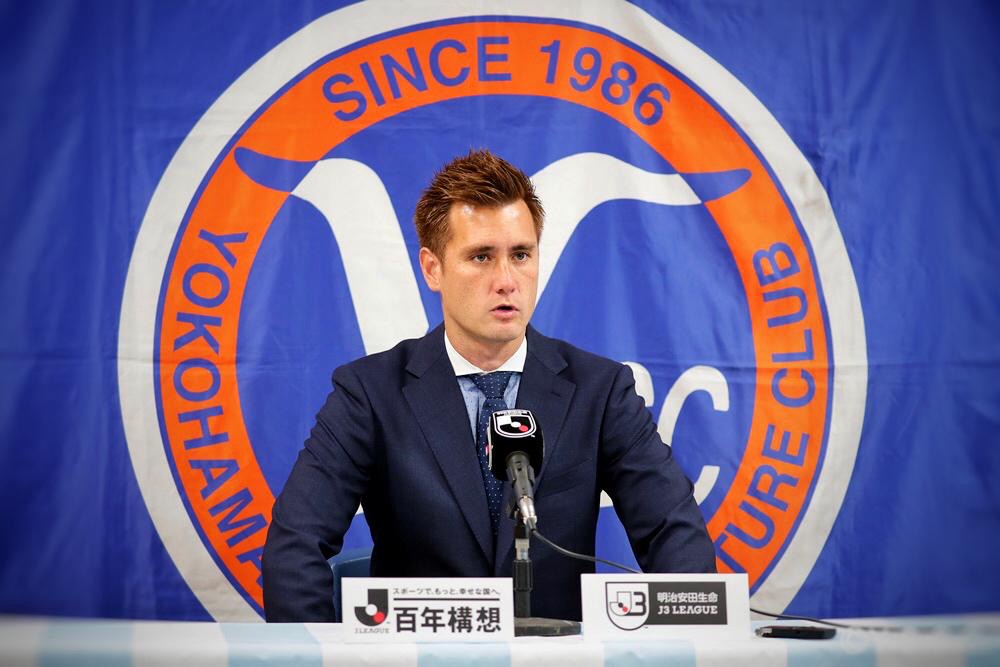
The biggest challenge was not the new role itself, but adapting to Japanese culture. Having grown up in Japan, I expected this to be much easier, but it turned out to be completely different.
I had never attended a Japanese school or worked in a completely Japanese environment before. The Pro Licence course was my first experience in such an environment, and I quickly realized how difficult it was to understand and adapt to the unwritten cultural rules and expectations.
As a head coach, I had to adjust quickly because everyone around me was Japanese. Although I spoke the language fluently, understanding how to “read the air”, interpret what was left unsaid and recognize people’s true intentions was a completely different challenge.
Your idea of “Fast Forward Football” is clearly defined. How do you translate these principles into daily training and ensure they are consistently visible on the pitch?
First of all, I try to make my players understand the core principles of our game completely. I try to deliver the message in different ways for full understanding.
We do, of course, sessions on the pitch, but also visualize a lot using footage and animations, discuss situations in the meeting room and keep aligning ourselves on a daily basis through regular feedback.
Principles must be permanent in my opinion. That is why it is so important to define them precisely. They should give a clear order of preference to my players for their decision making on the pitch, but give them enough freedom and not restrict them in their creativity at the same time.
Principles must be permanent in my opinion.
Once you have a good definition and your players have understood the principles correctly, it is not so difficult to keep them alive. From there, it is about repetition in daily training sessions and directing the players during the games on the weekend.
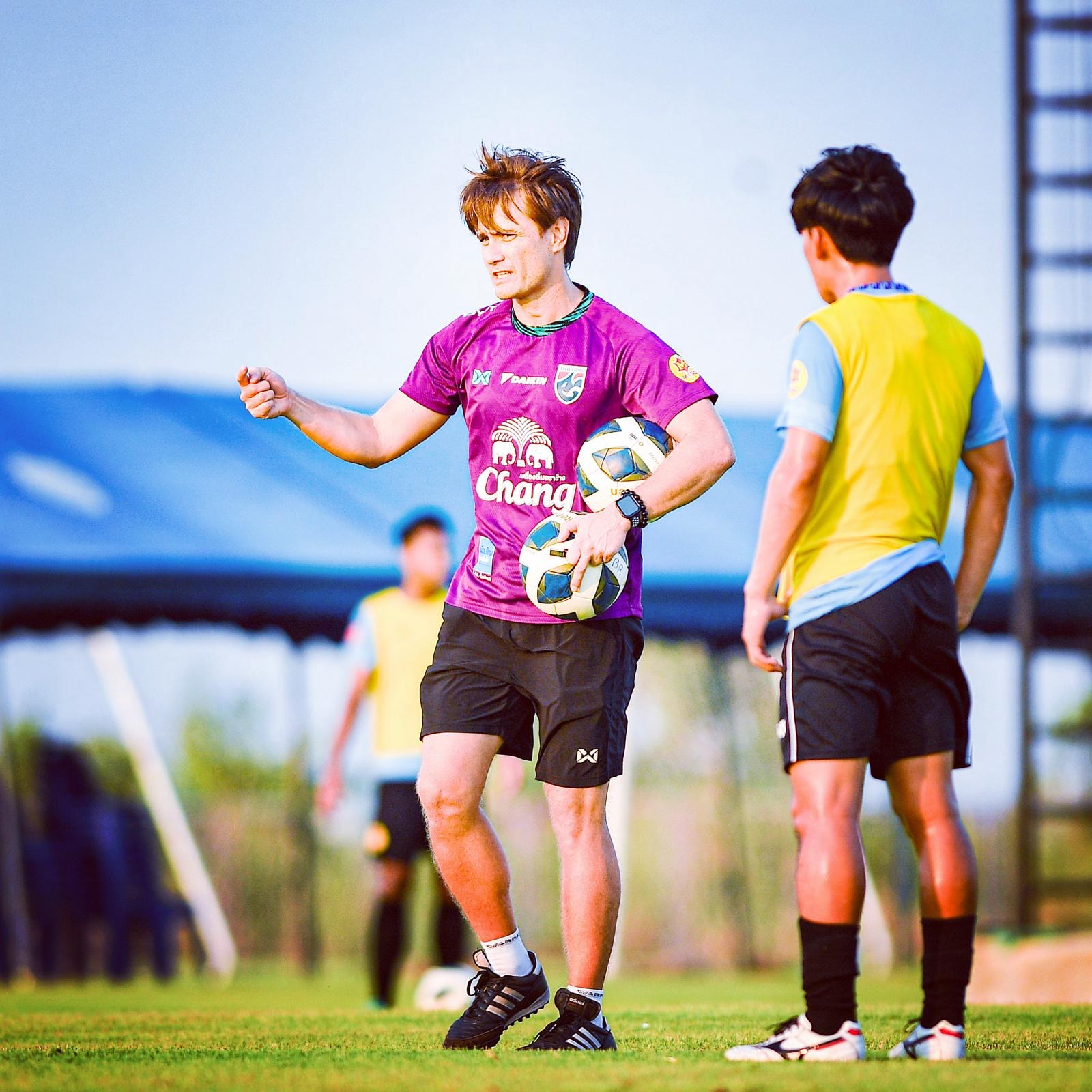
You have worked across multiple countries and environments. What are the biggest differences you have observed in player mentality and development between Japan and other regions?
Wow, that is a very good question. The answer would be much shorter if I explained what is the same in Japan. Pretty much everything is different.
Culture is everything. Culture really affects you in almost every part of the game because it influences you as a person so much.
If I give you the two biggest differences, in my opinion, that make Japanese mentality and development special in comparison to the rest of the world, they are “hard work” and “collectivity” or “harmony”.
Hard work has a different meaning in Japan. It is on another level. From a very young age, players are capable of juggling a ball for hours without ever seeming to get bored.
Collectivity and harmony are valued above almost everything else. Players also show great discipline and followership, which makes it much easier to build a strong team spirit and establish a culture in which everyone works towards the same goal.
However, these qualities sometimes come at a price. Players can work so hard that they lack the necessary composure, creativity and instinct on the pitch. Problems often arise in situations that cannot be planned in advance. When there are no clear instructions from the coach, players can be reluctant to take responsibility and make their own decisions. Yet those moments are often exactly what decides a football match.
You emphasize mindset, clarity and self belief in your coaching. How do you build these qualities within a team, especially in high pressure situations?
With clarity, I mean that I want to be very clear with my players. They should know where they are, what I like about them and what they need to improve on at all times.
Open communication is key for me to achieve this. I try to find time to talk to each individual on the pitch and also arrange regular meetings with individual players and groups.
Positive mindset and self belief are mental abilities that I want to cultivate in my team. First of all, I try to be positive myself at all times and take responsibility for my actions.
A player who has the right mindset will always develop and overcome difficulties, while players who blame others stagnate.
The best way to increase self belief, in my opinion, is by being successful. That is why I try to make my players experience success as much as possible. This can be small things like scoring goals in training or making a great first touch, all the way to big achievements in competition.
I find it extremely important to praise my players when things go well and to be passionate when we share happy moments.
Looking back at your journey from academy consulting to national team and club coaching, what have been the most important lessons that shaped you as a coach?
To be honest, the most important lessons come from the daily work. You learn something new every day.
Each day brings new challenges. Some things go well, while many others do not develop the way you hoped. As a coach, you constantly have to make decisions and take full responsibility for the consequences. Even small setbacks help you grow and become stronger.
I have also learned that you cannot make everyone happy in this profession. However, you always have a choice in how much time, attention and effort you invest in every single player on your team.
I am starting my ninth season in the J3 League this summer. I am grateful for this opportunity and determined to make the most of it.
In the end, I believe that who you work with matters more than the project or environment you are in. I can only be thankful for every single day I get to spend with my players and staff. Football is the best sport in the world, in my opinion, and being part of it is a real privilege.
Looking ahead, I want to continue developing and reach the highest level of coaching. No Japanese coach has yet worked as a head coach in one of Europe’s top leagues, and that is something I want to achieve during my career. The ultimate dream would be to lead the Japanese national team and win the World Cup.
The ultimate dream would be to lead the Japanese national team and win the World Cup.
FAQ
Who is Yuki Stalph?
Yuki Richard Stalph is a football coach born in Bochum and raised in Yokohama who has worked across more than eleven countries as a player and coach.
What is Yuki Stalph’s coaching philosophy?
His philosophy is called “Fast Forward Football” and is based on Forward Play, Forward Runs and Forward Defending.
What are Yuki Stalph’s long-term coaching ambitions?
He wants to reach the highest level of coaching, work as a head coach in one of Europe’s top leagues and ultimately lead the Japanese national team and win the World Cup.
For Yuki Stalph, that ambition is closely connected to the philosophy he has developed on the pitch. His career has already taken him across countries, cultures and very different football environments, but his direction remains clear.
Forward Play. Forward Runs. Forward Defending. And for Stalph himself, always one step forward.