

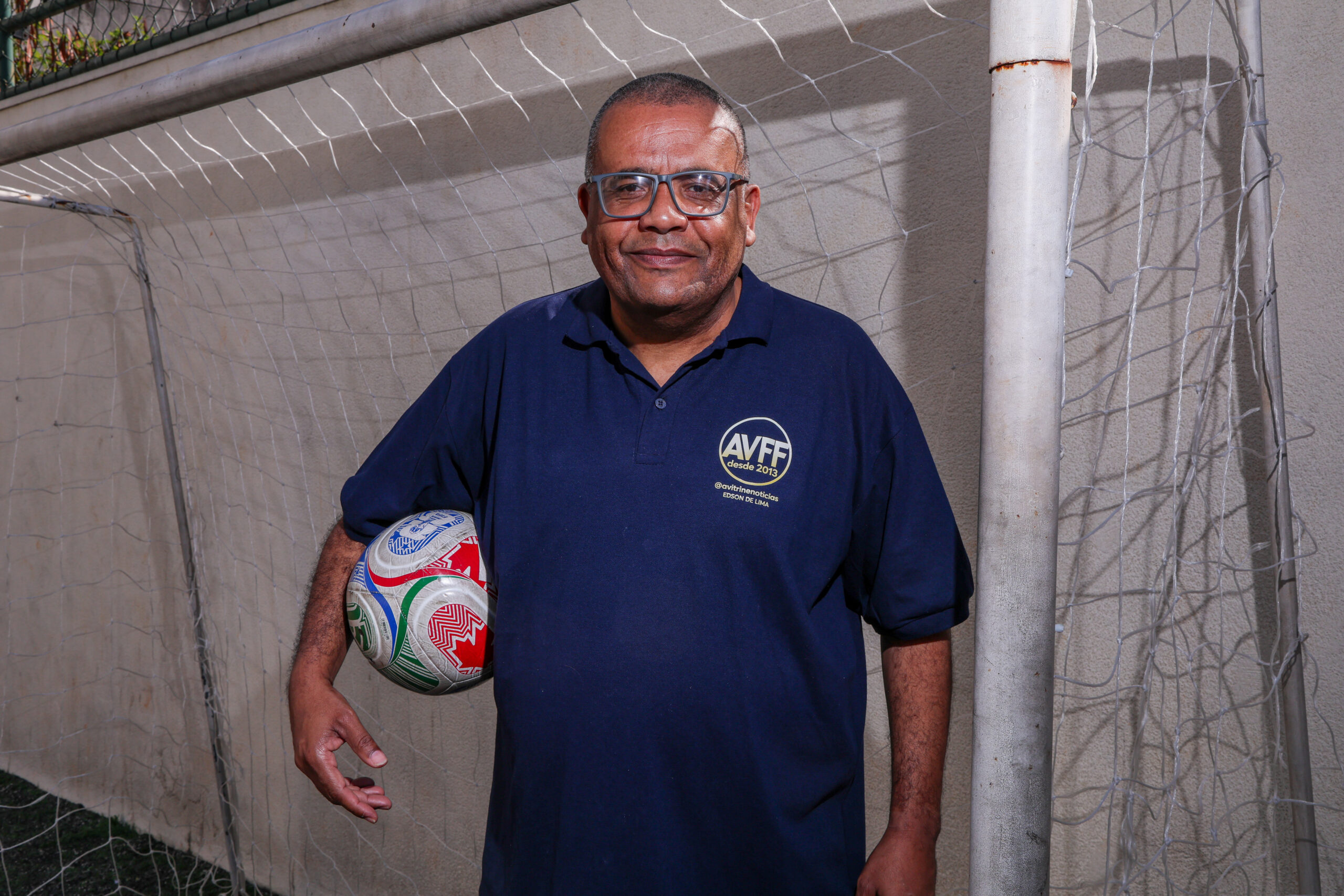
Profile
Role: Journalist, historian, and researcher
Specialisation: Brazilian women’s football
Experience: More than 13 years as a digital journalist
Focus Areas: Journalism, research, interviews, audiovisual content, documentary projects, and preserving the history of Brazilian women’s football
Preserving the Stories of Women’s Football
Who tells the stories that might otherwise disappear?
In women’s football, the answer is not always the biggest clubs, the most famous players, or the major competitions. Behind the headlines are generations of athletes, coaches, staff, clubs, and communities whose stories are rarely documented, and whose contributions risk being forgotten.
For journalist, historian, and researcher Edson Santos de Lima, preserving these stories has become a central part of his work. In 2013, he created A Vitrine do Futebol Feminino, an independent project dedicated to following, promoting, documenting, and preserving the history of Brazilian women’s football.
Over more than 13 years, Edson has looked beyond results and headlines to document the people and moments shaping the game, from major competitions and national teams to grassroots projects, youth football, smaller clubs, and the professionals working behind the scenes.
His work is rooted in a simple but powerful belief: women’s football needs more than visibility. It needs memory, context, and continuity. Through journalism, research, interviews, audiovisual content, and documentary projects, A Vitrine seeks not only to tell the stories of the present, but to ensure they remain part of the history of the game.
Women’s Football, Memory, and Sustainable Growth
In this conversation with The Football Week, Edson de Lima reflects on the evolution of women’s football journalism in Brazil, the stories that are still missing from the spotlight, the importance of preserving the game’s history, and what needs to happen for its current growth to become truly sustainable.
Key Insights
- Edson de Lima believes women’s football needs memory, context, and continuity alongside greater visibility.
- He argues that media coverage should look beyond major clubs, national teams, and competitions to document the wider football ecosystem.
- He believes the 2027 FIFA Women’s World Cup should leave a permanent legacy through infrastructure, development, investment, professional opportunities, and historical records.
Our Exclusive Interview with Edson de Lima
Edson, you have more than 13 years of experience as a digital journalist. How did your relationship with women’s football begin, and what made you decide to dedicate such an important part of your career to the women’s game?
My relationship with women’s football began with curiosity, a desire to understand a history that, for a long time, was rarely told. As a historian and researcher, I have always been deeply interested in preserving memory. When I started following women’s football more closely, I realized there were countless stories, people, matches, and moments that were simply disappearing.
In 2013, I created A Vitrine do Futebol Feminino. The initial idea was to give greater visibility to the game, but I soon realized that the work needed to go beyond reporting results. It was also about documenting the people behind the game, recording their testimonies, and preserving the moments that were shaping its history.
That combination of journalism, research, and memory is what made me stay. More than a decade later, I still believe that telling these stories is not only about giving visibility to women’s football today, it is also about building a permanent record of its history for the generations that will come next.
More than a decade later, I still believe that telling these stories is not only about giving visibility to women’s football today, it is also about building a permanent record of its history for the generations that will come next.
Having followed the game through different stages of its development, is there a particular moment that you consider a turning point for women’s football in Brazil?
I wouldn’t point to just one moment. Brazilian women’s football has gone through several important turning points. We have seen the return of national competitions, the growth of youth development, greater involvement from major clubs, the evolution of the Brazilian national team, and, above all, a gradual transformation in the way the public and the football industry itself perceive the game.
But there is one shift I consider fundamental: women’s football is no longer treated merely as an exception. It has increasingly become part of the broader sporting agenda. At the same time, we need to be careful not to confuse increased visibility with structural consolidation. There are still significant gaps between discourse and reality. That is why this history needs to be told with enthusiasm, but also with a critical perspective.
Today, there is significantly more content about women’s football than there was a decade ago. In your opinion, what are some of the biggest mistakes the media still makes when covering the game?
One of the main problems is treating women’s football as if it constantly needs to be presented as something new. Another mistake is focusing too heavily on the major clubs, the national team, and the biggest competitions. This creates a very limited view of the game. I also see a lack of historical context. Many articles introduce a player, a competition, or an event without explaining what came before.
And there is also a need for greater self-criticism. Coverage cannot be built solely around praise. Women’s football needs journalism that recognizes its progress, but also questions issues related to scheduling, infrastructure, youth development, management, communication, working conditions, and continuity.
Media coverage often focuses on major clubs, national teams, and major tournaments. What stories are we still missing outside this “bubble”?
There are many.
There is women’s football outside the major centers, the smaller clubs, the teams fighting to survive, the coaches, fitness coaches, physiotherapists, administrators, communications professionals, and so many other people who work every day to develop the sport. There is also an enormous history in the youth categories.
Many of the girls who are playing for major teams today started out in grassroots projects and clubs that rarely receive any attention. And there is the story of the players themselves. What happened before they joined the club? Who opened that door for them? Who encouraged them? What challenges did they face? This is where journalism can play a very important role: going beyond the surface and discovering the stories that are still not being told.
What makes a great women’s football story, and how have social media and digital platforms changed the way these stories are told, shared, and consumed?
A great story does not necessarily depend on a great result. Sometimes, a defeat can produce a much more important story than a victory. For me, a good story needs a character, context, memory, and meaning. It is important to show who is behind that result. Social media has greatly democratized the production and distribution of content. Today, a story can be published directly to the public without relying exclusively on major media outlets.
But this has also brought a problem: speed is often valued above quality. We have an excess of information and, paradoxically, very little documentation. That is why I consider audiovisual and documentary projects so important. A post can quickly disappear in the constant flow of social media. A documentary, a well-recorded interview, or an audiovisual archive can remain for decades.
A documentary, a well-recorded interview, or an audiovisual archive can remain for decades.
Many new fans have only started following women’s football in recent years. What do you think they should know about the generations of players who came before the current era?
They need to know that Brazilian women’s football did not start just now. Before the current generation, there were women who played when there was no structure, visibility, or recognition. Players such as Roseli, Meg, Lucia, Sissi, Pretinha, Formiga, Marta, Cristiane, and so many others are part of a journey built over decades.
And even before them, there were other women who fought simply for the right to play. Knowing this history changes the way we see the present. The current generation did not emerge out of nowhere. It is the result of a collective effort built over time.
Preserving this memory is one of the reasons why I consider historical records, interviews, photographs, videos, and documentaries so important. We cannot allow a sport that fought so hard to gain space to lose its own memory.
We constantly hear about the growth, professionalization, and investment in women’s football. From your perspective, is this growth already structural, or is there still a significant gap between discourse and reality?
There is growth, without a doubt. But I still do not consider all of this growth to be structural. There are clubs with very well-organized projects, significant investment, and solid planning.
But there are also situations in which women’s football still depends on short-term initiatives.
Professionalization does not simply mean increasing salaries or signing players. It means providing a proper schedule, infrastructure, player development, qualified coaching staff, professional departments, communications, youth academies, planning, and continuity.
We need to stop confusing visibility with development. Brazilian women’s football has made tremendous progress, but it still needs to turn individual achievements into a permanent structure. True growth will become evident when good projects are no longer the exception, but the rule.
True growth will become evident when good projects are no longer the exception, but the rule.
What could Brazil learn from other countries when it comes to media coverage, professionalization, and the development of women’s football? And what do you think other countries could learn from Brazil?
Brazil can learn a great deal from countries that have managed to build a more integrated structure connecting youth development, clubs, competitions, broadcasting, marketing, and professionalization. We need to observe international experiences without simply copying them. Every country has a different reality.
On the other hand, I believe other countries can learn a great deal from Brazil in terms of tradition, technical quality, and our ability to develop talent. Brazil has an extraordinary history in women’s football. What we need to do is turn that tradition into planning. We have talent. We have history. We have an audience. We have clubs that are interested. The great challenge is to turn all of this into a sustainable and continuous structure.
The 2027 FIFA Women’s World Cup will be hosted in Brazil. What kind of legacy do you hope the tournament will leave for Brazilian women’s football?
I would like the legacy to be much greater than full stadiums and a large audience during the competition. A World Cup needs to leave behind infrastructure, projects, development programs, investment, new female and male fans, as well as professional opportunities.
I would especially like the tournament to help strengthen women’s football outside the traditional axis of the major centers. I also believe it is essential to preserve the memory of this World Cup. We need to produce photographs, interviews, audiovisual records, and documentaries that will allow future generations to understand not only who became champions, but also what the competition meant for Brazilian women’s football. The greatest legacy would be to look back at 2027 ten years later and realize that the World Cup truly changed something in a permanent way.
And finally, looking ahead: how would you like to see women’s football being told and represented ten years from now?
I would like, ten years from now, for us no longer to have to explain why women’s football deserves space. I want to see journalism that treats the sport with naturalness, depth, and responsibility. Journalism that talks about the biggest stars, but also about the unknown players; that follows the major clubs, but also the smaller ones; that records titles, but also the processes behind them.
And I would like us to have a much more organized record of its history. That is precisely why I see audiovisual projects and documentaries as an important part of the future. We need to produce today the records that will allow us to tell the story of these generations tomorrow.
FAQ
Who is Edson de Lima?
Edson Santos de Lima is a journalist, historian, and researcher whose work focuses on documenting and preserving the history of Brazilian women’s football.
What is A Vitrine do Futebol Feminino?
A Vitrine do Futebol Feminino is an independent project created by Edson de Lima in 2013 dedicated to following, promoting, documenting, and preserving the history of Brazilian women’s football.
What does Edson de Lima believe the 2027 FIFA Women’s World Cup should leave behind in Brazil?
He believes the World Cup should leave behind infrastructure, projects, development programs, investment, new female and male fans, professional opportunities, and records that preserve the tournament’s history for future generations.