

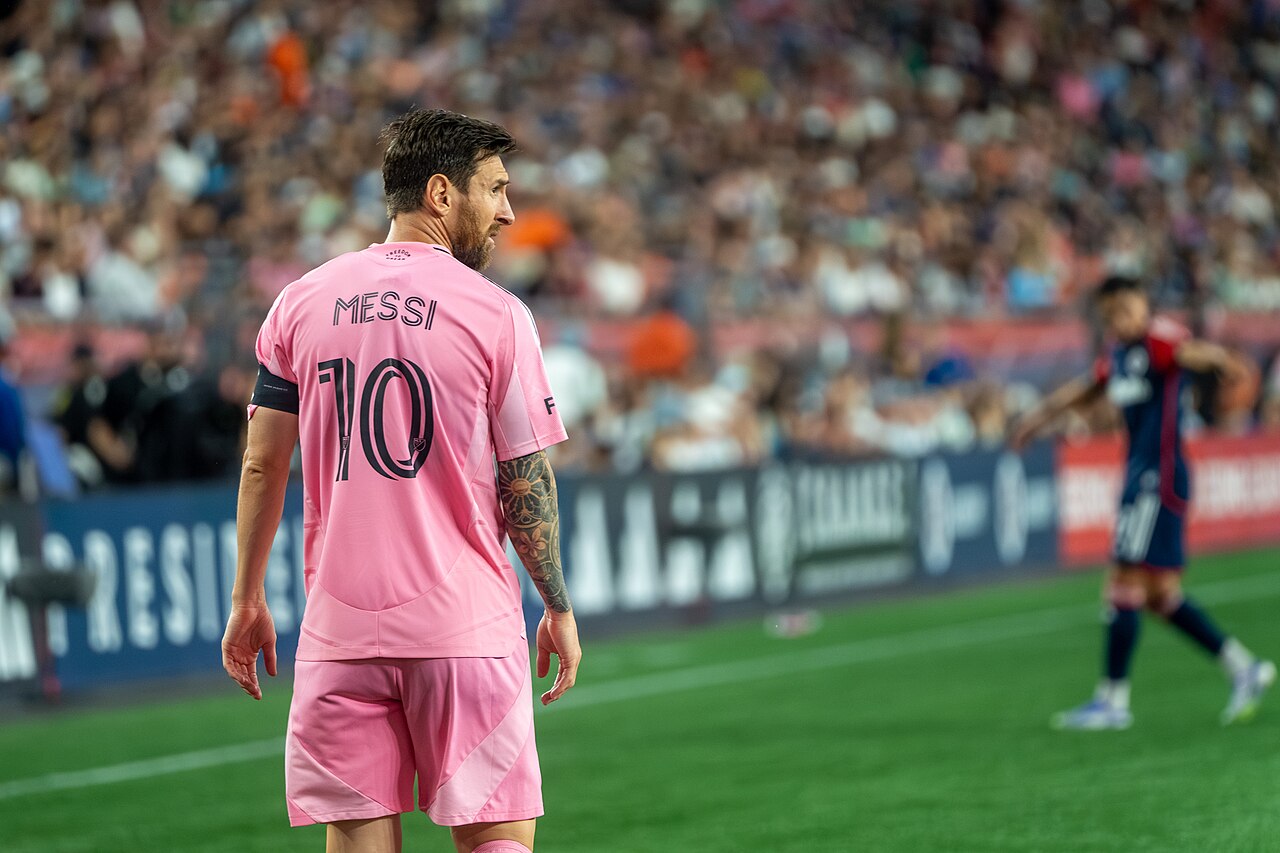

By now, you have probably seen the photograph even if you were not looking for it.
A pink jersey. The number ten. A stadium in Fort Lauderdale that, a few years ago, most of the football world could not have found on a map. Since the summer of 2023, Lionel Messi in the colours of Inter Miami has become one of the most reproduced images in world sport, on phone screens in Jakarta, on café televisions in Buenos Aires, on the backs of children who have never set foot in the United States.
On the surface, this is a familiar story, and a simple one. The greatest player of his generation, in the twilight of his career, chose a comfortable life in the American sun over one final, staggering payday elsewhere. Football has seen this film before. David Beckham made the same journey to Los Angeles in 2007, trading trophies for lifestyle and a gentle commercial afterlife. Ageing icons have always drifted west.
But look a little closer, and the familiar story starts to come apart.
Because Major League Soccer did not simply outbid its rivals for Messi. It could not have. This is a league built, deliberately, from its very first day, to make sure no single team could ever spend the kind of money that brings a player like him. When Saudi Arabia reportedly offered something close to half a billion dollars a year, MLS answered with a fraction of it, and still won.
That is the part worth stopping on. Not the sunshine. Not the family. The mechanics. How does a league that is structurally forbidden from affording the world’s most expensive footballer end up signing him anyway, without breaking the one rule that made him unaffordable in the first place?
The answer turns out to have very little to do with how much Messi was paid, and everything to do with what he was paid with. To understand it, you have to stop thinking about his contract as a salary at all.
A Machine Built Against Its Own Past
To see why Messi’s arrival was so strange, you first have to understand the machine he walked into. And to understand that machine, you have to understand the fear it was built around.
Most football leagues in the world are, at heart, a collection of independent clubs. Each one is its own business, with its own owner, free to spend whatever it can afford, or whatever it is reckless enough to borrow. Real Madrid and a newly promoted side in the same league are not partners. They are rivals competing for the same players, and the richer one usually wins. This is the model football grew up with, and for the giants of Europe it works beautifully.
It also happens to be the model that killed professional soccer in America once already.
In the 1970s, a league called the NASL tried exactly this. One club, the New York Cosmos, backed by a corporate fortune, signed Pelé and a cast of ageing legends, and the spending spread like a fever. Smaller clubs, terrified of being left behind, chased stars they could not possibly afford. Within a decade the whole league had spent itself to death. When Major League Soccer was built from the ashes roughly a decade later, its founders made one decision that shaped everything that followed. They would not build another collection of rivals. They would build a single company.
This is the piece outsiders always miss, so it is worth saying plainly. In MLS, the teams do not really own themselves. The league owns them. It owns the clubs, the contracts, the players. The wealthy men who appear to be team owners are, in the league’s own language, “investor-operators,” shareholders in one central business who are handed a team to run. And because every club is ultimately the same company, no two of them can bid against each other for a player. There is no auction. There is a budget, set at the centre, and it applies to everyone.
That budget is deliberately, almost aggressively, small. For a league of this ambition, the amount each team can spend on its roster is a rounding error next to what a mid-table European club pays. On top of it sits a tangle of rules with names only a tax lawyer could love, each one designed to do the same quiet job: to let a club reach for a star now and then, while making absolutely certain it can never again spend itself into the grave.
Which brings us back to the pink jersey. Set Messi’s reported price against this machine, and the problem is no longer a question of ambition or nerve. It is a question of arithmetic. There was no legal way, inside the rules MLS had spent thirty years defending, to pay Lionel Messi what Lionel Messi was worth.
So they stopped trying to pay him the usual way. And that is where the story turns from a transfer into an invention.
What He Was Paid With
Here is the idea that made it work, and it is worth slowing down for, because almost everything written about Messi and Miami skips straight past it.
If MLS could not pay Messi a big enough salary, then it would not pay him a salary at all. Not in the way we normally mean the word. Instead, according to widely reported accounts of the deal, the league did something that had never been done in a major American sport. It let Messi become a part-owner of the money he generated.
The arrangement is understood to rest on three pillars, and each one quietly rewrites a rule about how athletes get paid.
The first pillar is Apple. In 2022, before Messi, Apple had bought the global streaming rights to MLS for two and a half billion dollars, putting every match behind its own service. A player who could draw the entire planet to that service was, to Apple, not a football expense at all. He was a customer-acquisition tool. So the reporting suggests Apple agreed to hand Messi a share of the revenue from new subscribers who signed up, in effect, to watch him. Read that again slowly. A media company agreed to pay a player a cut of its own subscription business. The wage stopped being a cost the club absorbed and became a percentage of the audience the player himself delivered.
The second pillar is Adidas. Adidas makes the kit for every club in the league, and has sponsored Messi personally for most of his life. When his pink shirt became the best-selling jersey in Adidas’s entire sports catalogue, and one of the fastest-selling in the sport’s history, Adidas is understood to have agreed to share a slice of that surge directly with him. This is the logic Nike stumbled into with Michael Jordan forty years ago, taken to its conclusion. The player is no longer a face the brand rents to sell a product. He is a partner who takes a cut of the product he moves.
The third pillar is the club itself, and it is the smallest of the three. Inter Miami provides a base salary and signing bonuses, the ordinary part of the deal, the part that actually looks like football. But even here there is a twist. Messi was reportedly given the option to buy an ownership stake in the club when he retires, tying his fortune not to his wages but to the soaring value of the franchise he was brought in to build.
Now step back and look at what these three pillars, stacked together, actually describe. Messi’s compensation is not really a salary. It is a revenue-share agreement spread across a technology company, a sportswear giant, and a football club, each one paying him not for his labour but for the commercial value his presence creates for them. He is not an employee of Inter Miami in any traditional sense. Messi is not on the payroll. He is on the cap table.
Messi is not on the payroll. He is on the cap table.
This is the quiet revolution buried inside the pink jersey. And once you see it, a much larger question comes into view, one that reaches far beyond a single player or a single league. If a wage can be rebuilt like this, then what, exactly, is a superstar worth, and to whom?
The Weapon Hidden in the Constraint
Step back from the mechanics of the deal, and something larger comes into focus. What MLS pulled off was not just a clever way to pay one player. It was a quiet lesson in how constraints actually work.
The instinct, in business as in sport, is to treat a limit as a disadvantage. The league with the salary cap is the poorer relation, the one that cannot compete when a Gulf state or a European giant decides it wants something. And on paper, that is exactly what MLS was. Saudi Arabia had a fortune and offered it. MLS had a rulebook that forbade matching it. In a straight fight over money, MLS should have lost, and lost badly.
It did not lose, because it refused to have the fight on those terms. Instead of asking how it could spend more, it asked a different question. It asked what it already had that no rival could easily copy. And the answer was not money. It was a structure.
Because MLS owns everything centrally, it could do something no ordinary league could. It could bring its own commercial partners into the deal. Apple was already the league’s broadcaster. Adidas was already the league’s outfitter. These were not Inter Miami’s partners. They were the whole league’s partners, contracted to the single company that owns every club. So when the moment came, MLS could turn to them and, in effect, ask them to help pay for a player, because that player would grow their businesses too.
This is the part worth dwelling on, because it inverts something we take for granted. In an ordinary market, a technology company, a sportswear brand and a football club are three separate businesses with three separate interests. Getting all three to willingly thin their own margins to fund a single signing should be almost impossible. What made it possible was that MLS’s structure had already tied their interests together. The rigid, defensive design that looked like a weakness, the thing that stopped Miami from simply outbidding Riyadh, was the very thing that let three giants act as one.
So the constraint did not block the deal. The constraint produced it. A league that could not win with a bigger cheque won instead with a better structure, and it is hard to think of a cleaner illustration of a principle that reaches well beyond football: when you cannot outspend a problem, you have to out-design it.
So the constraint did not block the deal. The constraint produced it.
There is a second lesson hidden in the same deal, though, and it belongs not to the strategist but to the marketer. Because the structure did not just change how Messi was paid. It quietly changed what he was.
From Billboard to Business Partner
For as long as sport has sold things, the relationship between a star and a brand has run in one direction. The brand has the money. The athlete has the fame. The brand pays to borrow that fame for a while, stamps it on a product, and hopes some of it rubs off. A sponsorship, in other words, is a cost. It is a line in the marketing budget, spent in the hope of a return that is always a little hard to measure.
Messi’s contract runs the other way. It takes that century-old arrangement and turns it inside out.
Apple is not paying Messi to appear in an advertisement. It is paying him a share of the subscribers he brings through the door. Adidas is not paying him to pose in a photograph. It is paying him a share of the sales he drives. The money flowing to Messi is not a fee spent up front and hoped upon. It is a percentage of value already created, paid out only because that value showed up. The star has stopped being a cost the brand carries. He has become a partner the brand shares with.
This is a small change in wording and an enormous change in meaning. When a brand rents fame, it is buying attention and praying it converts. When a brand shares revenue with an athlete, it is no longer buying attention at all. It is buying a growth engine, and paying for it only in proportion to how much it grows. Apple did not acquire a celebrity endorser. It acquired a tool for signing up customers in countries it had struggled to reach. Messi’s face was never the point. His pull was.
And this is the part that travels far beyond one footballer. The whole logic of how brands work with famous people has been drifting this way for years. The old model rented reach and hoped. The new one buys a share of an outcome. The Messi deal did not invent this. It simply shows it at its most extreme, in the open, for anyone paying attention to study: the star is no longer a billboard. He is a business partner.
The star is no longer a billboard. He is a business partner.
Which is a genuinely new and powerful thing. But it is worth remembering that everything described so far has been the success story, the view from the winner’s side. Turn the deal over, and there is a cost written on the back of it, one the league has been careful not to talk about.
The Price of Winning
Remember what the whole machine was built to do. It was built to stop one club from spending its way to dominance and dragging the rest to ruin. The salary cap, the central ownership, the small and stubborn budget, all of it existed to protect one sacred idea: that in this league, no team could buy its way permanently above the others. Parity was not a nice feature. It was the foundation. It was the thing that separated MLS from the league that died before it.
Now look at what the Messi deal did to that idea.
The reason MLS could pay Messi without breaking its own salary cap is that most of his money did not come from Inter Miami at all. It came from Apple and Adidas, from outside the cap entirely. And that is a door that only opens for certain clubs. A team in Miami, in a glamorous international market, with owners wired into global commerce, can attract that kind of partner arithmetic. A team in a smaller city, with a modest local profile, cannot. The mechanism that let Miami sign the greatest player alive is not available to everyone equally. It is available to whoever the world’s biggest brands find worth subsidising.
And so the numbers have quietly split in two. Inter Miami is now worth several times what the league’s smaller clubs are worth. A handful of teams in the biggest markets have pulled away, their values climbing, while others sit still, watching. Here is the irony the celebration never mentions. The gap now opening between the rich clubs and the rest is the same gap that killed the NASL. That league died because its wealthy clubs pulled away and the rest bankrupted themselves trying to keep up. MLS built its entire structure to make sure that gap could never open again, and then, through this one brilliant deal, quietly opened it anyway. The difference is only in the mechanism. The old league lost control of spending. This one engineered a door that only its biggest markets can walk through. The wall did not fall. Someone simply found a way to reach over it, and not everyone has arms that long.
This is the quiet cost the celebration tends to skip. MLS solved an impossible problem with genuine ingenuity, and in solving it, it strained the one principle that impossibility was there to protect. The engineering that made Messi possible is the same engineering that is pulling the league apart at the seams it was designed to hold together.
None of this makes the Messi deal a mistake. It makes it a trade, and trades have two sides. The league bought thirty years of global relevance in a single summer. What it spent, quietly, was a piece of the equality that was once its whole reason for being. Whether that was a bargain or a debt is a question MLS will not be able to answer until the man who made the deal work is no longer on the pitch.
A Bet Against the Clock
There is a clock running underneath all of this, and everyone in the room can hear it. Lionel Messi is thirty-nine years old. He carried Argentina to a World Cup final in the summer of 2026, and he will not do that many more times. The entire edifice described here, the record valuations, the global subscribers, the pink shirts on children in cities he will never visit, rests on a body that is running out of seasons.
This is what makes the Messi deal such a revealing document. Strip away the specifics, and it is a bet about time. MLS used a fleeting thing, the last few years of one extraordinary career, to try to buy a permanent thing: relevance, valuation, a place in the American sporting conversation that outlasts the man who bought it. The genius of the structure was never really about Messi’s wages. It was about converting his brief, blinding presence into something that stays behind when he is gone. Whether the league manages that conversion in time is the only question that finally matters, and it is one the clock, not the accountants, will decide.
But look past this one player, this one league, and the deal leaves behind something more durable than any valuation. It quietly rewrote a rule that reaches into every business, not just sport. For a century, the relationship between talent and the companies that pay for it ran one way: the company held the money, the talent held the appeal, and the money was spent to rent the appeal. Messi’s contract turned that around. It made the talent a partner in the value it creates, paid not for showing up but for what shows up because of him. That idea did not stay in football. It is already spreading through every industry that has learned a famous name can be a growth engine rather than a line of expense.
And underneath even that sits the plainest lesson of all, the one MLS learned the hard way across thirty years. When you cannot win with the size of your cheque, you win with the shape of your thinking. A league forbidden, by its own hand, from ever being the richest bidder in the room found the one thing richer than money: a structure nobody else could copy. The Gulf state had the fortune. MLS had the design.
And that is the real inheritance of the summer Messi came to Miami. Not the trophies he may or may not lift, not the valuations that may or may not hold, but the quiet proof, written into the most famous contract in modern sport, that in a game increasingly decided by money, the most valuable asset on the field was never the most expensive one. It was the idea nobody else had thought to build.