


“Everything I have achieved in football is due to playing football in the streets with my friends.”
— Zinedine Zidane
Few football careers better illustrate the journey from the street to the very top of the game than Zinedine Zidane’s. Born in Marseille and raised on the tough housing concrete of La Castellane, Zinedine began playing football with friends in the spaces around his home before entering the organised game. From those informal games emerged the qualities which later defined him: extraordinary balance, close control, imagination and an ability to find solutions in crowded spaces. He would go on to become a World Cup-winning France international, a Ballon d’Or winner, a Real Madrid icon and one of the most successful coaches in the club’s history. Now, having been appointed France’s national-team head coach in 2026, Zinedine’s journey has come full circle. The boy who learned the game in the streets now sits at the highest level of French football. This is a reminder that before football is coached, structured and analysed, it’s first discovered through play.
This is a reminder that before football is coached, structured and analysed, it’s first discovered through play.
Street Football is Education
The streets are an education in themselves. While coaching and modern infrastructure seek to refine young players and make them the best versions of themselves, street football offers something increasingly difficult to reproduce: freedom. It gives players the opportunity to discover their own solutions, test their technique against different opponents and perhaps most importantly, make mistakes without someone immediately telling them what they have done wrong.
The ingredients are rarely ideal. There are sharp stones and uneven surfaces, small playing areas and too many players competing for too little space. Yet these very ingredients become part of the education. A player learns:
- to adjust to the surface beneath their feet,
- to protect the ball when there is little room to turn and
- to find a way through a crowd of bodies when the obvious pass is not available.
The street is an artist’s studio and, in many ways, a footballer’s kitchen (in the words of this Nutritionist). There is no coach standing over the player deciding which drill comes next, no referee stopping the game every time there is contact and no tactical instruction telling them where they should stand. The perfect mixing bowl for youth here, is to make decisions for themselves based on their hunger for the ball. They learn through repetition, competition and observation, borrowing a trick from an older player or inventing one of their own.
This is one reason street football has produced so many players whose games are built around deception and improvisation. The stepover, the feint, the sudden change of direction or the audacious flick are not simply techniques learned from a coaching manual; they’re often solutions developed because a player needed to escape an opponent and discovered that something worked.
Pep Guardiola has repeatedly spoken about the importance of this freedom during the early years of a child’s development. For children around the age of 7 or 8, his argument is football should be about playing as much as possible, making mistakes and developing a genuine love for the game rather than becoming consumed by tactics and results. Before a child learns how to play football according to a system, there should be an opportunity to discover why they enjoy playing it at all.
In one interview, Pep urged young children to “play and play and play” in the street, describing the freedom to make mistakes as an important part of development. His wider philosophy is straightforward:
- passion ought to come before trophies,
- creativity should be allowed to develop without fear of failure and
- children should not be over-coached before they’ve had the opportunity to develop their own relationship with the ball.
This very freedom to fail matters. A child can attempt a skill, lose the ball and try it again without the experience being treated as a coaching error. Children can spend an entire afternoon trying to beat the same opponent, gradually working out which movement will create the half-yard they need. In a game where there is no prescribed answer, creativity becomes something that has to be discovered rather than something that is simply taught.

The Cultural Ingredients of the Beautiful Game
Neymar is perhaps one of the clearest modern examples of the street footballer. His game has always contained an element of spontaneity, from the backheels and stepovers to the trivelas and sudden changes of direction, and that sense of freedom is part of what made his football so captivating. Ronaldinho carried a similar quality. He played with a visible sense of enjoyment, turning dribbling, passing and improvisation into entertainment and inspiring a generation of children to imitate what they saw.
The appeal of these players lies partly as their football feels expressive. It’s not simply about reaching the most efficient solution, but about finding a beautiful one. Pelé understood this relationship between individuality and football culture, as did generations of Brazilian players who grew up with the idea of Ginga (foundational movement and physical rhythm) and Joga Bonito (the philosophy and aesthetic outcome on the pitch). In Brazil, creativity has long been regarded as intrinsic to the identity of the game, rather than an indulgence to be coached out of it.
Futsal has also played an important role in that development. Its smaller pitches and constant pressure force players to become comfortable in confined spaces, while the limited time available on the ball encourages quick decisions and close control.
The cage offers a similar education. Its walls remove the easy escape route, the dimensions compress the game and the ball is rarely out of play for long. A player may find themselves surrounded by opponents with barely enough space to turn, forcing them to protect the ball, anticipate pressure and improvise.
The cage does more than produce flair; it teaches players how to solve problems. That education has obvious relevance to the modern game, where players are increasingly expected to operate in congested areas and make decisions in fractions of a second. Yet the value of the cage extends beyond producing professional footballers. For every child who eventually reaches an academy, there are thousands who don’t and the experience is no less valuable for them. The cage can teach confidence, communication, competitiveness and resilience, while giving young people the opportunity to take ownership of the game rather than waiting for an adult to organise it for them.
The cage does more than produce flair; it teaches players how to solve problems.
From the Streets to South London
South London has a particularly rich relationship with this form of football. Players such as Jadon Sancho, Wilfried Zaha, Eberechi Eze and Marc Guéhi have emerged from environments where informal football was an important part of their development, and their games carry qualities associated with the cage:
- close control,
- confidence in one-on-one situations,
- improvisation and
- an ability to operate in tight spaces.
The connection isn’t simply anecdotal. Reporting on London’s cage culture has highlighted the number of England internationals who grew up regularly playing in cages. Among those cited are Marc Guéhi, Fikayo Tomori, Ezri Konsa, Declan Rice, Conor Gallagher and Bukayo Saka.
The important question is, what happens to all the children who play there without ever becoming professionals? The answer is they still acquire something special. They learn how to:
- compete with people of different ages and abilities,
- negotiate disagreements,
- deal with losing and express themselves in an environment where nobody has predetermined what they are supposed to do.
All of this culminating into a sense of ownership is increasingly important. In my observation, children’s lives are far more structured than they once were and much of their sporting experience takes place in organised sessions, be it at schools, academies or commercial facilities. Those environments have enormous value, but there’s something different about a child being able to walk outside with a football, find a group of other children and create a game without having to ask permission.
The cage provides this very possibility.
Alongside, it also reflects the city around it. London is one of the world’s great multicultural cities and its cages have become meeting points for different footballing traditions. Brazilian, African, European and British influences can co-exist in a melting pot on the same pitch, with skills and styles passed from one player to another simply through observation and imitation. An older player teaches a younger one a move; a younger player brings something they have seen elsewhere; another player adapts it. Football culture is transferred horizontally, from friend to friend and generation to generation.
All of this is difficult to replicate through a formal coaching programme because of the unpredictability. You don’t know who will turn up, and the cage belongs to everyone.
I remember taking the DLR from Bank towards Canary Wharf around 15 years ago and looking out from the window seeing children playing within the cages below, happy and free. From the train they seemed tiny and the pitches themselves looked almost insignificant: rectangles of concrete surrounded by metal fencing in the middle of an enormous city. Yet there was something about the sight that stayed with me to this day. The children were completely absorbed in the game, seemingly oblivious to the trains passing above them and the office towers surrounding them. The cages had created their own little worlds.
This also got me thinking about what is happening to the Keith Miller sports pitch aka the ‘San Siro’ cage in Hackney.
Tara Darby is an artist who came up with an idea called the ‘White Cage’ photography project, which aims to showcase the vital role free public spaces play in the community. Her project was displayed at Homerton Library in June this year, as part of Hackney Art Week. Her own children grew up playing football at this very cage.
Tara says: “This is just a free cage, but it’s life-changing for kids to be able to have a space that’s not massively overseen, where they can just go and make loads of noise. I think especially teenage boys, they’re so policed – where can you go and just make loads of noise without people telling you to be quiet or calling the police? It’s so important.”
Hackney council has announced plans to close the pitch for 18 months as part of a redevelopment to create 400 homes, with two-thirds designated as council homes for social rent. The need for those homes is real, which is precisely why the issue can’t be reduced to a simple view between housing and football. With my financial lens, cities need homes and investment, but they also need informal spaces in which communities can meet, children can play and people can spend time without having to buy anything.
The Keith Miller cage illustrates what can be lost when one of those spaces disappears. There’s no booking system. Players turn up, wait for a game to finish and, if they are invited in, they join the game. Teenagers can play alongside younger children; women’s players can use the space; deaf players have played there too.
Former Arsenal defender Kirsty Pealling grew up playing at the cage. It has become a place where different generations and sections of the community encounter one another through football. In that sense, it’s something between a playground, a football academy and a community centre, without formally being any of them and its informality is precisely what makes it so valuable.
A formal football session can provide coaching and competition, but it can’t completely reproduce the experience of walking into a cage without a plan and finding a game already underway. You don’t need a team, a league, a membership or a parent prepared to drive you across London. You need a ball and enough people who want to play.
Coaches have expressed to me time and again over the past few years, a growing concern that young players are not always as adept at thinking for themselves or as hungry to compete as previous generations. Whether that perception is entirely fair is another question, but their concern points towards something that organised football often struggles to provide: situations in which young players are responsible for solving problems themselves.
The distinction does matter, as access to football is not the same as access to a football space. London has a large population but relatively limited access to playing fields, while commercial facilities can be expensive to hire. Pay-to-play football has its place, and organised programmes can provide vital opportunities, but the free cage offers something different: a place where the cost of entry is simply turning up.
There are efforts to find a temporary alternative for the San Siro cage during development work, but it will need to be local and accessible. Hackney Council also says that when there is a new pitch, it’ll be smaller in size at 515 sq. m vs. 717 sq. m. They state that this reduced size will make improvements such as seating, lockers, netting to keep balls inside, and a third space for young people to socialise.
Modern Solutions
The London FA has tried to address some of this problem through its Play Zones initiative, which allows communities to use refurbished areas which were once rundown pitches or cages at a subsidised rate. It is a significant improvement on the cost of hiring a conventional Powerleague pitch, ranging from around £40-£80 per hour across London, but it still highlights the difficulty of guaranteeing young people somewhere to play for free.
The problem isn’t a lack of understanding of how important these spaces are, but a lack of funding. London FA chief executive Paul Bickerton has spoken about the pressure on local authorities and the consequences of cuts to investment in facilities and activities that are not considered a statutory responsibility. As he puts it, “Everyone thinks there is a lot of money in football but there is a lack of money lower down compared to the top level.”
The imbalance is difficult to ignore. At the top of the game, football is an industry capable of generating enormous sums of money, yet further down the pyramid, the spaces in which children first discover the game can struggle to find the funding they need. The London FA has increasingly had to look towards private-sector investment and corporate social responsibility to help fund these initiatives, but that can’t completely replace the security of having publicly accessible spaces where children can simply turn up and play.
There are some encouraging examples of investment in football spaces across London. #Merky FC HQ in Croydon, created by Stormzy and Adidas and has transformed a previously neglected football site into a modern community facility, combining football with music, gaming and education. It’s the kind of investment giving young people opportunities that might otherwise be unavailable to them. A modern football facility can provide better pitches, better equipment and more organised opportunities, but it can’t necessarily reproduce the spontaneity of a cage. It doesn’t make one model better than the other, as London needs both and high-quality facilities such as #Merky FC HQ, but it also needs spaces where football can remain informal, free and genuinely self-organised.
The challenge is making sure that progress doesn’t come at the expense of the very culture that helped produce the players and communities these facilities are designed to serve.
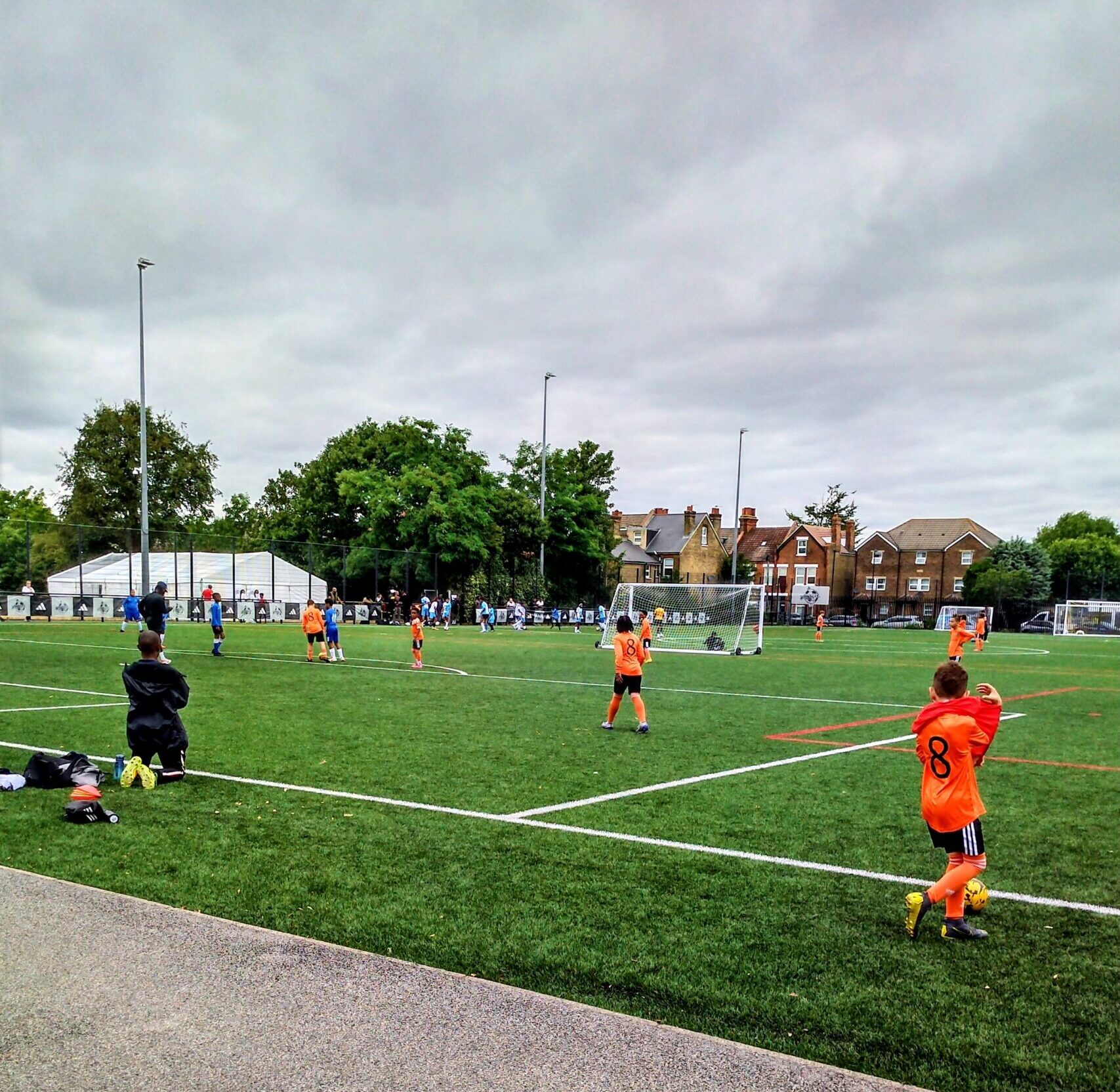
I captured these photos last year, when visiting No1.Fan Club’s inaugural parent conference with children in grassroots football, which really highlighted the power of community. It was a wonderfully insightful and informative event. Marcia Lewis, through education, understanding and unity has aimed to positively impact the football experience for parents and their families on a journey from grassroots to elite academies and beyond with the No1.Fan Club.
Some of football’s biggest names have felt a responsibility to give something back to the communities that shaped them. Jadon Sancho helped create a football pitch in his home borough of Lambeth in collaboration with Nike back in 2019, while Wilfried Zaha established the Wilfried Zaha Academy to give young players the opportunity to develop and pursue their ambitions.
Players such as Jadon and Wilfried grew up in an era when a football and a cage could be enough to occupy an afternoon. They didn’t need an organised session, an expensive facility or someone to tell them what to do. They had a ball, a cage and the freedom to play. In urban areas of London, a youngster can build tenacity needed to survive and be successful in football, and for the next generation, that should not become a luxury.
What happens when the cages disappear?
The debate around Keith Miller raises a question going beyond one pitch in Hackney. As cities become denser and land becomes more valuable, what happens to the informal spaces communities use without needing to organise them first?
The answer simply can’t be to provide a replacement pitch and assume the function remains the same. A new facility may be better surfaced, better equipped or more modern, but if access becomes dependent on bookings, organised sessions or payment, then something fundamental has changed.
The cage is valuable precisely because it is unpredictable.
The cage is valuable precisely because it is unpredictable.
A seven-year-old can find his or herself taking penalties with teenagers. A player who’s spent years in organised football can encounter somebody who’s learned entirely through the street. Someone can arrive knowing nobody and leave with a group of friends. A talented youngster can test themselves against stronger players, while another child can spend an afternoon attempting a trick that nobody has taught them.
There’s no statistics for these things. No league table records the confidence a child gains after finally beating an older opponent and no academy database measures the friendships formed between children who might otherwise never have met.
Kieran Squire has worked across multiple academies across the West Midlands and has seen footballers football excel at different academies due to the techniques learnt in the cage. He says: “Cage football is something I looked at, especially in south London, and the players there play with so much freedom…. The under-the-microscope things such as technical key capabilities and the physical outputs are really visible to see. You can’t quantify the way they play. It is survival of the fittest and everyone is a different age.’’
The walls of a cage create a particular atmosphere. You often hear the ball before you see the players and the game feels compressed, physical and immediate. Every touch matters because the next challenge is already coming. The walls become part of the game rather than merely its boundary.
Sometimes the football is beautiful. A player slips between two opponents in a space barely large enough for one, a perfectly disguised pass opens the game or a child tries a skill they have spent weeks practising. The moment passes quickly, but the desire to try it again remains.
The cage won’t guarantee that a child will become a professional footballer, but more important is giving children somewhere to play, experiment and belong.
The streets gave football much of its imagination. The cage has carried that tradition into the modern city. If we allow these spaces to disappear, we should at least recognise what we’re losing, not just patches of concrete surrounded by metal, but some of the few places where football can still exist in its most instinctive form unstructured, competitive, creative and above all, free.