
Where Analysis Meets Coaching
Profile
Role: First Team Tactical Analyst and Assistant Coach at S.E. Palmeiras; Instructor at the CBF Academy
Specialisation: Tactical Analysis, Individual Tactical Development, Set-Piece Preparation and Player Performance
Experience: Youth Football, Futsal, S.E. Palmeiras Academy, First-Team Football and Coach Education
Focus Areas: Tactical Analysis, Player Development, Decision-Making, Game Models, Performance Analysis and Coaching
Where Analysis Meets Coaching
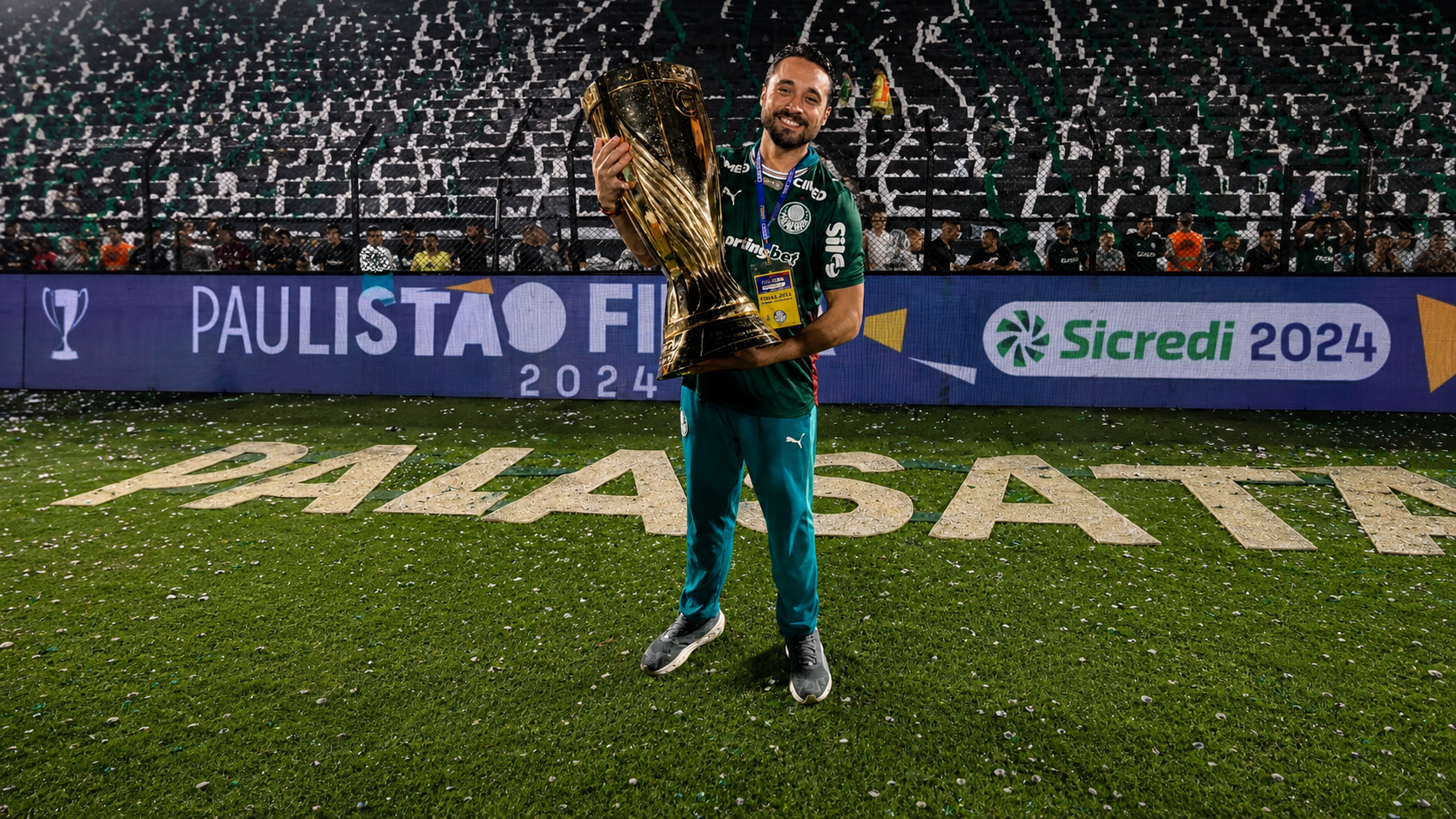
As First Team Tactical Analyst and Assistant Coach at S.E. Palmeiras, Roberto Torrecilhas plays a key role in opponent analysis, individual tactical development, set-piece preparation and player performance. Alongside his work at one of South America’s leading clubs, he is an instructor at the CBF Academy and holds both the CBF Pro Coaching Licence and the CONMEBOL Pro Coaching Licence, reflecting his ambition to progress into senior coaching. A former youth player, coach, analyst and educator, Torrecilhas has built his career around helping players better understand the game and make more effective decisions.
From Youth Football to S.E. Palmeiras
After studying Physical Education at UniFAJ, Torrecilhas began coaching youth football and futsal before joining S.E. Palmeiras in 2016 as a U15 Tactical Analyst. He quickly progressed through the club’s renowned academy, serving as U20 Assistant Coach and Tactical Analyst, contributing to the development of young players while helping Palmeiras win the 2017 Paulista U15 Championship and the 2019 Brazilian U20 Cup.
Turning Analysis Into Player Development
Since moving to the first team in 2020, Torrecilhas has focused on translating video and performance data into clear, personalised tactical feedback that enhances players’ perception, decision-making and understanding of the team’s game model. His philosophy centres on developing intelligent, autonomous footballers rather than simply correcting mistakes. During his tenure, Palmeiras has won two CONMEBOL Libertadores titles, two Brasileirão Série A championships and the Copa do Brasil, among other honours.
Coach Education and Football Analysis
Alongside his club responsibilities, Torrecilhas has been an instructor at the CBF Academy since 2023, teaching courses for football performance analysts, tactical analysts and football managers. He believes successful analysis starts with asking the right football questions, using technology as a tool rather than the driving force, and communicating complex tactical concepts in a simple and practical way.
Beyond the Lines
With experience spanning youth development, elite football and coach education, Torrecilhas views analysis as part of a broader coaching journey. He has also shared his philosophies in his book, Beyond the Lines: The Science, Art, and Mind Behind the Game, exploring how tactical analysis, neuroscience and high-performance psychology shape decision-making in elite football. His long-term ambition is to lead teams as a head coach, combining his expertise in tactical analysis, player development and leadership to make a lasting impact on the game.
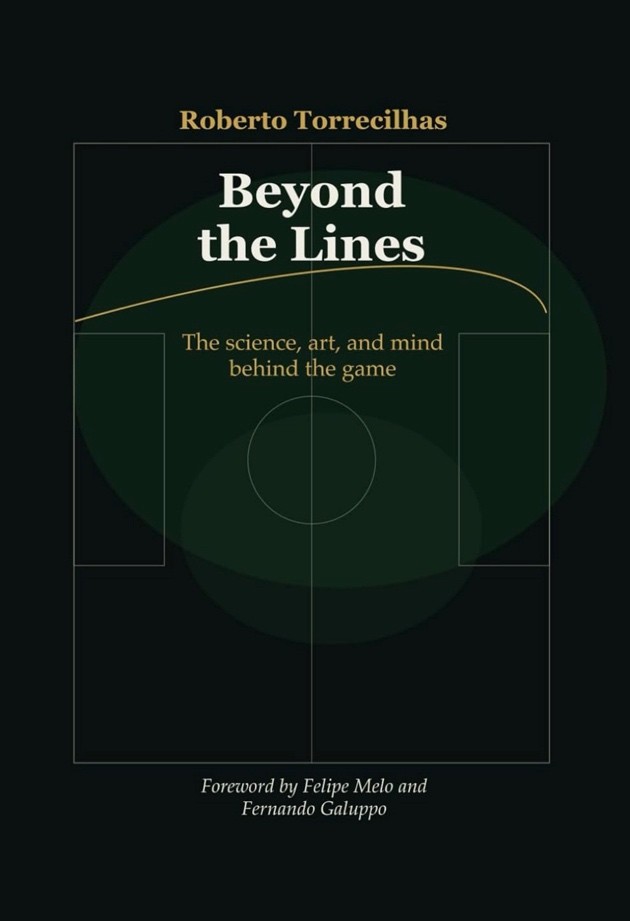
Beyond the Lines: The Science, Art, and Mind Behind the Game
Explore Roberto Torrecilhas’ book on tactical analysis, neuroscience and high-performance psychology in football.
Key Insights
- Tactical analysis should improve players’ perception, understanding and decision-making rather than simply identify mistakes.
- Technology and data are most valuable when they begin with clear football questions and support practical interventions.
- Torrecilhas sees tactical analysis, coach education and player development as part of his long-term pathway towards becoming a head coach.
Here’s Our Exclusive Interview with Roberto Torrecilhas
How did your football journey begin?
My football journey began on the pitch, as a player for youth and amateur teams. Although I did not progress into professional football as a player, those experiences gave me my first understanding of the game from the inside: the emotions of competition, the dynamics of a dressing room and the difficulty of making decisions under pressure.
Over time, my curiosity began to extend beyond playing. I wanted to understand why certain situations occurred, how teams could be better prepared and how training could influence the decisions made during a match. In 2011, that curiosity led me to study Physical Education at UniFAJ.
During my studies, and after graduating in 2015, I sought practical experience wherever I could find it. I completed internships and worked as a coach with amateur and youth teams, including projects with the Municipality of Jaguariúna and Jaguar Tennis Club. Coaching allowed me to begin developing my own methodology, test ideas and understand that the reality of the pitch is always more complex than theory. I arrived in professional football with many questions, and those questions became an important part of my development.
In March 2016, I joined S.E. Palmeiras. Working across the academy and later with the first team exposed me to different age groups, coaches, methodologies, game models and performance demands. It broadened my understanding of football from several complementary perspectives: as a former player, coach, analyst and educator.
What has remained constant throughout this journey is my commitment to learning. The more I study football, the more I respect its complexity. Progress, for me, has never been about accumulating definitive answers. It has been about learning to ask better questions and transforming knowledge into something useful for players, coaches and teams.
Progress, for me, has never been about accumulating definitive answers. It has been about learning to ask better questions and transforming knowledge into something useful for players, coaches and teams.
You are currently the First Team Individual Tactical Analyst at S.E. Palmeiras, what are your key responsibilities?
My main responsibility is to help players see the game with greater clarity and translate that understanding into more effective decisions. Individual tactical analysis cannot isolate the player from the team. Every movement, body orientation, press, cover, run or pass occurs within a game model and through constant interaction with teammates, opponents, the ball, space and time.
I analyse matches and training sessions to identify recurring behaviours, decision-making patterns and situations in which a player’s qualities can be expressed more effectively. I then transform video, data and tactical references into concise and personalised feedback. The purpose is not simply to show clips or point out errors. It is to stimulate reflection, clarify the player’s role and help them recognise the most relevant cues earlier.
This process requires close alignment with the coaching and performance staff. Individual interventions must support the collective plan, the principles of the team and the specific demands of each match. It is also important to monitor whether the feedback is transferring to training and competition. If it is not, we must question the message, the method or the context, not simply the player. At the highest level, the volume of available information is enormous, but the player’s attention is limited. Our responsibility is therefore to select the right information, communicate it in the right language and deliver it at the right moment.
For me, analysis is not about controlling every action or giving the player a predetermined answer. Its value lies in improving perception, interpretation and decision-making while preserving creativity and autonomy. The ultimate objective is to help the player understand not only what to do, but also why, when and under which conditions a particular action can benefit the team.
For me, analysis is not about controlling every action or giving the player a predetermined answer.
Having analysed the Brazilian Championship for several seasons, what tactical and strategic trends have you observed that make the league unique?
The first point is that there is no single Brazilian playing style. What makes the Brazilian Championship unique is the degree of contextual and tactical variation within the same competition. Teams face different climates, significant travel demands, intense stadium environments and opponents with very distinct football identities. When domestic cups and continental competitions are added to the schedule, adaptability becomes a decisive competitive quality.
Tactically, Brazilian football has become increasingly hybrid. We see more structured build-up, coordinated pressing, compact defensive blocks and sophisticated use of data. At the same time, the game preserves an important South American dimension: technical individuality, relational play, improvisation and the capacity to solve situations that no tactical board can fully predict. The strongest teams are often those capable of combining organisation with freedom.
Transitions and set pieces remain particularly important because matches are highly competitive and are frequently decided by short moments of imbalance. However, formations alone tell us very little about a team. Many sides change their structure according to the phase of play, the score, the opponent or the profiles of the available players. The important question is not simply whether a team plays in a 4-3-3 or a 3-4-3, but which functions are being fulfilled and how the relationships between players are organised.
Strategically, squad depth, recovery, rotation and the integration of academy players have become fundamental. The density of the calendar often limits training time, so teams must learn, recover and adapt while competing. In that environment, the management of physical, tactical, cognitive and emotional resources becomes as important as the initial game plan.
In my view, the Brazilian Championship rewards teams that possess stable principles but flexible solutions, an identity with elasticity. A team must know what it is without becoming predictable. The ability to change without losing identity is one of the most valuable qualities in Brazilian football.
A team must know what it is without becoming predictable.
You’ve worked as a tactical analyst across academy and first-team football. How does the role differ between those environments?
The main difference is the relationship between development, time and consequence. In academy football, the priority is to develop a player who understands the game, not simply one who reproduces instructions. Mistakes are part of the learning process, and analysis should help the young player understand why a situation occurred, what information was available and which alternative solutions could have been considered.
The time horizon is longer. Success cannot be measured only by the result at the weekend. It must also be measured by the player’s growing autonomy, adaptability, tactical understanding and ability to solve increasingly complex problems. Feedback must respect the player’s age, emotional maturity, individual characteristics and stage of development.
With the first team, the competitive consequence is immediate. Preparation time is shorter, opponents change quickly and information must be highly prioritised. The challenge is to communicate with precision without overloading the player. At this level, one carefully selected clip and one clear question may be more valuable than a long presentation.
The first-team player also brings a developed identity, accumulated experience and an established way of interpreting the game. The analyst must respect that background. The process is not about replacing the player’s knowledge, but creating a productive dialogue between their experience, the team’s principles and the demands of the next match.
However, academy and first-team football should not be treated as opposites. Academy football taught me the importance of patience, individualisation and allowing players to discover solutions. First-team football reinforced the importance of clarity, timing and competitive relevance.
In both environments, the analyst must understand the person before trying to influence the player. Technology may support the process, but trust is what allows information to become action.
Since 2023, you’ve been an instructor at the CBF Academy. What are the most important principles you aim to teach aspiring football performance and tactical analysts?
The first principle is that analysis must begin with a football question, not with a piece of software. Technology can collect, organise and visualise information, but it cannot determine the relevance of that information without a clear understanding of the game and its context.
I encourage analysts to distinguish between data, information, knowledge and action. A number is only data. When we place it within a tactical context, it becomes information. When we understand why it occurred and how it relates to the team’s intentions, it can become knowledge. Its real value appears only when that knowledge supports a better decision or intervention.
The second principle is that individual and collective analysis cannot be separated. A player’s behaviour must be understood through their interactions, responsibilities, constraints and the opportunities created by the game model. Position is only a reference; behaviour reveals intention.
The third principle is communication. The best analysis is not necessarily the most complex. It is the one the recipient can understand and use. Analysts must learn to select, simplify and adapt their message to different coaches and players without losing its meaning. The right information delivered at the wrong moment may have no value.
I also emphasise the importance of connecting analysis to training. Video should not be used only to show an error after it has happened. It can also train perception, stimulate reflection and help players recognise the information that guides their decisions. Analysis should return to the pitch.
Finally, I try to teach curiosity, ethics and intellectual humility. Analysts are not the owners of the truth. Our role is to reduce uncertainty, challenge assumptions and contribute evidence without ignoring experience or human sensitivity. The objective is not to make players or coaches dependent on the analyst, but to help them become more intelligent, creative and autonomous interpreters of the game.
What are your ambitions for the upcoming seasons?
My first ambition is always collective: to help Palmeiras remain competitive at the highest level and compete for every trophy with consistency, identity and the capacity to evolve. In an elite environment, past success creates responsibility rather than comfort. Every season presents new players, opponents and problems, so maintaining high standards requires continuous reinvention.
Professionally, I want to deepen the connection between individual tactical development, collective performance and the perceptual-cognitive side of the game. Video, data, neuroscience and emerging technologies, including artificial intelligence, can expand our understanding, but they must remain tools in service of football and people. Innovation has value when it makes interventions more precise, not when it makes the process more distant or mechanical.
Becoming a coach is also a clear professional project for me. It is not simply a future possibility, but a pathway for which I have been preparing deliberately. I have achieved the CBF Pro Licence and the CONMEBOL Pro Coaching Licence, in addition to completing formal education in Tactical Periodisation. These qualifications have expanded my understanding of training, game modelling, leadership and the management of complex performance environments.
My experiences as a player, coach, analyst and educator have allowed me to observe football from complementary perspectives. Individual tactical analysis has brought me extremely close to the player’s learning and decision-making process, while my work in academy and first-team football has helped me understand how identity, methodology, human relationships and competitive demands must be integrated. I see all these experiences as part of my preparation to become a coach and eventually lead a technical project.
I also want to continue contributing to the education of analysts and coaches. Teaching and writing force me to organise my thinking, question my own assumptions and remain connected to new ideas. Sharing knowledge is not separate from high performance; it is part of my own development.
I am ambitious about assuming greater technical and leadership responsibilities, with the long-term objective of leading teams as a coach. However, I do not want to pursue a title or position without being genuinely prepared for its responsibilities. I want to take each step with substance, integrity and respect for the process. Ultimately, I would like the next seasons to be measured not only by trophies, but also by the players, teams and professionals I help to develop, and by my growing capacity to lead them.
FAQ
Who is Roberto Torrecilhas?
Roberto Torrecilhas is First Team Tactical Analyst and Assistant Coach at S.E. Palmeiras and an instructor at the CBF Academy.
What is Roberto Torrecilhas’ approach to tactical analysis?
His approach focuses on using analysis to improve players’ perception, interpretation and decision-making while preserving creativity and autonomy.
What are Roberto Torrecilhas’ long-term ambitions?
His long-term objective is to lead teams as a coach, combining his experience in tactical analysis, player development, education and leadership.