

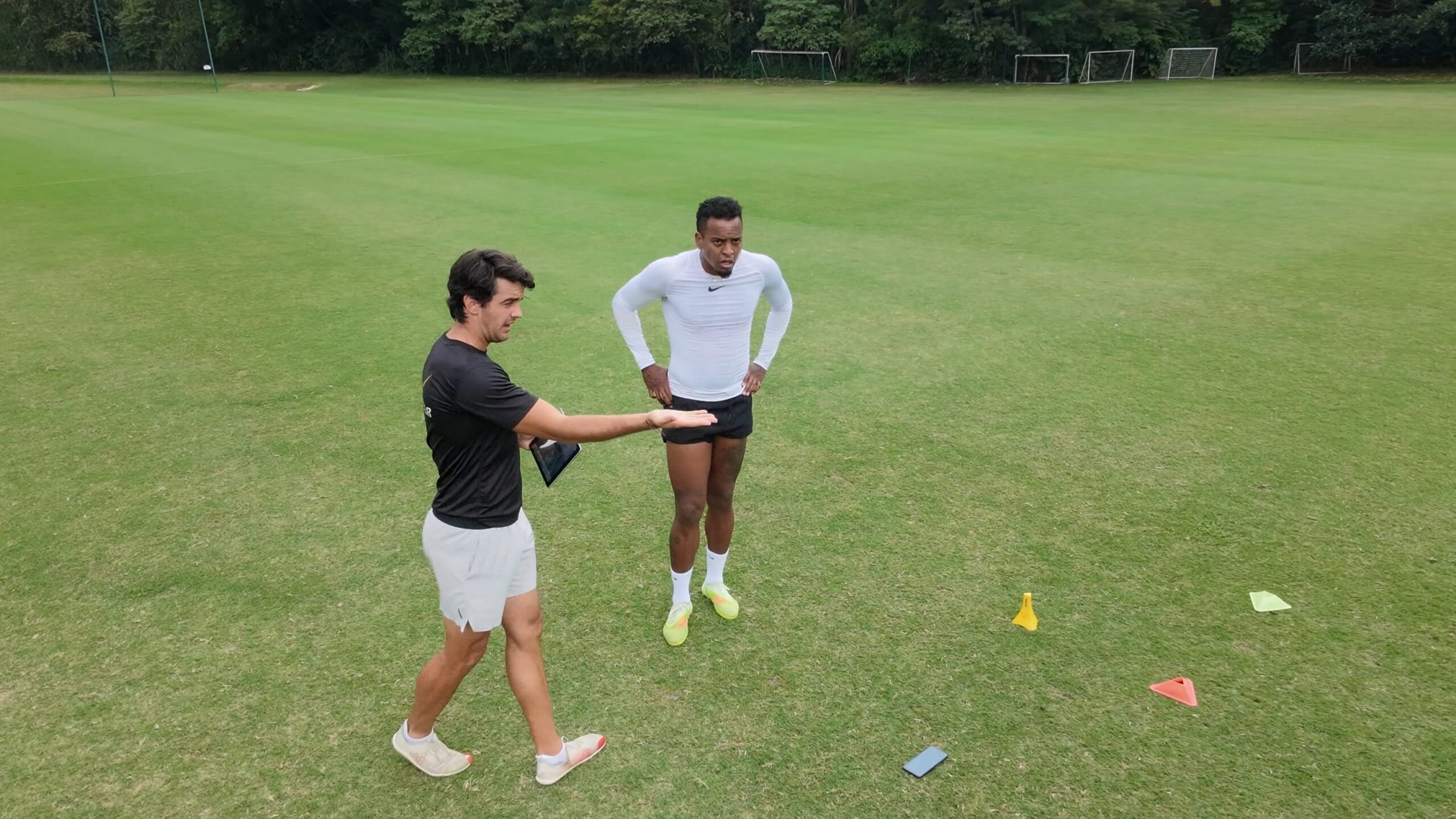
Profile
Role: Football performance specialist
Specialisation: Speed development, biomechanics, movement efficiency and sprint mechanics
Experience: Elite sprinting, sports science, football performance analysis and tactical analysis at Sydney FC
Focus Areas: Acceleration, top speed, running economy, sprinting with the ball and football-specific movement efficiency
Mathias Lukauskis represents a new generation of football performance specialists who challenge one of the game’s biggest assumptions: that speed is largely determined by genetics. Combining an elite sprinting background, sports science research, biomechanics expertise, and football performance analysis, he has developed a methodology focused on one of football’s greatest competitive advantages, helping players become faster both with and without the ball.
Originally from Colombia, Lukauskis first established himself as an elite sprinter, becoming Colombia’s National University Champion in both the 100m and 200m before transitioning into sports science and football performance. He later completed a degree in Applied Science (Exercise and Sport) at the University of Technology Sydney, where he combined academic research with practical coaching, while also working as a tactical analyst for Sydney FC, giving him valuable insight into football beyond pure athletic performance.
Over the past decade, Lukauskis has developed the SpeedLab Movement Economy Protocol, a methodology built around biomechanics, movement efficiency, and sprint mechanics. Rather than simply improving straight-line speed, his work focuses on helping footballers maximize acceleration, top speed, running economy, and, perhaps most importantly, their ability to maintain maximum velocity while carrying the ball, one of the most decisive yet underdeveloped qualities in modern football.
His philosophy challenges traditional speed training by recognizing that football sprinting is fundamentally different from track and field. Every movement must integrate technical execution, decision-making, tactical context, and ball control while maintaining explosive efficiency. By combining scientific research with football-specific application, Lukauskis aims to help clubs unlock hidden performance gains that directly influence transitions, counterattacks, pressing actions, recovery runs, and one-versus-one situations.
As football increasingly searches for marginal gains, Lukauskis represents a new type of specialist capable of bridging sports science, biomechanics, and football performance. His ambition is to work alongside professional clubs, integrating speed development into everyday football methodology and helping players perform faster, more efficiently, and more effectively in real match situations.
Key Insights
- Football speed development can be influenced by biomechanics and running technique, not only physiology and genetics.
- Lukauskis focuses on movement economy and maintaining maximum velocity both with and without the ball.
- His methodology combines sports science, sprint mechanics and football-specific application to improve efficiency and performance.
Our Exclusive Interview with Mathias Lukauskis
Most clubs invest heavily in strength, conditioning, and sports science, yet very few have a specialist dedicated exclusively to speed development with and without the ball. Why do you believe this area remains one of football’s biggest untapped performance opportunities?
There are a number of reasons that this area is yet to be exploited in football performance, let me start by explaining 4 of the biggest reasons.
- 1: Most teams believe speed and endurance are only reliant on physiology, genetics and training. And yes, these are VERY important but they cannot function at their 100% unless biomechanics and or technique allow them too. Imagine a formula 1 car with the BEST engine possible, amazing fuel and the best pilot, but two front tires are 20 degrees to the right. This car will NOT be able to perform at its best, even having the best engine, best pilot and fuel. Not only that, it will definitely start having “injuries” or getting damaged and worn-out a lot faster than the other cars.
- 2: Some teams actually understand how important it is for a player to run with the correct technique but they believe this is not taught but learnt only in the early development of the player and cannot be changed later in their career. Fortunately, anyone, especially athletes with amazing motor skills and physiology like professional football players, can learn running biomechanics in a very short time (1 month or even less).
- 3: Some teams believe that it will take too long to teach such a technique, and they don’t give it priority. Instead, when a player is not reaching the distance or sprint velocity they want him to and he has gone through all the physiological training they can give him. They prefer to trade him for a player that does reach those metrics because they believe there are no other ways to develop the player.
- 4: Teaching sprint mechanics requires a very specific type of coach in order for it to be a faster learning curve and more applicable for all athletes. You need someone that can explain, understand the physics and also apply and demonstrate. This way the players can see and learn from the coach’s movement a LOT faster, emulating movement and getting “timing” a lot faster while sprinting.
One of your biggest areas of expertise is helping players improve their maximum speed while carrying the ball. Why is this such a difficult skill to develop, and how can clubs gain a competitive advantage by training it differently?
Sprinting with the ball has many limitations and complications for football players. Usually, they train it without even thinking about it, instinctively, they are already very fast but not very efficient. Why?
Our brains are the efficient “kings”, they always find the best way to do things after repetition. When you run with the ball, your brain is also thinking about kicking and passing. This makes your nervous system create a lateral movement of the foot towards your center of mass, as if you were about to kick. This creates a “skating” movement (that’s how I call it) that does not add any propulsion or help to your displacement while sprinting.
Most football players have this problem, and it can account for 5-25% of the total energy used in a football game depending on the distance the foot moves laterally. Adjusting that small detail while running, will give that same football player 5-20% more distance on field with the same Vo2 max, physiology and training he has right now, while protecting his ligaments and cartilage from unnecessary wear and tear.
Adjusting that small detail while running, will give that same football player 5-20% more distance on field with the same Vo2 max, physiology and training he has right now, while protecting his ligaments and cartilage from unnecessary wear and tear.
You often speak about biomechanics and movement economy rather than simply running faster. How can improving movement efficiency reduce injuries while simultaneously increasing performance on the pitch?
Again, the formula 1 metaphor is probably the most accurate explanation for this. Imagine, trying to accelerate a formula 1 car with maximum power, while the 2 front tires are 20 degrees off axis, trying to change the car’s direction to one side and then to the other.
Tires, metal parts, axles, everything would be wearing down a lot faster than if the whole car is aligned. “Skating” while running in a straight line creates unnecessary torque in the knee and ankle on every step. In terms of performance: This torque has to be created by a series of muscles, then decelerated and accelerated again to reach the same location for the next step. All to move the foot towards the center of mass and then back away from it helping the athlete in nothing except utilizing energy with no return of speed or acceleration or change of direction.
In terms of injury:
Acute: this unnecessary torque, when measured, can account for 0% when not “skating” to up to 17% when “skating” of the total energy the ACL can withstand in tension. This means that the ACL is already being reduced in strength by 17%, and now, it can tear with just 83% of the necessary force for me to injure it.
Chronic: These unnecessary forces, and movements that do not follow the correct biomechanic direction of forces in my body, will start to add up every day of training, and every day of competing, making my body’s wear and tear a lot faster.
I could go on and on about more ways performance, speed and injury protection all improve, this is just one of the most common issues which can easily be avoided.
I could go on and on about more ways performance, speed and injury protection all improve, this is just one of the most common issues which can easily be avoided.
If a Sporting Director or Head Coach gave you one preseason to work with their squad, what measurable improvements would you expect to deliver, and why do you believe speed development should become a permanent part of every elite football club’s performance department?
First, I believe that this “efficiency development” (changing your question from speed development) is not something that has to be permanent, because it is something that you can change in 1 month forever. What do I mean by this? It is like learning to play the guitar, or learning to ride a bicycle, you have to learn, but once you do, you don’t really have to learn again every day, you could just practice it every now and then and you will keep running well. Just ask Usain Bolt to run for you, his technique will be great. He wont have the same power and speed, but his technique is still great. His brain will remember how efficient movement feels like.
His brain will remember how efficient movement feels like.
If a sporting director or head coach gave me one athlete to train I could expect an improvement of minimum 6% speed in 30 meters to a maximum average speed change of 25% but I think the most valuable improvement is not actually speed but efficiency. This athlete will be able to run from 6-20% more per game, and his number of sprints about 20 km/h will increase by even 50%. He will feel he has a better Vo2 max but he hasn’t improved how much fuel he can burn per minute; he actually burns less fuel now, which gives him a huge advantage over the others. Even for his recovery after games or training, he can do the same with less.
What should be permanent is a biomechanical analysis of every athlete while sprinting, as soon as they join the squad or even when they are about to get a new player on the squad. Why ?
Because you can predict objectively how much an athlete can improve in speed and endurance by analysing a video of his running technique, something you can’t really know in terms of physiology, well not yet. Genetic analysis might give us that answer later on, on how much a player could actually achieve in vo2 max, strength, power etc.
FAQ
Who is Mathias Lukauskis?
Mathias Lukauskis is a football performance specialist with an elite sprinting background whose work combines sports science, biomechanics and football performance analysis.
What is the SpeedLab Movement Economy Protocol?
The SpeedLab Movement Economy Protocol is a methodology developed by Mathias Lukauskis around biomechanics, movement efficiency and sprint mechanics, with a focus on football-specific speed development.
What areas of football performance does Mathias Lukauskis focus on?
His work focuses on acceleration, top speed, running economy, sprint mechanics and maintaining maximum velocity while carrying the ball.