

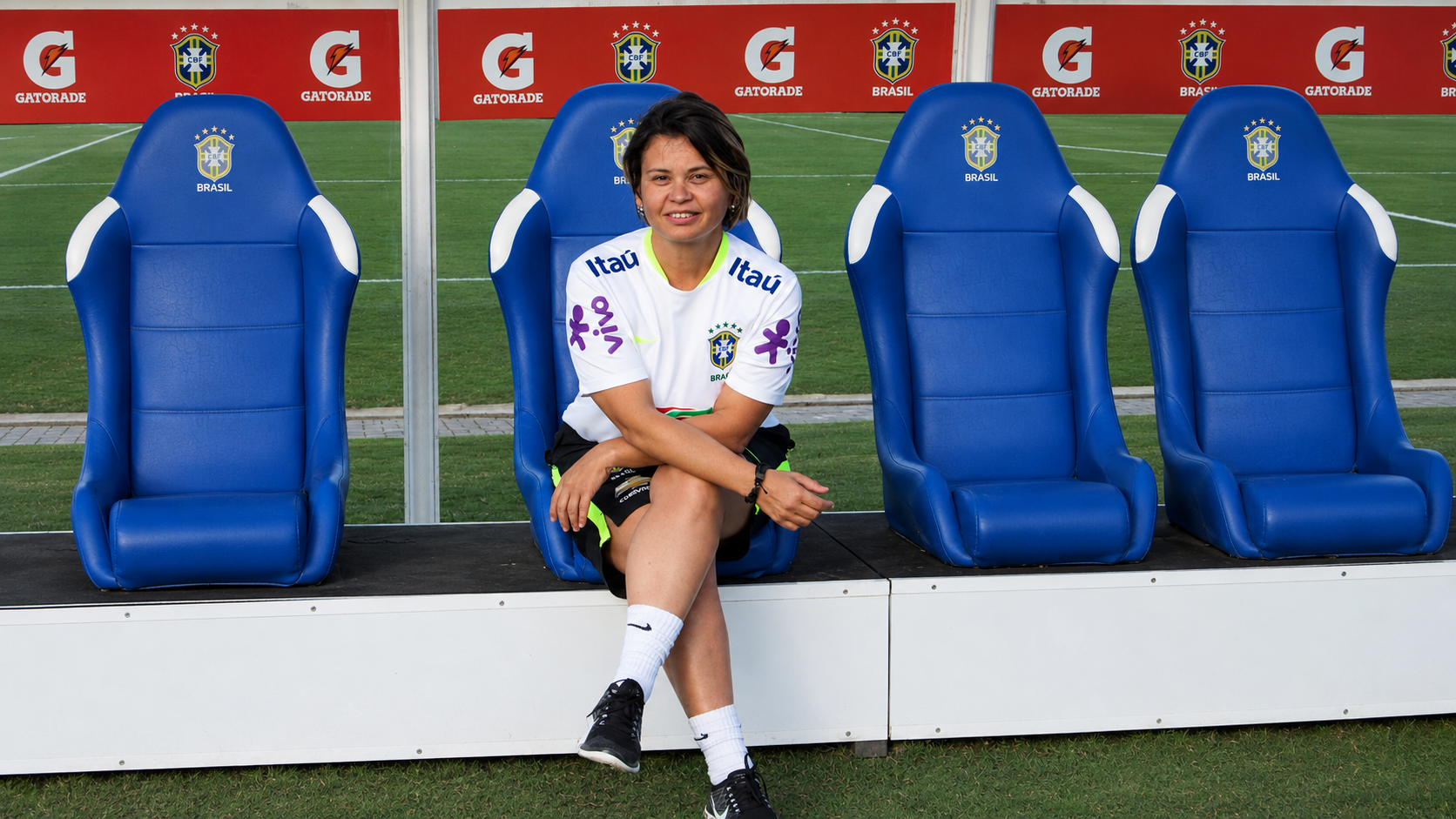
Profile
Role: Co-founder of the Brazilian Institute of Women’s Football (IBFF) and leader of Projeto Estrelas
Specialisation: Women’s football development, athlete development, leadership and public policy
Experience: Grassroots community projects, Santos FC, Brazilian National Teams, Brazil’s Ministry of Sport, IBFF and Projeto Estrelas
Focus Areas: Human development, mental coaching, coach education, gender equity, public policy and sustainable opportunities for girls and women
Football as a Catalyst for Human Development
Sandra Santos believes football can change lives long before it produces champions.
From the touchline to the halls of government, Sandra Santos has spent more than two decades helping shape the future of women’s football in Brazil. Her work is driven by one belief: lasting success is built by developing people, not just players.
For more than three decades, Sandra Santos has dedicated her career to creating opportunities for girls and women through football. From grassroots community projects to the Brazilian National Teams, from coaching on the pitch to shaping national public policy, she has worked across every level of the game with one clear purpose: using football as a catalyst for human development.
Today, as co-founder of the Brazilian Institute of Women’s Football (IBFF) and leader of Projeto Estrelas, Sandra continues to champion a future where every girl, regardless of where she is born, has the opportunity to play, learn, lead, and belong.
In this exclusive interview with The Women’s League, Sandra reflects on athlete development, leadership, public policy, and the lasting legacy she hopes the FIFA Women’s World Cup Brazil 2027™ will leave for future generations. Above all, she shares why the future of women’s football depends not only on growing the game, but on investing in the people who will shape it.
Key Insights
- Football can be a powerful tool for human and social transformation.
- Sustainable growth in women’s football requires investment in people, leadership, education and long-term opportunity.
- The FIFA Women’s World Cup Brazil 2027™ should create a lasting legacy for girls, professionals and communities across Brazil.
Our Exclusive Interview with Sandra Santos
You have dedicated your career to women’s football for more than two decades. At what point did you realize you wanted to dedicate your life to women’s game, and what was it like building a career being a woman in technical and leadership roles within the football environment?
I don’t think there was one defining moment. It was a decision that evolved naturally throughout my career. I began working with a wide range of groups in community projects, university futsal, and football, and it was through my daily interactions with girls and women that I truly came to understand the challenges they face in staying involved in the game. I realized that the issue was never a lack of talent. More often than not, what was missing were opportunities, safe environments, qualified professionals, and policies capable of turning potential into meaningful development. That realization gave my career a clear sense of purpose.
I chose to dedicate my life to women’s football because I deeply believe that sport is one of the most powerful tools for human and social transformation. Throughout my journey, I have had the opportunity to work in youth development, serve on the Brazilian National Team’s technical staff as a behavioral coach, focusing on active listening with athletes and fostering team cohesion among the coaching staff across all national team categories. In addition, I led the Department of Football Policy and Women’s Football Promotion at Brazil’s Ministry of Sport, where I oversaw the development of the National Strategy for the Development of Brazilian Women’s Football. After leaving the Ministry, I became a co-founder of the Brazilian Women’s Football Institute (IBFF). Each of these experiences broadened my perspective and reinforced the same conviction: when we invest in the development of girls and women, we transform far more than teams. We transform lives, strengthen communities, and help shape the future of football itself.
When we invest in the development of girls and women, we transform far more than teams.
Building a career as a woman in technical and leadership positions within a historically male-dominated environment has often meant having to prove my competence before even being given the opportunity to demonstrate it. Fortunately, I have seen meaningful progress over the years, but there is still a long way to go before women are recognized for their knowledge, experience, and achievements rather than their gender.
Today, beyond developing players, coaches, and women leaders, my commitment is to help build an ecosystem in which girls and women have genuine opportunities to dream, learn, lead, and thrive in every space they have earned through their talent and dedication. That mission continues to guide every project I take on, every decision I make, and every new challenge I embrace.
Your career combines extensive hands-on experience with a strong academic background, and you also work as a sports and mental coach. How significant is the psychological aspect in an athlete’s development?
In my experience, it influences every aspect of an athlete’s development. Technical ability may open doors, but it is mindset that sustains a long-term career. Psychological development shapes an athlete’s ability to learn, make sound decisions under pressure, recover from setbacks, maintain confidence, collaborate with teammates, and navigate the inevitable challenges of elite sport.
That is why I have always believed in a holistic approach to athlete development. We are not simply developing footballers, we are developing people. When a young woman builds a strong sense of identity, discovers her purpose, and learns to manage her emotions, she grows not only as a player but also as a person.
We are not simply developing footballers, we are developing people.
Research consistently shows that social and emotional skills are fundamental to both sporting success and professional achievement. Modern football demands emotionally intelligent athletes who embrace continuous learning and can adapt to the fast pace of the game, as well as to the pressures and complexities of high-performance environments.
You spent seven years at Santos FC and were the runner-up in the 2022 Brazilian U-17 Championship. Working in youth development requires a different perspective from elite performance. In your view, how do you balance player development with competitiveness?
In my view, this is one of the greatest challenges in athlete development. Competition matters, and winning is an important part of the learning process, but we should never allow the pursuit of short-term results to overshadow what truly matters: the development of the young athlete. I have always believed that the primary purpose of youth football is to develop people who are capable of competing at the highest level, not simply to build teams that win a particular championship.
Achieving that starts with fostering a winning mindset from an early age. But a winning mindset is about much more than victories or trophies. It is about embracing continuous learning, taking responsibility, persevering through adversity, and striving for excellence every day. It also means understanding that setbacks are an inevitable part of the journey. In football, especially at the professional level, defeats, periods without playing time, injuries, missed national team selections, and dips in performance are all part of the reality. Athletes who learn to navigate these experiences during their formative years develop resilience, emotional balance, and the ability to keep improving by turning challenges into opportunities for growth.
Scientific research supports this perspective, showing that psychological development is a long-term process and that qualities such as resilience, self-regulation, and reflective learning play a crucial role in the progression of young athletes.
In practice, this means recognizing that mistakes are an essential part of learning, providing diverse developmental experiences, encouraging autonomy, and helping players become confident decision-makers both on and off the pitch. When the process is valued more highly than immediate results, young athletes build confidence, become more adaptable, and are better prepared for the demands of elite football, where long-term success depends far more on sustained development than on early achievements.
Recent research in football also highlights that long-term performance is driven by the integration of technical, tactical, physical, and psychological development, not by talent alone or by results at youth level. Throughout my career, I have placed great importance on the environment created by the coaching staff and the club. A safe, supportive environment is essential for unlocking an athlete’s potential.
For me, the formula is simple: Environment, Mindset, and Competitiveness.
For a period, you worked with the Department of Football Policy and Women’s Football Promotion at Brazil’s Ministry of Sport. In your view, which public policies are most urgently needed to accelerate the growth of women’s football in Brazil?
Brazil needs a long-term national strategy for women’s football, one that extends beyond individual initiatives or changes in government. Sustainable growth requires a coordinated vision, bringing together the public sector, clubs, schools, universities, social organizations, and private partners to build a strong and lasting foundation for the game.
That means expanding girls’ access to sport from an early age through the education system, fostering a stronger sporting culture, strengthening youth competitions, investing in the development of coaches, referees, and sports leaders, supporting community programs, and ensuring safe, inclusive environments where girls and women can thrive. Women’s football does not grow through financial investment alone. It grows when there is a genuine commitment to opportunity, education, leadership, and long-term participation.
During my time at the Ministry of Sport, I had the privilege of leading the development of Brazil’s National Strategy for Women’s Football, which was built around exactly this long-term vision. Our goal was to look beyond individual competitions or sporting calendars and create a framework that would strengthen every part of the women’s football ecosystem while leaving a lasting legacy for the country.
Hosting the FIFA Women’s World Cup Brazil 2027™ represents a historic opportunity to accelerate that progress. However, I believe the tournament’s true success will not be measured solely by the quality of the event or by what happens on the pitch. Its greatest legacy will be its ability to create more opportunities for girls across every region of Brazil, strengthen the development of professionals, reinforce public policies, and establish women’s football as a lasting national priority.
If, after the World Cup, we see more girls playing the game, more women in leadership positions, more qualified professionals, and a stronger system for developing talent across the country, then we will have created a legacy that extends far beyond football. We will have contributed to building a more inclusive, equitable, and just society. That is the future I believe in, and the one I continue to work toward every day.
When you co-founded the Brazilian Women’s Football Institute (IBFF), what kind of transformation did you hope to bring to women’s football in Brazil? Looking at the current landscape, what do you see as the biggest challenges to ensuring development opportunities for girls across every region of the country?
The Brazilian Women’s Football Institute (IBFF) was founded on the belief that the growth of women’s football requires much more than competitions. Creating lasting change means investing in people, developing leaders, and building an ecosystem that provides sustainable opportunities for girls and women.
Our vision was to create an organization that connects knowledge, research, education, innovation, leadership, and human development. We believe that strengthening women’s football depends on empowering coaches, sports leaders, athletes, researchers, and organizations that are committed to advancing the game. Equally important is fostering a collaborative network where knowledge is shared, best practices are exchanged, and meaningful, long-term change can take place.
Despite the significant progress made in recent years, one of our greatest challenges remains reducing the inequalities in access and development that exist across Brazil’s different regions.
Thousands of girls still do not have the opportunity to join a team, learn from qualified coaches, or experience a safe and supportive environment where they can grow through sport.
Our dream is that where a girl is born should never determine the opportunities available to her. We want to help build a future in which every girl can find, through football, a place to learn, fulfil her potential, develop as a leader, and write her own story. More than growing the women’s game, our mission is to help shape a generation of women who will transform football, and through football, help transform society.
Projeto Estrelas was created with a unique approach to player development. Today, the project is providing two young athletes with a development opportunity at VfL Wolfsburg in Germany through a partnership with Volkswagen. How did this partnership come about, and what impact do you hope this experience will have on these girls and on Projeto Estrelas itself?
The Projeto Estrelas was founded on the belief that developing a young athlete goes far beyond technical training. From the very beginning, we built a holistic methodology that brings together education, personal development, health, family, and football. We believe that sport is a powerful tool for developing life skills, strengthening values, and expanding opportunities, preparing each girl not only to play the game but also to lead her own future.
The partnership between Projeto Estrelas, VfL Wolfsburg, and Volkswagen grew out of this shared vision. We all believe that sporting excellence and personal development should go hand in hand, and that investing in girls is ultimately an investment in social transformation. Through this initiative, two young athletes have the opportunity to experience the environment of one of the world’s leading women’s football clubs, gaining exposure to new coaching methodologies, different cultures, and a high-performance environment.
More than an international experience, we hope these girls will return as ambassadors of knowledge and inspiration for other young athletes. We want them to bring back not only technical learning but also a broader understanding of what is possible when people, institutions, and companies come together with a genuine commitment to creating opportunities.
For us, the true impact of this partnership will not be measured solely by the time these girls spend in Germany, but by the ripple effect it creates for countless others who begin to believe that their dreams can also become reality. That is the purpose of Projeto Estrelas: to empower girls to transform their own lives and, through football, inspire positive change in their communities and beyond.
After a career marked by leadership across different areas of football, what do you believe is the most important quality of a great leader? And what message would you leave for the next generation of professionals who dream of working in sport?
For me, leadership begins with a commitment to developing people.
Throughout my career, I have worked in community projects, professional clubs, the Brazilian National Teams, government, and now with the Brazilian Women’s Football Institute (IBFF) and Projeto Estrelas. Across every one of these experiences, I have learned that sustainable success is never built by one person alone. It comes from creating environments where people can grow, collaborate, and take ownership of their development.
A great leader is not someone who has all the answers. A great leader asks the right questions, inspires trust, and creates the conditions for others to reach their full potential. I also believe that leadership requires courage: the courage to make difficult decisions, challenge outdated ways of thinking, and create new paths where none yet exist.
To the next generation, my message is simple: never stop learning. Football is evolving rapidly, and the professionals who will make the greatest impact are those who combine technical expertise with emotional intelligence and strategic vision. In the end, the greatest competitive advantage will not simply be understanding football, it will be understanding people.
In the end, the greatest competitive advantage will not simply be understanding football, it will be understanding people.
With the FIFA Women’s World Cup Brazil 2027™ approaching, what opportunities do you believe clubs, institutions, and sports leaders should seize to drive the development of women’s football beyond the tournament itself?
The FIFA Women’s World Cup Brazil 2027™ represents a historic opportunity for Brazil. However, I believe its true legacy will not be measured by the quality of the stadiums or the number of matches played. It will be measured by how many girls are still playing football five, ten, or even twenty years after the tournament.
This is the moment to expand player development programs, invest in the education of coaches, strengthen youth competitions, support research, create safe and inclusive environments for girls, and empower more women to take on leadership roles both on and off the pitch.
It is also an opportunity to bring together governments, clubs, schools, universities, businesses, and community organizations around a shared vision for the future of the game. Women’s football cannot grow in isolation. It must be recognized as a driver of social, educational, and economic development.
During my time at Brazil’s Ministry of Sport, I had the privilege of leading the development of the National Strategy for Women’s Football as part of the legacy of Brazil’s successful bid to host the FIFA Women’s World Cup. I have always believed that major sporting events should serve as catalysts for lasting public policies, not as ends in themselves. If we embrace this opportunity with a long-term vision, the 2027 World Cup could mark the beginning of the most significant transformation in the history of women’s football in Brazil.
Women’s football is experiencing unprecedented growth. Where do you see the game ten years from now, and what is your vision for the future of women’s football in Brazil?
I am genuinely optimistic about the future of women’s football.
I believe we are witnessing a structural transformation, not simply a period of rapid growth. The game is gaining greater visibility, attracting increased investment, becoming more professional, and benefiting from a new generation of leaders who are committed to building a more inclusive, sustainable, and forward-looking future. The development of women’s football is no longer a trend, it is a global movement that is reshaping the way the sport is played, managed, and valued.
But my greatest hope extends far beyond football itself.
I believe that the progress of women’s football goes hand in hand with the progress of society. Promoting gender equity through sport is not about creating advantages for women; it is about ensuring that girls and boys have the same opportunities to develop their potential, lead with confidence, and contribute to a fairer future. When we expand opportunities for women in sport, we strengthen values such as respect, diversity, collaboration, and inclusion, principles that are essential to the development of any society.
My hope is that one day a girl will step onto a football pitch without ever having to prove that she belongs there. I want her to be recognized for her talent, her dedication, her character, and her dreams. I want her to grow up knowing that every path within football is genuinely open to her: as a player, coach, executive, referee, researcher, or club leader.
If we can build that future, we will have achieved far more than developing great footballers. We will have helped shape confident women who are prepared to lead, inspire, and create positive change in their communities through sport.
That is the legacy I believe in. And, to me, that is the greatest impact sport can have.
FAQ
Who is Sandra Santos?
Sandra Santos is the co-founder of the Brazilian Institute of Women’s Football (IBFF) and leader of Projeto Estrelas, with experience across grassroots football, Santos FC, the Brazilian National Teams and Brazil’s Ministry of Sport.
What is Sandra Santos’s approach to athlete development?
Her approach combines technical, tactical, physical, psychological and human development within safe and supportive environments.
What legacy does Sandra Santos hope the FIFA Women’s World Cup Brazil 2027™ will create?
She hopes the tournament will expand opportunities for girls, strengthen professional development, reinforce public policies and establish women’s football as a lasting national priority.