

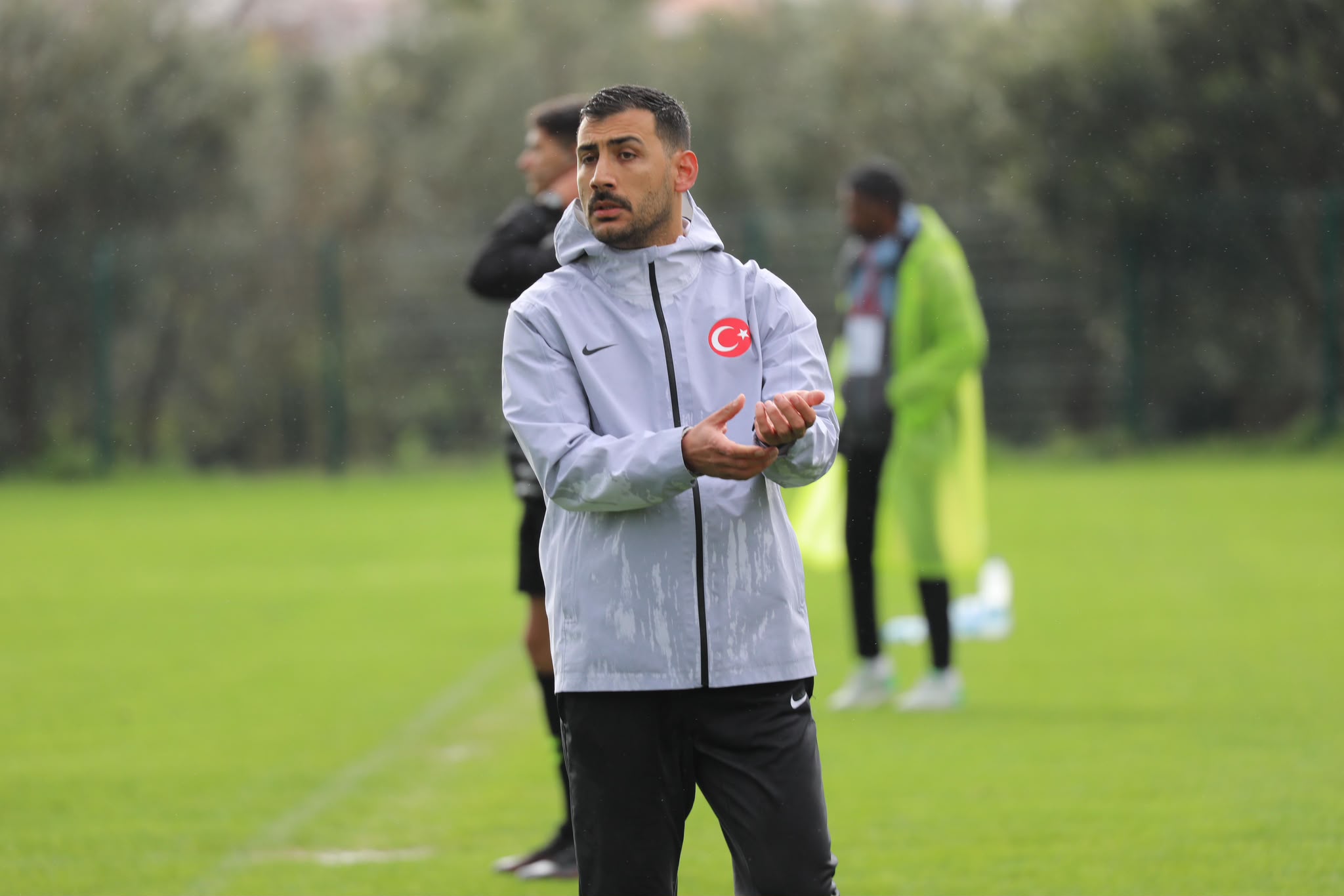
Profile
Role: Head coach
Specialisation: Football tactics, player development, performance analysis and attacking football
Experience: More than 250 matches as an assistant coach in the Turkish Süper Lig, Football General Director at Bursaspor and head coach of the Turkey U17 national team
Focus Areas: High performance culture, scientific analysis, youth development, attacking football and team organisation
Selçuk Erdoğan is one of the rare figures standing out as part of a new generation of head coach profiles in modern football, combining hands on experience on the pitch with academic depth. Despite his young age, the international experience he has gathered, his scientific approach, his game centred ideas and his performance driven understanding of football have made him a coach who draws attention within European football.
Early Coaching Career
Born on 10 October 1990, Erdoğan stepped into his career at a very early age, taking charge of Beşiktaş’s first team at just 21 years old and becoming one of UEFA’s youngest coaches. This early start laid the foundation for a career built not only around the pitch, but also around structure, analysis and a developmental perspective.
Experience Across the Turkish Süper Lig
Over the course of his professional career he has gained more than 250 matches of experience as an assistant coach in the Turkish Süper Lig, working at major clubs such as Adana Demirspor, Eskişehirspor, Sivasspor, Adanaspor, Bursaspor, Kayserispor and Antalyaspor. This process gave him the ability to work across different game models, technical staff structures and high pressure environments.
Leadership and Football Management
Taking on the role of Football General Director at Bursaspor at just 28 years old shows that his profile is strong not only on the pitch, but also in managerial and strategic terms. This role gave him significant experience in structuring football organisations, decision making processes and sustainable success models.
Learning at the Highest Level
An important step supporting his international development came in 2014, with an internship alongside Diego Simeone at Atlético Madrid. This experience gave him a deep perspective on the culture, discipline and footballing philosophy of a team competing at the elite level.
Academic Excellence
Academically, Erdoğan also has an extremely strong background, having studied at Gazi University and Muğla University and earned a doctorate in football tactics. His research covers modern football analysis, player development, and comparative performance analysis across European leagues. In this respect he represents a head coach profile that grounds his decisions on the pitch in scientific foundations.
Success with Türkiye U17
Erdoğan, who has held roles within the youth national teams under the Turkish Football Federation, drew attention for his performance during his time as head coach of the Turkey U17 national team. Across 42 matches with the 2009 generation, Erdoğan achieved a point average of 2.29, a statistic through which he outperformed the 2.11 point average recorded by Luis de la Fuente, the current head coach of the Spain senior national team, during his 44 matches in charge of Spain’s U19 side, a significant statistical achievement in this area. This performance shows that he is not only development focused, but also a coach capable of delivering results. Erdoğan is no longer in this role with the Turkey U17 national team.
Football Philosophy
In terms of playing philosophy, Selçuk Erdoğan favours an attacking, proactive style of football built around a 4-3-3 system. He aims for his teams to control the game, use transitions effectively and reflect the high tempo, organised structure that modern football demands.
An International Coaching Profile
Speaking English, Spanish, Portuguese and Romanian, four languages in total, also makes him a head coach who can work comfortably in international environments and adapt easily to different cultures.
A Coach Built for the Modern Game
When all these elements come together, a clear picture of Selçuk Erdoğan emerges:
A coach who combines scientific knowledge with practical experience on the pitch, who has gained top level experience despite his young age, who understands and can apply the requirements of modern football, and who is capable of building a high performance culture.
In a developing football world, at a time when data, structure and playing identity are becoming increasingly important, profiles like Selçuk Erdoğan offer clubs and federations a significant competitive advantage.
Key Insights
- Selçuk Erdoğan combines scientific knowledge with extensive experience in elite football environments.
- His football philosophy centres on dominant, attacking and high tempo football supported by discipline and organisation.
- He views data as an essential tool while placing trust, character and human relationships at the centre of leadership.
Our Exclusive Interview with Selçuk Erdoğan
Modern Football, a Scientific Approach and a High Performance Culture
You started your football career at an elite level at a very young age. Looking back from where you stand today, how do you think stepping into this level so early shaped your identity as a head coach?
One of the most important elements in football is managing pressure. The biggest contribution that working at a young age within high attendance clubs, under constant media pressure and in environments chasing continuous success, has given me is the ability to manage pressure, in other words to manage the moment of crisis. Managing the moment is one of the most important building blocks of leadership. Managing situations rationally comes through effective communication and accurate observation. I can say that I have come a long way in these areas. On the other hand, understanding the variables of the game at the elite level and being able to provide effective instant responses to these variables has had a striking impact on me in footballing terms. The essential thing here was being able to play the match itself, in other words the period between the two whistles, as a head coach.
Managing the moment is one of the most important building blocks of leadership.
You are a head coach with a doctorate in football tactics. How do you balance a scientific approach with intuitive football knowledge in your decision making processes on the pitch?
For a head coach the most important blend is the combination of emotion and logic. Football is played at a high pulse and with intense force. The game never carries logic or emotion alone. Because of this, I go with whichever tools I need depending on the situation of the game on that particular day, the overall trajectory of the team, and what is required to bring out the pattern. Let me give an example. My team is leading 1-0 and the designated penalty takers are known, but alongside them there is a player who is very well liked within the team, who is not skilled at taking penalties and is not among the penalty takers, but who needs one more goal for the top scorer title. In that case I let him take the penalty. Trust in the player and the player’s own values come above everything else for me. At the same time, if a midfielder is showing an extreme fatigue warning in the instant physical match tracking data, I take him off even if I need him, because in that moment using science and making every player feel valued both matter.
Trust in the player and the player’s own values come above everything else for me.
The high point average you achieved with the youth national teams also shows a results driven success. In a development focused environment, how do you strike the right balance between performance and results?
I have only one aim, to win. Think of it as a tree with three branches. The first branch is winning the game. If you play in a planned, disciplined, organised, versatile and dominant way and make that consistent, the second branch appears. That is earning respect, because quality football is rewarded with respect. When you sustain these consistently, the third and final branch appears. That is winning the match. In fact, if I do not win the game, I do not want to win any match at all. Just as matter has solid, liquid and gas states, winning the different cycles that exist within the game, in defence, in attack, in transition and in set pieces, is the foundation of my coaching philosophy. And let me not forget, at the roots of the tree are respect, discipline and team unity. Trust and self confidence are essential.
Your footballing philosophy is generally built around an attacking structure based on 4-3-3. What are the core principles that are non negotiable for you within this system?
Playing every aspect of the game at a high level is my milestone. It is especially valuable for my wingbacks to contribute in attack and use the inside channels, for my central midfielders to develop the habit of being the third man, and for my wide players to show off their ability to penetrate. Even though our formation may look like a 1-4-3-3, the numbers can vary in different phases of the game. Double and triple rotations, pressing in the final third, the time it takes to win the ball back, and different variations in building from the back form the foundation of my game.
In today’s football, player development covers not only technical and tactical aspects but also mental and character development. What are the most decisive factors for you when assessing a player?
When you select or sign a player, what you are really acquiring is character, not talent. In fact, everything we see on the pitch put together is the player’s talent. Social life, outlook on the game and sense of responsibility are, alongside positional ability, the most important elements. I can say that I prefer players who like to play vertically, who have settled half turn and full turn skills, who have a high ability to carry the ball, and whose ball winning abilities are at an elite level.
When you select or sign a player, what you are really acquiring is character, not talent.
Your experience across different clubs and at national team level gave you the chance to observe different footballing cultures. How do you assess the biggest differences between player development in Turkey and systems in Europe?
In Europe you manage a system. There are established frameworks and everyone is focused on their own area of work. In Turkey the processes revolve a little more around individuals and confusion. Because the processes depend on individuals, there are major disappointments when it comes to consistency. Both in coaching and in playing terms, we Turks are very talented. But we still have a long way to go when it comes to translating merit into process and into genuine competition. And especially when it comes to persisting with talent, we need to go a very long way, because we are not game focused. We need to think much more about what happens inside the 105 by 68 metre pitch.
You had the opportunity to be alongside a top level head coach like Diego Simeone. What were the most important things you took from that experience into your own footballing understanding or leadership style?
Diego Simeone is a name extremely focused on training performance. For him physical fitness and running quality are non negotiable. He has built the whole foundation of his philosophy on these two elements. He is someone who dedicates an enormous amount of time to football. Player commitment matters to him above everything else. In terms of playing philosophy I prefer an attack dominant game, and our variety of play is very wide. Since Simeone tends more towards a rigid, defence centred approach, I do not see much similarity there.
In modern football, data analysis and performance measurement are becoming increasingly important. To what extent do you think the way a head coach uses this data affects team performance?
Data is the key factor of the future, because the number of variables within football and within footballing processes has increased considerably. Alongside this, since controlling, managing and using these variables has opened analytical doors within football, data has become an indispensable building block. Let me not forget that there are people and emotions involved in all of this. Data is not an end in itself, but it can be the most important tool. At the same time, shared data usage and sharing will become even more important for the healthy functioning of technical staffs.
You have held both on field and managerial roles during your career. What do you think are the most critical structural elements for a football organisation to achieve sustainable success?
Merit, development, belonging and representation. If these are in place, lean back and enjoy your tea.
Looking ahead, what type of project motivates you the most? When a club or federation works with you, what kind of footballing identity and structure should they expect from Selçuk Erdoğan?
My one and only goal is to build a planned, disciplined team with a variety of attacking options, made up especially of young players, that plays dominant, attacking, high tempo football. I tried to do this as much as I could with the national team. I will follow a similar path in the future too. Football is the beautiful game for me. It is very valuable for the game to bring enjoyment and to show unity. My path, and my journey, will always be built first around winning the game itself.
FAQ
Who is Selçuk Erdoğan?
Selçuk Erdoğan is a head coach with experience across the Turkish Süper Lig, football management and Turkey’s youth national teams.
What is Selçuk Erdoğan’s football philosophy?
His philosophy is based on planned, disciplined, dominant, attacking and high tempo football, with a particular focus on young players.
What is Selçuk Erdoğan’s academic background?
He studied at Gazi University and Muğla University and earned a doctorate in football tactics.