

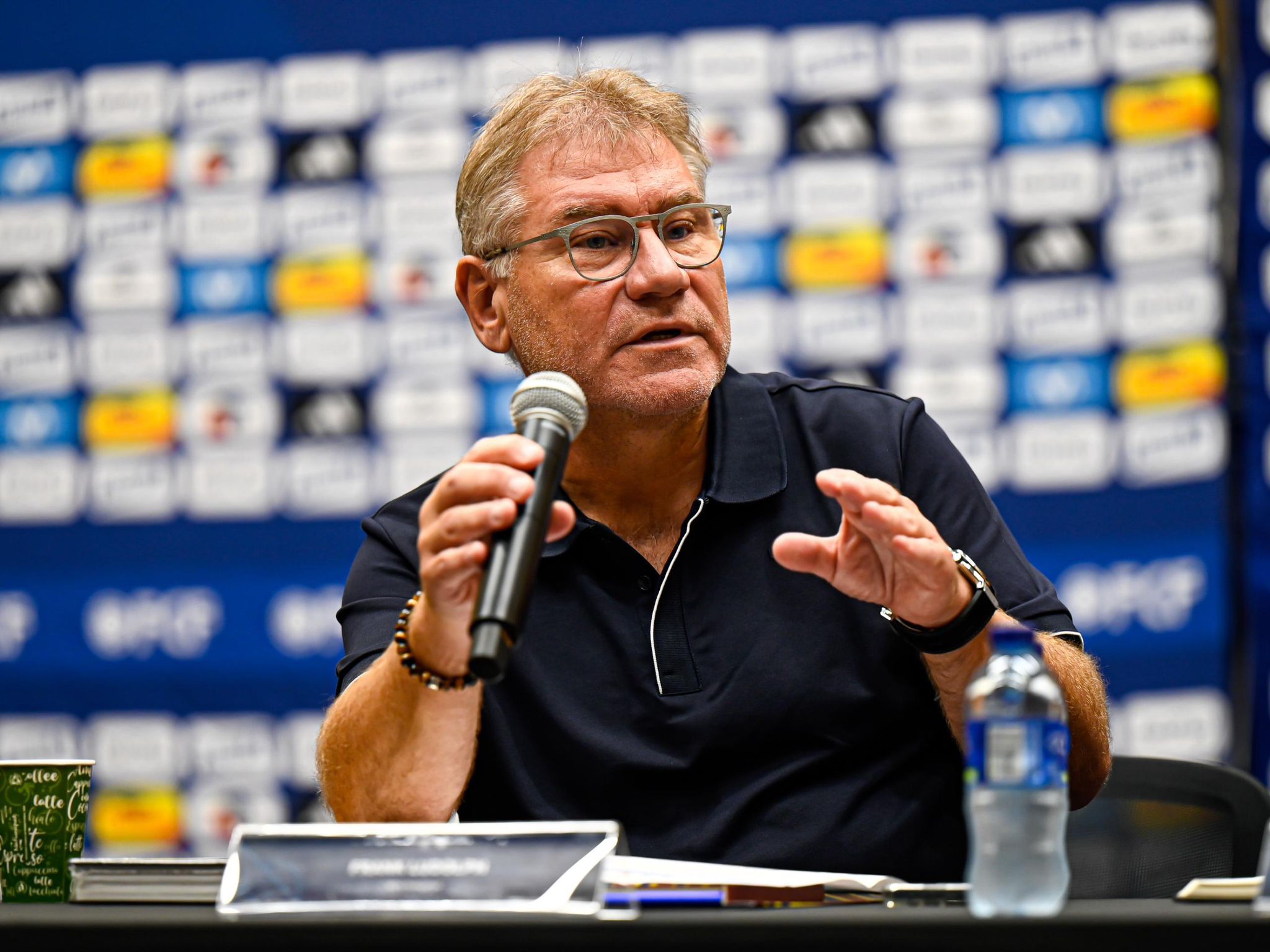
Profile
Role: UEFA Technical Advisor
Specialisation: Football Education, Coach Education, Grassroots Football and Technical Development
Experience: German Football Association, UEFA and UEFA’s 55 member associations
Focus Areas: Coach Education, Technical Leadership, Grassroots Football, Women’s Football Education and International Cooperation
Biography
Frank K. Ludolph is one of the most influential figures in the development of modern football education and technical leadership in Europe. With a career spanning more than three decades at both the German Football Association and UEFA, he has played a pivotal role in shaping the standards, structures, and philosophies that underpin coach education, grassroots football, and technical development across the European game.
Few professionals can claim to have had such a profound impact on how football is taught, developed, and governed throughout an entire continent. Throughout his career, Ludolph has combined educational expertise, strategic leadership, and football knowledge to help establish and maintain the frameworks that continue to influence thousands of coaches, technical directors, and football administrators across UEFA’s 55 member associations.
After beginning his professional journey as Coach Education Manager at the German Football Association (DFB), Ludolph joined UEFA in 1997, embarking on a remarkable career that would see him become one of the organization’s leading technical experts. Over the years, he held several key positions including Section Manager Coach Education, Technical Education Manager, Head of Football Education Services, Chairman of the UEFA Jira Panel, Chairman of the UEFA Grassroots Panel, and later Head of Technical Development.
Frank Ludolph’s influence in football has never depended only on his position or title. It has been built through relationships. Over three decades, he has developed a unique network of trusted technical contacts across Europe’s national associations and throughout the wider football world. Technical Directors, Coach Education leaders, Grassroots specialists and senior football administrators know him not only as an expert, but as someone who listens, understands and connects people.
It has been built through relationships.
This combination of technical authority and understated human touch is central to his legacy. Frank is widely appreciated because he brings humility to expertise. He does not impose; he guides. He does not dominate conversations; he creates space for others to contribute. His quiet ability to build trust, connect people and encourage shared learning has made him one of the most respected and effective figures in international football development.
In these roles, he became one of the driving forces behind UEFA’s commitment to raising coaching standards across Europe. His work included the continuous development of the UEFA Coaching Convention, which established common educational benchmarks and minimum standards for coaching qualifications throughout the continent. The Convention remains one of the most important frameworks in global football education and has contributed significantly to the professionalization of coaching across Europe.
Beyond coach education, Ludolph has been a strong advocate for long-term football development. He has consistently emphasized the strategic importance of Technical Directors within national associations, recognizing their crucial role in creating sustainable football structures and development pathways. His influence can be seen in numerous technical development projects that have helped national associations strengthen their football ecosystems from grassroots participation to elite performance.
A particular area of passion throughout his career has been grassroots football. As Chairman of the UEFA Grassroots Panel, he played a leading role in creating and developing the UEFA Grassroots Charter, promoting initiatives focused on Football in Schools, club development, community engagement, and participation growth. His vision has always been that football’s long-term success begins with strong foundations at the grassroots level.
Ludolph was also instrumental in launching several of UEFA’s most impactful knowledge-sharing initiatives, including the UEFA Study Group Scheme, the UEFA SHARE programme, and the UEFA Pro Licence Student Exchange Programme. These projects have fostered collaboration, innovation, and the exchange of best practices among football professionals throughout Europe and beyond.
Another significant contribution was his involvement in the development of women’s football education. He helped create dedicated coach development programmes, mentorship initiatives, and scholarship schemes designed to support the growth of female coaches and strengthen leadership opportunities within the women’s game.
Since 2024, Ludolph has served as UEFA Technical Advisor, reporting directly to UEFA’s senior leadership. In this role, he focuses on international and intercontinental cooperation in technical development, helping UEFA strengthen relationships with football organizations around the world while continuing to promote educational excellence and strategic development.
His academic background further complements his football expertise. A qualified secondary school teacher in physical education and French, he studied in both Germany and France and holds a Master’s degree in Romance Languages and Literature. Combined with his qualifications as a UEFA and DFB coach and instructor, this educational foundation has shaped a leadership style that blends pedagogical excellence with practical football experience.
Across every stage of his career, a consistent theme emerges. Frank K. Ludolph has been far more than an administrator or educator. He has been a builder of systems, a developer of people, and a strategic architect of football development. His work has helped shape generations of coaches, influenced the technical direction of national associations, and strengthened the foundations of European football from grassroots participation to elite performance.
He has been a builder of systems, a developer of people, and a strategic architect of football development.
Today, he remains one of the most respected voices in global football education and technical development, continuing to contribute his expertise to the future evolution of the game.
Key Insights
- Frank K. Ludolph has helped shape coach education, grassroots football and technical development across European football.
- His career has centred on building systems, developing people and creating shared standards across UEFA’s member associations.
- He believes football’s future depends on education, collaboration, grassroots foundations, human leadership and responsible use of technology.
Our Exclusive Interview with Frank K. Ludolph
Throughout your career, you have emphasized the importance of Technical Directors within national associations, and you have spent more than 30 years shaping coach education across Europe. What distinguishes an outstanding Technical Leader or Director, and what qualities must modern football leaders possess to successfully guide the game into the future?
The role and the impact of technical directors is crucial, both within their respective national football environments and for the future of European football as a whole. Technical Directors are key. They are responsible for defining and leading the technical development programmes and processes of their individual national associations. Frontline coaches try to win the next game. Technical Directors try to win the next decade.
Technical Directors try to win the next decade.
The profile of a Technical Leader or Director is a multifaceted one. In general terms, it is about education, experience and human skills. There are different educational channels to be mentioned: UEFA, FIFA, and also a selected number of national associations are now offering specific technical leadership courses that are extremely beneficial and adapted to the needs of the game. Coach education is crucial as well, combined with a coaching record. For academy leadership roles, I also strongly recommend the age-specific coaching licences for the elite youth sector. Sport management studies at university level are an additional option worth considering.
Above all, a technical leader needs to understand the tendencies of the game, and must have a strategic approach and a vision. Without that combination of knowledge, experience, and forward-thinking leadership, the role cannot fulfil its true purpose within a national association or a club.
You have played a key role in developing and evolving the UEFA Coaching Convention. How has coach education changed over the past three decades, and what skills do coaches need today that were perhaps less important in previous generations?
The UEFA Coaching Convention on the mutual recognition of coaching qualifications was originally signed by six of our member associations back in 1998. Those six were considered to be leading in coach education at the time and they already had a long history of delivering high-quality courses. The important thing to mention is that all of them were willing to share their knowledge and experience with their counterparts in the other member associations.
It has been a long way through the tunnel. A lot of guidance had to be provided, particularly when the former Soviet Union and former Yugoslavia broke up, and numerous new individual national associations came into existence. As we speak today, all 55 member associations are recognised members of the Convention, not all at the Pro Licence level of course, but there is a clear and shared understanding of the need to nurture high-quality coach education pathways at the respective national levels.
Coach education delivery is definitely not the same as it was 20 years ago. We review the Convention in a five-year cycle, because nothing is set in stone as the game evolves and coaches need to be prepared appropriately. The education of the educators is also fundamental, and today all member associations have a system in place with UEFA’s support. Reality-based learning and teaching is more important than ever. The pandemic forced us to explore innovative ways of online teaching, and this is now part of all course modules. Artificial intelligence is already an integral part of learning, teaching and coaching, and that integration will only deepen in the years ahead.
Grassroots football has been one of your major focus areas at UEFA. In an increasingly professionalized and commercialized football landscape, why is grassroots football more important than ever for the long-term health of the game?
The elite game is only the icing on the cake. The broad foundation needs to be nurtured, and healthy grassroots are needed to ensure that the game continues to flourish.
The role of grassroots football is to ensure that everybody, everywhere, has the opportunity to play football in a safe and quality-controlled environment. And the school is where many children play football for the first time. School sport and physical education are, in fact, the only opportunities many children have to engage in physical activity at all. Football in schools is therefore vital to making this vision a reality.
UEFA officially launched the Football in Schools programme in 2019. It aims to increase opportunities to engage young people in high-quality physical activity and give them a positive, perhaps their very first, experience of football in a safe and inclusive environment. It also aims to create a lifelong habit of sport and physical activity, and to leverage the positive impact football can have on the lives of young people at multiple levels, by presenting, organising, and managing football in ways suitable for the children and the context in which they play. The implementation of the programme was initially accompanied by Leeds Beckett University to measure its impact, and our current partner in that work is Loughborough University.
Grassroots football is about creating a solid foundation for the game: producing playing opportunities, ensuring respect and equality, uniting people and transcending differences, serving as a vehicle for educational, social and sporting development, and promoting lifelong participation. It plays a crucial social role and promotes healthy exercise.
UEFA’s grassroots programme is intended to motivate Europe’s national associations to implement philosophies and initiatives that will ensure the future of the game. We are taking care of children, and so many children love football and come together with their friends because of it. Football has a significant social impact. It is also the number one sport for inclusivity in Europe. Everyone can play football. It is an equal game. Football brings positive values into society. It promotes friendliness, openness, and fun. Everyone is good enough to play football, from the youngest person to the oldest, from those with great skills to those who are less skilled. We have to continue to let the grassroots blossom.
We have to continue to let the grassroots blossom.
You were instrumental in creating initiatives such as the UEFA Study Group Scheme, UEFA SHARE, and the Pro Licence Student Exchange Programme. How important is international knowledge sharing in football, and what can organizations learn from each other beyond tactical concepts?
International knowledge sharing is extremely beneficial for our national associations and is a core part of our technical development offer. Learning from each other is so important, and it is overwhelming to see how enthusiastic everyone remains even after so many years of working together. There are no barriers, only open dialogue.
The programme is structured around different pillars, each very focused, and we ensure a clear thread runs through everything, in line with our broader development programme. We have roughly 1000 participants every year. And we have also provided exchange successfully at the coaching student level for many years now. The frontline coaches of the future receive UEFA-specific insights and get to meet prominent coaches of today. That connection between the next generation and the current elite is something I consider tremendously valuable.
Women’s football has experienced extraordinary growth in recent years. From your perspective, what have been the most important factors behind this progress, and what further steps are necessary to continue developing female coaches and technical leaders?
We have more than half a million UEFA-qualified coaches in Europe, which is a remarkable number. But one statistical reality we must address is the need to bring significantly more women into the qualification pathways and to create more job opportunities for them within our national associations and clubs.
Our coach development programme for women is directly aimed at increasing the female workforce in the game. It includes a mentorship offer, a scholarship scheme, specific workshops and forums, and a dedicated LinkedIn presence. We also apply a ten per cent quota for women on all UEFA courses that we promote. These are not just symbolic gestures. They are structural interventions, and we need to continue building on them with ambition.
Your current role focuses strongly on international and intercontinental cooperation. What can European football still learn from other regions of the world, and how important will global collaboration become in the next decade?
In my current role, I nurture the dialogue in technical terms, across coach education, grassroots development, and more, with our sister confederations around the world. With CONMEBOL and the AFC, we have entered agreements that include a mutual recognition process for qualifications. Under the banner of UEFA together, we also have a three-year coach education support programme with CONCACAF.
But I want to be clear that this is never a one-way process. You always bring something back that is beneficial within our own spheres as well. Continental conferences are a perfect example of that. Every time we convene at that level, European football learns something. The willingness to share and to listen openly is what makes these partnerships genuinely productive, and I believe global collaboration will only grow in importance over the next decade.
Looking back on your career at the DFB and UEFA, what achievement gives you the greatest sense of pride, and what legacy would you like to leave for future generations of coaches, educators, and football leaders?
After 29 years at UEFA, there are a number of milestones I carry with immense pride. First among them is definitely the evolution of the Coaching Convention. We have been adapting that convention every five years, responding to the requirements of the game, the changing environment of coaches, and the need to continuously upskill educational standards and methodology. It is recognised across the globe and has also influenced our sister confederations to invest more meaningfully into coach education and to recognise that the coach is truly key. The same applies to the Grassroots Charter, which was never set in stone but brought continuously to the next level.
I have initiated quite a number of programmes and projects over the years, but never alone. I was fortunate to always work with a highly talented team around me, as well as with top experts from the national associations. It has always been a guiding principle not to impose anything from above, but to take decisions that really respond to the realities and requirements of the associations we serve. That principle of collaboration and listening is something I hope will outlast any single programme or initiative.
As someone who has helped define educational standards across European football, what advice would you give to young coaches, technical directors, and football executives who aspire to become influential leaders within the game?
Learning is a lifelong process, and it is important to bear this in mind and to apply it at all levels: young coaches, professional coaches, technical directors, and football executives alike. For coaches in particular, my advice is to take formal education seriously and to be committed. They should not try to accelerate the steps, but should ensure they have enough practical experience between each licence. Education combined with experience is a thorough process. If not well prepared, even a former professional player can find that a coaching or technical leadership career is over before it has truly started.
Beyond formal education, I would strongly recommend staying open-minded and curious: explore additional experiences and learn from others. For all the groups mentioned, good communication skills and the competence for teamwork are significant, because isolated decision-making is something to be avoided at all costs.
A professional and impactful head coach today needs to be an all-rounder, working with a large team behind the team. A clear definition of expectations is essential. The coach needs to manage that team, to delegate, and to listen to the competent experts around them. The coach cannot and should not try to do all the work alone, and this approach is significant for the quality of final decisions. Part of that team today is also a trusted media officer, because handling the demands of the modern media world is something that also has to be learned and managed professionally.
When you look at the future of football development, what are the biggest opportunities and challenges that football organizations must address to ensure sustainable success both on and off the pitch?
In general terms, we should all strive, at international and national levels alike, to continuously improve the standards and criteria at every level of the game. That means coach education and development, elite youth player development, match analysis, and leadership development. From coaches to technical leaders and other specialists, the educational pathways at all levels must continue to evolve. Qualification paired with experience, within the right frameworks, is what produces sustainable impact.
The trends need to be regularly analysed. If you understand where the game is evolving, you are in a position to have a real influence on its development. The game continues to grow, and that is something to celebrate. But we should not forget to protect players against overload. There are human limits, and those limits must be respected.
Artificial intelligence will have a growing impact on the coaching side, and in many respects it already does. But the human coach remains decisive and will continue to be. Technology enhances. It does not replace the judgement, the relationship, and the educational craft that great coaches bring to the game.
FAQ
Who is Frank K. Ludolph?
Frank K. Ludolph is a UEFA Technical Advisor and one of the most respected voices in global football education and technical development.
What areas has Frank K. Ludolph influenced in football?
Frank K. Ludolph has influenced coach education, grassroots football, technical development, women’s football education and international knowledge-sharing across Europe and beyond.
What does Frank K. Ludolph believe is important for football’s future?
Frank K. Ludolph highlights education, experience, strategic leadership, grassroots development, international collaboration and the continued importance of the human coach.