

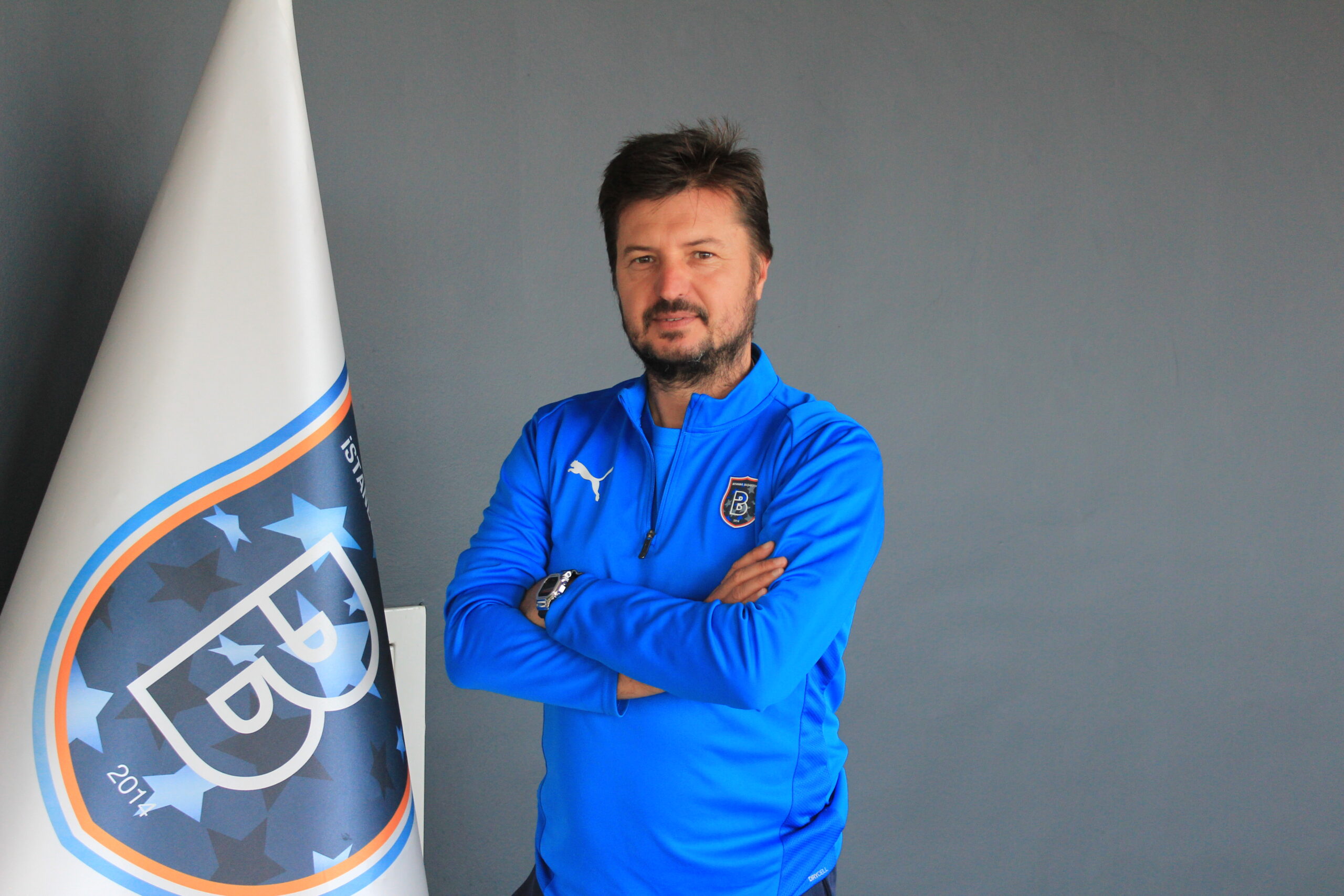
Profile
Role: Coach
Specialisation: Women’s Football, possession, pressing, set-pieces, AI-assisted analysis and drone footage
Experience: Twelve years at Galatasaray, two seasons in the Women’s Super League, six age groups, three elite clubs and twenty years of elite Turkish football
Focus Areas: Training, player development, discipline, mentality, communication and elite performance
Biography
Twelve years at Galatasaray. Two seasons in the Women’s Super League. Six age groups, three elite clubs, twenty years of relentless preparation. UEFA A Licence certified and trusted by TFF Football Director Emrah Bayraktar, Technical Director Burak Dilmen and Başakşehir Academy Director Marco Pezzaiuoli, Ahmet Geçer is not arriving at European Women’s Football as an unknown. He is arriving as the most prepared coach in the room.
His football is aggressive, intelligent and uncompromising. His teams dominate possession, press with ferocity and dismantle opponents through set-pieces with precision. His sessions run on discipline, AI-assisted analysis and drone footage, because for Geçer, matches are won in training. He doesn’t develop tactics. He develops winners.
His football is aggressive, intelligent and uncompromising.
Twenty years of elite Turkish football behind him, Europe ahead of him Ahmet Geçer is making one thing clear, his best work is still ahead of him.
Key Insights
- Ahmet Geçer has built his coaching career through twenty years of preparation, including twelve years at Galatasaray.
- His approach is rooted in training, discipline, possession, pressing, set-pieces and detailed analysis.
- He believes player development depends on mentality, communication, individual work and strong on-pitch training.
Our Exclusive Interview with Ahmet Geçer
Twenty years, hundreds of players, countless training pitches, but go back to the very beginning. Who was that 20-year-old from Marmara University, what did he believe about football, and how much of him is still alive in the coach you are today?
Twenty years ago, I was someone who actively played football and had enthusiastically embarked on a coaching career. I gained my first professional experiences through football training sessions I conducted voluntarily and without pay at amateur sports clubs and youth centers. The fact that the number of players kept growing after each training session and seeing the happiness of the players on the pitch, had given me more than enough spiritual fulfilment. Today, with that same enthusiasm, I want to become the coach who is recognized and known, particularly in Turkish Women’s Football, when viewed from Europe. My aim is to become one of the coaches of Women’s Football in Europe.
You’ve developed a belief, that football is a training game. In a world that only cares about the scoreline, where did that come from, how has it survived, and why do you still believe it so completely after everything you been through?
Football is a game of training. I believe that planned, developmental training sessions will bring gains on the scoreboard as well. We have the opportunity to train before matches. Attacking and defensive situations can be taught. Through individual work, we can support the player in playing their core technique with as few errors as possible.
Football is a game of training.
Twenty years of early mornings, late nights and missed moments at home, you’re a husband and a father of two. How have you held all of that together, and has there ever been a point where something had to give?
When I left the Galatasaray Football Academy, where I had worked for 12 years, I had been uncertain about what I could do. I was hopeless. However, the words I told myself were: “I am a good coach; the fact that I have left does not mean I am a bad one. I need to discover new league levels and get to know new football people and players.”
Discipline, tempo, and concentration must stay high every day, but late in a long, exhausting season, when players are physically and mentally drained, what keeps the drive alive, and how do you bring the team back without losing your standards?
During the season, there are times when our training and match standards can slip. In such situations, it is necessary to observe and decide whether the problem lies on the pitch, off it, or is managerial in nature. Afterwards, I prefer to carry out the necessary work to find a solution in the shortest possible time.
You often talk about the gap between good and very good, but what does it really take to cross it? What breaks the players who fall short, and is that gap truly just about football or something deeper, more human, about who a player really is inside?
I believe there is potential in every player. At the very minimum, someone who runs, fights, stays motivated and is open to communication is, for me, a “Good Footballer.” From among these good footballers, “Very good footballers” will also emerge through strong and effective on-pitch training, individual training sessions, and mental support.
I believe there is potential in every player.
You analyze every session with AI and drone footage, but hunger, leadership, and mentality don’t show up on any screen. Where does technology stop helping and instinct take over? And what has data never been able to reveal about a player?
Yes, there are situations that cannot be seen on the monitor. In such cases, body language, tone of voice, and whether the player is open to communication will serve as reference points for me regarding that player. In this situation, I think about winning the player over by making use of my “communication” skills.
When a player returns from injury you’re watching their mind just as closely as their body, their courage, their willingness to compete, their openness. How do you read someone who is hiding their fear, and has there ever been a player you knew deep down would never truly come back?
Understanding a player who conceals their fear during the return-to-pitch process after an injury can be difficult. I can make comparisons with the player’s past profile, and I cannot expect the player to immediately display their former performance. I manage this process through team play and through the players in other positions.
Twenty years of victories, defeats, sacrifices and relationships, when you sit quietly and look back, what did this career take from you that you never expected to lose, and what did it give you that you never expected to find?
I am doing the profession I love. My gains have always been greater. What I could mention as a loss would perhaps be a few training courses I did not attend because I considered myself sufficiently capable.
I am doing the profession I love.
You have coached players who now represent Turkey and Colombia on the biggest stages. When you watch them perform at that level, what do you feel in that moment, and is there something you never got the chance to say to any one of them that you wish you had?
To elite players, regardless of the results, for as long as you play: “reflect your character on the pitch, seize the opportunities to display your talent, be an example.” And again, regardless of the result: “show respect to the opponent, the referee, and the spectators.”
FAQ
Who is Ahmet Geçer?
Ahmet Geçer is a coach with twenty years of elite Turkish football experience, including twelve years at Galatasaray and two seasons in the Women’s Super League.
What is Ahmet Geçer’s coaching approach?
His football is aggressive, intelligent and uncompromising, with teams that dominate possession, press with ferocity and use set-pieces with precision.
What does Ahmet Geçer believe about player development?
He believes there is potential in every player and that strong training, individual sessions and mental support can help good footballers become very good footballers.