

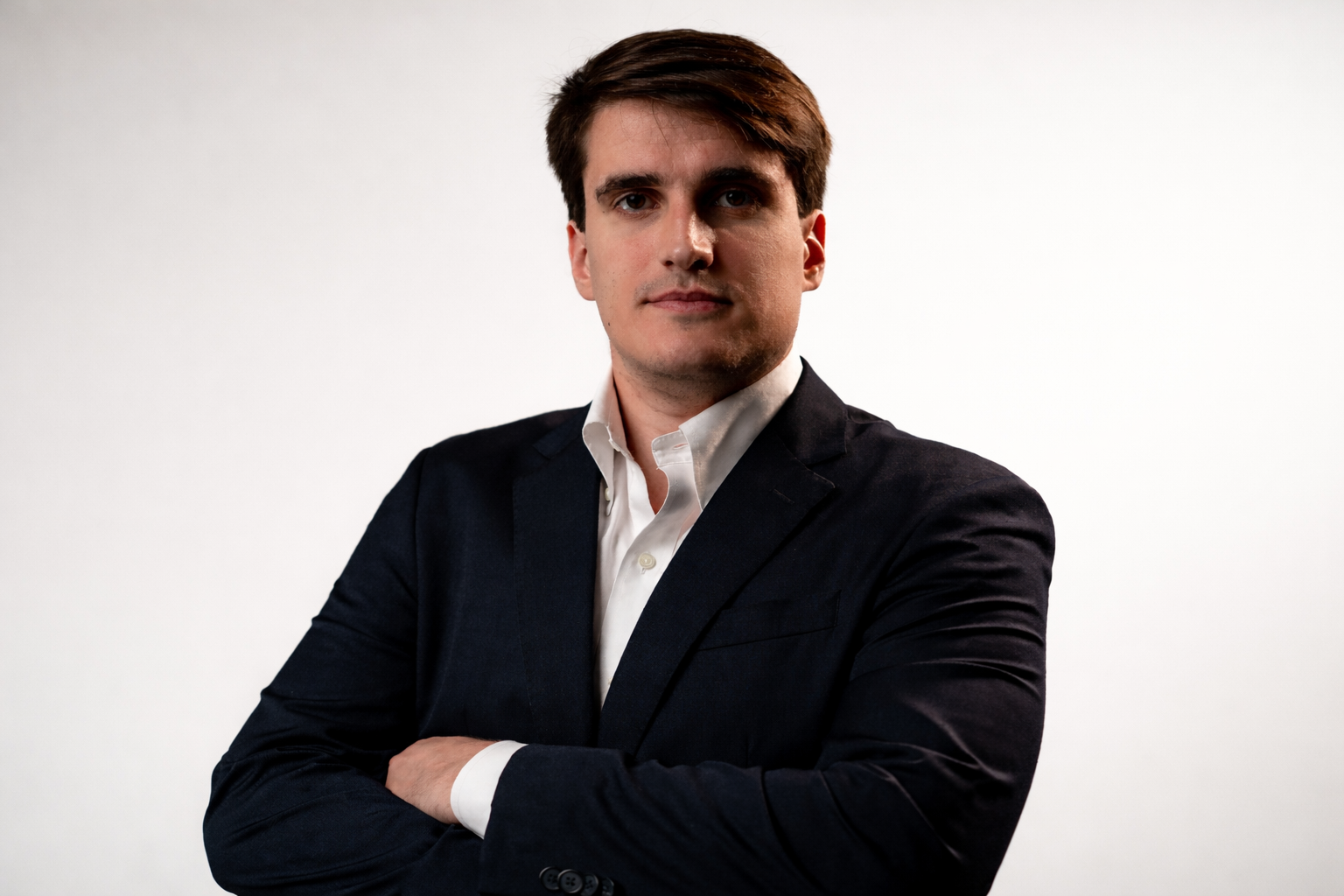
A New Generation of Football Executive
Profile
Role: General Director of the SAF
Specialisation: Finance, global strategy and modern football operations
Experience: Eagle Football Group, Botafogo, player trading, financial planning and multi-club ownership
Focus Areas: Player trading, transfer and loan opportunities, international networking, financial restructuring and multi-club ownership strategy
Biography
Eduardo Iglesias represents a new generation of football executives emerging at the intersection of finance, global strategy and modern football operations. At just 31 years old, he has built a profile within one of the most dynamic structures in the global game, the multi-club ownership ecosystem, and has now translated that profile into one of the most significant executive appointments of his career to date.
Over the past four years, Iglesias worked within Eagle Football Group, contributing to the strategic development of one of the most visible multi-club ownership projects in world football. The group manages a portfolio of clubs including Olympique Lyonnais in France, Botafogo in Brazil, and RWDM in Belgium, operating across multiple football markets, regulatory environments and competitive ecosystems.
Over the past four years, Iglesias worked within Eagle Football Group, contributing to the strategic development of one of the most visible multi-club ownership projects in world football.
During the last two years, Iglesias served in the Player Trading Department, where he was responsible for identifying and executing transfer and loan opportunities across the group’s global network. His work focused particularly on optimizing exit strategies for players while strengthening relationships with clubs across different leagues. Over that period, the group generated more than €250 million in player sales, reflecting both the scale and efficiency of its trading operations.
Beyond negotiations themselves, Iglesias played an active role in expanding the group’s international network. He regularly represented Eagle Football Group at major industry platforms such as TransferRoom and the World Football Summit, building relationships with decision-makers across more than 400 clubs worldwide and identifying strategic partnerships with investors, sponsors and stakeholders.
Prior to joining the player trading structure, Iglesias worked closely with Botafogo’s football department as a financial planner, helping design budget frameworks and investment strategies to maximise capital efficiency within the club’s sporting operations. His responsibilities also included contract negotiations and participation in restructuring processes related to the club’s financial transformation. In 2023, he led the negotiations with creditors directly during Botafogo’s extrajudicial debt restructuring process, an agreement that was ultimately approved by an overwhelming majority of creditors.
Academically trained in economics and holding the Chartered Financial Analyst (CFA) designation, one of the most demanding and respected financial certifications globally, Iglesias brings a rare financial discipline to the football industry. His profile combines financial expertise, knowledge of corporate and sports law, and a strong understanding of global transfer markets.
His profile combines financial expertise, knowledge of corporate and sports law, and a strong understanding of global transfer markets.
Fluent in multiple languages including Portuguese, English and Spanish, and with good knowledge in German, French and Italian, Iglesias moves naturally across football’s international ecosystem. This linguistic and cultural versatility allows him to navigate negotiations and partnerships across continents and markets.
After completing a full cycle within the Eagle Football Group structure, Iglesias returned to Botafogo in a new capacity. On 14 May 2026, the club’s Extraordinary General Assembly appointed him General Director of the SAF, placing him at the helm of the football department he had previously helped build from a financial and structural standpoint. The appointment closes a notable circle: the same executive who once designed budget frameworks and led creditor negotiations during the club’s financial restructuring now holds overall responsibility for the sporting and corporate direction of the organisation.
With a profile that combines financial sophistication, international networking and operational experience inside a major MCO structure, Eduardo Iglesias represents a new type of football executive, one whose analytical grounding, global connections and strategic focus have now been recognised with one of the most demanding leadership roles in Brazilian football.
Key Insights
- Eduardo Iglesias represents a new generation of football executives at the intersection of finance, global strategy and modern football operations.
- He contributed to Eagle Football Group’s multi-club ownership structure and player trading operations across global markets.
- His appointment as General Director of the SAF places him at the helm of Botafogo’s sporting and corporate direction.
Our Exclusive Interview with Eduardo Iglesias
Finance, Strategy and the Future of Multi-Club Ownership in Football
You have worked at the heart of one of the most visible multi-club ownership projects in global football. How did your experience within the Eagle Football Group shape your understanding of how modern football organisations operate across multiple leagues and markets?
My experience within the Eagle Football Group gave me a very practical understanding of how modern football organisations operate in an increasingly interconnected and globalised industry.
Working within a multi-club structure exposed me to both the strategic advantages and the operational complexities of managing football assets across different leagues and regulatory frameworks. A good example is the player pathway we developed between Botafogo and our European clubs.
Botafogo operates in one of the most productive talent markets in world football, and the idea was to create a pathway for those players to take the next step in Europe. However, each league has different regulatory constraints. France, for instance, has strict limits on non-EU players, only four can be registered with professional contracts, with exceptions for countries under the Cotonou Agreement, which does not include Brazil. Belgium, on the other hand, is far more flexible and mainly requires a minimum number of domestic players.
In practice, this meant that moving Brazilian players directly to France was often constrained, while Belgium provided a more accessible entry point into European football. At the same time, having a potential pathway to France made Botafogo an attractive platform for talented players who could develop there before progressing to a higher European league.
Player trading has become one of the most important strategic pillars for many clubs. From your perspective, what separates successful player trading models from those that struggle to generate long-term value?
I would also like to highlight the role of our scouting departments. The professionals working both at Lyon and Botafogo were truly first-class. They had an exceptional ability to identify players that the broader market was not yet paying much attention to, but who later became widely discussed. These were the so-called “hidden gems.”
Having that level of scouting is a crucial part of building sporting success because, ultimately, the foundation of any project is having the right players.
In addition, my colleague Deive Bandeira and I were connected to the market virtually 24/7, constantly looking for ways to innovate in how we approached our work. One thing we noticed early on was that when agents or clubs wanted to present a player, they would often just send a Transfermarkt link.
We tried to raise the standard of that process. Instead of simply forwarding a link, we prepared a concise but well-structured player card, including key statistics, video clips, and the most relevant information for the decision-making process. It was visually clear, informative, and straight to the point.
I believe this helped us create a more professional environment and ultimately contributed to better discussions and better outcomes.
I believe this helped us create a more professional environment and ultimately contributed to better discussions and better outcomes.
Your background combines economics, finance and football operations. How does financial discipline influence sporting decision-making in modern football clubs?
I would also add the legal aspect to this answer, as it was something I learned a great deal about over these four years. In modern clubs, sporting decisions such as recruitment, contract structures, and squad planning must always be aligned with the club’s financial capacity and long-term strategy.
In France, for example, this was closely monitored by the local regulator. At the end of the day, you must be very efficient in your decision-making, because second chances tend to take time to appear. In Brazil, is the opposite but changes are happening fast.
During your time working with Botafogo and within the Eagle Football Group structure, you were involved in building relationships across global football markets. How important are international networks and trust-based partnerships in today’s transfer ecosystem?
They are fundamental. I often say that communication is much more about perception than about what you actually say. Being seen as a trustworthy person, and having that kind of reputation in the market, helps create many opportunities.
Many of the deals we made were driven more by relationships and credibility than anything else. Of course, you still need to deliver on what you promise.
Multi-club ownership models continue to expand across the football landscape. In your view, what are the key advantages and potential challenges of operating within an MCO structure?
For me, the advantages today are largely concentrated in gains of scale and efficiency in the player market. The way these groups are typically structured is with clubs focused on talent identification and development, and usually one flagship club that represents the final step for those players. Having a well-connected scouting process under the same umbrella allows you to access a wide range of markets.
The challenges, in my view, relate precisely to the integration of all areas. While some groups, and I would particularly mention City Football Group, have managed to build a very connected and organized scouting structure, others have not. This sometimes creates the impression that there are not many true multi-club organizations in the world, when in reality many simply share the same owners.
In addition, commercial and administrative synergies still need to evolve. In my view, that is often not the initial focus of these groups.
After completing this chapter of your career, you are now exploring new opportunities. What type of projects or environments excite you most as you look toward the next stage of your journey in the global football industry?
I see the emergence of new MCO projects with great excitement. In addition, a significant financial arm is increasingly entering football, large private equity funds, family offices, and even individual investors, which also creates room to build new things.
What motivates me most is precisely this: the possibility of (re)building something transforming in something better and doing it with excellence.
FAQ
Who is Eduardo Iglesias?
Eduardo Iglesias represents a new generation of football executives emerging at the intersection of finance, global strategy and modern football operations.
What role did Eduardo Iglesias hold at Botafogo?
On 14 May 2026, the club’s Extraordinary General Assembly appointed him General Director of the SAF, placing him at the helm of the football department he had previously helped build from a financial and structural standpoint.
What is Eduardo Iglesias known for?
His profile combines financial expertise, knowledge of corporate and sports law, and a strong understanding of global transfer markets.