

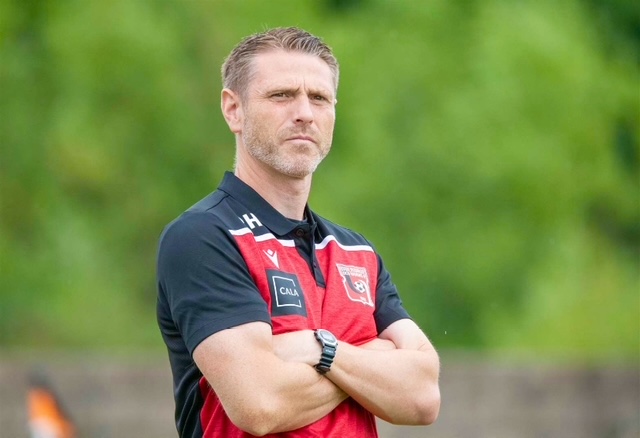
Profile
Role: UEFA A Licensed football manager and former Canadian international
Specialisation: Player development, academy leadership and first team management
Experience: More than three decades inside the professional game
Focus Areas: Organization, adaptability, player development, tactical clarity and building a winning culture
Biography
Richard Hastings represents a rare football profile that combines international playing experience, elite youth development expertise, and hands-on first team leadership. A UEFA A Licensed football manager and former Canadian international, Hastings has spent more than three decades inside the professional game, building a reputation as a coach defined by organization, adaptability, and a strong commitment to player development.
Hastings, a dual citizen having been born in Canada but raised in the UK, enjoyed a distinguished professional playing career, competing in topflight leagues across Europe including Scotland, Austria, and the Netherlands, sampling UEFA Champions League qualifying and UEFA Cup competition along the way. Over the course of his club career, he accumulated more than 400 professional club appearances while also representing his native Canadian National Team for more than a decade, earning 59 international caps. His international achievements include competing in the FIFA U20 Youth World Cup in 1997 and winning the CONCACAF Gold Cup in 2000, where he was named Young Player of the Tournament, and later being selected in the tournament’s Best XI in 2007. His contributions to Canadian football were formally recognized with induction into the Canadian Soccer Hall of Fame in 2023.
Transitioning from player to coach, Hastings moved seamlessly into the development side of the game, eager to earn his coaching stripes from the ground up and applying knowledge and experience gained from his 16-year playing career to mentoring the next generation of talent. His early coaching work included a leadership role with the Scottish FA’s School of Football program and at Inverness Caledonian Thistle FC’s academy where he served as U17 Head Coach. During this period, he guided the team to the U17 League Title, against the country’s top talent, and developed players who progressed onto First Team football and international recognition.
Hastings later became Head of Youth Academy Program & U18 Head Coach at Ross County FC, where he designed and delivered the club’s academy curriculum, managed over 100 youth players and coaching staff, and contributed to recruitment and scouting processes. Several players developed within this structure progressed to senior football, highlighting the effectiveness of the system he built.
Transitioning from his academy leadership experience, Hastings has made the natural progression into First Team Management after serving an invaluable and deeply rooted “apprenticeship” in the academies. Having held senior managerial positions at both Inverurie Loco Works FC and Rothes FC in Scotland, he led all aspects of football operations including training methodology, recruitment, squad management and development, tactical preparation, and performance analysis. Known for meticulous planning and strong communication skills, he has consistently emphasized structure, accountability, and a clear game model to build competitive teams.
What distinguishes Hastings is the breadth of his football education. Having experienced the game as an international player, academy architect, youth developer, and first team manager, he understands the entire pathway of football development from grassroots to elite performance. His leadership philosophy combines tactical clarity, strong organizational discipline, and an ability to connect with players across different personalities and cultural backgrounds.
Today, Richard Hastings represents a confident, dynamic, and progressive coaching profile shaped by a well-rehearsed football philosophy, adaptability, and building a winning culture. His work reflects a belief that sustainable success is built through clear identity, detailed preparation, and environments where players are inspired and empowered to maximize their potential.
His work reflects a belief that sustainable success is built through clear identity, detailed preparation, and environments where players are inspired and empowered to maximize their potential.
Key Insights
- Richard Hastings represents a rare football profile that combines international playing experience, elite youth development expertise, and hands-on first team leadership.
- Over the course of his club career, he accumulated more than 400 professional club appearances while also representing his native Canadian National Team for more than a decade, earning 59 international caps.
- His work reflects a belief that sustainable success is built through clear identity, detailed preparation, and environments where players are inspired and empowered to maximize their potential.
Our Exclusive Interview with Richard Hastings
Leadership, Development and Building High Performance Teams
Your career spans international football as a player and many years of coaching across academy and first team environments. How have these different experiences shaped your identity as a coach and leader today?
My experience of playing at the highest level has provided me with a depth of football knowledge and insight that cannot be learned in a classroom. Since transitioning into coaching, this experience has been an invaluable guide, helping me identify key areas for player development and navigating the shift into a different yet closely related environment.
As a leader, the most important attribute is genuinely caring about the role. When you care, everything within your responsibility carries purpose and importance, making challenges easier to confront and address. If you can instill that same level of commitment in your players, it creates a powerful alignment, strong collective accountability, and a platform for success.
As a leader, the most important attribute is genuinely caring about the role.
I strive to be a leader that players want to play for. I am honest, demanding, and relentless in my standards, while also being motivational and empowering. I bring energy, enthusiasm, and passion to my work and take a hands-on approach to getting the very best out of a squad. I provide players with a clear vision of how I want the team to play, establish a strong identity and style, and continually assess their understanding and execution thereof. Within that framework, I work to refine and develop players, so they become informed, confident, and formidable opponents.
You have worked extensively in youth development systems in Scotland while also managing senior teams. What are the key principles you believe are essential when developing players who can successfully transition to professional football?
I believe assessing a young player’s emotional, psychological, and physical readiness is crucial when transitioning into a first-team environment, as it is significantly more demanding and less forgiving. Striking the right balance between meeting first-team expectations and recognizing a player’s stage of development is essential. Young players who feel supported and confident are far more likely to adapt, understand requirements, and progress quickly.
I also encourage young players to take ownership of their development. This includes valuing the importance of mastering the fundamentals, understanding their positional role, maintaining high personal standards, and demonstrating consistency. Equally important are the willingness to learn from mistakes, the hunger to seize opportunities when they arise, and the ability to remain grounded and humble.
In my experience and opinion, preparation for this stage should begin early in the academy pathway. Instilling key professional habits such as strong attitude, work ethic, discipline, commitment, openness to feedback, and the confidence to ask questions helps ensure players are better equipped for the demands of professional football in the future.
Throughout your coaching career you have been known for strong organisational preparation and clear tactical structures. How would you describe your football philosophy and the type of team identity you aim to build?
Football is fundamentally a simple game, and in my experience, success is achieved when players operate within a clear philosophy, tactical structure, and defined game plan. Each match presents unique challenges, making clarity in understanding and decision-making essential. A well-organized framework not only supports performance but also enables effective analysis and accountability within defined roles.
My philosophy is built on three core principles: simplicity, effectiveness, and attractiveness. I strongly believe that a team must earn the loyalty and commitment of its supporters, which brings a responsibility to deliver an engaging and entertaining style of play. Regardless of the result, the team should consistently demonstrate a clear identity – competitive, purposeful in attack, and defensively disciplined, with the adaptability to meet varying demands.
Ultimately, my aim is to develop a team identity that resonates with supporters: well-prepared, determined, and relentless, playing proactive, attacking football with clear intent to win every match.
My philosophy is built on three core principles: simplicity, effectiveness, and attractiveness.
Modern football requires coaches to combine technical knowledge with leadership and communication skills. How do you approach man-management when working with players of different personalities, cultures, and experience levels?
As a manager, you work with a diverse group of players – different ages, experiences, personalities, and backgrounds. For me, the starting point is always authenticity, being consistent in who I am both on and off the training field. It is important that players understand my personality, principles, standards, and expectations, as these remain constant.
I place great value on observation. Watching players closely, in training, in matches, around the training ground, and during both positive and challenging moments, provides the clearest insight into their character and mindset. This understanding helps shape how I interact and communicate with everyone individually.
When addressing the squad collectively, communication is guided by experience, observation, and the needs of the moment, with the aim of producing a positive response and maintaining high performance standards. On an individual level, communication is more tailored, recognizing each player’s personality and motivations to help bring out the very best in them as both players and people.
You have played and coached in multiple countries and football environments. In your opinion, what lessons from international football culture are most valuable when building competitive and resilient teams?
International football presents a uniquely demanding environment, where a manager’s philosophy, tactical approach, and game plan must be understood and applied within a matter of days. At the same time, there is a need to quickly establish cohesion and a strong collective spirit among players.
This highlights the importance of prioritising clarity and repetition on the training ground, particularly in the early stages of a tenure. If international teams can adopt and implement a clear identity within such limited preparation time, then at club level, given greater continuity, this should be even more achievable with the right focus and commitment.
Equally important is the sense of unity developed in international settings. The shared purpose of representing one’s country creates a strong bond in a short period. Replicating this level of togetherness at club level is essential in building a resilient, competitive, and cohesive team.
Looking ahead, what type of projects or environments excite you most as a coach, and what kind of football culture would you like to help build in the next phase of your career?
As a Manager, I am excited and motivated by projects of all types, as each presents an opportunity to make a meaningful impact. Every environment brings its own objectives and challenges, requiring strong leadership, adaptability, and consistent high performance. With a background in player development and in building competitive, well-organised teams, I am well equipped to contribute across a range of contexts – whether competing for titles, pursuing promotion, ensuring survival, rebuilding squads, or developing younger players for long-term value.
My aim is to help establish a football culture that balances immediate performance with long-term sustainability, enabling consistent year-on-year progress. Central to this is strong alignment across the club, ensuring cohesion and consistency in standards, behaviours, processes, playing identity, and recruitment strategy, all working toward clearly defined objectives.
FAQ
Who is Richard Hastings?
Richard Hastings represents a rare football profile that combines international playing experience, elite youth development expertise, and hands-on first team leadership.
What is Richard Hastings known for?
Hastings has spent more than three decades inside the professional game, building a reputation as a coach defined by organization, adaptability, and a strong commitment to player development.
What is Richard Hastings’ coaching philosophy?
My philosophy is built on three core principles: simplicity, effectiveness, and attractiveness.